

Introduction
Nitrosamine Testing for Generic Drugs has become a regulatory-critical and business-sensitive requirement in today’s pharmaceutical industry. Global health authorities are closely monitoring nitrosamine impurities and NDSRIs (Nitrosamine Drug Substance-Related Impurities). Expectations for scientific justification, ultra-trace detection, and lifecycle monitoring have significantly increased. Generic manufacturers must ensure their Contract Research Organization (CRO) partners can meet these strict and evolving standards. Failure to do so may result in delays, recalls, or compliance actions.
Selecting the right CRO directly impacts ANDA approvals, product releases, and overall brand reputation. Nitrosamine-related observations often receive immediate regulatory attention. Even a minor data gap can delay submissions by several months. This article provides a structured and practical framework to help manufacturers make informed decisions when evaluating a CRO.
Explore specialized support for your pipeline:Learn more about CRO services for generic drug development
Summary: Key Factors in Selecting the Right CRO for Nitrosamine Testing for Generic Drugs
- Regulatory alignment is non-negotiable: Ensure the CRO operates fully in line with current FDA, EMA, and ICH nitrosamine guidance (including NDSRI frameworks).
- Advanced analytical capability is essential: Look for validated LC-MS/MS and high-resolution mass spectrometry (HRMS) methods with ultra-trace detection limits.
- Experience with generic drug matrices matters: The CRO must understand complex formulations, excipient interactions, and legacy process risks.
- Proven regulatory audit history reduces risk: Choose a CRO with successful FDA/EMA inspections and defensible documentation practices.
- Comprehensive support is critical: From risk assessment and method development to confirmatory testing and stability studies.
- Data integrity and reproducibility must be demonstrated: ALCOA+ compliant data systems and transparent reporting are mandatory.
- Turnaround time and scalability impact business continuity: Nitrosamine testing delays can halt ANDA approvals or product releases.
- Clear communication and scientific advisory support are differentiators.
Why Nitrosamine Testing for Generic Drugs Is a Strategic Decision
Choosing the wrong CRO can lead to regulatory setbacks, non-compliant data, or expensive product recalls. Nitrosamine testing has moved beyond simple screening and now requires continuous lifecycle management. Regulatory standards are much stricter than in previous years. For generic manufacturers, this creates both compliance and business risks.
Key risks include:
- ANDA approval delays
- Post-approval change complications
- Batch rejections
- Warning letters or import alerts
- Market withdrawals
- Reputational damage
Regulatory authorities now expect structured and science-based programs that include:
- Risk-based nitrosamine assessments
- Confirmatory testing with highly sensitive methods
- Validated limits aligned with AI values
- Continuous monitoring throughout product lifecycle
A CRO should function as a regulatory risk management partner. Beyond testing, it should provide scientific reasoning and preventive guidance to reduce long-term compliance exposure.
Optimize your outsourcing strategy: Find out why choosing the best CRO for pharma generic projects is critical
Regulatory Expectations in Nitrosamine Testing for Generic Drugs
A qualified CRO must show full alignment with FDA, EMA, and ICH nitrosamine guidelines. This includes updated AI limits, NDSRI assessment frameworks, and impurity-specific risk evaluations. Regulators expect strong scientific justification for analytical methods and impurity classification. Even when testing is outsourced, the sponsor remains fully responsible for compliance.
Key Regulatory Requirements in Nitrosamine Testing for Generic Drugs
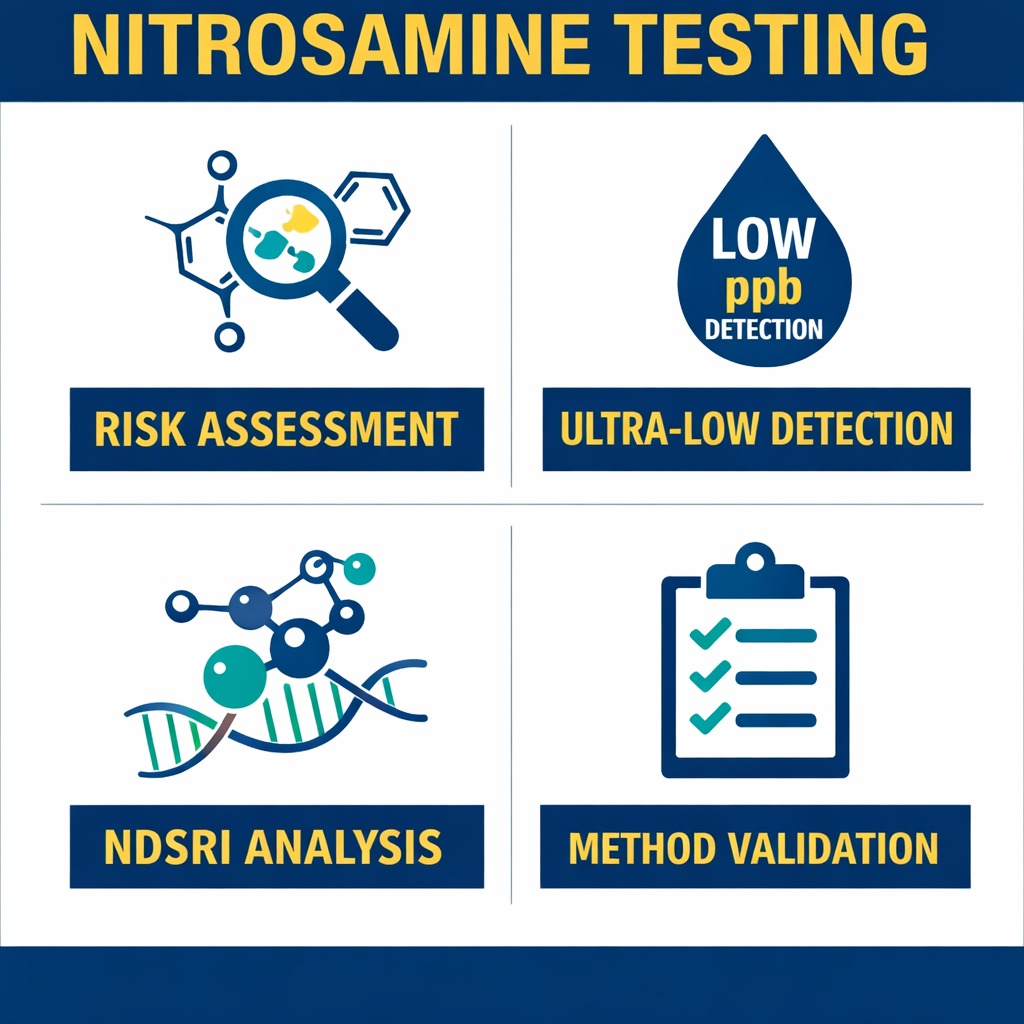
Risk Assessment – The CRO should evaluate synthetic routes, impurity formation pathways, and nitrosation risks. Documentation must be scientifically sound and submission-ready. Risk assessments should clearly explain assumptions and conclusions.
Ultra-Low Detection – LOQs must meet low ppb or ng/day equivalent requirements. Sensitivity must align with AI calculations and maximum daily dose. Method capability should be verified during validation studies.
NDSRI Assessment – Structural analysis, impurity identification, and AI justification are critical. Scientific rationale must support impurity classification. Reports should be clear, traceable, and regulator-friendly.
Method Validation – Validation should follow ICH Q2(R2) principles. Accuracy, precision, specificity, robustness, and linearity must be documented. Matrix effects and worst-case scenarios should also be evaluated.
Ongoing Monitoring – Stability testing and lifecycle monitoring are essential for continued compliance. Periodic reassessment ensures risk remains controlled. Trending data strengthens regulatory confidence.
Documentation – Reports must be inspection-ready with complete traceability. Data packages should include chromatograms, raw data references, and validation summaries. Clear documentation reduces review queries.
Ensure compliance with the latest standards: Understand Nitrosamine Specification Setting and regulatory expectations
Analytical Capabilities Required for Nitrosamine Testing for Generic Drugs
Advanced instrumentation is fundamental for reliable detection. The selected CRO should operate validated LC-MS/MS and HRMS platforms designed for ultra-trace impurity analysis. Equipment qualification, calibration, and maintenance must be well documented. Analytical consistency cannot be compromised in regulatory-critical studies.
1. Instrumentation Standards
A competent CRO should maintain:
- Triple Quadrupole LC-MS/MS for accurate quantification
- High-Resolution Mass Spectrometry (HRMS) for unknown impurity identification
- GC-MS/MS for volatile nitrosamines
- Controlled laboratory environments to prevent contamination
Routine instrument qualification ensures stable performance. Preventive maintenance reduces downtime. Environmental controls minimize cross-contamination risks.
Solve complex impurity challenges: Expert CRO services for unknown impurity identification
2. Sensitivity & Selectivity
Nitrosamines often require:
- Detection limits below 0.03 ppm, depending on dosage
- Matrix-specific extraction optimization
- Strict blank and carryover control
- Low background interference
Sensitivity must be demonstrated in the finished product matrix. Selectivity ensures correct identification without overlapping peaks. Validation studies should confirm reliable performance.
3. Multi-Nitrosamine Capability
The CRO must be capable of detecting:
- NDMA
- NDEA
- NMBA
- NMPA
- DIPNA
- EIPNA
- Product-specific NDSRIs
Generic formulations may introduce unique nitrosamine risks. The CRO should have experience developing customized methods beyond standard panels. Flexibility in method development is essential.
Manage complex impurity profiles: Calculate Acceptable Intake for multiple nitrosamines effectively
Experience in Nitrosamine Testing for Generic Drugs: Why It Matters
Experience with generic submissions improves regulatory outcomes. CROs familiar with ANDA timelines understand documentation expectations and review cycles. This knowledge reduces back-and-forth queries. It also strengthens submission quality.
Indicators of relevant expertise include:
- Support for ANDA filings
- Responses to FDA deficiency letters
- Participation in remediation programs
- Method transfers to manufacturing sites
- Stability-indicating method development
Generic drug products often require reformulation or process adjustments. An experienced partner can anticipate these needs early. Strategic input helps avoid unnecessary delays.
Mitigate risks during production: Explore strategies for nitrosamine solvent and catalyst mitigation
Data Integrity in Nitrosamine Testing for Generic Drugs
Regulatory agencies place strong emphasis on data integrity. ALCOA+ compliance, secure audit trails, and validated LIMS systems are mandatory. Even technically accurate data can be rejected if documentation is incomplete. Transparent reporting builds regulatory trust.
Sponsors should verify:
- 21 CFR Part 11 compliance
- Secure electronic systems
- Defined OOS procedures
- Raw data traceability
- Clear contamination control documentation
Strong data governance ensures inspection readiness at all times.
Quality Systems & Inspection History
A well-established quality system reflects operational discipline. CROs with successful regulatory inspections demonstrate preparedness. Transparent CAPA processes show commitment to improvement. Inspection history often predicts future compliance performance.
Request confirmation of:
- Recent FDA and EMA inspection outcomes
- Warning letter history
- ISO or GLP certifications
- Independent audit reports
These indicators help reduce regulatory uncertainty.
Analyze potential contamination sources: Understand the impact of packaging leachables on nitrosamine levels
How ResolveMass Laboratories Inc. Supports Nitrosamine Testing for Generic Drugs
ResolveMass Laboratories Inc. focuses on advanced mass spectrometry solutions for regulatory-critical applications, including Nitrosamine Testing for Generic Drugs. The laboratory operates with strong scientific rigor and compliance-driven processes. Testing strategies are tailored to product-specific risk profiles to ensure accurate and defensible results. Regulatory readiness is integrated at every stage.
Key strengths include:
- Advanced LC-MS/MS and HRMS systems
- Expertise in ultra-trace impurity quantification
- NDSRI identification and risk assessment support
- Customized method development
- Inspection-ready documentation
- Scientific consultation and regulatory guidance
This approach ensures long-term compliance sustainability and patient safety.
Conclusion
Selecting the right partner for Nitrosamine Testing for Generic Drugs is a high-impact regulatory and business decision. Manufacturers must prioritize scientific capability, regulatory alignment, data integrity, and lifecycle support. A reliable CRO reduces compliance risk and protects product approvals. Strategic collaboration strengthens both regulatory submissions and commercial stability.
As regulations continue to evolve, working with an experienced and inspection-ready laboratory ensures consistent compliance. Careful selection safeguards patient safety and brand credibility.
If you are evaluating CRO partners for Nitrosamine Testing for Generic Drugs, connect with our scientific team for a technical consultation:
Most Asked FAQs on Nitrosamine Testing for Generic Drugs
When choosing a CRO, focus on regulatory compliance, validated ultra-trace analytical methods, and proven experience with generic drug submissions. The laboratory should understand NDSRIs and have strong documentation practices. A solid inspection history and reliable data integrity systems are also very important. Clear communication and scientific support add extra value.
The LOQ must be low enough to meet the Acceptable Intake (AI) limit based on the product’s maximum daily dose. Different nitrosamines have different safety thresholds, so sensitivity requirements can vary. The method should consistently detect impurities at or below the required level. Proper validation must confirm this performance.
NDSRI expertise is critical in Nitrosamine Testing for Generic Drugs because regulators expect proper structural assessment and safety justification. The CRO must be able to evaluate impurity formation pathways and calculate acceptable intake limits when required. Without this knowledge, submissions may face delays. Scientific clarity is essential for approval.
Nitrosamine testing is guided mainly by FDA recommendations, EMA guidance documents, and relevant ICH impurity guidelines. These regulations outline risk assessment, acceptable intake limits, and validation expectations. Requirements may change over time, so ongoing monitoring is important. Staying aligned with updated guidance is essential for compliance.
Nitrosamine data is carefully reviewed during ANDA evaluation. If the testing strategy or documentation is incomplete, approval may be delayed. Regulators expect a clear risk assessment and validated analytical data. Strong planning and defensible reports improve the chances of smooth approval.
Data integrity ensures that all results are accurate, traceable, and reliable. Regulatory agencies expect compliance with ALCOA+ principles and secure electronic systems. Missing audit trails or inconsistent records can create serious compliance concerns. Strong data governance protects both the sponsor and the product.
Reference:
- Manchuri, K. M., Shaik, M. A., Gopireddy, V. S. R., Naziya, S., & Gogineni, S. (2024). Analytical methodologies to detect N-nitrosamine impurities in active pharmaceutical ingredients, drug products and other matrices. Chemical Research in Toxicology, 37, 1456–1483. https://doi.org/10.1021/acs.chemrestox.4c00234
- U.S. Food and Drug Administration. (2024). Control of nitrosamine impurities in human drugs: Guidance for industry (Revision 2). https://www.fda.gov/media/141720/download
- Jaywant, M. (2025, September 9). Nitrosamines: An urgent demand for vigilance and reliable testing. Quality Matters – U.S. Pharmacopeia. https://qualitymatters.usp.org/nitrosamines-an-urgent-demand-for-vigilance-and-reliable-testing
Get In Touch With Us
About The Author


