

Introduction:
Nitrosamine testing for metformin is no longer optional — it is a regulatory and patient safety requirement that every pharmaceutical manufacturer must address before market approval or continued commercialization. Beginning in 2019, when N-nitrosodimethylamine (NDMA) was first detected in metformin drug substances and finished products, health agencies across North America, Europe, and Asia-Pacific responded with sweeping recalls, revised guidance documents, and mandatory risk-based testing frameworks.
Understanding what nitrosamines are and why they form is critical for manufacturers:
👉 What are Nitrosamines
Metformin hydrochloride, the world’s most widely prescribed oral antidiabetic agent, serves an estimated 150 million patients globally. Given its volume of use and the carcinogenic potential of nitrosamine impurities at trace levels, even parts-per-billion (ppb) contamination represents a meaningful public health exposure.
A key scientific driver behind this issue is nitrosamine formation during API synthesis, especially involving amine–nitrite chemistry:
👉 Nitrosamine Formation Pathways in API Synthesis
Regulatory agencies including the FDA, EMA, and Health Canada now require full risk assessments, validated analytical testing, and lifecycle control strategies such as:
👉 Nitrosamine Lifecycle Management
For pharmaceutical companies navigating these requirements, partnering with a specialized contract research organization (CRO) equipped with advanced analytical capabilities is the most efficient path to compliance. ResolveMass Laboratories Inc. provides comprehensive nitrosamine testing services aligned with ICH M7, FDA guidance (2020, 2021, 2023 updates), and EMA’s Article 5(3) referral procedure — delivering scientifically rigorous, defensible data to support regulatory submissions.
Summary:
- Nitrosamine impurities in metformin and other oral hypoglycemics pose serious patient safety risks and have triggered major global recalls since 2019.
- Regulatory agencies including FDA, EMA, and Health Canada mandate nitrosamine risk assessment and confirmatory testing for all affected drug products.
- Key nitrosamines of concern in metformin include NDMA, NDEA, and process-related nitrosamines formed during synthesis or storage.
- Validated analytical methods such as LC-MS/MS, GC-MS, and headspace GC-MS are essential for accurate, sensitive detection below acceptable intake (AI) limits.
- Regulatory thresholds include complex interpretations such as:
👉 Nitrosamine Alert Limit vs Action Limit - A qualified CRO like ResolveMass Laboratories Inc. offers end-to-end nitrosamine testing services — from risk assessment and method development to ICH M7-aligned reporting.
- Oral hypoglycemics beyond metformin — including glyburide, sitagliptin, and empagliflozin — also require nitrosamine evaluation under current regulatory frameworks.
- Proactive testing through a specialized CRO accelerates regulatory submissions and protects product integrity.
1: What Are Nitrosamine Impurities and Why Do They Form in Metformin?
Nitrosamines are a class of potentially genotoxic and carcinogenic compounds classified as cohort of concern (COC) impurities under ICH M7(R2). They form through the reaction of secondary or tertiary amines with nitrosating agents — a reaction pathway directly relevant to metformin’s chemical structure.
Key formation pathways in metformin and oral hypoglycemics include:
- Drug substance synthesis: Dimethylamine, a key precursor in metformin manufacturing, can react with nitrite contaminants in reagents, solvents, or water to generate NDMA.
- Degradation during storage: NDMA formation has been observed in metformin tablets stored under elevated temperature and humidity conditions, particularly in the presence of nitrite excipients or packaging interactions.
- Drug-drug interactions in the GI tract: Co-administration of metformin with nitrite-containing foods or co-prescribed drugs under acidic gastric conditions can generate nitrosamines in vivo — a distinct but regulatory-relevant exposure pathway.
- Solvent and reagent contamination: Residual dimethylformamide (DMF) or dimethylacetamide (DMAc) used in synthesis can degrade to dimethylamine, increasing NDMA risk.
👉 Solvent and Catalyst Mitigation in Nitrosamine Formation
Advanced impurity classification also differentiates between:
👉 Nitrosamine Impurity vs Nitrosamine Leachable Difference
Nitrosamines of primary concern in metformin products:
| Nitrosamine | Abbreviation | AI Limit (FDA) | Primary Source |
|---|---|---|---|
| N-Nitrosodimethylamine | NDMA | 96 ng/day | Dimethylamine + nitrosation |
| N-Nitrosodiethylamine | NDEA | 26.5 ng/day | Solvent degradation |
| N-Nitrosomethylethylamine | NMEA | 26.5 ng/day | Mixed amine nitrosation |
| N-Nitrosodibutylamine | NDBA | 26.5 ng/day | Reagent contamination |
| Drug Substance-Derived Nitrosamines (DSDNs) | Variable | Structure-specific | Metformin backbone |
2: Regulatory Framework Governing Nitrosamine Testing for Metformin
Regulatory agencies have published multiple guidance documents establishing the expectations for nitrosamine risk assessment and testing in oral hypoglycemics. Understanding this framework is essential for manufacturers planning their compliance strategy.
Regulatory agencies require structured compliance strategies including NDA/ANDA alignment:
👉 NDA vs ANDA Nitrosamine Submission Requirements
👉 Nitrosamine Risk Assessment for ANDA Submission
FDA Requirements
The FDA’s 2020 guidance, Control of Nitrosamine Impurities in Human Drugs, established a three-step approach:
- Step 1 – Risk Assessment: Evaluate all synthetic routes, materials, and degradation pathways for potential nitrosamine formation. Review excipients, packaging, and co-administered drug interactions.
- Step 2 – Confirmatory Testing: If risk cannot be ruled out, conduct validated analytical testing of the drug substance and finished drug product.
- Step 3 – Change Reporting and Regulatory Submission: Implement controls, update specifications, and report findings via appropriate regulatory pathways (PAS, CBE-30, or Annual Report).
These expectations are reinforced by evolving ICH M7 updates:
👉 Impact of ICH M7(R2) Updates on Nitrosamine Risk Assessment
Batch release and specification controls are also critical:
👉 Nitrosamine Batch Release Testing Requirement
👉 Nitrosamine Specification Setting
The FDA’s 2023 update further addressed drug substance-derived nitrosamines (DSDNs) — a category particularly relevant to metformin — requiring structure-activity relationship (SAR) analysis and calculation of compound-specific AI limits using the Carcinogenic Potency Categorization Approach (CPCA).
EMA Requirements
The EMA’s Article 5(3) referral procedure established harmonized limits and testing expectations across EU member states. EMA guidance also introduced:
- A requirement to test both drug substance and finished drug product.
- Evaluation of nitrosamine formation from nitrosatable drug substances — relevant for metformin and several sulfonylureas.
- Specific guidance on the use of chromatographic and mass spectrometric methods for confirmatory analysis.
Health Canada Requirements
Health Canada’s Guidance on Nitrosamine Impurities in Medications (2021) aligns closely with FDA and EMA requirements, mandating risk assessment and validated method confirmation for all marketed oral antidiabetics. Canadian manufacturers and importers of metformin products must comply with the same AI limits and reporting timelines.
3: Analytical Methods for Nitrosamine Testing in Metformin: What a Qualified CRO Uses
Accurate nitrosamine quantification in metformin and oral hypoglycemics demands highly sensitive, selective analytical platforms capable of detecting impurities at sub-ppb levels in complex pharmaceutical matrices. ResolveMass Laboratories Inc. employs validated methods across the following platforms:
LC-MS/MS (Liquid Chromatography-Tandem Mass Spectrometry)
LC-MS/MS is the gold-standard method for nitrosamine testing in metformin, particularly for polar, water-soluble nitrosamines like NDMA and NMEA in the metformin matrix.
Advantages:
- Exceptional sensitivity (LOQ typically 0.01–0.03 ppm)
- Simultaneous multi-analyte quantification in a single run
- High selectivity in complex pharmaceutical matrices
- Applicable to both drug substance and finished product (tablets, extended-release formulations)
Advanced detection strategies include:
👉 Ultra Low LOQ in Nitrosamine Testing
👉 HRMS for Nitrosamine Testing
👉 Direct Injection vs Headspace Techniques for Nitrosamines
Matrix interference is a major analytical challenge:
👉 Overcoming Matrix Effects in LC-MS/MS
Method development and validation are critical for compliance:
👉 Nitrosamine Method Development and Validation Services
Headspace GC-MS and GC-MS/MS
Headspace GC-MS is highly effective for volatile nitrosamines and offers an orthogonal confirmation approach when used alongside LC-MS/MS.
Advantages:
- Minimal sample preparation for volatile nitrosamines (NDMA, NDEA, NDPA)
- Reduced matrix interference for tablet formulations
- High throughput for batch-release testing
High-Resolution Mass Spectrometry (HRMS)
HRMS platforms (Orbitrap, Q-TOF) enable non-targeted screening for unknown or unexpected nitrosamine impurities — a capability increasingly requested by regulatory reviewers for novel synthesis routes or reformulations.
Method Validation Parameters (ICH Q2(R1)-Aligned)
| Parameter | Requirement | ResolveMass Capability |
|---|---|---|
| Specificity | Demonstrate freedom from matrix interference | Confirmed via MS/MS fragmentation |
| LOD/LOQ | Below 10% of AI limit | Routinely achieved at 0.01–0.03 ppm |
| Linearity | ≥5 concentration levels, R² ≥ 0.999 | Achieved across validated range |
| Accuracy (Recovery) | 80–120% across all spike levels | Confirmed for metformin matrix |
| Precision (RSD) | ≤10% intra- and inter-day | Verified per ICH Q2(R1) |
| Matrix Effect | Evaluated and compensated with isotope-labeled IS | Stable isotope IS used for all methods |
4: Nitrosamine Testing Beyond Metformin: The Full Oral Hypoglycemic Drug Class
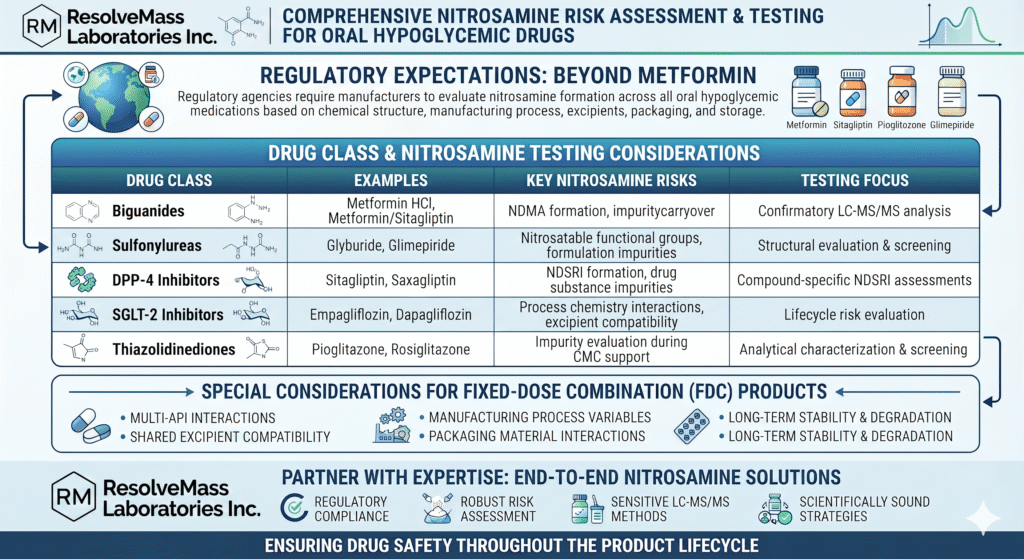
Nitrosamine risk assessment is not limited to metformin. Regulatory agencies expect manufacturers to evaluate the potential for nitrosamine formation across all oral hypoglycemic drugs based on their chemical structure, manufacturing process, excipients, packaging materials, and storage conditions.
While metformin has received the greatest regulatory attention due to NDMA-related recalls, other oral antidiabetic medications may also require comprehensive nitrosamine risk assessments and confirmatory analytical testing. At ResolveMass Laboratories Inc., we support pharmaceutical companies with end-to-end nitrosamine testing programs for a wide range of oral hypoglycemic products.
| Drug Class | Examples | Nitrosamine Testing Considerations |
|---|---|---|
| Biguanides | Metformin HCl (Immediate-Release and Extended-Release), Metformin/Sitagliptin, Metformin/Empagliflozin | Comprehensive nitrosamine risk assessment, NDMA analysis, and confirmatory LC-MS/MS testing. |
| Sulfonylureas | Glyburide (Glibenclamide), Glipizide, Glimepiride | Structural evaluation for nitrosatable functional groups and potential impurity formation during manufacturing and storage. |
| DPP-4 Inhibitors | Sitagliptin, Saxagliptin, Linagliptin | Risk assessment for nitrosamine drug substance-related impurities (NDSRIs), including compound-specific evaluations based on current regulatory guidance. |
| SGLT-2 Inhibitors | Empagliflozin, Canagliflozin, Dapagliflozin | Assessment of manufacturing processes, excipients, packaging components, and storage conditions to identify potential nitrosamine risks. |
| Thiazolidinediones | Pioglitazone, Rosiglitazone | Nitrosamine screening and impurity evaluation as part of analytical characterization and Chemistry, Manufacturing, and Controls (CMC) support. |
Regulatory expectations extend across multiple therapeutic classes:
👉 Nitrosamine Testing for Rifampicin
👉 Nitrosamine Testing for Rifapentine
👉 Nitrosamine Testing for Ranitidine
👉 Nitrosamine Testing Beta Blockers
👉 Nitrosamine Testing for High-Risk Drug Classes
Combination products require special attention:
👉 Nitrosamine Testing in Combination Products
Generic drug manufacturers must also comply:
👉 Nitrosamine Testing for Generic Drugs
Special Considerations for Fixed-Dose Combination (FDC) Products
Fixed-dose combination (FDC) therapies present additional analytical challenges because multiple active pharmaceutical ingredients and shared excipients may increase the number of potential nitrosamine formation pathways.
Comprehensive risk assessments for FDC products should consider:
- Interactions between co-formulated active pharmaceutical ingredients (APIs)
- Compatibility of shared excipients
- Manufacturing process variables
- Packaging material interactions
- Stability under long-term and accelerated storage conditions
- Potential degradation pathways throughout the product lifecycle
These additional complexities often require highly sensitive LC-MS/MS methods, robust risk assessments, and extensive analytical expertise. Partnering with an experienced analytical CRO such as ResolveMass Laboratories Inc. helps pharmaceutical manufacturers develop scientifically sound testing strategies, generate regulatory-compliant data, and confidently support product development, regulatory submissions, and commercial manufacturing.
5: ResolveMass Laboratories Inc.: Our Nitrosamine Testing CRO Service Offering
ResolveMass Laboratories Inc. delivers a fully integrated nitrosamine testing service designed to meet the needs of pharmaceutical manufacturers at every stage — from early development to post-market surveillance. Our team combines deep analytical chemistry expertise with a thorough command of the evolving international regulatory landscape.
Outsourcing ensures faster compliance and scientific reliability:
👉 Outsourcing Nitrosamine Testing to a CRO
Our Service Scope Includes:
1. Nitrosamine Risk Assessment (NRA)
- Review of synthesis routes, raw materials, excipients, packaging, and degradation pathways
- Identification of nitrosatable structural alerts in the drug substance
- CPCA-based AI limit calculation for drug substance-derived nitrosamines (DSDNs)
- Written risk assessment report formatted for FDA/EMA/Health Canada submission
2. Analytical Method Development and Validation
- Development of fit-for-purpose LC-MS/MS and GC-MS/MS methods for confirmed nitrosamines
- Full ICH Q2(R1)-aligned method validation with matrix-matched calibration
- Stability-indicating method development where required
3. Confirmatory Testing of Drug Substance and Drug Product
- Analysis of metformin API and finished oral dosage forms (tablets, capsules, extended-release)
- Reporting against FDA, EMA, and Health Canada AI limits
- Turnaround-optimized workflows with clear chain-of-custody documentation
4. Forced Degradation and Stability Studies
- Stress testing under ICH Q1A-relevant conditions to characterize nitrosamine formation potential
- Real-time and accelerated stability monitoring
5. Regulatory Documentation Support
- Technical summary preparation for NDA, ANDA, MAA, and Health Canada submissions
- Specification justification reports and impurity control strategy documents
- Response support for FDA Complete Response Letters (CRLs) related to nitrosamines
ResolveMass Laboratories provides:
- Risk Assessment
- Method Development
- Stability Studies
👉 Nitrosamine Testing in Stability Studies - Reference Standard Qualification
👉 Nitrosamine Reference Standard Qualification
Batch-to-batch variability and lifecycle control are also addressed via:
👉 Nitrosamine Batch Release Testing Requirement
6: Risk Management, Recalls, and Reformulation
Industry-wide mitigation strategies include:
👉 Nitrosamine Drug Recalls Analysis
👉 Nitrosamine Reformulation Strategy
👉 Packaging Leachables and Nitrosamines
Exposure-based regulatory concepts:
👉 Less-than-Lifetime (LTL) Exposure Calculations
👉 Acceptable Intake for Multiple Nitrosamines
7: CRO Expertise by ResolveMass Laboratories Inc.
ResolveMass provides integrated nitrosamine solutions including:
- Risk assessment and lifecycle management
- LC-MS/MS & HRMS method development
- Regulatory submission support
👉 Nitrosamine Testing Timeline
Conclusion:
Nitrosamine testing for metformin and oral hypoglycemics sits at the intersection of patient safety, analytical chemistry excellence, and regulatory rigor. As agencies continue to tighten requirements — particularly around drug substance-derived nitrosamines and fixed-dose combinations — pharmaceutical manufacturers need a CRO partner with both the scientific depth and regulatory literacy to deliver compliant, defensible results.
ResolveMass Laboratories Inc. brings proven expertise in nitrosamine risk assessment, validated LC-MS/MS and GC-MS/MS analytical methods, and regulatory documentation that supports submissions across the FDA, EMA, and Health Canada frameworks. Whether you are conducting an initial risk assessment for a new metformin formulation, responding to a regulatory query on an existing product, or proactively establishing a post-market surveillance program, our team is positioned to support your compliance objectives with precision and speed.
Frequently Asked Questions:
Nitrosamine testing is important because metformin is widely prescribed for long-term treatment of Type 2 diabetes, making patient exposure cumulative over many years. Nitrosamines can potentially form during manufacturing, storage, or packaging if proper controls are not in place. Regulatory agencies require manufacturers to assess these risks and confirm that impurity levels remain within acceptable limits. Effective testing helps ensure product safety, maintain regulatory compliance, and protect public health.
The primary nitrosamine monitored in metformin products is N-Nitrosodimethylamine (NDMA), which has received significant regulatory attention. Depending on the manufacturing process and risk assessment, additional nitrosamines such as NDEA, NMBA, NMPA, DIPNA, and EIPNA may also require evaluation. The selection of analytes is based on potential formation pathways and regulatory expectations. Comprehensive screening helps identify impurities before products reach patients and supports ongoing quality assurance.
Nitrosamine testing is technically challenging because these impurities are often present at extremely low concentrations. Analysts must overcome issues such as matrix interference, low detection limits, and potential contamination during sample preparation. Robust analytical methods are required to ensure accurate identification and quantification of target compounds. Careful method development and validation are essential to generate reliable, reproducible results that meet regulatory expectations.
A specialized Contract Research Organization (CRO) provides access to experienced scientists, advanced LC-MS/MS instrumentation, and validated analytical methods without requiring significant internal investment. CROs also stay current with evolving regulatory guidance and can support method development, validation, routine testing, and documentation. Their expertise helps reduce project timelines while maintaining data quality and compliance. This enables pharmaceutical companies to focus on product development and commercialization.
The timeline for a complete nitrosamine testing and validation program depends on the complexity of the product, analytical requirements, and regulatory expectations. A typical project may take anywhere from a few weeks for routine testing to several months if method development, validation, stability studies, and regulatory documentation are required. Factors such as the number of target nitrosamines, sample types, and project scope can also influence the duration. Working with an experienced CRO helps streamline the process while maintaining data quality and compliance.
Not necessarily. Metformin extended-release (ER) formulations are not inherently more likely to contain nitrosamines than immediate-release (IR) products. The potential risk depends on factors such as the API manufacturing process, excipient composition, manufacturing conditions, packaging materials, and storage environment rather than the dosage form itself. Each formulation should undergo a scientific risk assessment followed by confirmatory analytical testing to determine whether nitrosamine impurities are present.
The acceptable intake (AI) limit for N-Nitrosodimethylamine (NDMA) established by major regulatory agencies, including the FDA, is 96 nanograms (ng) per day, which is equivalent to 0.096 micrograms (µg) per day. Pharmaceutical manufacturers must demonstrate through validated analytical testing that NDMA levels remain below this limit throughout the product’s shelf life. Compliance with the AI limit is an important part of regulatory submissions and ongoing quality control to ensure patient safety.
Reference
- Kozłowska M, Śliwińska A. The Link between Diabetes, Pancreatic Tumors, and miRNAs—New Players for Diagnosis and Therapy?. International Journal of Molecular Sciences. 2023 Jun 16;24(12):10252.https://www.mdpi.com/1422-0067/24/12/10252
- Nwokike J. Regulatory reliance and post-marketing surveillance systems for safe and accelerated introduction of new medical products in low-and middle-income countries.https://pearl.plymouth.ac.uk/cgi/viewcontent.cgi?article=1177&context=foh-theses-other
- Vidal MD. Metabolic Compartmentalization as a Driver of Head and Neck Squamous Cell Carcinoma Aggressiveness (Doctoral dissertation, Thomas Jefferson University).https://search.proquest.com/openview/202390229f185a3e2fe5f5f10e4aa5c5/1?pq-origsite=gscholar&cbl=18750&diss=y
About the Author


