

Introduction
Nitrosamine Testing for OTC Products demands a risk-based and stability-focused approach that goes beyond traditional impurity testing. Over-the-counter medicines such as antacids, antihistamines, cough syrups, and pain relievers have diverse compositions. Their wide availability and frequent use increase the importance of strong impurity control. Because these products are used without medical supervision, safety expectations are high.
Unlike prescription drugs, OTC medicines are directly accessible to consumers. They may be reformulated under monograph systems and distributed in multiple countries. This creates variability in excipients, suppliers, and packaging. As a result, impurity control strategies must be consistent and well-documented.
Many OTC products are used chronically, sometimes for years. Regulators expect manufacturers to take a proactive approach to nitrosamine risk. Stability studies must simulate real-world storage conditions, and toxicological assessments must consider lifetime exposure. These expectations apply regardless of the regulatory pathway.
This article explains the special considerations involved in Nitrosamine Testing for OTC Products, including regulatory, analytical, toxicological, manufacturing, and supply chain aspects.
Share via:
Summary: Key Insights on Nitrosamine Testing for OTC Products
- Nitrosamine Testing for OTC Products requires matrix-specific analytical validation, as excipient variability and high-throughput manufacturing create unique risk pathways.
- OTC drugs present distinct regulatory complexities, especially under monograph pathways and global distribution models.
- Low-dose, chronic-use OTC products demand ultra-trace detection limits aligned with AI (Acceptable Intake) thresholds set by FDA, EMA, and ICH.
- Formulation-driven nitrosamine formation (e.g., secondary amines + nitrites in excipients) is a critical consideration for OTC stability programs.
- Packaging, storage, and real-world consumer use conditions must be incorporated into nitrosamine risk assessments.
- Orthogonal LC-MS/MS and GC-MS methods, with validated LOQs in the low ppb range, are essential for compliance.
- Post-market surveillance and ongoing risk review are increasingly expected for OTC portfolios.
- Robust documentation, toxicological justification, and science-based risk mitigation strategies define regulatory defensibility.
Why Does Nitrosamine Testing for OTC Products Require a Different Strategy?
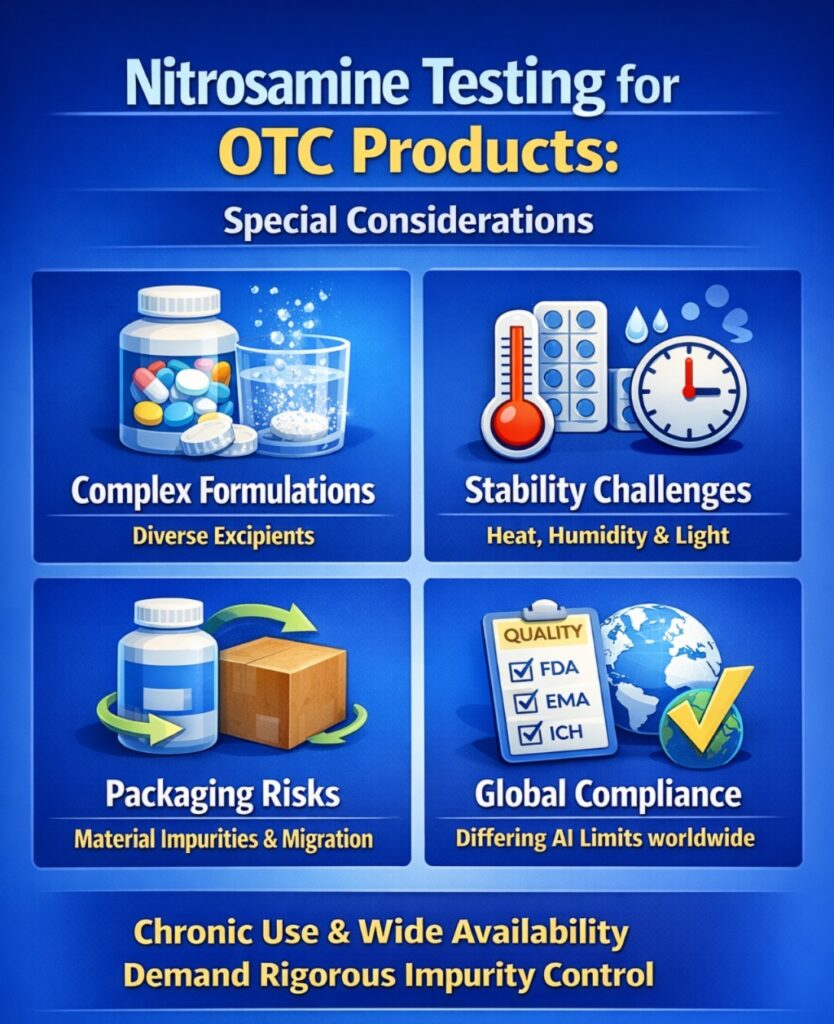
OTC products are often manufactured in large volumes and contain multiple excipients. Many are approved under monograph systems rather than NDA pathways. These features create a different nitrosamine risk profile compared to prescription-only drugs. High production scale and excipient diversity increase the possibility of variability between batches.
Key differentiators include:
| Factor | Prescription Drugs | OTC Products |
|---|---|---|
| Regulatory Pathway | NDA/ANDA | Monograph or NDA |
| Use Pattern | Physician-directed | Self-administered, chronic use |
| Distribution | Controlled | Mass retail distribution |
| Reformulation Frequency | Moderate | Higher |
| Excipient Variability | Lower | Often higher |
| Post-Market Surveillance | Structured | Increasingly scrutinized |
OTC formulations often contain sweeteners, flavors, preservatives, and coloring agents. Some of these ingredients may contain trace levels of nitrites or amines. Packaging materials may also be exposed to environmental stress during shipping and storage. All of these factors influence the overall impurity risk.
Because of these variables, Nitrosamine Testing for OTC Products must address both analytical performance and possible chemical formation pathways.
Would you like to learn more about specialized testing protocols? Explore Nitrosamine Testing for High-Risk Drug Classes
Regulatory Expectations in Nitrosamine Testing for OTC Products
Regulators expect OTC manufacturers to perform detailed risk assessments and confirmatory testing similar to prescription drug standards. Being an OTC product does not reduce impurity control requirements. Documentation must clearly explain the scientific basis for decisions. Transparent reporting is essential during inspections.
Relevant Guidance Frameworks for Nitrosamine Testing for OTC Products
- FDA Guidance for Industry: Control of Nitrosamine Impurities
- EMA Q&A on Nitrosamines
- ICH M7 (Genotoxic Impurities)
- Health Canada and MHRA risk-based approaches
These guidelines emphasize consistent impurity control across all drug categories. Authorities expect evaluation of both manufacturing-related risks and stability-related formation. Companies must show that their control strategy is data-driven and complete.
Need help navigating the latest regulatory updates? Check the Impact of ICH M7(R2) Updates on Nitrosamine Risk Assessment
Acceptable Intake Considerations
AI limits for nitrosamines such as NDMA and NDEA are usually expressed in nanograms per day. For OTC drugs used daily, lifetime exposure calculations are conservative. Special attention may be required for pediatric products.
This means analytical methods must achieve LOQs often below 10–30 ppb, depending on dosage and daily intake. Validation should demonstrate consistent accuracy, precision, and sensitivity at these low levels.
Analytical Challenges in Nitrosamine Testing for OTC Products
One major challenge is matrix interference from excipients and flavoring agents. OTC products may contain sorbitol, sodium benzoate, artificial dyes, flavor oils, magnesium stearate, or starch. These components can interfere with extraction and detection. As a result, method development must be carefully optimized.
Excipients may suppress ionization in LC-MS/MS systems or create artifacts during sample preparation. This can affect accuracy if not properly controlled. Matrix-matched calibration and recovery studies are essential. Sample preparation procedures must minimize artificial nitrosamine formation.
Are you dealing with complex sample matrices? Learn about High-Resolution Mass Spectrometry (HRMS) for Nitrosamine Testing
Recommended Analytical Strategies for Nitrosamine Testing for OTC Products
LC-MS/MS (Triple Quadrupole)
This technique is preferred for detecting NDMA, NDEA, and similar compounds. It offers high sensitivity in the low ppb range. Stable isotope-labeled internal standards are necessary to ensure reliable quantification.
GC-MS (Headspace)
GC-MS is suitable for volatile nitrosamines. Extraction conditions must be optimized to prevent loss or degradation. Headspace parameters should be validated for consistency and repeatability.
Orthogonal Confirmation
Using two independent analytical techniques increases regulatory confidence. It reduces the risk of false positives or matrix-related errors. Cross-validation strengthens inspection readiness.
Monitoring precursor substances, such as dimethylamine and nitrites, can also support proactive risk control.
Struggling to achieve the necessary sensitivity for OTC products? See our guide on Ultra-Low Limit of Quantitation (LOQ) in Nitrosamine Testing
Stability-Driven Formation: A Critical OTC Concern
Nitrosamines may form during storage instead of during manufacturing. OTC products are often exposed to heat, humidity, and light in retail settings. These factors can accelerate chemical reactions. Therefore, stability testing must go beyond routine evaluation.
Research shows that certain conditions, including acidic environments, may increase NDMA formation in specific APIs. Nitrite-dependent reactions are especially important when excipients contain trace impurities. Compatibility studies between APIs and excipients are necessary. Storage stress testing helps identify delayed formation risks.
Ensure your product remains compliant throughout its shelf life: Nitrosamine Testing in Stability Studies: Best Practices
OTC-Specific Stability Considerations in Nitrosamine Testing for OTC Products
OTC products usually have shelf lives of two to three years. They may remain on store shelves before purchase and later be stored in homes. Consumers often keep medicines in bathrooms or kitchens where humidity is high.
Stability programs should include accelerated testing at 40°C/75% RH, intermediate conditions, and light exposure studies. Extractables and leachables testing should also be considered. These evaluations help ensure long-term safety.
Excipient-Driven Nitrosamine Risk in OTC Products
Excipients can act as nitrite sources or contain secondary amines. Even small amounts of contamination can become significant over time. Supplier variability increases this uncertainty. Long storage periods further increase the risk.
Common risk factors include sodium nitrite contamination, degradation of preservatives, and cross-contamination in shared facilities. Any excipient change must go through strict change control. A structured risk evaluation should be documented.
Substructure screening can help identify nitrosatable amines in formulations. Reviewing synthetic routes and impurity profiles strengthens the overall assessment. Supplier audits and routine nitrite testing add another layer of control.
Mitigate risks by addressing chemical precursors: Nitrosamine Solvent and Catalyst Mitigation Strategies
Packaging and Supply Chain Considerations
Packaging materials may indirectly contribute to nitrosamine formation. Adhesives, printing inks, rubber stoppers, or recycled materials may contain reactive substances. Oxygen and moisture permeability can also affect product stability.
Risk mitigation includes supplier certification, extractables and leachables testing, and migration studies. Nitrite testing of packaging components may be appropriate in some cases. Distribution studies under simulated transport conditions further strengthen control strategies.
Evaluate potential migration risks from your container closure systems: Packaging Leachables and Nitrosamine E&L Studies
Risk Assessment Framework for Nitrosamine Testing for OTC Products
A structured framework supports defensible decision-making.
Step 1: Structural Risk Assessment
Identify nitrosatable functional groups in APIs and impurities. Review synthetic processes for possible exposure to amines or nitrites. Document the scientific reasoning clearly.
Step 2: Excipient and Supplier Risk Mapping
Evaluate excipient specifications for nitrite contamination and amine content. Review supplier audit data and quality agreements. Maintain updated qualification records.
Step 3: Manufacturing Process Evaluation
Assess pH control, water systems, solvent recovery, and cleaning procedures. Identify any steps where nitrosating conditions could occur. Process consistency reduces variability.
Step 4: Confirmatory Analytical Testing
Use validated LC-MS/MS methods with LOQs below AI limits. Ensure methods are stability-indicating and specific. Confirm recovery and reproducibility.
Step 5: Toxicological Justification
Use carcinogenicity databases to define compound-specific AI limits when required. Provide clear justification for any risk-based decisions.
Chronic Use OTC Products: Higher Toxicological Sensitivity
Daily-use OTC medicines such as allergy tablets and acid reducers require conservative exposure modeling. Lifetime cumulative dose calculations should use protective assumptions. Pediatric exposure may require separate assessment.
Combination products may need aggregated risk evaluation across multiple ingredients. Regulators expect strong justification if AI thresholds are approached. Predefined mitigation and recall strategies improve compliance readiness.
Manage risks for products containing multiple active ingredients: Guidance on Acceptable Intake for Multiple Nitrosamines
Post-Marketing Surveillance in OTC Nitrosamine Control
Post-market monitoring is becoming a regulatory expectation. Periodic re-testing ensures impurity levels remain under control throughout the product lifecycle. Trend analysis can reveal early warning signals.
Change management records should capture formulation updates, supplier changes, and packaging modifications. Clear documentation supports inspection readiness. Lifecycle monitoring strengthens long-term compliance and patient safety.
Best Practices for Defensible Nitrosamine Testing for OTC Products
- Use validated LC-MS/MS methods with isotope-labeled internal standards.
- Establish matrix-specific LOQ validation.
- Implement excipient nitrite screening programs.
- Conduct forced degradation studies.
- Monitor stability-related formation pathways.
- Maintain complete and organized documentation.
- Align with global AI limits.
- Integrate toxicology-based risk assessment.
These best practices improve regulatory defensibility and reduce the likelihood of recalls.
Conclusion
Nitrosamine Testing for OTC Products requires a proactive, science-based, and lifecycle-driven strategy. The complexity of excipients, long shelf life, and widespread consumer use increase regulatory expectations. Manufacturers must address analytical sensitivity, stability risks, packaging effects, and toxicological limits.
By combining strong analytical validation, structured risk assessment, and ongoing monitoring, companies can build a defensible control program. A comprehensive approach not only supports compliance but also protects public health. Effective Nitrosamine Testing for OTC Products is now a critical part of modern OTC quality management.
Ready to choose a testing partner for your OTC portfolio? How to Navigate Nitrosamine Testing CRO Selection
Frequently Asked Questions (FAQs)
OTC products often contain multiple excipients and are produced in large volumes, which can increase variability. They are also stored in homes where heat and humidity may fluctuate. In addition, many OTC drugs are taken daily for long periods, increasing overall exposure concerns.
Yes, stability testing is essential because nitrosamines can form over time during storage. Accelerated and long-term studies help identify potential increases in impurity levels. This ensures the product remains safe throughout its shelf life.
Certain excipients may contain trace amounts of nitrites or amines that can react under specific conditions. Over extended storage, these reactions may lead to nitrosamine formation. Careful supplier qualification and routine testing help reduce this risk.
Packaging components can influence product stability and should be evaluated as part of the overall risk assessment. Materials such as inks, adhesives, or rubber parts may introduce reactive substances. Proper testing and supplier controls are important to prevent contamination.
The limit of quantification should be below the regulatory AI threshold for the specific nitrosamine. In most cases, this requires detection in the low parts-per-billion range. The method must be validated to consistently perform at that level.
Toxicological evaluation is necessary, especially if a new or product-specific nitrosamine is detected. Manufacturers may need to establish a compound-specific intake limit based on scientific data. Clear documentation supports regulatory acceptance.
Yes, monograph status does not remove the responsibility for impurity control. Manufacturers must still conduct thorough risk assessments and confirmatory testing. Regulatory agencies expect the same level of safety oversight.
Reference:
- U.S. Food and Drug Administration. (2023, August 4). Recommended acceptable intake limits for nitrosamine drug substance-related impurities (NDSRIs): Guidance for industry. https://www.fda.gov/regulatory-information/search-fda-guidance-documents/recommended-acceptable-intake-limits-nitrosamine-drug-substance-related-impurities
- Health Canada. (2024, May 31). Guidance on nitrosamine impurities in medications: Evaluating and managing the risks of N-nitrosamine impurities in human pharmaceutical, biological and radiopharmaceutical products (Catalogue No. H164-327/2024E-1-PDF). Government of Canada. https://publications.gc.ca/collections/collection_2024/sc-hc/H164-327-2024-eng.pdf
Get In Touch With Us
About The Author


