


Introduction
Nitrosamine Testing in Stability Studies is no longer limited to initial risk mitigation. It has evolved into an ongoing, data-driven process that confirms nitrosamine levels remain controlled throughout the entire product shelf life. Manufacturers must now show sustained impurity control under both real-time and accelerated storage conditions. This shift reflects increased global regulatory attention and stricter compliance expectations.
Designing long-term monitoring programs requires alignment between analytical sensitivity, degradation chemistry, packaging interaction, and regulatory requirements. Each of these factors influences nitrosamine formation potential. Stability programs must be customized for the specific formulation and storage conditions. A well-designed strategy connects laboratory capability with long-term regulatory planning.
In this article, we focus on building scientifically sound long-term monitoring programs for Nitrosamine Testing in Stability Studies. Key areas include method selection, interval planning, statistical trending, and lifecycle management strategies. The objective is to create programs that are technically strong and inspection-ready. The emphasis is on sustainable compliance rather than short-term solutions.
Explore our comprehensive services for Nitrosamine Analysis: Nitrosamine Analysis Services
Summary: Key Takeaways for Designing Robust Long-Term Monitoring Programs
- Nitrosamine Testing in Stability Studies must be integrated into long-term stability protocols—not treated as a one-time risk assessment exercise.
- Long-term monitoring programs require validated ultra-trace analytical methods, matrix-specific sensitivity, and stability-indicating capabilities.
- Sampling frequency, packaging interaction, and degradation kinetics must be built into the stability design.
- Regulatory expectations demand ongoing confirmation that nitrosamine levels remain below AI limits throughout product shelf life.
- Statistical trending and data modeling are critical to detect low-level formation patterns over time.
- A risk-based re-evaluation strategy is essential when manufacturing changes, API sourcing changes, or packaging changes occur.
- Proper documentation, data integrity, and independent verification enhance regulatory confidence and align with global compliance frameworks.
Nitrosamine Testing in Stability Studies: Why Long-Term Monitoring Is a Regulatory Expectation
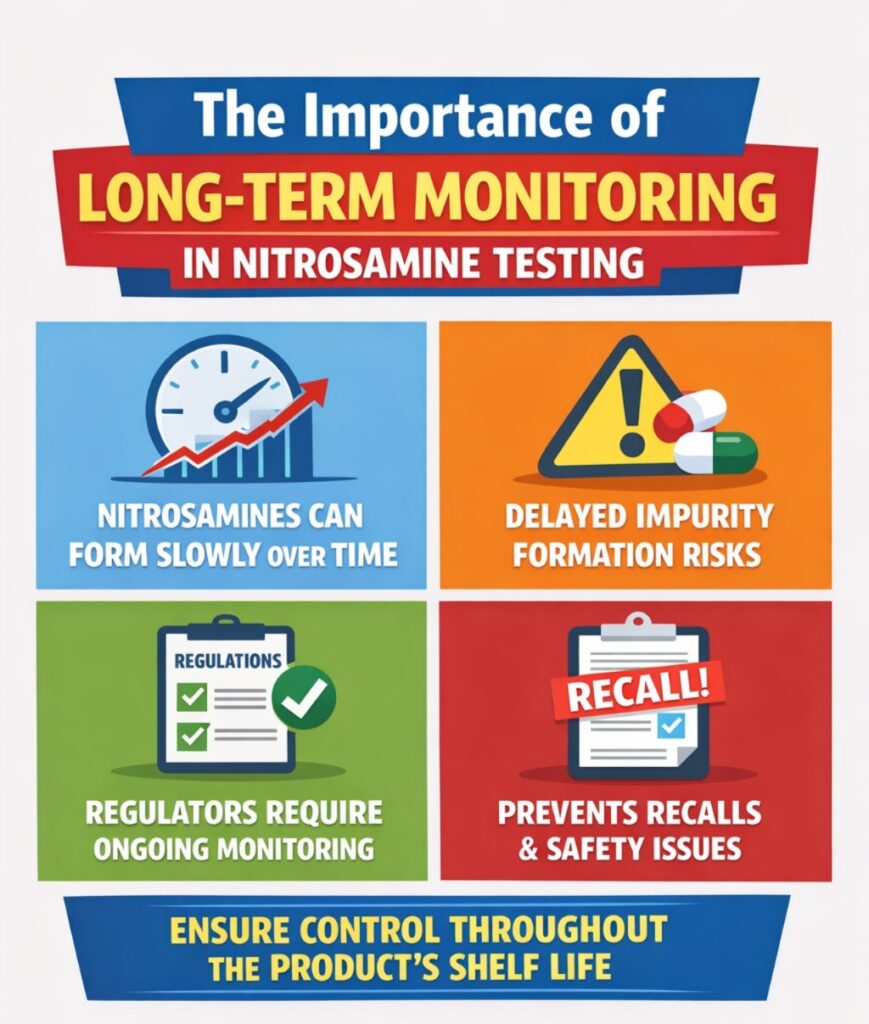
Long-term monitoring is essential because nitrosamines can form slowly, even when initial release testing shows non-detectable results. Certain degradation reactions may activate only under specific environmental conditions. Trace nitrites and amines can react gradually during storage. This delayed formation makes periodic evaluation critical.
Global regulatory agencies expect manufacturers to confirm nitrosamine control at release and continue monitoring throughout the labeled shelf life. Risk reassessment during lifecycle changes is mandatory. Detection capability must remain validated at ultra-trace levels. These expectations are now standard across major regulatory markets.
Learn more about navigating regulatory updates: Impact of ICH M7R2 Updates on Nitrosamine Risk Assessment
Key drivers for long-term programs include secondary nitrosamine formation during storage and API degradation pathways activated by temperature or humidity. Packaging-related amine migration may introduce additional risk. Excipient interactions can change during extended storage. Oxidative or nitrosating environments may further accelerate impurity formation.
Without a structured monitoring program, a product may pass release specifications but fail at later stability intervals. This situation creates regulatory and commercial risk. Late-stage failures can lead to recalls or supply disruptions. Proactive long-term monitoring significantly reduces these risks.
Designing a Risk-Based Framework for Nitrosamine Testing in Stability Studies
An effective long-term strategy starts with a structured, product-specific risk model. The evaluation must consider chemical structure, formulation design, and manufacturing processes. Generic templates are not sufficient for complex pharmaceutical products. Each product requires a detailed and individualized assessment.
1. Define Product-Specific Nitrosation Risk Factors
Risk modeling should evaluate API structure, especially the presence of secondary or tertiary amines. Nitrite impurities in excipients must be measured and controlled. Known degradation pathways should be clearly mapped. Residual solvents and processing aids may also contribute to nitrosation risk.
pH-dependent nitrosation kinetics should be evaluated, particularly for liquid and semi-solid dosage forms. Packaging permeability to oxygen or moisture must be assessed. Interactions between excipients and the API can alter impurity pathways. A complete chemical risk profile supports focused and efficient monitoring.
Understand how to manage risk for complex drug classes: Nitrosamine Testing for High-Risk Drug Classes
2. Establish Trigger Points for Monitoring Expansion
Monitoring should expand when new suppliers are added or when process parameters change. Any upward stability trend must trigger immediate reassessment. Packaging modifications require renewed compatibility evaluation. Increased nitrite levels in excipients also justify additional testing.
A fixed testing schedule is not adequate for long-term impurity control. Programs must adapt as new data become available. Dynamic reassessment supports full lifecycle compliance. Continuous improvement strengthens overall nitrosamine risk management.
Nitrosamine Testing in Stability Studies: Selecting the Right Analytical Method for Long-Term Monitoring
The selected analytical method must detect nitrosamines at or below regulatory acceptable intake limits during the entire stability period. Sensitivity alone is not enough. Specificity, robustness, and reproducibility are equally important. The method must perform consistently across different batches and matrices.
Method Requirements for Long-Term Monitoring:
| Requirement | Explanation |
|---|---|
| Ultra-trace sensitivity (ppb/ppt) | Nitrosamines form at very low concentrations and require highly sensitive instrumentation. |
| Stability-indicating capability | The method must distinguish nitrosamines from other degradation products. |
| Matrix specificity | False positives from excipient interference must be avoided. |
| Low background contamination | Laboratory artifacts must be tightly controlled. |
| Robust LOD/LOQ validation | Detection limits must be scientifically justified and reproducible. |
Preferred technologies include LC-MS/MS (Triple Quadrupole), High-Resolution Mass Spectrometry (HRMS), and GC-MS for volatile nitrosamines, often using stable isotope-labeled internal standards. These systems provide high selectivity and sensitivity. Instrument performance should be routinely verified through system suitability testing. Preventive maintenance supports long-term reliability.
Method validation should include forced degradation studies and nitrosation stress testing. Matrix recovery studies confirm extraction efficiency. Carryover assessment prevents artificial elevation of results. Long-term reproducibility ensures consistent data across stability intervals.
Deep dive into high-resolution testing techniques: HRMS for Nitrosamine Testing
Nitrosamine Testing in Stability Studies: Designing Stability Time Points and Sampling Intervals
Sampling intervals should reflect nitrosamine formation kinetics rather than relying only on standard ICH intervals. Product risk level should guide testing frequency. Early stability intervals can reveal emerging trends. Customized scheduling improves data clarity and interpretation.
Recommended Monitoring Structure
For high-risk products:
0 month (release), 3 months, 6 months, 9 months, 12 months, 18 months, 24 months, and annually thereafter if shelf life is extended. Frequent monitoring captures gradual impurity development and supports early intervention.
For moderate-risk products:
0, 6, 12, and 24 months may be appropriate. However, periodic reassessment is still required. Any trend shift should trigger expanded testing.
For low-risk products:
Initial validation plus annual confirmatory testing may be sufficient. Reduced frequency must be supported by scientific justification and documented risk assessment.
Technical insight on achieving lower detection limits over time: Ultra-Low Limit of Quantitation (LOQ) in Nitrosamine Testing
Accelerated conditions (40°C/75% RH) can reveal hidden nitrosation potential and packaging influence. These studies help predict long-term behavior. However, accelerated data cannot replace real-time confirmation. Regulatory acceptance requires actual long-term stability data.
Statistical Trending in Nitrosamine Testing in Stability Studies
Trend analysis is essential for detecting small increases before acceptable intake limits are exceeded. Minor numerical changes may indicate developing instability. Without structured statistical tools, these signals can be missed. Data-driven evaluation improves objectivity and regulatory defensibility.
Key statistical tools include linear regression modeling, moving average trend analysis, control charts, outlier detection models, and shelf-life projection modeling. These tools help identify risk early. Data visualization improves clarity during audits and inspections. Consistent application strengthens scientific credibility.
Nitrosamine formation may begin at undetectable levels, increase gradually, and spike under certain storage conditions. Statistical modeling allows proactive mitigation. Early action prevents specification failure. This approach enhances long-term quality assurance.
Evaluate the risks associated with container closure systems: Packaging Leachables and Nitrosamine E&L
Packaging Impact in Nitrosamine Testing in Stability Studies
Packaging materials can either reduce or contribute to nitrosamine formation, depending on their composition and permeability. Rubber stoppers with amine accelerators may present risk. Blister materials containing residual nitrites can also contribute. Environmental exposure through permeable packaging must be evaluated carefully.
Long-term monitoring should include extractables and leachables studies, packaging stress testing, headspace analysis when appropriate, and comparative packaging evaluations. These assessments help identify hidden nitrosation sources. Monitoring should be repeated if packaging changes occur. Packaging qualification must align with the impurity control strategy.
Lifecycle Management and Change Control in Nitrosamine Testing in Stability Studies
Long-term monitoring must evolve throughout the product lifecycle. API manufacturing changes, new excipient suppliers, scale-up activities, equipment modifications, and regulatory limit updates all require reassessment. Even small process adjustments can affect impurity pathways. Continuous review prevents unexpected compliance issues.
A structured change control system ensures nitrosamine risk is reassessed in a systematic manner. Risk evaluations must be clearly documented and scientifically justified. Preventive actions should be implemented when trends shift. Lifecycle oversight ensures sustainable impurity control.
Data Integrity and Documentation Requirements
Regulatory reviewers expect complete chromatographic data, audit trails, raw data access, justified sampling frequency, validated method transfer, and well-documented stability protocols. Transparency is critical during inspections. Incomplete records may delay approvals or raise compliance concerns.
Best practices include independent quality assurance review, electronic data capture systems, detailed method lifecycle documentation, and periodic revalidation of analytical sensitivity. Consistent record retention supports inspection readiness. Strong documentation reflects scientific accountability and professionalism.
Nitrosamine Testing in Stability Studies: Addressing Emerging Nitrosamines
New nitrosamines, including NDSRIs, continue to be identified across the pharmaceutical industry. Long-term monitoring programs should include broad-spectrum screening and non-targeted HRMS analysis where possible. Structure-based risk modeling helps anticipate potential new impurities. Regular scientific literature review supports awareness of emerging risks.
Regulatory guidance evolves as new toxicology data become available. Monitoring programs must adapt accordingly. Testing only previously known nitrosamines may leave compliance gaps. Proactive screening strengthens overall impurity management.
Learn about the CPCA approach for NDSRIs: Nitrosamine CPCA Approach for NDSRIs
Integration with ICH Stability Guidelines
Long-term monitoring should align with ICH Q1A(R2) stability requirements, ICH M7 impurity risk assessment principles, EMA/FDA nitrosamine guidance, and post-approval change management expectations. Stability testing must be clearly described in approved protocols. Informal or undocumented testing is not sufficient.
Alignment with global regulatory standards ensures harmonized compliance. Stability plans should explicitly describe Nitrosamine Testing in Stability Studies within the overall protocol. Clear integration avoids confusion during inspections. Structured documentation improves audit readiness.
Practical Implementation Roadmap
Step-by-Step Implementation
- Conduct a product-specific nitrosamine risk assessment.
- Develop and validate an ultra-trace analytical method.
- Integrate testing into the formal stability protocol.
- Establish a statistical trending model.
- Define clear re-evaluation triggers.
- Implement packaging compatibility testing.
- Maintain an annual review program with documented reassessment.
Each step should be reviewed by cross-functional teams, including analytical, regulatory, and quality experts. Collaboration ensures technical accuracy and compliance alignment. Ongoing evaluation keeps the program effective. Continuous refinement improves long-term performance.
Conclusion
Nitrosamine Testing in Stability Studies requires a proactive, scientifically sound, and continuously evolving long-term monitoring strategy. Effective programs combine ultra-sensitive analytical methods, structured statistical trending, packaging assessment, and disciplined lifecycle reassessment. This integrated approach ensures sustained impurity control.
When properly designed, long-term monitoring programs go beyond simple compliance. They provide data-driven assurance that nitrosamine levels remain within acceptable intake limits throughout the product’s shelf life. Strong programs reduce regulatory risk and protect patient safety. Scientific vigilance remains essential for sustainable compliance.
For expert guidance in designing and validating long-term monitoring programs for Nitrosamine Testing in Stability Studies, consult experienced analytical laboratories equipped with advanced mass spectrometry platforms and regulatory-focused methodologies.
For consultation or technical discussion, connect with our experts:
Frequently Asked Questions (FAQs)
The frequency of testing depends on the overall risk profile of the product. High-risk products usually require testing at multiple stability intervals throughout the shelf life. Lower-risk products may follow a reduced schedule, but this must be scientifically justified. The final plan should always be documented in the approved stability protocol.
Accelerated studies are helpful for identifying potential nitrosamine formation under stressed conditions. However, they cannot replace real-time stability data generated under labeled storage conditions. Regulatory agencies require long-term confirmation of impurity control. Both accelerated and real-time studies work together to provide a complete risk assessment.
Yes, packaging components can influence nitrosamine formation during storage. Materials may introduce amines, nitrites, or allow environmental exposure. Extractables and leachables studies help identify these potential risks. Packaging should be reassessed whenever any changes are made.
Statistical trending helps detect small increases in nitrosamine levels before they reach regulatory limits. It provides a structured way to evaluate data across multiple time points. Early identification of trends allows preventive action. This strengthens overall quality control and regulatory confidence.
Risk should be reviewed whenever there are changes in manufacturing processes, raw material suppliers, packaging, or regulatory requirements. Even minor modifications can affect impurity formation pathways. A documented reassessment ensures that previous conclusions remain valid. Continuous review supports lifecycle compliance.
Monitoring programs should remain flexible to address newly identified nitrosamines. Regular review of scientific literature and regulatory updates is necessary. When new risks are identified, analytical scope may need to expand. Proactive updates help maintain long-term compliance.
Regulators expect complete and well-organized records, including raw analytical data, validated methods, and approved stability protocols. Chromatograms and statistical evaluations should be readily accessible. Clear documentation of decisions and justifications is essential. Audit-ready data supports smooth inspections.
Reference:
- Food and Drug Administration. (2024). Control of nitrosamine impurities in human drugs: Guidance for industry (Revision 2) [Guidance document]. U.S. Department of Health and Human Services. https://www.fda.gov/media/141720/download
- European Medicines Agency. (2025). Nitrosamine impurities: Guidance for marketing authorisation holders. https://www.ema.europa.eu/en/human-regulatory-overview/post-authorisation/pharmacovigilance-post-authorisation/referral-procedures-human-medicines/nitrosamine-impurities/nitrosamine-impurities-guidance-marketing-authorisation-holders
Get In Touch With Us
About The Author


