

Introduction:
Nitrosamine impurities are among the most scrutinized safety concerns in modern pharmaceutical development, and no NDA or BLA submission can proceed without a thorough, documented nitrosamine risk assessment and — where indicated — confirmatory analytical testing. Since 2018, when the FDA first detected N-nitrosodimethylamine (NDMA) in valsartan drug products, the global regulatory landscape has shifted dramatically. Today, pharmaceutical sponsors working toward FDA approval must address nitrosamine risk comprehensively or face submission delays, Complete Response Letters (CRLs), and potential market withdrawal.
At ResolveMass Laboratories Inc., our analytical scientists and regulatory affairs specialists have built a purpose-built suite of Nitrosamine Testing Services NDA BLA Submission CRO capabilities that give sponsors the data, documentation, and confidence they need to move through the regulatory review process without interruption. Whether you are filing an NDA for a small-molecule new chemical entity or a BLA for a complex biologic, this guide will walk you through every dimension of what a high-quality nitrosamine program looks like — and how ResolveMass can serve as your scientific partner from early risk assessment through final submission.
Summary:
- Nitrosamine impurities are potent carcinogens requiring rigorous risk assessment and testing before NDA/BLA submission to the FDA and Health Canada.
- Regulatory agencies including the FDA, EMA, and ICH have issued mandatory guidelines (ICH M7, FDA 2021 Guidance) requiring sponsors to evaluate all drug substances and drug products for nitrosamine contamination.
- ResolveMass Laboratories Inc. offers end-to-end nitrosamine testing services — from risk assessment through confirmatory analytical testing — specifically tailored for NDA and BLA submissions.
- Key testing methodologies include HPLC-MS/MS, GC-MS/MS, GC-HRMS, and LC-HRMS, all validated to sub-ppt sensitivity levels.
- Acceptable intake (AI) limits established under ICH M7 and FDA guidelines must be met for all detected nitrosamine impurities.
- Partnering with an experienced CRO like ResolveMass Laboratories significantly reduces the risk of regulatory hold, complete response letters (CRLs), and submission rejections.
- This article covers everything sponsors need to know: regulatory background, risk assessment framework, analytical testing services, timelines, and how to get started.
1: What Are Nitrosamine Impurities and Why Do Regulators Care?
Nitrosamines are N-nitroso compounds classified as probable or possible human carcinogens (IARC Group 2A/2B), formed when secondary or tertiary amines react with nitrosating agents during manufacturing or storage. Their significance in pharmaceutical submissions lies in their extreme potency at very low concentrations — acceptable intake limits are set in the nanogram-per-day range.
Common Nitrosamine Impurities Found in Drug Products
| Nitrosamine | Abbreviation | Acceptable Intake (AI) Limit | Common Source |
|---|---|---|---|
| N-Nitrosodimethylamine | NDMA | 96 ng/day | Dimethylamine + nitrite; solvent residue |
| N-Nitrosodiethylamine | NDEA | 26.5 ng/day | Solvent/reagent contamination |
| N-Nitrosodiisopropylamine | NDIPA | 26.5 ng/day | Isopropylamine derivatives |
| N-Nitrosomethylphenylamine | NMPA | 26.5 ng/day | Catalyst contamination |
| N-Nitroso-N-methyl-4-aminobutyric acid | NMBA | 96 ng/day | Ranitidine degradation |
| Drug-specific nitrosamines (DSNIs) | — | Compound-specific | API structure-dependent formation |
Key regulatory fact: The FDA’s 2021 Guidance for Industry on “Control of Nitrosamine Impurities in Human Drugs” requires that manufacturers conduct nitrosamine risk assessments for all ANDAs, NDAs, and BLAs — with confirmatory testing when any risk is identified.
2: The Regulatory Framework: What FDA, EMA, and ICH Require
The regulatory expectation is clear: all NDA and BLA sponsors must conduct a structured nitrosamine risk assessment in compliance with ICH M7(R1), FDA 2021 Guidance, and EMA guidelines, and must submit results as part of their Chemistry, Manufacturing, and Controls (CMC) package.
Key Regulatory Guidelines
- ICH M7(R1) — Assessment and Control of DNA Reactive (Mutagenic) Impurities in Pharmaceuticals: Establishes acceptable intake thresholds for mutagenic impurities, including nitrosamines, based on lifetime carcinogenic risk.
- FDA Guidance for Industry (2021) — Control of Nitrosamine Impurities in Human Drugs: Requires sponsors to conduct a two-step process — risk assessment first, followed by confirmatory testing — and to report findings in Module 3 of the CTD.
- EMA “Questions and Answers for Marketing Authorisation Holders / Applicants” (EMA/409815/2020): Mandates equivalent nitrosamine assessments for European submissions.
- Health Canada — Nitrosamine Impurities Guidance (2021): Establishes Canadian-specific requirements aligned with FDA/EMA expectations.
FDA’s Two-Step Nitrosamine Review Process
- Step 1 — Risk Assessment: Evaluate the drug substance synthesis, drug product formulation, packaging, and storage conditions for potential nitrosamine formation pathways. If no risk is identified and the rationale is robust, no further testing may be required.
- Step 2 — Confirmatory Testing: If any plausible risk is identified in Step 1, validated analytical testing must be conducted at or below the AI limit, and results must be submitted to the FDA.
3: Nitrosamine Risk Assessment: The Scientific Foundation
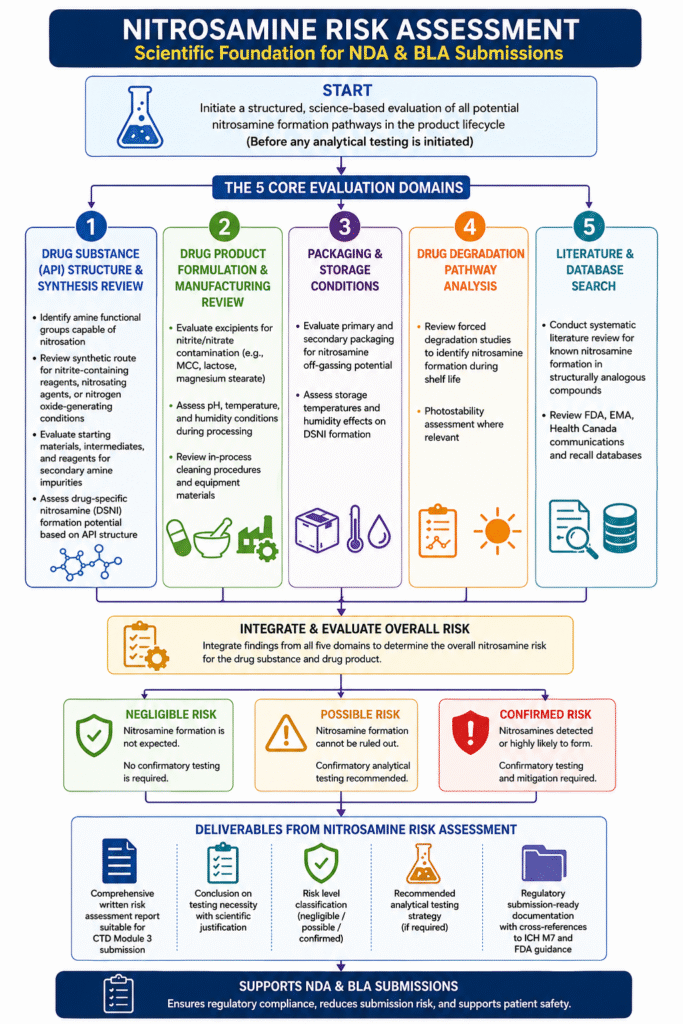
A nitrosamine risk assessment is a structured, science-based evaluation of all potential nitrosamine formation pathways within a pharmaceutical product and its manufacturing lifecycle. Regulatory agencies including the U.S. Food and Drug Administration, European Medicines Agency, and Health Canada consider this assessment the essential first step before confirmatory analytical testing is initiated.
For NDA and BLA submissions, a scientifically justified risk assessment demonstrates that pharmaceutical companies understand the origin, probability, and control strategy for potential nitrosamine impurities.
At ResolveMass Laboratories Inc., nitrosamine risk assessments are designed to support regulatory compliance, reduce submission risk, and establish a defensible analytical strategy aligned with current global guidance.
1. Drug Substance (API) Structure and Synthesis Review
The first stage of a nitrosamine risk assessment focuses on the active pharmaceutical ingredient (API) structure and synthetic pathway. This evaluation identifies whether the molecular structure or manufacturing process contains conditions favorable for nitrosamine formation.
Key Areas Evaluated
Identification of Nitrosation-Susceptible Functional Groups
Scientific review includes identification of:
- Secondary amines
- Tertiary amines
- Amides with nitrosation potential
- Reactive nitrogen-containing intermediates
These functional groups may react with nitrosating agents under suitable conditions to generate nitrosamine impurities.
Synthetic Route Evaluation
The complete synthetic pathway is evaluated for:
- Nitrite-containing reagents
- Sodium nitrite usage
- Nitrosating agents
- Acidic process conditions
- Nitrogen oxide-generating reactions
Special attention is given to reaction steps where nitrosation chemistry may occur unintentionally.
Assessment of Raw Materials and Intermediates
Starting materials, intermediates, catalysts, solvents, and reagents are reviewed for:
- Secondary amine contamination
- Residual impurities
- Recycled solvent risks
- Supplier-related variability
This step helps identify hidden nitrosamine precursors entering the process.
Drug-Specific Nitrosamine (DSNI) Formation Potential
Drug-specific nitrosamines (DSNIs) are structurally related nitrosamine impurities formed directly from the API structure.
ResolveMass scientists evaluate:
- Molecular structural alerts
- Potential nitrosation sites
- Mechanistic degradation pathways
- Probability of DSNI formation during manufacturing or storage
This assessment is particularly important for complex small molecules, peptides, and biologics.
2. Drug Product Formulation and Manufacturing Review
The second domain evaluates how formulation composition and manufacturing conditions may contribute to nitrosamine formation.
Excipients Assessment
Certain pharmaceutical excipients may contain trace nitrite or nitrate impurities that contribute to nitrosamine generation.
Commonly evaluated excipients include:
- Microcrystalline cellulose
- Lactose
- Magnesium stearate
- Starch derivatives
- Crospovidone
- Polyvinylpyrrolidone (PVP)
Supplier variability and excipient quality profiles are also assessed.
Manufacturing Process Conditions
Manufacturing conditions capable of accelerating nitrosation reactions are carefully reviewed.
Critical parameters include:
| Process Parameter | Potential Impact |
|---|---|
| Acidic pH | Promotes nitrosation reactions |
| Elevated temperature | Accelerates impurity formation |
| High humidity | Supports degradation pathways |
| Long processing times | Increases reaction opportunity |
Equipment and Cleaning Evaluation
Equipment design and cleaning procedures are reviewed for:
- Cross-contamination risks
- Residual amine contamination
- Cleaning agent compatibility
- Stainless steel reactivity concerns
This evaluation helps minimize process-related impurity introduction.
3. Packaging and Storage Conditions
Packaging systems and storage environments can significantly influence nitrosamine formation during shelf life.
Packaging Compatibility Review
ResolveMass evaluates both primary and secondary packaging components for:
- Nitrosamine off-gassing potential
- Reactive packaging materials
- Permeability characteristics
- Interaction with formulation components
Packaging materials may contribute impurities indirectly through degradation products or volatile contaminants.
Storage Condition Assessment
Storage-related stress factors are analyzed to predict long-term nitrosamine formation risk.
Key variables include:
- Temperature exposure
- Relative humidity
- Oxygen exposure
- Light sensitivity
- Shelf-life duration
These studies are particularly important for extended-release formulations and biologics with long storage periods.
4. Drug Degradation Pathway Analysis
Nitrosamines may form during degradation rather than during initial manufacturing. Therefore, degradation pathway analysis is a critical component of risk assessment.
Forced Degradation Studies
Existing forced degradation data are reviewed to identify conditions that may trigger nitrosamine generation.
Typical stress conditions include:
- Acid hydrolysis
- Base hydrolysis
- Oxidation
- Thermal stress
- Humidity stress
This helps determine whether nitrosamine levels may increase over time.
Photostability Assessment
Photostability testing evaluates whether light exposure contributes to degradation pathways associated with nitrosamine formation.
This assessment is especially relevant for:
- Photosensitive APIs
- Transparent packaging systems
- Long-term storage products
5. Literature and Database Search
A scientifically defensible risk assessment requires comprehensive review of published scientific and regulatory information.
Literature Review
ResolveMass scientists conduct systematic literature searches to identify:
- Reported nitrosamine impurities
- Structurally analogous compounds
- Known degradation pathways
- Published toxicological information
Regulatory Database Review
Global regulatory communications and recall databases are evaluated, including guidance and enforcement actions from:
- U.S. Food and Drug Administration
- European Medicines Agency
- Health Canada
This review helps identify emerging regulatory concerns and previously reported nitrosamine risks relevant to the product.
Deliverables from a ResolveMass Nitrosamine Risk Assessment
- Comprehensive written risk assessment report suitable for CTD Module 3 submission
- Conclusion on testing necessity with scientific justification
- Risk level classification (negligible / possible / confirmed)
- Recommended analytical testing strategy (if required)
- Regulatory submission-ready documentation with cross-references to ICH M7 and FDA guidance
4: Analytical Testing Services: Methods, Validation, and Sensitivity
If a nitrosamine risk assessment identifies any plausible nitrosamine formation pathway, FDA-compliant confirmatory analytical testing becomes mandatory. Regulatory authorities expect analytical methods capable of detecting nitrosamines at or below the established Acceptable Intake (AI) limits, which frequently fall within the single-digit nanogram-per-gram (ng/g) or parts-per-billion (ppb) range.
At ResolveMass Laboratories Inc., advanced mass spectrometry platforms are specifically optimized for ultra-trace nitrosamine detection in complex pharmaceutical matrices, including APIs, drug products, biologics, peptides, and excipients.
ResolveMass Laboratories Inc. operates state-of-the-art mass spectrometry platforms specifically optimized for ultra-trace nitrosamine detection in complex pharmaceutical matrices.
Analytical Methods Offered
| Method | Application | Sensitivity Range | Matrices |
|---|---|---|---|
| LC-MS/MS (HPLC-MS/MS) | NDMA, NDEA, NMBA, and other polar nitrosamines | 0.01–0.1 ng/g | Tablets, capsules, APIs, solutions |
| GC-MS/MS (Headspace) | Volatile nitrosamines (NDMA, NDEA, NDIPA) | 0.01–0.05 ng/g | Solid oral dosage forms, APIs |
| GC-HRMS | Unknown/novel nitrosamines, DSNI screening | Sub-ppt | APIs, drug products |
| LC-HRMS | Drug-specific nitrosamine impurity profiling | Sub-ppt | Complex matrices, BLA biologics |
| GC-TEA | Total nitrosamine analysis / matrix screening | ng/g range | Excipients, packaging materials |
Method Validation Parameters (ICH Q2(R1) Compliant)
All ResolveMass analytical methods are fully validated against ICH Q2(R1) and FDA Bioanalytical Method Validation guidance, including:
- Specificity / Selectivity — demonstrated absence of matrix interference at AI limits
- Linearity — validated across the entire calibration range relevant to AI limit reporting
- Limit of Detection (LOD) and Limit of Quantitation (LOQ) — typically 10–30% of the applicable AI limit
- Accuracy and Precision — intra- and inter-day variability ≤ 15% (≤ 20% at LOQ)
- Matrix Recovery — spike-recovery experiments across multiple batches and matrices
- Stability — stock solution stability, freeze-thaw, and in-process stability
Drug-Specific Nitrosamine Impurity (DSNI) Testing
Drug-specific nitrosamines — formed from the API’s own structure — are among the most challenging to test for, as no commercial reference standard exists at the time of assessment. ResolveMass Laboratories provides:
- DSNI Structural Prediction using in silico tools (Lhasa Nexus, Derek Nexus) and mechanistic chemistry review
- Custom Reference Standard Synthesis Coordination with certified synthesis partners
- Method Development and Validation for each novel DSNI
- AI Limit Derivation using the Carcinogenic Potency Categorization Approach (CPCA) in alignment with FDA’s April 2023 DSNI guidance
5: The ResolveMass Advantage: Why Sponsors Choose Us for NDA/BLA Nitrosamine Programs
Pharmaceutical sponsors choose ResolveMass Laboratories Inc. as their nitrosamine testing CRO because we combine deep regulatory science expertise, validated ultra-trace analytical platforms, and a track record of successful NDA and BLA submissions with no nitrosamine-related deficiencies.
Here is what differentiates our services:
- Dedicated Regulatory Liaison Team: Our scientists communicate directly with FDA reviewers and respond to deficiency letters with technical precision — reducing back-and-forth and submission timelines.
- ICH M7 and FDA Guidance Expert Authors: Our team has co-authored SOPs and white papers on nitrosamine control strategies adopted by major pharmaceutical manufacturers.
- GMP-Compliant Laboratory Operations: Our facility operates under a robust Quality Management System (QMS) and is audit-ready, providing sponsors with the documentation confidence required for CDER submissions.
- CTD-Ready Reporting: All risk assessment and analytical reports are delivered in Common Technical Document (CTD) format, structured for immediate incorporation into Module 3.2.S and 3.2.P sections.
- Rapid Turnaround: Standard confirmatory testing programs completed within 6–8 weeks; expedited services available for NDA/BLA filing deadlines.
- Comprehensive Coverage: We test all regulatory-priority nitrosamines (NDMA, NDEA, NDIPA, NMBA, NMPA, NIPEA) as well as custom DSNIs — in a single integrated program.
6: Timeline and Process: From Risk Assessment to Submission-Ready Package
Understanding the end-to-end timeline helps sponsors plan their regulatory pathway efficiently. The table below reflects typical timelines for a standard NDA small-molecule program.
| Phase | Activity | Typical Duration |
|---|---|---|
| Phase 1 | Project kickoff, document collection, API/DP review | Week 1–2 |
| Phase 2 | Nitrosamine risk assessment and report | Week 2–5 |
| Phase 3 | Method development and qualification (if testing indicated) | Week 4–8 |
| Phase 4 | Confirmatory testing (3 validation batches + commercial) | Week 6–12 |
| Phase 5 | CTD report authoring and QC review | Week 11–14 |
| Phase 6 | Delivery of submission-ready dossier | Week 14–16 |
Note: Timelines for BLA submissions involving biologics, drug-device combinations, or novel DSNIs requiring reference standard synthesis may extend to 20–24 weeks. Contact our team early to align on your PDUFA target date.
Conclusion:
Nitrosamine impurity assessment is no longer an afterthought — it is a core regulatory requirement that sits at the intersection of analytical science, toxicology, and CMC documentation. Sponsors who invest early in a robust, expertly executed nitrosamine program significantly reduce the risk of FDA information requests, clinical holds, and CRLs that can delay approvals by twelve months or more.
ResolveMass Laboratories Inc. is purpose-built to serve as your scientific and regulatory partner for Nitrosamine Testing Services NDA BLA Submission CRO programs. Our integrated capabilities — spanning risk assessment, DSNI prediction, validated ultra-trace analytical testing, and CTD-ready documentation — give sponsors a clear, defensible, and efficient path to submission.
From early-phase NDAs to complex BLA biologics, our team brings the experience, methodology, and regulatory credibility that FDA reviewers expect. Do not let nitrosamine uncertainties put your approval timeline at risk.
Frequently Asked Questions:
Not every NDA or BLA requires confirmatory nitrosamine testing, but every submission should include a nitrosamine risk assessment. Regulatory agencies expect sponsors to evaluate the potential for nitrosamine formation throughout the product lifecycle. If the assessment demonstrates no plausible risk, testing may not be necessary. However, if any potential formation pathway is identified, sensitive analytical testing is generally required. A scientifically justified risk assessment forms the foundation of the regulatory strategy.
When nitrosamines are detected above the acceptable intake (AI) limit, a thorough investigation must be conducted to determine the source and extent of contamination. Sponsors are expected to perform root-cause analysis, evaluate patient risk, and implement mitigation strategies. Corrective actions may include process changes, raw material controls, or additional purification steps. Regulatory agencies may request additional data before approving a product. For marketed products, elevated nitrosamine levels can potentially lead to recalls or regulatory actions.
Yes, regulatory agencies can issue a Complete Response Letter (CRL) if nitrosamine-related deficiencies are identified during NDA review. Common issues include inadequate risk assessments, insufficient analytical sensitivity, incomplete method validation, or unresolved nitrosamine contamination concerns. Agencies may also request additional stability data or impurity characterization studies. These deficiencies can delay approval until satisfactory scientific evidence is provided. A comprehensive nitrosamine control strategy helps minimize the risk of regulatory setbacks.
Confirmatory testing is required when a risk assessment identifies a plausible nitrosamine formation pathway. Testing may also be recommended when historical data, literature reports, or manufacturing conditions suggest potential risk. Regulatory agencies expect testing methods to detect nitrosamines at or below acceptable intake limits. Sensitive analytical techniques such as LC-MS/MS and HRMS are commonly used. The goal is to verify whether nitrosamines are actually present in the product.
DSNIs are nitrosamines that form directly from the molecular structure of the active pharmaceutical ingredient. Unlike common nitrosamines, these impurities are unique to a specific drug product. They often lack commercially available reference standards, making analysis more challenging. DSNI assessment usually involves structural prediction, toxicological evaluation, and custom analytical method development. Regulatory agencies have increased their focus on DSNIs in recent years.
Yes. Nitrosamines may form over time due to degradation reactions occurring during storage. Factors such as temperature, humidity, pH, packaging materials, and shelf-life duration can influence formation. This is why stability studies are an important component of nitrosamine evaluations. Long-term and accelerated stability testing help identify potential increases in nitrosamine levels. Understanding storage-related risks supports effective control strategies.
Reference
- Bulger PG, Jones MT, Ford JG, Schrier K, Cole KP, Bernardoni F, Dirat O, Zhang Q, Chahrour O, Miller J, Bonaga L. Risk Assessment and Control of N-Nitrosamines in Antibody–Drug Conjugates: Current Industry Practices. Organic Process Research & Development. 2024 Jul 30;28(8):3078-84.https://pubs.acs.org/doi/abs/10.1021/acs.oprd.4c00254
- Costa M. The regulatory challenge of determining acceptable intakes for nitrosamine drug substance-related impurities while ensuring medicinal product supply. Masterarbeit zur Erlangung des Titels” Master of Drug Regulatory Affairs, MDRA. 2023.https://www.dgra.de/media/masterthesis/1415-master_costa-marianna_2023.pdf
- Yerram S, Muhammad Nizam VP, Srivastava S, Nanduri S. Nitrosamine Contamination in Pharmaceuticals: A Retrospective Regulatory Analysis of USFDA Recalls and Risk Mitigation Strategies (2018–2025). Therapeutic Innovation & Regulatory Science. 2026 Mar;60(2):519-33.https://link.springer.com/article/10.1007/s43441-025-00891-y
- Tarafder A, Vega E, Beck HP, Mundal D, Tilala M, Wang S. Nitrosamine control: From risk assessment to analytical testing with emphasis on sample preparation and phase-appropriate method validation. Organic Process Research & Development. 2025 Nov 7;29(11):2602-24.https://pubs.acs.org/doi/abs/10.1021/acs.oprd.5c00158
About the Author


