


Introduction
Biopharmaceutical sponsors are increasingly reshoring active pharmaceutical ingredient (API) manufacturing through North American Peptide CDMO Services to address critical cross-border supply chain bottlenecks, maintain compliance with regulatory frameworks such as the BIOSECURE Act, and gain access to high-capacity infrastructure designed for complex peptide therapeutics. This strategic transition brings essential clinical development and commercial-scale manufacturing activities closer to key regulatory and commercial markets, thereby reducing geopolitical exposure while strengthening protection for valuable intellectual property.
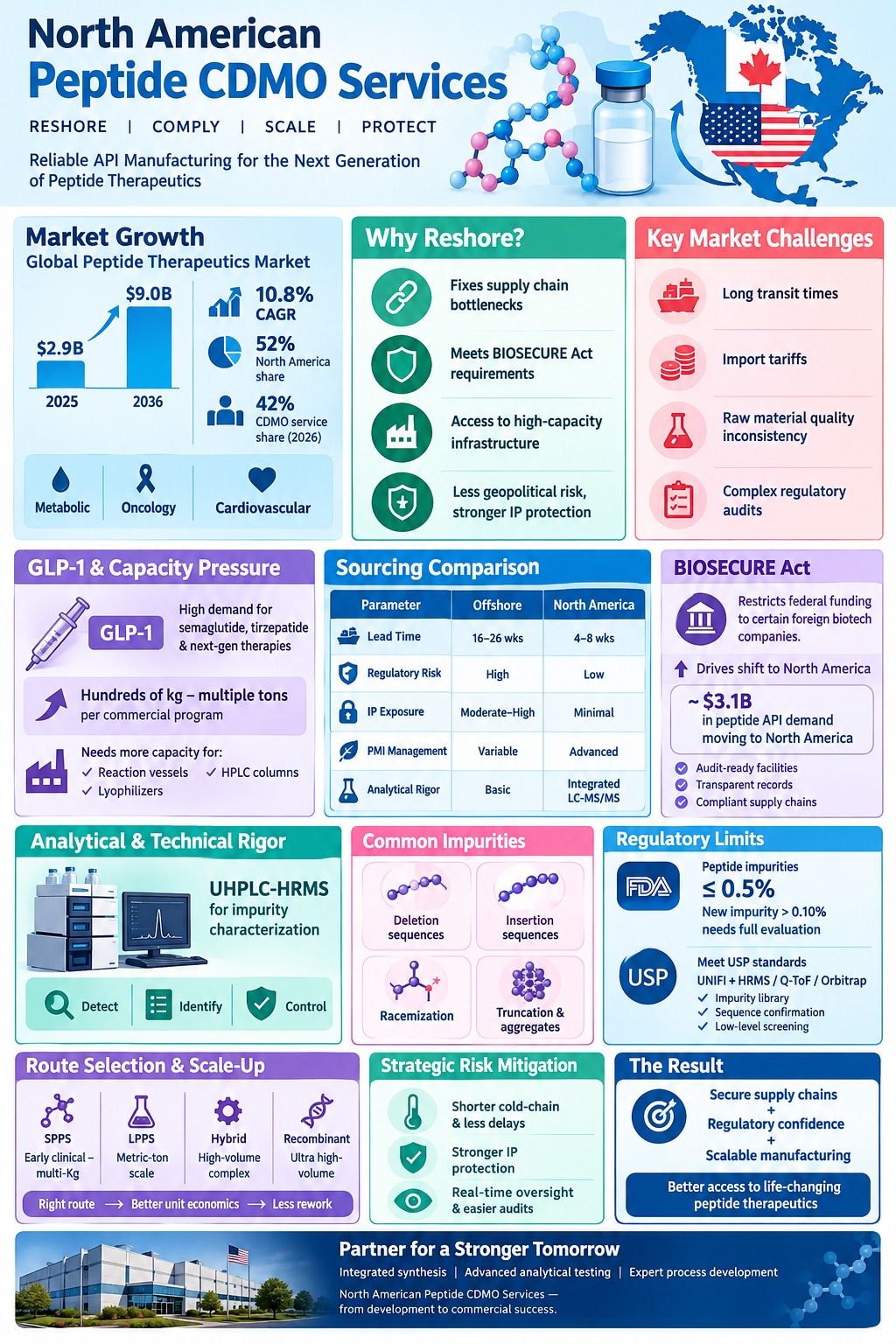
The global peptide therapeutics market is undergoing a significant structural transformation. Peptides were historically regarded as niche molecules manufactured at multi-kilogram scales for specialized therapeutic indications. However, their use has expanded substantially, with peptide-based medicines now supporting high-volume treatment areas that include metabolic, oncological, and cardiovascular diseases. The market was valued at 2.9 billion in 2025 and is projected to reach 9.0 billion by 2036, representing a compound annual growth rate (CAGR) of 10.8%. North America holds a leading 52% share of this market, supported by strong clinical development activity and substantial domestic commercial demand.
| Market Metric | Value / Projection |
|---|---|
| 2025 Global Market Value | 2.9 Billion |
| 2026 Estimated Market Value | 3.2 Billion |
| 2036 Projected Market Value | 9.0 Billion (10.8% CAGR) |
| North American Market Share | 52% of global volume |
| Peptide API Manufacturing Service Share | 42% of total service segment (2026) |
Nevertheless, conventional offshore manufacturing models often depend on highly fragmented supply chains. These structures can expose sponsors to prolonged shipping transit times, unpredictable import tariffs, inconsistent raw material quality, and demanding regulatory audits. As peptide therapeutics pipelines increasingly move toward longer and more extensively modified sequences alongside substantially larger commercial volumes, pharmaceutical developers need manufacturing partners that can integrate advanced analytical characterization, regulatory alignment, and dependable physical production capacity. Specialized organizations, such as ResolveMass Laboratories Inc., provide analytical testing, mass spectrometry characterization, and quality oversight that can support the validation of reshored manufacturing processes and the preparation of regulatory submissions.
Learn how customized manufacturing infrastructure supports regional supply stability through Peptide CDMO in Canada.
Share via:
Quick Summary:
- North American peptide CDMO services are gaining importance as biopharmaceutical companies reshore API manufacturing to reduce supply-chain disruptions, regulatory exposure, and IP risks.
- The peptide therapeutics market is rapidly expanding, driven by metabolic, oncology, and cardiovascular applications, with GLP-1 therapies creating major demand for commercial-scale peptide manufacturing.
- GLP-1 programs require much larger production capacity, potentially hundreds of kilograms to multiple metric tons of API annually, increasing demand for large reaction vessels, preparative HPLC systems, and lyophilization capacity.
- The BIOSECURE Act is accelerating supply-chain localization, encouraging sponsors to reduce dependence on certain overseas biotechnology suppliers and adopt North American or “China-Plus-One” sourcing strategies.
- Advanced UHPLC-HRMS and mass spectrometry workflows help identify and control peptide impurities such as deletion sequences, insertion sequences, racemization, truncations, and aggregates while supporting FDA/USP expectations.
- Route selection is critical for commercial scale-up: SPPS, LPPS, hybrid synthesis, and recombinant/enzymatic approaches offer different advantages depending on peptide complexity, production volume, cost, and material requirements.
- Reshoring can provide shorter lead times, stronger IP protection, improved analytical oversight, better supply-chain visibility, and scalable manufacturing, supporting more reliable development and commercialization of complex peptide therapeutics.
Industrial Scale Challenges: GLP-1 Dynamics and Capacity Constraints in North American Peptide CDMO Services
Obtaining North American Peptide CDMO Services can address major global capacity limitations associated with the rapidly increasing demand for Glucagon-Like Peptide-1 (GLP-1) receptor agonists, which has placed substantial pressure on international solid-phase peptide synthesis (SPPS) capacity. By working with local contract development and manufacturing partners, drug developers can establish long-term supply arrangements while reducing dependence on global capacity allocation and associated scheduling delays.
The commercial success of metabolic therapies, including semaglutide, tirzepatide, and emerging multi-agonists such as retatrutide, has substantially reshaped the peptide manufacturing environment. Conventional peptide manufacturing was primarily designed around relatively small kilogram-scale batches intended for limited patient populations. In comparison, commercial GLP-1 programs can require hundreds of kilograms to multiple metric tons of highly purified active ingredient each year. This rapid increase in demand has generated significant pressure on commercial-scale reaction vessel capacity, large-diameter preparative High-Performance Liquid Chromatography (HPLC) columns, and industrial lyophilization infrastructure.
Read our technical guide on Scaling a GLP-1 Analog from Preclinical Synthesis to GMP Kilogram-Scale Manufacturing.
Peptide synthesis is intrinsically material-intensive. Process Mass Intensity (PMI), which represents the total kilograms of raw materials consumed to manufacture one kilogram of target API, averages approximately 13,000 for solid-phase peptide synthesis. This is substantially higher than the PMI range of approximately 168 to 308 associated with traditional small-molecule manufacturing. A single multi-kilogram campaign may therefore require metric tons of protected amino acids, specialized coupling reagents such as HATU and PyBOP, resin substrates, and high-purity organic solvents, including DMF, NMP, and acetonitrile.
Understand technical distinctions with Difference Between a Peptide and a Small Molecule Drug.
The growing commercial shift toward oral GLP-1 formulations further increases API volume requirements. Because oral peptide bioavailability is lower than that achieved through injectable administration, substantially greater quantities of active ingredient may be required to deliver an equivalent therapeutic exposure. Although oral solid dose processing avoids certain sterile fill-finish limitations, it transfers a significant operational constraint upstream to crude synthesis and purification. Reshored North American manufacturing facilities are designed to accommodate these increased requirements for solvents, raw materials, processing capacity, and production scale.
Evaluate long-term capacity options with Peptide CDMO Scale-Up Services.
| Sourcing Parameter | Traditional Offshore Sourcing | Reshored North American Sourcing |
|---|---|---|
| Supply Chain Lead Time | Extended (16–26 weeks); vulnerable to shipping delays | Shortened (4–8 weeks); localized distribution networks |
| Regulatory Compliance Risk | High; varied cGMP interpretation and distant audit access | Low; continuous alignment with FDA and Health Canada standards |
| Intellectual Property Exposure | Moderate to High; weak local legal enforceability | Minimal; robust federal intellectual property frameworks |
| Process Mass Intensity Management | Variable waste treatment and raw material verification | Advanced solvent recovery, environmental compliance, and traceable sourcing |
| Analytical Rigor & Impurity Control | Basic HPLC purity testing; deferred high-resolution mass spec | Integrated LC-MS/MS, UNIFI workflows, and full USP compliance |
Legislative Catalysts: How the BIOSECURE Act Drives Sourcing to North American Peptide CDMO Services
The U.S. BIOSECURE Act is encouraging biopharmaceutical sponsors to reassess their dependence on overseas biotechnology suppliers and consider North American Peptide CDMO Services. The legislation restricts certain federal agencies from contracting with or providing funding to entities that utilize designated foreign biotechnology companies of concern. This regulatory development has increased the need for pharmaceutical developers to conduct comprehensive vendor assessments and evaluate the geographic structure of their supply chains.
The BIOSECURE Act is intended to address national biosecurity considerations and strengthen domestic healthcare supply chain infrastructure. Under its provisions, U.S. federal agencies are restricted from procuring specified equipment or services from designated foreign biotechnology companies and from entering certain contracts with pharmaceutical developers that rely on those entities. In response to this changing regulatory environment, pharmaceutical innovators are evaluating “China-Plus-One” strategies as well as more extensive reshoring approaches to reduce potential long-term regulatory compliance exposure.
An estimated 3.1 billion in peptide API manufacturing demand is reportedly shifting toward North American facilities as a consequence of this evolving regulatory environment. CDMOs operating in North America can provide audit-ready manufacturing infrastructure, transparent batch production documentation, and compliant supply networks designed to support continued access to federal drug markets and associated funding streams.
Read our full breakdown of United States vs. Overseas Peptide CDMOs.
Technical and Analytical Rigor in North American Peptide CDMO Services
North American Peptide CDMO Services incorporate advanced ultra-high-performance liquid chromatography coupled with high-resolution mass spectrometry (UHPLC-HRMS) to support FDA and USP requirements for comprehensive impurity characterization. Implementing robust analytical workflows enables process-related impurities and degradation products to be detected, identified, and controlled within applicable regulatory acceptance criteria.
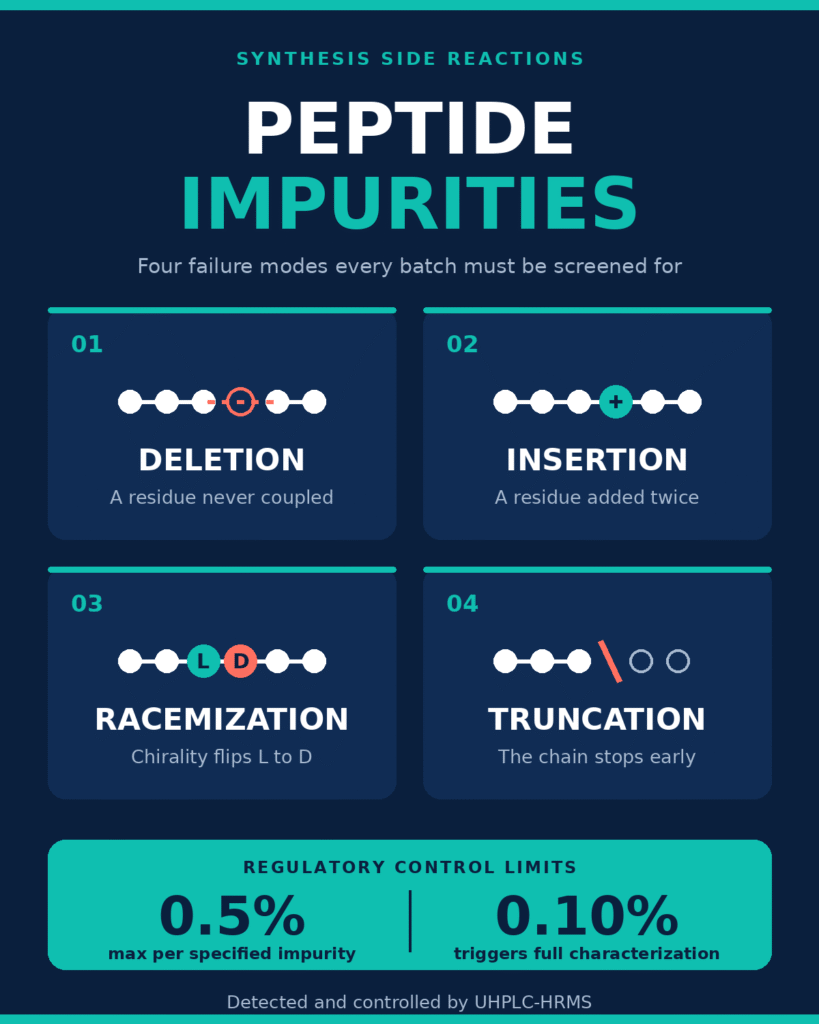
Peptide synthesis consists of repeated amino acid coupling cycles, which makes peptide molecules susceptible to multiple side reactions and structural modifications. A typical 30-mer peptide may undergo dozens of sequential chemical transformations, including Fmoc/tBu deprotection, coupling reactions, cleavage from solid support, and side-chain deprotection. Important impurity profiles encountered during process development include:
- Deletion Sequences: These occur when amino acid coupling is incomplete or when deprotection does not proceed completely during an individual reaction cycle.
- Insertion Sequences: These can result from double coupling of amino acid reagents or from instability involving protecting groups.
- Diastereomeric Impurities: These may arise through racemization at the alpha-carbon during amino acid activation steps.
- Truncation Variants and Aggregates: These can develop because of incomplete chain assembly or secondary beta-sheet structure formation during synthesis and purification.
Review detailed control frameworks in Impurity Control Strategies Under ICH Q3A.
Under FDA guidance applicable to generic synthetic peptides, including glucagon, liraglutide, and teriparatide, applicants are required to demonstrate appropriate control of peptide-related impurities. Specified peptide-related impurities are expected to be controlled at levels no greater than 0.5% of the drug substance. In addition, a new specified impurity present above 0.10% may require comprehensive structural characterization and safety evaluation to establish that it does not present an unacceptable risk of immunogenic responses.
Discover complete validation solutions via Peptide Analytical Testing Services.
To satisfy United States Pharmacopeia standards, including USP Impurities in Drug Substances and Drug Products and applicable USP requirements, contract laboratories utilize specialized software suites such as UNIFI in combination with high-resolution Q-ToF or Orbitrap mass spectrometers. These compliance-ready analytical platforms facilitate the deconvolution of complex mass spectra, confirmation of primary sequences, and screening for low-abundance impurities. Analytical organizations, including ResolveMass Laboratories Inc., provide mass spectrometry characterization, custom impurity library development, and stability-indicating assay development that can support regulatory submissions.
Explore regulatory documentation requirements in CMC Documentation at a CDMO for ANDA.
Route Selection and Scale-Up Economics in North American Peptide CDMO Services
Modern North American Peptide CDMO Services utilize advanced route-selection strategies that evaluate SPPS, LPPS, and chemo-recombinant hybrid processes to establish commercially viable unit economics for multi-kilogram and metric-ton API campaigns. Assessing potential manufacturing routes early in process development can reduce the need for expensive process modifications and re-validation during subsequent commercial scale-up.
Although Solid-Phase Peptide Synthesis (SPPS) remains widely preferred during clinical development because of its rapid optimization timelines and broad synthetic versatility, its material requirements increase substantially as production volume rises. For blockbuster peptides that require multi-hundred-kilogram annual production, alternative synthetic approaches can provide important manufacturing advantages:
- Liquid-Phase Peptide Synthesis (LPPS): This approach eliminates resin-related costs and permits convergent block coupling in solution, potentially reducing organic solvent consumption per kilogram of API.
- Hybrid SPPS/LPPS: This strategy combines solid-phase synthesis for short, high-purity fragment blocks with solution-phase coupling. It can reduce cumulative yield losses associated with the assembly of longer peptide sequences.
- Recombinant Expression with Chemical Modification: This approach uses fermentation to generate the linear peptide backbone, followed by chemical modification, such as lipidation or conjugation.
Explore options for early phase and complex sequences through Custom Peptide Synthesis Services.
| Synthetic Methodology | Ideal Production Volume | Key Operational Advantages | Primary Operational Constraints |
|---|---|---|---|
| Solid-Phase Synthesis (SPPS) | Early Clinical to Multi-Kg Commercial | Rapid process development; automated coupling cycles; versatile | High raw material costs; linear cost scaling; high Process Mass Intensity |
| Liquid-Phase Synthesis (LPPS) | Metric-Ton Commercial Scale | Lower unit costs at volume; reduced organic solvent consumption | Complex route development; extended lead times; challenging intermediate isolation |
| Hybrid Fragment Coupling | High-Volume Complex Peptides | Limits cumulative yield loss on long sequences; higher output per run | Requires precise purity control of individual fragment blocks |
| Recombinant / Enzymatic | Extremely High-Volume Peptides | Sustainable manufacturing profile; lower chemical solvent reliance | Complex host cell protein purification; limited to naturally occurring amino acid backbones |
Strategic Risk Mitigation and Intellectual Property Protection
Reshoring peptide API manufacturing to North America can reduce supply chain exposure through shorter logistical distances, stronger intellectual property protections, and opportunities for real-time collaborative oversight. Developing localized manufacturing relationships also facilitates closer coordination among analytical development teams, synthetic chemists, and quality assurance personnel throughout the manufacturing lifecycle.
Geographic proximity can substantially reduce risks associated with cold-chain transportation and import-related delays. Highly modified peptide APIs and intermediates may require carefully controlled temperature conditions during storage and transportation. Domestic supply chains can shorten transit durations, thereby reducing opportunities for temperature excursions and supporting maintenance of product stability throughout distribution.
Learn more about fill-finish and formulation considerations in Formulating a Lyophilized Peptide Injectable.
North American jurisdictions also maintain established intellectual property protections and stringent expectations concerning raw data integrity. Biopharmaceutical sponsors can maintain direct and timely access to batch records, chromatographic data, and analytical validation documentation. This degree of operational visibility can simplify preparation for regulatory inspections and audits while strengthening documentation packages used in drug master file (DMF) submissions.
Learn about stability requirements for filings with Stability Batches Required for an ANDA Submission.
Conclusion
Securing North American Peptide CDMO Services represents an important strategic consideration for biopharmaceutical sponsors working to reduce supply chain exposure, address legislative requirements such as the BIOSECURE Act, and establish reliable access to commercial-scale peptide API manufacturing. Integrating domestic manufacturing capacity with advanced analytical testing provides a framework for supporting the development and commercialization of complex peptide therapeutics.
By collaborating with experienced service providers that offer integrated synthesis, advanced analytical testing, and process development capabilities, drug sponsors can facilitate clinical scale-up, address stringent FDA acceptance criteria, and strengthen the continuity and oversight of their commercial supply chains.
Discover cGMP compliant manufacturing solutions with GMP Peptide API Manufacturing Services.
To discuss your analytical characterization, impurity profiling, or peptide drug development requirements, visit the ResolveMass Laboratories Contact Page.
Frequently Asked Questions
The BIOSECURE Act places restrictions on certain federal procurement and funding activities involving designated foreign biotechnology entities of concern. As a result, sponsors must evaluate their CDMO networks and associated supply chains for potential regulatory exposure. North American or appropriately compliant CDMO partners can help sponsors maintain alignment with applicable federal contracting and funding requirements.
The rapid expansion of GLP-1 receptor agonists for metabolic diseases, particularly diabetes and obesity, has significantly increased demand for peptide manufacturing capacity. Large-volume requirements have placed pressure on SPPS, purification, preparative HPLC, and lyophilization infrastructure. This capacity pressure is encouraging greater investment in regional and domestic peptide manufacturing facilities.
For applicable generic synthetic peptide products, FDA guidance requires appropriate control and characterization of specified peptide-related impurities. Certain specified impurities are expected to remain at or below 0.5% of the drug substance, while a new specified impurity above 0.10% may require additional structural characterization and safety assessment. Sponsors must evaluate impurity data within the applicable regulatory framework.
Solid-phase peptide synthesis has a high Process Mass Intensity (PMI) because substantial quantities of protected amino acids, coupling reagents, resin, and organic solvents are required. A PMI of approximately 13,000 kg of material per 1 kg of purified API illustrates this manufacturing burden. CDMOs can address PMI through solvent recovery, process optimization, improved reaction efficiency, and controlled waste-management strategies.
Peptide sequence integrity and impurity profiles require complementary analytical techniques capable of confirming molecular identity and structural characteristics. These may include ultra-high-performance liquid chromatography (UHPLC), LC-MS/MS, high-resolution mass spectrometry, tandem MS fragmentation, amino acid sequencing, and two-dimensional nuclear magnetic resonance (NMR) spectroscopy. Combining orthogonal methods provides stronger analytical evidence for peptide characterization.
Solid-Phase Peptide Synthesis (SPPS) provides considerable flexibility and rapid process development but can become increasingly material-intensive as manufacturing volume rises. Liquid-Phase Peptide Synthesis (LPPS) and hybrid strategies may require more extensive route development but can reduce resin-related expenses and solvent consumption. These approaches can therefore become relevant when production expands toward metric-ton commercial volumes.
North American Peptide CDMO Services operate within established legal and contractual frameworks that can support protection of proprietary manufacturing information and trade secrets. Sponsors can implement non-disclosure agreements, controlled data-access procedures, and documented information-management systems. Localized collaboration also enables closer oversight of proprietary synthesis routes, analytical data, and manufacturing documentation.
Peptide manufacturing can generate structurally related species, including deletion sequences, truncation variants, and other closely related impurities that may be difficult to distinguish using conventional HPLC alone. High-resolution mass spectrometry (HRMS) provides accurate mass measurements and fragmentation information for differentiating molecular species. This supports identification and characterization of low-level impurities within complex peptide mixtures.
Oral peptide formulations generally have lower systemic bioavailability than injectable formulations, which can increase the amount of API required to achieve the desired therapeutic exposure. Consequently, large-scale oral GLP-1 programs may create substantially greater demand for peptide synthesis and purification capacity. This can shift manufacturing constraints toward upstream raw material availability, crude synthesis, purification, and overall API production.
Reference:
- Lakshmi, Editorial Team. (2026). Manufacturing strategies for GLP-1s, peptides, and high-demand biologics. Pharma Focus America. https://www.pharmafocusamerica.com/articles/manufacturing-strategies-for-glp-1s
- United States Pharmacopeia. (2024). <em>General chapter 〈1086〉 impure peptide synthesis</em>. United States Pharmacopeia–National Formulary. USP–NF PDF
- George, B. (2026). The BIOSECURE Act: Key implications for U.S. biotechnology, national security, and federal funding. International Journal of Drug Regulatory Affairs, 14(1), 1–5. https://doi.org/10.22270/ijdra.v14i1.840
- U.S. Food and Drug Administration. (2023, December). Clinical pharmacology considerations for peptide drug products (Draft guidance). FDA guidance document
Get In Touch With Us
About The Author


