

Introduction
Establishing robust Oligonucleotide CMC Specifications requires addressing unique regulatory challenges because therapeutic oligonucleotides possess physical, chemical, and structural characteristics that place them between traditional small-molecule pharmaceuticals and complex biological therapeutics. Although regulatory authorities, including the United States Food and Drug Administration (FDA) Center for Drug Evaluation and Research (CDER), primarily regulate them as new chemical entities (NCEs), therapeutic oligonucleotides cannot be assessed exclusively using conventional small-molecule regulatory approaches.
Therapeutic oligonucleotides include single-stranded antisense oligonucleotides (ASOs), double-stranded small interfering RNAs (siRNAs), microRNA mimics/inhibitors, aptamers, and phosphorodiamidite morpholino oligomers (PMOs). These molecules are generally manufactured through automated solid-phase phosphoramidite synthesis. This repetitive, cycle-based chemical manufacturing process differs considerably from the individual chemical transformations involved in conventional small-molecule synthesis. Each coupling step has an inherent yield efficiency, typically ranging from 98% to 99%. Consequently, manufacturing a 20-mer or 30-mer oligonucleotide batch naturally produces a complex mixture containing closely related sequence variants, truncated species, and chemically modified side products.
Therapeutic oligonucleotides are characterized by high molecular mass (approximately 5,000 to 15,000 Da), substantial polyanionic charge density, sequence heterogeneity, and diastereomeric complexity, particularly when phosphorothioate backbones are involved. These characteristics make it difficult to apply historical International Council for Harmonisation (ICH) quality guidelines without appropriate scientific modifications. Developing an effective control strategy therefore requires scientifically justified specifications supported by risk-based toxicological frameworks, advanced analytical characterization, and harmonized regulatory expectations.
For further insight into the therapeutic applications of these hybrid molecules, explore peptide-oligonucleotide conjugates for targeted drug delivery.
Share via:
Quick Summary:
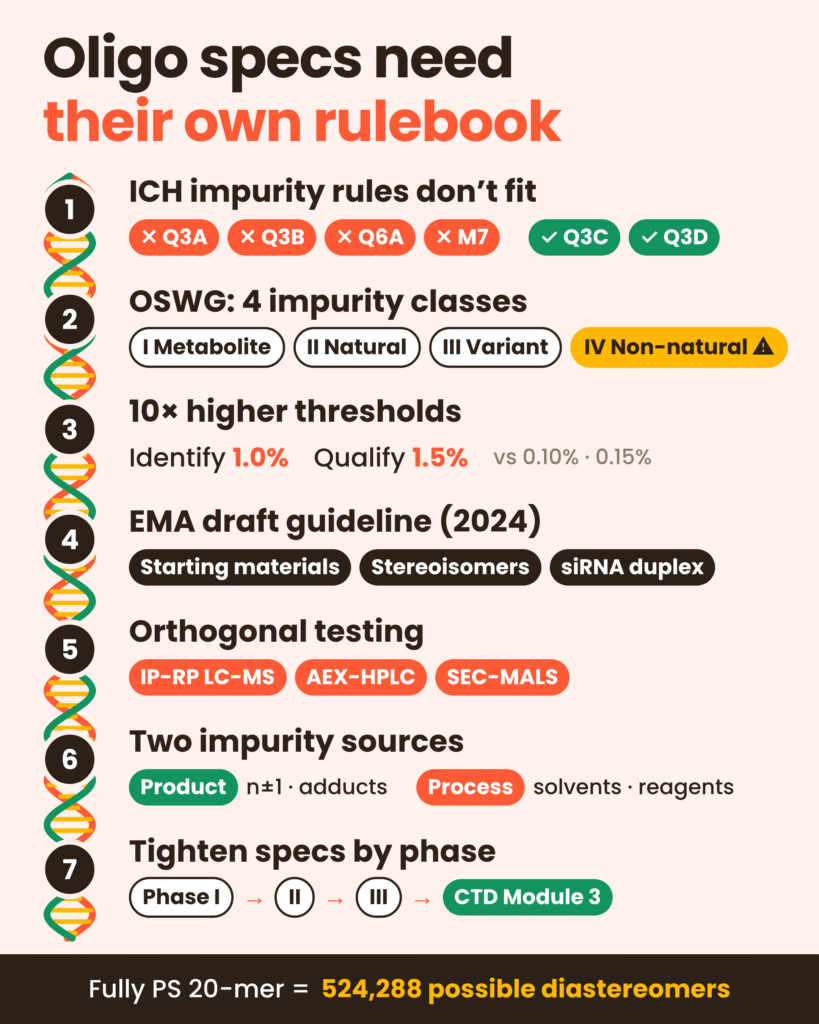
- Oligonucleotides need their own rules. They are regulated as new chemical entities, but their size (about 5,000–15,000 Da), polyanionic charge and step-wise synthesis place them between small molecules and biologics. Standard small-molecule approaches therefore don’t fit.
- Most ICH impurity guidelines exclude them. ICH Q3A, Q3B, Q6A and M7 exclude oligonucleotides from their scope, because the 0.10% identification and 0.15% qualification thresholds are impractical for step-wise synthesis. ICH Q3C (residual solvents) and Q3D (elemental impurities) still apply.
- The OSWG framework sorts impurities into four classes. Class I covers metabolites, Class II natural nucleic acid elements, Class III sequence variants such as n-1 and n+1, and Class IV non-natural structures. Only Class IV needs a separate safety assessment once it exceeds the threshold.
- Thresholds are higher than for small molecules. The OSWG proposes 1.0% for identification and 1.5% for qualification, about 10 times the small-molecule values. Many sponsors use a more conservative 0.5% identification threshold.
- The EMA’s July 2024 draft guideline fills the gaps. It sets expectations for starting-material control under ICH Q11, in-process synthesis controls, and consistent diastereomer profiles for phosphorothioate oligos. A fully phosphorothioate 20-mer has 524,288 possible diastereomers. The draft also covers duplex annealing controls for siRNAs.
- Testing must be orthogonal, and impurities come from two sources. No single method resolves every impurity, so IP-RP-HPLC with high-resolution MS is combined with AEX-HPLC and SEC-MALS. Product-related impurities (n±1, depurination, adducts) are controlled with sequence-based safety models. Process-related impurities (solvents, reagents, metals, leachables) are controlled with residual limits.
- Specifications tighten in phases. Teams start by defining CQAs and classifying impurities in Phase I, then validate methods under ICH Q14 and Q2(R2). Limits are tightened toward Phase III using batch data. Any non-standard limit is justified in CTD Module 3 with OSWG and EMA references.
Regulatory Scope Limitations of Legacy ICH Guidelines for Oligonucleotides
Traditional small-molecule quality guidelines, particularly ICH Q3A, ICH Q3B, and ICH Q6A, explicitly exclude synthetic oligonucleotides from their formal scope. Their high molecular weight and step-wise impurity profiles make conventional small-molecule qualification thresholds impractical. Applying rigid small-molecule limits to product-related sequence impurities would require extensive animal toxicology studies for minor variants that generally share the primary pharmacological and toxicological characteristics of the parent compound.
The main challenge in applying small-molecule guidelines arises from the impurity reporting, identification, and qualification thresholds established under ICH Q3A(R2) and ICH Q3B(R2). For a daily dose threshold of ≤ 2 g/day, ICH Q3A specifies an identification threshold of 0.10% and a qualification threshold of 0.15%. During a typical 20-mer oligonucleotide synthesis, even a relatively high coupling efficiency of 98.5% per step can generate a crude mixture containing numerous minor n-1 deletion sequences, n+1 insertion sequences, depurinated species, and incompletely deprotected adducts. Even after extensive downstream purification using ion-pair reversed-phase (IP-RP) or anion-exchange (AEX) chromatography, several of these individual sequence-related impurities may remain at concentrations ranging from 0.1% to 1.0%.
Applying a qualification threshold of 0.15% would compel biopharmaceutical sponsors to isolate and identify numerous minor oligonucleotide variants and conduct separate animal toxicology studies for each. However, toxicological research indicates that n-1 deletion sequences and closely related product variants generally exhibit pharmacological and toxicological characteristics comparable to those of the parent molecule. They typically do not introduce distinct organ toxicity or additional safety concerns. Therefore, applying ICH Q3A thresholds to these impurities can result in unnecessary animal testing and inappropriate scientific interpretations without providing meaningful improvements in patient safety.
Additionally, mutagenic impurity guidelines, including ICH M7, explicitly exclude therapeutic oligonucleotides. The structural components of oligonucleotides, including natural and modified nucleobases, sugar rings, and phosphate/phosphorothioate linkages, do not exhibit the electrophilic DNA-reactive mechanisms that ICH M7 algorithms are designed to identify. Instead, their potential genotoxicity is assessed through standard battery assays, which generally produce negative results for non-alkylating nucleic acid structures.
| Regulatory Guideline | Applied Modality Scope | Applicable to Oligonucleotides? | Primary Technical Conflict for Oligonucleotides |
|---|---|---|---|
| ICH Q3A(R2) | Small Molecule APIs | Excluded (Foreword) | The qualification threshold (0.15%) is too restrictive for impurity profiles generated through step-wise synthesis. |
| ICH Q3B(R2) | Small Molecule Drug Products | Excluded (Foreword) | Product-related degradation thresholds do not adequately address the breakdown of polyanionic oligonucleotides. |
| ICH Q6A | Universal Specifications (NCEs) | Excluded / Partial Principles | Testing criteria assume simple crystalline structures, distinct melting points, and minimal diastereomeric complexity. |
| ICH M7(R1) | Genotoxic/Mutagenic Impurities | Excluded | Excludes nucleic acid structures; nucleobases do not follow conventional electrophilic DNA-reactivity mechanisms. |
| ICH Q3C(R9) | Residual Solvents | Directly Applicable | Organic solvents used during synthesis and purification, such as acetonitrile, DCM, and pyridine, must comply with established limits. |
| ICH Q3D(R2) | Elemental Impurities | Directly Applicable | Trace metals originating from synthetic reagents, catalysts, or manufacturing equipment require risk evaluation. |
nderstanding the differences between peptide- and antibody-based targeting approaches can help clarify their respective development requirements.
Learn more about peptide versus antibody oligonucleotide conjugates.
The OSWG Framework and Safety Thresholds for Oligonucleotide CMC Specifications
The Oligonucleotide Safety Working Group (OSWG) developed a risk-based classification framework that divides oligonucleotide impurities into four structural categories to establish scientifically appropriate safety qualification limits. This approach replaces rigid small-molecule thresholds with scientifically justified Oligonucleotide CMC Specifications supported by toxicological exposure models and immunogenicity reference thresholds.
Published by Capaldi et al. (2017), the OSWG consensus white paper provides a scientific justification for moving beyond conventional ICH Q3A thresholds. The framework acknowledges that impurities sharing structural characteristics with the parent compound or naturally occurring nucleic acids generally do not introduce entirely new toxicological hazards.
According to the OSWG framework, impurity safety qualification follows a hierarchical decision-tree approach:
Class I Impurities: These impurities have structural characteristics identical to those of major in vivo metabolites or the parent compound’s chemistry, such as truncated 3′ or 5′ metabolites. They are generally qualified through the existing nonclinical toxicology package for the parent compound and do not require separate animal testing.
Class II Impurities: This category includes impurities composed exclusively of naturally occurring nucleic acid structural elements, including unmodified RNA/DNA sequence variants. These impurities are generally associated with a low safety concern and are controlled through routine batch release specifications.
Class III Impurities: These are parent compound sequence variants that retain modified chemical components, such as n-1 deletion, n+1 insertion, or deaminated species. Because they generally retain pharmacological activity comparable to the parent molecule, they can be qualified using the parent compound’s safety package within established limits.
Class IV Impurities: These impurities contain non-natural structural modifications that are absent from both the parent compound and naturally occurring nucleic acids. Examples include protecting group adducts, depurinated non-natural species, and novel base modifications. If their concentrations exceed established safety thresholds, formal toxicological qualification is necessary.
The OSWG recommendations suggest an identification threshold of 1.0%, although many biopharmaceutical sponsors adopt a more conservative limit of 0.5%. A qualification threshold of 1.5% is proposed for product-related impurities. These recommendations are further supported by human exposure limits ranging from 1.0 mg/day to 1.8 mg/day for individual impurities, depending on molecular weight and dosing frequency.
The scientific justification incorporates Cramer Class I toxicological principles, which indicate a low potential for oral or systemic toxicity for defined organic structures, alongside an immunogenicity reference threshold of 0.05 mg per dose. This threshold is derived from non-responsive baseline levels reported in peptide vaccine literature. Product-related impurities, including n-1 shortmers, may function as weak competitive antagonists or demonstrate tissue distribution comparable to that of the parent oligonucleotide. Therefore, their presence below established exposure limits is generally not expected to meaningfully alter the clinical safety margin.
| OSWG Impurity Class | Structural Description | Typical Impurity Types | Regulatory & Toxicological Requirement |
|---|---|---|---|
| Class I | Parent sequence/structure identical to major in vivo metabolites. | Truncated 3′ or 5′ metabolites formed in vivo. | Qualified by default through nonclinical animal metabolite profiles. |
| Class II | Contains only naturally occurring nucleic acid structural elements. | Unmodified RNA/DNA sequence variants and natural nucleobases. | Considered toxicologically low-risk and controlled through standard batch specifications. |
| Class III | Parent compound sequence variants retaining modified chemistry. | n-1 deletion, n+1 insertion, and deaminated species. | Toxicologically qualified through the parent safety package up to 1.5%. |
| Class IV | Contains non-natural structural elements absent from the parent compound or natural nucleic acids. | Protecting group adducts, depurinated non-natural species, and novel base modifications. | Requires toxicological qualification when exceeding the 1.5% or 1 mg/day threshold. |
Explore the analytical considerations involved in structural characterization of peptide-oligonucleotide conjugates.
The 2024 EMA Draft Guideline and Global Harmonization Trends
The European Medicines Agency (EMA) published its 2024 draft guideline, introducing the first comprehensive regulatory framework specifically addressing the development, synthesis, characterization, and analytical control of synthetic oligonucleotides. This document establishes specific regulatory expectations for starting material purity under ICH Q11, consistency of stereoisomeric profiles, and duplex annealing controls for siRNA therapeutics.
Released for consultation in July 2024 (EMA/CHMP/CVMP/QWP/262313/2024), the guideline addresses several quality-related gaps that remained unresolved by existing ICH documents outside their formal scope. It covers antisense oligonucleotides, single-stranded constructs, double-stranded siRNAs, and aptamers while providing recommendations across several important CMC areas:
Control of Active Substance Starting Materials: In accordance with ICH Q11 principles, sponsors must identify and scientifically justify starting materials, including nucleoside phosphoramidites, solid support resins, and functionalized linkers. Phosphoramidite purity profiles must be appropriately controlled to minimize the formation of downstream n+1 insertion sequences and unintended modified bases.
Synthesis and In-Process Controls: Solid-phase synthesis operations must establish critical process parameters (CPPs) for deprotection (detritylation), coupling, capping, oxidation/sulfurization, cleavage, and resin deprotection. The guideline also emphasizes preventive controls to minimize internal cross-contamination during automated synthesis cycles.
Control of Stereoisomers (P-Chirality): In oligonucleotides containing phosphorothioate linkages, every sulfur substitution creates a chiral center at the phosphorus atom, resulting in either an Rp or Sp configuration. A 20-mer phosphorothioate ASO contains 19 chiral centers, theoretically producing 2^19 (524,288) possible diastereomers. Unless a stereopure synthesis process is employed, the EMA guideline expects sponsors to demonstrate consistent diastereomeric distributions across manufacturing batches using qualified chromatographic or spectroscopic fingerprinting techniques.
Double-Stranded siRNA Annealing: For duplex molecules, specifications must establish appropriate stoichiometric ratios between sense and antisense strands, control unhybridized single strands, verify overhang integrity, and demonstrate consistency in thermal melting profiles (Tm).
By incorporating Quality by Design (QbD) principles under ICH Q8, risk management practices under ICH Q9, pharmaceutical quality systems under ICH Q10, analytical procedure development under ICH Q14, and analytical method validation under ICH Q2(R2), the 2024 EMA guideline helps address longstanding regulatory gaps.
For additional regulatory context, review the CMC requirements for peptide-oligonucleotide conjugates in IND submissions.
Analytical Methodologies for Setting Oligonucleotide CMC Specifications
Developing scientifically defensible Oligonucleotide CMC Specifications requires an orthogonal analytical toolkit capable of distinguishing structurally similar sequence variants, charge isomers, and aggregates. Since no individual analytical separation technique can adequately resolve every potential product-related impurity, regulatory authorities expect sponsors to combine complementary analytical methods.
Ion-pair reversed-phase high-performance liquid chromatography (IP-RP-HPLC), coupled with electrospray ionization high-resolution mass spectrometry (ESI-HRMS), serves as a primary analytical approach for intact mass confirmation and product-related impurity profiling. IP-RP-HPLC uses lipophilic alkylammonium ion-pairing reagents, such as triethylammonium acetate (TEAA) or hexylamine/hexafluoroisopropanol (HFIP), to retain and separate polyanionic oligonucleotides according to their chain length and hydrophobicity.
Anion-exchange chromatography (AEX-HPLC) provides a complementary separation mechanism based primarily on charge density. This technique is particularly useful for distinguishing failure sequences (n-1, n-2) and backbone modifications from the full-length product (FLP). For double-stranded siRNAs and higher-order structures, including aptamer hairpins, Size-Exclusion Chromatography coupled with Multi-Angle Light Scattering (SEC-MALS) is used to evaluate molecular size, aggregate formation, and single-strand duplex dissociation.
| Quality Attribute | Analytical Testing Methodology | Primary Objective / Acceptance Criteria | Regulatory Guideline Reference |
|---|---|---|---|
| Appearance & Color | Visual inspection / Colorimetry | Clear, colorless to light yellow solution, or white to off-white lyophilized powder. | EMA Draft Guideline 2024 |
| Identification (Mass) | LC-ESI-MS / High-Resolution Mass Spectrometry (HRMS) | Observed monoisotopic or average mass matches the theoretical molecular structure within ± 1 Da. | OSWG Identity White Paper |
| Identification (Sequence) | LC-MS/MS oligonucleotide sequencing / Tandem MS | Confirms the primary nucleobase sequence map from the 5′ to the 3′ terminus. | EMA Draft 2024 / ICH Q2(R2) |
| Assay (Purity/Content) | IP-RP-HPLC or AEX-HPLC with UV detection (260 nm) | Main peak purity typically ≥ 85.0% to 90.0% FLP; content 95.0%–105.0% of label claim. | ICH Q6A Principles |
| Product-Related Impurities | IP-RP-LC-MS / AEX-HPLC | Individual specified impurities ≤ 1.5%; unspecified impurities ≤ 0.5%; total impurities ≤ 10.0%–15.0%. | OSWG Impurity Paper / EMA Draft |
| Stereoisomer Pattern | Chromatographic Fingerprinting / Ion Mobility MS | Diastereomeric profile corresponds to the established reference standard pattern. | EMA Draft Guideline 2024 |
| Duplex Ratio (siRNA) | Thermal Melting (Tm) / SEC-MALS / Native IP-RP | Duplex content ≥ 97.0%; free sense/antisense strands ≤ 1.5%. | EMA Draft Guideline 2024 |
| Water / Moisture Content | Karl Fischer Titration / Thermogravimetric Analysis (TGA) | Controlled within the specified limit, typically ≤ 8.0% w/w for powders. | EMA Draft Guideline 2024 |
| pH & Osmolality | Potentiometric pH meter / Freezing point depression | Solution API / DP pH maintained within the targeted physiological range, such as 6.5–8.5. | EMA Draft / Ph. Eur. / USP |
| Residual Solvents | Headspace Gas Chromatography (HS-GC-MS/FID) | Complies with ICH Q3C limits for acetonitrile, triethylamine, DCM, toluene, and pyridine. | ICH Q3C(R9) |
| Elemental Impurities | ICP-MS (Inductively Coupled Plasma Mass Spectrometry) | Complies with ICH Q3D daily exposure limits for Cadmium, Lead, Arsenic, Mercury, Nickel, and Palladium. | ICH Q3D(R2) |
| Bacterial Endotoxins | Limulus Amebocyte Lysate (LAL) Kinetic Assay | Parenteral limits based on the maximum dose, typically less than 0.2 EU/mg or less than 5.0 EU/kg/hr. | USP / Ph. Eur. 2.6.14 |
| Microbial Contamination | Membrane Filtration / Bioburden Testing | Drug substance bioburden less than 10 CFU/100 mg; drug product must be sterile. | USP / Ph. Eur. 2.6.1 |
Discover how 2D NMR techniques support peptide characterization and structural assessment.
Product-Related vs. Process-Related Impurity Control Strategies
Effective impurity management in oligonucleotide manufacturing requires two distinct control strategies: one for product-related variants generated during sequence synthesis and another for process-related impurities introduced through chemical reagents, solvents, and solid supports. While product-related sequence variants are assessed using sequence-similarity-based safety models, process-related impurities are controlled through residual limits and appropriate raw material qualification.
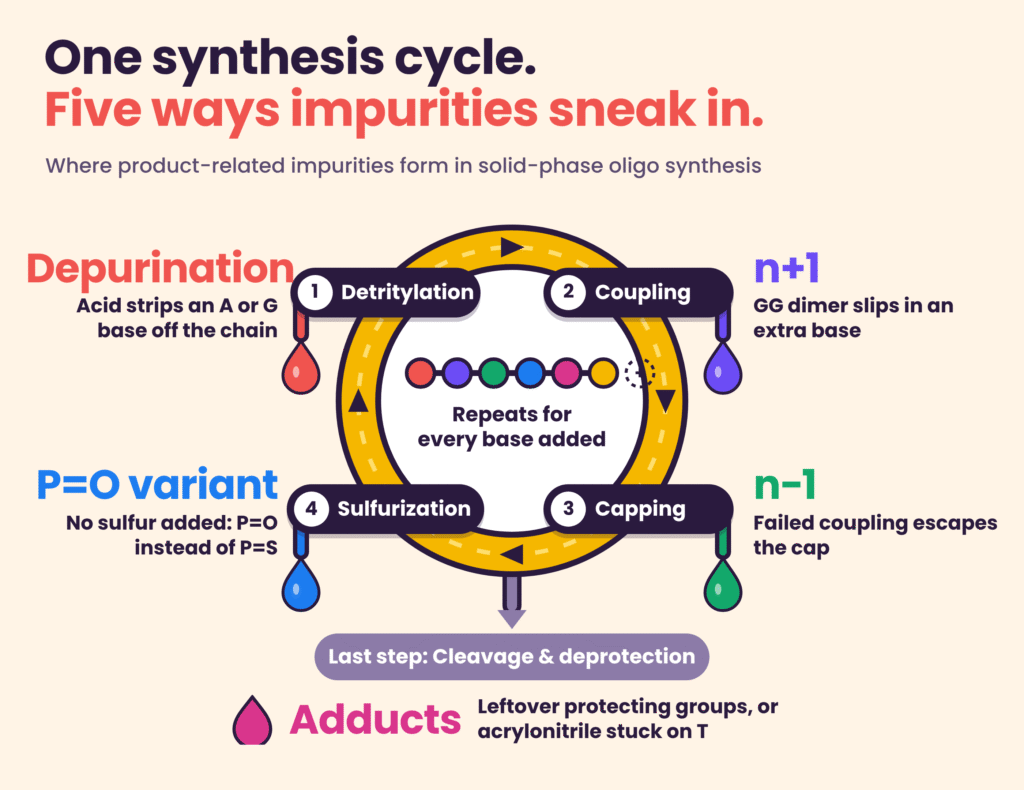
Product-related impurities represent one of the most challenging categories from an analytical perspective because their structures closely resemble those of the full-length product. n-1 deletion sequences are generated when a phosphoramidite fails to couple during an automated synthesis cycle and subsequently escapes capping by acetic anhydride. In contrast, n+1 insertion sequences may develop because of double-coupling events or the presence of trace phosphoramidite impurities containing reactive site-chain modifications.
Depurination can occur under the acidic conditions used during detritylation, which involves removing dimethoxytrityl (DMT) groups using dichloroacetic acid. These conditions can cause purine bases, including adenine or guanine, to detach from the sugar-phosphate backbone. Similarly, incomplete removal of protecting groups, such as benzoyl, isobutyryl, or 2-cyanoethyl groups, can generate adduct impurities that modify the molecule’s hydrophobicity and mass profile. In phosphorothioate oligonucleotides, insufficient sulfurization during the oxidation cycle can produce phosphodiester variants through sulfur-to-oxygen exchange, potentially reducing nuclease resistance in vivo.
Process-related impurities originate from residual raw materials, synthesis reagents, and downstream processing components. Important process-related impurities that require monitoring in release specifications include:
Residual Coupling Activators: 5-Ethylthio-1H-tetrazole (ETT) or 4,5-dicyanoimidazole (DCI) may remain following their use during coupling cycles.
Residual Sulfurizing Reagents: Xanthane hydride or EDITH (3-ethoxy-1,2,4-dithiazolidin-5-one), which are used during phosphorothioate backbone conversion, must be adequately controlled.
Residual Deprotection Reagents: Residual quantities of concentrated aqueous ammonium hydroxide, methylamine, or triethylamine trihydrofluoride (TEA·3HF) must be evaluated and controlled.
Leachables and Extractables: Potential contaminants may originate from functionalized solid-support resin matrices, polymeric filter fragments, or container-closure system leachables.
For additional guidance on defining suitable quality limits, explore specification-setting considerations for peptide-oligonucleotide conjugates.
Strategic Workflow for Establishing Defensible Specifications
A phase-appropriate specification strategy ensures that impurity limits remain consistent with the clinical development lifecycle. It balances patient safety requirements during early-phase clinical trials with statistical process capability and manufacturing controls required for commercial production. Biopharmaceutical developers can establish reliable control frameworks by following a structured regulatory workflow:
Define Quality Target Product Profile (QTPP) and CQAs: Identify and evaluate potential product-related and process-related impurities during early Phase I development. Use high-resolution LC-MS/HRMS and complementary chromatographic techniques to characterize critical quality attributes (CQAs).
Apply OSWG Classification Early: Assign identified impurities to the appropriate OSWG Classes I through IV. During Phase I, establish provisional acceptance limits of 0.5% for unspecified impurities and define specified impurity limits according to the corresponding clinical batch exposure levels.
Establish Method Validation under ICH Q14 and Q2(R2): Validate analytical procedures for specificity, intermediate precision, linearity, range, and quantitation limits. Confirm that IP-RP-HPLC and AEX methods possess adequate stability-indicating capabilities through forced degradation studies involving thermal, oxidative, acidic, basic, and photolytic stress conditions.
Phase-Appropriate Tightening of Acceptance Criteria: As clinical manufacturing progresses from Phase I/II to Phase III, refine impurity specifications using historical batch data, process capability measurements (Cpk), stability trends, and updated toxicological qualification packages.
Justify Exclusions and Non-Standard Thresholds: Prepare formal CMC justification documents for inclusion in Module 3 of the Common Technical Document (CTD). These submissions should reference OSWG white papers, Cramer Class I safety principles, and the 2024 EMA guidance to scientifically support specifications that differ from conventional small-molecule impurity limits.
Explore specialized drug product formulation services for peptide-oligonucleotide conjugates to understand the formulation-related considerations.
Conclusion
Establishing scientifically defensible Oligonucleotide CMC Specifications requires moving beyond conventional small-molecule ICH approaches and adopting risk-based impurity classification supported by advanced orthogonal analytical techniques. Synthetic oligonucleotides possess distinctive chemical characteristics, high molecular weights, and predictable step-wise impurity profiles. Consequently, applying historical small-molecule qualification thresholds is often technically impractical and may result in unnecessary toxicological investigations.
By implementing OSWG impurity classification frameworks, utilizing advanced analytical techniques such as LC-HRMS, IP-RP-HPLC, and AEX-HPLC, and aligning quality control strategies with modern regulatory guidance, including the 2024 EMA draft guideline, biopharmaceutical developers can establish comprehensive and reliable quality control systems. These scientifically justified, risk-based strategies help protect patient safety while facilitating the consistent and scalable development of innovative oligonucleotide therapeutics.
For technical inquiries, analytical methodology support, or expert regulatory guidance concerning complex oligonucleotide characterization and specification strategies, contact the analytical specialists at ResolveMass Laboratories:
Contact ResolveMass Laboratories
Frequently Asked Questions
Regulatory authorities, including the US FDA (CDER), generally regulate synthetic therapeutic oligonucleotides as chemical entities rather than conventional biological products. They are sometimes described as “big small molecules” because they combine chemical synthesis characteristics with complex structural properties. However, certain products, including specific vaccine adjuvants and complex conjugates, may fall under CBER or other specialized regulatory frameworks.
The Oligonucleotide Safety Working Group (OSWG) developed a risk-based framework that divides oligonucleotide impurities into four classes according to their structural similarity to the parent compound and naturally occurring nucleic acids. Each category has specific toxicological qualification requirements. The framework supports a qualification threshold of 1.5% and considers daily exposure limits, including a 1.0 mg/day safety reference.
Unspecified impurity limits are established according to the development stage, manufacturing process, and toxicological risk associated with the impurities. A limit of 0.5% is commonly considered during early clinical development and may also be adopted in commercial release specifications. Its justification involves structural assessment, Cramer Class I toxicological principles, and potential immunogenicity considerations.
Oligonucleotide CMC Specifications rely on multiple complementary analytical techniques to evaluate identity, purity, structural integrity, and potential contaminants. Important methods include IP-RP-HPLC, AEX-HPLC, and LC-ESI-HRMS for impurity profiling and molecular characterization. SEC-MALS evaluates aggregation, ICP-MS detects elemental impurities, and Headspace GC-MS measures residual solvents.
The 2024 EMA draft guideline (EMA/CHMP/CVMP/QWP/262313/2024) introduces specific quality expectations for synthetic oligonucleotide development and manufacturing. It addresses starting material qualification under ICH Q11, solid-phase synthesis controls, phosphorothioate stereoisomer consistency, and siRNA duplex annealing. It also provides direction for establishing appropriate analytical controls and comprehensive release specifications.
Product-related impurities develop during synthesis or storage and generally retain structural similarities to the intended oligonucleotide. Examples include n-1 deletion sequences, n+1 insertion sequences, and depurinated species. Process-related impurities originate from manufacturing materials and operations, including residual coupling activators, solvents, sulfurizing reagents, trace metals, and other chemical residues.
Phosphorothioate oligonucleotides contain chiral phosphorus centers that can exist in either Rp or Sp configurations, creating numerous possible diastereomeric combinations. Manufacturers monitor this complexity using qualified chromatographic separation and spectroscopic fingerprinting techniques. Comparing these analytical profiles across batches helps establish consistent stereoisomeric distributions, unless a stereopure synthesis strategy is specifically implemented.
Terminal heat sterilization is generally avoided because elevated temperatures can compromise oligonucleotide stability and promote chemical degradation. Potential changes include hydrolysis, depurination, and cleavage of phosphodiester or phosphorothioate backbones. Consequently, parenteral oligonucleotide drug products are commonly processed through validated membrane filtration and subsequently filled under aseptic conditions.
High-Resolution Mass Spectrometry (HRMS) is essential for confirming the molecular mass and evaluating the structural integrity of therapeutic oligonucleotides. Tandem MS provides sequence information and helps identify modifications, truncated products, and protecting group adducts. When combined with suitable chromatographic separation, mass spectrometry also supports the characterization and assessment of co-eluting product-related impurities.
Reference:
- Thürmer, R. (n.d.). European quality guidelines. U.S. Pharmacopeia (USP). https://www.usp.org/sites/default/files/usp/document/our-work/biologics/documents/Rene%20Thurmer_European%20quality%20guidelines.pdf
- European Medicines Agency. (2024). Guideline on the development and manufacture of oligonucleotides (Draft). EMA/CHMP/CVMP/QWP/262313/2024. https://www.ema.europa.eu/en/documents/scientific-guideline/draft-guideline-development-manufacture-oligonucleotides_en.pdf
- Pack, B. (n.d.). Toxicity and immunogenicity considerations. U.S. Pharmacopeia (USP). https://www.usp.org/sites/default/files/usp/document/our-work/biologics/documents/brian%20pack_Toxicity%20and%20Immunogenicity%20Considerations.pdf
- European Medicines Agency. (2024). Guideline on the development and manufacture of oligonucleotides. https://www.ema.europa.eu/en/scientific-guidelines/development-manufacture-oligonucleotides
- Capaldi, D., Teasdale, A., Henry, S., Akhtar, N., den Besten, C., Gao-Sheridan, S., Kretschmer, M., Sharpe, N., Andrews, B., Burm, B., & Foy, J. (2017). Impurities in oligonucleotide drug substances and drug products. Nucleic Acid Therapeutics, 27(6), 309–322. https://doi.org/10.1089/nat.2017.0691
Get In Touch With Us
About The Author