
Introduction
Oligonucleotide Purification Explained focuses on assessing Anion-Exchange Chromatography (AEX) and Ion-Pair Reversed-Phase Chromatography (IP-RP), the two primary chromatographic techniques used to separate synthetic oligonucleotides from synthesis failure sequences and chemical impurities. Selecting between charge-based AEX and hydrophobicity-based IP-RP directly influences achievable yield, target purity, mass spectrometry compatibility, and downstream process complexity in both analytical and preparative workflows.
Solid-phase phosphoramidite synthesis proceeds through successive nucleotide coupling cycles, with stepwise coupling efficiencies typically ranging from 98.5% to 99.0%. Throughout the synthesis of a 20- to 100-mer chain, incomplete coupling and side reactions accumulate, generating a complex mixture containing the full-length product (FLP), n−1 shortmers, n+1 longmers, depurinated strands, and partially thiolated backbones. As therapeutic nucleic acids expand from short antisense oligonucleotides (ASOs) and small interfering RNAs (siRNAs) to single-guide RNAs (sgRNAs) and messenger RNA (mRNA) fragments, chromatographers must address distinct thermodynamic and mass-transfer limitations. ResolveMass Laboratories Inc. utilizes advanced liquid chromatography and mass spectrometry platforms to characterize these biopolymer profiles and develop high-resolution separation protocols.
Explore CMC services for peptide-oligonucleotide conjugates to learn more about integrated analytical and development support for complex therapeutic molecules.
Share via:
Quick Summary:
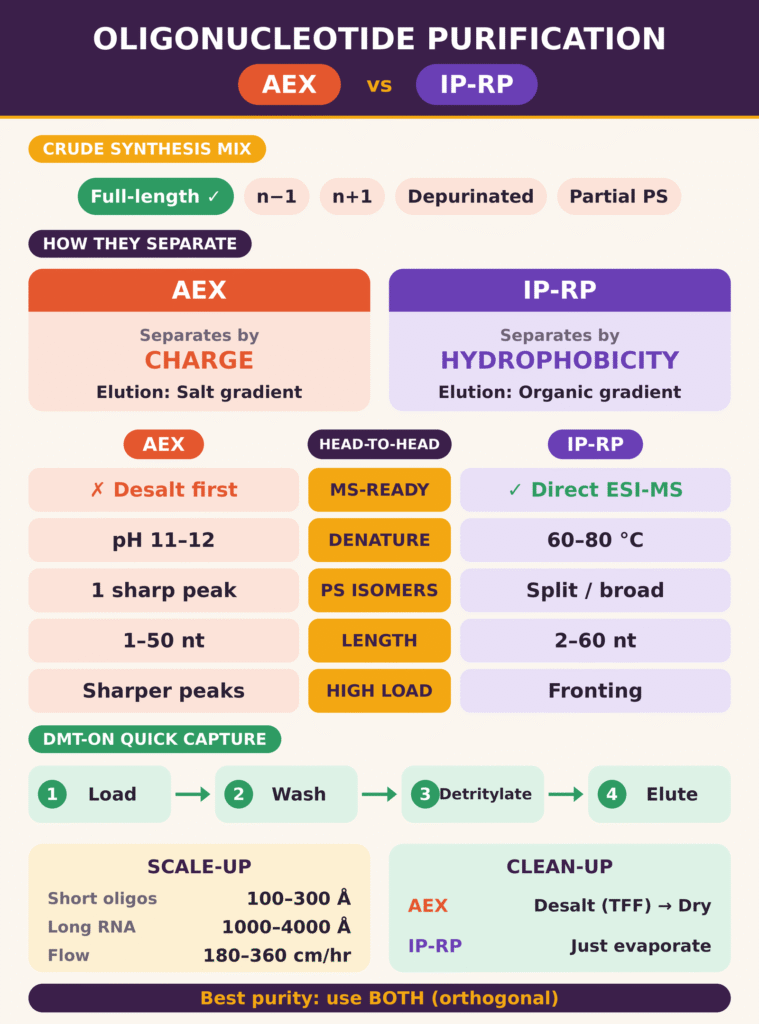
- The problem: Making oligonucleotides leaves a messy mix. Alongside the full-length product, it contains n−1 shortmers, n+1 longmers, depurinated strands and partly thiolated backbones. AEX and IP-RP are the two main ways to clean it up.
- How they differ: AEX separates by charge. It binds the phosphate backbone and releases strands with a rising salt gradient. IP-RP separates by hydrophobicity, using alkylamine ion-pairing reagents and an organic solvent gradient such as acetonitrile.
- Impurity resolution: Both methods resolve n−1 failures well up to about 30–40 nt. With phosphorothioates, AEX at high pH (11–12) squeezes the diastereomers into one sharp peak. IP-RP may split or broaden them, which makes purity integration harder.
- DMT-On shortcut: The hydrophobic 5′-DMT group lets the full-length product be captured selectively on a reversed-phase column. The process is load, wash away failures, remove the DMT on the column with dilute acid, then elute.
- MS and denaturation: IP-RP’s volatile mobile phase (TEA/HFIP) connects directly to ESI-MS. AEX salts must be removed first. AEX denatures with high pH, while IP-RP needs high temperature (60–80 °C).
- Scale-up economics: AEX loads more product, because self-displacement sharpens peaks at high loading. IP-RP tends to show fronting when overloaded. Pore size should match the molecule: 100–300 Å for short oligos and 1000–4000 Å for long RNA. Linear velocity should stay at 180–360 cm/hr during scale-up.
- Downstream and takeaway: AEX fractions need desalting by UF/DF or TFF. IP-RP fractions can simply be evaporated or lyophilized. For the best purity and characterization, use both methods together as orthogonal techniques.
Separation Mechanisms in Oligonucleotide Purification Explained
Anion-Exchange Chromatography separates oligonucleotides according to electrostatic charge differences along the sugar-phosphate backbone, whereas Ion-Pair Reversed-Phase Chromatography retains target strands through hydrophobic interactions mediated by amphiphilic alkylammonium ion-pairing reagents. Accordingly, AEX separates analytes based on their net charge density, while IP-RP distinguishes molecules through a combination of chain length and nucleobase sequence hydrophobicity.
The fundamental operational difference between these techniques lies in how each interacts with the polyanionic backbone of nucleic acids:
- Anion-Exchange Chromatography (AEX): This technique relies on direct Coulombic attraction between negatively charged phosphate groups and positively charged ligands on the stationary phase. Elution is achieved by increasing the ionic strength of the mobile phase using inorganic salts, which compete with the oligonucleotides for binding sites on the resin.
- Ion-Pair Reversed-Phase Chromatography (IP-RP): This technique employs lipophilic cationic reagents (alkylamines) that dynamically adsorb onto a hydrophobic stationary phase or associate with nucleic acids in solution. Elution is driven by an increasing gradient of an organic solvent, such as acetonitrile, which reduces hydrophobic adsorption and facilitates analyte release.
Learn about the different types of peptide-oligonucleotide conjugates and how their structural differences influence therapeutic development.
Anion-Exchange Chromatography Mechanics
Anion-Exchange Chromatography employs stationary phases functionalized with quaternary ammonium (SAX) or diethylaminoethyl (WAX) ligands to bind the polyanionic sugar-phosphate backbone of synthetic oligonucleotides. Elution is initiated by applying an increasing ionic strength gradient using non-volatile salts, such as sodium chloride (NaCl), sodium perchlorate (NaClO4), or potassium bromide (KBr), or by adjusting the pH to disrupt electrostatic interactions between the analyte and the stationary phase.
Strong Anion Exchange (SAX) media constructed on non-porous or wide-pore polymeric matrices (1000 Å to 4000 Å) minimize intraparticle diffusion resistance, enabling efficient separation of large nucleic acid structures. Operating AEX under strongly alkaline denaturing conditions (pH 11.0–12.0) using sodium hydroxide (NaOH) disrupts secondary structures, hairpins, and Watson-Crick base pairing. High-pH denaturation sharpens chromatographic peak profiles, exposes previously inaccessible charge sites, and facilitates the resolution of closely eluting oxidation impurities in phosphorothioate oligonucleotides. However, the high salt concentrations in AEX mobile phases prevent direct coupling with electrospray ionization mass spectrometry (ESI-MS) unless online or offline desalting is performed beforehand.
Ion-Pair Reversed-Phase Chromatography Mechanics
Ion-Pair Reversed-Phase Chromatography operates by forming dynamic ion pairs between cationic alkylammonium reagents in the mobile phase and the anionic phosphate backbone of oligonucleotides. These interactions reduce electrostatic repulsion and facilitate retention on non-polar stationary phases. Elution is accomplished using an organic modifier gradient, typically acetonitrile, which progressively weakens hydrophobic interactions between the ion-paired complex and the stationary phase.
In IP-RP systems, alkylamine cations adsorb onto hydrophobic surfaces, such as polystyrene-divinylbenzene (PS-DVB) or C18/C8 organo-silica, creating a dynamic ion-exchange interface. Fluorinated organic additives, particularly hexafluoroisopropanol (HFIP), serve two purposes: they act as weak acidic modifiers that adjust the mobile phase pH and function as volatile organic additives that facilitate gas-phase ion formation during negative ESI-MS. Adjusting the hydrophobicity of the ion-pairing reagent by switching from triethylamine (TEA) to tripropylamine (TPA) or hexylamine (HA) increases retention. This approach allows chromatographers to reduce HFIP concentrations while optimizing sequence-dependent selectivity.
Review structural characterization of peptide-oligonucleotide conjugates to understand approaches for assessing the structural attributes of these complex molecules.
Impurity Resolution Strategies and Selectivity
Matching the chemical characteristics of synthesis impurities, including deletion shortmers, addition longmers, phosphorothioate stereoisomers, and hydrophobic protecting groups, with the appropriate chromatographic mode is essential for achieving the desired purification selectivity. Although AEX is particularly effective at resolving charge-differentiated deletion sequences in longer oligonucleotides, IP-RP offers excellent resolution of base modifications, sequence variants, and lipophilic protecting tags.
Shortmer and Longmer Failure Sequence Resolution
The separation of n−1 deletion shortmers and n+1 addition longmers depends on differences in net charge for AEX and cumulative hydrophobic surface area for IP-RP. For oligonucleotides up to 30–40 nucleotides long, both chromatographic modes generally provide reliable separation of n−1 species. As sequence length increases, the relative contribution of a single nucleotide to the overall charge and hydrophobicity decreases. Consequently, shallower gradients and higher temperatures may be required to maintain adequate resolution.
- AEX Mode: This mode resolves n−1 impurities primarily by distinguishing charge differences along the phosphate backbone. High-pH conditions disrupt secondary structures that might otherwise conceal these differences, improving separation efficiency.
- IP-RP Mode: This mode separates n−1 impurities according to reductions in total hydrophobic contact area. Selectivity can be improved by modifying the hydrophobic characteristics of the ion-pairing reagent or increasing the column temperature to 60–80 °C.
Phosphorothioate Backbone Modifications and Diastereomer Separation
Replacing a non-bridging oxygen atom with sulfur introduces a chiral center at each phosphorothioate (PS) linkage. This modification generates complex mixtures containing 2N diastereomers, which can broaden chromatographic peaks in IP-RP because of subtle differences in hydrophobic interactions. Performing AEX under denaturing conditions at strongly basic pH (pH 11–12) minimizes the influence of these subtle stereochemical differences, compressing the diastereomeric envelope into a sharp, single peak. This behavior is advantageous for total product quantification and preparative fraction collection.
IP-RP can partially resolve individual Rp and Sp diastereomers, potentially producing split peaks or broad chromatographic envelopes that complicate baseline integration during purity testing. When complete compression of the diastereomeric envelope is necessary for preparative recovery, denaturing AEX generally provides sharper peaks than IP-RP.
DMT-On vs. DMT-Off Purification Modes
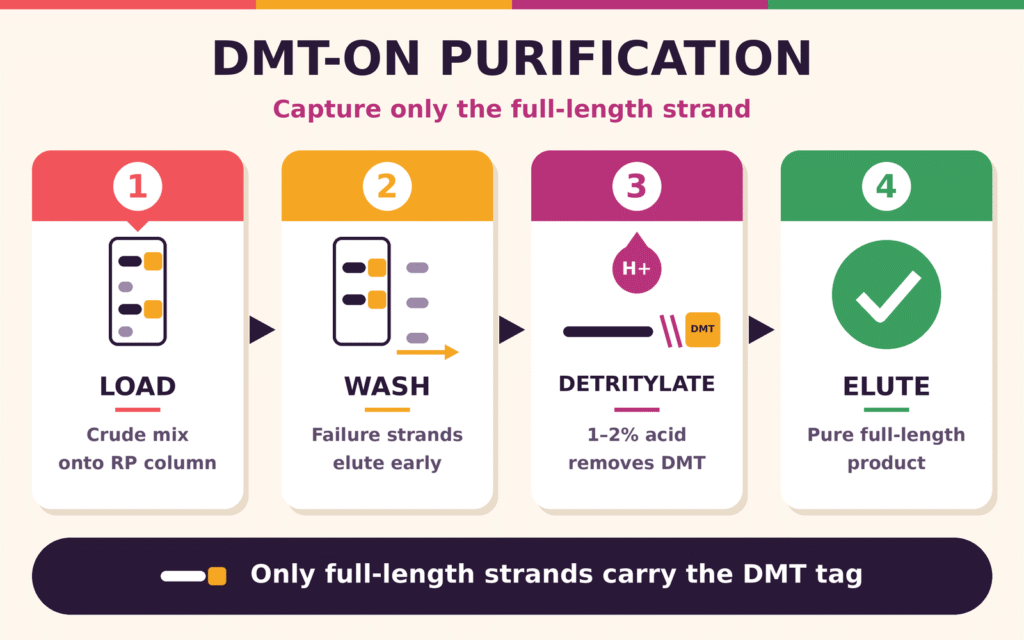
DMT-On purification takes advantage of the hydrophobic 5′-dimethoxytrityl protecting group retained on full-length oligonucleotides to selectively capture target strands, while failure sequences pass through the reversed-phase medium without significant retention. In contrast, DMT-Off purification is performed after the final deprotection step and relies on differences in length, sequence, or charge among fully deprotected species using AEX or IP-RP.
The DMT-On strategy provides a streamlined, single-step capture process through the following stages:
- Sample Loading: The crude synthesis mixture, containing the 5′-DMT-tagged target product and untagged n−1 failure sequences, is loaded onto a reversed-phase column.
- Impurity Wash: Hydrophilic failure sequences lack the hydrophobic DMT group and therefore elute early under low-organic mobile phase conditions.
- On-Column Detritylation: Dilute acid, such as 1–2% trifluoroacetic acid or acetic acid, is passed through the column to remove the 5′-DMT group and restore the free 5′-hydroxyl group.
- Target Elution: The deprotected, high-purity full-length product is subsequently eluted using a mild organic wash, reducing the need for complex gradient optimization.
Explore peptide-oligonucleotide conjugate synthesis methods to learn more about synthesis strategies for these specialized therapeutic constructs.
Operational Parameters and Technical Comparison
A comparison of the operational parameters of AEX and IP-RP highlights important trade-offs involving mobile phase composition, temperature requirements, mass spectrometry compatibility, and downstream processing. The table below summarizes these parameters to support analytical method development and informed decisions about preparative scale-up.
| Parameter / Operational Feature | Anion-Exchange Chromatography (AEX) | Ion-Pair Reversed-Phase (IP-RP) Chromatography |
|---|---|---|
| Primary Separation Mechanism | Coulombic electrostatic interactions with cationic functional groups on the resin | Hydrophobic interactions involving alkylammonium-oligonucleotide ion pairs on a non-polar stationary phase |
| Mobile Phase Composition | Aqueous buffers with high-salt gradients (NaCl, NaClO4, KBr, pH 7–12) | Volatile aqueous alkylamines (TEA, TPA) and fluorinated modifiers (HFIP) in acetonitrile |
| Direct ESI-MS Compatibility | Generally incompatible without online or offline desalting because of non-volatile salts | Highly compatible because volatile mobile phase components permit direct coupling with ESI-MS |
| Denaturation Capability | High; strongly alkaline eluents (pH 11–12) disrupt secondary structures without requiring elevated temperatures | High; secondary structure disruption generally relies on elevated column temperatures (60–80 °C) |
| Phosphorothioate Diastereomers | Compresses the diastereomeric envelope into a single sharp peak under basic conditions | May partially resolve diastereomers, resulting in peak broadening or splitting |
| Optimal Sequence Length Scope | Effective for short-to-medium sequences (1–50 nt); wide-pore resins support longer RNA molecules | Effective for small-to-medium oligonucleotides (2–60 nt), with highly sequence-dependent resolution |
| Preparative Loadability Isotherm | Anti-Langmuirian behavior; self-displacement can sharpen target peak bands | Langmuirian overload behavior; peak fronting and tailing can increase at high mass loadings |
| Downstream Salt Removal | Requires tangential flow filtration (TFF), ultrafiltration/diafiltration, or size-exclusion desalting | Target recovery using volatile mobile phase components can permit evaporation or vacuum lyophilization |
Scalability, Dynamic Binding Capacity, and Process Economics
The economics of industrial-scale preparative oligonucleotide purification depend on dynamic binding capacity (DBC), stationary phase pore accessibility, and the costs associated with downstream desalting. Although AEX can provide higher mass loadability and greater volumetric productivity at the process scale, IP-RP can reduce the number of unit operations by eliminating post-chromatographic desalting for smaller manufacturing batches.
Pore Size and Stationary Phase Mass Transfer
Selecting a stationary phase with an appropriate pore size for the molecular dimensions of the target oligonucleotide is essential for maximizing accessible surface area and minimizing mass-transfer limitations during scale-up. Small oligonucleotides (15–30-mers) can achieve optimal binding capacity on media with pore sizes ranging from 100 Å to 300 Å. In contrast, large guide RNAs and mRNA transcripts require wide-pore matrices (1000 Å to 4000 Å) to facilitate unobstructed pore diffusion and maintain sharp chromatographic peak profiles.
During scale-up, equivalent linear velocity (180–360 cm/hr) must be maintained across different column geometries to preserve comparable chromatographic performance. Transitioning from analytical particle sizes (3–5 μm) to preparative media (10–50 μm) reduces column backpressure but can also decrease separation efficiency. These losses can be mitigated by increasing column length or optimizing the gradient slope to achieve the required resolution.
Learn about the scale-up of peptide-oligonucleotide conjugates and the factors involved in transferring complex molecule production to larger manufacturing scales.
Isotherm Behavior: Anti-Langmuirian vs. Langmuirian Loading
The preparative loading capacity of AEX benefits from anti-Langmuirian isotherm behavior, in which self-displacement sharpens peak fronts and concentrates the target fraction under high sample-loading conditions. In contrast, IP-RP generally exhibits Langmuirian overload behavior, where increasing the sample mass can cause peak fronting, reduced resolution, and lower preparative yield per column cycle.
Under preparative overload conditions in AEX, early-eluting failure sequences can be displaced forward by the higher-affinity full-length target, potentially widening the collection window for the purified product. In IP-RP, high sample loading can produce nonlinear sorption behavior, broadening chromatographic bands and requiring narrower fraction collection windows to maintain the desired purity specifications.
Post-Purification Desalting and Buffer Exchange
Post-purification buffer exchange is generally mandatory after AEX to replace high concentrations of non-volatile inorganic salts with biocompatible buffers. This process is typically performed using ultrafiltration/diafiltration (UF/DF) or tangential flow filtration (TFF) membranes. By comparison, IP-RP mobile phase additives such as triethylamine and HFIP are volatile, allowing the target fraction to be concentrated through rotary evaporation or lyophilization without necessarily requiring additional filtration steps.
The typical process flows for these chromatographic techniques are outlined below:
- AEX Process Flow: Column Loading → High-Salt Elution → Fraction Pooling → UF/DF Desalting (1–3 kDa MWCO) → Lyophilization.
- IP-RP Process Flow: Column Loading → Organic Solvent Elution → Fraction Pooling → Vacuum Evaporation / Lyophilization.
Discover quality control testing for peptide-oligonucleotide conjugates to understand the analytical assessments used to evaluate complex conjugate quality.
Conclusion
Oligonucleotide Purification Explained highlights the importance of balancing sequence chemistry, manufacturing scale, mass spectrometry requirements, and downstream processing when choosing between Anion-Exchange Chromatography and Ion-Pair Reversed-Phase Chromatography. Combining charge-based AEX with hydrophobicity-based IP-RP in orthogonal workflows can improve impurity resolution and support comprehensive structural characterization across therapeutic biopolymer development and manufacturing pipelines. Selecting the appropriate chromatographic approach for each application is essential for achieving the required purity, recovery, and analytical performance.
Explore peptide-oligonucleotide conjugate requirements for IND submissions for additional insight into the information needed to support investigational drug development.
ResolveMass Laboratories Inc. provides specialized liquid chromatography and mass spectrometry services to investigate complex impurities and evaluate critical quality attributes in synthetic nucleic acids. For guidance on analytical method development or contract characterization services, visit Contact ResolveMass Laboratories Inc.
Frequently Asked Questions
IP-RP is well suited for direct coupling with liquid chromatography–mass spectrometry (LC-MS) because it can use volatile mobile phase additives, including triethylamine and hexafluoroisopropanol (HFIP). These components facilitate analyte transfer into the electrospray ionization source while minimizing non-volatile residue. However, ion suppression and other matrix effects may still occur depending on the mobile phase composition and analytical conditions.
Operating AEX at a high pH of 11.0–12.0 using sodium hydroxide helps disrupt Watson-Crick hydrogen bonding and oligonucleotide secondary structures, including hairpins. This exposes backbone charge differences that may otherwise be obscured by molecular folding. As a result, chromatographic peaks can become sharper, improving the separation of synthesis failure sequences and related impurities.
Hexafluoroisopropanol (HFIP) serves as a volatile acidic modifier in IP-RP chromatography and helps establish suitable mobile phase conditions for oligonucleotide separation. When combined with appropriate alkylamine reagents, it supports ion-pair formation and influences retention selectivity. HFIP is also useful in negative electrospray ionization mass spectrometry (ESI-MS), although its concentration and combination with other additives can affect ionization efficiency.
Long guide RNAs and messenger RNA (mRNA) constructs generally benefit from wide-pore stationary phases, with pore sizes ranging from 1000 Å to 4000 Å. These larger pores improve access to the internal surface of the stationary phase and reduce steric restrictions during molecular transport. Appropriate pore selection supports efficient mass transfer, effective analyte retention, and improved chromatographic performance for large nucleic acids.
Phosphorothioate (PS) linkages introduce stereogenic centers into the oligonucleotide backbone, resulting in mixtures of diastereomers that can exhibit slightly different chromatographic retention. In IP-RP, these differences may produce broad peaks or partially resolved chromatographic profiles. Denaturing AEX under strongly basic conditions can reduce stereochemistry-dependent retention differences, often producing a narrower peak suitable for quantification and preparative collection.
DMT-On purification uses the hydrophobic 5′-dimethoxytrityl (DMT) protecting group retained on full-length oligonucleotides to selectively capture the target during reversed-phase chromatography. Shorter failure sequences lacking this group generally exhibit weaker retention and can be removed during the washing step. This approach is particularly advantageous when rapid enrichment of full-length product is required before additional purification or analytical characterization.
Anion-Exchange Chromatography commonly uses non-volatile inorganic salts, such as sodium chloride (\(NaCl\)) and sodium perchlorate (\(NaClO_4\)), to elute retained oligonucleotides. Residual salts can interfere with downstream applications, affect sample quality, and compromise mass spectrometry measurements. Ultrafiltration/diafiltration (UF/DF), tangential flow filtration (TFF), or suitable desalting methods are therefore used to remove salts and exchange the buffer when necessary.
AEX can provide high preparative loading capacity and may exhibit anti-Langmuirian behavior, in which competitive displacement helps sharpen the target peak under suitable loading conditions. IP-RP more commonly exhibits Langmuirian adsorption behavior, with excessive sample loading potentially causing peak broadening and reduced resolution. Actual dynamic binding capacity and loading performance depend on the stationary phase, oligonucleotide properties, mobile phase conditions, and operating parameters.
Polymeric stationary phases, including polystyrene-divinylbenzene (PS-DVB), are frequently suitable for high-pH denaturing chromatography because of their chemical stability under strongly alkaline conditions. Certain hybrid organo-silica materials may also be appropriate, provided their stability has been established for the intended operating conditions. Selecting a matrix that tolerates the required pH range helps prevent stationary phase degradation and supports consistent retention, reproducibility, and separation performance.
Reference:
- Zhang, P., Wang, T., Jiang, S., Li, Q., Kong, W., Yang, K., & Nan, H. (2026). Diastereomer separation of phosphorothioate oligonucleotides via conformationally stabilizing ion pairs in reversed-phase liquid chromatography. Journal of Chromatography A, 1783, 467137. https://doi.org/10.1016/j.chroma.2026.467137
- Lardeux, H., Stavenhagen, K., Paris, C., Dueholm, R., Kurek, C., De Maria, L., Gnerlich, F., Leek, T., Czechtizky, W., Guillarme, D., & Jora, M. (2024). Unravelling the link between oligonucleotide structure and diastereomer separation in hydrophilic interaction chromatography. Analytical Chemistry, 96(24), 9994–10002. https://doi.org/10.1021/acs.analchem.4c01384
- Obata, Y., & Sakamaki, H. (2025). Improving the chromatographic separation of phosphorothioate oligonucleotide from impurities by optimizing selectivity through mobile-phase conditions in ion-pair reversed-phase high-performance liquid chromatography. Journal of Chromatography A, 1750, 465915. https://doi.org/10.1016/j.chroma.2025.465915
- Biba, M., Jiang, E., Mao, B., Zewge, D., Foley, J. P., & Welch, C. J. (2013). Factors influencing the separation of oligonucleotides using reversed-phase/ion-exchange mixed-mode high performance liquid chromatography columns. Journal of Chromatography A, 1304, 69–77. https://doi.org/10.1016/j.chroma.2013.06.050
- Gilar, M., Koshel, B. M., & Birdsall, R. E. (2023). Ion-pair reversed-phase and hydrophilic interaction chromatography methods for analysis of phosphorothioate oligonucleotides. Journal of Chromatography A, 1712, 464475. https://doi.org/10.1016/j.chroma.2023.464475
Get In Touch With Us
About The Author