

Introduction
Obtaining approval for an Abbreviated New Drug Application (ANDA) from the U.S. Food and Drug Administration (FDA) requires manufacturers to demonstrate that a generic drug is bioequivalent, chemically equivalent, and structurally comparable to its Reference Listed Drug (RLD). Implementing One-Stop CDMO Analytical Services for ANDA brings together analytical method development, method validation, stability studies, and Chemistry, Manufacturing, and Controls (CMC) documentation within a unified quality management system. This integrated strategy helps minimise regulatory risk while shortening development and submission timelines. The regulatory pathway for generic medicines, established under Section 505(j) of the Federal Food, Drug, and Cosmetic Act (FD&C Act) and reinforced through the Generic Drug User Fee Amendments (GDUFA), requires uncompromising data integrity, rigorous impurity management, and full compliance with International Council for Harmonisation (ICH) guidelines.
Distributing analytical activities among multiple contract laboratories often creates significant operational challenges, including unsuccessful method transfers, inconsistent validation practices, and conflicting interpretations of analytical data. These inconsistencies are among the leading causes of FDA Refuse-to-Receive (RTR) determinations and Complete Response Letters (CRLs) associated with CTD Module 3 submissions. In contrast, integrating analytical operations—from establishing the initial Analytical Target Profile (ATP) through preparation of the final eCTD Module 3 documentation—ensures continuous data traceability, streamlines regulatory submissions, and supports compliance with evolving regulatory expectations, including ICH Q14 and ICH Q2(R2).
Discover how an integrated approach simplifies generic drug development: Learn more about outsourcing generic drug development in Canada.
Share via:
Article Summary:
- One-Stop CDMO Analytical Services for ANDA integrate analytical method development, validation, stability studies, and CMC documentation into a single workflow, improving data consistency, reducing regulatory risks, and accelerating ANDA submissions.
- ICH Q14 and Analytical Quality by Design (AQbD) support a structured method development approach by defining the Analytical Target Profile (ATP), applying risk assessment, using Design of Experiments (DoE), establishing the Method Operational Design Region (MODR), and implementing a robust analytical control strategy.
- Analytical method validation under ICH Q2(R2) verifies that testing procedures consistently deliver reliable results by evaluating critical parameters such as specificity, linearity, accuracy, precision, detection limits, quantitation limits, and robustness.
- Extractables and Leachables (E&L) assessments, performed in accordance with USP <1663> and USP <1664>, identify potential chemical migrants from packaging and manufacturing materials while using Analytical Evaluation Threshold (AET) calculations to prioritise compounds requiring toxicological evaluation.
- Comprehensive eCTD Module 3 documentation compiles analytical procedures, validation reports, specifications, impurity assessments, batch analysis data, and scientific justifications into a regulatory-ready format that supports FDA expectations and reduces the likelihood of submission deficiencies.
- An integrated CDMO model eliminates challenges associated with multi-vendor method transfers, strengthens data integrity, speeds up out-of-specification (OOS) investigations, and enables faster, more efficient analytical development programmes.
- A unified analytical strategy helps generic drug manufacturers achieve stronger regulatory compliance, streamline FDA review, improve submission quality, and maintain product quality throughout the entire product lifecycle.
Integrating One-Stop CDMO Analytical Services for ANDA Method Development Under ICH Q14 and AQbD
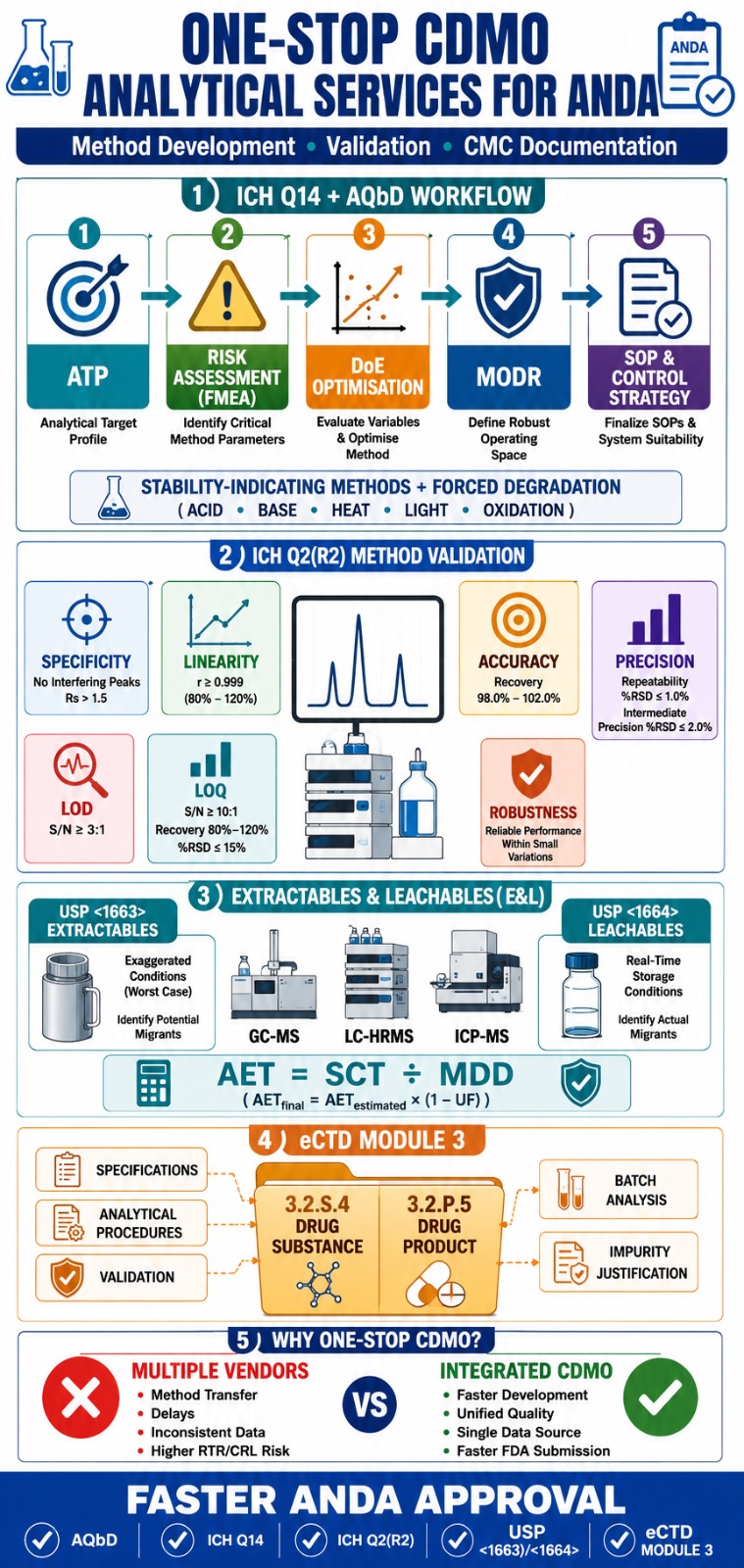
Analytical method development in accordance with ICH Q14 applies the principles of Analytical Quality by Design (AQbD) to proactively incorporate quality into analytical procedures through structured risk assessments and scientifically defined operating boundaries. By adopting One-Stop CDMO Analytical Services for ANDA, generic drug developers establish an Analytical Target Profile (ATP) that clearly specifies the desired analytical performance characteristics—such as accuracy, precision, sensitivity, and analytical range—based on the Quality Target Product Profile (QTPP) and the Critical Quality Attributes (CQAs) of both the drug substance and finished drug product.
Explore advanced method development tailored for generic pharmaceuticals: Read about analytical development for generic drugs in Canada.
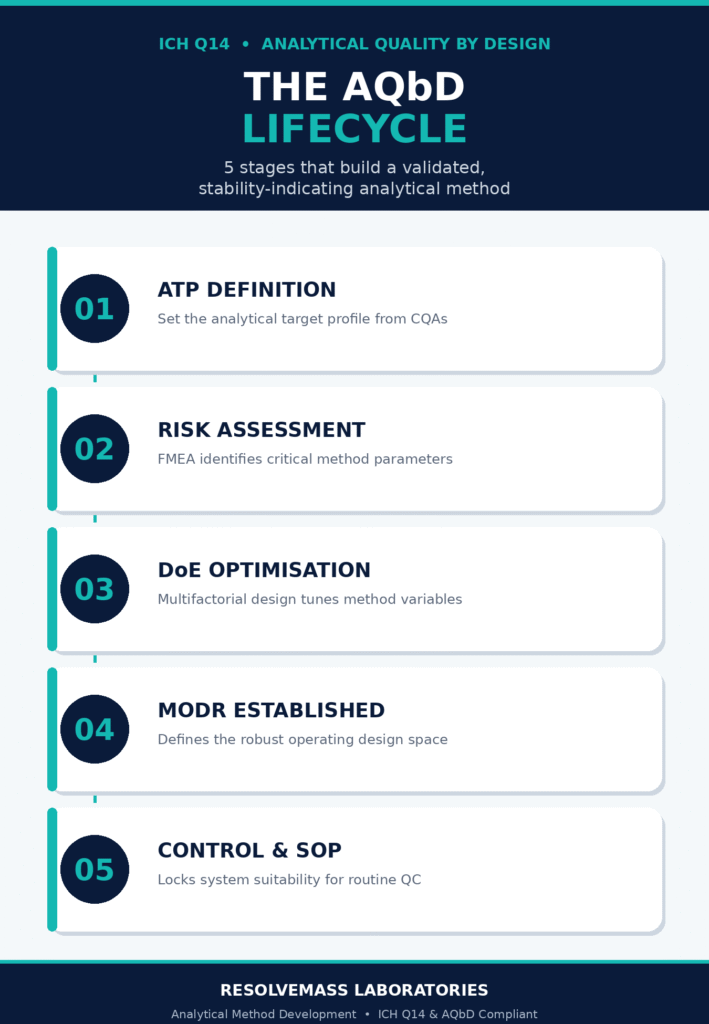
The AQbD lifecycle follows five progressive, phase-specific stages:
Analytical Target Profile (ATP) Definition
Defines the intended analytical purpose and establishes predetermined performance requirements for the analytical procedure.
Quality Risk Assessment
Applies structured risk management tools, including Failure Mode and Effects Analysis (FMEA), to identify Critical Method Parameters (CMPs) that may influence Critical Quality Attributes.
Design of Experiments (DoE) and Method Optimisation
Employs multifactorial experimental designs to evaluate interactions among variables such as mobile phase pH, organic solvent composition, column temperature, and flow rate, enabling systematic optimisation of analytical performance.
Method Operational Design Region (MODR) Establishment
Defines a scientifically justified multidimensional operating space within which the analytical method consistently produces reliable and reproducible results.
Analytical Control Strategy and SOP Finalisation
Establishes system suitability requirements and standard operating procedures (SOPs) to ensure consistent analytical performance during routine commercial quality control.
The development of stability-indicating analytical methods also requires comprehensive forced degradation studies to confirm that chromatographic methods can clearly separate active pharmaceutical ingredients (APIs) from all potential degradation products. These stress studies expose samples to harsh conditions—including acid hydrolysis, alkaline hydrolysis, thermal degradation, photolytic exposure, and oxidative stress—in accordance with ICH Q1 guidance. Advanced High-Performance Liquid Chromatography (HPLC) and Liquid Chromatography–Mass Spectrometry (LC-MS/MS) systems equipped with Photodiode Array (PDA) detectors are then used to confirm peak purity and verify that no co-eluting degradation products interfere with accurate API quantification. Operating within a validated Method Operational Design Region (MODR) provides valuable flexibility by allowing controlled adjustments to analytical parameters during routine testing without requiring formal regulatory revalidation.
Compare development partner models for your drug strategy: Compare options with this guide on CDMO vs. CRO for generic drug development.
| AQbD Lifecycle Phase | Key Analytical Activities | Regulatory & Operational Deliverable |
|---|---|---|
| 1. Target Definition | Establish the Analytical Target Profile (ATP) aligned with CQAs. | Documented analytical performance requirements, including accuracy, precision, and analytical range. |
| 2. Risk Assessment | Perform Failure Mode and Effects Analysis (FMEA) on analytical method parameters. | Identification of Critical Method Parameters (CMPs). |
| 3. DoE Optimisation | Evaluate mobile phase composition, stationary phases, pH, and other variables using systematic experimental designs. | Multifactorial response surface models supporting method optimisation. |
| 4. MODR & Control Strategy | Define the robust operating space together with system suitability requirements. | Final analytical method SOP incorporating validated operational limits. |
Analytical Method Validation Framework Under ICH Q2(R2)
Analytical method validation performed according to ICH Q2(R2) provides documented experimental evidence that an analytical procedure is suitable for its intended use in pharmaceutical quality control. The validation framework systematically evaluates essential performance characteristics, including specificity, linearity, accuracy, precision, limit of detection (LOD), limit of quantitation (LOQ), and robustness for both drug substances and finished drug products.
Accelerate your development timeline across North America: Discover how a CDMO can accelerate generic drug development in the US and Canada.
Specificity and Selectivity
Specificity confirms that the analytical method can accurately measure the target analyte in the presence of all anticipated matrix components, including degradation products, synthetic intermediates, excipients, and residual solvents. For chromatographic methods, the primary API peak should demonstrate baseline separation from adjacent peaks, typically with a resolution (Rs) greater than 1.5, supported by PDA-based peak purity assessment to confirm the absence of co-eluting impurities.
Linearity and Range
Linearity demonstrates that the analytical response remains directly proportional to analyte concentration throughout the intended analytical range. For finished product assay methods, the validated linearity range generally extends from 80% to 120% of the target concentration. Content uniformity methods typically cover concentrations between 70% and 130%, while dissolution methods generally encompass ±20% of the specified operating limits. Linear regression analysis generally requires a correlation coefficient (r) of at least 0.999 for API assay methods and at least 0.99 for quantitative impurity analyses.
Accuracy and Recovery
Accuracy measures the closeness between the experimentally determined result and the accepted reference value. Validation studies generally include a minimum of nine determinations performed across three concentration levels, commonly 80%, 100%, and 120% of the target concentration. For finished product API assays, acceptable mean recovery typically ranges from 98.0% to 102.0%. In contrast, trace organic impurity methods generally accept recovery values between 80.0% and 120.0%, depending on the applicable specification limits.
Precision: Repeatability and Intermediate Precision
Precision evaluates the consistency of analytical results when homogeneous samples are analysed repeatedly. Repeatability assesses within-run precision using at least six independently prepared samples at 100% of the target concentration, with a target Relative Standard Deviation (%RSD) of 1.0% or less for API assay methods. Intermediate precision examines normal laboratory variability by evaluating different analysts, instruments, and testing days, with typical acceptance criteria of %RSD not exceeding 2.0%.
Quantitation and Detection Limits
The Limit of Detection (LOD) and Limit of Quantitation (LOQ) represent the lowest analyte concentrations that can be reliably detected and accurately quantified while maintaining acceptable precision and accuracy. For instrumental analytical techniques such as HPLC and GC, signal-to-noise (S/N) ratios of 3:1 and 10:1 are commonly accepted for LOD and LOQ, respectively. Alternatively, these limits may be determined mathematically using the standard deviation of the analytical response (σ) together with the slope of the calibration curve (S):
LOD = (3.3 × σ) / S
LOQ = (10 × σ) / S
At the established LOQ, experimental verification should demonstrate a precision of %RSD not exceeding 10–15%, together with recovery values between 80% and 120%.
| Validation Parameter | API Assay Acceptance Criteria | Impurity Quantitation Acceptance Criteria |
|---|---|---|
| Specificity | No interfering peaks (Rs > 1.5; peak purity confirmed). | Complete baseline separation between API and degradation products. |
| Linearity | r ≥ 0.999 across 80%–120% of the target concentration. | r ≥ 0.990 from the LOQ to 120% of the specification limit. |
| Accuracy (Recovery) | Mean recovery between 98.0% and 102.0% across nine determinations. | Mean recovery between 80.0% and 120.0% (70%–130% at the LOQ where applicable). |
| Repeatability | %RSD ≤ 1.0% (n = 6 preparations). | %RSD generally between ≤ 5.0% and ≤ 10.0%, depending on concentration level. |
| Intermediate Precision | %RSD ≤ 2.0% across analysts, instruments, and testing days. | %RSD generally between ≤ 10.0% and ≤ 15.0% across evaluated variables. |
| LOQ Verification | Not applicable. | S/N ≥ 10:1, recovery between 80% and 120%, and %RSD ≤ 15%. |
Gain specialized insight into complex peptide characterization: Review our real-world generic peptide drug analytical characterization case study.
Extractables and Leachables (E&L) Qualification: USP <1663>, USP <1664>, and AET Calculations
Extractables and leachables (E&L) qualification is a critical component of pharmaceutical risk assessment that identifies and quantifies chemical compounds capable of migrating from container closure systems, manufacturing equipment, or processing materials into drug products. The primary objective is to minimise potential toxicological risks associated with these migrating substances. Regulatory compliance with USP <1663> and USP <1664> relies heavily on the calculation of the Analytical Evaluation Threshold (AET), which establishes the reporting threshold above which detected compounds must undergo identification and toxicological assessment.
Extractables studies expose packaging components to exaggerated thermal and chemical stress conditions using solvents with different polarities, including purified water, ethanol-water mixtures, and hexane. These studies are designed to identify compounds that could potentially migrate under worst-case conditions. Organic and inorganic constituents are characterised and quantified using advanced analytical platforms such as Gas Chromatography–Mass Spectrometry (GC-MS), Liquid Chromatography–High Resolution Mass Spectrometry (LC-HRMS), and Inductively Coupled Plasma–Mass Spectrometry (ICP-MS). In contrast, leachables studies evaluate finished pharmaceutical products stored under long-term and accelerated stability conditions to identify the chemical species that actually migrate into the formulation during its intended shelf life.
A fundamental element of E&L risk assessment is the Analytical Evaluation Threshold (AET), which specifies the concentration level at or above which an extractable or leachable compound must be identified and assessed for toxicological safety. The estimated AET is mathematically derived from the Safety Concern Threshold (SCT)—typically 0.15 μg/day for orally inhaled and nasal drug products (OINDPs) or 1.5 μg/day for parenteral and oral dosage forms—while accounting for the Maximum Daily Dose (MDD):
AETestimated = SCT / Maximum Daily Dose (MDD)
Because many compounds detected during mass spectrometric screening do not have authentic reference standards, an Uncertainty Factor (UF) is incorporated into the calculation to compensate for variations in analytical response factors. The operational AET is therefore determined using the following relationship:
AETfinal = AETestimated × (1 − UF)
When Relative Response Factor (RRF) databases indicate significant variability in detector response, industry practice commonly applies a 50% uncertainty factor (UF = 0.50). This conservative adjustment effectively halves the operational threshold, reducing the likelihood that trace-level toxicologically relevant compounds will remain undetected during analytical screening.
Ensure cross-border compliance across North American markets: Learn about regulatory support for generic drugs with a US and Canada CDMO.
Compilation of CMC Documentation for Module 3 (3.2.S.4 and 3.2.P.5)
Chemistry, Manufacturing, and Controls (CMC) documentation transforms analytical results, laboratory procedures, validation evidence, and supporting scientific data into the structured Common Technical Document (CTD) format required for FDA submissions. Sections 3.2.S.4 and 3.2.P.5 contain the analytical specifications, validation documentation, impurity assessments, and supporting justifications that are essential for avoiding FDA Refuse-to-Receive (RTR) determinations.
The eCTD Module 3 framework organises analytical information systematically across both drug substance and finished drug product sections.
3.2.S – Drug Substance Control
3.2.S.4.1 Specifications
Defines analytical specifications, acceptance criteria, and applicable pharmacopeial references for the drug substance.
3.2.S.4.2 Analytical Procedures
Provides comprehensive Standard Operating Procedures (SOPs) describing analytical methods used for testing the active pharmaceutical ingredient.
3.2.S.4.3 Validation of Analytical Procedures
Includes complete analytical method validation reports prepared in accordance with ICH Q2(R2).
3.2.S.4.4 Batch Analyses
Presents Certificates of Analysis (CoAs) generated from representative API production batches.
3.2.S.4.5 Justification of Specification
Documents the scientific and toxicological rationale supporting proposed impurity limits and specification criteria.
3.2.P – Drug Product Control
3.2.P.5.1 Specifications
Defines release specifications and shelf-life acceptance criteria for the finished dosage form.
3.2.P.5.2 Analytical Procedures
Provides detailed SOPs describing analytical methods used for product release testing and stability studies.
3.2.P.5.3 Validation of Analytical Procedures
Contains complete analytical validation packages, including forced degradation studies and supporting validation data.
3.2.P.5.4 Batch Analyses
Includes analytical results from exhibit batches, process validation batches, and bioequivalence batches.
3.2.P.5.5 Characterisation of Impurities
Documents the identification, qualification, and assessment of degradation products, process-related impurities, and leachables.
Analytical documentation submitted within these CTD sections should contain detailed analytical procedures, representative chromatograms with enlarged baseline views, calibration curves, system suitability data, validation summaries, and complete raw data audit trails. Incomplete validation packages, insufficient impurity characterisation, inadequate chromatographic resolution, or unsupported analytical procedures are common reasons for FDA Refuse-to-Receive (RTR) actions.
Work with regional CDMO experts for streamlined operations: Read about partnering with a pharmaceutical CDMO in the US and Canada.
| eCTD Section | Sub-Section Title | Critical Analytical Content Required |
|---|---|---|
| 3.2.S.4.1 / 3.2.P.5.1 | Specifications | Tabulated analytical tests, acceptance criteria, and referenced analytical procedures. |
| 3.2.S.4.2 / 3.2.P.5.2 | Analytical Procedures | Complete step-by-step Standard Operating Procedures (SOPs), including system suitability requirements. |
| 3.2.S.4.3 / 3.2.P.5.3 | Validation of Analytical Procedures | Comprehensive ICH Q2(R2) validation reports supported by representative chromatograms and validation summaries. |
| 3.2.S.4.4 / 3.2.P.5.4 | Batch Analyses | Certificates of Analysis (CoAs) from representative exhibit batches and commercial-scale manufacturing lots. |
| 3.2.S.4.5 / 3.2.P.5.5 | Justification of Specification | Scientific and toxicological justification for impurity limits in accordance with ICH Q3A, ICH Q3B, and ICH M7. |
Managing complex impurity profiles—including potential mutagenic impurities, nitrosamines (NDSRIs), and elemental impurities addressed under ICH Q3D—often requires highly sensitive mass spectrometry platforms capable of ultratrace detection. Collaborating with ResolveMass Laboratories Inc. enables pharmaceutical sponsors to generate analytical data that are structured specifically for seamless integration into eCTD Module 3 while ensuring that trace-level limits of quantitation (LOQs) remain aligned with toxicological safety thresholds.
Explore end-to-end support for complex peptide therapeutics: Access specialized peptide CDMO services.
Strategic Value of One-Stop CDMO Analytical Services for ANDA
Consolidating analytical activities within One-Stop CDMO Analytical Services for ANDA eliminates the challenges associated with transferring methods between multiple contract laboratories, establishes a unified quality management approach, and significantly accelerates product development timelines. A single integrated CDMO partner maintains consistent regulatory compliance, data integrity, and quality oversight throughout the entire product lifecycle, beginning with analytical method development and extending through post-approval lifecycle management.
Analytical methods developed during the early stages of product development frequently require extensive optimisation or complete revalidation when transferred to another laboratory because of differences in instrumentation, chromatographic columns, laboratory environments, and operating practices. An integrated CDMO minimises these risks by maintaining continuity throughout the Analytical Quality by Design (AQbD) lifecycle, ensuring that analytical methods remain scientifically consistent across every stage of development. In addition, unified quality oversight enables faster investigation of out-of-specification (OOS) results, allowing analytical issues to be resolved efficiently without delaying regulatory submissions.
Evaluate top-tier partners for complex molecule development: See what sets apart the best peptide CDMO.
| Operational Advantage | Multi-Vendor Analytical Approach | Integrated One-Stop CDMO Model |
|---|---|---|
| Method Development & Transfer | Increased risk of inter-laboratory variability and lengthy method transfer activities. | Continuous AQbD-driven development with minimal transfer-related challenges. |
| Regulatory Risk (RTR / CRL) | Greater regulatory risk resulting from fragmented datasets and inconsistent documentation formats. | Harmonised documentation with standardised eCTD Module 3 preparation. |
| Investigation Speed (OOS) | Extended investigation timelines due to coordination across multiple laboratories. | Rapid root-cause analysis performed within a single integrated Quality Unit. |
| Overall Timeline | Development programmes commonly extend across 12–16 months when multiple vendors are involved. | Accelerated development and validation programmes completed within approximately 6–10 weeks. |
Implementing a centralised analytical testing strategy offers several important operational advantages for pharmaceutical sponsors:
- Accelerated project timelines by eliminating complex multi-vendor technology transfers.
- Fully integrated eCTD Module 3 preparation supported by direct access to complete laboratory data and analytical records.
- Reduced likelihood of regulatory deficiencies and Complete Response Letters (CRLs) through consistent compliance with ICH Q2(R2) and ICH Q14.
- Comprehensive in-house capability for specialised analytical services, including nitrosamine analysis, trace-level extractables and leachables testing, and polymorph characterisation.
Deepen your approach to characterising advanced peptides: Explore our dedicated peptide analytical characterization services.
Conclusion
Successfully obtaining ANDA approval depends on an integrated analytical strategy that combines scientifically robust method development, comprehensive validation in accordance with ICH Q2(R2), and well-structured CTD Module 3 documentation. Implementing One-Stop CDMO Analytical Services for ANDA reduces regulatory risk, improves submission quality, streamlines the FDA review process, and supports long-term product quality throughout the product lifecycle.
Analyze deep characterization insights for complex generics: Review our detailed peptide characterization case study of semaglutide.
To discuss your generic drug analytical development programme and regulatory requirements, contact the regulatory science team at ResolveMass Laboratories Inc.
Frequently Asked Questions
ICH Q2(R2) broadens the scope of analytical method validation to include advanced analytical technologies, multivariate methods, and spectroscopic techniques that were not fully addressed in ICH Q2(R1). The updated guideline also aligns closely with ICH Q14 by supporting lifecycle-based method development and modern statistical evaluation. In addition, it provides enhanced recommendations for assessing validation characteristics such as precision, accuracy, linearity, robustness, and quantitation limits.
For parenteral products, the Analytical Evaluation Threshold (AET) is calculated by dividing the applicable Safety Concern Threshold (SCT) of 1.5 μg/day by the product’s Maximum Daily Dose (MDD). The resulting value is then adjusted using an uncertainty factor to account for differences in analytical response among unknown compounds detected during screening. This conservative calculation ensures that potentially hazardous leachables are identified and evaluated before they pose a patient safety concern.
Section 3.2.S.4.3 should contain comprehensive validation documentation demonstrating that each analytical procedure is suitable for its intended purpose. This typically includes validation results for specificity, linearity, accuracy, precision, robustness, and detection capability in accordance with ICH Q2(R2). The submission should also provide analytical protocols, statistical evaluations, representative chromatograms, calibration data, and sufficient supporting evidence to confirm method reliability.
Forced degradation studies intentionally expose the active pharmaceutical ingredient (API) to stress conditions such as acidic, alkaline, oxidative, thermal, and photolytic environments to generate potential degradation products. These studies demonstrate whether the analytical method can clearly separate degradation compounds from the intact API without analytical interference. Successfully establishing this separation confirms that the method is stability-indicating and suitable for stability testing throughout the product lifecycle.
Contract Development and Manufacturing Organizations (CDMOs) address response factor uncertainty by evaluating Relative Response Factors (RRFs) using structurally similar reference compounds whenever authentic standards are unavailable. When analytical variability cannot be fully characterised, a conservative uncertainty factor is applied during threshold calculations to minimise the risk of overlooking trace impurities. This approach enhances confidence in impurity detection while supporting toxicological risk assessments and regulatory compliance.
Intermediate precision measures the reproducibility of an analytical method under normal laboratory variations, including different analysts, instruments, and testing days. For finished product assay methods, a Relative Standard Deviation (%RSD) of 2.0% or lower is generally considered acceptable. For impurity methods operating near the Limit of Quantitation (LOQ), wider %RSD limits are acceptable depending on analyte concentration and the complexity of the analytical procedure.
Nitrosamine impurities are typically analysed using highly sensitive LC-MS/MS or GC-MS/MS techniques operating in Multiple Reaction Monitoring (MRM) mode to detect trace-level concentrations. Validation studies must demonstrate adequate specificity, accuracy, precision, sensitivity, and recovery at or below the applicable Acceptable Intake (AI) limits established for each nitrosamine. This ensures reliable monitoring of these potentially carcinogenic impurities throughout product development and commercial manufacturing.
Method re-validation becomes necessary whenever significant changes are introduced to the analytical procedure, formulation, sample matrix, equipment, or operating conditions that extend beyond the validated Method Operational Design Region (MODR). In contrast, method transfer verification is appropriate when an already validated analytical procedure is transferred to another laboratory without modifying critical analytical parameters. The objective is to confirm consistent method performance in the receiving laboratory while avoiding unnecessary re-validation.
One-Stop CDMO Analytical Services improve regulatory readiness by integrating analytical method development, validation, stability testing, impurity assessment, and CTD Module 3 documentation within a single quality management system. This unified approach minimises inconsistencies that often arise when multiple laboratories are involved, strengthens data integrity, and ensures that all analytical documentation follows current FDA and ICH expectations. As a result, sponsors can submit more complete, consistent, and review-ready ANDA dossiers, reducing the likelihood of receiving a Complete Response Letter (CRL).
Reference:
- U.S. Food and Drug Administration. (2019, June). ANDA submissions—Content and format of abbreviated new drug applications: Guidance for industry. https://www.fda.gov/files/drugs/published/ANDA-Submissions-%E2%80%94-Content-and-Format-of-Abbreviated-New-Drug-Applications.pdf
- Ding, Y., et al. (2023). Analytical quality by design (AQbD): Principles and applications in pharmaceutical analytical method development. Journal of Pharmaceutical Analysis. Advance online publication. https://pmc.ncbi.nlm.nih.gov/articles/PMC10385475/
- U.S. Food and Drug Administration. (2024). ICH Q2(R2) validation of analytical procedures: Guidance for industry. U.S. Department of Health and Human Services. https://www.fda.gov/media/183127/download
- U.S. Food and Drug Administration. (2023). NDA 210830: Multi-discipline review (Application No. 210830). U.S. Department of Health and Human Services. https://www.accessdata.fda.gov/drugsatfda_docs/nda/2023/210830Orig1s000.pdf
Get In Touch With Us
About The Author


