Introduction
Triple Quadrupole Mass Spectrometry (Triple Quad MS) has become a cornerstone in modern analytical science due to its unmatched capability in quantitative analysis. As industries increasingly demand highly sensitive, selective, and reproducible data, the need for robust analytical platforms has grown significantly. Triple Quad MS fulfills this demand by offering precise detection even in highly complex sample matrices.
In this article, we explore the fundamental working principles, diverse applications, and evolving advancements of Triple Quad MS in quantification. Additionally, we highlight how this technique continues to shape industries such as pharmaceuticals, environmental science, and clinical diagnostics through its reliability and efficiency.
Share via:
Understanding Triple Quadrupole Mass Spectrometry
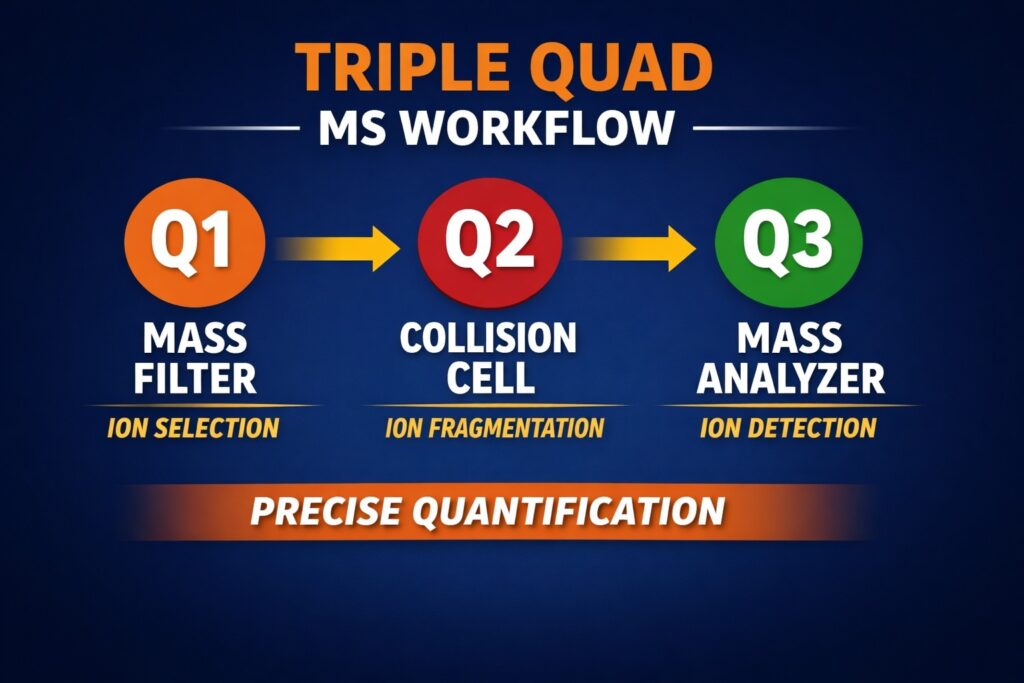
Triple Quadrupole Mass Spectrometry (Triple Quad MS) is an advanced analytical technique that provides high sensitivity and specificity for the quantification of target compounds. The triple quadrupole system consists of three quadrupole stages arranged in series, each serving a specific function in the mass spectrometric analysis. Let’s delve into each stage and its role in the quantification process.
1. Operational Principles
- First Quadrupole (Q1) – Mass Filter
The first quadrupole, Q1, functions as a mass filter. It is designed to selectively transmit ions of a specific mass-to-charge ratio (m/z) from the ion source to the next stage. Here’s how it works:
- Ion Selection: Ions generated in the ion source are introduced into Q1, where they are filtered based on their m/z ratios. Only ions with the desired m/z values are allowed to pass through, while ions of other m/z ratios are excluded. This selective filtering ensures that only the target analytes proceed to the next stage.
- Applications: Q1’s role is crucial for isolating the target compounds from a complex mixture. For instance, in drug quantification, Q1 isolates the drug ions from other endogenous substances present in biological samples.
- Collision Cell (Q2) – Collision Induced Dissociation (CID)
The collision cell, Q2, is responsible for fragmenting the ions selected by Q1. This process is known as Collision Induced Dissociation (CID) and involves the following:
- Fragmentation: Ions entering Q2 collide with an inert gas (e.g., nitrogen or argon) in the collision cell. These collisions cause the ions to fragment into smaller pieces, known as product ions. The fragmentation patterns provide detailed information about the molecular structure of the target analyte.
- Applications: CID allows for the identification of compound structures and the generation of unique product ion spectra. This is particularly useful for distinguishing between closely related compounds and confirming the identity of the target analyte.
- Third Quadrupole (Q3) – Mass Analyzer
The third quadrupole, Q3, acts as a second mass analyzer. It selects and quantifies specific product ions generated in Q2:
- Ion Selection and Quantification: Q3 filters the product ions based on their m/z ratios and allows only the ions of interest to pass through to the detector. The intensity of these ions is proportional to the concentration of the target analyte in the sample.
- Applications: By using Multiple Reaction Monitoring (MRM) mode, Q3 enables precise quantification of target compounds. For example, in pharmaceutical analysis, Q3 quantifies drug levels and metabolites with high accuracy.
2. Advantages of Triple Quadrupole Mass Spectrometry
Triple Quadrupole MS offers several advantages that make it a preferred technique for quantification:
- High Sensitivity and Specificity
- Sensitivity: Triple Quad MS can detect and quantify analytes at very low concentrations, making it suitable for trace analysis. The high sensitivity is achieved through selective ion filtering and efficient fragmentation, allowing detection of even minute quantities of compounds.
- Specificity: The technique provides high specificity by isolating target ions at each stage and reducing interference from other compounds. This specificity is crucial for accurate quantification in complex samples, such as biological fluids or environmental matrices.
- Quantitative Accuracy
- Precision: Triple Quad MS ensures precise quantification by using MRM mode, which allows for the measurement of specific ion transitions associated with the target analyte. This precision is essential for generating reliable data and making informed decisions in research and development.
- Accuracy: The technique provides accurate quantification by using internal standards and calibration curves. Internal standards help correct for potential variations in sample preparation and analysis, while calibration curves allow for accurate determination of analyte concentrations.
- Versatility
- Wide Range of Analytes: Triple Quad MS can analyze a broad spectrum of compounds, including small molecules, peptides, proteins, and environmental contaminants. Its versatility makes it applicable to various fields, including pharmaceuticals, environmental analysis, clinical diagnostics, and food safety.
- Complex Samples: The technique is capable of analyzing complex samples with high matrix interference. By employing advanced data processing and peak integration methods, Triple Quad MS can accurately quantify analytes even in challenging matrices.
Limitations and Challenges
Despite its numerous advantages, Triple Quadrupole Mass Spectrometry is not without limitations. One of the primary challenges is the requirement for prior knowledge of the target analytes. Since the technique relies heavily on predefined ion transitions in Multiple Reaction Monitoring (MRM) mode, it is less suitable for unknown compound identification compared to high-resolution mass spectrometry systems.
Additionally, matrix effects can pose significant challenges, especially when analyzing complex biological or environmental samples. Co-eluting compounds may suppress or enhance ionization, leading to inaccuracies in quantification. Careful method development, sample preparation, and the use of internal standards are essential strategies to mitigate these challenges and ensure reliable results.
3. Ionization Techniques in Triple Quad MS
Ionization plays a critical role in determining the efficiency and sensitivity of Triple Quadrupole Mass Spectrometry. Different ionization methods are employed depending on the nature of the analyte and the sample matrix. Common techniques include Electrospray Ionization (ESI) and Atmospheric Pressure Chemical Ionization (APCI), both of which allow for soft ionization, preserving the molecular integrity of analytes. These methods ensure that analytes are transferred into the gas phase with minimal fragmentation prior to entering the mass analyzer.
The selection of an appropriate ionization technique significantly impacts the overall analytical performance. For instance, ESI is particularly suitable for polar and high molecular weight compounds such as peptides and proteins, whereas APCI is often preferred for less polar, thermally stable compounds. Optimizing ionization conditions enhances signal intensity, reduces background noise, and ultimately improves quantification accuracy.
Applications of Triple Quadrupole Mass Spectrometry
Forensic Science Applications
Triple Quadrupole Mass Spectrometry has become an indispensable tool in forensic science due to its high sensitivity and specificity. It is widely used for the detection and quantification of drugs, toxins, and chemical residues in biological samples such as blood, urine, and hair. Its ability to detect trace-level substances makes it particularly valuable in criminal investigations and toxicological studies.
In forensic toxicology, the technique aids in identifying substances involved in poisoning cases, drug overdoses, and substance abuse. The use of MRM mode ensures accurate confirmation of compounds, reducing the likelihood of false positives. This level of precision supports legal proceedings by providing scientifically robust and defensible analytical results.
Triple Quadrupole MS is used in various fields due to its ability to provide detailed quantitative information about target compounds. Here are some key applications:
1. Pharmaceutical Analysis
- Drug Quantification
- Pharmacokinetics: Triple Quad MS is employed to measure drug concentrations in biological fluids (e.g., blood, plasma, urine) to understand drug absorption, distribution, metabolism, and excretion. Accurate quantification supports pharmacokinetic studies, which are essential for optimizing dosing regimens and evaluating drug efficacy.
- Therapeutic Drug Monitoring: The technique helps monitor drug levels in patients to ensure they remain within the therapeutic range. This is important for adjusting dosages and avoiding potential side effects or toxicity.
- Metabolite Identification
- Metabolic Profiling: Triple Quad MS is used to identify and quantify drug metabolites, providing insights into the drug’s metabolic pathways. This information helps in assessing drug interactions, metabolism, and potential side effects.
- Biomarker Discovery: The technique aids in discovering biomarkers related to drug response or disease states, supporting drug development and personalized medicine approaches.
2. Environmental Analysis
- Contaminant Detection
- Pesticides and Pollutants: Triple Quad MS is used to detect and quantify environmental contaminants such as pesticides, heavy metals, and industrial pollutants in soil, water, and air samples. Its high sensitivity allows for the detection of trace levels of contaminants, ensuring environmental safety.
- Regulatory Compliance: Accurate quantification of contaminants supports regulatory compliance and environmental monitoring programs. The technique helps ensure that environmental samples meet safety standards and regulatory limits.
- Water Quality Testing
- Contaminant Analysis: Triple Quad MS is employed in water quality testing to measure concentrations of contaminants and pollutants. This application is crucial for assessing the safety of drinking water and managing water resources effectively.
- Trace Analysis: The technique can detect trace amounts of contaminants, providing a comprehensive assessment of water quality and identifying potential sources of pollution.
3. Clinical Diagnostics
- Biomarker Analysis
- Disease Monitoring: Triple Quad MS is used to quantify biomarkers associated with diseases, aiding in diagnosis and monitoring disease progression. For example, measuring specific protein or metabolite levels can provide insights into cancer or cardiovascular conditions.
- Personalized Medicine: The technique supports personalized medicine by identifying biomarkers that predict patient responses to treatments. This information allows for tailored therapeutic approaches and improved patient outcomes.
- Drug Testing
- Substance Abuse Testing: Triple Quad MS is employed to test for drugs and their metabolites in biological samples, such as urine or blood. This application is crucial for detecting drug abuse, monitoring treatment adherence, and ensuring patient safety.
- Clinical Trials: The technique supports clinical trials by providing accurate measurements of drug levels and metabolites, contributing to the evaluation of drug safety and efficacy.
4. Food and Beverage Industry
- Nutrient Analysis
- Nutritional Labeling: Triple Quad MS is used to quantify nutrients, vitamins, and additives in food and beverage products. Accurate quantification supports nutritional labeling and ensures compliance with regulatory requirements.
- Quality Control: The technique helps maintain product quality by analyzing nutrient content and verifying ingredient formulations.
- Contaminant Testing
- Pesticides and Toxins: Triple Quad MS is employed to detect contaminants such as pesticides, allergens, and toxins in food products. This application ensures consumer safety and helps meet regulatory standards for food safety.
- Food Safety Monitoring: The technique supports food safety monitoring programs by providing detailed information about potential contaminants and ensuring that food products are free from harmful substances.
5. Advances in Automation and High-Throughput Analysis
Recent advancements in automation have significantly enhanced the efficiency of Triple Quadrupole Mass Spectrometry workflows. Automated sample preparation systems, coupled with high-throughput data acquisition, allow laboratories to process a large number of samples in a shorter time frame. This is particularly beneficial in industries such as pharmaceuticals and clinical diagnostics, where time-sensitive analyses are crucial.
High-throughput capabilities also improve reproducibility by minimizing human error during sample handling and preparation. Integration with advanced software enables real-time data processing, automated calibration, and quality control checks. These innovations not only increase productivity but also ensure consistent and reliable analytical performance across large datasets.
6. Role of Data Analysis and Software Integration
Data analysis is a vital component of Triple Quadrupole Mass Spectrometry, as accurate quantification depends on precise interpretation of mass spectral data. Modern software platforms provide advanced tools for peak integration, calibration curve generation, and statistical validation. These tools streamline data processing and reduce the likelihood of manual errors.
Furthermore, integration with laboratory information management systems (LIMS) enhances data traceability and workflow efficiency. Automated reporting features allow for faster decision-making, particularly in regulated environments. As analytical demands continue to grow, the role of intelligent data processing systems becomes increasingly important in maximizing the potential of Triple Quad MS.
The Resolvemass Laboratories Approach
At Resolvemass Laboratories, we leverage the advanced capabilities of Triple Quadrupole Mass Spectrometry to provide comprehensive quantification services tailored to the needs of our clients. Our approach is characterized by:
1. Customized Analytical Solutions
We offer tailored solutions to address specific research and development needs:
- Method Development: Our experts design and optimize Triple Quad MS methods to meet the unique requirements of each project. This includes developing methods for different matrices, analyte types, and quantification goals.
- Matrix Adaptation: We adapt methods to handle complex matrices and address matrix effects, ensuring accurate quantification despite potential interferences.
2. State-of-the-Art Technology
Our laboratories are equipped with cutting-edge Triple Quad MS systems:
- Advanced Instrumentation: We use high-resolution Triple Quad MS instruments to achieve exceptional sensitivity and specificity. Our technology ensures reliable data and high-quality results.
- Contact Us
For more information about our Triple Quadrupole Mass Spectrometry quantification services and how we can assist with your research and development needs, please Resolvemass laboratories & contact us
Conclusion
Triple Quadrupole Mass Spectrometry remains one of the most powerful and reliable techniques for quantitative analysis across multiple scientific domains. Its ability to deliver high sensitivity, specificity, and reproducibility makes it indispensable in applications ranging from pharmaceutical development to environmental monitoring and clinical diagnostics. Continuous advancements in instrumentation, automation, and data processing further enhance its capabilities and expand its scope of use.
As analytical challenges become more complex, the importance of robust and accurate quantification techniques will continue to grow. Triple Quad MS, with its proven performance and adaptability, is well-positioned to meet these demands. By leveraging expert methodologies and state-of-the-art technologies, laboratories can unlock deeper insights and drive innovation across various industries.
Frequently Asked Questions
A triple quadrupole mass spectrometer is an analytical instrument that uses three quadrupoles arranged in sequence to detect and quantify specific compounds. The first quadrupole selects target ions, the second induces fragmentation, and the third analyzes the resulting fragments. This setup enables highly selective and sensitive measurement of compounds in complex samples.
MS/MS refers to a general concept of tandem mass spectrometry, where ions are fragmented and analyzed in multiple stages. A triple quadrupole is a specific type of MS/MS instrument designed with three quadrupoles to perform this process. In simple terms, all triple quads perform MS/MS, but not all MS/MS systems are triple quadrupoles.
A single quadrupole mass spectrometer uses only one mass filter, making it suitable for basic analysis and screening. In contrast, a triple quadrupole has three stages, allowing for ion selection, fragmentation, and re-analysis. This added capability provides much higher sensitivity and selectivity for quantitative applications.
Triple quadrupole instruments utilize techniques such as Multiple Reaction Monitoring (MRM), Selected Reaction Monitoring (SRM), and product ion scanning. These approaches focus on monitoring specific ion transitions or fragmentation patterns. Such targeted techniques enhance detection accuracy and are widely used for quantitative and confirmatory analysis.
Triple quadrupole mass spectrometry offers excellent sensitivity, allowing detection of very low concentrations of analytes. It also provides high specificity by filtering ions at multiple stages, reducing interference. Additionally, it delivers reliable and reproducible quantitative results, making it ideal for regulated and research environments.
Triple quadrupole instruments operate in several modes, including MRM, product ion scan, precursor ion scan, and neutral loss scan. Each mode serves a different purpose, such as quantification, structural analysis, or compound screening. These flexible modes make the instrument adaptable to a wide range of analytical needs.
Reference:
- Tsakalof, A., Sysoev, A. A., Vyatkina, K. V., Eganov, A. A., Eroshchenko, N. N., Kiryushin, A. N., Adamov, A. Y., Danilova, E. Y., & Nosyrev, A. E. (2024). Current role and potential of triple quadrupole mass spectrometry in biomedical research and clinical applications. Molecules, 29(23), 5808. https://doi.org/10.3390/molecules29235808
- Yost, R. A., & Enke, C. G. (1979). Triple quadrupole mass spectrometry. Analytical Chemistry, 51(12), 1251A–1264A. https://doi.org/10.1021/ac50048a792
- Yost, R. A. (2022). The triple quadrupole: Innovation, serendipity and persistence. Journal of Mass Spectrometry and Advances in the Clinical Lab, 24, 90–99. https://doi.org/10.1016/j.jmsacl.2022.05.001