Introduction
In analytical chemistry, the precision of quantification methods is paramount for accurate data interpretation and decision-making. Triple Quadrupole Mass Spectrometry (Triple Quad MS) stands out as a premier technique for achieving exceptional quantification accuracy. At Resolvemass Laboratories, our expertise in Triple Quad MS enables us to offer unparalleled quantification services across various fields, including pharmaceuticals, environmental analysis, and clinical diagnostics. This blog provides an in-depth look at the principles, applications, and advantages of Triple Quad MS in quantification.
Summary
- Triple Quadrupole Mass Spectrometry (Triple Quad MS) delivers highly sensitive, selective, and accurate quantification for complex analytical samples.
- The article explains the working principles of Q1, Q2, and Q3, highlighting how controlled ion selection and fragmentation enable precise measurements.
- Critical factors such as ionization techniques, collision energy optimization, and internal standards are discussed for improving quantitative reliability.
- Key advantages include low detection limits, strong specificity, excellent reproducibility, and broad regulatory acceptance.
- Applications across pharmaceuticals, environmental analysis, clinical diagnostics, and food safety demonstrate the versatility of Triple Quad MS.
- The Resolvemass Laboratories approach emphasizes customized methods, advanced instrumentation, and compliant, high-quality quantitative results.
🎥 Watch: Triple Quadrupole Mass Spectrometry Quantification Workflow Explained
1: What is Triple Quad Mass Spectrometry?
Triple Quad Mass Spectrometry is a tandem mass spectrometry technique using three quadrupoles to selectively filter, fragment, and detect analytes for precise quantification.
It consists of:
| Component | Function |
|---|---|
| Q1 | Selects precursor ion |
| Q2 | Collision cell (CID fragmentation) |
| Q3 | Selects product ion for detection |
The technique primarily operates in MRM (Multiple Reaction Monitoring) mode, which provides:
- Ultra-high selectivity
- Low noise
- Exceptional sensitivity
- Reproducible quantification
Because of these features, Triple Quad Mass Spectrometry remains superior for targeted quantitation compared to high-resolution MS platforms.
2: Why is Triple Quad Mass Spectrometry Ideal for Quantification Workflows?
Triple Quad Mass Spectrometry is ideal for quantification because it combines high selectivity with unmatched sensitivity in complex matrices.
Key Advantages:
- ✔ Picogram to femtogram detection limits
- ✔ Minimal matrix interference via MRM transitions
- ✔ Wide linear dynamic range (4–5 orders of magnitude)
- ✔ Regulatory acceptance globally
- ✔ Excellent reproducibility across batches
In regulated studies such as pharmacokinetics or impurity quantification, reproducibility and robustness are critical — and this is where Triple Quad Mass Spectrometry excels.
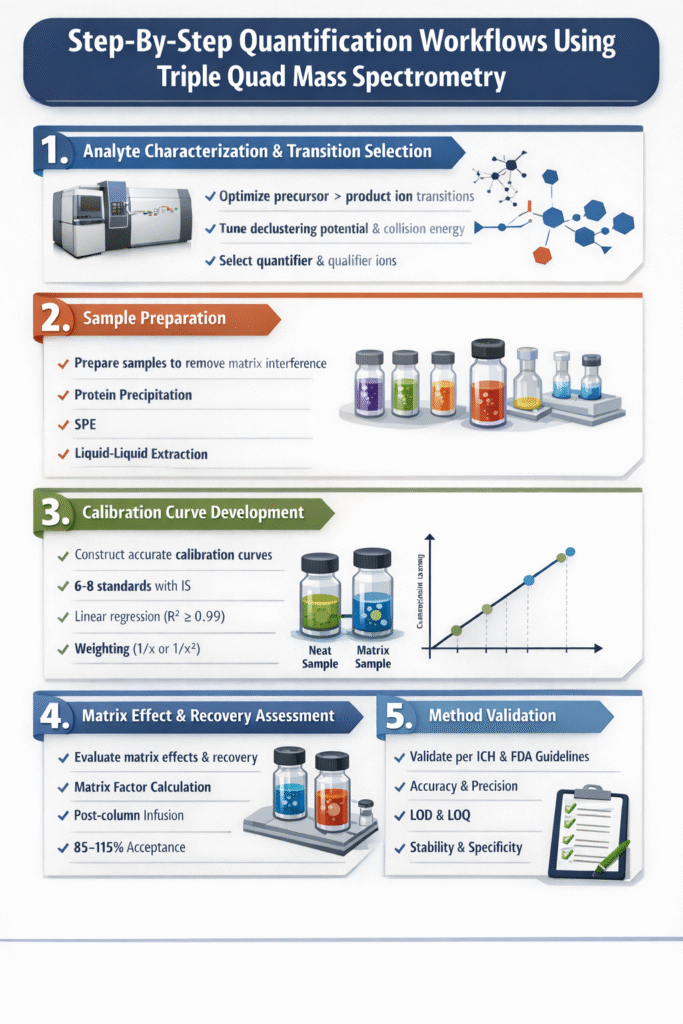
3: Step-by-Step Quantification Workflows Using Triple Quad Mass Spectrometry
Below is the complete industrial workflow followed at advanced analytical laboratories like ResolveMass.
3.1 Analyte Characterization & Transition Selection in Triple Quad Mass Spectrometry
The first step is selecting optimal precursor-to-product ion transitions (MRM transitions).
This involves:
- Direct infusion of analyte
- Optimization of:
- Declustering potential
- Collision energy
- Fragmentation pattern
- Selection of:
- Quantifier ion
- Qualifier ion
Best Practices:
- Choose most abundant and specific fragment
- Avoid interference-prone fragments
- Optimize dwell time for sensitivity
At this stage, Triple Quad Mass Spectrometry ensures only the analyte of interest is monitored, dramatically reducing background noise.
3.2 Sample Preparation in Triple Quad Mass Spectrometry Workflows
Sample preparation ensures removal of matrix interference before analysis.
Common preparation strategies:
| Matrix Type | Preparation Method |
|---|---|
| Plasma | Protein precipitation, SPE |
| Tablets | Dilution & filtration |
| Peptides | Solid phase extraction |
| Environmental | Liquid-liquid extraction |
Improper sample preparation leads to:
- Ion suppression
- Poor recovery
- Inaccurate quantification
ResolveMass applies validated extraction recovery and matrix effect evaluation protocols to ensure reliable Triple Quad Mass Spectrometry results.
3.3 Calibration Curve Development in Triple Quad Mass Spectrometry
Accurate quantification requires properly designed calibration curves.
Key elements:
- Minimum 6–8 concentration levels
- Use of isotopically labeled internal standards
- Weighting factor (1/x or 1/x²)
- Evaluation of linearity (R² ≥ 0.99 typically)
Example Calibration Table:
| Level | Concentration (ng/mL) | Response Ratio |
|---|---|---|
| LLOQ | 1 | 0.012 |
| Mid | 50 | 0.601 |
| ULOQ | 1000 | 12.45 |
Triple Quad Mass Spectrometry provides consistent response across a wide dynamic range, ensuring reliable quantification even at trace levels.
3.4 Matrix Effect & Recovery Assessment in Triple Quad Mass Spectrometry
Matrix effects can suppress or enhance ionization, impacting quantification accuracy.
Evaluation includes:
- Post-column infusion studies
- Matrix factor calculation
- Comparison of neat vs extracted samples
Matrix Factor Calculation:
Matrix Factor = Response in matrix / Response in neat solution
Acceptance criteria typically fall within 85–115%.
Triple Quad Mass Spectrometry, when properly optimized, minimizes these matrix-related variabilities.
3.5 Method Validation for Triple Quad Mass Spectrometry Quantification
Method validation ensures compliance with ICH, FDA, and EMA regulatory standards.
Parameters evaluated:
- Accuracy
- Precision
- Specificity
- LOD & LOQ
- Linearity
- Stability
- Carryover
Typical Acceptance Criteria:
| Parameter | Acceptance |
|---|---|
| Accuracy | ±15% (±20% at LLOQ) |
| Precision | CV ≤ 15% |
| Selectivity | No significant interference |
At ResolveMass Laboratories Inc., validation workflows using Triple Quad Mass Spectrometry follow globally accepted regulatory frameworks to ensure submission-ready data.
4: Understanding Triple Quadrupole Mass Spectrometry
Triple Quadrupole Mass Spectrometry (Triple Quad MS) is an advanced analytical technique that provides high sensitivity and specificity for the quantification of target compounds. The triple quadrupole system consists of three quadrupole stages arranged in series, each serving a specific function in the mass spectrometric analysis. Let’s delve into each stage and its role in the quantification process.
Role of Ionization Techniques in Triple Quad Quantification
Ionization efficiency is a critical factor that directly impacts quantitative performance in Triple Quadrupole Mass Spectrometry. Techniques such as Electrospray Ionization (ESI) and Atmospheric Pressure Chemical Ionization (APCI) are commonly employed depending on analyte polarity, molecular weight, and matrix complexity. Selecting the appropriate ionization method ensures efficient conversion of analytes into gas-phase ions while maintaining structural integrity, which is essential for reproducible signal intensity.
Careful optimization of ionization parameters—including spray voltage, nebulizing gas flow, and source temperature—helps reduce ion suppression and signal variability. In matrices such as biological fluids or environmental extracts, ionization conditions must be tailored to minimize interference from co-eluting compounds. Optimized ionization improves sensitivity, enhances linearity, and supports robust quantitative workflows across different sample types.
1. Operational Principles
- First Quadrupole (Q1) – Mass Filter
The first quadrupole, Q1, functions as a mass filter. It is designed to selectively transmit ions of a specific mass-to-charge ratio (m/z) from the ion source to the next stage. Here’s how it works:
- Ion Selection: Ions generated in the ion source are introduced into Q1, where they are filtered based on their m/z ratios. Only ions with the desired m/z values are allowed to pass through, while ions of other m/z ratios are excluded. This selective filtering ensures that only the target analytes proceed to the next stage.
- Applications: Q1’s role is crucial for isolating the target compounds from a complex mixture. For instance, in drug quantification, Q1 isolates the drug ions from other endogenous substances present in biological samples.
- Collision Cell (Q2) – Collision Induced Dissociation (CID)
The collision cell, Q2, is responsible for fragmenting the ions selected by Q1. This process is known as Collision Induced Dissociation (CID) and involves the following:
- Fragmentation: Ions entering Q2 collide with an inert gas (e.g., nitrogen or argon) in the collision cell. These collisions cause the ions to fragment into smaller pieces, known as product ions. The fragmentation patterns provide detailed information about the molecular structure of the target analyte.
- Applications: CID allows for the identification of compound structures and the generation of unique product ion spectra. This is particularly useful for distinguishing between closely related compounds and confirming the identity of the target analyte.
Optimization of Collision Energy for Reliable Quantification
Collision energy optimization is a key step in generating reproducible and structurally informative product ions during Collision Induced Dissociation. Insufficient collision energy may result in weak fragmentation, while excessive energy can cause over-fragmentation and loss of quantitative signal. Selecting the optimal collision energy ensures consistent production of diagnostic product ions for accurate Multiple Reaction Monitoring (MRM).
Fine-tuning collision energy also enhances selectivity by improving the signal-to-noise ratio of monitored transitions. This optimization is especially important when quantifying structurally similar compounds or trace-level analytes in complex matrices. Well-optimized CID conditions contribute to higher method robustness and long-term analytical stability.
- Third Quadrupole (Q3) – Mass Analyzer
The third quadrupole, Q3, acts as a second mass analyzer. It selects and quantifies specific product ions generated in Q2:
- Ion Selection and Quantification: Q3 filters the product ions based on their m/z ratios and allows only the ions of interest to pass through to the detector. The intensity of these ions is proportional to the concentration of the target analyte in the sample.
- Applications: By using Multiple Reaction Monitoring (MRM) mode, Q3 enables precise quantification of target compounds. For example, in pharmaceutical analysis, Q3 quantifies drug levels and metabolites with high accuracy.
2. Advantages of Triple Quadrupole Mass Spectrometry
Triple Quadrupole MS offers several advantages that make it a preferred technique for quantification:
- High Sensitivity and Specificity
- Sensitivity: Triple Quad MS can detect and quantify analytes at very low concentrations, making it suitable for trace analysis. The high sensitivity is achieved through selective ion filtering and efficient fragmentation, allowing detection of even minute quantities of compounds.
- Specificity: The technique provides high specificity by isolating target ions at each stage and reducing interference from other compounds. This specificity is crucial for accurate quantification in complex samples, such as biological fluids or environmental matrices.
- Quantitative Accuracy
- Precision: Triple Quad MS ensures precise quantification by using MRM mode, which allows for the measurement of specific ion transitions associated with the target analyte. This precision is essential for generating reliable data and making informed decisions in research and development.
- Accuracy: The technique provides accurate quantification by using internal standards and calibration curves. Internal standards help correct for potential variations in sample preparation and analysis, while calibration curves allow for accurate determination of analyte concentrations.
Importance of Internal Standards in Quantitative Accuracy
Internal standards are fundamental to achieving reliable and reproducible quantification in Triple Quadrupole MS. These compounds, often isotopically labeled versions of the target analytes, behave similarly during ionization and fragmentation. Their inclusion allows analysts to correct for variations arising from sample preparation, extraction efficiency, and instrumental fluctuations.
By normalizing analyte response to that of an internal standard, laboratories can significantly improve precision and accuracy. This approach is especially critical in regulated environments such as pharmaceutical development and clinical diagnostics, where consistency and traceability are essential. The strategic use of internal standards strengthens method validation and enhances confidence in quantitative results.
- Versatility
- Wide Range of Analytes: Triple Quad MS can analyze a broad spectrum of compounds, including small molecules, peptides, proteins, and environmental contaminants. Its versatility makes it applicable to various fields, including pharmaceuticals, environmental analysis, clinical diagnostics, and food safety.
- Complex Samples: The technique is capable of analyzing complex samples with high matrix interference. By employing advanced data processing and peak integration methods, Triple Quad MS can accurately quantify analytes even in challenging matrices.
5: Applications of Triple Quadrupole Mass Spectrometry
Triple Quadrupole MS is used in various fields due to its ability to provide detailed quantitative information about target compounds.
Regulatory Acceptance and Compliance Considerations
Triple Quadrupole Mass Spectrometry is widely accepted by regulatory agencies due to its robustness, reproducibility, and quantitative reliability. Regulatory guidelines often recommend Triple Quad MS for bioanalytical studies, impurity profiling, and residue analysis because of its ability to deliver precise and traceable results. Proper documentation of method development and validation is essential to meet compliance expectations.
Validated Triple Quad methods typically include assessments of accuracy, precision, linearity, sensitivity, and stability. Maintaining compliance also requires routine system suitability testing and adherence to Good Laboratory Practice (GLP) or Good Manufacturing Practice (GMP) standards. These regulatory considerations make Triple Quad MS a trusted platform for high-stakes analytical applications.
Here are some key applications:
1. Pharmaceutical Analysis
- Drug Quantification
- Pharmacokinetics: Triple Quad MS is employed to measure drug concentrations in biological fluids (e.g., blood, plasma, urine) to understand drug absorption, distribution, metabolism, and excretion. Accurate quantification supports pharmacokinetic studies, which are essential for optimizing dosing regimens and evaluating drug efficacy.
- Therapeutic Drug Monitoring: The technique helps monitor drug levels in patients to ensure they remain within the therapeutic range. This is important for adjusting dosages and avoiding potential side effects or toxicity.
- Metabolite Identification
- Metabolic Profiling: Triple Quad MS is used to identify and quantify drug metabolites, providing insights into the drug’s metabolic pathways. This information helps in assessing drug interactions, metabolism, and potential side effects.
- Biomarker Discovery: The technique aids in discovering biomarkers related to drug response or disease states, supporting drug development and personalized medicine approaches.
2. Environmental Analysis
- Contaminant Detection
- Pesticides and Pollutants: Triple Quad MS is used to detect and quantify environmental contaminants such as pesticides, heavy metals, and industrial pollutants in soil, water, and air samples. Its high sensitivity allows for the detection of trace levels of contaminants, ensuring environmental safety.
- Regulatory Compliance: Accurate quantification of contaminants supports regulatory compliance and environmental monitoring programs. The technique helps ensure that environmental samples meet safety standards and regulatory limits.
- Water Quality Testing
- Contaminant Analysis: Triple Quad MS is employed in water quality testing to measure concentrations of contaminants and pollutants. This application is crucial for assessing the safety of drinking water and managing water resources effectively.
- Trace Analysis: The technique can detect trace amounts of contaminants, providing a comprehensive assessment of water quality and identifying potential sources of pollution.
3. Clinical Diagnostics
- Biomarker Analysis
- Disease Monitoring: Triple Quad MS is used to quantify biomarkers associated with diseases, aiding in diagnosis and monitoring disease progression. For example, measuring specific protein or metabolite levels can provide insights into cancer or cardiovascular conditions.
- Personalized Medicine: The technique supports personalized medicine by identifying biomarkers that predict patient responses to treatments. This information allows for tailored therapeutic approaches and improved patient outcomes.
- Drug Testing
- Substance Abuse Testing: Triple Quad MS is employed to test for drugs and their metabolites in biological samples, such as urine or blood. This application is crucial for detecting drug abuse, monitoring treatment adherence, and ensuring patient safety.
- Clinical Trials: The technique supports clinical trials by providing accurate measurements of drug levels and metabolites, contributing to the evaluation of drug safety and efficacy.
High-Throughput Quantification and Workflow Efficiency
Triple Quadrupole MS is particularly well-suited for high-throughput environments where large sample volumes must be analyzed with consistent accuracy. Automated sample handling, rapid chromatographic separations, and fast scanning capabilities enable laboratories to process hundreds of samples per day without compromising data quality. This efficiency is critical in clinical testing and large-scale monitoring programs.
High-throughput workflows also reduce operational costs by minimizing reanalysis and downtime. When combined with robust data processing software, Triple Quad MS allows rapid data review, automated quantitation, and streamlined reporting. These efficiencies make the technique ideal for laboratories seeking scalability without sacrificing analytical rigor.
4. Food and Beverage Industry
- Nutrient Analysis
- Nutritional Labeling: Triple Quad MS is used to quantify nutrients, vitamins, and additives in food and beverage products. Accurate quantification supports nutritional labeling and ensures compliance with regulatory requirements.
- Quality Control: The technique helps maintain product quality by analyzing nutrient content and verifying ingredient formulations.
- Contaminant Testing
- Pesticides and Toxins: Triple Quad MS is employed to detect contaminants such as pesticides, allergens, and toxins in food products. This application ensures consumer safety and helps meet regulatory standards for food safety.
- Food Safety Monitoring: The technique supports food safety monitoring programs by providing detailed information about potential contaminants and ensuring that food products are free from harmful substances.
6: Triple Quad Mass Spectrometry vs High-Resolution MS for Quantification
| Comparison Parameter | Triple Quad Mass Spectrometry | High-Resolution Mass Spectrometry (HRMS) |
|---|---|---|
| Core Principle | Uses three quadrupoles (Q1–Q2–Q3) operating in MRM mode for selective precursor → product ion monitoring | Uses Orbitrap or TOF analyzers for accurate mass full-scan detection |
| Primary Mode of Operation | Targeted Multiple Reaction Monitoring (MRM) | Full scan with high mass accuracy (can perform PRM or targeted modes) |
| Sensitivity (LLOQ) | Extremely high; typically pg/mL range for small molecules | High but often slightly lower than Triple Quad in routine targeted assays |
| Signal-to-Noise Ratio | Very high due to dual mass filtering (Q1 and Q3) | Moderate to high; more background noise in full-scan mode |
| Selectivity | Very high; monitors specific precursor–product transitions | High; relies on accurate mass and resolving power |
| Matrix Tolerance | Excellent; MRM minimizes interference in complex matrices | Good; but full scan may capture co-eluting interferences |
| Quantitative Reproducibility | Excellent; highly stable across long batches | Good; may show slightly higher variability compared to MRM |
| Dynamic Range | Wide (4–5 orders of magnitude commonly) | Wide but sometimes narrower under high-load conditions |
| Targeted Assays | Ideal platform; gold standard for validated quantitative assays | Acceptable; increasingly used but not traditional gold standard |
| Untargeted Analysis | Limited capability | Excellent; ideal for non-target screening and discovery |
| Unknown Identification | Not suitable for structural elucidation of unknowns | Highly suitable due to exact mass and fragmentation libraries |
| Regulatory Acceptance (Quantitative Workflows) | Long-established benchmark for FDA/ICH bioanalytical validation | Growing acceptance; often used for confirmation and impurity profiling |
| Data Processing Complexity | Moderate; streamlined targeted data analysis | High; large datasets require advanced software processing |
| Throughput | High; optimized for routine high-volume testing | Moderate to high; depends on data acquisition strategy |
| Best Applications | PK studies, impurity quantification, peptide quantification, nitrosamine testing, therapeutic drug monitoring | Metabolomics, impurity identification, structural confirmation, non-target screening |
| Instrument Robustness for Routine Labs | Highly robust and optimized for routine QC and regulated labs | Advanced systems requiring skilled operation and maintenance |
| Cost Consideration (Operational) | Generally cost-effective for targeted assays | Higher cost for acquisition and maintenance |
7: The Resolvemass Laboratories Approach
At Resolvemass Laboratories, we leverage the advanced capabilities of Triple Quadrupole Mass Spectrometry to provide comprehensive quantification services tailored to the needs of our clients. Our approach is characterized by:
1. Customized Analytical Solutions
We offer tailored solutions to address specific research and development needs:
- Method Development: Our experts design and optimize Triple Quad MS methods to meet the unique requirements of each project. This includes developing methods for different matrices, analyte types, and quantification goals.
- Matrix Adaptation: We adapt methods to handle complex matrices and address matrix effects, ensuring accurate quantification despite potential interferences.
2. State-of-the-Art Technology
Our laboratories are equipped with cutting-edge Triple Quad MS systems:
- Advanced Instrumentation: We use high-resolution Triple Quad MS instruments to achieve exceptional sensitivity and specificity. Our technology ensures reliable data and high-quality results.
Conclusion:
Triple Quad Mass Spectrometry remains the gold standard for sensitive, selective, and reproducible quantification workflows in regulated analytical science. From transition optimization to validation, a well-designed workflow ensures accurate, defensible data suitable for global regulatory submissions.
At ResolveMass Laboratories Inc., we combine scientific rigor, regulatory expertise, and advanced instrumentation to deliver high-quality quantification solutions using Triple Quad Mass Spectrometry.
If your project requires precision, compliance, and reliability — our team is ready to support you.
Frequently Asked Questions
Triple quadrupole mass spectrometry is an analytical technique that uses three quadrupoles arranged in series to selectively detect and quantify specific compounds. It is widely used for targeted analysis because it offers high sensitivity and strong selectivity. The system is especially effective for trace-level quantification in complex sample matrices.
Triple quad MS operates by filtering a target ion in the first quadrupole, fragmenting it in the second quadrupole using controlled collisions, and analyzing specific product ions in the third quadrupole. This stepwise process isolates the analyte from background noise. The resulting signal intensity is directly related to analyte concentration.
A single quadrupole mass spectrometer separates ions based only on their mass-to-charge ratio, which limits selectivity in complex samples. In contrast, a triple quadrupole system adds fragmentation and secondary filtering, greatly improving specificity. This makes triple quad MS more suitable for accurate quantitative analysis.
Triple quad MS can operate in several scan modes, including multiple reaction monitoring (MRM), product ion scan, precursor ion scan, and neutral loss scan. Each mode serves a different analytical purpose. MRM is most commonly used for precise and sensitive quantification.
The principle of triple quadrupole mass spectrometry is based on selective ion filtering, controlled fragmentation, and targeted ion detection. By monitoring specific ion transitions, the system minimizes interference from unrelated compounds. This approach ensures high accuracy and reproducibility in quantitative measurements.
Time-of-flight mass spectrometry offers high mass accuracy and rapid data acquisition across a wide mass range. It is well suited for untargeted analysis and compound identification. TOF MS also enables the detection of unknowns due to its full-spectrum data collection.
Triple quadrupole mass spectrometry provides exceptional sensitivity and selectivity for targeted compounds. It delivers highly reproducible quantitative results even in complex matrices. The technique is also widely accepted for regulated applications due to its robustness and precision.
Reference
- Yost, R. A. (2022). The triple quadrupole: Innovation, serendipity and persistence. Journal of Mass Spectrometry and Advances in the Clinical Lab, 24, 90–99. https://www.ncbi.nlm.nih.gov/pmc/articles/PMC9115313/
- 2. Reference for the MDPI article:
Tsakalof, A., Sysoev, A. A., Vyatkina, K. V., Eganov, A. A., Eroshchenko, N. N., Kiryushin, A. N., Adamov, A. Y., Danilova, E. Y., & Nosyrev, A. E. (2024). Current role and potential of triple quadrupole mass spectrometry in biomedical research and clinical applications. Molecules, 29(23), 5808. https://doi.org/10.3390/molecules29235808 - Creative Proteomics. (n.d.). Triple quadrupole mass spectrometry: Principles & applications. Creative Proteomics. https://www.creative-proteomics.com/technology/triple-quadrupole-mass-spectrometry.htm
- Yost, R. A., & Enke, C. G. (1979). Triple quadrupole mass spectrometry. Analytical Chemistry, 51(12), 1251A–1264A. https://doi.org/10.1021/ac50048a792