

Introduction:
In today’s competitive pharmaceutical landscape, companies increasingly Outsource peptide Manufacturing to CDMO partners to accelerate drug development and ensure high-quality production. Peptides are complex molecules requiring specialized synthesis, purification, and analytical capabilities—making outsourcing a strategic necessity rather than just an option.
With growing demand for advanced services such as peptide CDMO services and peptide drug development CDMO, outsourcing has become a key growth driver in the pharmaceutical industry.
Share via:
Summary:
- Pharmaceutical companies outsource peptide manufacturing to CDMOs to reduce cost, time, and operational complexity
- CDMOs provide specialized expertise, advanced infrastructure, and regulatory compliance support
- Outsourcing enables faster drug development and scalability from clinical to commercial stages
- It minimizes risks related to quality control, supply chain, and regulatory approvals
- Strategic outsourcing allows companies to focus on core competencies like R&D and commercialization
1: What Does It Mean to Outsource Peptide Manufacturing to CDMO?
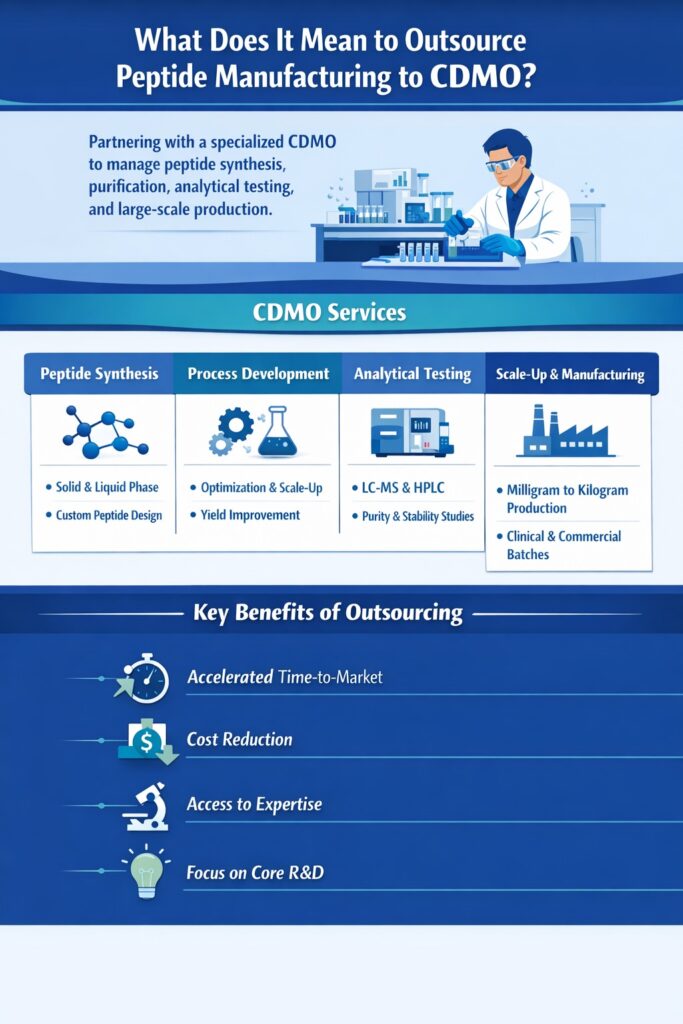
Outsource peptide Manufacturing to CDMO means collaborating with a specialized partner that manages the complete lifecycle of peptide production—from development to large-scale manufacturing—ensuring quality, efficiency, and regulatory compliance.
When pharmaceutical or biotech companies Outsource peptide Manufacturing to CDMO, they leverage external expertise and infrastructure instead of building and maintaining in-house capabilities.
Companies leverage services like:
- Peptide testing service
- Peptide analytical characterization services
- Peptide characterization in drug development
What Services Do CDMOs Provide?
CDMOs (Contract Development and Manufacturing Organizations) offer end-to-end peptide manufacturing solutions, including:
1. Peptide Synthesis
- Solid-phase peptide synthesis (SPPS)
- Liquid-phase peptide synthesis
- Custom peptide design and modification
2. Process Development and Optimization
- Route scouting and feasibility studies
- Process scale-up strategies
- Yield and purity optimization
3. Analytical Characterization
Supported by experts in mass spectrometry in drug development and robust bioanalytical strategy in drug development
- LC-MS (Liquid Chromatography–Mass Spectrometry)
- HPLC (High-Performance Liquid Chromatography)
- Impurity profiling and stability studies
Regulatory Support
Including regulatory support for generic drugs US and Canada CDMO
4. Scale-Up and Manufacturing
- Production from milligram to kilogram scale
- Clinical and commercial batch manufacturing
- Technology transfer and process validation
5. Regulatory Support and Compliance
- GMP-compliant manufacturing
- Documentation for FDA and EMA submissions
- Quality assurance and control systems
Why It Matters
Choosing to Outsource peptide Manufacturing to CDMO enables companies to:
- Accelerate drug development timelines
- Ensure high-quality and compliant production
- Reduce infrastructure and operational costs
- Focus on core research and innovation
This strategic approach is especially critical for complex peptide therapeutics, where precision, expertise, and regulatory alignment are essential.
2: Why Do Pharmaceutical Companies Outsource Peptide Manufacturing to CDMOs?
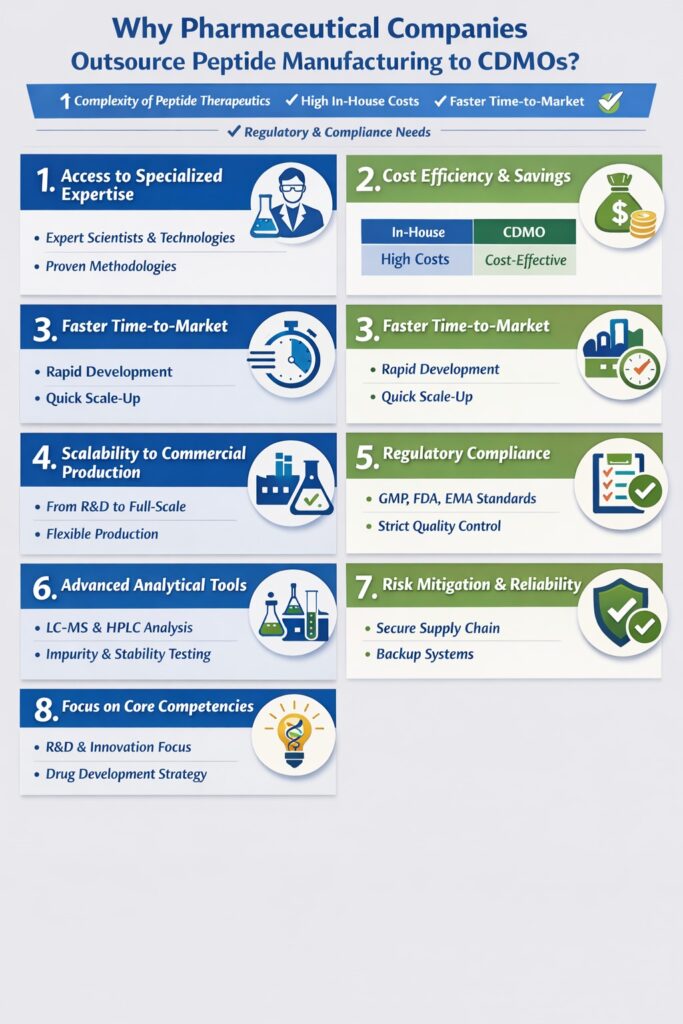
Pharmaceutical companies outsource peptide manufacturing to CDMOs primarily to access expertise, reduce costs, and accelerate timelines.
Key Drivers:
- Increasing complexity of peptide therapeutics
- High capital investment required for in-house facilities
- Need for faster time-to-market
- Regulatory challenges and compliance requirements
1. Access to Specialized Expertise
Outsourcing provides immediate access to experienced scientists and advanced technologies in peptide chemistry.
Peptide manufacturing is highly technical, involving:
- Complex amino acid sequences
- Sensitive synthesis conditions
- Advanced purification techniques
Companies benefit from advanced services like:
Benefits:
- Skilled chemists and analysts
- Proven methodologies
- Reduced trial-and-error during development
2. Cost Efficiency and Resource Optimization
Outsourcing peptide manufacturing to CDMOs significantly reduces capital and operational costs.
Outsourcing eliminates the need for in-house infrastructure and aligns with services like: Outsourced chemistry in drug discovery
Setting up an in-house peptide manufacturing facility requires:
| Cost Component | In-House Setup | CDMO Outsourcing |
|---|---|---|
| Equipment Investment | Very High | None |
| Skilled Workforce | Required | Provided |
| Maintenance & Compliance | Ongoing Cost | Included |
| Scalability | Limited | Flexible |
Key Cost Advantages:
- No need for expensive infrastructure
- Reduced labor and training costs
- Pay-as-you-go model
3. Faster Time-to-Market
CDMOs accelerate drug development timelines by offering ready-to-use infrastructure and optimized processes.
CDMOs accelerate development using integrated solutions such as: CDMO accelerate generic drug development US and Canada
How it helps:
- Parallel development and manufacturing
- Faster scale-up capabilities
- Reduced delays in technology transfer
This is especially critical in:
- Clinical trials
- Competitive therapeutic markets
4. Scalability from R&D to Commercial Production
Outsourcing peptide manufacturing to CDMOs allows seamless scale-up from early research to commercial production.
Supported by providers offering:
Stages Supported:
- Preclinical development
- Clinical trial material production
- Commercial-scale manufacturing
Advantages:
- Flexible batch sizes
- Consistent product quality
- No need to switch vendors during scale-up
5. Regulatory Compliance and Quality Assurance
CDMOs ensure compliance with global regulatory standards such as GMP, FDA, and EMA.
Ensured through expertise in:
Key Compliance Areas:
- Good Manufacturing Practices (GMP)
- Documentation and validation
- Quality control and assurance
Why it matters:
- Reduces risk of regulatory rejection
- Ensures patient safety
- Builds trust with stakeholders
6. Advanced Analytical and Characterization Capabilities
CDMOs offer cutting-edge analytical tools required for peptide characterization.
Backed by:
Techniques Include:
- LC-MS (Liquid Chromatography-Mass Spectrometry)
- HPLC (High-Performance Liquid Chromatography)
- Impurity profiling
- Stability studies
These capabilities ensure:
- Accurate molecular identification
- High purity levels
- Regulatory compliance
7. Risk Mitigation and Supply Chain Reliability
Outsourcing reduces operational and supply chain risks associated with peptide manufacturing.
Supported by structured CDMO ecosystems such as: Generic pharmaceutical CDMO Canada
Risk Reduction Areas:
- Equipment failure
- Raw material sourcing
- Production delays
- Regulatory non-compliance
CDMO Advantage:
- Established supplier networks
- Backup systems and redundancy
- Quality risk management frameworks
8. Focus on Core Competencies
Outsourcing allows pharmaceutical companies to focus on innovation, R&D, and commercialization.
Companies can focus on innovation while leveraging: Outsourcing generic drug development Canada
Instead of managing manufacturing complexities, companies can:
- Invest in drug discovery
- Enhance clinical strategies
- Strengthen market positioning
3: When Should You Outsource Peptide Manufacturing to CDMO?
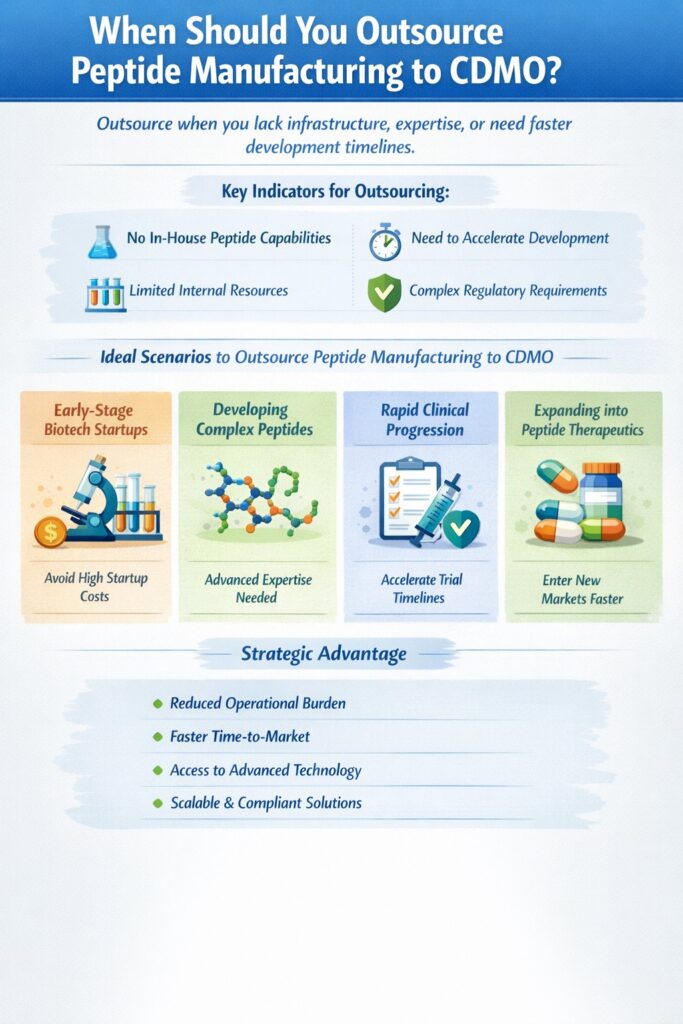
Companies should Outsource peptide Manufacturing to CDMO when they lack in-house infrastructure, specialized expertise, or require faster development timelines. This decision is often strategic, helping organizations accelerate progress while maintaining quality and compliance.
Key Indicators for Outsourcing
You should consider outsourcing if:
- Your organization does not have peptide synthesis or analytical capabilities
- You need to speed up development or clinical timelines
- Your internal resources are limited or stretched
- Regulatory requirements are complex and require expert handling
Ideal Scenarios to Outsource Peptide Manufacturing to CDMO
1. Early-Stage Biotech Startups
Startups often Outsource peptide Manufacturing to CDMO to avoid high capital investment and access immediate expertise.
- No need to build expensive facilities
- Faster transition from discovery to development
- Access to experienced scientific teams
2. Companies Developing Complex Peptides
Outsourcing is critical when dealing with complex peptide structures that require advanced technologies and expertise.
- Long or modified peptide chains
- Challenging synthesis and purification processes
- High purity and precision requirements
3. Firms Aiming for Rapid Clinical Progression
Companies targeting faster clinical trials often Outsource peptide Manufacturing to CDMO to meet tight timelines.
- Quick production of clinical trial materials
- Efficient scale-up capabilities
- Reduced delays in manufacturing
4. Organizations Expanding into Peptide Therapeutics
Pharmaceutical companies entering the peptide space benefit from outsourcing to reduce risk and accelerate entry.
- No prior peptide manufacturing experience
- Need for regulatory guidance and compliance
- Faster market entry with minimal risk
Organizations often evaluate options like:
Strategic Advantage
Choosing to Outsource peptide Manufacturing to CDMO in these scenarios enables:
- Reduced operational burden
- Faster time-to-market
- Access to cutting-edge technology
- Scalable and compliant manufacturing solutions
By outsourcing at the right stage, companies can maximize efficiency, minimize risk, and accelerate the successful development of peptide therapeutics.
4: Challenges of Outsourcing
While companies Outsource peptide Manufacturing to CDMO for efficiency and expertise, challenges can arise if the partnership is not managed properly. Identifying these risks early—and addressing them proactively—is key to successful outsourcing.
Common Challenges in Outsourcing Peptide Manufacturing to CDMO
1. Communication Gaps
Misalignment between the company and CDMO can lead to delays, errors, or unmet expectations.
- Lack of real-time updates
- Differences in technical understanding
- Time zone and coordination issues
2. Intellectual Property (IP) Protection Concerns
Sharing sensitive peptide designs and processes raises concerns about data security and ownership.
- Risk of data leakage
- Unauthorized use of proprietary information
- Weak confidentiality agreements
3. Quality Inconsistencies
Variability in manufacturing processes can impact product quality and regulatory compliance.
- Batch-to-batch variation
- Inadequate quality control systems
- Non-compliance with GMP standards
How to Overcome These Challenges
1. Choose Experienced and Reputable CDMOs
Partnering with a trusted CDMO minimizes risks from the start.
Choose trusted providers like best peptide CDMO
- Proven track record in peptide manufacturing
- Strong regulatory compliance history
- Advanced technical capabilities
2. Establish Clear Contracts and Expectations
Define roles, responsibilities, and deliverables upfront to avoid misunderstandings.
- Detailed scope of work (SOW)
- Defined timelines and milestones
- Confidentiality and IP protection clauses
3. Conduct Regular Audits and Performance Reviews
Continuous monitoring ensures quality, compliance, and alignment.
- Periodic quality audits
- Performance KPIs and reporting
- On-site or virtual inspections
Quick Overview
| Challenge | Impact | Solution |
|---|---|---|
| Communication Gaps | Delays, errors | Clear communication protocols |
| IP Protection Risks | Data/security issues | Strong legal agreements |
| Quality Inconsistency | Compliance and product risks | Regular audits & qualified CDMO selection |
Key Takeaway
Successfully choosing to Outsource peptide Manufacturing to CDMO requires more than just selecting a vendor—it involves building a strategic partnership. By addressing communication, IP, and quality challenges proactively, companies can ensure smooth operations, regulatory compliance, and high-quality peptide production.
5: How to Choose the Right CDMO Partner
Selecting the right partner is critical when you Outsource peptide Manufacturing to CDMO, as it directly impacts quality, timelines, and regulatory success. A well-qualified CDMO acts as an extension of your team, ensuring smooth development and manufacturing.
Key Selection Criteria
1. Proven Experience in Peptide Manufacturing
Choose a CDMO with a strong track record in peptide synthesis and production.
- Experience with complex peptide structures
- Successful project history across development stages
- Expertise in both small-scale and large-scale manufacturing
2. Strong Regulatory Track Record
A reliable CDMO must demonstrate compliance with global regulatory standards.
- Adherence to GMP (Good Manufacturing Practices)
- Experience with FDA and EMA submissions
- Well-documented quality systems and audits
3. Advanced Analytical Capabilities
Analytical expertise is essential to ensure peptide quality, purity, and stability.
- LC-MS and HPLC capabilities
- Impurity profiling and stability testing
- Method development and validation expertise
4. Scalability and Flexibility
Your CDMO should support seamless scale-up from R&D to commercial production.
- Flexible batch sizes (mg to kg scale)
- Capability to handle clinical and commercial manufacturing
- Ability to adapt to changing project needs
5. Strong Communication and Project Management
Effective collaboration ensures smooth execution and minimizes risks.
- Dedicated project management teams
- Transparent communication and reporting
- Clear timelines and milestone tracking
Top providers often specialize in:
6: Why Choose ResolveMass for Outsource Peptide Manufacturing to CDMO?
ResolveMass Laboratories Inc. stands out as a trusted partner for outsourcing peptide manufacturing due to its expertise, advanced technology, and commitment to quality.
What Sets ResolveMass Apart:
- Expertise in peptide bioanalysis and characterization
- State-of-the-art LC-MS capabilities
- Strong regulatory compliance framework
- Tailored solutions for each project
- Proven track record with global clients
Conclusion:
In conclusion, pharmaceutical companies increasingly Outsource peptide Manufacturing to CDMO partners to gain access to specialized expertise, reduce costs, accelerate timelines, and ensure regulatory compliance. This strategic approach not only enhances efficiency but also enables organizations to stay competitive in the rapidly evolving peptide therapeutics market.
By choosing the right CDMO partner, companies can unlock innovation, minimize risks, and successfully bring high-quality peptide drugs to market.
Frequently Asked Questions:
Reference
- Kurata H, Ishino T, Ohshima Y, Yohda M. CDMOs play a critical role in the biopharmaceutical ecosystem. Frontiers in bioengineering and biotechnology. 2022 Mar 21;10:841420.https://www.frontiersin.org/journals/bioengineering-and-biotechnology/articles/10.3389/fbioe.2022.841420/full
- Taylor M. An Experienced CDMO Can Be a Differentiator in the Rapidly Growing Biologics Market.https://www.scorpiusbiologics.com/hubfs/SCRP88_Article01.pdf
- Bieri C. CDMO Industry Thrives Amid Consolidation The underlying drivers for these developments and what they mean for the pharma industry.https://www.pharmamanufacturing.com/sector/contract-manufacturing/article/11309693/cdmo-industry-thrives-amid-consolidation
- Markarian J. Equipment Suppliers and CDMOs Advance Process Development. Pharmaceutical Technology. 2021 Feb 1(S1):s16-.https://go.gale.com/ps/i.do?id=GALE%7CA677253131&sid=googleScholar&v=2.1&it=r&linkaccess=abs&issn=15432521&p=HRCA&sw=w
- Lax ER, Shah T. Economic and Environmental Factors Affecting the Sustainability of Peptide Therapeutic Manufacturing.https://books.rsc.org/books/edited-volume/801/chapter/542277
- Hu M. Global Pharmaceutical Outsourcing Strategy Report for Small Pharmaceutical Companies (Master’s thesis, Case Western Reserve University).https://rave.ohiolink.edu/etdc/view?acc_num=case1463662432
About the Author


