
Introduction
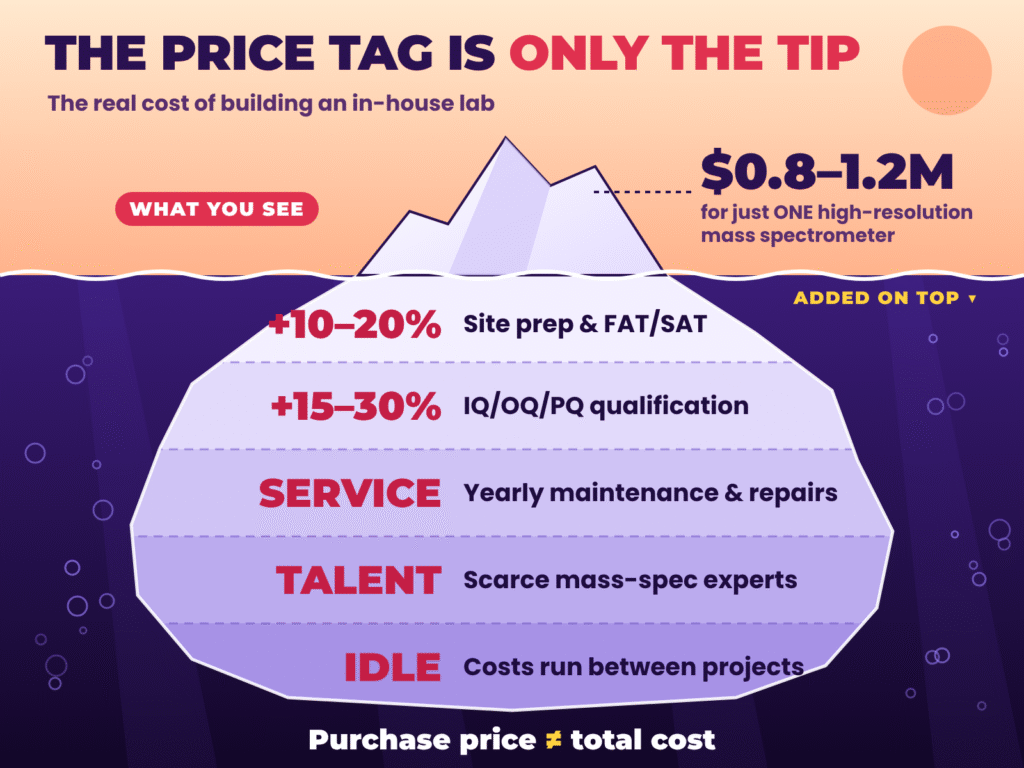
Deciding whether to establish an in-house analytical laboratory or outsource biosimilar characterization to a specialized Contract Development and Manufacturing Organization (CDMO) primarily depends on capital efficiency, speed to regulatory submission, and immediate access to orthogonal analytical instrumentation. For most emerging biotechnology companies and mid-sized biosimilar developers, partnering with a specialized CDMO eliminates substantial upfront equipment investments. For example, a single flagship high-resolution mass spectrometer can cost 800,000 to 1,200,000. Outsourcing also eliminates lengthy internal equipment qualification processes while providing access to regulatory-ready analytical quality packages.
Explore specialized analytical capabilities through our biosimilar characterization services to support comprehensive structural and functional assessments.
This build-versus-buy decision has become increasingly important following significant regulatory reforms introduced across the United States, Europe, and Canada during 2025–2026. Health authorities are placing greater emphasis on comprehensive structural and functional comparability rather than relying on extensive Phase III comparative clinical efficacy trials as the primary basis for biosimilar approval. Since analytical deficiencies can no longer be compensated for through larger downstream clinical studies, the decision to maintain an internal laboratory or outsource characterization to a qualified CDMO directly influences program risk, Chemistry, Manufacturing, and Controls (CMC) predictability, and commercial launch timelines.
Share via:
Quick Summary:
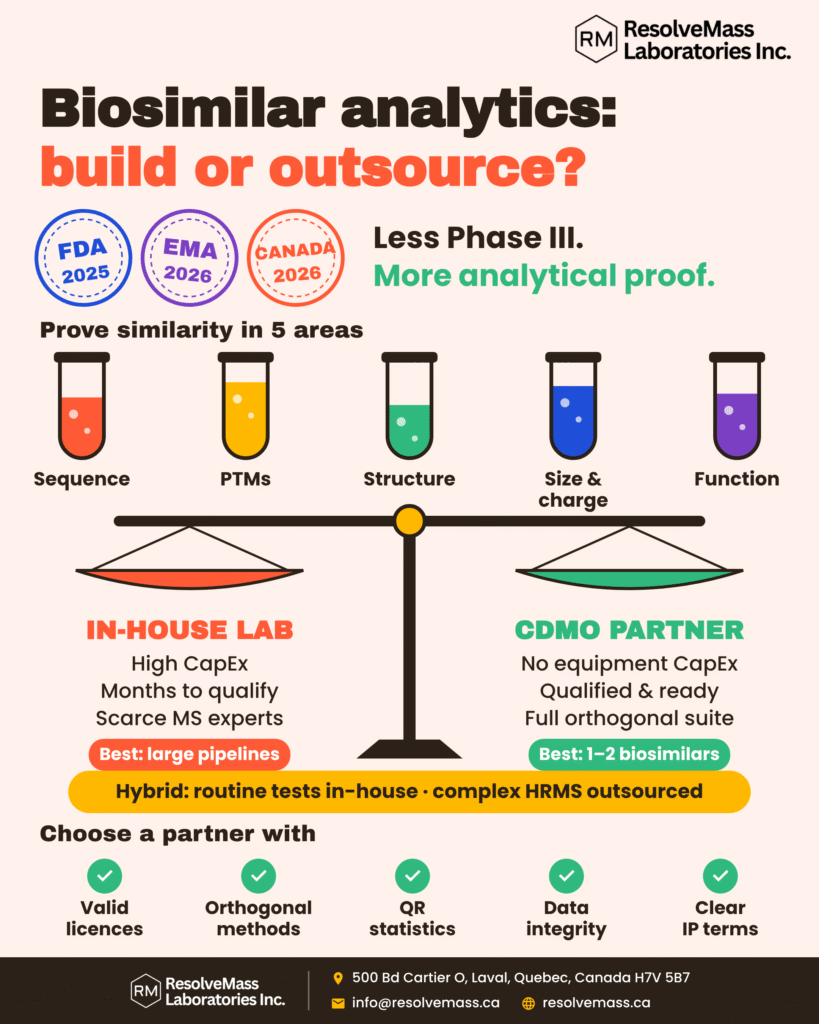
- Regulators now rely on analytics: FDA (September 2025 final guidance, October 2025 draft), EMA (March 2026 reflection paper) and Health Canada (May 2026 guidance) now rely mainly on comparative analytical data rather than Phase III efficacy trials. That makes analytical characterization the main basis of a biosimilar application.
- FDA lot expectations: At least 10 reference product lots and 6–10 biosimilar lots, made with the intended commercial process. High- and moderate-risk quality attributes are judged with the Quality Range (QR) statistical method.
- What a comparability package must cover: Sequence, PTMs such as glycosylation, disulfide bonds and higher-order structure, size and charge variants, impurities, and biological function. Each needs orthogonal methods (LC-MS/MS, HRMS, HDX-MS, NMR, SEC-MALS, SPR and cell-based assays), not a single assay.
- The hidden cost of an in-house lab: Building one takes heavy capital spending on high-resolution mass spectrometers and other platforms. On top of that come commissioning, IQ/OQ/PQ qualification, GMP overhead, maintenance, scarce MS experts, and instruments left idle between programs.
- When to keep it in-house: Large companies with continuous, multi-product biologics pipelines can spread these costs. They also benefit from internal teams for fast clone screening and routine lot release.
- When to outsource to a CDMO: Emerging biotechs and sponsors with one or two biosimilars gain the most. A CDMO is especially useful for multi-lot comparability studies, investigating structural differences, forced degradation and low-level impurity profiling. Many sponsors use a hybrid model: routine work in-house, complex HRMS work outsourced.
- How to choose a partner: Don’t pick on per-sample price alone. Check regulatory credentials, orthogonal capabilities, QR statistics expertise, data integrity, method validation pass rates and clear IP terms. The article’s conclusion is that for most developers, outsourcing is the faster and more capital-efficient route to regulatory readiness.
Why 2025–2026 Regulatory Shifts Raise the Stakes for Outsourcing Biosimilar Characterization
Recent regulatory guidance from the U.S. Food and Drug Administration (FDA), the European Medicines Agency (EMA), and Health Canada places the primary burden of evidence on comparative analytical characterization rather than comparative clinical efficacy studies. Consequently, outsourcing biosimilar characterization to a partner with pre-qualified, orthogonal analytical platforms can help sponsors identify and address analytical deficiencies early, preventing issues that could delay or jeopardize a marketing application.
Explore the scientific and regulatory considerations involved in designing effective biosimilar comparability studies for regulatory submissions.
In September 2025, the U.S. FDA finalized its guidance, Development of Therapeutic Protein Biosimilars: Comparative Analytical Assessment and Other Quality-Related Considerations. According to a regulatory analysis by Lachman Consultants, the final guidance establishes specific expectations for lot sampling and statistical evaluation. Sponsors should analyze at least 10 reference product lots representing multiple expiration years, together with 6 to 10 proposed biosimilar lots manufactured using the intended commercial process. High- and moderate-risk Critical Quality Attributes (CQAs) are assessed using the Quality Range (QR) method, defined as:
QR = (μR − XσR, μR + XσR)
Here, (μR) and (σR) represent the mean and standard deviation of the reference product lots, respectively, while (X) represents a risk-justified multiplier, typically 3 standard deviations. The approach requires a sufficient proportion of biosimilar lots, such as 90%, to fall within the established target range. One month later, in October 2025, the FDA issued draft guidance titled Scientific Considerations in Demonstrating Biosimilarity to a Reference Product: Updated Recommendations for Assessing the Need for Comparative Efficacy Studies. The document explicitly recognizes that modern comparative analytical assessments are generally more sensitive than clinical efficacy studies for identifying molecular differences between products.
Learn how critical quality attributes (CQAs) in biosimilars influence analytical similarity and regulatory assessment.
European and Canadian regulatory authorities have introduced similar changes, increasingly supporting analytically driven biosimilar approval pathways. In March 2026, the EMA’s Committee for Medicinal Products for Human Use (CHMP) adopted its Reflection paper on a tailored clinical approach in biosimilar development. This approach allows sponsors to reduce clinical data requirements when analytical and pharmacokinetic (PK) evidence provides sufficient support for biosimilarity. Similarly, in May 2026, Health Canada released its revised Guidance on Information and Submission Requirements for Biosimilar Biologic Drugs, clarifying that comparative Phase III clinical efficacy studies are not generally required. Instead, submissions primarily depend on structural, functional, and stability similarity, supported by a comparative PK trial and an anti-drug antibody (ADA) immunogenicity assessment. For the PK evaluation, the 90% confidence interval for relative geometric mean parameters, such as Cmax, must fall within the 80.0%–125.0% acceptance range. Once a high degree of similarity has been established, Health Canada permits extrapolation across all authorized indications of the reference biologic without requiring separate scientific justification for each indication.
Although eliminating routine Phase III clinical trials can substantially reduce clinical development expenditure, industry analyses indicate that scientific risk has increasingly shifted upstream into CMC analytical development. Any unexplained difference in glycosylation, sequence variants, or higher-order structure (HOS) may lead to regulatory questions, additional studies, or a determination that the candidate does not qualify as a biosimilar. Furthermore, accelerated Canadian review timelines may increase the likelihood of earlier patent disputes under the Patented Medicines (Notice of Compliance) Regulations.
Technical Scope: What an In-House Lab or CDMO Must Deliver
Regardless of whether analytical activities are performed internally or outsourced, an approvable biosimilar comparability package requires an orthogonal analytical matrix. This matrix must comprehensively characterize primary sequence, post-translational modifications (PTMs), higher-order structure, size and charge heterogeneity, impurities, and biological activity using methods based on independent analytical principles. Depending on a single assay for each attribute can leave important analytical gaps and may not satisfy the expectations established under ICH Q6B and FDA comparative assessment standards.
Review the ICH Q6B guidelines for biological characterization to understand the quality considerations involved in evaluating biological products.
| Structural or Functional Tier | Critical Quality Attributes (CQAs) | Primary and Orthogonal Technologies | Regulatory and Clinical Relevance |
|---|---|---|---|
| Primary Structure | Exact amino acid sequence, N/C-terminal heterogeneity, low-level misincorporation variants, extinction coefficient | LC-MS/MS peptide mapping (>95% sequence coverage through multi-enzyme digestion), intact mass MS, Edman degradation, Amino Acid Analysis (AAA) | Establishes molecular identity and identifies transcription/translation variants. AAA determines the protein extinction coefficient required for Beer-Lambert concentration measurements. |
| Post-Translational Modifications (PTMs) | N- and O-glycosylation (core fucosylation, sialylation), methionine/tryptophan oxidation, deamidation, glycation | High-Resolution Mass Spectrometry (HRMS), HILIC-FLD, site-specific glycopeptide mapping, intact glycoprotein MS | Influences serum clearance, ADCC/CDC effector activity, and CDR binding affinity while identifying stress-induced chemical degradation. |
| Disulfide Connectivity and Higher-Order Structure (HOS) | Intra- and inter-chain disulfide pairing, scrambled bonds, free cysteines, secondary/tertiary folding | Non-reducing peptide mapping (with ETD/UVPD fragmentation), Hydrogen-Deuterium Exchange MS (HDX-MS), Native MS, Circular Dichroism (CD), FTIR, NMR | Identifies less than 1% disulfide scrambling and subtle Fc or antigen-binding conformational changes that may influence potency or immunogenicity. |
| Size, Charge, and Purity Profile | Soluble/sub-visible/visible aggregates, truncated fragments, acidic/basic isoforms, Host Cell Proteins (HCPs), residual DNA | SEC-MALS, CE-SDS (reduced and non-reduced), IEX, cIEF coupled with MS, targeted HCP-MS | Addresses the limitations of traditional ELISA for detecting co-purifying HCPs while monitoring cleavage products, aggregation, and lot-to-lot consistency. |
| Biological and Functional Activity | Receptor binding kinetics, Fc-gamma receptor binding, ADCC, CDC, cell-based potency | Surface Plasmon Resonance (SPR / Biacore), cell-based potency bioassays, enzyme activity assays, ADA/NAb immunoassays | Establishes the relationship between physicochemical equivalence and the clinical mechanism of action while helping resolve remaining structural uncertainties. |
Achieving the analytical depth required for regulatory submissions involves considerably more than routine chromatographic screening. For example, forced degradation studies expose both the biosimilar candidate and the reference product to conditions such as elevated temperatures, pH variations, and oxidative stress. These studies must combine separation techniques with LC-MS/MS site localization to determine whether both molecules follow comparable chemical degradation pathways at susceptible complementarity-determining region (CDR) residues. Similarly, combining targeted proteomics (HCP-MS) with conventional immunoassays helps identify low-level co-purifying host cell proteins that may remain undetected by traditional ELISA kits.
Discover how proteomics approaches for biosimilars support detailed protein characterization and the identification of molecular differences.
Capital Expenditure vs. Operational Agility: The True Cost of Building In-House
Establishing an internal biosimilar characterization laboratory requires substantial upfront capital expenditure (CapEx), multiple stages of GMP equipment qualification, and recurring specialist staffing and maintenance costs. In contrast, outsourcing biosimilar characterization allows sponsors to convert fixed infrastructure investments into more flexible operational expenditure (OpEx).
There is no universally accepted independent benchmark that establishes the exact cost of building a complete biosimilar characterization laboratory. Total expenditure varies considerably according to mass analyzer specifications, coupled chromatography systems, GMP compliance software, facility modifications, and commercial service arrangements. Nevertheless, market reports and biopharma Total Cost of Ownership (TCO) frameworks demonstrate why instrument purchase prices alone significantly underestimate the actual investment required to establish and operate an internal laboratory.
Flagship Analytical Instrumentation
Market research reports estimate that high-resolution time-of-flight (TOF) and Orbitrap mass spectrometers can cost approximately 800,000 each. Specialized proteomics systems, such as the Thermo Fisher Fusion Orbitrap Lumos, may range from 800,000 to 1,200,000 per instrument. Establishing genuine orthogonal analytical capabilities also requires separate investments in Surface Plasmon Resonance (SPR) systems, including Biacore, CD and FTIR spectrometers, NMR spectroscopy, SEC-MALS, CE-SDS, and cell-culture facilities for potency bioassays.
Explore the role of native mass spectrometry for biosimilars in evaluating molecular structure and complex protein assemblies.
Commissioning and Qualification Multipliers
An industry CapEx-versus-OpEx planning framework published by Lab Manager for bioprocessing equipment highlights several additional expenses that extend beyond the initial purchase order. Site preparation, utility connections, and Factory/Site Acceptance Testing (FAT/SAT) can add approximately 10–20% to the purchase price. Installation, Operational, and Performance Qualification (IQ/OQ/PQ) activities for GMP-critical systems may contribute another 15–30%.
GMP Overhead and Preventive Maintenance
According to a bioanalytical vendor cost analysis, maintaining GLP/GMP documentation, quality assurance oversight, and archival systems can increase baseline analytical operating expenses by approximately 40–70%. High-precision analytical platforms also require regular manufacturer-supported maintenance. For example, Cytiva’s maintenance guidance for Biacore SPR systems recommends two preventive maintenance visits annually under high-throughput or multi-user operating conditions. These visits help assess optical interfaces, microfluidic cartridges, and software performance.
Specialist Scarcity and Asset Underutilization
Industry market reports identify an ongoing shortage of qualified mass spectrometry professionals. Additionally, after completing reference profiling involving 10 lots and comparative assessments involving 6 to 10 biosimilar lots, specialized characterization instruments may remain underutilized between development programs. This creates an ongoing financial burden because depreciation, maintenance, and other ownership expenses continue even when instrument usage declines.
In-House Lab vs. Specialized CDMO Partner: Head-to-Head Comparison
An internal analytical laboratory provides large biopharmaceutical organizations with greater control over daily scheduling and analytical activities across multiple ongoing development pipelines. Conversely, a specialized CDMO offers smaller sponsors immediate access to established analytical platforms, scalable capacity, and existing regulatory-compliant quality systems.
| Strategic Dimension | In-House Analytical Laboratory | Specialized CDMO Partner |
|---|---|---|
| Upfront Capital Expenditure | High investment requirements for multiple analytical platforms, including Orbitrap/Q-TOF MS, SPR, NMR, CD/FTIR, SEC-MALS, and bioassay suites. | No equipment CapEx is required from the sponsor. Expenses can be managed through milestone-based FTE, fee-for-service, or hybrid OpEx arrangements. |
| Time to Analytical Readiness | Extended timelines are generally required for instrument procurement, site commissioning (10–20% CapEx benchmark), IQ/OQ/PQ (15–30% benchmark), and recruitment. | Faster onboarding through access to pre-qualified, regulatory-aligned instrumentation and established analytical workflows. |
| Orthogonal Depth | Analytical capabilities may be restricted by available capital. Individual laboratories may struggle to maintain specialized methods such as HDX-MS, ETD/UVPD disulfide mapping, and qNMR simultaneously. | Access to a comprehensive orthogonal analytical suite within a single facility for investigating subtle structural differences and PTM variations. |
| Scientific Talent | Operations depend on recruiting and retaining specialists in protein HRMS, analytical characterization, and chemometrics, where qualified professionals are often difficult to find. | Direct access to Ph.D.-level scientists with experience in complex large-molecule characterization and biosimilar regulatory submissions. |
| Regulatory Track Record | The sponsor must independently establish its Quality Management System (QMS), validation SOPs, and regulatory inspection history. | Access to pre-audited ISO, GMP, and FDA-registered quality systems supported by documented regulatory compliance practices. |
| Capacity Utilization | Fixed depreciation, maintenance, and infrastructure costs continue during clinical holds and periods of reduced analytical activity after submission. | Flexible capacity can accommodate early clone screening, 10-lot statistical comparability assessments, and commercial release testing. |
| Communication and Tech Transfer | Direct daily communication between internal upstream process engineers and analytical chemists supports rapid collaboration. | Requires mutual NDAs, structured milestone governance, and formal analytical method transfer procedures. |
| IP and Data Custody | Raw spectral data, proprietary cell lines, and assay-related intellectual property remain physically within the sponsor’s facilities. | Intellectual property and confidential data are protected through strict NDAs and auditable data management systems, subject to vendor governance arrangements. |
When Should Biopharma Sponsors Keep Characterization In-House vs. Outsource?
Resource allocation decisions should be based on pipeline volume, analytical complexity, and internal quality management maturity rather than a fixed preference for internal ownership or outsourcing.
Learn how cell-line development for biosimilars contributes to consistent manufacturing and product quality.
Scenarios Favoring an In-House Characterization Model
Maintaining a dedicated internal characterization laboratory is generally more economically viable for large biopharmaceutical companies managing continuous, multi-asset biologics pipelines. In these organizations, sustained sample throughput can distribute equipment depreciation, maintenance expenses, and other ownership costs across multiple development programs.
Internal analytical teams are also particularly useful for rapid, iterative upstream clone screening and routine in-process monitoring activities. Examples include titer ELISAs and daily HPLC process confirmation, where immediate feedback between analytical scientists and cell-line development teams can accelerate media optimization and culture development. Similarly, commercial manufacturers supplying high-volume marketed biosimilars often retain routine lot-release QC testing internally to maintain direct control over batch release schedules and production operations.
Scenarios Favoring Outsourcing Biosimilar Characterization to a Specialized CDMO
For emerging biotechnology companies, virtual developers, and generic drug manufacturers entering the biologics sector, outsourcing biosimilar characterization generally represents a more capital-efficient approach. It allows these organizations to access advanced analytical infrastructure and specialized scientific expertise without taking on the financial and operational risks associated with laboratory construction and equipment ownership.
Externalizing analytical characterization offers substantial advantages in four important operational scenarios:
Multi-Lot Statistical Comparability
Conducting FDA-aligned reference profiling involving 10 lots alongside comparative testing of 6 to 10 biosimilar lots manufactured using the intended commercial process requires considerable instrument capacity and parallel analytical workflows. These requirements can easily exceed the capabilities of smaller internal QC departments. A specialized CDMO can provide the infrastructure and personnel needed to manage these extensive comparative assessments efficiently.
Understand the scientific requirements of a structured comparability exercise in biosimilar development and its role in establishing analytical similarity.
Targeted Structural Investigations
When routine SEC or IEX screening identifies minor differences between a proposed biosimilar and its reference biologic, additional investigations may be necessary to determine their underlying causes. Resolving these differences requires advanced orthogonal techniques, including HDX-MS, native MS, ETD/UVPD disulfide mapping, and quantitative NMR. Purchasing and maintaining all these specialized platforms may not be financially justified for sponsors developing only one or two biosimilar candidates.
Forced Degradation and Sub-1% Impurity Profiling
Demonstrating comparable degradation pathways under different stress conditions and accurately quantifying sub-1% sequence variants, disulfide scrambling, or host cell proteins through HRMS requires substantial mass spectrometry expertise. Outsourcing these investigations provides access to specialized method-development capabilities without requiring sponsors to establish the necessary infrastructure internally.
Explore advanced impurity profiling approaches for biosimilars to support the identification and evaluation of product-related and process-related impurities.
Hybrid Overflow Architectures
Many experienced biopharmaceutical sponsors adopt a hybrid operating model that combines internal analytical capabilities with external scientific support. Under this arrangement, routine chromatography and early cell-line screening remain in-house, while complex HRMS characterization, extractables and leachables (E&L), nitrosamine screening, and GLP/GMP bioanalysis are assigned to a specialized CDMO. This approach maintains internal operational control while providing access to advanced analytical capabilities whenever required.
Mitigating Risks When Outsourcing Biosimilar Characterization: Tech Transfer, Data Integrity, and Partner Selection
Successfully outsourcing biosimilar characterization requires careful management of analytical technology-transfer challenges, clearly defined quality performance metrics, and thorough verification of the CDMO’s regulatory track record. Since delays in analytical method development or execution can directly affect clinical supply schedules and regulatory submission timelines, sponsors should manage outsourced activities using Quality-by-Design (QbD) and Design of Experiments (DoE) principles aligned with ICH Q9 quality risk management.
Implementing fit-for-purpose analytical validation strategies can also help control development expenditure. For example, qualified analytical methods may be sufficient during early candidate screening, whereas complete ICH validation should be reserved for pivotal comparability assessments and release testing. This risk-based approach prevents unnecessary early-stage validation expenses while maintaining the analytical rigor required for regulatory submissions.
When evaluating CDMO proposals, sponsors should prioritize measurable operational performance rather than selecting a provider solely on the basis of the lowest per-sample fee. Expedited retesting charges, which may be approximately 25–50% higher than standard rates under certain vendor pricing models, and unsuccessful method validations can quickly eliminate the initial savings associated with a lower-cost provider.
Vendor quality benchmarks recommend prioritizing bioanalytical and characterization laboratories that demonstrate first-time method validation pass rates above 95%, incurred sample reanalysis (ISR) pass rates above 90%, on-time milestone delivery above 95%, and zero critical findings during regulatory inspections.
Verifiable quality credentials offer objective evidence of a laboratory’s operational and regulatory standards. For example, ResolveMass Laboratories Inc., a Canadian CDMO operating from Laval, Quebec, maintains an ISO 9001:2015-certified Quality Management System, holds a Health Canada Drug Establishment Licence (Licence No. 3-002945-A) covering GMP release testing and clinical supply, and is registered with the U.S. FDA (FEI 3042696771) in alignment with IND, ANDA, and 351(k) biosimilar filings. Collaborating with Ph.D.-led scientific teams operating validated HRMS, LC-MS/MS, and NMR platforms can help sponsors develop comprehensive analytical packages capable of withstanding regulatory review while reducing the likelihood of expensive repeat bridging studies.
Consider an end-to-end biosimilar analytical package for regulatory submissions to coordinate structural, functional, and quality assessments.
Checklist for Selecting a Biosimilar Characterization Partner
Use the following checklist when evaluating a potential biosimilar characterization partner:
- Verify Active Regulatory Credentials: Confirm current U.S. FDA FEI registration, Health Canada DEL or equivalent GMP authorization, ISO certification, and documented inspection outcomes.
- Confirm Orthogonal Analytical Capabilities: Ensure the laboratory has demonstrated expertise across primary sequence characterization using multi-enzyme LC-MS/MS, PTM analysis through HRMS, HOS evaluation using HDX-MS, native MS, CD/FTIR, and NMR, as well as functional binding and potency assays.
- Evaluate Statistical Comparability Expertise: Require evidence of experience in developing Quality Range (QR) statistical comparisons and analyzing multivariate datasets, including Principal Component Analysis (PCA).
- Audit Data Integrity and Method Transfer Procedures: Review analytical method transfer protocols, GLP/GMP archival systems, and historical first-time method validation pass rates to assess operational reliability.
- Establish Clear IP and Commercial Arrangements: Secure clearly defined intellectual property ownership through mutual NDAs while ensuring flexible engagement options, including FTE, fee-for-service, or hybrid commercial arrangements.
Conclusion
Outsourcing biosimilar characterization to a specialized CDMO offers a faster and more capital-efficient route to regulatory readiness than establishing an internal characterization laboratory for most biopharmaceutical developers. By avoiding individual HRMS instrument investments of 800,000–1,200,000, GMP commissioning and qualification expenses, and recruitment challenges associated with scarce scientific talent, sponsors can gain immediate access to the orthogonal structural, biophysical, and bioassay workflows required under the 2025–2026 FDA, EMA, and Health Canada regulatory frameworks. Only large organizations managing continuous, multi-asset biologics pipelines can consistently justify complete internal ownership of these analytical capabilities. Even these organizations frequently collaborate with external partners for specialized investigations and periods of increased multi-lot comparability requirements.
Discuss your project requirements and explore a tailored biosimilar comparability study design and CRO support service for your analytical development program.
For sponsors seeking Ph.D.-led analytical expertise supported by a Health Canada Drug Establishment Licence (Licence No. 3-002945-A), U.S. FDA registration (FEI 3042696771), and an ISO 9001:2015-certified Quality Management System, ResolveMass Laboratories Inc. provides integrated biosimilar analytical similarity, HRMS, peptide characterization, NMR, forced degradation, and regulatory documentation services from its Laval, Quebec facility. To discuss your comparative analytical strategy or arrange a virtual consultation with the scientific team, connect through the Contact Us page.
Frequently Asked Questions
Outsourcing analytical characterization does not automatically remove clinical study requirements. However, strong structural, functional, and pharmacokinetic (PK) similarity evidence may support waiving routine Phase III comparative efficacy studies. Regulatory recommendations from the FDA, EMA, and Health Canada increasingly recognize comprehensive analytical evidence as a sensitive approach to identifying meaningful product differences and establishing biosimilarity.
CDMOs use statistical approaches such as the Quality Range (QR) method to compare high- and moderate-risk Critical Quality Attributes (CQAs) against reference product variability. This approach evaluates biosimilar results using the reference mean and standard deviation, commonly applying a three-standard-deviation range. Additional methods, including equivalence confidence intervals, Multivariate Data Analysis (MVDA), Principal Component Analysis (PCA), Comparative Signature Diagrams (CSDs), and Glycosimilarity Index scoring, help assess complex analytical datasets.
Identifying a difference in an individual analytical attribute does not necessarily mean that a biosimilar candidate will fail comparability requirements. The scientific team must investigate the observation using complementary physicochemical techniques, functional bioassays, and, where appropriate, forced-degradation studies. These investigations help determine whether the variation affects product safety, purity, potency, or biological activity and whether it can be scientifically justified under the totality-of-evidence approach.
Operating under GLP or GMP conditions involves additional expenditure for documentation, quality assurance supervision, controlled data management, and regulatory record retention. Industry cost analyses estimate that these requirements may increase baseline analytical operating expenses by approximately 40–70%, while expedited testing can add another 25–50%. Sponsors can manage these expenses by using fit-for-purpose method qualification during early development and reserving full validation for critical comparability assessments and regulatory release activities.
Yes, pharmaceutical companies can adopt a hybrid analytical model that combines internal laboratory operations with specialized external testing. Routine activities, including HPLC monitoring, concentration measurements, and preliminary candidate screening, can remain within the sponsor’s laboratory. More complex procedures, such as LC-MS/MS peptide mapping, disulfide bond analysis, forced degradation, NMR, extractables and leachables (E&L), and nitrosamine testing, can be assigned to an experienced CDMO.
Multi-enzyme LC-MS/MS peptide mapping provides detailed information about the primary amino acid sequence of a therapeutic protein and helps identify sequence modifications, misincorporation events, and clipping variants. Achieving greater than 95% sequence coverage strengthens confidence in molecular identity and supports comprehensive comparability assessments. Using multiple proteolytic enzymes reduces the possibility of undetected sequence regions that may remain unresolved with a single-enzyme digestion strategy.
Circular Dichroism (CD) and FTIR provide information about the overall secondary structural characteristics of therapeutic proteins. To investigate more localized structural features, specialized laboratories combine these methods with Hydrogen-Deuterium Exchange MS (HDX-MS), Native MS, and NMR spectroscopy. These complementary techniques help evaluate conformational changes, Fc/Fab domain characteristics, and non-covalent interactions, providing a more comprehensive understanding of structural comparability and potential functional differences.
A reliable characterization CDMO should demonstrate consistent analytical performance, dependable project delivery, and a strong quality management record. Important performance indicators include first-time method validation success rates above 95%, incurred sample reanalysis (ISR) pass rates exceeding 90%, and on-time milestone completion above 95%. Sponsors should also review regulatory inspection histories, with particular attention to the absence of critical findings from authorities such as the FDA, Health Canada, and EMA.
Efficient outsourced analytical characterization can help sponsors complete comparative similarity assessments sooner and prepare regulatory submissions without unnecessary laboratory infrastructure delays. This advantage becomes particularly important when streamlined regulatory pathways reduce the need for routine Phase III comparative efficacy studies. In Canada, earlier regulatory progress and potential market-entry plans may also bring patent disputes under the Patented Medicines (Notice of Compliance) Regulations forward, making coordination between analytical development teams and intellectual property counsel essential.
Reference:
- U.S. Food and Drug Administration (FDA). Development of Therapeutic Protein Biosimilars: Comparative Analytical Assessment and Other Quality-Related Considerations — Guidance for Industry (Final Guidance, September 2025). https://www.fda.gov/regulatory-information/search-fda-guidance-documents/development-therapeutic-protein-biosimilars-comparative-analytical-assessment-and-other-quality
- U.S. Food and Drug Administration (FDA). Scientific Considerations in Demonstrating Biosimilarity to a Reference Product: Updated Recommendations for Assessing the Need for Comparative Efficacy Studies — Draft Guidance for Industry (October 2025). https://www.fda.gov/regulatory-information/search-fda-guidance-documents/scientific-considerations-demonstrating-biosimilarity-reference-product-updated-recommendations
- U.S. Food and Drug Administration (FDA). Quality Considerations in Demonstrating Biosimilarity of a Therapeutic Protein Product to a Reference Product (Guidance excerpt / PDF). https://www.fda.gov/media/159261/download
- European Medicines Agency (EMA). Reflection paper on a tailored clinical approach in biosimilar development (EMA/CHMP/BMWP/60916/2025, March 27, 2026). https://www.ema.europa.eu/en/scientific-guidelines/reflection-paper-tailored-clinical-approach-biosimilar-development
- Health Canada. Guidance on Information and Submission Requirements for Biosimilar Biologic Drugs: Non-clinical and clinical information requirements (Modified May 19, 2026). https://www.canada.ca/en/health-canada/services/drugs-health-products/biologics-radiopharmaceuticals-genetic-therapies/applications-submissions/guidance-documents/information-submission-requirements-biosimilar-biologic-drugs/non-clinical-and-clinical.html
- Health Canada. Guidance on Information and Submission Requirements for Biosimilar Biologic Drugs: Quality information requirements. https://www.canada.ca/en/health-canada/services/drugs-health-products/biologics-radiopharmaceuticals-genetic-therapies/applications-submissions/guidance-documents/information-submission-requirements-biosimilar-biologic-drugs/quality.html
Get In Touch With Us
About The Author