

Introduction
Outsourcing your first generic drug project to a CDMO requires a structured technical transition that covers candidate characterization, technology transfer governance, analytical validation, and regulatory batch execution to meet FDA Abbreviated New Drug Application (ANDA) requirements. Successfully managing this transition requires close scientific and operational alignment between the sponsor’s quality systems and the CDMO’s manufacturing infrastructure. For emerging pharmaceutical sponsors, outsourcing an initial generic drug project to a CDMO can represent an important strategic milestone by reducing capital expenditure while providing access to specialized contract manufacturing capabilities.
Developing generic drug products under section 505(j) of the Federal Food, Drug, and Cosmetic Act requires the sponsor to establish pharmaceutical equivalence and bioequivalence relative to a Reference Listed Drug (RLD). Demonstrating qualitative (Q1) and quantitative (Q2) excipient sameness relative to the RLD requires advanced analytical reverse engineering, comprehensive Chemistry, Manufacturing, and Controls (CMC) packages, and well-controlled technology transfer frameworks. Establishing scientifically rigorous protocols at an early stage helps protect regulatory timelines and supports long-term commercial viability.
Explore how to effectively transfer technical packages and streamline outsourcing by reviewing Outsource Peptide Manufacturing to CDMO.
Share via:
Quick Summary:
- Structured outsourcing is critical: A first generic drug project requires strong alignment between the sponsor and CDMO across CMC, quality, analytical, manufacturing, and regulatory activities.
- Characterize the RLD thoroughly: Establish Q1/Q2 sameness, API solid-state properties, particle size, dissolution, impurities, nitrosamine risks, and excipient profiles before development and technology transfer.
- Select the right CDMO: Evaluate facility fit, equipment capabilities, analytical infrastructure, HVAC/environmental controls, quality history, data integrity, and regulatory expertise.
- Establish clear technical governance: A detailed Quality Agreement should define responsibilities for MBR approval, deviations/OOS, change control, batch release, audits, inspections, and regulatory communication.
- Follow a controlled technology-transfer lifecycle: Use four key phases—knowledge management, facility fit/scale-up, analytical method transfer, and process performance qualification (PPQ)—supported by ICH Q8, Q9, Q10, Q14, and Q2(R2).
- Execute exhibit batches and stability studies: Commercially relevant exhibit batches generate material for bioequivalence studies and stability programs while supplying critical data for ANDA Module 3 (CMC).
- Proactively manage technical risks: Scale-up differences, excipient variability, analytical method drift, and process variability should be identified early through QbD, risk assessment, comparative testing, and robust validation to protect FDA approval timelines and commercial launch.
Candidate Selection and Reference Listed Drug Characterization
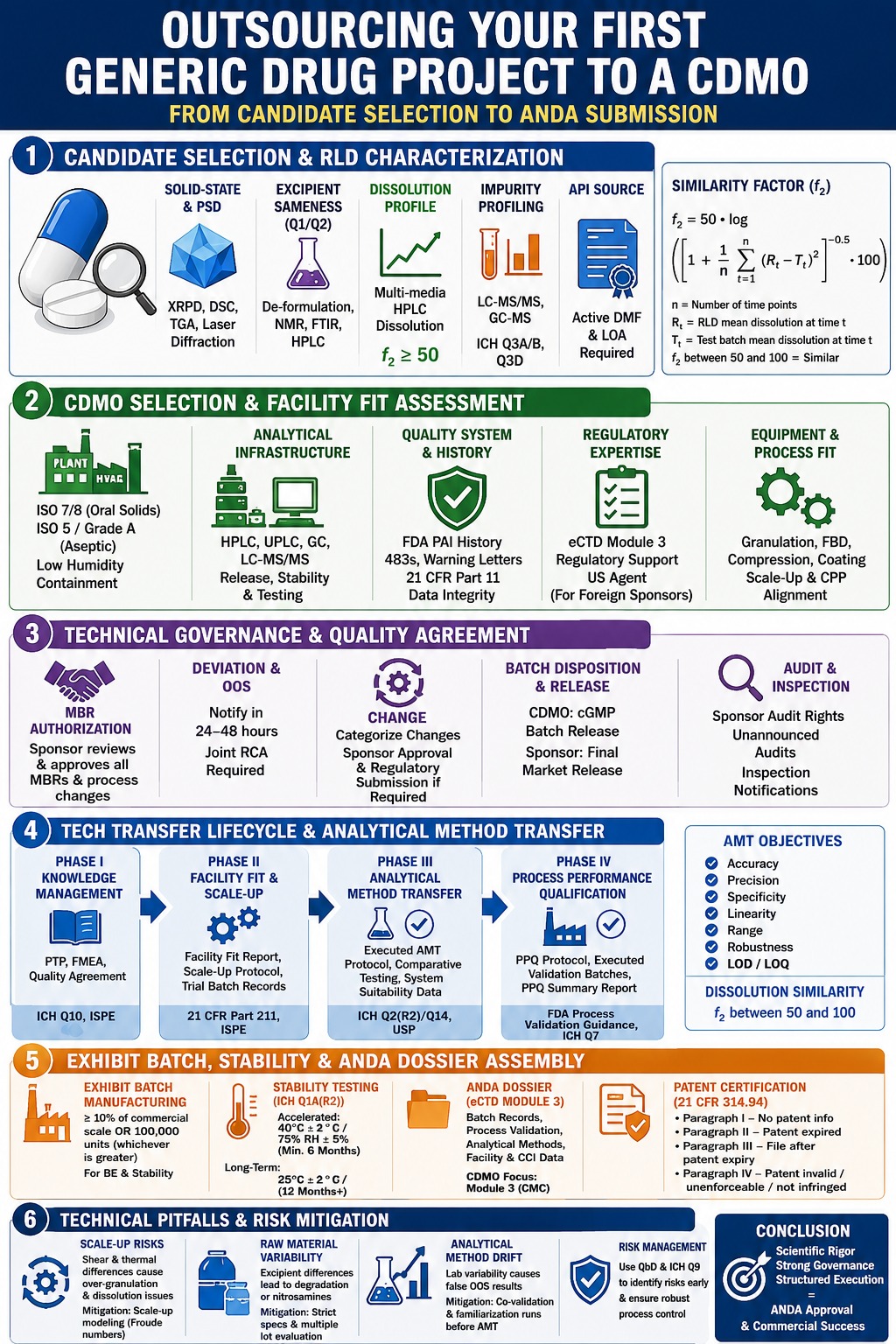
Candidate selection and Reference Listed Drug (RLD) characterization require comprehensive reverse engineering and analytical profiling to establish qualitative (Q1) and quantitative (Q2) sameness before engaging a CDMO. Performing detailed analytical characterization across multiple commercial lots of the RLD provides the baseline data required for formulation development, comparative assessment, and subsequent analytical method validation.
Understanding the active pharmaceutical ingredient (API) solid-state form is essential for predicting formulation performance. Analytical characterization should assess polymorphic forms, solvates, hydrates, or amorphous states, together with particle size distribution (PSD) and morphic stability, because these characteristics can influence dissolution kinetics and overall bioavailability. At the same time, quantitative excipient profiling confirms that inactive ingredients remain within the applicable historical limits established by the FDA Inactive Ingredient Database (IID), helping minimize the potential for unexpected safety-related questions during regulatory review.
Read a practical breakdown of advanced analytical profiling techniques in this Case Study of Semaglutide Characterization.
Impurity profiling must be performed in accordance with applicable International Council for Harmonisation (ICH) standards. Active ingredients and finished drug products must meet the relevant requirements of ICH Q3A (impurities in active substances) and ICH Q3B (impurities in new drug products). Current ANDA development programs also require elemental impurity risk assessments under ICH Q3D and comprehensive nitrosamine risk evaluations that consider excipient-derived nitrites and secondary amines introduced or generated during processing. API sourcing should include verification that the active substance supplier maintains an active Drug Master File (DMF) and has provided a Letter of Authorization (LOA) permitting the sponsor to reference the DMF within Module 3 of the submission.
Deepen your understanding of complex active ingredient characterization by exploring Difference Between a Peptide and a Small Molecule Drug.
| Characterization Parameter | Primary Analytical Technique | Technical Objective | Regulatory Target Standard |
|---|---|---|---|
| Active Solid-State Form | XRPD, DSC, TGA | Identify crystalline polymorphs, solvates, or amorphous states | Phase purity matching RLD specifications |
| Excipient Sameness (Q1/Q2) | De-formulation, NMR, FTIR, HPLC | Quantify exact inactive ingredient concentrations | FDA Inactive Ingredient Database (IID) limits |
| Dissolution Profiling | Multi-media HPLC Dissolution | Evaluate release rates across pH 1.2, 4.5, and 6.8 media | (f_2) similarity factor ≥ 50 relative to RLD |
| Impurity & Degradation | LC-MS/MS, GC-MS | Quantify organic, inorganic, and nitrosamine impurities | ICH Q3A/B reporting, identification, and qualification thresholds |
| Particle Size Distribution | Laser Diffraction (Mastersizer) | Characterize API (d_{10}, d_{50}, d_{90}) volumetric dimensions | Equivalent surface area and dissolution kinetics |
CDMO Selection and Facility Fit Assessment
Evaluating a partner when outsourcing your first generic drug project to a CDMO requires matching the product Quality Target Product Profiles (QTPP) with the facility’s processing capabilities, environmental controls, and analytical instrumentation. A comprehensive facility fit assessment helps confirm that receiving equipment dynamic parameters and scale-up models are suitable for the intended manufacturing process and can minimize potential bottlenecks during commercial scale-up.
Check out our guide on key criteria for evaluation when reviewing How to Choose a Peptide CDMO in the US.
A systematic facility fit assessment compares the sending site’s bench-scale or pilot-scale parameters with the receiving CDMO’s commercial manufacturing suites. Technical teams should assess equipment volumetric capabilities, mixing dynamics, tip speed, fluidization hydraulics, and thermal transfer efficiencies. For oral solid dosage forms, appropriate matching of high-shear granulators, fluid bed dryers, rotary tablet presses, and pan coaters is necessary to maintain Critical Quality Attributes (CQAs) throughout the manufacturing process.
Sponsors should assess prospective contract partners against several key operational criteria:
- Physical Plant and HVAC Capability: Verification of dedicated cleanroom environmental classifications, such as ISO 7/8 for oral solids or ISO 5/Grade A for aseptic fill-finish, together with low-humidity controls for hygroscopic formulations and suitable containment infrastructure for potent compounds.
- Analytical Infrastructure: Evaluation of on-site testing capabilities, including high-performance liquid chromatography (HPLC), ultra-performance liquid chromatography (UPLC), gas chromatography (GC), and mass spectrometry (LC-MS/MS), to support release, stability, and other analytical testing requirements.
- Quality System and Compliance History: Review of FDA Pre-Approval Inspection (PAI) history, inspectional observations (Form FDA 483s), Warning Letters, and data integrity practices in accordance with 21 CFR Part 11.
- Regulatory Expertise: Assessment of the CDMO’s ability to support electronic Common Technical Document (eCTD) Module 3 preparation, regulatory query responses, and US Agent representation for foreign sponsors.
Compare regional advantages and facility capabilities via Canadian vs US Peptide CDMOs
and United States vs Overseas Peptide CDMOs.
Technical Governance and Quality Agreements
Establishing effective technical governance requires execution of a detailed Quality Agreement that clearly assigns cGMP compliance responsibilities between the sponsor and the CDMO in accordance with applicable FDA guidance. This framework defines responsibilities for batch release, deviation management, and change control while supporting data integrity and regulatory compliance under 21 CFR Parts 210 and 211.
The FDA guidance Contract Manufacturing Arrangements for Drugs: Quality Agreements establishes that sponsors retain ultimate accountability for ensuring that commercial drug products are not adulterated or misbranded. The Quality Agreement should therefore establish clearly defined operational boundaries between the “Owner” (sponsor) and the “Contract Facility” (CDMO) throughout all relevant manufacturing and testing activities.
Key provisions that should be formally established within the Quality Agreement include:
- Master Batch Record (MBR) Authorization: Procedures specifying that the sponsor’s quality unit reviews and approves all MBRs, Master Packaging Records, and significant process modifications before execution.
- Deviation and Out-of-Specification (OOS) Workflows: Defined notification timelines, typically within 24 to 48 hours, for phase I/II OOS analytical results or major manufacturing deviations, together with joint Root Cause Analysis (RCA) procedures when required.
- Change Control Governance: Clear categorization of facility, process, analytical, and raw material changes, with provisions requiring sponsor approval and, where applicable, regulatory submission before implementation of major changes that could affect the approved regulatory filing.
- Batch Disposition and Release: Clear delineation of responsibilities under which the CDMO performs cGMP batch release activities to confirm manufacturing compliance, while the sponsor retains final authority for commercial market release.
- Audit and Inspection Terms: Provisions granting the sponsor rights to conduct routine quality audits, unannounced cause audits, and receive timely notification of regulatory agency inspections.
Understand operational structural differences before finalizing contracts by reading Peptide CDMO vs CMO.
Tech Transfer Lifecycle and Analytical Method Transfer
Executing technology transfer when outsourcing your first generic drug project to a CDMO depends on a four-phase lifecycle encompassing knowledge management, facility fit adaptation, analytical method transfer (AMT), and Process Performance Qualification (PPQ). Aligning analytical procedure transfer activities with ICH Q2(R2) and ICH Q14 helps demonstrate that the receiving laboratory can consistently perform product testing and generate reliable release data.
A structured technology transfer approach follows Quality by Design (QbD) principles under ICH Q8 and Quality Risk Management principles under ICH Q9. Failure Mode and Effects Analysis (FMEA) can be used to identify Critical Process Parameters (CPPs) that may influence product Critical Quality Attributes (CQAs).
| Technology Transfer Phase | Primary Technical Focus | Key Technical Deliverables | Applicable Regulatory Guidelines |
|---|---|---|---|
| Phase I: Knowledge Management | Assembly of Project Technical Package (PTP) | Approved PTP, Initial Risk Assessment (FMEA), Quality Agreement | ICH Q10, ISPE Good Practice Guides |
| Phase II: Facility Fit & Scale-Up | Equipment parameter matching and hydrodynamic scale-up | Facility Fit Report, Engineering Scale-Up Protocol, Trial Batch Records | 21 CFR Part 211, ISPE Baseline Guides |
| Phase III: Analytical Method Transfer | Qualifying analytical procedures at the receiving CDMO lab | Executed AMT Protocol, Comparative Testing Report, System Suitability Data | ICH Q2(R2)/Q14, USP |
| Phase IV: Process Performance Qualification | Commercial process validation under routine cGMP conditions | Approved PPQ Protocol, Executed Validation Batch Records, PPQ Summary Report | FDA Process Validation Guidance, ICH Q7 |
Analytical Method Transfer (AMT) is performed concurrently with facility fit engineering activities. Governed by ICH Q2(R2) and ICH Q14, AMT is intended to demonstrate that the receiving testing laboratory can generate results comparable to those produced at the originating site. Comparative testing protocols assess characteristics such as accuracy, precision (repeatability and intermediate precision), specificity, linearity, range, robustness, and limits of detection/quantitation (LOD/LOQ). For dissolution testing, comparative profiling between generic prototype batches and the RLD is performed, with a similarity factor ((f_2)) score between 50 and 100 across relevant physiological pH media.
$$\text{Similarity Factor } (f_2) = 50 \cdot \log \left( \left[ 1 + \frac{1}{n} \sum_{t=1}^{n} (R_t – T_t)^2 \right]^{-0.5} \cdot 100 \right)$$
Where (n) represents the number of time points, (R_t) represents the mean dissolution value of the Reference Listed Drug at time (t), and (T_t) represents the mean dissolution value of the generic test batch at time (t).
Learn how to structure analytical regulatory compliance with our guide on One-Stop CDMO Analytical Services for ANDA Applications.
Exhibit Batch Manufacturing, Stability Testing, and ANDA Dossier Assembly
Executing exhibit batch manufacturing generates the submission samples and stability data required for preparation of Module 3 of the electronic Common Technical Document (eCTD) for ANDA filing. Manufacturing these batches at a minimum of 10% of commercial scale (or 100,000 units) demonstrates manufacturing consistency while also generating material that can be used for pivotal bioequivalence trials.
Explore scale-up validation strategies through Peptide CDMO Scale-Up Services.
FDA guidance specifies that generic exhibit batches should be manufactured at a scale equivalent to at least 10% of the proposed commercial batch size or 100,000 units for solid oral dosage forms, whichever is greater. These batches should be manufactured in commercial production suites at the receiving CDMO using appropriately qualified equipment. The resulting exhibit product supplies dosing units for pivotal in vivo bioequivalence (BE) studies and provides material for stability evaluation.
Exhibit stability testing is conducted in accordance with ICH Q1A(R2) guidelines:
- Accelerated Stability Storage: Product samples are stored at (40^\circ\text{C} \pm 2^\circ\text{C} \text{ / } 75% \text{ RH} \pm 5% \text{ RH}) for a minimum period of 6 months.
- Long-Term Stability Storage: Product samples are maintained at (25^\circ\text{C} \pm 2^\circ\text{C} \text{ / } 60% \text{ RH} \pm 5% \text{ RH}) for 12 months and continue through the regulatory review cycle to support establishment of the commercial shelf life.
Data generated from exhibit manufacturing, method validation, bioequivalence trials, and stability testing are compiled within the electronic Common Technical Document (eCTD). The CDMO’s primary contributions are generally concentrated in Module 3 (Quality / Chemistry, Manufacturing, and Controls), where the submission describes batch manufacturing records, process control and validation activities, analytical methods, facility information, and container closure integrity.
At the same time, legal and regulatory teams submit the appropriate patent certifications under 21 CFR 314.94 in relation to patents listed in the Orange Book:
- Paragraph I: No patent information has been submitted by the RLD sponsor.
- Paragraph II: The Orange Book patent has expired.
- Paragraph III: Approval of the generic product is requested after the listed patent expires.
- Paragraph IV: The listed patent is considered invalid, unenforceable, or will not be infringed by the manufacture, use, or sale of the generic drug product.
Technical Pitfalls and Risk Mitigation in Generic Outsourcing
Managing technical risks during generic drug development requires early identification of scale-up thermodynamic discrepancies, raw material lot variability, and analytical method drift before commercial validation. Applying structured Quality by Design (QbD) approaches together with ICH Q9 risk management principles can help reduce unexpected batch failures and regulatory delays.
Physical scale-up can expose previously unidentified formulation vulnerabilities. Moving a wet granulation process from a 10-liter pilot granulator to a 500-liter commercial system changes shear dynamics and may result in over-granulation, tablet hardness anomalies, or changes in dissolution release rates. Scale-up modeling based on dimensionless engineering parameters, including Froude numbers, can help establish dynamic similarity between equipment at different manufacturing scales.
Discover solutions for API scaling challenges by exploring Peptide API Scale-Up.
Excipient lot-to-lot variability is another potential failure mode. Small differences in excipient micro-structure, trace nitrite content, or moisture levels may contribute to chemical degradation or nitrosamine formation. Establishing well-defined raw material specifications and assessing multiple excipient lots during feasibility studies can reduce the risk of batch failures associated with material variability.
Analytical method variability between laboratories may result in false Out-of-Specification (OOS) reports during technology transfer. Conducting pre-transfer familiarization runs and co-validation testing between the sponsor and CDMO laboratories can identify subtle chromatographic baseline drift or extraction inefficiencies before formal transfer protocols are finalized. Specialized analytical testing partners, such as ResolveMass Laboratories Inc., can provide advanced API characterization, impurity profiling, and method validation infrastructure required to reduce the risks associated with complex analytical method transfers.
For specialized characterization strategies, discover GLP-1 Peptide Analytical Characterization.
Conclusion
Outsourcing your first generic drug project to a CDMO requires scientific rigor, effective technical governance, and structured execution across analytical and manufacturing operations. Aligning technology transfer protocols with applicable regulatory standards provides a more controlled pathway toward ANDA approval and eventual commercial launch.
By implementing structured technology transfer lifecycles, establishing clearly defined Quality Agreements, and validating analytical procedures according to applicable ICH guidelines, sponsors can better protect regulatory timelines and support commercial viability. Partnering with an experienced contract organization that has advanced analytical instrumentation, strong CMC regulatory expertise, and scalable manufacturing capabilities can help ensure that generic product submissions are adequately prepared to withstand FDA review.
To discuss your technical transfer strategy, analytical characterization, or generic formulation development needs, connect with our expert team directly via our Contact Us Page.
Frequently Asked Questions
Q1 (Qualitative Sameness) refers to the use of the same inactive ingredients present in the Reference Listed Drug (RLD). Q2 (Quantitative Sameness) concerns the amounts of those inactive ingredients and whether they are sufficiently comparable to the RLD formulation. Establishing Q1 and Q2 sameness can support formulation comparability and help reduce potential regulatory concerns during ANDA review.
For many solid oral dosage forms, FDA expectations generally call for an exhibit batch manufactured at a scale of at least 10% of the proposed commercial batch size or 100,000 dosage units, whichever is greater. The batch should be produced using appropriately qualified commercial-scale equipment and under applicable cGMP requirements. The resulting material can support stability studies, analytical testing, and other activities associated with the ANDA submission.
The similarity factor (f2) is a mathematical measure used to compare the dissolution profiles of a generic test product with those of the Reference Listed Drug (RLD). It evaluates the difference between the mean percentage of drug dissolved at corresponding sampling time points. An f2 value of 50 or greater is generally considered indicative of similar dissolution profiles when the applicable conditions for using the calculation are satisfied.
A Quality Agreement defines the quality and cGMP responsibilities shared between the drug owner and the contract facility, including documentation, deviations, change controls, investigations, and batch disposition. A commercial agreement, in contrast, primarily addresses business matters such as pricing, supply commitments, delivery terms, and contractual liabilities. Maintaining a separate Quality Agreement provides a clear framework for quality oversight and demonstrates how regulatory responsibilities are managed between both organizations.
The duration of technology transfer varies according to product complexity, process maturity, analytical requirements, facility capabilities, and regulatory commitments. For a generic solid oral dosage form, a complete transfer program may commonly require approximately 6 to 12 months. This period can encompass knowledge transfer, facility fit assessment, engineering batches, Analytical Method Transfer (AMT), process optimization, and Process Performance Qualification (PPQ).
A Paragraph IV certification asserts that a relevant patent listed for the Reference Listed Drug (RLD) is invalid, unenforceable, or would not be infringed by the proposed generic product. Submitting this certification can lead to patent litigation under the Hatch-Waxman framework. When the statutory requirements are met, the first applicant to submit a qualifying Paragraph IV certification may become eligible for 180-day generic drug exclusivity.
Nitrosamine risk assessment begins by examining potential sources across the manufacturing process, including the API synthesis pathway, raw materials, excipients, water systems, and processing conditions. If a credible risk is identified, targeted analytical testing using sensitive techniques such as LC-MS/MS may be performed to determine whether nitrosamine impurities are present. Appropriate process controls, material controls, or formulation and manufacturing adjustments can then be implemented to maintain levels within applicable acceptable intake limits.
Process Performance Qualification (PPQ) represents Stage 2 of the process validation lifecycle and provides documented evidence that the commercial manufacturing process can consistently produce acceptable product. During PPQ, the process is operated under routine manufacturing conditions while established Critical Process Parameters (CPPs) and Critical Quality Attributes (CQAs) are monitored. Successful PPQ demonstrates that the transferred process is capable of reproducible commercial production within the established control strategy.
Sponsors can improve PAI readiness by establishing a cross-functional inspection team and conducting mock inspections at the CDMO facility before the FDA visit. All relevant eCTD Module 3 information should be reconciled with executed batch records, analytical data, validation documentation, deviations, and change controls. Sponsors should also confirm that Quality Agreement responsibilities are understood and consistently followed by both sponsor and CDMO personnel, with supporting records readily available for inspection.
Reference:
- U.S. Food and Drug Administration. (n.d.). Generic drug development. FDA: Generic Drug Development
- The CDMO model in lyophilization: Bridging technological gaps and postharvest losses in emerging economies—Case study Colombia. (n.d.). ResearchGate. ResearchGate publication
- European Pharmaceutical Review. (n.d.). Staying competitive within the evolving CDMO model. European Pharmaceutical Review
- Future Market Insights. (n.d.). CMO/CDMO market: Major segments and sub-segments by product type, including skin products. ResearchGate. ResearchGate publication
Get In Touch With Us
About The Author


