


Introduction
Overcoming Polymorphic Instability During NDA CMC Review requires the implementation of orthogonal solid-state characterization protocols, validation of robust crystallization and manufacturing parameters, and demonstration that solid-form transitions do not adversely affect drug dissolution or clinical bioequivalence. When unexpected crystal phase transformations occur during the later stages of the regulatory review cycle, pharmaceutical sponsors must conduct prompt root-cause investigations and provide comprehensive technical justifications to regulatory authorities, including the U.S. Food and Drug Administration (FDA).
Active pharmaceutical ingredients (APIs) used in oral solid dosage forms frequently exhibit polymorphism, which refers to the ability of a single chemical structure to crystallize into different lattice arrangements. These distinct crystal structures determine several critical physicochemical properties, including thermodynamic free energy, equilibrium solubility, intrinsic dissolution kinetics, hygroscopicity, and mechanical compressibility. In commercial drug development, particularly for Biopharmaceutics Classification System (BCS) Class II and IV candidates, where systemic absorption is limited by dissolution, unintended polymorphic phase transitions during stability monitoring or commercial-scale manufacturing can introduce substantial regulatory and clinical risks. Failure to anticipate, characterize, or control solid-state transitions during Chemistry, Manufacturing, and Controls (CMC) evaluations may result in Complete Response Letters (CRLs), mandatory extensions of regulatory review timelines, or expensive reformulation activities.
Effective management of these challenges requires comprehensive CMC development and manufacturing support to establish appropriate solid-state controls and maintain consistent product quality throughout development and commercialization.
Share via:
Quick Summary:
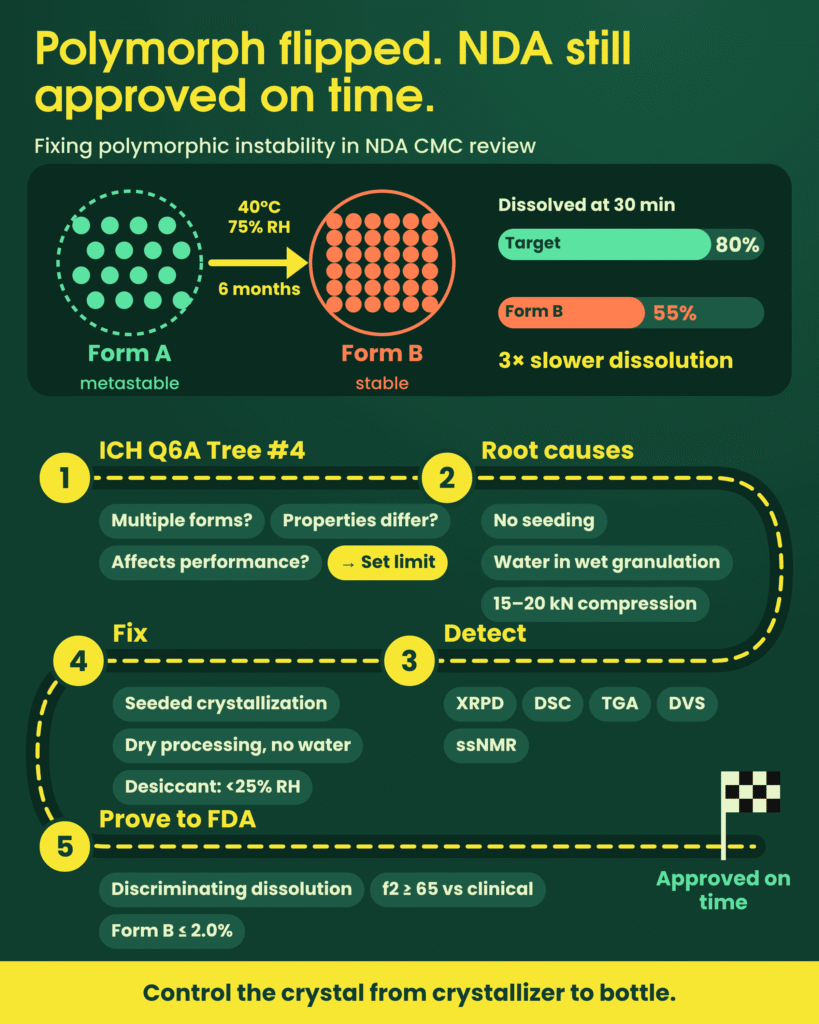
- Problem: In a BCS Class II tablet NDA, the metastable Form A converted to the stable Form B during 6-month accelerated stability testing (40°C/75% RH). Form B’s intrinsic dissolution is 3× slower, so dissolution at 30 minutes fell from the ≥80% target to 55%. This created a serious bioequivalence risk late in CMC review.
- Regulatory framework: ICH Q6A Decision Tree #4 asks three questions. Can the drug form multiple polymorphs? Do they differ in properties? Does that difference affect product performance? If the answer to all three is yes, sponsors must set solid-form acceptance criteria in CTD Module 3.2.S.4 and 3.2.P.5.
- Root causes: Three process steps triggered the conversion. Unseeded API crystallization produced strained, variable Form A. Water during high-shear wet granulation enabled solution-mediated transformation. Compression at 15–20 kN created lattice defects that acted as nucleation sites.
- Analytical investigation: Orthogonal techniques mapped the problem. XRPD identified and quantified the forms, DSC showed thermal stability relationships, TGA ruled out hydrates or solvates, DVS found the humidity thresholds, and solid-state NMR quantified the forms inside intact tablets.
- Technical fixes: The API crystallization was redesigned with 1.5% w/w Form A seeds at a controlled supersaturation. Tablet manufacturing switched to dry roller compaction and direct compression with no water. Tablets were packed in HDPE bottles with desiccant to keep humidity below 25% RH.
- Regulatory defense: The response to FDA information requests had three parts. A validated discriminating dissolution method could detect Form B down to 3%. Dissolution profiles matched the pivotal clinical batches (f2 ≥ 65). New XRPD-based specifications limit Form B to ≤2.0% in both the API and the drug product.
- Outcome and takeaway: The NDA was approved within the original review goal date. Polymorphic risk is best handled by controlling the crystal form at every stage, from the crystallizer to the final package.
Case Study Context: Identifying Solid-State Instability in an Oral Solid Dosage Form
Solid-state instability in an oral solid dosage form occurs when manufacturing stresses or environmental exposure trigger an unintended conversion from a kinetically favored metastable form into a lower-energy, less soluble polymorph. In this representative New Drug Application (NDA) scenario involving a BCS Class II immediate-release tablet, the primary registration batches demonstrated a progressive reduction in dissolution rates during accelerated stability testing, necessitating an extensive CMC investigation and corrective intervention.
The small-molecule active drug candidate was initially developed using a metastable anhydrate designated as Form A. This polymorphic form was selected during early candidate evaluation because of its favorable kinetic solubility and rapid oral absorption profile. However, during six-month accelerated stability testing at (40^\circ\text{C} / 75%\text{ RH}), conducted on primary registration batches manufactured at commercial scale, routine stability assessments identified unexpected reductions in dissolution rates. Subsequent solid-state characterization revealed the appearance of additional diffraction peaks and changes in thermal profiles, confirming the conversion of Form A into Form B. Form B was identified as a thermodynamically stable polymorph with an intrinsic dissolution rate three times lower than that of Form A.
| Quality Attribute | Quality Target Product Profile (QTPP) Target | Observed Impact of Polymorphic Conversion (Form A → Form B) | Analytical Control & Critical Quality Attribute (CQA) Risk Level |
|---|---|---|---|
| Solid-State Identity | Pure Form A metastable anhydrate (>98.0%) | Appearance of the Form B crystal lattice (>5.0% phase fraction) | High; non-compliance with the registered drug substance solid-form specification. |
| Intrinsic Dissolution Rate | Q ≥ 80% dissolved at 30 minutes in pH 6.8 buffer | Dissolution rate decreased to 55.0% at 30 minutes. | Critical; high probability of bioinequivalence and therapeutic failure. |
| Chemical Stability | Total degradation products <0.5% over shelf life | Minimal chemical degradation observed (<0.1%). | Low; the conversion represents a physical phase transition rather than chemical degradation. |
| Content Uniformity | 95.0%–105.0% of label claim | Maintained within acceptable limits. | Low; particle size distribution remained consistent across scale-up batches. |
| Moisture Sorption | Total water content <1.0% w/w | Increased surface moisture uptake promoted phase nucleation. | High; environmental humidity accelerates solution-mediated transformation. |
Maintaining reliable drug substance quality requires well-defined manufacturing and analytical controls. Appropriate drug substance CMC strategies help establish the necessary specifications and demonstrate consistency across manufacturing batches.
Regulatory Framework: ICH Q6A Decision Tree #4 and Overcoming Polymorphic Instability During NDA CMC
ICH Q6A Decision Tree #4 establishes the need for a drug substance solid-state specification when different polymorphic forms exhibit distinct physical properties that can influence product dissolution, bioavailability, or physical stability. Regulatory authorities expect sponsors to establish validated acceptance criteria and appropriate control strategies whenever solid-state variations have the potential to affect the therapeutic performance or shelf-life stability of the finished oral dosage form.
During an NDA CMC review, the regulatory assessment of solid-state characteristics primarily focuses on confirming that the specific crystalline form present in pivotal clinical trial batches can be consistently reproduced during commercial manufacturing and maintained throughout the product shelf life. The ICH Q6A Decision Tree #4 framework provides a systematic approach for evaluating the need for solid-form controls through the following steps:
Step 1: Solid Form Identification: Establish whether the active drug substance exists in multiple polymorphic, hydrated, or solvated states through comprehensive crystallization screening and solid-state characterization.
Step 2: Physicochemical Assessment: Determine whether the identified solid forms exhibit differences in fundamental physical properties, including thermodynamic solubility, intrinsic dissolution rate, thermal behavior, and hygroscopicity.
Step 3: Performance Impact Analysis: Evaluate whether the identified differences in physical attributes could influence the safety, clinical efficacy, or bioequivalence of the finished dosage form.
When solid-state variations directly affect dosage form performance, as demonstrated in this case study where the emergence of Form B reduced tablet dissolution below acceptable release criteria, sponsors must establish and document numerical acceptance limits within Module 3.2.S.4 (Control of Drug Substance) and Module 3.2.P.5 (Control of Drug Product) of the Common Technical Document (CTD).
Developing scientifically justified acceptance criteria also requires reliable analytical procedures capable of detecting and quantifying polymorphic variations. Appropriate analytical method development for IND and NDA submissions supports the generation of dependable data for regulatory assessments.
Root Cause Investigation: Process-Induced Phase Transformations (PIPT)
Process-induced phase transformations (PIPT) occur when manufacturing-related stresses, including mechanical shear, solvent exposure, elevated humidity, or compaction energy, destabilize a metastable crystal lattice and initiate conversion into another solid form. Identifying the underlying cause of polymorphic instability requires a systematic evaluation of individual unit operations throughout API crystallization and drug product manufacturing.
In this case study, a comprehensive multi-technique analytical investigation identified three distinct operational factors responsible for initiating the phase conversion:
Unseeded API Crystallization: The original drug substance crystallization process depended on spontaneous nucleation under unseeded cooling conditions. This approach produced Form A material characterized by high surface free energy, internal lattice strain, and batch-to-batch variability in residual amorphous content.
High-Shear Wet Granulation Stress: The tablet manufacturing process involved aqueous high-shear wet granulation. Introducing liquid water generated localized micro-dissolution zones on API particle surfaces, creating a low-activation-energy pathway for solution-mediated phase transformation into the less soluble Form B anhydrate.
Compression-Induced Strain: Conventional tableting compression forces of 15–20 kN generated mechanical shear and lattice dislocations within the crystal structure. These defects acted as nucleation sites, accelerating solid-state conversion during storage under elevated-temperature conditions.
| Analytical Technique | Evaluated Physical Attribute | Analytical Capability & Role in PIPT Root-Cause Mapping | Limit of Detection (LOD) / Quantitation (LOQ) |
|---|---|---|---|
| X-Ray Powder Diffraction (XRPD) | Long-range atomic order and unit cell geometry | Identifies primary crystalline phases and quantifies the Form B phase fraction within the Form A matrix. | LOD: 0.5%–1.0% w/w; LOQ: 1.5%–2.0% w/w. |
| Differential Scanning Calorimetry (DSC) | Melting point onset and enthalpy of fusion (ΔHf) | Evaluates thermodynamic stability relationships, including monotropic and enantiotropic behavior. | Resolution: ±0.1°C; supports qualitative and semi-quantitative phase mapping. |
| Thermogravimetric Analysis (TGA) | Mass loss as a function of temperature | Differentiates anhydrous polymorphs from hydrates, channel solvates, and residual solvents. | Mass resolution <0.1 µg; enables precise stoichiometric determination. |
| Dynamic Vapor Sorption (DVS) | Isothermal moisture sorption and hysteresis | Identifies relative humidity thresholds associated with moisture-induced solid-state conversion. | Mass resolution: 0.1 µg; enables mapping of relative humidity phase boundaries. |
| Solid-State NMR (13C SSNMR) | Local carbon chemical environments | Enables nondestructive quantification of crystalline phase proportions directly within intact tablets. | Quantitation LOQ down to 1.0% w/w in intact dosage units. |
In addition to solid-state characterization, impurity assessment is important for distinguishing physical phase changes from chemical degradation and identifying potential changes in material quality. A structured impurity profiling approach helps evaluate related substances and maintain appropriate analytical oversight throughout pharmaceutical development.
Technical Strategy for Overcoming Polymorphic Instability During NDA CMC Review
An effective technical remediation strategy for overcoming polymorphic instability requires optimizing the API crystallization process, modifying finished product manufacturing operations to eliminate transformation triggers, and implementing appropriate moisture-barrier controls. Removing the conditions that promote phase conversion helps maintain the desired crystalline form throughout manufacturing, storage, and the commercial product life cycle.
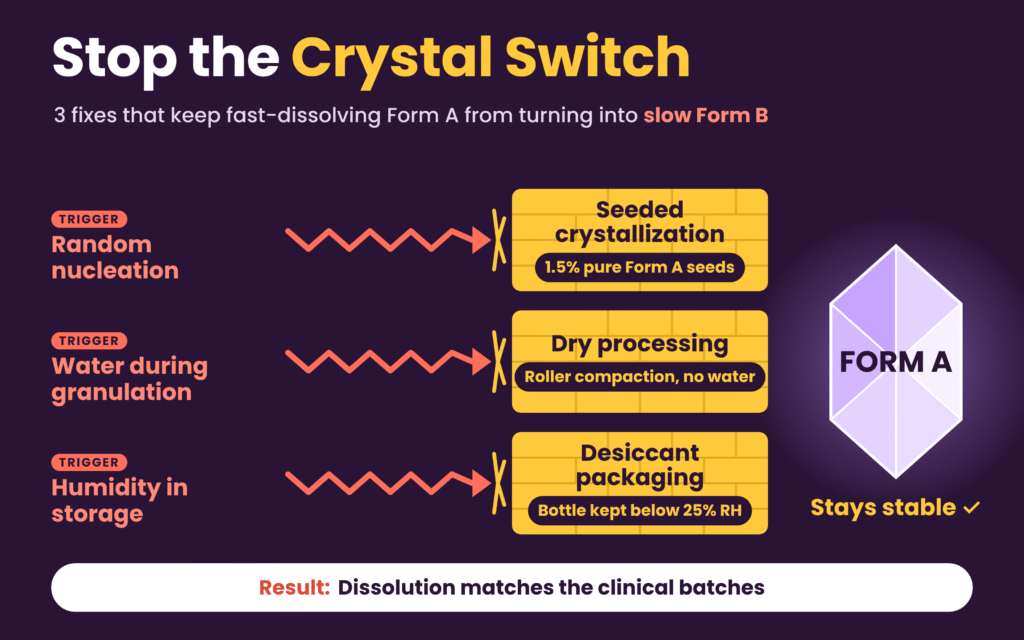
To address the solid-state instability without introducing substantial delays into the NDA review timeline, a three-part engineering intervention was implemented:
Crystallization Re-Engineering and Seeded Growth: The API crystallization process was redesigned to incorporate a controlled seeding strategy. Pure Form A seed crystals were introduced at a loading of 1.5% w/w, with a controlled surface area, at a precisely defined supersaturation ratio of (S = 1.35) within an ethanol/water solvent system. This controlled crystallization approach eliminated spontaneous nucleation and produced phase-pure Form A material with reduced surface energy and improved crystal perfection.
Transition to Solvent-Free Dry Processing: The drug product manufacturing process was changed from wet granulation to a dry roller compaction and direct compression workflow. Eliminating liquid water from the manufacturing process removed the solution-mediated transformation pathway responsible for promoting the conversion of Form A into Form B.
Moisture Isolation via Packaging Control: The finished tablets were packaged in high-density polyethylene (HDPE) bottles equipped with integrated molecular sieve desiccants. Maintaining the internal package relative humidity below 25% RH effectively prevented moisture-catalyzed solid-state conversion during long-term stability testing.
In addition to solid-state characterization, impurity assessment is important for distinguishing physical phase changes from chemical degradation and identifying potential changes in material quality. A structured impurity profiling approach helps evaluate related substances and maintain appropriate analytical oversight throughout pharmaceutical development.
Regulatory Defense Strategy and Responding to FDA Information Requests
Successfully addressing solid-state modifications during an NDA CMC review requires the submission of comparative dissolution profiles, quantitative analytical method validation data, and revised Module 3 CTD documentation to respond adequately to regulatory Information Requests (IRs). Sponsors must demonstrate that the implemented manufacturing changes maintain the desired physical form while preserving bioequivalence with the pivotal clinical trial batches. This evidence is essential to support regulatory approval.
When submitting CMC revisions to the FDA during an active regulatory review, pharmaceutical sponsors must compile a structured technical package covering the relevant CTD sections:
Discriminatory Dissolution Method Validation (CTD 3.2.P.5.6): Development and validation of a discriminatory dissolution method using pH 6.8 phosphate buffer containing 0.1% sodium lauryl sulfate, USP Apparatus 2, and a rotation speed of 50 rpm. The validated method was designed to distinguish between batches containing different proportions of Form B, including concentrations as low as 3.0%.
In Vitro Profile Equivalence (CTD 3.2.P.2): Conducting comparative dissolution studies to establish profile similarity between the re-engineered direct-compression Form A tablets and the historical pivotal clinical trial batches. The comparative evaluation demonstrated a similarity factor of (f_2 \geq 65).
Updated Quality Specifications (CTD 3.2.S.4.1 & 3.2.P.5.1): Incorporating a quantitative XRPD-based release and stability acceptance limit of ≤2.0% Form B into the API and drug product control strategies. This specification provided regulatory assurance that solid-state characteristics would remain adequately controlled throughout manufacturing and the product shelf life.
The comprehensive technical and analytical data package successfully addressed all agency inquiries, enabling the NDA to receive approval within the original review goal date.
When agencies identify gaps in submitted documentation or request additional technical justification, sponsors must respond with complete and consistent supporting evidence. Effective FDA CMC query resolution helps address regulatory concerns and support timely review decisions.
Conclusion
Successfully overcoming polymorphic instability during NDA CMC review requires scientifically rigorous root-cause investigations, the implementation of effective Quality by Design (QbD) control strategies, and comprehensive regulatory documentation. Addressing solid-state instability through appropriate technical interventions helps protect commercial development timelines while ensuring that manufactured oral solid dosage forms consistently maintain their required quality, purity, and clinical efficacy.
Polymorphic transitions during late-stage drug development can create substantial risks to the viability of pharmaceutical programs if they are not identified and adequately controlled. By applying ICH Q6A decision frameworks, employing orthogonal solid-state characterization techniques such as XRPD, DSC, and SSNMR, and optimizing critical manufacturing unit operations, pharmaceutical companies can effectively improve the physical stability of active drug substances. Establishing stringent controls over crystallization conditions, dry dosage form manufacturing processes, and protective packaging systems supports consistent product quality and regulatory compliance throughout the product life cycle.
Organizations requiring scientific and analytical expertise in solid-state characterization, polymorph screening, or regulatory CMC responses can connect with specialist team members through the ResolveMass Laboratories Contact Page.
Frequently Asked Questions
Process-induced phase transformations can result from mechanical stress, moisture exposure, temperature fluctuations, solvent interactions, and compression forces encountered during manufacturing. For example, aqueous high-shear wet granulation can create localized dissolution conditions that promote the conversion of metastable crystals into more stable polymorphs. Similarly, milling and compression can introduce lattice defects and mechanical strain, potentially accelerating nucleation and subsequent solid-state transformations.
X-ray Powder Diffraction (XRPD) directly examines the crystalline structure of a material by identifying characteristic diffraction patterns associated with its lattice arrangement. Unlike Differential Scanning Calorimetry (DSC), which involves controlled heating and may trigger thermal transitions during analysis, XRPD allows solid-state evaluation without intentionally exposing the sample to elevated temperatures. It also supports the identification and quantification of different crystalline phases, making it valuable for monitoring polymorphic purity.
Yes. A polymorphic conversion can influence the bioequivalence of a BCS Class II drug product because the absorption of these compounds is often limited by their dissolution behavior. Conversion from a metastable, highly soluble form into a thermodynamically stable polymorph with lower solubility may reduce the drug dissolution rate in gastrointestinal fluids. Consequently, changes in dissolution can affect maximum plasma concentration (Cmax) and area under the plasma concentration-time curve (AUC), potentially resulting in differences in systemic exposure compared with the clinical reference batches.
Polymorphic impurity limits are determined by evaluating the potential impact of unwanted crystalline forms on dissolution performance, physical stability, and overall product quality. Sponsors must establish scientifically justified acceptance criteria supported by validated analytical methods capable of detecting relevant levels of polymorphic impurities. Discriminatory dissolution testing is particularly important for demonstrating that the specified impurity concentration does not produce meaningful changes in the drug product’s dissolution profile.
Dynamic Vapor Sorption (DVS) characterizes the moisture absorption and desorption behavior of pharmaceutical materials under controlled relative humidity conditions. By monitoring changes in sample mass, the technique helps identify humidity levels at which an anhydrous API may absorb water and undergo conversion into a hydrated crystalline form. This information allows formulation and manufacturing teams to establish suitable humidity controls, optimize processing conditions, and select protective packaging systems with appropriate desiccants.
When unexpected polymorphic transformation is identified during late-stage NDA review, sponsors can investigate the underlying manufacturing and environmental factors before implementing targeted corrective measures. Potential approaches include introducing controlled seeded crystallization, replacing aqueous wet granulation with dry processing, and improving moisture protection through suitable packaging. Comparative dissolution profiles and validated solid-state analytical methods can then support the updated CTD Module 3 documentation and demonstrate that the revised manufacturing process maintains the required product quality.
Direct polymorph testing may not be necessary for every finished drug product batch when a scientifically justified surrogate test, such as a validated discriminatory dissolution method, adequately detects changes in solid-state characteristics. However, if the selected performance test cannot reliably identify polymorphic variations that could affect product quality, direct analytical monitoring becomes important. Techniques such as quantitative XRPD and solid-state NMR can be incorporated into the control strategy to verify crystalline form identity and maintain consistent product performance.
True polymorphs have the same chemical composition but differ in the spatial arrangement of molecules within their crystal lattices. In contrast, hydrates and solvates contain water or organic solvent molecules incorporated into the crystalline structure. These differences can influence moisture sensitivity, thermal behavior, solubility, and physical stability. Regulatory submissions should therefore include appropriate characterization of hydrates and solvates using techniques such as Thermogravimetric Analysis (TGA) and Karl Fischer titration, alongside an assessment of their potential impact on drug product performance.
Quality by Design (QbD) provides a structured approach for identifying and controlling Critical Material Attributes (CMAs) and Critical Process Parameters (CPPs) that influence polymorphic stability. During API crystallization, parameters such as cooling rates, supersaturation levels, solvent composition, and seed loading can be evaluated to establish conditions that consistently produce the desired crystalline form. Integrating risk assessments, an appropriate Design Space, and process analytical technology (PAT) enables manufacturers to monitor critical process variations and reduce the likelihood of unwanted solid-state transformations.
Reference:
- Van Buskirk, G. A., Asotra, S., Balducci, C., Basu, P., DiDonato, G., Dorantes, A., Eickhoff, W. M., Ghosh, T., González, M. A., Henry, T., Howard, M., Kamm, J., Laurenz, S., MacKenzie, R., Mannion, R., Noonan, P. K., Ocheltree, T., Pai, U., Poska, R. P., … Vaithiyalingam, S. (2014). Best practices for the development, scale-up, and post-approval change control of IR and MR dosage forms in the current quality-by-design paradigm. AAPS PharmSciTech, 15(3), 665–693. https://doi.org/10.1208/s12249-014-0087-x
- U.S. Food and Drug Administration. (2015). Chemistry review(s): Tagrisso (osimertinib), NDA 208065. Center for Drug Evaluation and Research. https://www.accessdata.fda.gov/drugsatfda_docs/nda/2015/208065Orig1s000ChemR.pdf
- Zhang, G. G., Law, D., Schmitt, E. A., & Qiu, Y. (2004). Phase transformation considerations during process development and manufacture of solid oral dosage forms. Advanced Drug Delivery Reviews, 56(3), 371–390. https://doi.org/10.1016/j.addr.2003.10.009
- U.S. Food and Drug Administration. (n.d.). Draft pharmaceutical quality/chemistry manufacturing and controls (PQ/CMC) data exchange. https://www.fda.gov/media/157293/download
- U.S. Food and Drug Administration. (2007). ANDAs: Pharmaceutical solid polymorphism—Chemistry, manufacturing, and controls information: Guidance for industry. Center for Drug Evaluation and Research. https://www.fda.gov/media/71375/download
Get In Touch With Us
About The Author