
Introduction:
PCL Subcutaneous Implant Development is an emerging approach for designing long-acting hormonal drug delivery systems that may release an active pharmaceutical ingredient over 12 months or longer. By combining a biodegradable polymer with a carefully designed drug formulation, developers can investigate sustained release, reduced dosing frequency, and potentially lower dependence on repeated administration.
Polycaprolactone (PCL) is a biodegradable, hydrophobic polyester that has attracted research interest for controlled drug delivery because of its relatively slow degradation and potential for sustained release. Published research has demonstrated the feasibility of PCL-based reservoir implants for extended in-vitro delivery of hormonal agents, including contraceptive progestins. However, the performance of each implant depends on its specific formulation, geometry, manufacturing process, and intended application.
For development teams, the central challenge is not simply putting a hormone into a polymer. It is designing a reproducible implant that delivers the required amount of drug at an appropriate rate, keeps the drug stable, and meets relevant quality and safety expectations.
At ResolveMass Laboratories Inc., a Canadian analytical CRO/CDMO with experience in polymer-based drug delivery, mass spectrometry and impurity testing, we see that the analytical evidence behind an implant often decides whether a program succeeds. This case study examines how a hypothetical 12-month hormonal implant could be developed, characterized, and evaluated.
Summary:
- PCL subcutaneous implant development offers a promising approach to long-acting hormonal drug delivery using polycaprolactone (PCL), a biodegradable polyester.
- Achieving 12-month drug delivery requires careful optimization of polymer properties, implant geometry, drug loading, and formulation composition.
- In-vitro drug release testing evaluates release rate, cumulative release, burst release, and the ability to sustain delivery over the intended period.
- Stability studies must assess both the hormonal active pharmaceutical ingredient (API) and the physical integrity of the implant.
- Analytical characterization, degradation assessment, biocompatibility evaluation, and manufacturing controls are central to development.
- A successful strategy connects formulation design with reproducible manufacturing, safety assessment, and regulatory documentation.
- A 12-month in-vitro release profile is not, by itself, proof of 12-month clinical efficacy or safety.
Case study scope: This article presents an illustrative pharmaceutical development scenario based on established scientific principles and published research. It does not represent a verified ResolveMass Laboratories Inc. client project, and no company-specific experimental results or clinical outcomes are claimed.
1: What Is PCL Subcutaneous Implant Development?
PCL Subcutaneous Implant Development is the design and evaluation of a polymer-based implant placed beneath the skin to provide prolonged drug release. The objective is to establish a predictable relationship between implant composition, structural characteristics, and drug release performance.
PCL may be used in different implant architectures:
- Reservoir systems: A drug-containing core is enclosed within a polymeric wall that regulates drug release.
- Matrix systems: The drug is distributed throughout the polymer, and release is influenced by diffusion, drug distribution, and polymer degradation.
- Modified reservoir systems: Formulation composition and polymer dimensions are adjusted to reach a target release profile and improve structural performance.
The reservoir approach is particularly relevant when developers need to investigate sustained release from a defined drug-containing core. Research published in the Journal of Controlled Release has demonstrated PCL-based implant systems delivering selected hormonal agents in vitro for approximately 13–17 months. These findings establish scientific feasibility for specific research formulations, not a guarantee that every PCL implant will achieve the same performance. [1]
Why Is PCL Considered for Long-Acting Hormonal Delivery?
PCL is of interest because its material properties can support prolonged release and allow developers to investigate several design variables. For a side-by-side view of how it behaves against related polyesters, see this comparison of PLGA, PLA and PCL degradation rates.
Key considerations include:
- Polymer degradation: PCL degrades relatively slowly under many physiological conditions, although the actual profile depends on material properties and the implant environment.
- Drug diffusion: Drug molecules may migrate through polymer barriers or pathways within the formulation.
- Structural flexibility: PCL can be processed into different shapes and geometries.
- Formulation compatibility: Compatibility between the hormone, excipients, and polymer must be established experimentally.
- Potential biodegradability: A biodegradable design may reduce the need for surgical removal, depending on the final product and its clinical requirements.
| Property | PCL | PLGA (typical) | Relevance to a 12-month implant |
|---|---|---|---|
| Degradation timescale | Slow (often years) | Weeks to months | PCL can remain structurally intact through a long dosing period |
| Crystallinity | Semi-crystalline | Mostly amorphous | Crystalline domains can slow drug diffusion |
| Melting behavior | Melts at about 60 °C | No melt; Tg roughly 45–55 °C | Low melt temperature allows gentle hot-melt processing |
| Hydrophobicity | High | Moderate | Suits lipophilic hormones |
| Main release driver | Diffusion | Diffusion plus erosion | Simpler kinetics, but still formulation-dependent |
Biodegradability does not automatically establish safety, complete resorption within 12 months, or freedom from local tissue reactions. Each characteristic requires appropriate evidence.
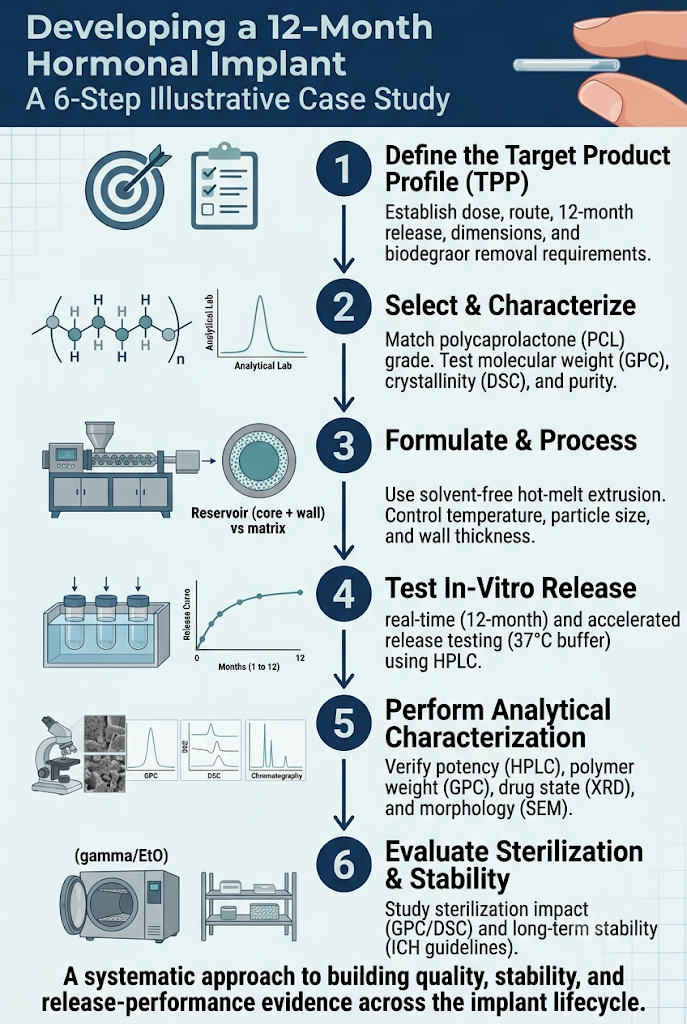
2: Illustrative Case Study: Developing a 12-Month Hormonal Implant
The hypothetical objective is a PCL-based subcutaneous implant that delivers a selected hormonal API over 12 months while maintaining acceptable drug stability and implant integrity. The team first defines the target product profile and the most important performance requirements.
| Development parameter | Illustrative target or question |
|---|---|
| Dosage form | Subcutaneous polymeric implant |
| Intended delivery period | 12 months |
| Active ingredient | A selected hormonal API |
| Release behavior | Sustained release meeting a justified target profile |
| Drug stability | Acceptable chemical integrity throughout the intended period |
| Implant integrity | Adequate mechanical performance during use |
| Polymer behavior | Characterized degradation and resorption profile |
| Quality requirements | Reproducible manufacture and predefined acceptance criteria |
These are development objectives, not achieved results. Actual specifications must be set using the selected hormone, clinical requirements, formulation data, and relevant regulatory expectations.
Step 1: How Do You Define the Target Product Profile?
You define it by establishing what the implant must accomplish throughout its lifecycle: dose, route, release duration, exposure requirements, physical dimensions, and handling characteristics. A clear profile keeps optimization from focusing on release duration alone while overlooking safety, usability, or manufacturing feasibility.
The team should establish:
- The intended indication and patient population
- The required dose and expected duration of delivery
- The target release-rate profile and acceptable variability
- The desired implant dimensions and insertion requirements
- Whether the implant should biodegrade completely or be removed
- The essential quality attributes and their testing methods
Step 2: How Do You Select and Characterize the PCL Material?
You select PCL by matching grade to the release and processing needs, then confirming it analytically. Molecular weight, molecular-weight distribution, crystallinity, and thermal properties all influence processing, mechanical behavior, drug transport, and degradation. Sourcing matters too: a qualified PCL excipient supplier with consistent lot quality reduces variability from the start.
Relevant characterization methods include:
- GPC/SEC for molecular-weight distribution
- DSC for thermal transitions and crystallinity-related assessment
- FTIR for material identification and investigation of chemical changes
- Thermal and mechanical testing for processing suitability and structural performance
- Residual catalyst and monomer testing by chromatography and ICP-MS
Each method should answer a specific development question rather than being applied as an unjustified checklist.
Development decision: Choose the polymer grade and processing conditions based on reproducible material characteristics, acceptable mechanical performance, and compatibility with the intended hormonal formulation.
Step 3: How Is the Drug Formulated into the Implant?
The drug is typically combined with PCL and shaped by a process such as hot-melt extrusion, which is solvent-free and uses PCL’s low melting point to protect heat-sensitive hormones. For a reservoir design, the drug-containing core is then enclosed in a PCL wall.
Critical process parameters to control and document:
- Temperature profile and residence time
- Drug particle size and blend uniformity
- Cooling rate, which affects PCL crystallinity and therefore release
- Wall thickness and implant dimensions
- Implant weight and content consistency
A design-of-experiments (DoE) approach can link these parameters to critical quality attributes such as drug content uniformity and release rate.
Step 4: How Do You Test In-Vitro Release for a 12-Month Implant?
You test it with long-duration release studies in physiologically relevant media, sampled on a defined schedule and quantified by a validated HPLC or LC-MS/MS method. The study should capture release rate, cumulative release, burst release, and whether delivery is maintained through the intended period.
- Real-time study: 37 °C buffer (often with a surfactant to maintain sink conditions), sampled frequently in month 1, then weekly to monthly.
- Accelerated study: Elevated temperature to probe the effect of polymer changes on release, interpreted with caution because PCL crystallinity responds to temperature.
- Acceptance logic: Release curves are compared against the target profile, and lot-to-lot similarity is evaluated with justified statistical approaches.
A 12-month in-vitro profile supports development decisions but is not proof of clinical efficacy or safety. In-vitro–in-vivo correlation must be established separately.
Step 5: What Analytical Characterization Does the Implant Need?
It needs an orthogonal package that proves identity, strength, purity, structure and consistency, because no single technique covers every quality attribute.
| Technique | What it tells you | Why it matters |
|---|---|---|
| HPLC / UPLC | Drug assay, related substances | Potency and impurity control |
| LC-MS/MS and HRMS | Impurity and degradant identification | Structural proof for unknowns |
| GPC/SEC | PCL molecular weight over time | Detects chain scission after processing and sterilization |
| DSC | Melting behavior, crystallinity | Links physical state to release |
| XRD | Drug crystalline vs amorphous state | Detects polymorphic change |
| SEM | Surface and cross-section morphology | Reveals pores and drug distribution |
| FTIR / NMR | Chemical identity and interactions | Confirms no unwanted drug–polymer reaction |
| Content uniformity | Dose consistency per implant | Lot release criterion |
Step 6: How Do Sterilization and Stability Affect PCL Implants?
Sterilization and storage can change PCL molecular weight, crystallinity and drug state, so both must be studied before the formulation is locked. Stability studies must assess the hormonal API and the physical integrity of the implant. For background on how these polyesters behave over time, see the shelf life of PLGA, PLA and PCL.
What to evaluate:
- GPC/SEC before and after sterilization to quantify molecular-weight shift
- DSC and XRD to detect crystallinity or polymorph changes
- Drug assay and degradant profile after sterilization
- Residual ethylene oxide and related residuals, if that method is used
- Gamma irradiation effects, including chain scission or crosslinking
- Long-term and accelerated stability following ICH Q1A(R2) principles
3: What Are the Main Challenges and How Are They Solved?
The main challenges are burst release, drug recrystallization, sterilization impact and weak in-vitro–in-vivo correlation. Each can be managed with targeted formulation and analytical controls.
| Challenge | Root cause | Mitigation |
|---|---|---|
| Initial burst release | Drug at or near the surface | Optimize particle size, add a drug-free PCL layer, or tune loading |
| Drug recrystallization | Supersaturation within the matrix | Monitor by XRD and DSC across stability time points |
| Variable release between lots | Cooling and crystallinity differences | Lock cooling parameters; set DSC acceptance ranges |
| Sterilization-induced change | Chain scission or residuals | Compare methods; confirm with GPC and release testing |
| Poor IVIVC | Media not matching subcutaneous conditions | Refine media; correlate with preclinical data |
4: What Regulatory Considerations Apply?
A PCL hormonal implant needs strong CMC data, biocompatibility evidence and a clear control strategy, and sponsors should plan early for FDA and Health Canada expectations. Early planning of IND-enabling studies and supply for PLGA, PLA and PCL helps avoid late surprises.
Key elements reviewers look for:
- Defined critical quality attributes and a justified specification set
- Validated analytical methods consistent with ICH Q2(R2) and Q14 principles
- Polymer characterization and supplier control
- Extractables and leachables assessment, including ISO 10993-based biocompatibility planning
- Stability data supporting the proposed shelf life
- Nitrosamine and elemental impurity risk assessments where applicable
This article is an educational overview, not regulatory advice. Confirm expectations with the relevant authority.
How Does PCL Compare with Other Polymer Platforms?
PCL is one of several biodegradable polyesters, and the right choice depends on the release duration and dosage form. Shorter-acting or particulate systems often use PLA or PLGA instead; for example, see how PLA nanoparticles for targeted cancer delivery are designed. Implants aimed at a full year tend to favor slower-degrading PCL.
Why Work with ResolveMass Laboratories Inc.?
ResolveMass Laboratories Inc. is a Canadian analytical CRO/CDMO with expertise in polymer-based drug delivery, mass spectrometry, biosimilar and peptide characterization, PLGA systems and nitrosamine testing. Our scientists design orthogonal, ICH-aligned analytical packages and document them so the data stands up to regulatory review.
- Method development and validation for assay, impurities and release testing
- Polymer characterization by GPC/SEC, DSC, FTIR, NMR and SEM
- LC-MS/MS and HRMS for unknown impurity identification
- Stability, forced degradation and extractables and leachables support
- Transparent, audit-ready reporting with full data traceability
Conclusion:
PCL Subcutaneous Implant Development succeeds when polymer science, process control and analytical rigor are planned together from the start. A well-characterized PCL implant, with a controlled burst, a stable solid state, validated release testing and reproducible manufacturing, gives developers a defensible path toward a 12-month hormonal delivery product.
Frequently Asked Questions:
A reservoir implant contains a drug-loaded core surrounded by a polymer barrier that can regulate drug transport. A matrix implant distributes the drug throughout the polymer, with release influenced by diffusion, drug dissolution, and polymer degradation.
Burst release may be reduced by optimizing polymer barrier thickness, drug distribution, formulation composition, and implant geometry. The effectiveness of each change must be verified through appropriately designed drug-release studies.
Important tests may include drug assay, related-substance analysis, content uniformity, in-vitro release, dimensional assessment, mechanical testing, polymer characterization, stability testing, and relevant biocompatibility and sterility assessments.
Stability testing evaluates whether the hormonal drug maintains its chemical integrity and whether the implant retains its required physical and functional properties during storage and the intended release period. It also helps identify potential degradation products and formulation-related changes.
PCL is biodegradable, but its degradation and resorption rates depend on polymer characteristics, implant geometry, and the biological environment. Complete resorption within 12 months should not be assumed without supporting experimental evidence.
Drug release is evaluated using a suitable in-vitro release method with controlled test conditions and scheduled sampling. The analysis measures the amount of drug released over time, evaluates burst release and variability, and may include residual drug and mass-balance assessments.
Reference
- Kütahya C, Panariello L, Najer A, Rizou T, Shamsabadi A, Brachi G, Peeler DJ, Zharova L, Fernandez Debets TF, Peschke P, Constantinou AP. An injectable soft implant for long-acting, reversible, ultra-stable release of therapeutics. bioRxiv. 2026 Feb 26:2026-02.https://www.biorxiv.org/content/10.64898/2026.02.25.707913.abstract
- Cohen J, Shull D, Reed S. Co-delivery of an HIV prophylactic and contraceptive using PGSU as a long-acting multipurpose prevention technology. Expert Opinion on Drug Delivery. 2023 Feb 1;20(2):285-99.https://www.tandfonline.com/doi/abs/10.1080/17425247.2023.2168642
- Chen W, Habraken TC, Hennink WE, Kok RJ. Polymer-free drug-eluting stents: an overview of coating strategies and comparison with polymer-coated drug-eluting stents. Bioconjugate chemistry. 2015 Jul 15;26(7):1277-88.https://pubs.acs.org/doi/abs/10.1021/acs.bioconjchem.5b00192
- Wang S, Liu R, Fu Y, Kao WJ. Release mechanisms and applications of drug delivery systems for extended-release. Expert Opinion on Drug Delivery. 2020 Sep 1;17(9):1289-304.https://www.tandfonline.com/doi/abs/10.1080/17425247.2020.1788541
- Shi Y, Li L. Current advances in sustained-release systems for parenteral drug delivery. Expert opinion on drug delivery. 2005 Nov 1;2(6):1039-58.https://www.tandfonline.com/doi/abs/10.1517/17425247.2.6.1039
About the Author