

Introduction: The Critical Role of Peptide Aggregation Analysis in Biopharmaceutical Quality
Peptide Aggregation Analysis is a critical regulatory and biophysical assessment used to detect, characterize, and quantify self-associated species within therapeutic formulations. This analytical approach plays a vital role in ensuring the safety, efficacy, and minimal immunogenicity of drug products by establishing a comprehensive structural profile of the active pharmaceutical ingredient (API) under native formulation conditions.
                (Light, Temperature, pH, Shear, Concentration)
                                       │
                                       ▼
                              [ Peptide Monomers ]
                                       │
                                       ▼

                                       │
                                       ▼

                                       │
                                       ▼
                     [ Irreversible Covalent Aggregates ]
                                       │
                                       ▼
Therapeutic peptides provide exceptional target specificity and potent pharmacological activity. Nevertheless, their intermediate physical size, positioned between small molecules and large globular proteins, makes them particularly vulnerable to both chemical and physical instability. Environmental and processing factors such as elevated temperatures, exposure to light, fluctuations in pH, changes in buffer composition, mechanical shear during manufacturing, and interactions with packaging materials can induce conformational alterations that expose normally buried hydrophobic domains. Once exposed, these hydrophobic regions can function as nucleation centers that promote the gradual assembly of peptide monomers into dimers, oligomers, and increasingly complex aggregate structures.
Discover how our local teams can support your domestic regulatory programs by visiting our dedicated peptide sameness study services in Canada.
The clinical implications of peptide aggregation are significant. In addition to reducing therapeutic potency through depletion of the active monomeric form, both soluble and insoluble aggregates can act as potent immunogenic stimuli. These aggregate species may disrupt immune tolerance mechanisms and promote the formation of anti-drug antibodies (ADAs). Such antibodies can diminish therapeutic effectiveness by neutralizing the drug or, in severe cases, provoke serious systemic immune reactions.
Achieving a thorough understanding of peptide self-association requires the application of advanced analytical methodologies. Because peptide aggregates can range from nanometer-scale soluble oligomers to sub-visible and visible particles measured in micrometers, no single analytical technique can adequately characterize the entire size spectrum. Consequently, biopharmaceutical developers employ an orthogonal combination of advanced biophysical tools, particularly SEC-MALS, DLS, and SV-AUC, to build a reliable and validated characterization strategy that satisfies rigorous global regulatory standards.
Learn more about our testing services tailored for international developers through our peptide sameness study services in United States.
Executive Summary:
- Peptide aggregation analysis is essential for biopharmaceutical quality control, helping detect, characterize, and quantify aggregate species that can affect drug safety, efficacy, and stability.
- Environmental and manufacturing stresses such as temperature changes, light exposure, pH fluctuations, mechanical shear, and formulation conditions can trigger peptide self-association, leading to dimers, oligomers, and larger aggregates.
- Aggregates pose significant clinical risks by reducing the amount of active therapeutic peptide and potentially inducing anti-drug antibody (ADA) formation, which may compromise treatment effectiveness and increase immunogenicity.
- No single analytical method can fully characterize all aggregate types and sizes, making an orthogonal analytical strategy necessary for comprehensive assessment across the complete aggregation spectrum.
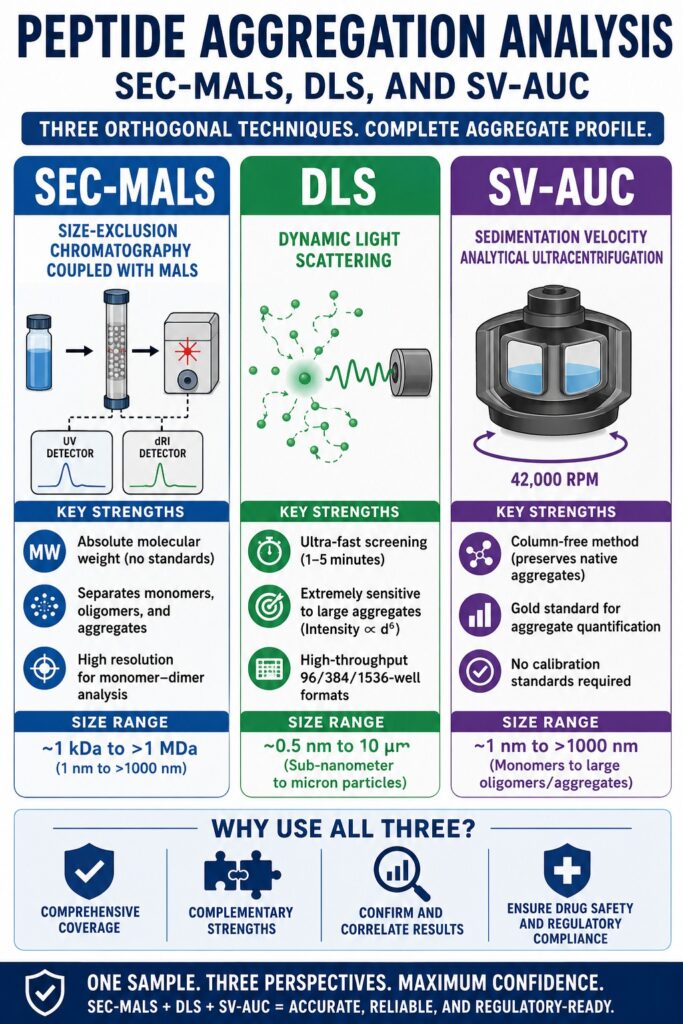
- SEC-MALS (Size Exclusion Chromatography–Multi-Angle Light Scattering) provides accurate molecular weight and size determination of peptide aggregates without relying on calibration standards, enabling detailed characterization of monomers, oligomers, and larger assemblies.
- Dynamic Light Scattering (DLS) serves as a rapid, highly sensitive screening tool capable of detecting early-stage aggregation and trace levels of larger particles, making it valuable for formulation development and stability studies.
- Sedimentation Velocity Analytical Ultracentrifugation (SV-AUC) is considered a gold-standard, column-free technique that preserves fragile non-covalent complexes and delivers precise aggregate quantification under native solution conditions.
- Combining SEC-MALS, DLS, and SV-AUC provides the most reliable aggregation profile, supporting regulatory compliance, formulation optimization, accelerated development, and improved patient safety for peptide-based therapeutics.
Biophysical Principles of SEC-MALS in Peptide Aggregation Analysis
SEC-MALS determines the absolute molecular weight and size of peptide aggregates by integrating size-exclusion chromatography with inline multi-angle light scattering and concentration detection systems. This combined approach eliminates the dependence on column calibration standards, which frequently introduce inaccuracies due to non-ideal interactions between peptides and chromatographic media.
                 ┌──────────────────────────────────────┐
                 │       Isocratic Pump & Injector      │
                 └──────────────────┬───────────────────┘
                                    │
                                    ▼
                 ┌──────────────────────────────────────┐
                 │    Size Exclusion Column (SEC)       │
                 │  (Fractionation by Hydrodynamic Size)│
                 └──────────────────┬───────────────────┘
                                    │
                                    ▼
                 ┌──────────────────────────────────────┐
                 │ Multi-Angle Light Scattering (MALS)  │
                 │      (Absolute Weight-Average Mass)  │
                 └──────────────────┬───────────────────┘
                                    │
                 ┌──────────────────┴───────────────────┐
                 │                                      │
                 ▼                                      ▼
    ┌──────────────────────────┐           ┌──────────────────────────┐
    │       UV Detector        │           │ Differential Refractive  │
    │  (Concentration at 280)  │           │      Index (dRI)         │
    └──────────────────────────┘           └──────────────────────────┘
Column-Based Separations and the Role of SEC-MALS in Peptide Aggregation Analysis
Column-based separation techniques fractionate peptide mixtures according to size as they pass through a porous stationary phase. However, these systems may be affected by non-specific adsorption and shear-induced disruption of fragile aggregates. Coupling size-exclusion chromatography with Multi-Angle Light Scattering (MALS) enables direct, real-time determination of molecular mass and overcomes many of these chromatographic limitations.
Traditional size-exclusion chromatography (SEC) separates macromolecules according to their hydrodynamic volume or Stokes radius. In conventional SEC workflows, analyte elution volumes are compared against calibration curves generated from standard molecules, usually globular proteins. This methodology assumes identical conformational properties, densities, and specific volumes between analytes and standards, while also assuming the absence of chemical or electrostatic interactions with the column matrix.
For peptide therapeutics, these assumptions frequently fail. Many peptides exhibit intrinsically disordered conformations, elongated linear structures, or amphiphilic modifications that differ substantially from the spherical geometry of calibration proteins. As a result, molecular weight estimates obtained through standard SEC calibration can be highly inaccurate.
The integration of a MALS detector with UV and differential refractive index (dRI) detectors transforms SEC from a calibration-dependent method into a true separation platform. The absolute weight-average molecular weight (M) is calculated continuously across each portion of the chromatographic peak using the Rayleigh equation:
M = R(0) / [K · c · (dn/dc)²]
In this model, R(0) represents the reduced Rayleigh ratio, describing the intensity of light scattered by the analyte relative to the incident laser beam and extrapolated to zero angle. The parameter c corresponds to the analyte concentration measured by either UV or dRI detection. The value dn/dc represents the refractive index increment, describing the change in refractive index as a function of analyte concentration. For peptide chains in aqueous systems, dn/dc is typically approximately 0.185 mL/g, making the calculation highly robust and largely independent of peptide sequence-specific UV absorbance properties. The constant K is defined as:
K = (4π²n₀²)/(λ₀⁴Nₐ)
where n₀ is the refractive index of the solvent, λ₀ is the laser wavelength in a vacuum, and Nₐ is Avogadro’s number.
During Multi-Angle Light Scattering measurements, peptides scatter light predominantly according to Rayleigh scattering principles. For larger aggregates with diameters exceeding approximately 25 nm, angular differences in scattered light intensity can be analyzed to determine the radius of gyration (rg), providing information about mass distribution. Smaller peptides and oligomers scatter light isotropically, producing equal intensity in all directions. To determine the hydrodynamic dimensions of these smaller species, a Dynamic Light Scattering (DLS) module may be incorporated directly into the MALS flow cell, enabling simultaneous measurement of hydrodynamic radii (Rh) beginning at approximately 0.5 nm.
To see how these orthogonal separation and sizing systems function on a regulatory scale, review our complete analysis of a generic product filing at peptide characterization of Ganirelix generic project.
Dynamic Light Scattering (DLS): High-Throughput Screening for Early Aggregate Detection
Dynamic Light Scattering (DLS) detects early peptide self-association events by monitoring rapid fluctuations in scattered light intensity generated by Brownian motion. It functions as an exceptionally sensitive screening technique capable of identifying trace quantities of high-molecular-weight aggregates within seconds.
Peptides dissolved in solution undergo continuous random movement due to collisions with surrounding solvent molecules, a phenomenon known as Brownian motion. When a coherent laser beam illuminates these moving particles, the scattered light waves interfere constructively and destructively at the detector. This interference produces rapid intensity fluctuations occurring over microsecond timescales. Smaller particles diffuse rapidly and therefore generate high-frequency fluctuations, whereas larger aggregates diffuse more slowly and produce lower-frequency variations.
DLS instruments analyze these fluctuations using high-speed digital correlators to calculate the intensity autocorrelation function g²(τ), represented as:
g²(τ) = 1 + β|g¹(τ)|²
In this equation, β is the instrumental coherence factor, and g¹(τ) represents the first-order electric field correlation function. For a monodisperse sample, g¹(τ) follows an exponential decay pattern expressed as e−Γτ, where the decay rate Γ is related to the translational diffusion coefficient D through:
Γ = Dq²
The scattering vector q is defined by:
q = (4πn₀/λ₀) sin(θ/2)
where n₀ is the solvent refractive index, λ₀ is the laser wavelength, and θ is the scattering angle.
Once the diffusion coefficient has been determined, the hydrodynamic radius Rh is calculated using the Stokes-Einstein equation:
Rh = kBT/(6πηD)
where kB represents the Boltzmann constant, T denotes absolute temperature, and η is the viscosity of the solvent.
Because scattered light intensity scales with the sixth power of particle diameter (Intensity ∝ d⁶), DLS demonstrates extraordinary sensitivity toward larger species. A single aggregate measuring 100 nm can scatter approximately one million times more light than a 10 nm peptide monomer. This unique sensitivity enables researchers to detect the earliest stages of self-association and particulate contamination well before visible precipitation or significant monomer depletion becomes apparent through alternative analytical methods.
High-Throughput Screening Formats and Phase Dynamics in DLS
High-throughput DLS screening platforms utilize multi-well plate formats to evaluate numerous peptide formulations simultaneously under controlled experimental conditions. These systems significantly accelerate formulation development by enabling rapid assessment of phase behavior, aggregation onset temperatures (Tonset), and molecular stability parameters.
Modern instruments such as the DynaPro Plate Reader III support 96-, 384-, and 1536-well formats, allowing samples to be analyzed directly within their formulation environments. By eliminating conventional fluidic pathways and reducing sample volume requirements to as little as 4 µL per well, these platforms facilitate rapid screening of pH conditions, ionic strength variations, and excipient compositions.
Simultaneous Static Light Scattering (SLS) and Dynamic Light Scattering (DLS) measurements can be performed within these formats. This capability enables calculation of the second osmotic virial coefficient (A22) and diffusion interaction parameter (kD), both of which provide valuable insight into peptide-peptide and peptide-solvent interactions.
Furthermore, automated temperature ramping protocols, commonly ranging from 4°C to 85°C, allow researchers to identify thermal instability onset temperatures (Tonset) and aggregation temperatures (Tagg). Characterizing these thermal phase transitions is essential for predicting shelf-life stability and optimizing both liquid and lyophilized formulations.
Analytical Ultracentrifugation (SV-AUC) as a Column-Free Matrix Standard
Sedimentation Velocity Analytical Ultracentrifugation (SV-AUC) quantifies peptide aggregates by observing molecular sedimentation within a high-speed centrifugal field without the use of a stationary phase. This column-free methodology preserves delicate non-covalent complexes and generates first-principles measurements directly within native formulation environments.
                 ┌──────────────────────────────────────┐
                 │   Assemble Double-Sector Centerpiece │
                 └──────────────────┬───────────────────┘
                                    │
                                    ▼
                 ┌──────────────────────────────────────┐
                 │ Align Cells Parallel to Rotor Center │
                 │      (Prevents Convective Artifacts) │
                 └──────────────────┬───────────────────┘
                                    │
                                    ▼
                 ┌──────────────────────────────────────┐
                 │ Load Rotor into Optima XL-A Instrument│
                 └──────────────────┬───────────────────┘
                                    │
                                    ▼
                 ┌──────────────────────────────────────┐
                 │ Spin at 42,000 RPM (Real-Time Scan)  │
                 │   (Absorbance/Interference Tracking) │
                 └──────────────────┬───────────────────┘
                                    │
                                    ▼
                 ┌──────────────────────────────────────┐
                 │      Fit Scans to c(s) Distribution  │
                 │   (Svedberg Equation & Resolution)   │
                 └──────────────────────────────────────┘
During an SV-AUC experiment, peptide samples and matched reference buffers are loaded into double-sector centerpieces and subjected to high rotational speeds, often around 42,000 rpm, within a vacuum rotor chamber. Optical detection systems continuously monitor concentration boundaries as they migrate radially outward under the influence of the centrifugal field.
The sedimentation process is described by the sedimentation coefficient (s), defined by the Svedberg equation:
s = v/(ω²r) = M(1 − v̄ρ)/(Nₐf)
where v represents sedimentation velocity, ω is rotor angular velocity, r is radial position, v̄ is the peptide partial specific volume, ρ is solvent density, Nₐ is Avogadro’s number, and f is the frictional coefficient reflecting molecular shape and hydration.
SV-AUC is widely regarded as the definitive biophysical standard for aggregate quantification. Because separation depends exclusively on intrinsic molecular properties such as mass, density, and shape, no external standards or calibration materials are required. Most importantly, the absence of a stationary phase eliminates interactions with chromatographic surfaces and prevents sample dilution. Weak non-covalent dimers and oligomers that may dissociate during SEC analysis remain intact throughout ultracentrifugation, providing a more accurate representation of the original sample.
Method Validation and Operational Best Practices for SV-AUC
Accurate SV-AUC validation requires strict adherence to operational parameters, including precise cell alignment, optimized sample loading, and careful management of thermodynamic non-ideality. Following these practices minimizes analytical artifacts and ensures reliable determination of detection and quantification limits.
Cell Alignment
To achieve accurate sedimentation measurements, assembled cells must be carefully aligned so that the centerpiece walls remain perfectly parallel to the centrifugal field. Even slight deviations can generate convective currents that distort sedimentation boundaries and artificially increase apparent aggregate levels.
Loading Concentration
Maintaining an optimal signal-to-noise ratio while remaining within the linear response range of the UV detector is essential. Samples are typically prepared to achieve an absorbance near 1.0 OD. For many peptide therapeutics and monoclonal antibodies, this corresponds to approximately 0.6 mg/mL in standard 12 mm pathlength centerpieces or approximately 2.4 mg/mL in 3 mm centerpieces.
Thermodynamic Non-Ideality
Formulations with low ionic strength may introduce long-range electrostatic interactions that distort sedimentation behavior. To mitigate these effects, buffer ionic strength should generally be adjusted to at least 25 mM through the addition of suitable ionic modifiers.
Density Gradients
Excipients such as sucrose, glycerol, and polyols can generate transient density and viscosity gradients during extended ultracentrifugation runs. These gradients may obscure aggregate detection. Accurate quantification often requires dialysis into excipient-free buffers or the application of inhomogeneous solvent models during data analysis.
Validation Parameters (LOD, LOQ, and Linearity)
Because SV-AUC data are generated by fitting boundary scans to continuous c(s) distributions, traditional visual baseline methods are not applicable. Validation should employ standard curve methodologies utilizing the response standard deviation (σ) and calibration slope (a) to determine LOD (3.3σ/a) and LOQ (10σ/a). This strategy provides a rigorous assessment of method sensitivity and linearity across the entire analytical range.
Comparative Performance of SEC-MALS, DLS, and SV-AUC in Peptide Aggregation Analysis
SEC-MALS, DLS, and SV-AUC each interrogate different but overlapping aggregate size ranges and structural populations. Their combined use is therefore scientifically essential for comprehensive aggregate characterization. While SEC-MALS and SV-AUC offer high-resolution quantification of monomers and oligomers, DLS provides exceptional speed and sensitivity for detecting larger aggregate species.
To establish a robust analytical package, researchers must leverage the strengths of each technique while understanding their limitations. Chromatographic methods offer excellent reproducibility but may expose non-covalent aggregates to dilution and shear. Comparing SEC-MALS findings with SV-AUC results allows developers to identify aggregate populations that may be disrupted during chromatographic separation.
Comparative Metrics
| Feature | SEC-MALS | Dynamic Light Scattering (DLS) | Sedimentation Velocity AUC |
|---|---|---|---|
| Physical Mechanism | Hydrodynamic size fractionation via porous matrix | Spatial diffusion of Brownian particles | Radial transport via centrifugal field |
| Separation Stage | Yes (physical column matrix) | No (bulk solution measurement) | Yes (differential sedimentation velocity) |
| Aggregate Disruption Risk | High (column shear and dilution) | None | None |
| Direct Molecular Weight | Yes | No | Yes |
| High-Throughput Format | Low | High | Low |
| Monomer-Dimer Resolution | High | Low | High |
| Sensitivity to Large Species | Medium | Extremely High | High |
| Operational Time | 15–45 minutes | 1–5 minutes | 4–12 hours |
The value of these orthogonal methods is demonstrated through comparative evaluation of identical sample lots. Representative data tracking monomer-dimer distributions are shown below:
| Sample Lot | Concentration (g/L) | SV-AUC Main s20,w (S) | SV-AUC Monomer (%) | DLS Rh Diameter (nm) | DLS Monomer (%) |
|---|---|---|---|---|---|
| Lot 1-A | 0.83 | 6.71 | 84.4% | 11.3 | 81.4% |
| Lot 1-B | 1.33 | 6.67 | 86.4% | 11.4 | 79.4% |
| Lot 2-A | 0.57 | 6.73 | 82.5% | 11.4 | 79.4% |
| Lot 2-B | 1.33 | 6.54 | 80.4% | 11.3 | 81.4% |
| Lot 3-A | 0.95 | 6.63 | 82.0% | 11.1 | 85.1% |
| Lot 3-B | 1.67 | 6.56 | 81.1% | 11.3 | 81.4% |
Although DLS generally produces broader size distributions than the high-resolution boundary analysis achieved by SV-AUC, monomer mass percentages obtained through both methods remain closely aligned. Maximum differences are typically below 7%, supporting the use of DLS as an efficient screening tool prior to formal ultracentrifugation studies.
Specialized Aggregation Behavior of Lipidated GLP-1 Therapeutics
Lipidated GLP-1 receptor agonists, including semaglutide and liraglutide, form complex micellar and fibrillar structures due to the self-assembly properties of their hydrophobic lipid chains. Accurate characterization of these systems requires optimized chromatographic conditions and dual-state analytical strategies capable of distinguishing reversible micellar assemblies from irreversible covalent aggregates.
Lipidated peptides have transformed therapeutic development by significantly extending in vivo circulation times. Semaglutide contains a stearic diacid (C18) side chain attached through a hydrophilic ethylene glycol spacer to Lys20, together with Ala2 → Aib2 and Arg28 → Lys28 substitutions. Liraglutide contains a palmitic acid (C16) chain attached to Lys26 through a glutamic acid spacer and includes an Arg34 substitution.
These structural modifications confer amphiphilic properties that drive self-assembly into organized spherical micelles above the critical aggregation concentration (cac). Under environmental stress or prolonged storage conditions, these micellar assemblies may convert into highly ordered amyloid-like fibrils, creating substantial risks to product quality and patient safety.
                 ┌──────────────────────────────────────┐
                 │       Native Buffer SEC-MALS         │
                 │   (Identifies Oligomers & Micelles)  │
                 └──────────────────┬───────────────────┘
                                    │
                                    ▼
                 ┌──────────────────────────────────────┐
                 │  Denaturing Acetonitrile/Acid SEC    │
                 │   (Disrupts Non-Covalent Micelles)   │
                 └──────────────────┬───────────────────┘
                                    │
                                    ▼
                 ┌──────────────────────────────────────┐
                 │     Isolated Covalent Aggregates     │
                 │   (Quantifies Irreversible Species)  │
                 └──────────────────┬───────────────────┘
                                    │
                                    ▼
                 ┌──────────────────────────────────────┐
                 │   2D-LC coupled with High-Res MS     │
                 │ (Structural Impurity Characterization)│
                 └──────────────────────────────────────┘
Characterization requires a dual-state analytical workflow. Under native conditions, SEC-MALS determines oligomeric identity and micellar dimensions. Under denaturing conditions, samples are analyzed in the presence of strong organic solvents and acids, such as 50% acetonitrile and 15% acetic acid, to disrupt non-covalent interactions. This approach enables the isolation, separation, and quantification of irreversible covalent aggregate species.
Partner with an experienced CRO for GLP-1 peptide characterization to design specialized analytical routines for your pipeline.
A major challenge during native SEC analysis is the tendency of lipidated peptides to adsorb strongly to silica-based stationary phases, resulting in peak tailing and analyte loss. To overcome these issues, specialized columns and optimized mobile phase compositions are required.
The use of low-adsorption SEC columns, such as Agilent AdvanceBio SEC 130Å columns for species up to 120 kDa and 300Å columns for species up to 1250 kDa, minimizes non-specific interactions. Addition of arginine at approximately 1 mg/mL can mask active silanol sites, while carefully optimized acetonitrile and acetic acid concentrations reduce hydrophobic adsorption, resulting in improved peak symmetry and enhanced recovery.
Learn more about designing stress programs for complex modern formulations at glp-1 peptide stability analytical methods.
Regulatory Frameworks and Specifications for Peptide Aggregation Analysis
Regulatory agencies, including the USFDA and EMA, require comprehensive peptide aggregation characterization under ICH Q6B and related synthetic peptide guidance documents to minimize immunogenicity risks. Approval of follow-on peptide products through the Abbreviated New Drug Application (ANDA) pathway depends heavily on demonstrating aggregation profiles equivalent to or lower than those of the Reference Listed Drug (RLD).
According to ICH Q6B, specifications for biotechnological and biological products must include validated procedures addressing physicochemical characteristics, biological activity, purity, and impurity content. Soluble and insoluble aggregates are classified as product-related impurities and therefore require rigorous control. Under ICH Q1A(R2) and Q5C, stability programs incorporating forced degradation studies involving temperature, pH, light exposure, and mechanical stress must demonstrate that analytical methods can reliably detect and quantify emerging aggregate populations.
Ensure absolute sequence fidelity alongside aggregation profiling by reviewing our standard glp-1 analog peptide sequencing workflow.
For generic synthetic peptide products submitted through the FDA ANDA pathway, establishing active ingredient sameness is particularly demanding. The FDA defines peptides as alpha-amino acid polymers containing 40 or fewer amino acids. Under synthetic peptide guidance covering therapeutics such as glucagon, liraglutide, semaglutide, nesiritide, teriparatide, and teduglutide, applicants must establish equivalence across four major structural categories:
- Primary amino acid sequence and impurity profile.
- Secondary structure characterized through Circular Dichroism (CD) or NMR.
- Oligomeric and aggregation states characterized using orthogonal methods such as SEC-MALS and SV-AUC.
- Biological activity.
To qualify for the ANDA pathway, a generic peptide product must not contain any new specified peptide-related impurity exceeding 0.5% of the drug substance if that impurity is absent from the RLD. Impurity levels above this threshold raise substantial immunogenicity concerns and may require clinical evaluation beyond the scope of the ANDA process.
Review the specific frameworks and protocols used to verify active ingredient identity at peptide sameness study for ANDA.
In addition, all peptide-related impurities present at concentrations of 0.10% or greater must be structurally identified and characterized. If comparative biophysical studies reveal novel aggregation states or significantly elevated aggregate levels relative to the RLD, the FDA may require detailed immunogenicity assessments, potentially delaying or preventing approval. These requirements highlight the importance of implementing sensitive and validated analytical methodologies early in product development.
Understand the exact expectations for metabolic and lipidated therapies by checking regulatory requirements for glp-1 peptide characterization.
Advanced Biophysical Characterization at ResolveMass Laboratories Inc.
ResolveMass Laboratories Inc. is a leading Contract Research Organization (CRO) specializing in advanced analytical characterization, impurity profiling, and custom synthesis services for pharmaceutical and biotechnology applications. Operating as a USFDA-registered facility with Establishment Identifier No. 3042696771 and certified under ISO 9001:2015 standards, the organization provides scientifically rigorous and regulatory-compliant analytical solutions.
Located in Canada at 500 Bd Cartier O, Laval, QC, H7V5B7, ResolveMass Laboratories Inc. offers a comprehensive range of analytical testing and research services designed to satisfy international regulatory requirements. Its team of highly experienced PhD-level scientists supports clients throughout the entire development lifecycle, from early-stage research and formulation development to IND and ANDA submissions and post-market activities.
ResolveMass Laboratories Inc. provides specialized biophysical characterization services tailored to therapeutic peptides, biosimilars, and peptide-oligonucleotide conjugates (POCs), including:
Aggregation State Analysis
Validated orthogonal characterization using advanced SEC-MALS, DLS, and SV-AUC platforms to establish definitive aggregate profiles and size distributions.
Advanced Chromatographic Separations
Optimized chromatographic methodologies utilizing specialized stationary phases and mobile phases for detailed characterization of lipidated peptide aggregates.
High-Resolution Mass Spectrometry (LC-MS/MS)
Comprehensive peptide sequencing, impurity profiling, and site-specific identification of deamidation, oxidation, and covalent aggregate species.
High-Field NMR Spectroscopy
Advanced conformational analysis and detailed higher-order structure (HOS) characterization through 1D and 2D NMR techniques.
Custom Synthesis
Tailored synthesis of organic compounds and biodegradable polymers, including PLGA, PLA, and PLCL systems for controlled drug delivery applications.
By combining deep scientific expertise with flexible project management, ResolveMass Laboratories Inc. enables clients to achieve research and development objectives with exceptional accuracy, transparency, and reliability.
Verify higher-order structure and spatial orientation using our specialized platforms for 2d nmr for peptide characterization.
Conclusion: Maximizing Drug Safety Through Advanced Peptide Aggregation Analysis
Robust Peptide Aggregation Analysis remains a fundamental component of successful biopharmaceutical development, protecting patient safety through the early detection and characterization of potentially immunogenic species. Implementing a validated and orthogonal analytical strategy ensures regulatory compliance while supporting long-term formulation stability.
As therapeutic peptides continue to evolve in structural complexity, reliance on a single analytical technique such as conventional SEC introduces significant limitations. Fragile oligomeric species may dissociate during chromatographic analysis, resulting in underestimation of aggregation levels. The combined application of SEC-MALS, DLS, and SV-AUC provides a comprehensive molecular characterization platform capable of defining oligomeric states, aggregate size distributions, and physical boundaries under both native and stressed conditions. This integrated analytical framework accelerates development timelines while enhancing product quality and clinical safety.
To implement validated, high-resolution aggregation characterization programs that satisfy global regulatory requirements, collaboration with an experienced contract research laboratory is essential. To discuss customized biophysical characterization strategies or arrange a technical consultation, contact the scientific team directly through the ResolveMass Laboratories Inc. contact page: https://resolvemass.ca/contact/
Frequently Asked Questions
Peptide Aggregation Analysis is regarded as a critical quality attribute because aggregation can directly influence the safety and performance of a therapeutic product. When peptide molecules associate into oligomers or larger aggregates, they may lose biological activity and reduce treatment effectiveness. These aggregated species can also increase the risk of immune responses, including the development of anti-drug antibodies. Comprehensive monitoring of aggregation is therefore essential for maintaining product quality and meeting regulatory expectations throughout development and commercialization.
Although both techniques rely on the scattering of light, they provide different types of information about peptide molecules. Static Light Scattering (SLS) evaluates the average intensity of scattered light to determine properties such as molecular weight and radius of gyration (rg). Dynamic Light Scattering (DLS), on the other hand, analyzes rapid fluctuations in scattered light caused by Brownian motion. This allows researchers to calculate diffusion behavior and determine the hydrodynamic radius (Rh) of particles in solution.
Sugars, polyols, and related formulation excipients can significantly influence the physical properties of a solution during SV-AUC analysis. These compounds increase both density and viscosity, which may lead to the formation of temporary gradients during centrifugation. Such gradients can alter sedimentation behavior and make aggregate populations more difficult to detect accurately. To obtain reliable results, researchers often use dialysis procedures or advanced data modeling approaches that account for solvent inhomogeneity.
Denaturing conditions are particularly useful when studying peptides that form reversible self-associated structures, such as lipidated or amphiphilic molecules. Native SEC-MALS analysis reveals the aggregate distribution present under formulation conditions, while denaturing conditions disrupt weak non-covalent interactions. Comparing the results from both approaches helps distinguish reversible assemblies, such as micelles, from permanent covalent aggregates. This information is important for understanding the true stability profile of the therapeutic peptide.
The refractive index increment (dn/dc) is a fundamental parameter used in Multi-Angle Light Scattering calculations. It describes how much the refractive index of a solution changes as the concentration of the analyte increases. Because molecular weight determination in MALS depends on accurate concentration measurements, dn/dc serves as a key optical constant in the calculation process. For most peptides and proteins in aqueous environments, this value remains relatively consistent at approximately 0.185 mL/g.
Proper cell alignment is essential for obtaining accurate and reproducible SV-AUC data. The sample cells must be positioned so that their sector walls are precisely aligned with the direction of the centrifugal field. Even minor alignment errors can create convective disturbances that interfere with normal sedimentation behavior. These disturbances may generate misleading signals that resemble aggregate populations, resulting in inaccurate quantification and interpretation of the data.
The “Observer Effect” in aggregation analysis refers to situations where the analytical method itself alters the sample being measured. In SEC-MALS, peptide aggregates are exposed to chromatographic dilution and shear forces as they pass through the column, which may disrupt weak non-covalent assemblies. SV-AUC avoids these effects because it analyzes molecules directly in solution without a stationary phase. As a result, SV-AUC often provides a more representative view of native aggregate populations, especially for fragile oligomeric species.
For lipidated GLP-1 therapeutics such as semaglutide, low-adsorption size-exclusion columns are generally preferred to minimize unwanted interactions with hydrophobic peptide regions. Agilent AdvanceBio SEC columns, including the 130Å and 300Å formats, are widely used because they offer excellent separation performance across a broad molecular weight range. When paired with carefully optimized mobile phases, these columns can effectively resolve monomers, oligomers, and larger aggregate species. This improves both recovery and analytical accuracy during characterization studies.
Reference:
- U.S. Food and Drug Administration. (2023). Clinical pharmacology considerations for peptide drug products: Guidance for industry (Draft guidance). U.S. Department of Health and Human Services. https://www.fda.gov/media/173379/download
- U.S. Food and Drug Administration. (2021). ANDAs for certain highly purified synthetic peptide drug products that refer to listed drugs of rDNA origin: Guidance for industry. U.S. Department of Health and Human Services. https://www.fda.gov/media/107622/download
- United States Pharmacopeial Convention. (2023). <430> Particle size analysis by dynamic light scattering. United States Pharmacopeia. https://www.usp.org/sites/default/files/usp/document/harmonization/gen-chapter/m11064_oct_2023.pdf
- Chen, J., Zhou, L., & Lu, Y. (2010, November 4). Comparing dynamic light scattering and the analytical ultra centrifuge. Malvern Panalytical. https://macro.lsu.edu/HowTo/MALVERN/PDF/MALVERN_FAQ_OTHER/Comparison%20of%20DLS%20vs%20AUC.pdf
Get In Touch With Us
About The Author


