

Introduction
Peptide Analytical Testing Services encompass the specialized bioanalytical, chromatographic, and spectrometric assessments necessary to confirm the identity, purity, potency, and safety of complex peptide drug candidates while meeting stringent global regulatory expectations. Guided by the modernized ICH Q2(R2) and ICH Q14 guidelines, these services are designed to demonstrate that analytical procedures consistently deliver reliable, precise, reproducible, and scientifically defensible results throughout the complete product lifecycle.
Explore how our One-Stop CDMO Analytical Services for ANDA can streamline your drug characterization, release, and stability testing.
Peptide therapeutics—including synthetic linear and cyclic peptides, peptide-drug conjugates (PDCs), and recombinant polypeptides—represent a specialized structural class positioned between conventional small molecules and large biopharmaceutical products. Manufacturing through Solid-Phase Peptide Synthesis (SPPS) or liquid-phase condensation naturally produces structurally related impurities. These may include deletion sequences that are missing one or more amino acid residues, truncated sequences, diastereomers formed through amino acid racemization during coupling, and incomplete side-chain deprotection adducts, including tBu or Pbf adducts. Peptides also possess distinctive physicochemical liabilities, including conformational flexibility, concentration-dependent aggregation, chemical degradation pathways such as deamidation, oxidation, and disulfide scrambling, as well as variable counterion stoichiometry involving trifluoroacetate, acetate, or chloride salts.
Read our detailed breakdown on the Difference Between a Peptide and a Small Molecule Drug to optimize your synthesis and testing strategy.
To meet the expectations of major regulatory authorities, including the U.S. Food and Drug Administration (FDA), European Medicines Agency (EMA), and Health Canada, analytical procedures must undergo comprehensive validation. The revised ICH Q2(R2) guideline, implemented together with ICH Q14 in 2024, significantly updates the regulatory approach to analytical procedure validation. Instead of treating validation as an independent and static activity performed after method development, the current framework establishes validation as the formal scientific demonstration that an analytical procedure developed using Quality by Design (QbD) principles is appropriate for its predefined intended purpose.
Share via:
Quick Summary:
- Peptide Analytical Testing Services verify peptide identity, purity, potency, safety, and quality using advanced analytical and bioanalytical techniques.
- ICH Q14 + ICH Q2(R2) establish a modern, science- and risk-based framework using QbD, Analytical Target Profile (ATP), risk assessment, DoE, and MODR for robust method development and validation.
- Peptide manufacturing can generate deletion sequences, truncated peptides, diastereomers, tBu/Pbf adducts, aggregates, oxidation, deamidation, and disulfide-scrambling impurities, requiring strong analytical selectivity.
- ICH Q2(R2) modernizes validation by integrating method development data and evaluating specificity/selectivity, accuracy, precision, reportable range, linearity, LOD/LOQ, and combined performance criteria.
- Key technologies include RP-UPLC-UV, LC-HRMS/MS, Ion Chromatography, Karl Fischer, SEC-MALS, and orthogonal techniques to characterize sequence, purity, counterions, moisture, and aggregates.
- Lifecycle management requires ongoing system suitability monitoring, risk-based revalidation, compendial alignment, and control of analytical changes throughout the product lifecycle.
- ALCOA+ data integrity principles, secure CDS/LIMS audit trails, and complete analytical records help ensure results are accurate, traceable, reproducible, and regulatory-ready from development through commercialization.
Framework for Method Development in Peptide Analytical Testing Services Under ICH Q14
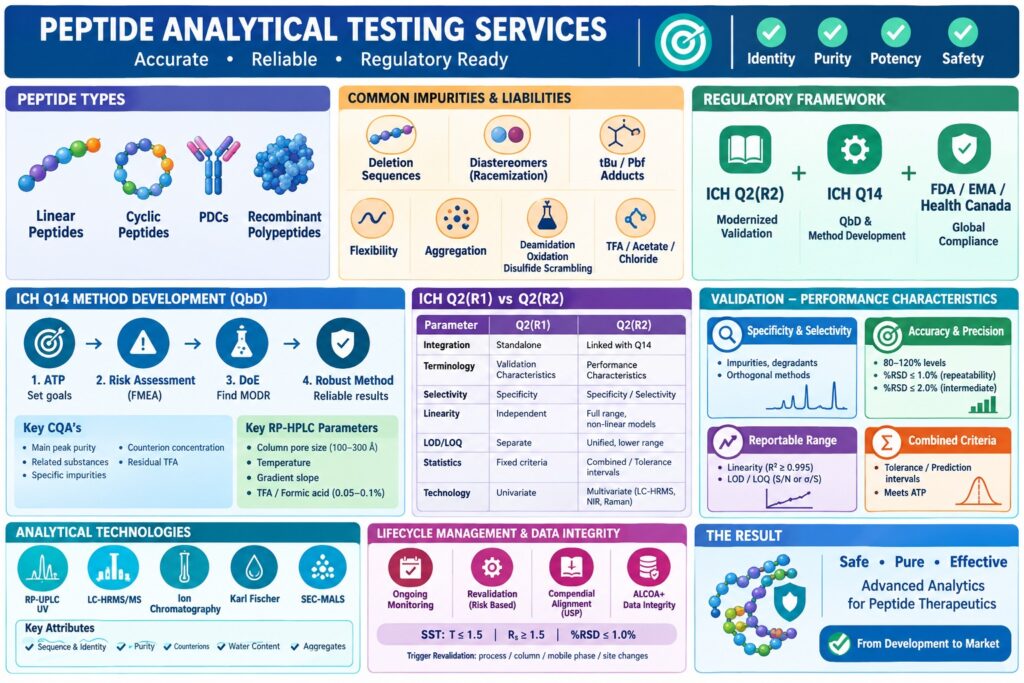
Method development according to ICH Q14 provides a systematic Quality by Design (QbD) framework for Peptide Analytical Testing Services by establishing an Analytical Target Profile (ATP) before formal method validation begins. This organized approach incorporates risk assessments and Design of Experiments (DoE) to establish a Method Operable Design Region (MODR), thereby supporting the robustness of peptide analytical procedures when normal operational variables are encountered.
The application of ICH Q14 shifts peptide method development away from empirical trial-and-error experimentation toward a structured, science- and risk-based approach. The ATP establishes predefined performance expectations for the analytical procedure and identifies requirements such as measurement uncertainty, reportable range, and specificity necessary for monitoring critical quality attributes (CQAs). For complex peptide molecules, these CQAs generally include main peak purity, total related substances, specified impurities such as D-histidine diastereomers or des-Gly deletion sequences, counterion concentration, and residual trifluoroacetic acid (TFA).
Check out our guide on How to Choose a Peptide CDMO in the US to ensure your analytical methods meet FDA expectations.
Risk assessment methodologies, including Failure Mode and Effects Analysis (FMEA), are introduced during the early stages of method development to determine which parameters may significantly influence critical analytical responses. In Reverse-Phase High-Performance Liquid Chromatography (RP-HPLC) or Ultra-High Performance Liquid Chromatography (RP-UPLC), important parameters may include stationary phase pore size, generally 100 Å to 300 Å for favorable peptide mass transfer, column temperature, organic modifier gradient slope, and ion-pairing agent concentration, such as 0.05% – 0.1% TFA or 0.1% formic acid.
Multifactorial DoE studies allow analytical scientists to systematically investigate interactions among these variables and establish the MODR. Experimental data obtained from operating within the MODR during ICH Q14 method development can subsequently contribute directly to the robustness evidence required under ICH Q2(R2). This approach reduces unnecessary duplication between development and validation studies while providing greater operational flexibility for appropriate post-approval analytical method changes.
Read our comparative analysis on Canadian vs US Peptide CDMOs to discover ideal development regions for your molecule.
Modernized Validation Framework: Comparing ICH Q2(R1) and ICH Q2(R2)
The progression from ICH Q2(R1) to ICH Q2(R2) represents a modernization of analytical validation, moving away from isolated evaluation of individual parameters toward a dynamic, risk-based framework that is connected to method development data. The revised framework accommodates contemporary analytical technologies, including LC-HRMS and multivariate models, and permits combined performance criteria to facilitate more integrated statistical assessments.
Under the previous ICH Q2(R1) framework, validation parameters were generally assessed individually against predetermined criteria, with limited formal integration of the information generated during method development. ICH Q2(R2) establishes a stronger connection between method development performed according to ICH Q14 and formal registration validation by considering overall measurement uncertainty in relation to the Analytical Target Profile (ATP).
| Attribute / Parameter | Legacy Framework: ICH Q2(R1) | Modernized Framework: ICH Q2(R2) |
|---|---|---|
| Development Integration | Standalone, isolated testing performed after development. | Direct integration with ICH Q14 Quality by Design (QbD) and Analytical Target Profile (ATP). |
| Terminology Scope | Focuses on static “Validation Characteristics”. | Evaluates dynamic “Performance Characteristics” associated with the intended application. |
| Selectivity Definition | Defined primarily as “Specificity”. | Expanded to “Specificity / Selectivity” to accommodate complex separation matrices. |
| Linearity Evaluation | Treated as an independent validation parameter. | Evaluated directly across the reportable range and permits appropriate non-linear mathematical models. |
| Limit Criteria | Detection Limit (LOD) and Quantitation Limit (LOQ) evaluated as separate parameters. | LOD and LOQ incorporated into unified evaluations of the lower range boundary. |
| Statistical Modeling | Uses fixed and independent acceptance criteria for accuracy and precision. | Allows combined performance criteria using statistical prediction or tolerance intervals. |
| Technology Scope | Primarily centered on univariate chromatographic and spectrophotometric assays. | Explicitly accommodates multivariate models such as NIR and Raman, together with hyphenated platforms such as LC-MS. |
This integration enables information generated during ICH Q14 development, including DoE-based robustness investigations and column batch variability assessments, to contribute directly to the validation evidence required under ICH Q2(R2). As a result, modern Peptide Analytical Testing Services can provide greater regulatory flexibility because appropriate analytical changes performed within an established validated MODR may not automatically require complete method revalidation or regulatory variation procedures.
Learn more about our Peptide CDMO Scale-Up Services to seamlessly bridge the gap from R&D to commercial scale.
Implementing ICH Q2(R2) Performance Characteristics in Peptide Analysis
Validation of peptide testing procedures according to ICH Q2(R2) requires systematic experimental confirmation of predefined performance characteristics, including specificity, accuracy, precision, reportable range, and lower limits, to establish that the analytical procedure is fit for its intended purpose. Completion of these validation studies generates the supporting documentation required for regulatory submissions involving peptide active pharmaceutical ingredients (APIs) and finished drug products.
Specificity, Selectivity, and Resolution of Peptide Impurities
Specificity and selectivity under ICH Q2(R2) demonstrate whether an analytical procedure can reliably measure the target peptide in the presence of structurally related synthetic impurities, deletion sequences, and degradation products. Because peptide-related impurities can possess highly similar physicochemical properties, adequate selectivity may require the combined use of orthogonal chromatographic techniques and mass spectrometric characterization to distinguish closely eluting diastereomers and process-related adducts.
Solid-Phase Peptide Synthesis can produce impurities whose physical chemical characteristics closely resemble those of the parent peptide. Examples include single amino acid deletion sequences such as ΔAla and ΔGly, as well as diastereomers generated through L- to D-amino acid racemization during peptide coupling. Under ICH Q2(R2), when one chromatographic procedure does not provide baseline resolution (R_s ≥ 1.5) for the relevant impurity profile, orthogonal analytical procedures may be required to establish adequate specificity.
Review our comprehensive breakdown on Impurity Control Strategies Under ICH Q3A.
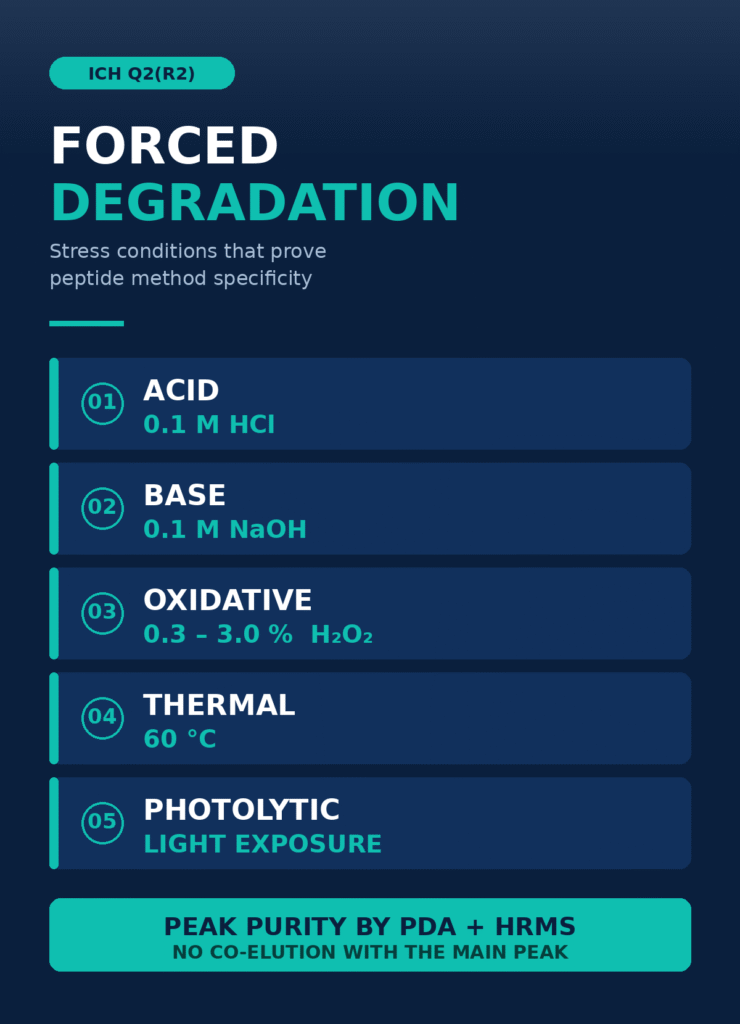
Forced degradation studies are an important component of specificity assessment. Peptide samples are deliberately exposed to stress conditions, including acidic conditions (0.1 M HCl), basic conditions (0.1 M NaOH), oxidative conditions (0.3% – 3.0% H₂O₂), thermal stress (60°C), and photolytic exposure, to generate representative degradation products. Peak purity assessment using Photodiode Array (PDA) detection in combination with High-Resolution Mass Spectrometry (HRMS) can demonstrate whether co-eluting degradation products interfere with accurate quantitation of the active peptide API peak.
Accuracy, Precision, and Combined Performance Criteria
Accuracy and precision establish the degree of agreement between an analytical measurement and its reference or true value while characterizing both short-term repeatability and intermediate inter-day variability. Within ICH Q2(R2), laboratories performing Peptide Analytical Testing Services may integrate accuracy and precision into a combined performance criterion through the application of statistical tolerance intervals or prediction intervals.
Accuracy is typically demonstrated by analyzing synthetic peptide samples prepared by spiking the peptide into matrix or placebo at a minimum of three concentration levels spanning the specified analytical range, commonly 80%, 100%, and 120% of the nominal test concentration. For peptide drug substance assays, mean recovery is generally expected to remain within 98.0%–102.0%. Precision is evaluated at two principal operational levels:
- Repeatability: Repeatability is determined using at least 6 replicate measurements at the 100% test concentration, or through 9 determinations distributed across 3 concentration levels covering the specified range. For peptide active content assays, repeatability relative standard deviation (%RSD) should satisfy ≤ 1.0%.
- Intermediate Precision: Intermediate precision evaluates intra-laboratory variability associated with different testing days, analysts, column lots, and instrument configurations. For assay determinations, total intermediate precision % RSD should remain ≤ 2.0%.
ICH Q2(R2) §3.3.3 formally allows combined performance criteria to be applied when scientifically justified. By establishing a statistical prediction interval or tolerance interval around the overall measurement error, analytical scientists can demonstrate with 95% statistical confidence that future individual analytical measurements are expected to remain within the predefined ATP specification limits.
Reportable Range, Linearity, and Quantitation Limits (LOD/LOQ)
The reportable range represents the concentration interval within which a peptide analytical procedure has demonstrated suitable accuracy, precision, and linearity. Supported by appropriately established Detection Limits (LOD) and Quantitation Limits (LOQ), the reportable range enables dependable measurement of both concentrated active ingredients and low-level related impurities.
Linearity is assessed throughout the reportable range using at least 5 concentration levels. The statistical assessment includes determination of the coefficient of determination (R² ≥ 0.995 for active assays), evaluation of the slope and y-intercept confidence interval, and inspection of residual plots. When peptide signal response becomes non-linear at elevated concentrations because of self-association or detector saturation, weighted linear regression (1/x or 1/x²) or scientifically justified and validated non-linear mathematical models may be used in accordance with ICH Q2(R2).
For trace-level peptide impurities and deletion sequences, LOD and LOQ can be established using signal-to-noise (S/N) measurements or by relating the standard deviation of response (σ) to the slope (S) of the calibration curve:
LOD = 3.3 × σ / S
LOQ = 10 × σ S
Experimental confirmation of the LOQ is required to demonstrate that acceptable precision (% RSD ≤ 10.0%) and accuracy (recovery 80.0% – 120.0%) are achieved at the lower reporting threshold. This threshold is commonly established at approximately 0.05% or 0.10% relative to the nominal target concentration, depending on the analytical procedure and applicable requirements.
Read our step-by-step case study on Scaling a GLP-1 Analog from Preclinical Synthesis to GMP Kilogram Scale.
Analytical Technologies Core to Advanced Peptide Analytical Testing Services
Contemporary Peptide Analytical Testing Services use an integrated portfolio of orthogonal analytical technologies, including RP-UPLC-UV, LC-HRMS/MS, Ion Chromatography, and Coulometric Karl Fischer, to characterize peptide primary structure, purity, counterion composition, and physical liabilities. Combining complementary analytical techniques reduces the possibility of analytical blind spots and provides a more comprehensive assessment of product quality.
An effective peptide testing strategy requires each analytical methodology to be selected according to the specific quality attribute being investigated because no individual analytical technology can comprehensively characterize every chemical, physical, and structural property of a peptide molecule.
| Critical Quality Attribute | Primary Testing Technology | Complementary / Orthogonal Method | Performance Metric & Acceptance Level |
|---|---|---|---|
| Primary Sequence & Identity | LC-HRMS Exact Mass | LC-MS/MS Tandem Sequencing (b/y ions) | Sub-5 ppm mass accuracy; 100% sequence coverage. |
| Chromatographic Purity | RP-UPLC-UV (λ = 214/220 nm) | Hydrophilic Interaction Liquid Chromatography (HILIC) | Baseline resolution (R_s ≥ 1.5) of main peak. |
| Counterion Quantitation | Ion Chromatography (IC) | ¹⁹F-NMR / Capillary Electrophoresis | Precise salt stoichiometry; % w/w content. |
| Residual Water Content | Coulometric Karl Fischer (KF) | Thermogravimetric Analysis (TGA) | Residual moisture typically ≤ 5.0% w/w. |
| Soluble Aggregates | SEC-MALS | Analytical Ultracentrifugation (AUC) | High-molecular-weight species quantified (≤ 1.0%). |
Reverse-Phase UPLC using sub-2 μm hybrid particle columns and acidic mobile phases containing TFA or formic acid offers high chromatographic efficiency for separating closely related peptide impurities. Liquid Chromatography-Tandem Mass Spectrometry (LC-MS/MS), using Electrospray Ionization (ESI) together with Higher-Energy C-Trap Dissociation (HCD) fragmentation, provides definitive sequence confirmation through the assignment of b and y fragment ions. This enables differentiation between the intended peptide sequence and structurally related isomeric variants. Ion Chromatography with suppressed conductivity detection can quantify volatile and non-volatile counterions, including TFA, acetate, chloride, and sodium, generating critical information for establishing accurate net peptide content and supporting complete mass balance assessment.
Learn key considerations in our guide on Formulating a Lyophilized Peptide Injectable.
Lifecycle Management, Data Integrity, and Compendial Alignment
Lifecycle management under ICH Q2(R2) is intended to preserve the fit-for-purpose status of validated peptide analytical methods through ongoing performance monitoring, risk-based revalidation, and rigorous adherence to data integrity requirements. Alignment of analytical validation activities with applicable compendial standards, including USP and USP , together with ALCOA+ data integrity principles, helps protect regulatory submissions from potential compliance deficiencies.
Analytical validation performed according to ICH Q2(R2) directly supports compliance with United States Pharmacopeia General Chapter USP (Validation of Compendial Procedures). When established compendial procedures are received or adopted, testing laboratories perform method verification according to USP (Verification of Compendial Procedures) or apply appropriate method transfer protocols under ICH Q14. These activities confirm that the receiving laboratory can achieve equivalent levels of precision, accuracy, specificity, and other applicable performance requirements.
Explore essential regulatory strategies for CMC Documentation at a CDMO for ANDA.
Continuous verification programs involve routine monitoring of system suitability testing (SST) parameters during release testing and stability studies. Typical peptide SST criteria may include peak tailing factors (T ≤ 1.5), chromatographic resolution (R_s ≥ 1.5), and injection precision (% RSD ≤ 1.0%). Events that may trigger partial or complete method revalidation include modifications to the synthesis route, changes to mobile phase organic modifiers, use of alternative manufacturing lots of the column stationary phase, or transfer of analytical testing activities to another facility.
Discover best practices in our overview of Reference Listed Drug (RLD) Sourcing and Reverse Engineering.
Data integrity controls must comply with ALCOA+ principles, which encompass Attributable, Legible, Contemporaneous, Original, and Accurate data. Automated Chromatography Data Systems (CDS) and Laboratory Information Management Systems (LIMS) should preserve date-stamped and protected audit trails that allow analytical activities to be reconstructed. Raw spectral datasets, chromatographic integration parameters, and calculation templates must be securely retained so that analytical results included in drug applications can be independently reviewed, audited, and verified.
Looking for custom peptide synthesis and analytical expertise in Canada? Learn about our local capabilities for a Peptide CDMO in Canada.
Conclusion: Advancing Therapeutics with Peptide Analytical Testing Services
Comprehensive Peptide Analytical Testing Services conducted within the modernized ICH Q2(R2) and ICH Q14 frameworks provide the analytical infrastructure necessary to support regulatory approval and quality assurance for peptide therapeutics. Advanced bioanalytical technologies, combined with rigorous lifecycle oversight, help maintain control of peptide identity, purity, and potency throughout the various stages of manufacturing and product development.
Integrating Quality by Design principles into analytical method development enables testing procedures to remain scientifically defensible under regulatory review while also supporting appropriate process and method optimization after approval. Combining high-resolution chromatographic separation, exact mass spectrometry, and comprehensive counterion profiling generates the empirical analytical evidence required for the development and commercialization of safe and thoroughly characterized peptide drug products.
Explore our complete suite of Custom Peptide Synthesis Services to advance your development pipeline today.
To consult with experts regarding the design, validation, or transfer of robust analytical methods for your peptide development pipeline, visit the ResolveMass Laboratories Contact Page.
Frequently Asked Questions
ICH Q2(R2) incorporates linearity assessment into the broader evaluation of the reportable range rather than treating it as an entirely independent validation characteristic. The guideline also allows scientifically justified use of weighted regression or appropriate non-linear calibration models when the analytical response does not follow a simple linear relationship. This approach better accommodates complex peptide assay behavior.
Mass spectrometry provides molecular mass information and fragmentation data, including b/y ions, that can support confirmation of peptide composition and sequence. HPLC retention time alone generally cannot conclusively differentiate the intended peptide from isobaric impurities or peptides with altered sequence arrangements. Combining both techniques therefore provides stronger structural identification.
Deletion sequences are peptide-related impurities formed when one or more amino acid residues are absent, commonly because of incomplete coupling during synthesis. Analytical validation must demonstrate that these species can be distinguished from the principal peptide peak. Where applicable, baseline chromatographic separation with R_s ≥ 1.5 supports the specificity assessment.
For peptide drug substance active content assays, repeatability is commonly assessed using six replicate determinations at the specified test concentration. The repeatability criterion is % RSD ≤ 1.0%, while intermediate precision evaluates additional laboratory variables and should remain at % RSD ≤ 2.0%. These criteria demonstrate consistency under defined analytical conditions.
Peptide drug substances are frequently recovered as salts containing counterions such as trifluoroacetate or acetate. Quantifying these components, including by Ion Chromatography, helps determine the actual peptide fraction within the isolated material. This information supports accurate net peptide content, mass balance calculations, and dose-related calculations.
Revalidation may become necessary when significant or intentional changes could affect the established analytical procedure or its performance. Examples include modifications to the peptide synthesis route, formulation composition, mobile phase, chromatographic stationary phase, or relocation of testing to another laboratory. The extent of revalidation should be determined according to the impact and risk associated with the change.
ICH Q14 establishes the Analytical Target Profile (ATP) and provides a structured development framework that can include Design of Experiments (DoE) and robustness investigations. Data generated during these activities can provide scientifically relevant evidence for subsequent ICH Q2(R2) validation. This connection reduces unnecessary duplication and creates continuity between method development and validation.
Forced degradation studies intentionally subject peptide samples to stress conditions such as heat, light, acidic conditions, alkaline conditions, and oxidative environments. The resulting degradation products challenge the analytical procedure’s ability to distinguish the intact peptide from its degradation-related species. Demonstrating appropriate separation and peak purity supports the specificity of the method.
Method validation establishes that a newly developed analytical procedure is suitable for its intended purpose according to applicable requirements such as ICH Q2. Method verification confirms that a laboratory can appropriately perform an established compendial procedure under its own operating conditions. Method transfer establishes that equivalent analytical performance can be achieved when a procedure moves from an originating laboratory to a receiving site.
Reference:
- European Medicines Agency. (2024). ICH Q2(R2) validation of analytical procedures – Scientific guideline. https://www.ema.europa.eu/en/ich-q2r2-validation-analytical-procedures-scientific-guideline
- International Council for Harmonisation of Technical Requirements for Pharmaceuticals for Human Use. (2023). ICH harmonised guideline: Validation of analytical procedures Q2(R2). https://database.ich.org/sites/default/files/ICH_Q2%28R2%29_Guideline_2023_1130.pdf
- International Council for Harmonisation of Technical Requirements for Pharmaceuticals for Human Use. (2022). ICH harmonised guideline: Validation of analytical procedures Q2(R2): Step 2 document. https://database.ich.org/sites/default/files/ICH_Q2-R2_Document_Step2_Guideline_2022_0324.pdf
- Sampathkumar, K., Kendrick, B. S., Gabrielson, J. P., & Ren, D. (2025). Analytical control strategy for biologics. Part II: Roadmap for development and implementation. Journal of Pharmaceutical Sciences, 114(8), 103834. https://doi.org/10.1016/j.xphs.2025.103834
- Ermer, J. (2025). ICH Q2(R2): Validation of analytical procedures. In J. Ermer & P. Nethercote (Eds.), Method validation in pharmaceutical analysis: A guide to best practice (pp. 351–372). Wiley-VCH. https://doi.org/10.1002/9783527831708.ch13
- Afonso Urich, J. A., Fedorko, A., Hölzer, B., & Khinast, J. (2023). Evidence of reliable gastro-resistance of novel enteric ready-to-fill capsules simplifying pharmaceutical manufacturing. Pharmaceutics, 15(11), 2592. https://doi.org/10.3390/pharmaceutics15112592
Get In Touch With Us
About The Author


