

Introduction
Peptide API Scale-Up requires translating laboratory solid-phase synthesis into scalable, robust, and compliant current Good Manufacturing Practice (cGMP) processes capable of producing multi-kilogram batches. Successful Peptide API Scale-Up involves optimizing coupling stoichiometry, controlling resin swelling dynamics, implementing green solvent systems, mathematically scaling preparative reversed-phase high-performance liquid chromatography (RP-HPLC), performing controlled counter-ion exchange, and establishing a Quality by Design (QbD) regulatory framework. As peptide therapeutics continue to advance across metabolic indications, oncology, and targeted delivery platforms, active pharmaceutical ingredient (API) developers must adapt exploratory discovery chemistries to industrial manufacturing environments. Transitioning synthesis from milligram-scale discovery vials to metric-scale commercial production alters reaction kinetics, heat dissipation, mass transfer, waste treatment requirements, and regulatory compliance expectations.
Learn how partnering with a pharmaceutical CDMO in the US and Canada can streamline your transition from discovery to commercial manufacturing.
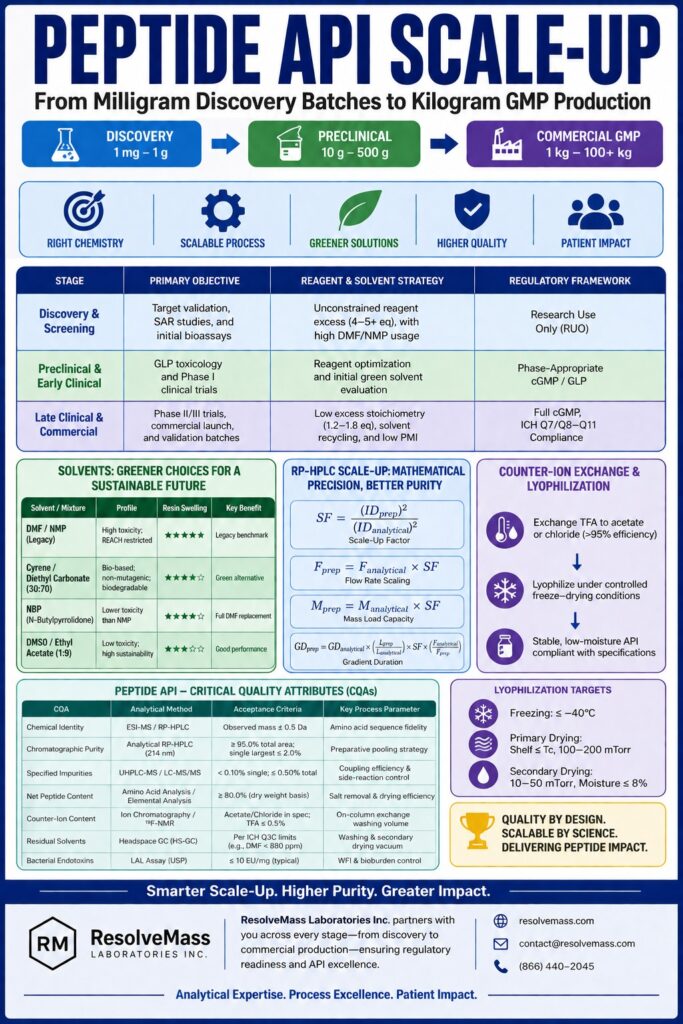
| Development Stage | Typical Batch Scale | Primary Objective | Reagent & Solvent Strategy | Regulatory Framework |
|---|---|---|---|---|
| Discovery & Screening | 1 mg – 1 g | Target validation, SAR studies, and initial bioassays | Unconstrained reagent excess (4–5+ eq), with high DMF/NMP usage | Research Use Only (RUO) |
| Preclinical & Early Clinical | 10 g – 500 g | GLP toxicology and Phase I clinical trials | Reagent optimization and initial green solvent evaluation | Phase-Appropriate cGMP / GLP |
| Late Clinical & Commercial | 1 kg – 100+ kg | Phase II/III trials, commercial launch, and validation batches | Low excess stoichiometry (1.2–1.8 eq), solvent recycling, and low PMI | Full cGMP, ICH Q7/Q8–Q11 compliance |
Article Summary:
- Peptide API scale-up transforms laboratory-scale solid-phase peptide synthesis into robust, cGMP-compliant manufacturing processes capable of producing kilogram-scale batches while maintaining consistent quality, purity, and regulatory compliance.
- Successful scale-up depends on optimizing resin loading, reducing reagent excess, improving coupling efficiency, and controlling reaction conditions to minimize impurities, lower production costs, and enhance overall process efficiency.
- Modern manufacturing increasingly incorporates sustainable solvent systems, replacing traditional solvents such as DMF and NMP with greener alternatives that reduce environmental impact while preserving synthesis performance and supporting global regulatory expectations.
- Large-scale peptide purification relies on scientifically validated preparative RP-HPLC scale-up principles, ensuring consistent flow rates, loading capacity, and gradient optimization to achieve high-purity peptide APIs suitable for clinical and commercial applications.
- After purification, counter-ion exchange and carefully controlled lyophilization convert crude peptide salts into stable pharmaceutical drug substances with reduced residual impurities, optimized moisture content, and improved long-term stability.
- Reliable product quality requires distinguishing chromatographic purity from Net Peptide Content (NPC), supported by comprehensive analytical testing to verify peptide identity, impurity levels, residual solvents, counter-ion content, and overall batch consistency.
- A Quality by Design (QbD) approach integrated with ICH Q7–Q11 guidelines enables manufacturers to define critical quality attributes, control process variability, and ensure scalable, reproducible production of high-quality peptide APIs for commercial use.
Critical Engineering and Chemical Transitions in Peptide API Scale-Up
Peptide API Scale-Up requires a transition from the high reagent excesses commonly used in exploratory synthesis to economically optimized stoichiometry and thermally regulated industrial reactor systems. Managing this transition requires balancing resin loading density, minimizing Process Mass Intensity (PMI), replacing toxic polar aprotic solvents with sustainable alternatives, and controlling reaction kinetics to suppress side-reactions.
At discovery scales, solid-phase peptide synthesis (SPPS) commonly relies on large molar excesses of protected amino acids and expensive coupling reagents to drive reactions toward near completion in small glass vessels. Directly transferring these unoptimized protocols to commercial-scale reactors can result in prohibitive material costs, significant vessel capacity limitations, and unacceptable environmental burdens. Consequently, chemical development teams must systematically re-engineer every unit operation—from solid support selection through final deprotection—to ensure high cycle yields while minimizing raw material consumption.
Explore our comprehensive guide on how a CDMO accelerates generic drug development in the US and Canada.
Solid Support Dynamics and Resin Loading Optimization in Peptide API Scale-Up
Solid support optimization in Peptide API Scale-Up focuses on reducing resin substitution rates and selecting suitable matrix polymers to prevent chain aggregation during synthesis. Lowering the initial resin loading from 0.8–1.2 mmol/g to 0.2–0.4 mmol/g minimizes sterically hindered β-sheet formation, substantially improving coupling efficiency and crude peptide purity for long or hydrophobic sequences.
Although high-loading polystyrene (PS) resins maximize initial mass throughput per reactor volume, the growth of peptide chains on densely functionalized beads promotes intra- and inter-chain association. This on-resin aggregation restricts N-terminal accessibility, leading to incomplete couplings, deletion impurities, and incomplete protecting group removal. To reduce steric overcrowding, process engineers often transition to low-loading polystyrene or polyethylene glycol (PEG)-grafted resins, such as Tentagel or ChemMatrix. Lower substitution rates spatially separate neighboring chains, helping maintain effective solvation and reagent diffusion throughout chain elongation. The associated trade-off—handling larger resin volumes and greater solvent masses per kilogram of finished product—requires precise sizing of mechanical agitators, filtration screens, and reactor jacket heating systems.
Read our detailed breakdown comparing CDMO vs CRO for generic drug development to choose the right partner for your program.
Reagent Stoichiometry and Coupling Kinetics in Peptide API Scale-Up
Optimizing reagent stoichiometry in Peptide API Scale-Up reduces raw material excess from 4–5 equivalents to approximately 1.2–1.8 equivalents while maintaining quantitative coupling yields. Achieving high conversion at reduced reagent concentrations depends on advanced coupling additives such as Oxyma Pure, paired with phosphonium or uronium reagents under controlled thermal jacket heating.
Industrial-scale coupling chemistry depends on suppressing racemization and minimizing side-reactions, including epimerization, aspartimide formation, and diketopiperazine generation. Traditional carbodiimide couplings using dicyclohexylcarbodiimide (DCC) produce insoluble dicyclohexylurea byproducts that can clog industrial reactor filtration frits. Modern scale-up protocols commonly use soluble carbodiimides such as diisopropylcarbodiimide (DIC) in combination with Oxyma Pure or uronium-based activators such as HATU or TATU. In addition, thermal activation using jacketed stainless-steel or glass-lined reactors provides consistent reaction kinetics across different batch volumes, compensating for lower reagent concentrations without significantly extending overall cycle times.
Discover how specialized peptide CDMO services can support your complex synthesis and scale-up requirements.
Green Solvent Integration and Waste Minimization in Peptide API Scale-Up
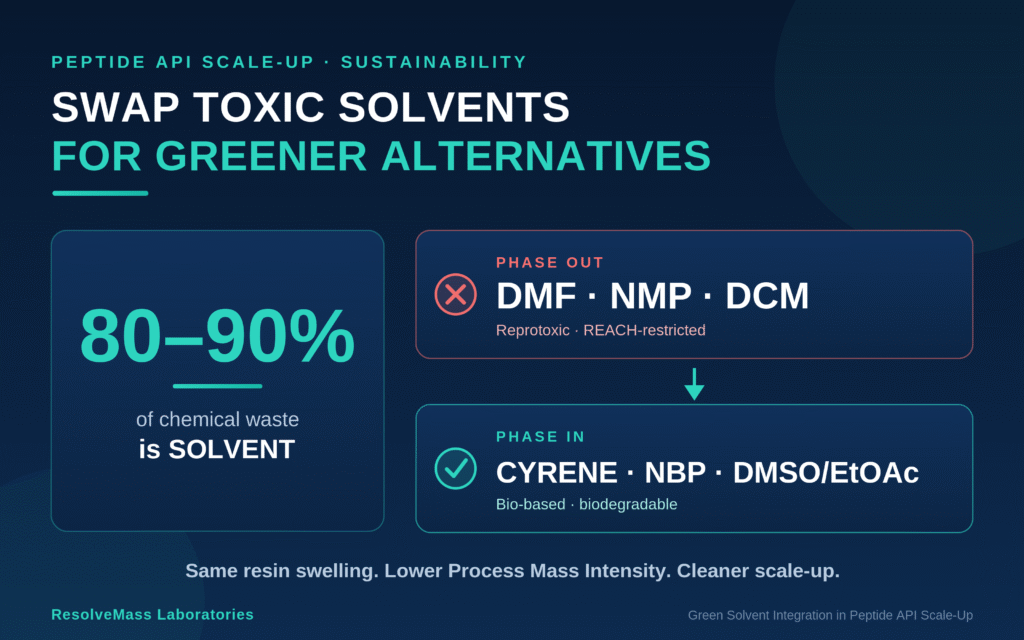
Green solvent integration in Peptide API Scale-Up involves replacing hazardous polar aprotic solvents such as N,N-dimethylformamide (DMF) and N-methyl-2-pyrrolidone (NMP) with more environmentally sustainable alternatives that reduce Process Mass Intensity (PMI). Bio-based solvents such as dihydrolevoglucosenone (Cyrene), N-butylpyrrolidinone (NBP), and binary solvent mixtures such as DMSO/ethyl acetate can maintain resin swelling and solubility while supporting compliance with global REACH restrictions.
Solvent consumption can account for 80% to 90% of the total chemical waste generated during therapeutic peptide production. Regulatory restrictions on DMF, NMP, and dichloromethane (DCM), driven by concerns related to reproductive toxicity, require process teams to incorporate sustainable solvent systems during process development. Binary solvent mixtures can be engineered to approximate the Hansen solubility parameters and Kamlet-Taft polarities of legacy solvents. For example, Cyrene/diethyl carbonate (30:70) and DMSO/ethyl acetate (1:9) systems can provide resin swelling profiles comparable to DMF, supporting rapid Fmoc removal and coupling without increasing backpressure during automated washing cycles.
| Solvent / Mixture System | Regulatory & Environmental Profile | Resin Swelling Efficiency | Operational Application | Process Constraints |
|---|---|---|---|---|
| DMF / NMP (Legacy) | High reproductive toxicity; REACH restricted | Superior benchmark | Traditional SPPS benchmark | Prohibitive waste treatment costs; regulatory phase-out |
| Cyrene / Diethyl Carbonate (30:70) | Bio-derived, non-mutagenic, and biodegradable | High (PS & PEG resins) | Fmoc deprotection and coupling cycles | Base-sensitive; requires strict temperature control |
| NBP (N-Butylpyrrolidone) | Reduced toxicity profile compared with NMP | Excellent | Full DMF replacement in linear SPPS | High viscosity requires increased pump pressures |
| DMSO / Ethyl Acetate (1:9) | Low toxicity and high sustainability rating | Good | Coupling and washing; recyclable through distillation | Limited solubility for highly hydrophobic amino acids |
Downstream Purification and Preparative Calculations for Peptide API Scale-Up
Downstream purification in Peptide API Scale-Up depends on mathematically rigorous chromatographic scale-up equations to transfer analytical separations to industrial column diameters without compromising resolution. Maintaining consistent linear velocity, stationary phase particle size, and proportional mass loading allows predictable purification performance across semi-preparative, pilot-scale, and multi-kilogram production operations.
The isolation of the target therapeutic sequence from crude cleavage mixtures represents a significant cost driver in commercial manufacturing. Crude peptide mixtures contain closely related synthesis byproducts, including single amino acid deletions (des-sequences), truncated fragments, diastereomers resulting from racemization, and incompletely deprotected adducts. Preparative Reversed-Phase HPLC remains the standard technology for isolating active pharmaceutical ingredients with purities exceeding 95.0%.
Review our specialized peptide analytical characterization services to ensure regulatory compliance and fraction purity.
Mathematical Scaling Equations for Preparative RP-HPLC
Preparative RP-HPLC scaling equations define operational flow rates, mass capacities, and gradient durations based on the expansion of column diameter. Applying the geometric cross-sectional area ratio between analytical and preparative columns helps maintain comparable chromatographic resolution, retention behavior, and fraction purity across different scales.
To transfer an analytical scouting method to a preparative scale, engineers calculate column volume (CV) by treating the packed bed as a cylinder:
CV = π × (ID / 2)2 × L
Where ID represents the internal column diameter and L represents the bed length. When column length (L) and stationary phase particle size (dp) remain unchanged between scales, the Scale-Up Factor (SF) can be simplified to the square of the diameter ratio:
SF = (IDprep)2 (IDanalytical)2
To maintain a consistent linear mobile phase velocity (μ) and preserve retention times, the preparative flow rate (Fprep) is scaled proportionally:
SF = (IDprep)2 / (IDanalytical)2
Mass load capacity (Mprep) scales directly according to the calculated Scale-Up Factor (SF):
Mprep = Manalytical × SF
Gradient duration (GD) must remain consistent relative to the number of column volumes passed, resulting in the following relationship:
GDprep = GDanalytical × (Lprep / Lanalytical) × (IDprep / IDanalytical)2 × (Fanalytical / Fprep)
Elution Strategy and Gradient Optimization in Preparative Purification
Optimizing gradient elution during preparative peptide purification requires the use of shallow organic modifier slopes to maximize the separation window between the target API and closely related deletion or diastereomeric impurities. Applying slow acetonitrile gradients (0.1–0.2% ACN/min) at optimized acid concentrations can improve target recovery and support batch purities exceeding 95.0%.
Standard analytical gradients with slopes of 0.5–1.0% ACN/min frequently fail to resolve critical impurity pairs when the column is loaded to preparative capacity. Reducing the gradient slope to 0.1–0.2% ACN/min expands the retention window, enabling cleaner fraction pooling between the principal peak and closely eluting D-amino acid or deletion variants. In addition, increasing trifluoroacetic acid (TFA) modifier concentrations in the mobile phase from 0.05% to 0.20% improves ion-pairing efficiency, sharpens peak shapes, and increases mass loadability per injection cycle.
Learn about our experience in analytical development for generic drugs in Canada for customized purification and method validation.
| Column Designation | Internal Diameter (ID, mm) | Bed Length (L, mm) | Column Volume (CV, mL) | Flow Rate (F, mL/min) | Scale-Up Factor (SF) | Typical Mass Load Range |
|---|---|---|---|---|---|---|
| Analytical | 4.6 | 150 | 2.49 | 1.0 | 1.0× (Baseline) | 1–5 mg |
| Semi-Prep | 21.2 | 250 | 88.2 | 21.2 | 21.3× | 20–100 mg |
| Preparative | 50.0 | 250 | 491 | 118 | 118× | 100–600 mg |
| Pilot Scale | 100.0 | 200 | 1,571 | 472 | 378× | 500–3,000 mg |
| Commercial GMP | 200.0 | 200 | 6,283 | 1,888 | 1,512× | 2,000–15,000+ mg |
Counter-Ion Exchange, Isolation, and Lyophilization in Peptide API Scale-Up
Counter-ion exchange and lyophilization in Peptide API Scale-Up transform crude trifluoroacetate (TFA) salts generated during synthesis into stable, biocompatible drug substances, including acetate or chloride salts. Controlled freeze-drying parameters remove residual volatile solvents and moisture, producing a pharmaceutical powder that complies with strict Net Peptide Content (NPC) and stability specifications.
TFA is the standard acidic cleavage and ion-pairing reagent used during solid-phase synthesis and RP-HPLC purification. However, residual TFA counter-ions associated with basic residues, including Arginine, Lysine, Histidine, and the N-terminus, may exhibit cellular toxicity, cause localized physiological pH reductions, and contribute to long-term peptide aggregation. Regulatory authorities restrict residual TFA levels in finished active pharmaceutical ingredients to ≤ 0.5% or ≤ 0.1%, making efficient counter-ion exchange protocols necessary before final isolation.
Check out our real-world generic peptide drug analytical characterization case study for practical insights.
Methodologies for On-Column and Lyophilization Counter-Ion Exchange
Counter-ion exchange converts potentially toxic trifluoroacetate (TFA) salts into pharmaceutically acceptable acetate or chloride forms through ion-exchange chromatography, on-column RP-HPLC washing, or multiple lyophilization cycles. Processing several column volumes of dilute hydrochloric acid (10–20 mM) or ammonium acetate solutions routinely achieves greater than 95% exchange efficiency while reducing residual TFA levels to below 0.5%.
On-column RP-HPLC exchange provides an efficient and automated approach for commercial-scale production. After the target peptide is captured on a preparative C18 column, the stationary phase is flushed with 3–5 column volumes of 0.1 M ammonium acetate or 10 mM HCl. The target counter-ion displaces the bound trifluoroacetate anions, which are subsequently washed into the waste stream before the peptide is eluted with aqueous acetonitrile. Alternatively, strong anion-exchange resins pre-equilibrated with acetate ions can efficiently process pooled fractions. For lower-volume batches, re-suspending the lyophilized peptide in dilute HCl (2–10 mM), followed by re-lyophilization over 2–3 cycles, can achieve counter-ion conversion that meets commercial specifications.
Understand how to evaluate providers using our criteria for selecting the best peptide CDMO.
Distinguishing Purity from Net Peptide Content in API Specification
Distinguishing chromatographic purity from Net Peptide Content (NPC) is essential for accurately establishing active ingredient dosing and batch release specifications. Chromatographic purity represents the relative proportion of the target peptide compared with peptidic impurities, whereas NPC quantifies the actual mass of the core peptide relative to non-peptidic salts, counter-ions, and water.
Commercial peptide specifications must clearly distinguish chromatographic purity from Net Peptide Content:
Chromatographic Purity (HPLC Area %): Quantifies the target peptide peak area relative to the total integrated peptidic peak areas at 214 nm.
Net Peptide Content (NPC %): Quantifies the mass fraction of the active peptide core within the total lyophilized bulk powder.
Net Peptide Content (%) = Mass of Target Active Peptide Core Total Mass of Lyophilized Powder Bulk × 100
Lyophilized peptide API bulk can contain bound counter-ions (5–15%), residual moisture (2–8%), and trace organic solvents (<0.5%) in addition to the peptide core. Accurate NPC determination through quantitative Amino Acid Analysis (AAA) or Elemental Analysis (EA) helps prevent under-dosing during drug product formulation.
See our dedicated analysis on GLP-1 peptide analytical characterization for metabolic drug characterization requirements.
Industrial Lyophilization Parameters and Moisture Control
Industrial lyophilization requires precise control of freezing rates, primary sublimation temperatures, and secondary desorption vacuum conditions to produce stable API cakes without structural collapse. Maintaining shelf temperatures below the collapse temperature (Tc) and secondary vacuum pressures between 10–50 mTorr helps reduce residual water content to target specifications of ≤ 8.0%.
The freeze-drying cycle represents the final physical transformation of the active pharmaceutical ingredient. Freezing must occur rapidly, typically at ≤ −40°C, to generate uniform micro-crystalline ice structures that facilitate water vapor transport during sublimation. During primary drying, shelf temperatures are maintained below the collapse temperature (Tc) or glass transition temperature (Tg′) under vacuum conditions of 100–200 mTorr to remove ice without causing cake melt-back. Secondary drying then increases the shelf temperature under a high vacuum of 10–50 mTorr to desorb bound water and achieve final moisture specifications suitable for long-term API storage.
Read our detailed peptide characterization case study of semaglutide to examine real-world analytical parameters.
Regulatory Frameworks and Quality by Design (QbD) in Peptide API Scale-Up
Implementing Quality by Design (QbD) frameworks in Peptide API Scale-Up aligns manufacturing operations with ICH Q8–Q11 guidelines to promote consistent product quality and patient safety. Defining Critical Quality Attributes (CQAs), identifying Critical Process Parameters (CPPs), and establishing a validated process design space support compliance with stringent FDA impurity thresholds.
Regulatory agencies regard synthetic peptides as complex chemical drug substances that require stringent control of manufacturing consistency and impurity profiles. Under FDA draft guidance for synthetic peptide drug products, unspecified impurities present at ≥ 0.10% must be identified, while new impurities exceeding 0.50% require explicit toxicological qualification relative to reference standards. Process development teams apply Quality by Design principles early during scale-up to establish a validated design space in which minor operational variations do not adversely affect API quality.
Explore our insights on regulatory support for generic drugs with a US and Canada CDMO.
Defining Critical Quality Attributes (CQAs) and Control Strategies
Critical Quality Attributes (CQAs) for peptide drug substances establish quantitative acceptance criteria for chemical identity, purity, impurity profiles, counter-ion content, residual solvents, and endotoxins. Implementing robust analytical release methods, including LC-MS, HS-GC, and LAL assays, helps ensure that every commercial batch complies with cGMP specifications.
A complete analytical release package combines multiple orthogonal methodologies to comprehensively evaluate active pharmaceutical ingredient quality. High-Resolution Mass Spectrometry confirms molecular weight, while analytical RP-HPLC quantifies target purity and specified impurities. Headspace Gas Chromatography measures residual organic solvents in accordance with ICH Q3C guidelines, and Ion Chromatography verifies counter-ion stoichiometry.
Discover strategies when you decide to outsource peptide manufacturing to a CDMO.
| Critical Quality Attribute (CQA) | Primary Release Analytical Method | Standard cGMP Acceptance Criteria | Associated Process Parameter (CPP) |
|---|---|---|---|
| Chemical Identity | ESI-MS / MALDI-TOF MS & RP-HPLC | Observed mass within ± 0.5 Da of theoretical | Amino acid sequence assembly fidelity |
| Chromatographic Purity | Analytical RP-HPLC (214 nm) | ≥ 95.0% total area; single largest ≤ 2.0% | Preparative chromatographic pooling strategy |
| Specified Impurities | Orthogonal UHPLC-MS / LC-MS/MS | Unspecified impurities < 0.10%; maximum < 0.50% | Coupling efficiency and side-reaction suppression |
| Net Peptide Content | Amino Acid Analysis (AAA) / EA | ≥ 80.0% (dry weight basis) | Isolation, salt removal, and drying efficiency |
| Counter-Ion Content | Ion Chromatography (IC) or ¹⁹F-NMR | Acetate/Chloride matched to specification; TFA ≤ 0.5% | On-column salt exchange washing volume |
| Residual Solvents | Headspace Gas Chromatography (HS-GC) | Conforms to ICH Q3C limits, e.g., DMF < 880 ppm | Washing efficiency and secondary drying vacuum |
| Bacterial Endotoxins | LAL Assay (USP) | ≤ 10 EU/mg (application dependent) | Water for Injection (WFI) and bioburden control |
Conclusion: Mastering Peptide API Scale-Up
Mastering Peptide API Scale-Up requires the integration of chemical synthesis optimization, linear chromatographic scale-up equations, rigorous counter-ion exchange, controlled lyophilization, and a Quality by Design regulatory framework. By systematically addressing scale-up risks throughout every stage of development and manufacturing, pharmaceutical developers can successfully transition discovery molecules into scalable, high-purity commercial drug substances.
ResolveMass Laboratories Inc. offers expertise in analytical characterization, impurity identification, and process validation to support complex peptide programs. Explore technical capabilities or discuss process development requirements by contacting the specialist team directly through the ResolveMass Contact Page.
Frequently Asked Questions
TFA counter-ions may remain associated with peptide molecules after cleavage and RP-HPLC purification and can create concerns related to cytotoxicity, localized pH effects, aggregation, and long-term product stability. For this reason, TFA is commonly exchanged for more biocompatible counter-ions, such as acetate or chloride. The exchange process is designed to reduce residual TFA to levels that meet established safety and regulatory expectations. Effective counter-ion control is therefore an important part of peptide API isolation and scale-up.
When the column bed length and stationary phase particle size remain unchanged, preparative HPLC flow rate is scaled according to the ratio of the cross-sectional areas of the two columns. This means that the flow rate increases with the square of the ratio between the preparative and analytical internal diameters. Maintaining this relationship helps preserve linear mobile phase velocity and comparable retention behavior. As a result, the chromatographic method can be transferred between column scales with more predictable performance.
Several alternatives can be evaluated as replacements for DMF in solid-phase peptide synthesis, including dihydrolevoglucosenone (Cyrene), N-butylpyrrolidinone (NBP), cyclopentyl methyl ether (CPME), and 2-methyltetrahydrofuran (2-MeTHF). Binary systems such as DMSO/ethyl acetate and Cyrene/diethyl carbonate may also be used depending on the resin and chemistry. The selected solvent system must provide suitable resin swelling and adequate reagent solubility. It should also support reduced environmental impact and practical process performance at scale.
Liquid-Phase Peptide Synthesis (LPPS) or hybrid segment condensation may become more attractive when manufacturing involves high production volumes or relatively short peptide sequences, particularly those containing fewer than 10 amino acids. These approaches can reduce dependence on costly solid supports and enable purification of intermediates during the process. However, LPPS may introduce additional challenges related to solubility, isolation, and process handling. Solid-phase methodologies generally remain more suitable for longer and structurally complex peptide sequences.
For highly purified synthetic peptides, new unspecified impurities present at or above 0.10% generally require structural identification under applicable FDA regulatory expectations. When a new unspecified impurity exceeds 0.50%, additional toxicological assessment and safety qualification may be required. These thresholds help ensure that potentially significant impurities are adequately characterized. Impurity control strategies should therefore be incorporated into process development and analytical testing from an early stage.
Excessively high resin loading can create steric crowding as peptide chains grow, increasing the likelihood of intra-chain aggregation and β-sheet formation. These effects can restrict reagent access to reactive sites and contribute to incomplete couplings and deletion impurities. Reducing the loading to approximately 0.2–0.4 mmol/g increases the spacing between growing peptide chains. This improved spatial separation can enhance reagent diffusion, coupling efficiency, and the purity of the resulting crude peptide.
Peptide structural identity is best confirmed using complementary analytical techniques rather than relying on a single test. High-Resolution Electrospray Ionization Mass Spectrometry (ESI-MS) or MALDI-TOF can verify the expected molecular mass, while Amino Acid Analysis (AAA) can provide information about amino acid composition and stoichiometry. RP-HPLC retention time comparison with an appropriate reference standard provides additional confirmation. Together, these orthogonal methods provide a more comprehensive identity assessment for cGMP release testing.
Preventing cake collapse requires maintaining the product temperature below the collapse temperature (Tc) or glass transition temperature (Tg′) during primary drying. Carefully controlled shelf temperatures and vacuum conditions, typically within the range of 100–200 mTorr, support efficient sublimation while preserving the structure of the dried cake. Maintaining these conditions helps prevent melt-back and structural collapse. The resulting porous cake can provide improved physical stability and more efficient reconstitution.
Quality by Design (QbD) applies a systematic approach to peptide manufacturing by defining the Quality Target Product Profile (QTPP) and identifying the Critical Quality Attributes (CQAs) that determine product quality. Design of Experiments (DoE) can then be used to evaluate process variables and establish the relevant Critical Process Parameters (CPPs). These studies support the definition of an appropriate process design space. Operating within this scientifically justified space helps maintain consistent API quality when minor process variations occur.
Reference:
- Richardson, P., Bryan, M. C., Diorazio, L., Gallou, F., Keily, S., Martinez, I., Plummer, S., Reed, A. B., Sheppard, R., Shields, J., Wrigley, G., Yeung, C., & Enríquez-García, Á. (2025). Solvent sustainability in drug discovery: Where are we now, and how can we improve? Journal of Medicinal Chemistry, 68(24), 25625–25664. https://doi.org/10.1021/acs.jmedchem.5c01220
- FDA. (2021). ICH Q11 Q&A: A supporting document for the selection and justification of starting materials and regulatory considerations for impurity qualification [PDF]. U.S. Food and Drug Administration. https://www.fda.gov/media/147595/download
- Chen, Y., Mant, C. T., & Hodges, R. S. (2006). Preparative reversed-phase high-performance liquid chromatography collection efficiency for an antimicrobial peptide on columns of varying diameters (1 mm to 9.4 mm I.D.). Journal of Chromatography A, 1140(1–2), 112–120. https://doi.org/10.1016/j.chroma.2006.11.052
- Jordan, A., Hall, C. G. J., Thorp, L. R., & Sneddon, H. F. (2022). Replacement of less-preferred dipolar aprotic and ethereal solvents in synthetic organic chemistry with more sustainable alternatives. Chemical Reviews, 122(6), 6749–6794. https://doi.org/10.1021/acs.chemrev.1c00672
Get In Touch With Us
About The Author


