
Introduction
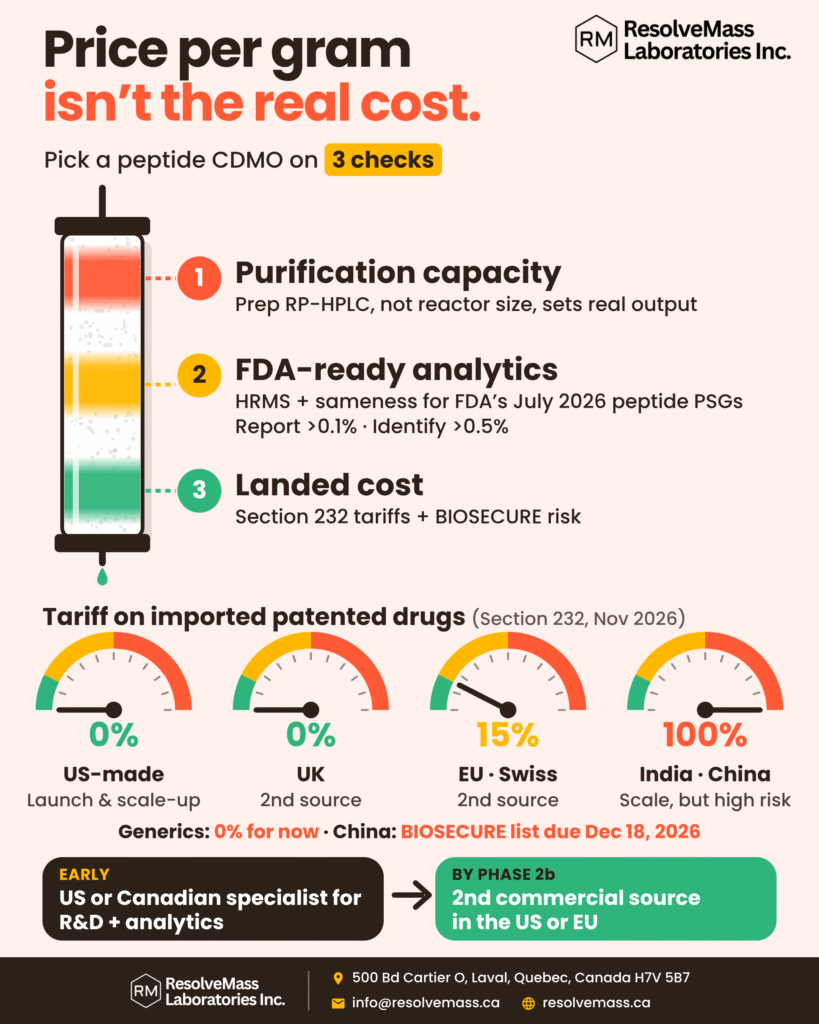
Choosing the right Peptide CDMO in the United States, or determining when to combine domestic manufacturing with a Canadian nearshore partner or an offshore facility in Europe or Asia, requires careful consideration of three critical factors: downstream purification throughput, orthogonal analytical readiness in accordance with the FDA’s July 2026 peptide guidances, and landed-cost exposure under Section 232 pharmaceutical tariffs and the BIOSECURE Act. Sponsors that assess contract manufacturers primarily on the basis of per-gram synthesis quotations often overlook regulatory rework, technology-transfer delays, and commercial import duties, all of which can significantly increase landed product costs and, in some cases, double the overall expense.
The growing urgency surrounding peptide sourcing reflects considerable structural pressure across the global manufacturing supply base. According to Grand View Research figures reported by World Pharma Today, the global peptide therapeutics market was valued at approximately $140.9 billion in 2025 and is projected to reach $294.6 billion by 2033. Meanwhile, the peptide and oligonucleotide CDMO market is expected to expand from $3.1 billion in 2025 to $8.1 billion by 2033. Industry models circulated during 2026 estimate that demand for GLP-1 active pharmaceutical ingredients (APIs) alone could reach nearly 99,000 kilograms annually by 2030. This represents a substantial transition for a chemical modality that was previously manufactured in quantities of tens of kilograms per franchise but is now moving toward metric-tonne industrial production volumes.
At the same time, three significant policy developments in 2026 have made CDMO geography an increasingly important regulatory and financial consideration. These include the FDA’s July 28, 2026, withdrawal of its 2021 synthetic peptide guidance, accompanied by 17 revised draft Product-Specific Guidances (PSGs); the September 29, 2026, expansion of Section 232 pharmaceutical tariffs to all importers; and the December 18, 2026, deadline for the Office of Management and Budget (OMB) to publish its BIOSECURE list. Together, these developments have made manufacturing location a strategic factor in pharmaceutical development, regulatory planning, and commercial supply-chain management.
Share via:
Quick Summary:
- Price per gram is misleading. Regulatory rework, tech-transfer delays and import duties can push a peptide’s landed cost far above its synthesis quote, sometimes doubling it. Location is now a strategic choice because of three 2026 events: FDA’s new peptide guidances, Section 232 drug tariffs and the BIOSECURE Act.
- Demand is outpacing capacity. The peptide therapeutics market is projected to grow from about $140.9B (2025) to $294.6B by 2033, with GLP-1 API demand nearing 99,000 kg a year by 2030. Much new investment targets commercial scale, so slots for early-stage and clinical programs are tighter.
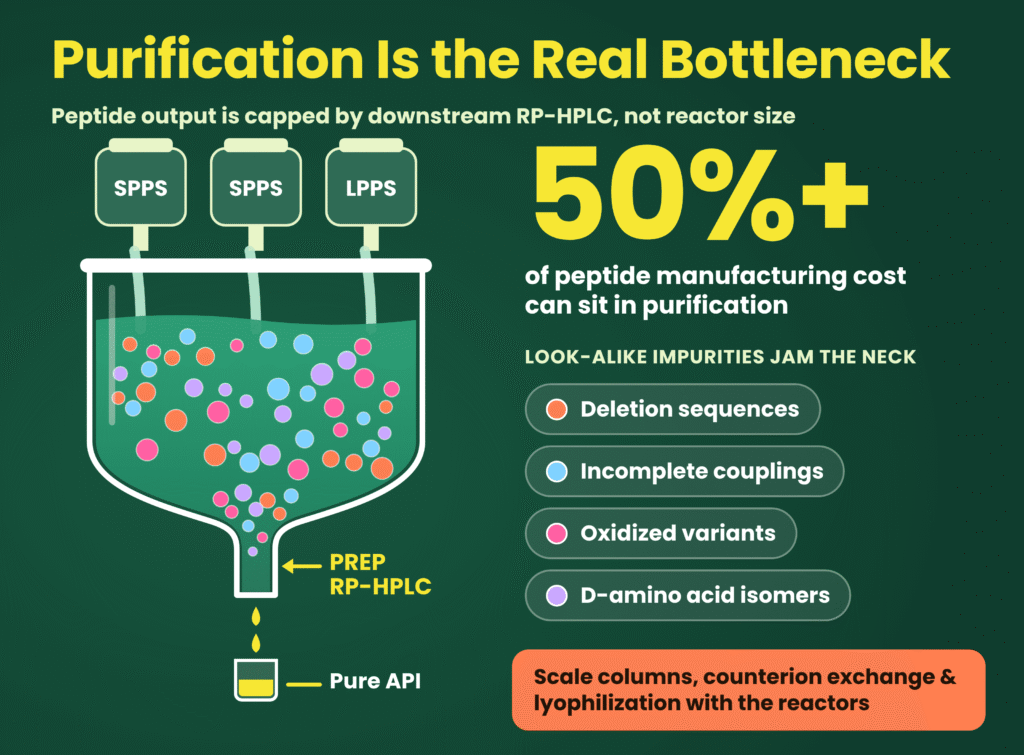
- Purification is the real bottleneck. Preparative RP-HPLC, counterion exchange and lyophilization capacity determine actual output more than reactor size, and purification can take more than half of production time and cost.
- FDA expectations have changed. On July 28, 2026, FDA withdrew its 2021 synthetic peptide guidance and issued 17 revised draft PSGs. CDMOs now need in-house HRMS, orthogonal sameness testing, impurity identification (report above 0.1%, identify above 0.5%), immunogenicity assessment and forced-degradation capability.
- Operational checks matter. Sponsors should look at first-time-right batch rates, FDA inspection and import-alert history, written slot commitments, direct access to scientists and Part 11 data integrity before signing.
- Each region has a different trade-off:
- US sites carry no Section 232 duty on US-origin products but have tight capacity.
- Canada offers integrated early R&D and analytics but has no FDA MRA and no tariff cap for patented drugs.
- EU and Swiss sites are capped at 15%, and the UK is now at 0%, not the 10% the article states.
- India and China offer scale but face a 100% default tariff on patented drugs, and China carries added BIOSECURE risk, with the OMB list due December 18, 2026.
- Recommended strategy is a hybrid. Use a US or FDA-registered Canadian specialist for early, analytics-heavy work. Then qualify a US or treaty-aligned European commercial second source by Phase 2b or before ANDA submission, and write tariff and BIOSECURE terms into CDMO contracts.
Technical Criteria for Selecting a Peptide CDMO in the United States
Assessing a Peptide CDMO in the United States or an international alternative requires a detailed evaluation of purification infrastructure, high-resolution mass spectrometry capabilities, and integrated project execution before considering reactor capacity. In the manufacturing of complex synthetic and semi-synthetic peptides, production failures and regulatory delays are more frequently associated with chromatographic impurity bottlenecks, insufficient sameness characterization, and fragmented coordination between multiple vendors than with upstream coupling chemistry itself.
Synthesis Modality Fit and the Purification Bottleneck
The actual manufacturing capacity of a peptide CDMO depends more heavily on its preparative reverse-phase high-performance liquid chromatography (RP-HPLC) purification capabilities and its ability to support multiple synthesis modalities than on the total volume of its reactors. Longer peptide sequences, including 31- to 39-amino-acid GLP-1 receptor agonists, as well as cyclic, disulfide-rich, stapled, and conjugated peptides, commonly produce closely eluting impurities. These may include deletion sequences, incomplete coupling products, oxidized variants, and epimerized D-amino acid isomers, all of which require specialized separation and characterization strategies.
Industry operational assessments indicate that purification-intensive manufacturing of complex peptides can account for more than half of the overall production time and manufacturing expenditure. Facilities that increase their solid-phase peptide synthesis (SPPS) reactor capacity without proportionately expanding RP-HPLC columns, counterion exchange systems, and lyophilization trains frequently create internal work-in-process bottlenecks. At commercial manufacturing scales, long-chain peptides may require a hybrid approach that combines SPPS for protected fragment assembly with liquid-phase peptide synthesis (LPPS) for subsequent fragment coupling, all within a unified quality system.
Understand how manufacturing capacity and purification infrastructure influence commercial peptide production through our peptide CDMO scale-up services.
Although a 2026 market estimate reported through GlobeNewswire valued global capital investment in GLP-1 CDMO infrastructure during 2025 at approximately $24.86 billion, a considerable proportion of this investment focused on commercial production capacity. Consequently, manufacturing slot availability for early-stage and clinical-volume peptide programs has become more constrained than it was two years earlier.
Orthogonal Analytical Readiness Under the July 2026 FDA Peptide Rules
Any CDMO supporting US regulatory submissions should possess in-house high-resolution mass spectrometry (HRMS), LC-MS/MS, enzymatic peptide mapping, and higher-order structure characterization capabilities to address the FDA’s updated expectations for impurity control and molecular sameness. Under the Federal Food, Drug, and Cosmetic Act, the FDA generally regulates polymers containing 40 or fewer amino acids as chemically synthesized drugs rather than biologics. Nevertheless, peptide drugs are specifically excluded from the standard ICH Q3A and Q3B impurity qualification guidelines.
On July 28, 2026, the FDA formally withdrew its May 2021 guidance, ANDAs for Certain Highly Purified Synthetic Peptide Drug Products That Refer to Listed Drugs of rDNA Origin, explaining that the document no longer represented current scientific thinking. The agency also issued 17 revised draft PSGs covering generic versions of semaglutide, tirzepatide, liraglutide, teriparatide, glucagon, dasiglucagon, calcitonin salmon, pegcetacoplan, and vosoritide.
Considering these 2026 draft PSGs and recent FDA review deficiencies, sponsors should confirm that prospective CDMOs can demonstrate the following five analytical capabilities:
1. Comprehensive orthogonal physicochemical sameness characterization: The CDMO should be capable of establishing equivalence in primary sequence, salt/ester composition, secondary and higher-order structure, and biological activity. These assessments should include comparisons involving aged and stressed Reference Listed Drug (RLD) lots to demonstrate that the proposed generic product maintains the required physicochemical and functional characteristics.
2. Impurity controls aligned with the updated 2026 draft PSGs: The facility should have validated stability-indicating analytical methods capable of reporting impurities above 0.1% and structurally identifying impurities above 0.5%. Shared impurities should remain within RLD levels or 1.0%, whichever is greater, while newly identified impurities should remain below 1.0%. Total impurities present above 0.1% should not exceed the corresponding RLD total. These expectations represent an evolution from the withdrawn 2021 guidance, which established a 0.5% ceiling for new impurities.
3. Innate and adaptive immunogenicity assessment: Analytical workflows should be available to evaluate peptide-related impurities for potential T-cell epitopes and compare innate immune response modulating impurities (IIRMIs) or aggregates. Under the 2026 draft PSGs, in vitro innate immune testing may be waived only when the impurity and aggregation profiles demonstrate sufficient similarity to those of the RLD.
4. In-house forced degradation and impurity synthesis: The CDMO should be able to isolate or synthesize trace oxidation, deamidation, and truncation variants for definitive structural characterization. Depending exclusively on chromatographic retention-time matching is insufficient, as this approach has contributed to previous FDA rejections.
5. Device compatibility and stability testing: The facility should have experience assessing peptide stability and aggregation within combination delivery systems, including pre-filled syringes and auto-injectors. These studies are essential for understanding potential interactions between the peptide formulation and its delivery device throughout the product’s intended shelf life.
Explore advanced peptide characterization approaches using semaglutide as a case study to understand the analytical considerations involved in complex peptide development.
Quality Systems, Slot Continuity, and Eliminating Multi-Vendor Context Loss
Development programs frequently experience delays when sponsors distribute custom synthesis, impurity identification, formulation development, and analytical validation among multiple contractors that do not share integrated datasets. Fragmented workflows can result in repeated investigations, inconsistent analytical interpretations, and unnecessary technology-transfer activities. Before signing a master services agreement, Chemistry, Manufacturing, and Controls (CMC) teams should assess five important operational and compliance indicators:
1. First-time-right batch performance: Request historical batch success data covering both clinical and commercial manufacturing campaigns. As a general industry benchmark, operators frequently identify an 85%–90% success rate as typical and rates above 95% as indicative of top-tier performance. However, no independent peptide-specific industry audit currently establishes standardized cross-vendor performance rates.
2. Public inspection and import-alert history: Review the FDA Data Dashboard for No Action Indicated (NAI), Voluntary Action Indicated (VAI), and Official Action Indicated (OAI) classifications. Sponsors should also examine available FDA warning letters and confirm that non-US manufacturing facilities are not listed under FDA Import Alert 66-40.
3. Written manufacturing slot reservations and single-site scale-up: Obtain binding written commitments for manufacturing capacity instead of relying on verbal availability estimates. It is equally important to establish whether the transition from pilot-scale production to commercial manufacturing can take place within the same quality system.
4. Direct scientist access and person-in-plant provisions: Determine whether PhD chemists and analytical scientists communicate directly with the sponsor’s technical team or whether scientific questions must pass through account managers. The agreement should also clearly define cleanroom observation rights and person-in-plant arrangements.
5. CMC dossier preparation and 21 CFR Part 11 data integrity: Evaluate electronic audit trails and data-integrity controls. Confirm whether the CDMO can prepare regulatory-ready analytical characterization reports, method validation packages, and IND/ANDA CMC modules to support regulatory submissions.
Learn how integrated manufacturing and development partnerships differ by reviewing our guide to Peptide CDMO vs. CMO services.
US, Canadian, and Offshore Peptide CDMOs Compared
Domestic US CDMOs eliminate commercial Section 232 import tariffs on qualifying US-origin products and provide a more direct route for FDA oversight. Canadian nearshore partners offer closely integrated early-stage development and analytical services, supported by convenient travel and real-time scientific collaboration. European and UK manufacturing facilities combine established commercial production capabilities with tariff ceilings ranging from 0% to 15% under applicable Mutual Recognition Agreements (MRAs) and trade arrangements. Asian facilities, particularly those in India and China, offer substantial reactor capacity but may expose sponsors to 100% tariffs on covered patented products and additional BIOSECURE-related compliance risks.
Because no independent peer-reviewed study provides a standardized comparison of fully loaded per-gram manufacturing costs across all four regions, procurement teams should calculate landed costs per US product unit. These calculations should account for applicable HTSUS Chapter 99 duty classifications, the likelihood of analytical rework, and anticipated technology-transfer timelines.
| Evaluation Dimension | US Domestic CDMOs | Canada (Nearshore) | Europe & UK (Offshore) | India & China (Offshore) |
|---|---|---|---|---|
| Primary Technical Strength | Clinical-to-commercial SPPS, conjugation, and sterile fill-finish | Early-stage synthesis, complex HRMS/NMR analytics, polymer formulation, and IND/ANDA CMC | Established commercial SPPS/LPPS capabilities developed over multiple decades, including the Malmö expansion | Multi-tonne SPPS/LPPS capacity; approximately 90% of new US API DMFs in 2025 |
| Regulatory & MRA Standing | Direct FDA cGMP jurisdiction; issues eCPPs for export | Health Canada DEL and optional US FDA site registration; no FDA-Canada GMP MRA | Active US-EU, US-UK, and US-Switzerland MRAs; FDA continues selective inspections | FDA-, EMA-, and PMDA-inspected facilities are available; Import Alert 66-40 diligence remains essential |
| Section 232 Tariff Exposure (as of November 2026) | 0% additional duty for qualifying US-origin APIs and dosage forms | 0% for clinical/R&D and generics, subject to the April 2027 review; no 15% ceiling for patented drugs | 15% cap for the EU and Switzerland; 10% moving toward 0% for the UK; 0% for qualifying clinical and specialty products | 100% default rate for covered patented APIs and drugs without applicable onshoring or MFN arrangements |
| Supply Chain & Policy Risk | Minimal trade exposure, but intense competition for manufacturing slots and peptide QC personnel | Relatively low geopolitical risk, with uncertainty surrounding the April 2027 generic tariff review | Relatively low geopolitical risk, although trans-Atlantic cold-chain logistics require careful management | Elevated risk in China because of the December 18, 2026, OMB BIOSECURE list deadline; commercial tariff exposure in India |
| Optimal Program Fit | US commercial patented launches, sterile fill-finish, and late-stage scale-up | Preclinical and IND programs, impurity identification, generic sameness, and multi-modality R&D | Patented commercial dual-sourcing and long-chain commercial API production | Non-US markets, cost-sensitive generic products before the 2027 review, and multi-tonne API manufacturing |
Domestic Sourcing with a Peptide CDMO in the United States
Selecting a Peptide CDMO in the United States can protect commercial patented products from Section 232 import duties when manufacturing meets the applicable domestic-origin requirements. Qualifying US-origin active ingredients and dosage forms enter duty-free under HTSUS heading 9903.04.68. Domestic manufacturing also makes on-site quality audits and technical oversight more accessible.
Under Proclamation 11020, signed on April 2, 2026, patented drugs listed in the FDA Orange Book or Purple Book, together with their APIs and key starting materials across 131 HTSUS Chapter 29 and 30 provisions, are subject to a default 100% tariff unless an applicable exemption or alternative arrangement applies. These provisions include domestic-origin exemptions, qualifying specialty-product categories, and bilateral or corporate agreements.
However, domestic US manufacturing also presents significant capacity and workforce limitations. Greenfield sterile manufacturing and peptide facilities can require several years and investments of up to $2 billion to establish. As a result, emerging and mid-sized biotechnology companies without established internal manufacturing infrastructure must compete with larger pharmaceutical sponsors for available US CDMO capacity.
Workforce assessments published in November 2026 identify peptide quality control, oligonucleotide/peptide CMC, and Annex 1 sterile fill-finish validation as some of the most difficult US positions to recruit for. For early-stage sponsors requiring gram-to-kilogram manufacturing batches, large US commercial CDMOs may prioritize established, higher-volume customers. This can make smaller programs more dependent on nearshore facilities that offer greater flexibility and responsiveness during early development.
Review the key considerations involved in choosing a peptide CDMO in the United States before selecting a manufacturing partner.
Canadian Nearshore CDMOs: Integrated Science and Trade Boundaries
Canadian peptide CDMOs provide US sponsors with same-time-zone scientific collaboration, convenient site access, and extensive analytical integration. These capabilities make Canadian facilities particularly suitable for preclinical peptide synthesis, generic peptide sameness characterization, and IND or ANDA preparation. Instead of arranging international travel and coordinating across distant time zones, US technical teams can work directly with Canadian bench scientists to address complex coupling reactions, polymer encapsulation, and purification challenges.
For complex modalities, including generic GLP-1 peptides such as semaglutide, liraglutide, and tirzepatide, as well as lanreotide, peptide-oligonucleotide conjugates, and PLGA or PEG-copolymer sustained-release systems, integrated Canadian laboratories can minimize the scientific context loss associated with transferring molecules between separate synthesis, polymer, formulation, and mass spectrometry contractors.
ResolveMass Laboratories Inc. in Laval, Quebec, represents this integrated development model. Its PhD chemists and analytical scientists support custom synthesis, forced-degradation impurity profiling, polymer science, formulation development, and orthogonal characterization through HRMS, LC-MS/MS, NMR, quantitative NMR, HPLC, ICP-MS, and thermal analysis. These activities are conducted using a shared dataset within a single facility.
By operating an ISO 9001:2015 certified quality system alongside a Health Canada Drug Establishment Licence (DEL) and active US FDA registration (Establishment ID 3042696771), nearshore specialists following this model can support the transition from research and development to US regulatory submissions.
Discover the capabilities and development considerations involved in working with a Peptide CDMO in Canada.
Nevertheless, sponsors evaluating commercial US supply from Canada must consider two important regulatory and trade limitations:
1. Absence of a US-Canada GMP Mutual Recognition Agreement: Although the FDA maintains active pharmaceutical GMP MRAs with the European Union, Switzerland, and the United Kingdom, no bilateral FDA-Health Canada GMP MRA is currently in force. Canada maintains separate MRAs with Switzerland, expanded on January 31, 2025, to include APIs and extra-jurisdictional inspections, and with the European Union under CETA for finished pharmaceutical products. However, APIs remain temporarily excluded from the Canada-EU CETA scope.
Consequently, US sponsors working with Canadian manufacturing and analytical facilities should independently verify active US FDA establishment registration and assess the regulatory status of the specific manufacturing site.
2. Section 232 exposure for commercial patented exports: Imports intended exclusively for clinical trials, research and development, or other non-commercial purposes remain subject to 0% additional duty. Generic pharmaceuticals are also currently excluded under heading 9903.04.67. However, customs guidance confirms that Section 232 duties can apply even to products that qualify under Free Trade Agreements.
Since Canada does not have the 15% tariff ceiling secured by the EU, Japan, and Switzerland, commercial patented drugs exported from Canada face greater potential tariff exposure. Canadian generic manufacturers must also consider uncertainty surrounding the April 2, 2027, Commerce Department review, which will examine whether Section 232 tariffs should be extended to generic pharmaceuticals. This uncertainty is further complicated by an announced, although not yet enacted, schedule indicating potential generic tariffs of 100%–200% during 2028–2029.
Compare the regulatory, manufacturing, and trade considerations of Canadian vs. US peptide CDMOs when developing a North American sourcing strategy.
European and UK Offshore CDMOs: MRA Leverage and Tariff Caps
European, Swiss, and UK CDMOs combine decades of commercial SPPS and LPPS experience with active US FDA MRAs and comparatively lower Section 232 tariff ceilings than those applicable to non-treaty manufacturing regions.
Under the US-EU MRA, which became operational for most human medicines in July 2019 and was expanded to veterinary products in May 2026, regulators exchange inspection certificates and waive routine import batch testing within the agreement’s covered product categories. Similar arrangements operate under the US-UK and US-Switzerland MRAs.
Nevertheless, these agreements do not eliminate FDA oversight or reduce established cGMP requirements. FDA inspection records indicate that the agency continued conducting targeted inspections of European manufacturing facilities throughout 2026. Therefore, sponsors must continue evaluating manufacturing quality, inspection history, and regulatory compliance when selecting European partners.
Regarding landed manufacturing economics, Proclamation 11020 establishes a 15% cap on patented pharmaceutical tariffs for the EU, Switzerland, and Liechtenstein. The United Kingdom is subject to a 10% additional duty, with the rate scheduled to move toward 0% under bilateral US-UK agreements. Qualifying specialty products, including orphan drugs and antibody-drug conjugates, may receive 0% rates under applicable conditions.
Major European peptide CDMOs remain attractive options for commercial dual-sourcing strategies. One example is PolyPeptide Group’s expansion in Malmö, Sweden, which involved an investment of approximately $116.2 million (EUR 100 million). Progressed during 2025, the expansion was intended to double the company’s SPPS capacity, strengthening its ability to support large-scale commercial peptide manufacturing.
Evaluate the potential benefits and limitations of international manufacturing through our comparison of US and overseas peptide CDMOs.
Asian Offshore CDMOs: Tonnage Scale vs. 100% Tariffs and BIOSECURE Risk
Indian and Chinese CDMOs offer substantial commercial peptide manufacturing capacity. Together, these markets accounted for approximately 90% of new API Drug Master Files (DMFs) filed for US medicines in 2025. However, covered patented pharmaceutical imports face a 100% Section 232 tariff in the absence of an approved onshoring arrangement or applicable pricing agreement. Chinese manufacturing also presents additional compliance considerations associated with the BIOSECURE Act.
Leading Indian peptide CDMOs inspected by the FDA, EMA, and PMDA operate extensive reactor infrastructure. For example, Neuland Laboratories reports SPPS reactor capacities of up to 750 liters and LPPS reactor capacities ranging from 250 to 6,250 liters. The company has also targeted an additional 6,370 liters of capacity by late 2026.
For non-US markets and non-patented generic products before the April 2027 US tariff review, Indian CDMOs can offer attractive manufacturing economics, particularly when supported by satisfactory FDA inspection records and appropriate quality oversight.
For China-based CDMOs, procurement and regulatory risks are closely associated with Section 851 of the FY2026 NDAA, commonly referred to as the BIOSECURE Act, which was signed into law on December 18, 2025. The legislation restricts federal executive agencies, federal contractors through supply-chain flow-down provisions, and recipients of federal grants or loans, including NIH and BARDA award recipients, from procuring or using biotechnology equipment or services from designated “Biotechnology Companies of Concern” (BCCs).
The designation framework incorporates both the Pentagon’s Section 1260H list and an OMB BCC list scheduled for publication by December 18, 2026.
Although WuXi AppTec obtained a preliminary injunction in the U.S. District Court on August 7, 2026, and was removed from the 1260H list effective November 5, 2026, the Department of Defense explicitly stated that the removal was made “without prejudice to relisting”. This means that its status may remain subject to future review.
Several additional factors make China-based manufacturing a significant consideration for US pharmaceutical supply chains. First, the OMB BCC list is scheduled for publication by December 18, 2026. Second, existing-contract grandfathering provisions do not apply to entities included on the 1260H list at the time of enactment. Third, China-origin patented drugs are subject to the 100% Section 232 duty unless an applicable exemption or alternative arrangement is available. Finally, China’s NMPA discontinued routine drug GMP certificates in 2019, making direct verification of inspection reports particularly important.
Considering these regulatory, tariff, and supply-chain uncertainties, relying on a single China-based manufacturing facility for US pharmaceutical programs can create substantial transition and continuity risks.
The following table summarizes the principal Section 232 tariff classifications and policy timelines relevant to pharmaceutical sourcing as of November 2026.
| Supply Route or Company Tier (as of November 2026) | HTSUS Chapter 99 Heading | Effective Section 232 Duty Rate | Key Sunset or Policy Review Date |
|---|---|---|---|
| US-Origin Active Ingredient in Dosage Form | 9903.04.68 | 0% additional duty (Column 1 rate only) | Permanent domestic exemption |
| Clinical Trials and R&D Non-Commercial Imports | Exemption | 0% additional duty | Active since September 29, 2026 |
| Generic Pharmaceuticals and Biosimilars | 9903.04.67 | 0% additional duty (currently excluded) | Commerce tariff review due April 2, 2027 |
| Specialty Products (Orphan, ADC, CGT, Nuclear) | 9903.04.66 | 0% additional duty (conditional) | Requires a framework agreement or urgent health need |
| Approved Onshoring Plan + HHS MFN Pricing Deal | 9903.04.65 | 0% additional duty | Terminates January 20, 2029 |
| Commerce-Approved Onshoring Plan Only | 9903.04.64 | 20% additional duty | Increases to 100% on April 2, 2030 |
| EU, Japan, South Korea, Switzerland, Liechtenstein | 9903.04.62 | 15% total headline cap | Subject to bilateral trade agreements |
| United Kingdom | 9903.04.63 | Column 1 + 10% (moving toward 0%) | Pending final US-UK implementation |
| Non-Deal Countries (e.g., India, China, Israel, Singapore) | 9903.04.60 | 100% default headline rate | Applies in the absence of onshoring, MFN, or specialty-tier arrangements |
How to Structure a Hybrid North American and Offshore Sourcing Strategy
For most emerging and mid-sized US biopharmaceutical companies, a lower-risk sourcing strategy in late 2026 involves combining an agile North American specialist, either a US manufacturing facility or an FDA-registered Canadian nearshore partner, with a domestic US or treaty-aligned European commercial supplier offering a 0%–15% tariff ceiling.
This approach allows sponsors to obtain July 2026 PSG-compliant analytical support during early development while preserving access to commercially scalable manufacturing capacity. Since clinical-trial imports remain duty-free and early-stage peptide programs frequently encounter regulatory obstacles because of impurity or sameness deficiencies rather than API batch pricing, investing in analytical rigor from the beginning can help protect development capital and FDA review timelines.
Sponsors developing a peptide CDMO shortlist should follow these five steps:
1. Determine patent status and HTSUS exposure first: Establish whether the candidate product is a patented asset listed in the Orange Book or Purple Book, a generic ANDA product subject to the April 2027 Commerce review, or an exempt specialty therapy. Obtain written customs-origin guidance to understand the applicable tariff classification and potential financial exposure before finalizing the manufacturing location.
2. Evaluate HRMS and purification capabilities before reactor capacity: Examine the facility’s preparative RP-HPLC infrastructure, HRMS/LC-MS/MS impurity identification workflows, and forced-degradation capabilities. These capabilities should be assessed against the requirements outlined in the 17 July 2026 draft PSGs to establish whether the CDMO can support the required impurity characterization and sameness assessments.
3. Consolidate early R&D and analytical characterization: Whenever possible, maintain custom synthesis, impurity synthesis, polymer or formulation development, and stability testing within a unified scientific dataset. This approach reduces fragmented communication, minimizes repeated analytical investigations, and limits technology-transfer difficulties before IND or ANDA submission.
4. Incorporate tariff and BIOSECURE provisions into CDMO MSAs: Include contractual requirements for batch-level country-of-origin documentation covering APIs and key starting materials. Clearly allocate responsibility for applicable customs duties, require advance written approval for manufacturing-site changes, and prohibit unauthorized subcontracting to entities designated under Section 1260H or the OMB BCC list.
5. Establish a secondary commercial manufacturing route by Phase 2b or before ANDA submission: Identify and qualify an alternative commercial manufacturing facility in the United States or Europe with an applicable 0%–15% tariff ceiling. Alternatively, consider licensing arrangements with a manufacturing partner that already benefits from an approved onshoring or MFN pricing arrangement. Establishing this alternative route before NDA or ANDA submission can reduce the risk of commercial supply interruptions.
Conclusion
Selecting the right Peptide CDMO in the United States, or developing a phased hybrid manufacturing strategy involving US, Canadian nearshore, and treaty-aligned European facilities, has a direct influence on whether a peptide development program progresses successfully through FDA review and enters the commercial market with sustainable profit margins.
Sponsors should evaluate preparative RP-HPLC purification capacity alongside synthesis capabilities, require orthogonal HRMS characterization and impurity-immunogenicity assessment aligned with the July 2026 draft PSGs, and incorporate Section 232 tariff exposure and BIOSECURE compliance milestones into their sourcing decisions from the beginning.
A structured evaluation of these factors enables biopharmaceutical companies to move away from fragmented and vulnerable manufacturing arrangements toward more resilient CMC execution and dependable commercial supply chains.
For companies seeking an integrated North American partner for peptide characterization, generic sameness packages, custom impurity synthesis, or polymer-enabled formulation without the complications of multiple vendor handoffs, ResolveMass Laboratories Inc. provides direct, bench-level collaboration with PhD chemists and analytical scientists from its single facility in Laval, Quebec.
Operating under an ISO 9001:2015 certified quality system, with a Health Canada Drug Establishment Licence and active US FDA registration (Establishment ID 3042696771), ResolveMass supports complex peptide and IND/ANDA development programs with 24/7 technical responsiveness.
Connect directly with the scientific team through the contact page.
Frequently Asked Questions
Canadian pharmaceutical exports do not receive an automatic exemption from Section 232 tariffs simply because they qualify under a Free Trade Agreement. However, clinical and R&D materials currently benefit from 0% additional duties, while generic pharmaceuticals remain excluded under heading 9903.04.67, subject to the April 2, 2027, Commerce review. Consequently, Canada can be an attractive location for early development and analytical services, although commercial patented products require a separate tariff assessment.
On July 28, 2026, the FDA withdrew its May 2021 synthetic peptide ANDA guidance and introduced 17 revised draft Product-Specific Guidances (PSGs). These updates place greater emphasis on molecular sameness, higher-order structure, biological activity, and comparative impurity and immunogenicity assessments. Peptide CDMOs must therefore demonstrate appropriate orthogonal analytical capabilities, including HRMS, peptide mapping, and comparative testing against aged and stressed Reference Listed Drug (RLD) lots.
No. Although WuXi AppTec was removed from the Section 1260H list effective November 5, 2026, following a preliminary court injunction, the Department of Defense clarified that the decision did not prevent future relisting. Furthermore, the OMB’s initial Biotechnology Companies of Concern list is due by December 18, 2026. US sponsors connected to federal funding, BARDA contracts, or covered supply chains should therefore continue evaluating potential BIOSECURE Act restrictions.
A capable peptide CDMO should maintain HPLC, HRMS, and LC-MS/MS capabilities for purity assessment, molecular characterization, and identification of unknown impurities. Amino acid analysis (AAA) and enzymatic peptide mapping are also important for evaluating composition, sequence integrity, oxidation, deamidation, and isomerization. Additionally, in-house forced-degradation studies and validated stability-indicating analytical methods help establish impurity control and support FDA CMC documentation.
Peptide purification frequently requires more than half of the total manufacturing time and cost because structurally similar impurities can be difficult to separate from the target peptide. Deletion sequences, incomplete coupling products, and epimerized variants may exhibit closely matching chromatographic properties. If SPPS production expands without corresponding investment in preparative RP-HPLC and lyophilization infrastructure, intermediates accumulate and restrict overall manufacturing throughput.
Canadian nearshore facilities can be particularly beneficial during discovery, IND-enabling development, generic ANDA sameness studies, and polymer-based formulation projects. They provide convenient communication with North American teams, direct access to PhD scientists, and integrated analytical services. Sponsors facing limited clinical manufacturing slots or fragmented vendor arrangements in the United States may benefit from Canada’s flexible development capabilities and 0% additional duties on qualifying R&D materials.
No. The US-EU Mutual Recognition Agreement allows regulatory authorities to recognize qualifying GMP inspection outcomes from their partner agencies and waive routine import batch testing within the agreement’s scope. However, the FDA retains its authority to conduct inspections when necessary, including targeted inspections of European facilities. Sponsors should verify the manufacturing site’s regulatory standing, confirm the relevant product scope, and conduct independent quality audits before approving a CDMO.
Solid-phase peptide synthesis (SPPS) builds peptide chains through sequential amino acid additions on a solid resin, making it particularly useful for controlled synthesis and clinical-scale manufacturing. Liquid-phase peptide synthesis (LPPS) performs reactions in solution and can provide economic advantages when assembling larger protected peptide fragments. Hybrid manufacturing combines both approaches, allowing commercial CDMOs to optimize long-chain peptide production, improve process efficiency, and manage sequence-related impurities within an integrated quality system.
Sponsors should be cautious of facilities with recent FDA warning letters, Official Action Indicated (OAI) classifications, or listings under Import Alert 66-40. Other concerns include restricted access to quality audits, inadequate client references, frequent changes in analytical or QA leadership, and dependence on unqualified external laboratories for critical mass spectrometry testing. A CDMO that refuses to document purification performance, manufacturing capacity, or confirmed production slots in writing may also present significant operational and compliance risks.
Reference:
- U.S. Food and Drug Administration. (2026, July 28). FDA publishes revised draft product-specific guidances for certain generic peptide products. https://www.fda.gov/drugs/drug-alerts-and-statements/fda-publishes-revised-draft-product-specific-guidances-certain-generic-peptide-products
- U.S. Food and Drug Administration. (2022, November). Sameness evaluations in an ANDA—Active ingredients: Guidance for industry (Draft guidance). U.S. Department of Health and Human Services. https://www.fda.gov/media/163018/download
- U.S. Food and Drug Administration. (2022, November). Sameness evaluations in an ANDA—Active ingredients: Guidance for industry (Draft guidance). U.S. Department of Health and Human Services. https://www.fda.gov/media/163018/download
- Pang, E. (2022, September 20). Assessing immunogenicity risk of peptides: The synthetic peptide guidance and PSGs [Conference presentation]. U.S. Food and Drug Administration, SBIA 2022: Advancing Generic Drug Development. https://www.fda.gov/media/166571/download
- U.S. Food and Drug Administration. (n.d.). Mutual recognition agreements (MRA). U.S. Department of Health and Human Services. https://www.fda.gov/international-programs/international-arrangements/mutual-recognition-agreements-mra
- U.S. Pharmacopeia. (n.d.). India leads API manufacturing capacity while China grows at the fastest pace on record. https://www.usp.org/blog/india-leads-api-manufacturing-capacity-while-china-grows-fastest-pace-record
- European Medicines Agency. (n.d.). Mutual recognition agreements (MRA). https://www.ema.europa.eu/en/human-regulatory-overview/research-development/compliance-research-development/good-manufacturing-practice/mutual-recognition-agreements-mra
- Health Canada. (n.d.). Mutual recognition agreement between Canada and Switzerland. Government of Canada. https://www.canada.ca/en/health-canada/services/drugs-health-products/compliance-enforcement/international/mutual-recognition-agreements/updates/mutual-recognition-agreement-canada-switzerland.html
Get In Touch With Us
About The Author