
Introduction
A Peptide CDMO Project Timeline extending from contract kickoff to Good Manufacturing Practice (GMP) active pharmaceutical ingredient (API) release generally ranges from 5.5 to 18 months. The actual duration depends on several factors, including peptide sequence complexity, the scope of analytical validation, and cleanroom scheduling. For relatively straightforward GMP manufacturing campaigns, vendor-reported timelines typically average 3 to 6 months. When manufacturing processes and analytical testing procedures are already established, completion may take approximately 6 to 12 weeks. However, integrated First-in-Human (FIH) programs involving API synthesis, analytical validation, and sterile drug product supply generally require 10 to 11 months. Developing a complete API manufacturing process from initial route selection can extend the timeline to 12 to 24 months, while complex peptide generics and long-acting depot formulations may require 24 to 42 months of CDMO development.
There is currently no independent, industry-wide empirical benchmark that establishes standardized timelines for every synthetic peptide modality. Most publicly available duration estimates are derived from contract development and manufacturing organization (CDMO) case studies and individual platform assessments. Across these programs, upstream amino acid coupling is rarely the primary factor controlling the overall schedule. Instead, limitations in preparative chromatography, regulatory requirements for identifying impurities at concentrations starting from 0.10%, and delays in cleanroom availability frequently determine when clinical materials can be delivered. These scheduling constraints also explain why sponsors are often advised to initiate CDMO discussions 12 to 18 months before their intended GMP batch production date.
Planning a peptide manufacturing program and need to evaluate your CDMO options? Explore how to choose a peptide CDMO in the United States based on manufacturing capabilities, analytical expertise, and project requirements.
Share via:
Quick Summary:
- Overall span: contract kickoff to GMP API release typically runs 5.5–18 months in vendor-reported figures, with no independent industry-wide benchmark; established linear peptides can clear GMP in 3–6 months, while complex cyclic, lipidated or PEGylated molecules need 10–12+ months and peptide generics or depot formulations 24–42 months.
- Six overlapping stages: feasibility and route selection (2–4 weeks) → starting material sourcing (up to ~12 months for specialty linkers) → process development (1–4 months non-GMP) → analytical method validation (2–5 months) → GMP synthesis, purification and lyophilization (6 weeks–6 months) → QC release and QA CoA (2 days–8 weeks). Running analytics, procurement and formulation in parallel removes months from the critical path.
- Route choice drives complexity: automated Fmoc SPPS suits linear sequences up to ~30–40 residues; LPPS fits short peptides and linkers at large scale; hybrid convergent synthesis (fragment + ligation) is the practical route for 30–60+ residue targets such as GLP-1 analogues, and switching to it can rescue a stalled program’s crude purity.
- Downstream processing, not coupling, sets the clock: peptide-related impurities (deletions, insertions, oxidation, D-isomers) resemble the target closely, so low crude purity forces repeat preparative HPLC cycles. Column void-volume tailing (10–20%, over 30% at large scale), counter-ion exchange, lyophilizer hold-up (15–25%) and MACO cleaning validation all add cleanroom time.
- Analytical work is peptide-specific: peptides sit fully or partly outside ICH Q3A/B, Q6A/B and M7, so a single UV-HPLC purity number isn’t enough — UHPLC-UV, LC-HRMS, peptide mapping, amino acid analysis and ion chromatography are needed, plus net peptide content to avoid overstating active mass. ICH Q2(R2) validation takes 2–5 months, up to ~28 weeks with ongoing API support.
- Four recurring bottlenecks: long-lead starting materials (specialty linkers up to a year), ISO 7 and aseptic fill-finish capacity (slots booked 1–2 years out, 6–12 months for a filling slot), mid-program CDMO or site changes (12–18 months of revalidation risk, 8–18 months for method transfer alone), and QC consumption of small Phase I lots, which can eat 20–40% of a 20 g batch.
- How to compress without cutting corners: engage the CDMO 12–18 months before the target GMP batch, screen hybrid routes during feasibility, pre-order long-lead building blocks at kickoff, develop and stress-test ICH Q2(R2) methods on non-GMP lots, size Phase I batches above the QC consumption floor, and keep API, drug product and release testing under one quality system.
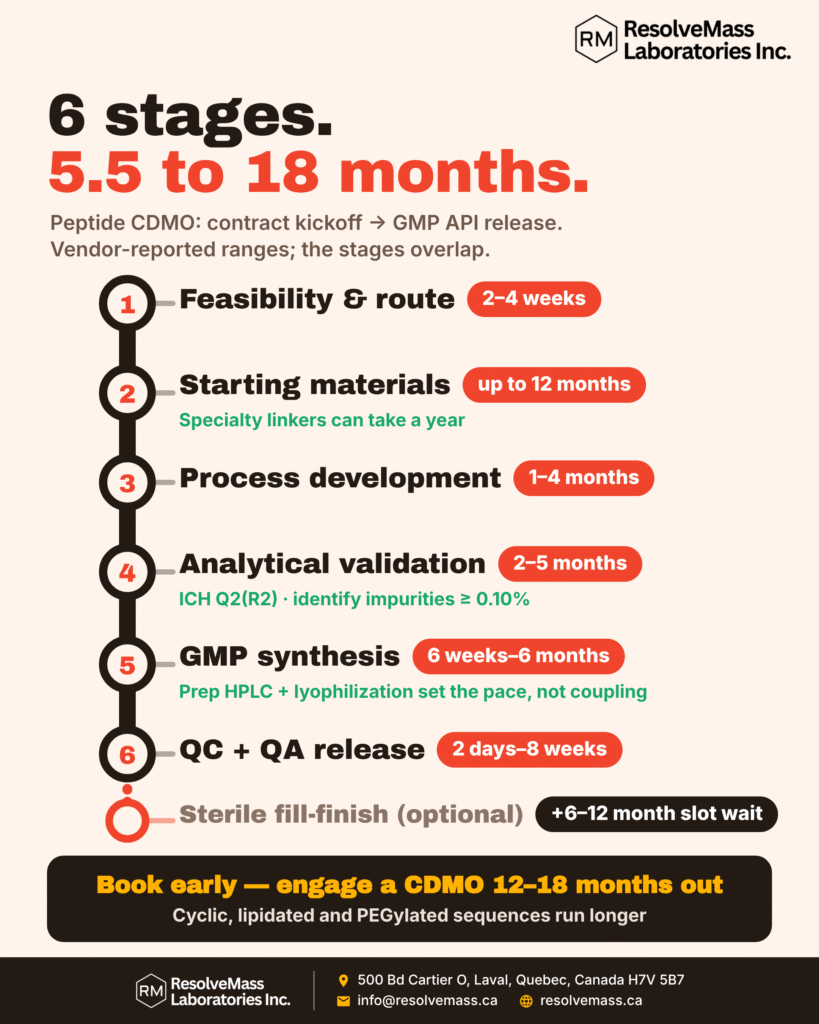
End-to-End Peptide CDMO Project Timeline Breakdown
An end-to-end Peptide CDMO Project Timeline generally progresses through six sequential but partially overlapping stages: feasibility assessment and route selection, starting material procurement, process development, analytical method validation, GMP synthesis and purification, and Quality Assurance (QA) batch release. Projects that conduct analytical development, formulation activities, and Chemistry, Manufacturing, and Controls (CMC) documentation alongside non-GMP synthesis can eliminate several months from the critical path compared with programs that complete each activity strictly in sequence.
| Project Phase | Typical Duration | Core Technical & Regulatory Deliverables | Primary Schedule Risk |
|---|---|---|---|
| Feasibility, NDA & Route Selection | 2–4 weeks (generic CDMO benchmark) | Sequence risk assessment, mutual NDA execution, route scouting (SPPS, LPPS, or hybrid), and formal proposal preparation | Underestimating aggregation or deletion errors in sequences exceeding 30 residues |
| Raw Material Sourcing & Qualification | Variable (up to 12 months for specialty linkers) | Protected amino acid procurement, incoming QC testing, and ICH Q11 starting material dossier preparation | Single-source supply delays involving unnatural amino acids or PEG/lipid modifiers |
| Process Development & Non-GMP Supply | 1–4 months (non-GMP / GLP tox); 12–24 months (complete API route-to-scale development) | Optimization of coupling and deprotection, salt exchange, lyophilization cycle development, and GLP toxicology batch production | Low crude purity (<10%) requiring an unplanned mid-project route change |
| Analytical Method Development & Validation | 2–5 months (generic CDMO benchmark); up to 28 weeks for full API support | UHPLC-UV purity testing, LC-HRMS identity confirmation, peptide mapping, forced degradation, and ICH Q2(R2) validation | Failed validation runs, co-eluting D-isomers, or delays in reference standard availability |
| GMP Synthesis, Purification & Lyophilization | 6–12 weeks (small/kilo GMP run); 3–6 months average | ISO 7 cleanroom SPPS/LPPS, preparative HPLC purification, counter-ion exchange, and freeze-drying under ICH Q7 | Column void-volume tailing, lyophilizer wall losses, and MACO cleaning restrictions |
| QC Release Testing & QA Batch Release (CoA) | 2 days–8 weeks | Release assay, sequence MS, amino acid analysis, ICH Q3D ICP-MS, nitrosamine LC-MS/MS, and CoA approval | Out-of-specification (OOS) investigations or stability failures |
| Sterile Fill-Finish (Optional Drug Product) | 12 weeks execution (+8 weeks–12 months slot wait) | Aseptic vial or pre-filled syringe filling, container closure integrity testing, and DP release | Disconnected API-to-fill-finish operations and limited aseptic manufacturing capacity |
The clinical development stage also influences the amount of time allocated to process development. Phase I manufacturing campaigns, typically involving 10 g to 250 g of peptide material, primarily prioritize sequence identity, appropriate safety controls, and timely clinical supply. In contrast, Phase II and Phase III pivotal manufacturing campaigns, generally ranging from 250 g to 5 kg, require additional activities such as hold-time validation, optimization of chromatographic loading conditions, and more stringent impurity acceptance criteria.
Scaling from laboratory synthesis to clinical or commercial manufacturing requires careful process optimization. Explore peptide API scale-up strategies to understand the technical considerations involved in transitioning peptide production across manufacturing scales.
How Do Synthesis Route and Molecular Complexity Shift the Timeline?
Peptide sequences containing more than 30 to 40 amino acids, particularly those incorporating chemical modifications such as cyclization, disulfide bridging, PEGylation, or fatty-acid lipidation, can extend manufacturing schedules considerably. These projects may move beyond the typical vendor-reported average of 3 to 6 months and require 10 to 11 months or longer. Solid-phase peptide synthesis (SPPS) is a well-established approach for relatively short, linear sequences containing approximately 30 residues or fewer. However, as sequence length increases, incomplete coupling reactions and deletion sequences can accumulate exponentially, reducing crude purity and increasing the number of purification cycles required.
To accommodate different peptide sequence lengths and manufacturing scales, CDMOs generally select from three primary synthesis architectures. Automated Fmoc SPPS supports sequences containing up to 40+ residues, with production ranging from gram quantities to more than 25 kg per batch. This approach offers relatively rapid turnaround for early-phase manufacturing, although solvent consumption becomes substantial when longer peptide chains are synthesized.
Liquid-phase peptide synthesis (LPPS) avoids resin-related expenses and is particularly suitable for short peptides containing 2 to 15 residues or linkers manufactured at commercial scales exceeding 100 kg. However, each coupling step requires intermediate purification, which increases the overall processing time and makes LPPS less efficient for extended peptide sequences.
Hybrid convergent synthesis combines protected peptide fragments produced through SPPS with subsequent ligation in solution. By isolating deletion-related impurities within shorter peptide segments, this approach can improve manufacturing efficiency for targets containing approximately 30 to 60+ residues, including GLP-1 analogues.
Selecting an appropriate synthesis architecture is essential for improving process efficiency and manufacturing scalability. Explore peptide CDMO scale-up services to understand how process optimization and manufacturing strategies support larger-scale peptide production.
A published WuXi TIDES case study involving DD01, a 30-amino-acid PEGylated GLP-1/glucagon dual agonist, demonstrates how selecting an alternative synthesis route can help recover a compressed project schedule. The initial linear synthesis approach achieved only 5% purity despite optimization efforts. Switching to a hybrid fragment-and-linear synthesis strategy increased crude purity to 15%–20%. This improvement supported the delivery of more than 20 batches within 6 weeks, non-GMP GLP toxicology API within 4 months, and GMP drug substance, drug product, and an IND-ready CMC dossier within 10 to 11 months.
GLP-1 peptide manufacturing requires careful coordination of synthesis, purification, and scale-up activities. Read about scaling a GLP-1 analog from preclinical synthesis to GMP manufacturing.
Similarly, CordenPharma’s integrated FIH platform reports the release of linear, branched, or cyclic GMP peptide drug products containing up to 40–45 amino acids, with batch sizes ranging from 50 to 600 g, in less than 11 months from drug substance project kickoff.
| Peptide Modality / Architecture | Preferred Synthesis Route | Reported Timeline Benchmarks | Primary Chemistry & Schedule Driver |
|---|---|---|---|
| Simple Linear Peptide (≤30 residues) | Automated Fmoc SPPS | 3–6 months average GMP batch (Asymchem); 6–12 weeks for established small GMP runs (Helix Peptide) | Standard RP-HPLC polishing and salt exchange |
| Short Peptide / Linker (2–15 residues) | LPPS | Campaign-dependent (no standardized benchmark; stepwise intermediate processing adds cycle time) | Intermediate isolation/crystallization and bulk solvent abatement |
| Cyclic / Disulfide-Bridged Peptide | SPPS or Hybrid + Orthogonal Cyclization | Up to approximately 11 months (integrated FIH DP release); 1–3 months for approximately 1 kg non-GMP supply | Regioselective disulfide bridging, dilution control, and ring topology confirmation |
| Modified / Lipidated / PEGylated GLP-1 (30–60+ residues) | Hybrid SPPS/LPPS Fragment | 10–11 months (integrated IND case study); 5.5 months in an expedited GLP-1 vendor case; 12–18 months with onboarding | Fragment ligation conversion, D-isomer co-elution, and long-lead linkers |
| Peptide Generics & Long-Acting Depots | Hybrid + PLGA Microsphere Formulation | 24–42 months (CDMO generic/depot development); 6–12 years after patent expiry to depot approval | RLD peptide mapping comparability, burst release control, and 24-week dosing follow-up |
Why Downstream Purification Dictates the Peptide CDMO Project Timeline
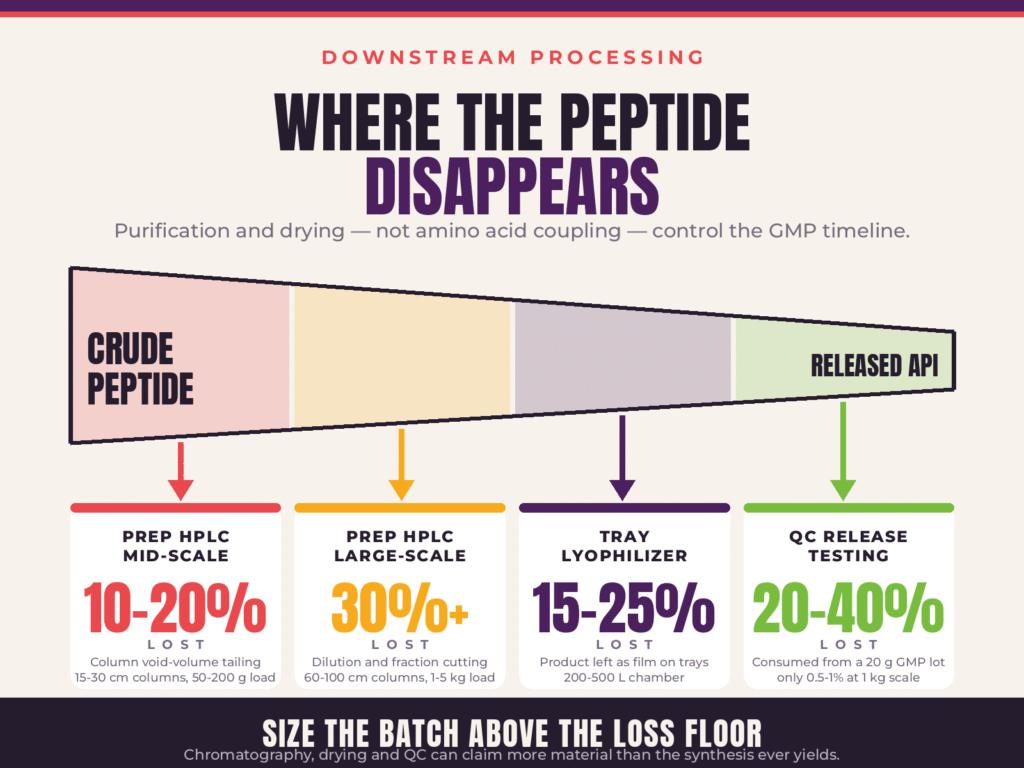
Downstream processing activities, particularly preparative reverse-phase HPLC (RP-HPLC), counter-ion exchange, and lyophilization, frequently determine cleanroom occupancy and variations in the overall Peptide CDMO Project Timeline more than upstream coupling reactions. Peptide-related impurities, including single-amino-acid deletions, insertions, oxidized residues, and epimerized D-isomers, often have structural similarities to the intended target sequence. Consequently, when crude purity is insufficient, multiple chromatographic fractionation cycles may be necessary to achieve the required product quality.
Equipment geometry introduces additional material-handling limitations that can extend small- and medium-scale manufacturing campaigns. Mid-scale preparative HPLC columns, generally measuring 15–30 cm in diameter and processing approximately 50–200 g of crude material per injection, may experience losses of 10%–20% because of column void-volume tailing. At larger manufacturing scales, columns measuring 60–100 cm in diameter and processing approximately 1–5 kg of crude material per injection may experience losses exceeding 30% due to excessive dilution and fraction-cutting requirements.
Subsequent counter-ion exchange operations, which convert trifluoroacetic acid (TFA) salts into acetate or hydrochloride forms, introduce additional processing steps. Industrial tray lyophilizers with chamber capacities of approximately 200–500 L may also experience material losses of 15%–25% because some product remains unrecoverable as a film on tray surfaces.
Lyophilization cycle development and formulation selection can influence both product quality and manufacturing efficiency. Explore the formulation of lyophilized peptide injectables for further insights into these development considerations.
Furthermore, multi-product cleanroom facilities must establish and maintain appropriate cleaning validation procedures before initiating subsequent manufacturing campaigns. This requires Maximum Allowable Carryover (MACO) calculations based on Permitted Daily Exposure limits to demonstrate that residual materials from previous products will not contaminate subsequent batches. These cleaning requirements can introduce additional scheduling dependencies, particularly when several peptide products share the same manufacturing infrastructure.
How Long Do Analytical Method Development, Validation, and GMP Release Take?
Analytical method development and validation under ICH Q2(R2) generally require 2 to 5 months in standard CDMO development programs. When continuous analytical support for the API is included, the duration can extend to approximately 28 weeks. After analytical activities are completed, finished-lot QC release testing and QA issuance of the Certificate of Analysis (CoA) typically require an additional 2 days to 8 weeks.
Unlike conventional small-molecule drugs, synthetic peptides are partially or fully excluded from the applicability of ICH Q3A, ICH Q3B, ICH Q6A/B, and ICH M7. As a result, their impurity assessment and quality control strategies require peptide-specific considerations, including more detailed impurity profiling and appropriate evaluation of immunogenicity risks.
A single UV-HPLC chromatogram is generally insufficient to identify and differentiate all co-eluting sequence variants and stereoisomers. Therefore, comprehensive analytical validation requires orthogonal analytical techniques that provide complementary information about peptide identity, purity, composition, and structural characteristics. These methods typically include UHPLC-UV, high-resolution mass spectrometry (LC-HRMS), enzymatic peptide mapping, amino acid analysis (AAA), and ion chromatography for counter-ion quantification.
Reliable peptide characterization requires complementary analytical methods to evaluate sequence identity, structural attributes, and impurities. Read this peptide characterization case study of semaglutide to understand how advanced analytical techniques support peptide quality assessment.
Chromatographic purity measurements can also overestimate the actual active drug content when they are not supported by Net Peptide Content (NPC) verification. To obtain a more representative estimate of active material, the following calculation can be applied:
Active Mass = Gross Weight × (NPC [%] / 100) × (HPLC Purity [%] / 100)
This calculation assumes that NPC and HPLC purity function as independent correction factors.
For programs requiring rapid IND-enabling analytical packages or detailed impurity characterization, specialized analytical partners such as ResolveMass Laboratories Inc. can integrate HRMS, NMR, peptide mapping, ICH Q3D ICP-MS elemental screening, and nitrosamine LC-MS/MS workflows within a unified quality system. Coordinating these analytical activities can help sponsors identify potential quality issues earlier and reduce the risk of multi-week OOS investigations that could otherwise delay GMP batch release.
Looking to coordinate peptide characterization, impurity profiling, and analytical release testing? Explore integrated CDMO analytical services to understand how consolidated analytical capabilities can support pharmaceutical development and quality control.
Regulatory Expectations for Peptide Analytical Characterization
| Regulatory Guidance | Quantitation / Reporting Limit | Identification Threshold | Qualification & Safety Expectations |
|---|---|---|---|
| FDA May 2021 Synthetic Peptide ANDA Guidance (5 rDNA-referenced peptides) | 0.10% via sensitive UHPLC-HRMS | ≥0.10% of drug substance | New impurities above 0.5% are unacceptable; impurities between 0.10% and 0.5% require immunogenicity risk justification using in silico MHC, in vitro T-cell, and aggregation comparisons against the RLD |
| EMA Synthetic Peptide Guideline (Dec 2025) & Ph. Eur. 2034 | 0.1% LC quantitation limit | >0.5% (comparative profile evaluation across 0.1%–0.5%) | Novel impurities above 1.0% require safety/toxicological qualification |
| ICH Q3D & Nitrosamine Controls | Health Canada / FDA & ICH Q3D limits | Elemental metals (e.g., iron promoting dimers) and nitrosamine FMEA | Directly applicable to synthetic peptides; requires validated ICP-MS and LC-MS/MS testing |
| Higher-Order Structure & Aggregation (EMA 2025 / USP ) | Fibril/dimer-sensitive methods | Thioflavin T (ThT), NMR, FTIR, Circular Dichroism (CD) | Demonstrates aggregate stability and can justify omitting routine finished-product bioassays |
Bioanalytical assays used to support GLP toxicology studies and clinical pharmacokinetic assessments introduce additional scheduling dependencies because they are often performed alongside other development activities. According to ResolveMass Laboratories’ validation benchmarks, standard LC-MS/MS bioanalytical validations generally require 4 to 8 weeks. For more complex matrices or larger molecules, the duration may increase to 8 to 12 weeks. A single unsuccessful validation run can add another 3 to 7 days, whereas stability-related failures may extend the schedule by 2 to 8 weeks.
What Are the Biggest Bottlenecks Delaying GMP Peptide Release?
Four major operational bottlenecks account for a substantial proportion of multi-month delays across a Peptide CDMO Project Timeline: starting material procurement lead times, limited cleanroom and aseptic fill-finish capacity, mid-program technology transfers, and depletion of analytical material during small-batch QC testing.
Starting material procurement challenges have become more significant with the growing demand for GLP-1-based therapeutics. Under the December 2025 EMA synthetic peptide guideline and ICH Q11, protected natural L-amino acids and justified dipeptides, including pseudoprolines or Dmb-Glycine used to reduce diketopiperazine formation and aggregation, can qualify as starting materials. In contrast, modified polypeptide fragments that undergo subsequent cyclization or PEGylation are regulated as GMP intermediates.
Introducing a new starting material supplier during an ongoing development program can trigger a regulatory variation and require additional qualification activities. Specialized conjugation building blocks may also have procurement lead times of up to 1 year, creating substantial risks for programs that depend on these materials.
Manufacturing capacity limitations within ISO 7 GMP suites and sterile fill-finish facilities introduce further delays before synthesis can begin. Market analysts indicate that establishing and qualifying new peptide manufacturing capacity can require 24 to 36 months. Consequently, existing clinical manufacturing slots may be reserved 1 to 2 years in advance. Separate sterile fill-finish facilities frequently impose waiting periods of 6 to 12 months for an available aseptic filling slot, followed by an additional 12-week filling campaign.
Manufacturing location can influence facility access, production scheduling, and coordination between development and GMP operations. Compare Canadian and US peptide CDMOs to evaluate regional manufacturing considerations when planning a peptide development program.
Changing manufacturing facilities during an ongoing development program can create further complications. Onboarding an integrated peptide CDMO generally takes approximately 12 to 18 months. According to DrugPatentWatch analysts, switching CDMOs during an active program may cost 2 million to 8 million and introduce an additional 12 to 18 months of revalidation-related schedule risk. Transferring analytical methods alone for late-stage biologics can require 8 to 18 months.
Choosing between domestic and international manufacturing partners requires evaluating more than production costs. Compare United States and overseas peptide CDMOs to understand how location, operational coordination, and manufacturing capabilities can affect project execution.
Finally, small Phase I manufacturing batches provide very limited flexibility for analytical testing and repeat investigations. At a GMP manufacturing scale of 20 grams, QC release testing may consume approximately 20% to 40% of the isolated batch. In comparison, the corresponding consumption at a 1 kg scale may be only 0.5% to 1.0%. Therefore, an unexpected repeat test or additional analytical investigation can exhaust the available clinical supply, potentially delaying scheduled dosing activities.
How Can Sponsors Compress a Peptide CDMO Project Without Compromising GMP?
Sponsors can reduce overall manufacturing and release timelines by conducting analytical qualification, raw material procurement, and formulation development in parallel with process chemistry instead of completing these activities sequentially. Early planning activities, such as qualifying reference standards and evaluating analytical method ruggedness before formal validation begins, have demonstrated the potential to reduce complex bioanalytical validation timelines from 10–12 weeks to 6–8 weeks.
Similarly, integrating drug substance manufacturing, drug product development, and CMC documentation within a coordinated program has enabled the delivery of an IND-ready complex conjugate within 10 to 11 months. Implementing the following strategies can help sponsors improve project coordination, minimize avoidable delays, and maintain GMP compliance.
- Engage CDMOs 12 to 18 months before the target GMP batch: Reserve ISO 7 synthesis facilities and sterile fill-finish capacity well in advance. Early engagement helps sponsors avoid manufacturing backlogs and the 6-to-12-month waiting periods associated with limited aseptic production availability.
- Screen convergent hybrid routes during feasibility: For peptide sequences exceeding 30 residues, evaluate SPPS/LPPS fragment ligation strategies during the initial feasibility assessment. Identifying an appropriate hybrid synthesis route early can prevent low-yield linear scale-up approaches from requiring expensive and time-consuming changes later in development.
- Audit and pre-order long-lead building blocks at kickoff: Identify specialty linkers, unnatural amino acids, and other critical starting materials during the initial 2-to-4-week feasibility review. Qualifying alternative suppliers under ICH Q11 can reduce dependency on single-source procurement and minimize the impact of unexpected supply disruptions.
- Develop ICH Q2(R2) and forced-degradation methods using non-GMP lots: Complete analytical method development, impurity identification at concentrations of ≥0.10%, and appropriate stress-testing activities before GMP resin loading begins. Early analytical readiness reduces the likelihood of discovering critical impurity-related issues during manufacturing or release testing.
- Size Phase I GMP lots above the QC consumption floor: Account for the substantial material requirements associated with small-scale QC release testing, including potential losses of 20%–40%. Sponsors should also consider chromatographic processing losses and lyophilizer hold-up when determining batch size to ensure that sufficient material remains available for clinical dosing and additional testing.
- Consolidate API, drug product, and release analytics under one QMS: Coordinating drug substance manufacturing, drug product operations, and analytical release activities within a unified quality management system can reduce inter-facility shipping delays and minimize the need for extensive analytical method transfers. This integrated approach also helps avoid the 8-to-18-month method transfer penalties that can arise when different facilities operate independently.
Conclusion
Successfully managing a Peptide CDMO Project Timeline from initial kickoff through GMP release requires careful coordination of synthetic route architecture, ICH Q11 starting material procurement, ICH Q2(R2) analytical validation, and cleanroom manufacturing capacity. Sponsors should begin aligning these critical activities approximately 12 to 18 months before their intended clinical manufacturing milestones to minimize procurement challenges, facility scheduling conflicts, and analytical delays.
Although established linear peptide sequences may complete GMP manufacturing and release within 3 to 6 months, complex cyclic, lipidated, and PEGylated therapeutics generally require 10 to 12+ months. More advanced peptide generics and long-acting depot formulations can extend the development period considerably. Avoiding unnecessary delays requires early impurity control, parallel analytical execution, appropriate synthesis route selection, and sufficient manufacturing capacity planning.
If your team requires IND-enabling peptide characterization, ICH Q3D elemental impurity testing, nitrosamine analysis, analytical method validation, or cGMP release support to maintain its development schedule, connect directly with the scientific team at ResolveMass Laboratories Inc. through our Contact Us page:
Reference:
- European Medicines Agency. (2024). Guideline on the development and manufacture of synthetic peptides. https://www.ema.europa.eu/en/documents/scientific-guideline/guideline-development-manufacture-synthetic-peptides_en.pdf
- European Medicines Agency. (n.d.). ICH guidelines: Quality. https://www.ema.europa.eu/en/human-regulatory-overview/research-development/scientific-guidelines/ich-guidelines/ich-guidelines-quality
- Puig, M., & Shubow, S. (2025). Immunogenicity of therapeutic peptide products: Bridging the gaps regarding the role of product-related risk factors. Frontiers in Immunology, 16, 1608401. https://doi.org/10.3389/fimmu.2025.1608401
- Health Canada. (n.d.). Guidance document: Quality (chemistry and manufacturing) guidance for new drug submissions (NDSs) and abbreviated new drug submissions (ANDSs). Government of Canada. https://www.canada.ca/en/health-canada/services/drugs-health-products/drug-products/applications-submissions/guidance-documents/chemical-entity-products-quality/guidance-document-quality-chemistry-manufacturing-guidance-new-drug-submissions-ndss-abbreviated-new-drug-submissions.html
Get In Touch With Us
About The Author