

Small-Scale to Commercial: Can One US Peptide CDMO Scale With You?
 By Anusha Sinha
•
July 27, 2026
By Anusha Sinha
•
July 27, 2026
Introduction
A single US-based contract development and manufacturing organization (CDMO) can provide continuous support for a therapeutic peptide program, beginning with milligram-scale early discovery and extending through metric-ton commercial production, when the facility combines flexible synthetic platforms, scalable downstream purification capabilities, and robust regulatory compliance frameworks. By utilizing end-to-end Peptide CDMO Scale-up Services, biopharmaceutical sponsors can reduce development risks, avoid complicated technology transfers between multiple manufacturing vendors, and maintain a consistent, uninterrupted commercial supply.
Learn how customized Peptide CDMO Services can streamline your development timeline from early discovery through commercial supply.
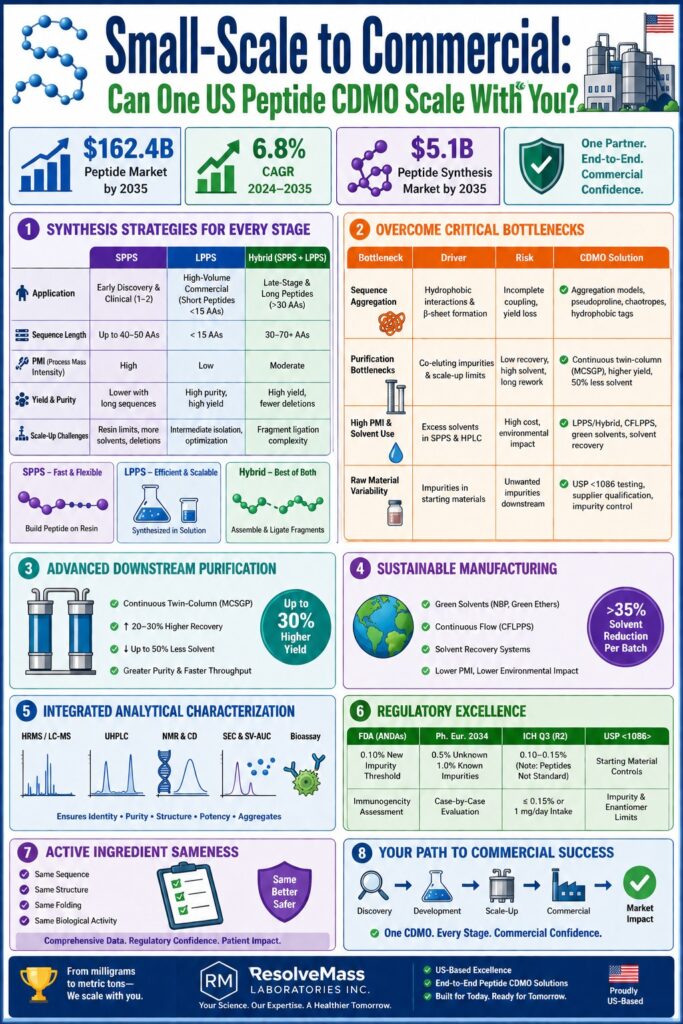
The global peptide therapeutics market is undergoing significant expansion and is projected to increase from 72.2 billion in 2024 to 162.4 billion by 2035, representing a compound annual growth rate (CAGR) of 6.8%. This growth is being driven primarily by metabolic therapeutics, including glucagon-like peptide-1 (GLP-1) receptor agonists, alongside expanding development pipelines in oncology, cardiovascular disease, and rare disorders. As a result, the need for specialized peptide active pharmaceutical ingredient (API) manufacturing has increased substantially, with the peptide synthesis market expected to reach 5.1 billion by 2035.
Peptide therapeutics occupy a distinctive structural and regulatory position between conventional small-molecule drugs and large biological proteins. Although peptides provide antibody-like target specificity and high potency, their manufacturing involves sequential amino acid coupling, complex folding processes, and challenging downstream purification. Scaling synthetic peptide manufacturing from early clinical supply, typically involving gram quantities, to commercial launch, involving multi-kilogram to metric-ton quantities, creates considerable operational risks. Industry metrics indicate that 21% of peptide programs encounter scale-up disruptions during the transition from pilot to commercial manufacturing, often experiencing yield losses of 15% to 28% for long-chain sequences containing more than 30 amino acids, along with unexpected increases in impurity levels. Partnering with an experienced US CDMO that can manage phase-appropriate synthetic transitions, continuous purification, and regulatory alignment is therefore essential for achieving commercial success.
Partner with a specialized Peptide Drug Development CDMO to de-risk your scaling strategy and ensure seamless process optimization.
Can Your Peptide Program Scale From Discovery to Commercial Manufacturing?
From early-stage peptide synthesis to clinical supply and commercial-scale API manufacturing, the right US-based peptide CDMO can help you navigate scale-up challenges, optimize synthesis and purification, and maintain consistent quality throughout development. Contact us
Article Summary: Key Takeaways
- A single US-based Peptide CDMO can support the entire product lifecycle, from early discovery and clinical development to large-scale commercial manufacturing, reducing technology transfer risks and ensuring a consistent API supply.
- Selecting the right synthesis platform is essential for successful scale-up. SPPS is ideal for early-stage development, LPPS offers cost-effective commercial production of short peptides, and hybrid synthesis provides high yields for long, complex peptide sequences.
- Commercial peptide manufacturing faces several technical challenges, including sequence aggregation, impurity formation, solvent-intensive processes, and raw material variability. Advanced CDMOs address these issues through predictive modelling, continuous purification, and rigorous quality controls.
- Continuous downstream purification technologies, such as twin-column chromatography (MCSGP), improve peptide recovery, reduce solvent consumption, increase manufacturing efficiency, and lower production costs compared with conventional batch purification.
- Sustainable manufacturing practices—including green solvents, continuous-flow peptide synthesis, and solvent recovery systems—help reduce environmental impact, lower process mass intensity (PMI), and improve scalability.
- Comprehensive analytical characterization using orthogonal techniques such as HRMS, LC-MS/MS, UHPLC, NMR, SEC, and bioassays ensures peptide identity, purity, structural integrity, and biological activity throughout development and commercial production.
- Regulatory success depends on strict FDA and international compliance. Experienced CDMOs control impurities, generate robust CMC documentation, demonstrate active ingredient sameness, and support seamless progression from IND to NDA/ANDA approval while accelerating time to market.
Synthetic Methodology Selection: SPPS, LPPS, and Hybrid Synthesis
Moving a peptide program from early discovery through commercial manufacturing requires the strategic evolution of synthetic methodologies. This may involve using Solid-Phase Peptide Synthesis (SPPS) for rapid early-stage iteration and transitioning to Liquid-Phase Peptide Synthesis (LPPS) or Hybrid Fragment Condensation to improve cost efficiency at commercial scale. A comprehensive partner offering Peptide CDMO Scale-up Services must have multi-platform synthesis capabilities to prevent process bottlenecks as production volumes increase.
The selection of a synthesis strategy directly affects active pharmaceutical ingredient (API) yield, process mass intensity (PMI), unit economics, and overall campaign timelines. Historically, Solid-Phase Peptide Synthesis (SPPS) has been widely used during early peptide development because of its compatibility with automation and its ability to rapidly assemble sequences on solid resin supports. However, as programs advance into Phase 3 trials and commercial manufacturing, alternative approaches, including Liquid-Phase Peptide Synthesis (LPPS) and hybrid synthesis strategies, become increasingly important for addressing physical and economic limitations.
| Metric / Parameter | Solid-Phase Peptide Synthesis (SPPS) | Liquid-Phase Peptide Synthesis (LPPS) | Hybrid Synthesis (SPPS + Solution Phase) |
|---|---|---|---|
| Primary Application | Discovery and early clinical trials (Phase 1–2), including complex sequences | High-volume commercial production and short sequences (less than 15 AAs) | Late-stage clinical and commercial manufacturing for long peptides (more than 30 AAs) |
| Market Share (by project count) | Approximately 52%–58% of development projects | Approximately 31% of commercial volume | Approximately 33% of development projects |
| Sequence Length Capability | Efficient for sequences up to 40–50 amino acids | Optimal for short peptides containing fewer than 15 amino acids | Highly scalable for sequences containing 30–70+ amino acids |
| Process Mass Intensity (PMI) | High due to excessive wash solvent and reagent consumption | Low due to a reduced solvent footprint and lower reagent stoichiometry | Moderate, with optimized solvent usage for each fragment |
| Scale-Up Bottlenecks | Resin swelling limits, batch-size constraints, and resin capacity ceilings | Complex intermediate isolation and optimization of reaction conditions | Optimization of fragment coupling conditions and solubility management |
| Yield & Purity Profile | Yield declines as sequence length increases, while deletion sequences accumulate | High purity per step, with intermediates that can be isolated and characterized | High overall yield with reduced propagation of deletion impurities |
Swipe horizontally to view the full table on smaller screens.
Solid-Phase Peptide Synthesis (SPPS)
Solid-Phase Peptide Synthesis (SPPS) supports rapid early-stage clinical production and sequence optimization by sequentially coupling amino acids to an insoluble resin support. However, its commercial scalability is limited by resin capacity constraints and substantial solvent consumption. SPPS enables rapid turnaround for lead candidate selection, toxicology studies, and early-phase clinical material production. Advanced automated synthesizers and microwave-assisted chemistry further support the rapid optimization of coupling reagents and deprotection cycles.
Despite its speed and flexibility, SPPS presents substantial scalability challenges at commercial manufacturing volumes. As the peptide chain becomes longer, steric hindrance and chain aggregation on the resin support can result in incomplete coupling and deprotection reactions. These incomplete reactions produce closely related deletion and insertion impurities that may co-elute with the target product during downstream purification. In addition, SPPS requires substantial stoichiometric excesses of protected amino acids, coupling agents, and washing solvents, including dimethylformamide (DMF) and N-methylpyrrolidone (NMP). This leads to high Process Mass Intensity (PMI) and increased production costs when manufacturing is scaled to multi-kilogram quantities.
Liquid-Phase Peptide Synthesis (LPPS)
Liquid-Phase Peptide Synthesis (LPPS) offers high cost efficiency and scalability for commercial-volume manufacturing of short peptide sequences by eliminating solid resin supports and substantially reducing solvent requirements. LPPS is performed entirely in solution, removing physical constraints associated with solid resin systems, including loading capacity limitations and solvent-induced resin swelling. It is commonly used for the large-scale commercial production of short peptides, typically those containing fewer than 15 amino acids, as well as commodity peptide APIs manufactured in multi-hundred-kilogram or metric-ton quantities.
The primary operational benefit of LPPS is its economic efficiency at large manufacturing scales. Compared with SPPS, LPPS generally requires lower reagent stoichiometry and reduced solvent volumes, thereby lowering material costs and reducing the environmental footprint of the manufacturing process. Because reaction intermediates can be isolated, washed, and purified after individual coupling steps, LPPS helps prevent the cumulative accumulation of truncated impurities and can produce cleaner crude reaction mixtures. However, LPPS development timelines are generally longer because the solubility characteristics and crystallization conditions of each intermediate must be individually evaluated and customized throughout the synthesis sequence.
Hybrid Synthesis Strategies
Hybrid peptide synthesis supports the scale-up of long and complex peptide sequences by combining the solid-phase assembly of short, protected fragments with high-yield solution-phase ligation. Short, fully protected peptide segments, typically containing 5 to 15 amino acids, are rapidly synthesized using SPPS on specialized cleavage resins. These protected fragments are then cleaved from the resin while maintaining side-chain protection, purified, and chemically ligated together in solution to construct the full-length peptide API.
Hybrid synthesis is particularly effective for scaling complex or long-chain peptide sequences containing more than 30 amino acids, including GLP-1 analogs and gastrointestinal peptides. By independently assembling shorter fragments, CDMO chemists can thoroughly evaluate and purify intermediate segments before the final assembly step. This strategy helps prevent the exponential yield losses associated with long linear SPPS sequences, substantially reduces the complexity of the final crude product, and eliminates significant risks during late-stage scale-up.
Discover strategic guidance on when to Outsource Peptide Manufacturing to a CDMO to optimize unit economics and production capacity.
Overcoming Technical Bottlenecks in Peptide CDMO Scale-up Services
Overcoming technical scale-up bottlenecks in peptide manufacturing requires addressing critical process challenges, including cumulative impurity formation, sequence aggregation, excessive solvent consumption, and variability in raw materials. Integrated Peptide CDMO Scale-up Services use advanced continuous purification technologies, predictive aggregation models, and standardized starting-material controls to maintain process yields and purity specifications at commercial scale.
Chemical and physical complexities increase substantially when production is transitioned from benchtop synthesis reactors, typically operating at 10–100 grams, to pilot-plant scale at 1–10 kilograms and then to commercial manufacturing reactors exceeding 100 kilograms. Successfully managing these technical challenges requires specialized chemical and engineering interventions throughout every stage of the manufacturing process.
| Scale-Up Bottleneck | Primary Chemical / Physical Driver | Operational Risk | Advanced CDMO Mitigation Strategy |
|---|---|---|---|
| Sequence Aggregation | Hydrophobic interactions and β-sheet formation during chain elongation | Cleavage failure, insoluble crude mixtures, and severe yield loss | Aggregation prediction algorithms, pseudoproline dipeptides, chaotropic additives, and hydrophobic tags |
| Purification Bottlenecks | Co-eluting deletion impurities and diastereomers during prep-HPLC | Low purification yield, high solvent waste, and 6–10 week batch rework delays | Continuous twin-column chromatography (MCSGP) and multi-step gradient RP-HPLC |
| High Environmental Impact (PMI) | Massive solvent volume requirements associated with repetitive SPPS washing | High hazardous-waste disposal costs and potential non-compliance with green chemistry expectations | Transition to LPPS/Hybrid Synthesis, Continuous Flow LPPS (CFLPPS), and green-solvent replacement |
| Raw Material Variability | Contaminants in protected amino acid derivatives, including enantiomers and β-alanine | Generation of unqualified diastereomeric impurities downstream | Strict raw material testing under USP standards and qualified supplier auditing |
Swipe horizontally to view the full table on smaller screens.
Sequence Aggregation and Cleavage Optimization
Suppressing peptide aggregation during large-scale synthesis requires real-time predictive modelling, chemical backbone modifications, and optimized global cleavage protocols to prevent secondary-structure formation and preserve crude-product yields. During peptide elongation, growing peptide chains can frequently form secondary structures, including intermolecular β-sheets, as a result of hydrophobic interactions between amino acid side chains. Aggregation reduces solvent accessibility to the terminal amine group, causing coupling reactions to become incomplete or stall and generating truncated deletion sequences.
To control aggregation during scale-up, experienced CDMOs use predictive aggregation software during process development. Chemical approaches may include incorporating backbone-modifying building blocks, such as pseudoproline dipeptides or isoacyl derivatives, and adding chaotropic salts, including lithium chloride, to disrupt secondary structures. In addition, optimization of global cleavage conditions, including the appropriate balance of trifluoroacetic acid (TFA) ratios, scavenger cocktails, and temperature control, helps prevent re-aggregation and side-chain modification, such as methionine oxidation or tryptophan alkylation, during resin cleavage and peptide release.
Read our insights on Peptide API Scale-Up to overcome aggregation and downstream purification bottlenecks effectively.
Downstream Processing and Continuous Chromatography
Downstream processing bottlenecks at commercial scale can be addressed by transitioning from conventional batch preparative HPLC to continuous twin-column chromatography, such as Multicolumn Countercurrent Solvent Gradient Purification (MCSGP). This approach can increase purification recovery yields by up to 30% while reducing solvent consumption by approximately half. Downstream purification may account for up to 70% of the overall manufacturing cost of synthetic peptides. Traditional single-column preparative Reverse-Phase High-Performance Liquid Chromatography (RP-HPLC) operates as a batch process, consuming substantial volumes of acetonitrile and water while providing limited flexibility in balancing yield and purity. During batch prep-HPLC, fractions containing the purified peptide must be separated from overlapping side fractions containing closely related impurities. This can result in the loss of up to 30% of the pure product when therapeutic purity targets exceeding 98% must be achieved.
To address this bottleneck, commercial US CDMOs are increasingly implementing continuous multi-column chromatography technologies, including Multicolumn Countercurrent Solvent Gradient Purification (MCSGP). MCSGP uses twin-column systems that continuously recycle overlapping side-cut fractions through the purification circuit. This continuous processing approach delivers two major benefits:
- Increases total target peptide recovery yield by 20% to 30% compared with conventional single-column prep-HPLC.
- Reduces solvent consumption by up to 50%, substantially lowering operational expenditure and environmental impact.
After chromatography, the purified liquid peptide solution undergoes lyophilization (freeze-drying) to isolate the final dry API powder. Scaling up lyophilization requires industrial tray freeze-dryers equipped with controlled nucleation systems and rapid ice-sublimation controls. These systems help produce consistent and stable cake structures while minimizing the presence of residual organic solvents.
Sustainable Manufacturing and Green Chemistry
Sustainable commercial peptide manufacturing depends on the adoption of alternative green solvents, continuous-flow liquid-phase microreactors, and solvent-recovery systems to substantially reduce process mass intensity (PMI). Environmental sustainability has become an increasingly important consideration in vendor selection, with leading production facilities pursuing solvent-reduction targets exceeding 35% per batch. The extensive solvent consumption associated with conventional SPPS increases process mass intensity (PMI), creating both sustainability concerns and additional operational expenses.
To align with modern green chemistry principles, CDMO scale-up protocols may incorporate alternative solvents, including N-butylpyrrolidone (NBP) and green ether formulations, to replace more hazardous solvents such as DMF and DCM. In addition, the use of Continuous Flow Liquid-Phase Peptide Synthesis (CFLPPS) microreactors enables precise control of reaction temperature and stoichiometry during coupling reactions. Microreactor-based flow chemistry can significantly reduce residence times, minimize reagent excess, and support seamless linear scale-up by adding parallel reactor channels without altering the underlying reaction kinetics.
Integrated Analytical Characterization in Peptide CDMO Scale-up Services
Integrated analytical characterization confirms product identity, structural integrity, and purity during commercial scale-up by applying orthogonal testing methodologies throughout the manufacturing process. The use of advanced analytical platforms within Peptide CDMO Scale-up Services helps prevent unexpected batch rejections and supports compliance with global regulatory requirements for active pharmaceutical ingredients (APIs).
Robust analytical method development should progress in parallel with synthesis process development. Peptides may undergo subtle degradation and structural changes, including deamidation, racemization, disulfide scrambling, and oligomerization. Therefore, relying on a single analytical technique is insufficient for comprehensive product characterization and release testing. Leading CDMOs use orthogonal analytical suites that may include:
- High-Resolution Mass Spectrometry (HRMS) & LC-MS/MS: Confirms the primary amino acid sequence and identifies minor structural modifications, sequence variants, and deletion impurities.
- Ultra-High Performance Liquid Chromatography (UHPLC): Resolves closely related impurities, diastereomers, and degradation products using orthogonal stationary phases, including C18, C4, and phenyl-hexyl.
- Nuclear Magnetic Resonance (NMR) & Circular Dichroism (CD): Evaluates secondary and tertiary conformational structures to confirm appropriate peptide folding.
- Size-Exclusion Chromatography (SEC) & Sedimentation Velocity Analytical Ultracentrifugation (SV-AUC): Quantifies high-molecular-weight aggregates and oligomeric species that may present immunogenicity risks.
- In Vitro Cell-Based Bioassays: Measures functional biological potency and receptor-binding affinity against qualified biological reference standards.
Learn more about advanced Peptide Analytical Characterization Services designed for complex therapeutic profiles.
Navigating FDA and International Regulatory Requirements
Obtaining regulatory approval for scaled synthetic peptides requires strict adherence to FDA immunogenicity thresholds, ICH Q7 cGMP guidelines, and applicable USP standards. A qualified CDMO supports a smooth transition from IND to NDA/ANDA by implementing rigorous analytical characterization and impurity-control strategies that are aligned with current FDA guidance.
The regulatory assessment of synthetic peptides has evolved considerably in recent years. Although historical guidelines permitted higher impurity limits for synthetic peptides under European Pharmacopoeia (EP 2034) standards, regulatory authorities worldwide, led by the US Food and Drug Administration (FDA), have established increasingly stringent expectations for peptide quality and safety.
| Regulatory Framework / Guidance | Applicable Scope | Identification Threshold | Qualification Threshold | Immunogenicity Risk Assessment Requirement |
|---|---|---|---|---|
| FDA Guidance for Synthetic Peptides (ANDAs) | Generic synthetic peptides referencing rDNA-listed drugs, such as glucagon and liraglutide | 0.10% of total API mass | 0.50% maximum limit for new impurities | Mandatory for any new specified peptide-related impurity present at ≥ 0.10% |
| European Pharmacopoeia (Ph. Eur. Monograph 2034) | Synthetic active pharmaceutical ingredients in European jurisdictions | 0.50% for individual unknown impurities | 1.00% for known identified impurities | Case-by-case evaluation based on clinical safety data |
| ICH Q3A(R2) / ICH Q3B(R2) | Small-molecule APIs and finished drug products | 0.10%–0.15% (Note: Synthetic peptides are explicitly excluded from the scope of ICH Q3A) | 0.15% or 1.0 mg/day intake | Not standard for small molecules unless structural alerts are present |
| USP General Chapter <1086> & Synthetic peptide drug substances and amino acid starting materials | Case-by-case specifications based on NDA/ANDA filing | Aligned with FDA safety parameters | Aligned with FDA safety parameters | Mandatory starting-material impurity controls to limit downstream risk |
Swipe horizontally to view the full table on smaller screens.
The FDA 0.10% Impurity Threshold and Immunogenicity Risk
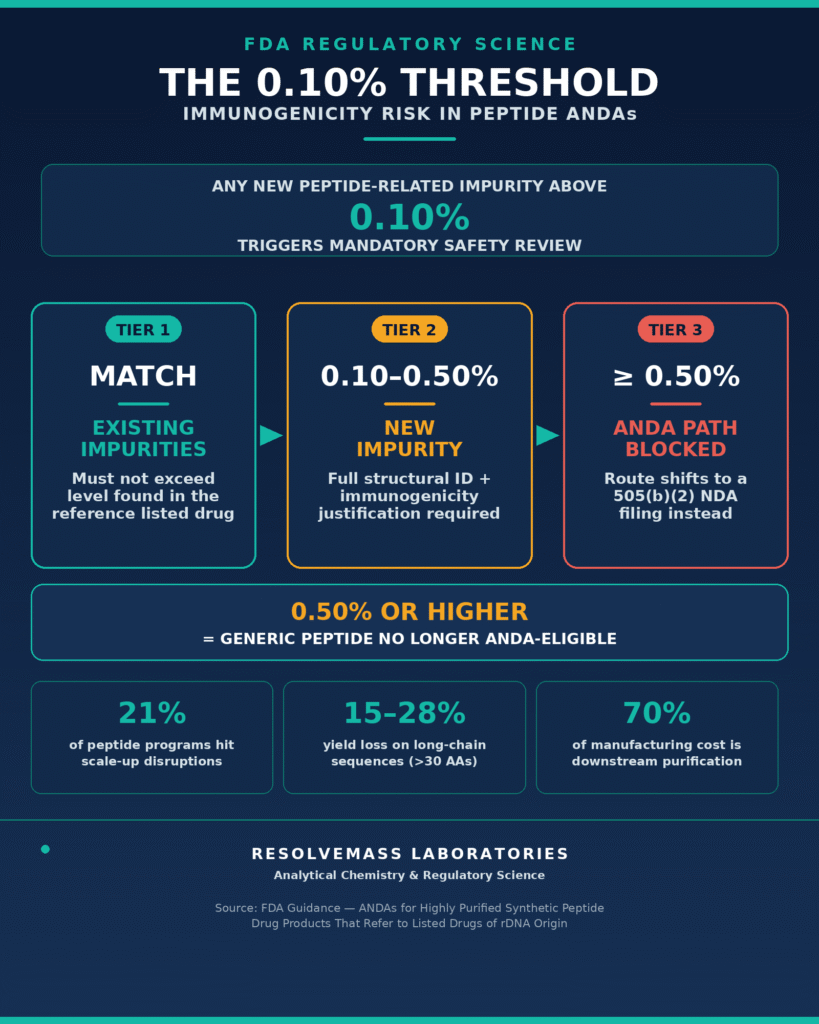
The FDA applies a strict 0.10% threshold to specified peptide-related impurities in generic synthetic peptides that reference products of recombinant origin. Any new impurity above this level may require complete structural characterization and an assessment of immunogenicity-related safety risks. This regulatory standard is described in the FDA guidance document, ANDAs for Certain Highly Purified Synthetic Peptide Drug Products That Refer to Listed Drugs of rDNA Origin. It directly affects synthetic peptides developed to replicate reference listed drugs (RLDs) originally manufactured using recombinant DNA technology, including glucagon, liraglutide, nesiritide, teriparatide, and teduglutide.
Under this regulatory framework, the FDA has established three key criteria for peptide-related impurities:
- Existing Impurities: Any peptide-related impurity that is also present in the RLD must not exceed the concentration observed in the RLD.
- New Impurities (≥ 0.10% to < 0.50%): Any new peptide-related impurity that is absent from the RLD and present at a level between 0.10% and 0.50% must undergo complete structural characterization. The applicant must provide a detailed scientific justification demonstrating that the new impurity does not increase immunogenicity risk or adversely affect clinical efficacy.
- New Impurities (≥ 0.50%): A generic synthetic peptide product containing a new peptide-related impurity at or above 0.50% is generally not eligible for an Abbreviated New Drug Application (ANDA) submission and may instead require a 505(b)(2) NDA filing.
These stringent regulatory expectations require CDMOs to establish precise controls over synthesis and downstream purification. Preventing new impurities from exceeding the 0.10% threshold requires strict control of starting materials, as defined in USP <1086>. Protected amino acid derivatives must undergo rigorous testing for D-enantiomers, foreign amino acids, and β-alanyl impurities before being introduced into the manufacturing process.
Access full regulatory expertise with our Regulatory Support for Generic Drugs US and Canada CDMO services.
Establishing Active Ingredient Sameness
Establishing active ingredient sameness for scaled synthetic peptides requires comprehensive physicochemical, structural, and bioactivity characterization to demonstrate equivalent primary sequence, secondary folding, and biological function relative to the reference drug product. To support regulatory approval of synthetic generic peptides, CDMOs must generate comprehensive data packages demonstrating active ingredient sameness. The FDA requires robust evidence that the synthetic peptide’s primary sequence, secondary backbone structure, oligomeric state, and biological activity correspond to those of the reference product. CDMOs compile extensive chemistry, manufacturing, and controls (CMC) documentation under ICH Q11 and verify process repeatability across three consecutive cGMP validation batches.
Compare regional options with our guide on Canadian vs US Peptide CDMOs or learn How to Choose a Peptide CDMO in the US.
Conclusion
A single US-based CDMO can support a peptide program from discovery through commercialization when it has integrated synthesis capabilities, scalable purification infrastructure, and extensive regulatory expertise. Engaging an end-to-end partner for Peptide CDMO Scale-up Services can minimize development risks, reduce technology-transfer costs, and help secure a reliable long-term supply of commercial API.
The technical challenges associated with commercial peptide manufacturing, ranging from aggregation management and high process mass intensity to compliance with the strict FDA 0.10% immunogenicity threshold, require a manufacturing partner with extensive scientific expertise and advanced facility infrastructure. By selecting a US CDMO capable of smoothly transitioning programs across development phases, biopharmaceutical sponsors can mitigate scale-up risks, reduce capital expenditure, and accelerate the time to market for life-changing peptide therapeutics. ResolveMass Laboratories Inc. provides technical infrastructure and analytical expertise to support biopharmaceutical sponsors throughout the various phases of peptide development and scale-up.
Partner with a premier Pharmaceutical CDMO in the US and Canada or consult a specialized Peptide CDMO in the United States to advance your therapeutic pipeline.
To explore customized peptide scale-up solutions and consult with technical experts, visit the ResolveMass Contact Page.
Frequently Asked Questions (FAQs)
Why do peptide synthesis yields drop significantly during commercial scale-up?
Peptide yields can decrease during commercial scale-up because larger reactors introduce challenges related to heat transfer, mass transfer, mixing, and reaction uniformity. Incomplete amino acid coupling and solvent-driven aggregation may also become more pronounced as batch size increases. These issues can lead to the accumulation of truncated deletion sequences, making downstream purification more difficult and reducing overall product recovery.
When should a sponsor transition from SPPS to hybrid or LPPS synthesis?
Sponsors should begin assessing a transition from SPPS to hybrid or LPPS synthesis during late Phase 2 or early Phase 3 development, particularly when projected annual commercial requirements reach approximately 10 to 50 kilograms. Evaluating the transition before commercial validation batches can provide sufficient time for process optimization and scale-up studies. This approach can also reduce development expenses and solvent consumption before regulatory filings are finalized.
What is the FDA 0.10% impurity threshold rule for synthetic generic peptides?
Under the FDA framework for certain synthetic generic peptides referencing rDNA-derived drugs, a new peptide-related impurity present at or above 0.10% may require detailed structural characterization and an evaluation of potential immunogenicity risk. The impurity must also be assessed in relation to the reference listed drug. New impurities exceeding specified limits can create regulatory challenges and may affect eligibility for a simplified ANDA pathway.
How does continuous twin-column chromatography (MCSGP) improve commercial peptide economics?
Continuous twin-column chromatography, including Multicolumn Countercurrent Solvent Gradient Purification (MCSGP), improves process efficiency by allowing overlapping side fractions to be continuously recycled through the purification system. This can increase recovery of the target peptide by approximately 20% to 30% compared with conventional single-column prep-HPLC. The approach can also reduce preparative solvent consumption by up to 50%, lowering both manufacturing costs and environmental impact.
What role does starting material purity play in preventing peptide scale-up failure?
The quality of starting materials has a direct effect on the impurity profile and overall quality of the final peptide API. Trace contaminants in protected amino acids, including D-amino acid enantiomers and free amino acids, can become incorporated into the growing peptide chain. These impurities may form closely related diastereomeric species that are difficult to separate during downstream purification, potentially reducing yield and increasing process complexity.
How is Process Mass Intensity (PMI) measured and optimized during peptide manufacturing?
Process Mass Intensity (PMI) represents the total mass of materials, including chemicals, reagents, and solvents, used to manufacture one kilogram of purified API. CDMOs can reduce PMI by adopting greener solvent systems, recovering and reusing suitable solvents, and minimizing excessive reagent use. For long peptide sequences, transitioning from linear SPPS to solution-phase fragment condensation or hybrid synthesis can further reduce material consumption.
What analytical methodologies are required to prove active ingredient sameness for synthetic peptides?
Demonstrating active ingredient sameness requires a combination of complementary analytical techniques rather than a single test method. High-Resolution Mass Spectrometry (HRMS) can confirm the primary sequence, while NMR and Circular Dichroism (CD) evaluate structural conformation and folding. SEC can assess oligomerization and aggregate formation, and cell-based bioassays can confirm biological potency and functional activity.
How do CDMOs handle peptide aggregation during large-scale manufacturing?
CDMOs control peptide aggregation through a combination of predictive modelling, synthetic design strategies, and optimized process conditions. Aggregation prediction tools can help identify sequences that are prone to secondary-structure formation, while pseudoproline dipeptides and chaotropic salts may be used to disrupt aggregation. Cleavage conditions, including scavenger composition and temperature, are also optimized to preserve product quality and prevent re-aggregation.
Can a synthetic peptide candidate qualify for approval via the FDA ANDA regulatory pathway?
Yes, certain synthetic peptide candidates may qualify for an Abbreviated New Drug Application (ANDA) when they reference an eligible approved peptide drug of rDNA origin, such as liraglutide or teriparatide. The applicant must demonstrate active ingredient sameness and adequately control peptide-related impurities. New impurities that are not appropriately characterized or that exceed applicable regulatory thresholds can create barriers to approval through the ANDA pathway.
Reference:
- U.S. Food and Drug Administration. (2021, May). ANDAs for certain highly purified synthetic peptide drug products that refer to listed drugs of rDNA origin: Guidance for industry. U.S. Department of Health and Human Services. FDA guidance document
- U.S. Food and Drug Administration. (2023, May). Current good manufacturing practice (CGMP) regulations. U.S. Department of Health and Human Services. FDA CGMP Regulations
- U.S. Food and Drug Administration. (2021, May). ANDAs for certain highly purified synthetic peptide drug products that refer to listed drugs of rDNA origin: Guidance for industry. U.S. Department of Health and Human Services. FDA guidance document
- Duncan, K. (n.d.). CMC regulatory experiences and expectations [PowerPoint slides]. United States Pharmacopeia. USP presentation
Can Your Peptide Program Scale From Discovery to Commercial Manufacturing?
From early-stage peptide synthesis to clinical supply and commercial-scale API manufacturing, the right US-based peptide CDMO can help you navigate scale-up challenges, optimize synthesis and purification, and maintain consistent quality throughout development.
Contact usAbout The Author
Anusha Sinha
Anusha Sinha, B.Pharm, is an experienced pharma professional with a strong background in Analytical Chemistry and Polymer Chemistry. With a passion for translating complex scientific data into clear, accessible content, she plays a vital role in communicating ResolveMass Laboratories Inc.’s advanced testing capabilities. In addition to her scientific expertise, Anusha leads Business Development initiatives, helping clients across pharmaceutical, biotechnology, and materials science sectors find tailored analytical solutions. Her combined experience in science and strategy positions her at the forefront of client engagement and technical communication.

