

Introduction
Peptide drugs require specialized cold-chain infrastructure because their dynamic amino acid structures and chemically reactive side chains are highly vulnerable to degradation when exposed to thermal, oxidative, or ambient environmental stress. Maintaining strict Peptide Cold Chain Storage conditions helps suppress temperature-dependent chemical reactions, including hydrolysis, deamidation, and oxidation, while preserving the active molecular conformation required for bioactivity and patient safety.
During the past two decades, peptide therapeutics have become an important category of biopharmaceuticals, occupying an intermediate position between conventional small-molecule synthetic drugs and large monoclonal antibodies. Unlike structurally rigid small molecules, peptides are composed of short to medium-length chains of amino acids connected through peptide bonds. This structural organization provides considerable biological specificity and potency; however, it also makes peptides intrinsically vulnerable to environmental degradation. If appropriate environmental controls are not maintained, peptides may experience a reduction in therapeutic potency, generate toxic impurities, or induce undesirable immune responses following administration to patients.
Maintaining an uninterrupted cold chain requires extensive expertise spanning biopharmaceutical analytics, thermal packaging engineering, and international regulatory compliance. Technical testing facilities such as ResolveMass Laboratories Inc. implement rigorous stability testing protocols to determine temperature tolerances, container-closure requirements, and appropriate storage conditions that protect complex peptide formulations throughout their complete product lifecycle.
Explore specialized peptide analytical testing capabilities for evaluating peptide purity, identity, degradation, and stability.
Explore Peptide Analytical Testing Services →
Share via:
Quick Summary:
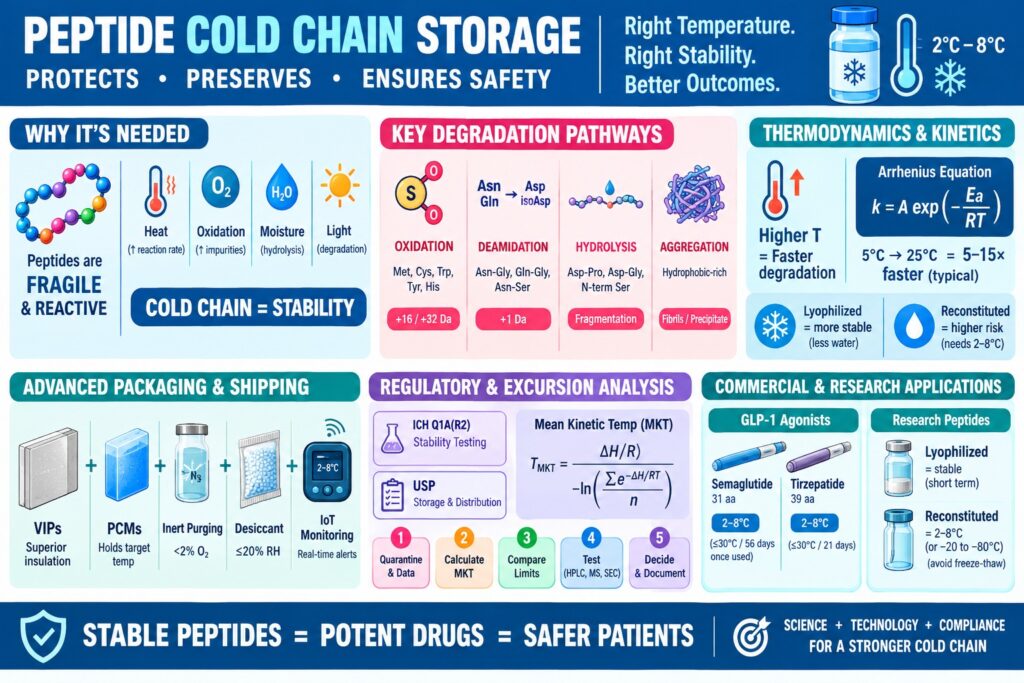
- Peptide cold-chain storage is essential because peptides are sensitive to temperature, oxidation, moisture, and other environmental stresses that can reduce potency and stability.
- Major degradation pathways include oxidation of Met/Cys, deamidation of Asn/Gln, peptide-backbone hydrolysis, and aggregation or fibril formation.
- Temperature strongly affects degradation: higher temperatures accelerate chemical reactions, while refrigerated or frozen storage slows degradation and helps preserve peptide structure.
- Advanced shipping technologies such as Vacuum Insulation Panels (VIPs), Phase Change Materials (PCMs), inert-gas purging, desiccants, and IoT temperature monitoring help maintain controlled conditions during transportation.
- Regulatory control is critical: ICH Q1A(R2) and USP guidance support stability testing, thermal mapping, monitoring, and formal evaluation of temperature excursions using Mean Kinetic Temperature (MKT).
- Excursion management involves quarantine, temperature-data retrieval, MKT calculation, stability comparison, analytical testing such as HPLC/LC-MS/SEC, and documented batch disposition.
- Commercial and research peptides require different handling: GLP-1 agonists such as semaglutide and tirzepatide require controlled refrigeration, while lyophilized research peptides are generally more stable than reconstituted liquids, which require stricter cold storage and minimized freeze-thaw cycles.
Molecular Mechanisms Driving the Necessity of Peptide Cold Chain Storage
Peptide drugs require temperature-controlled storage because increased thermal energy can accelerate covalent chemical degradation pathways and promote physical conformational unfolding. Controlling thermal kinetic energy through refrigerated or frozen storage helps preserve primary amino acid sequences and reduces the formation of insoluble, immunogenic aggregates.
Chemical Degradation Pathways in Peptide Cold Chain Storage
Chemical degradation within Peptide Cold Chain Storage systems involves covalent modifications that change the fundamental primary structure and molecular weight of peptide molecules. These temperature-sensitive reactions can consequently affect drug identity, purity, and therapeutic activity.
- Methionine and Cysteine Oxidation: Sulfur-containing amino acids are particularly vulnerable to oxidative modification. Methionine (Met) residues can undergo chemical and photochemical oxidation, producing methionine sulfoxide and methionine sulfone and introducing additional oxygen atoms (+16 Da or +32 Da). These modifications can disrupt local hydrophobicity and binding affinity. Cysteine (Cys) thiols may undergo base-catalyzed oxidation, resulting in intra- or inter-chain disulfide bridges that can substantially modify secondary structure.
- Asparagine and Glutamine Deamidation: Deamidation is a non-enzymatic modification in which the side-chain amides of Asparagine (Asn) or Glutamine (Gln) are hydrolytically converted into carboxylic acid derivatives. Under neutral to basic pH conditions, the nitrogen atom of the C-terminal adjacent peptide bond attacks the Asn side-chain carbonyl carbon, producing a cyclic succinimide intermediate. Hydrolysis of this intermediate generates a mixture of L-aspartyl (Asp) and L-isoaspartyl (iso-Asp) residues—typically at a ratio of 1:3—thereby introducing a negative charge and potentially causing backbone rearrangement. Sequences containing Asparagine-Glycine (Asn-Gly) are recognized as important “hot spots” for rapid deamidation because of their low steric hindrance.
- Peptide Backbone Hydrolysis: Hydrolysis refers to the cleavage of amide bonds within the peptide backbone through interactions with ambient water molecules, acids, or bases. Sequences containing Aspartate (Asp), particularly Asp-Pro and Asp-Gly, can undergo acid-catalyzed dehydration and form cyclic imide intermediates, which may subsequently result in backbone cleavage or isomerization into iso-aspartate analogs. In liquid formulations, the rate of backbone hydrolysis increases substantially as temperature rises.
Learn more about impurity-control strategies for pharmaceutical development and quality assessment.
Explore Impurity Control Strategies Under ICH Q3A →
Physical Instability, Unfolding, and Aggregation
Physical instability develops when increased thermal kinetic energy disrupts delicate non-covalent hydrophobic and hydrogen bonds, causing peptides to unfold, associate with one another, and generate insoluble aggregates. Maintaining appropriately low temperatures reduces molecular movement and helps prevent exposure of internal hydrophobic domains that can initiate oligomerization and fibril precipitation.
Peptides exist within dynamic conformational equilibria that are maintained by weak hydrogen bonds, van der Waals forces, and hydrophobic interactions. As thermal energy increases, peptide molecules can overcome conformational energy barriers, exposing internal hydrophobic side chains to the surrounding aqueous environment. These exposed hydrophobic regions then associate with one another to reduce free energy. The process may progress from soluble dimers and oligomers to insoluble amorphous aggregates or organized β-sheet amyloid fibrils. Such aggregation substantially decreases the concentration of active drug and can increase the potential for anti-drug antibody (ADA) responses following administration to patients.
| Degradation Pathway | Vulnerable Amino Acid Sequences | Primary Structural / Chemical Impact | Cold Chain Mitigation Strategy |
|---|---|---|---|
| Oxidation | Met, Cys, Trp, Tyr, His | Covalent addition of oxygen (+16/32 Da), disulfide cross-linking. | Lowers reaction rates and minimizes dissolved oxygen reactivity. |
| Deamidation | Asn-Gly, Gln-Gly, Asn-Ser | Succinimide formation yielding Asp and iso-Asp (+1 Da). | Freezes molecular flexibility needed for cyclic intermediate formation. |
| Hydrolysis | Asp-Pro, Asp-Gly, N-terminal Ser | Amide backbone cleavage and active peptide fragmentation. | Lowers water nucleophilicity and molecular collision frequency. |
| Aggregation | Hydrophobic domain-rich sequences | Conformational unfolding, β-sheet fibrillization, precipitation. | Suppresses thermal kinetic energy and hydrophobic core exposure. |
Thermodynamic and Kinetic Principles of Peptide Cold Chain Storage
Peptide degradation rates increase exponentially with temperature in accordance with the Arrhenius equation, making temperature control a critical factor in maintaining chemical stability. By reducing kinetic energy through specialized Peptide Cold Chain Storage, the energy threshold required for degradation pathways to proceed is effectively maintained at a higher level.
The temperature dependence of chemical reaction rate constants (k) in both solid-state and liquid peptide formulations follows the classical Arrhenius relationship:
k = A exp(−Ea/RT)
Where:
- k is the kinetic reaction rate constant.
- A is the pre-exponential frequency factor.
- Ea is the activation energy of the specific degradation reaction (J·mol−1).
- R is the universal gas constant (8.314 J·mol−1·K−1).
- T is the absolute temperature in Kelvin (K).
Because absolute temperature (T) appears in the negative exponent, even relatively small increases in temperature can produce non-linear and exponential increases in reaction velocity. For a typical peptide chemical degradation reaction with an activation energy (Ea) ranging from 70 kJ/mol to 100 kJ/mol, increasing the temperature from 5°C (278.15 K) to 25°C (298.15 K) can increase the degradation rate constant by approximately 5 to 15 times.
In addition, the enthalpy of peptide bond hydrolysis (ΔHhyd) is influenced by ambient temperature and local vibrational energy. Thermal energy and infrared radiation increase vibrational overtones within C-N and H-O-H bonds, supplying the activation energy necessary for cleavage of amide linkages.
Changes in physical state can also influence these thermodynamic processes. Lyophilized (freeze-dried) peptides contain substantially less available water as a reactant, thereby suppressing hydrolytic and deamidation kinetics and supporting long-term stability at -20°C or -80°C. However, after reconstitution into an aqueous liquid, water functions as both a solvent and a nucleophilic reactant. This condition can lower activation energy barriers and makes continuous 2°C to 8°C cold-chain control necessary.
Read more about formulation considerations for lyophilized peptide injectables and how freeze-drying can support peptide stability.
Learn About Lyophilized Peptide Injectable Formulation →
Advanced Technologies in Peptide Cold Chain Storage and Shipping
Contemporary cold-chain shipping systems use high-performance passive insulation, phase-change materials, inert atmospheric purging, and real-time digital monitoring to maintain product stability. Integrating these packaging controls into Peptide Cold Chain Storage networks helps prevent thermal excursions, ambient moisture penetration, and oxygen-mediated chemical degradation.
Passive Thermal Control: Vacuum Insulation Panels and Phase Change Materials
Passive thermal-control systems combine advanced structural insulation with phase-change materials to maintain specified internal temperatures without depending on mechanical refrigeration units during transportation.
- Vacuum Insulation Panels (VIPs): VIPs contain a porous core material, such as fumed silica, enclosed within a gas-tight, multilayer barrier film. The internal air is evacuated before the panel is heat-sealed. Removing the internal air significantly minimizes thermal conduction and convection, allowing thermal conductivity levels below 1.5 mW/(m·K), which can provide up to seven times greater insulation than conventional expanded polystyrene (EPS) or polyurethane (PU).
- Phase Change Materials (PCMs): PCMs use a high latent heat of fusion to absorb or release thermal energy at predetermined transition temperatures. Formulations designed for +5°C help maintain a controlled refrigerated environment of 2°C to 8°C, whereas subzero PCMs can support frozen shipping at -20°C or -80°C on dry ice during multi-day transportation routes.
Environmental and Digital Controls: Inert Purging and IoT Data Monitoring
Environmental factors, including headspace oxygen concentration and relative humidity, can directly affect long-term peptide stability. Consequently, comprehensive container-closure validation is required. Analytical standards implemented at facilities such as ResolveMass Laboratories Inc. focus on precise control of packaging parameters:
- Inert Gas Purging: Headspace oxygen concentrations within primary containers, such as Type I borosilicate glass vials or aluminum foil pouches, can be reduced to <2% through nitrogen or argon purging. Removing oxygen from the headspace helps reduce oxidative reactions involving oxidation-sensitive Met and Cys residues.
- Desiccant Integration: Moisture levels within secondary packaging are maintained at ≤20% Relative Humidity (RH) using silica gel or molecular sieve desiccants. Controlling humidity limits moisture uptake in the solid state, which could otherwise decrease the glass transition temperature (Tg) of lyophilized cakes and contribute to cake collapse or hydrolysis.
- IoT Real-Time Tracking: Modern cold-chain containers can incorporate IoT-enabled data loggers equipped with calibrated thermistors, humidity sensors, optical light sensors, and cellular/GPS tracking capabilities. These devices record environmental conditions at short intervals, typically between 1 and 5 minutes, and transmit the information to cloud-based platforms. This enables prompt intervention when a shipping container experiences a temperature or environmental excursion.
Explore specialized sterile fill-finish capabilities for peptide injectable products.
Explore Sterile Fill-Finish Services for Peptide Injectables →
| Packaging System Component | Technical Mechanism | Primary Stability Function | Performance Benefit |
|---|---|---|---|
| Vacuum Insulation Panels (VIPs) | Evacuated fumed silica core within gas-tight barrier films. | Eliminates conductive and convective heat transfer. | Delivers conductivity <1.5 mW/(m·K); maximizes payload capacity. |
| Phase Change Materials (PCMs) | Encapsulated organic/bio-based compounds with engineered melting points. | Absorbs or releases thermal energy at constant temperature. | Holds target 2–8°C or subzero ranges for up to 96+ hours. |
| Inert Gas Purging | Automated nitrogen/argon displacement during filling. | Reduces container headspace oxygen to <2%. | Prevents oxidative chain cleavage in Met, Cys, Trp, and Tyr residues. |
| Molecular Sieve Desiccants | High-affinity synthetic aluminosilicate adsorbents. | Holds secondary packaging relative humidity at ≤20% RH. | Prevents water-triggered cake collapse and solid-state hydrolysis. |
| IoT Data Loggers | Multi-sensor microprocessors with cellular/satellite transmitters. | Continuous 1–5 minute logging of temperature, RH, light, GPS. | Enables real-time visibility and instant alert management. |
Regulatory Guidelines and Excursion Analysis in Peptide Cold Chain Storage
Global regulatory authorities require continuous environmental monitoring and formal evaluation of temperature excursions in accordance with ICH Q1A(R2) and USP standards. Quantifying cumulative thermal exposure through Mean Kinetic Temperature (MKT) allows quality management teams to evaluate product quality when distribution deviations occur during Peptide Cold Chain Storage.
Regulatory Frameworks: ICH and USP Guidelines
Meeting international distribution requirements requires drug manufacturers, contract testing facilities, and logistics providers to maintain documented Quality Management Systems (QMS).
- ICH Q1A(R2) (Stability Testing of New Drug Substances and Products): Establishes standardized long-term, intermediate, and accelerated stability testing protocols. Long-term stability data for refrigerated biopharmaceutical products must be generated at 5°C ± 3°C, while accelerated studies are conducted at 25°C ± 2°C / 60% RH ± 5% RH to evaluate the potential effects of short-term excursions.
- USP General Chapter (Good Storage and Distribution Practices for Drug Products): Provides operational requirements applicable across the pharmaceutical supply chain, including thermal mapping, equipment qualification, container-closure integrity, and formal procedures for handling temperature excursions.
Learn more about stability batches and their role in an ANDA submission.
Explore Stability Batches Required for an ANDA Submission →
Thermal Excursion Evaluation Using the Haynes Equation
A temperature excursion occurs when a biopharmaceutical product is exposed to temperatures outside its specified labeled storage conditions during transportation or storage. Simple arithmetic mean temperatures can underestimate degradation because chemical reaction rates do not increase linearly with temperature. Therefore, regulatory frameworks such as USP <1079.2> use Mean Kinetic Temperature (MKT), which is calculated using the Haynes equation:
TMKT = (ΔH/R) / [-ln((exp(-ΔH/RT1) + exp(-ΔH/RT2) + … + exp(-ΔH/RTn))/n)]
Where:
- TMKT is the Mean Kinetic Temperature in Kelvin.
- ΔH is the standard activation energy for pharmaceutical degradation (USP default value = 83.144 kJ·mol−1).
- R is the universal gas constant (8.3145 J·mol−1·K−1).
- T1, T2, …, Tn represent individual temperature readings recorded in Kelvin at equal time intervals.
- n is the total number of temperature observations.
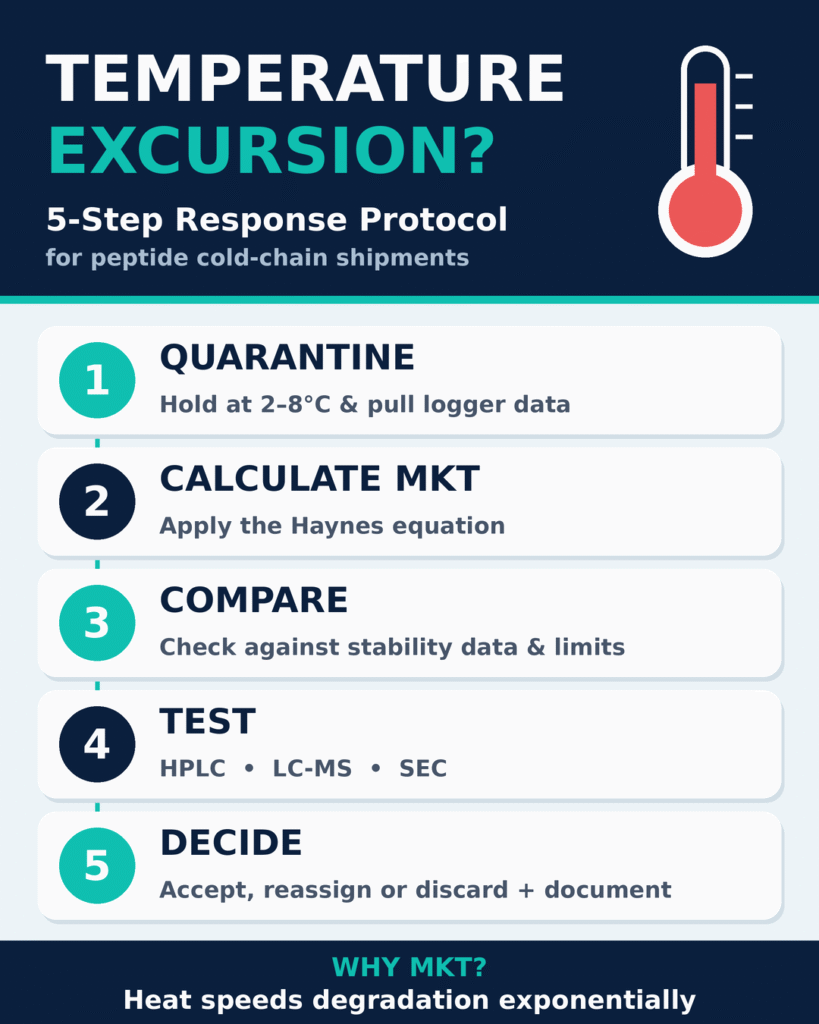
When a thermal excursion occurs during transportation, quality control teams can follow a structured five-step audit protocol:
- Quarantine and Data Retrieval: Immediately place the affected shipment under 2°C to 8°C quarantine conditions and retrieve the complete, time-stamped data from the temperature logger.
- MKT Calculation: Calculate TMKT for the excursion period using the Haynes equation.
- Stability Profile Comparison: Compare the calculated TMKT and maximum exposure duration with accelerated stability data and the manufacturer’s established excursion limits.
- Analytical Verification: If TMKT exceeds acceptable limits, submit samples for analytical release testing, including High-Performance Liquid Chromatography (HPLC), Mass Spectrometry (LC-MS), and Size-Exclusion Chromatography (SEC), to assess drug purity, fragment levels, and aggregate profiles.
- Disposition Documentation: Based on the analytical findings, formally accept, reassign, or discard the affected lot and document the decision through a detailed non-conformance report within the QMS.
For peptide programs requiring comprehensive characterization, explore analytical testing capabilities designed specifically for peptide products.
Explore Peptide Analytical Testing Services →
Commercial and Research Applications: GLP-1 Agonists and Reconstituted Peptides
Commercial GLP-1 receptor agonists and custom research peptides require controlled cold-chain conditions because aqueous liquid environments can accelerate deamidation and fibril formation following exposure to elevated temperatures. Recognizing the formulation differences between dry lyophilized powders and reconstituted liquids is important for establishing appropriate handling protocols in both clinical and research environments.
GLP-1 Receptor Agonists: Semaglutide and Tirzepatide
Glucagon-Like Peptide-1 (GLP-1) receptor agonists and dual GLP-1/GIP agonists constitute an important class of peptide therapeutics. Their molecular stability characteristics demonstrate the importance of appropriate temperature control:
- Semaglutide: A 31-amino-acid peptide containing a synthetic C18 fatty acid di-acid side chain designed for albumin binding. Before dispensing, semaglutide pens require continuous refrigeration at 2°C to 8°C. Exposure above 8°C can accelerate deamidation at susceptible asparagine residues and promote self-association involving the fatty acid side chain. Once initiated by a patient, the drug may be maintained at controlled room temperature (≤30°C) for up to 56 days; exposure beyond this period can result in progressive monomer loss.
- Tirzepatide: A 39-amino-acid synthetic peptide containing a C20 fatty di-acid moiety. Liquid formulations require 2°C to 8°C cold-chain management. Exposure outside refrigerated conditions can accelerate covalent dimer formation and thermal denaturation, with room-temperature exposure limited to a maximum of 21 days before active potency decreases below release specifications.
Explore considerations involved in scaling GLP-1 analog manufacturing from preclinical synthesis toward GMP production.
Learn About Scaling GLP-1 Analogs to GMP Manufacturing →
Lyophilized vs. Reconstituted Research Peptides
In research environments, peptides such as BPC-157, TB-500, and GHK-Cu are commonly supplied as lyophilized powders. When maintained in a dry, lyophilized state and protected from moisture and light, these molecules may tolerate short periods of ambient transportation without substantial loss of purity. However, after reconstitution with Bacteriostatic Water or Sterile Water for Injection, the activation energy associated with degradation can decrease considerably. Reconstituted liquid aliquots should be maintained at 2°C to 8°C for short-term use or frozen at -20°C to -80°C for long-term preservation. Freeze-thaw cycles should be avoided because they can introduce mechanical shear stress and cold denaturation.
Explore GMP peptide API manufacturing capabilities for development and commercial peptide programs.
Explore GMP Peptide API Manufacturing Services →
Conclusion
Maintaining an uninterrupted Peptide Cold Chain Storage system is critical for protecting the chemical integrity, physical stability, and therapeutic safety of peptide pharmaceuticals throughout their complete lifecycle. Combining high-performance packaging technologies, rigorous regulatory compliance under ICH Q1A(R2) and USP standards, and comprehensive excursion analytics helps preserve drug potency and support patient safety.
Peptides occupy a distinctive molecular position between small-molecule synthetic drugs and larger biopharmaceutical proteins. Their susceptibility to methionine oxidation, asparagine deamidation, backbone hydrolysis, and aggregation makes continuous thermal management essential throughout manufacturing, transportation, distribution, and storage.
Controlling these degradation mechanisms requires an integrated strategy that includes advanced thermal packaging technologies such as VIPs and PCMs, atmospheric controls including nitrogen purging and low humidity, continuous IoT-based environmental monitoring, and mathematical risk assessment using Mean Kinetic Temperature (TMKT). Through comprehensive stability testing protocols, contract analytical laboratories and biopharmaceutical organizations such as ResolveMass Laboratories Inc. can help ensure that sensitive peptide therapeutics comply with stringent quality, efficacy, and safety requirements worldwide.
For end-to-end peptide development, manufacturing, analytical, and CDMO support across North America, explore specialized peptide CDMO capabilities.
Explore North American Peptide CDMO Services →
For technical inquiries regarding analytical peptide characterization, stability study design, or packaging validation protocols, contact the technical team at ResolveMass Laboratories Inc.: https://resolvemass.ca/contact/
Frequently Asked Questions
Lyophilized peptides contain very little available water, which can significantly slow moisture-dependent degradation reactions during storage and transportation. After reconstitution, the presence of water can increase the rate of chemical and physical degradation. Therefore, reconstituted products generally require tighter temperature control according to their validated stability conditions.
Increasing temperature generally speeds up chemical reactions involving susceptible amino acid residues such as methionine. In the presence of oxygen or other oxidizing species, methionine can form oxidation products including methionine sulfoxide. Such modifications may change the peptide’s structural characteristics and potentially affect its biological performance.
Mean Kinetic Temperature (MKT) provides a temperature-based representation of the overall thermal exposure experienced by a pharmaceutical product. Unlike a simple temperature average, it gives greater significance to periods of higher temperature because they can contribute disproportionately to degradation. It can therefore support stability assessments when evaluating temperature excursions during transportation.
Storage requirements for GLP-1 medicines depend on the specific product, formulation, and manufacturer’s approved labeling. Many refrigerated formulations are maintained within a defined temperature range before use, while certain products may permit controlled room-temperature storage for a specified period. The approved product label should always be followed for exact storage limits and allowable out-of-refrigeration time.
Vacuum Insulation Panels reduce heat transfer by creating a highly insulating barrier around the temperature-sensitive payload. Phase Change Materials provide additional thermal protection by absorbing or releasing heat as they transition between physical states. Used together, these technologies can help maintain the required temperature range during transportation without continuous external power.
Cold chain operations for pharmaceutical and biopharmaceutical products are supported by several international quality and distribution frameworks. ICH stability guidance provides principles for evaluating product stability, while USP storage and distribution chapters address appropriate handling and temperature control. Additional requirements may apply depending on the product, country, transportation route, and regulatory authority.
Asparagine deamidation is a chemical modification that can occur when susceptible peptide residues undergo conversion into acidic forms. This change can alter the molecule’s charge, conformation, and interaction with its biological target. Depending on the peptide and extent of modification, deamidation may therefore affect potency, stability, or the overall impurity profile.
Freezing and thawing can expose peptides to several stresses, including ice formation, concentration of solutes, and changes in the local chemical environment. These conditions can increase interactions between peptide molecules and promote aggregation or precipitation. Repeated cycles may therefore cause cumulative physical instability and should be avoided unless specifically supported by stability data.
Several analytical techniques can be used to determine whether temperature exposure has affected a peptide product. HPLC can assess changes in purity and related substances, while LC-MS can help identify specific chemical modifications through mass changes. SEC is commonly used to evaluate aggregation and changes in the molecular-size distribution.
Reference:
- Nugrahadi, P. P., Hinrichs, W. L. J., Frijlink, H. W., Schöneich, C., & Avanti, C. (2023). Designing formulation strategies for enhanced stability of therapeutic peptides in aqueous solutions: A review. Pharmaceutics, 15(3), 935. https://doi.org/10.3390/pharmaceutics15030935
- Adav, S. S. (2025). Advances in the study of protein deamidation: Unveiling its influence on aging, disease progression, forensics and therapeutic efficacy. Proteomes, 13(2), 24. https://doi.org/10.3390/proteomes13020024
- Pei, J., Gao, X., Pan, D., Hua, Y., He, J., Liu, Z., & Dang, Y. (2022). Advances in the stability challenges of bioactive peptides and improvement strategies. Current Research in Food Science, 5, 2162–2170. https://doi.org/10.1016/j.crfs.2022.10.031
- Tsioptsias, C. (2023). Thermodynamic and vibrational aspects of peptide bond hydrolysis and their potential relationship to the harmfulness of infrared radiation. Molecules, 28(23), 7902. https://doi.org/10.3390/molecules28237902
- Lai, M. C., & Topp, E. M. (1999). Solid-state chemical stability of proteins and peptides. Journal of Pharmaceutical Sciences, 88(5), 489–500. https://doi.org/10.1021/js980357k
- International Council for Harmonisation of Technical Requirements for Pharmaceuticals for Human Use. (2025). ICH harmonised guideline Q1: Stability testing of drug substances and drug products (Draft version, Step 2, endorsed April 11, 2025). https://database.ich.org/sites/default/files/ICH_Q1EWG_Step2_Draft_Guideline_2025_0411.pdf
Get In Touch With Us
About The Author


