


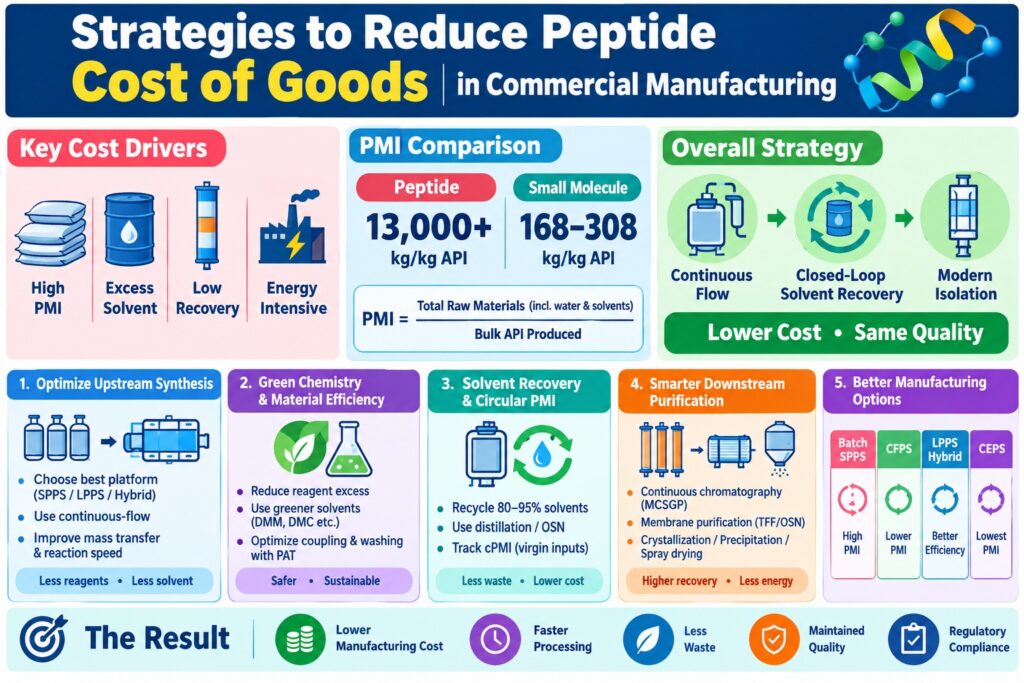
Reducing the Peptide Cost of Goods for commercial therapeutic drugs requires a comprehensive optimization strategy that addresses high process mass intensity, excessive solvent consumption, limited chromatographic recovery, and energy-intensive downstream processing. By systematically moving away from conventional batch manufacturing toward continuous-flow platforms, implementing closed-loop solvent recovery, and modernizing isolation technologies, pharmaceutical manufacturers can achieve substantial reductions in active pharmaceutical ingredient (API) manufacturing costs while maintaining product quality and process control.
Peptide therapeutics have undergone significant commercial expansion, particularly as demand has increased for high-volume metabolic therapies such as glucagon-like peptide-1 (GLP-1) receptor agonists. Despite this commercial growth, the economic viability of peptide manufacturing remains challenging because peptide API production can require exceptionally high quantities of raw materials, solvents, and processing resources. In solid-phase peptide synthesis (SPPS), Process Mass Intensity (PMI)—defined as the total mass of materials required to manufacture one kilogram of final API—can frequently exceed 13,000 kg/kg API, whereas conventional small-molecule pharmaceutical manufacturing may typically operate within a range of approximately 168–308 kg/kg API.
PMI formula:
PMI = ∑ Mass of Raw Materials (including water and solvents) [kg] / Mass of Bulk API Produced [kg]
Solvents can account for approximately 80% to 90% of the total material input and may contribute 20% to 40% of variable manufacturing expenditure. In addition to solvent consumption, significant costs are associated with protected amino acid derivatives, specialized coupling reagents, limited chromatographic recovery, and extended lyophilization cycles. Addressing these cost drivers requires coordinated improvements across the manufacturing process, including synthesis platform selection, green chemistry implementation, solvent recovery, process intensification, and downstream isolation modernization.
Share via:
Quick Summary:
- Peptide manufacturing costs are driven by high PMI, solvent consumption, reagent excess, low purification recovery, and energy-intensive downstream processing.
- Upstream optimization through the right choice of SPPS, LPPS, hybrid, continuous-flow, or emerging synthesis platforms can reduce material use and improve scalability.
- Continuous-flow peptide synthesis (CFPS) can improve heat and mass transfer, shorten reaction times, reduce solvent/wash volumes, and lower equipment and processing requirements.
- Green chemistry and solvent optimization can reduce reagent excess, replace less sustainable solvents, improve washing efficiency, and decrease waste generation.
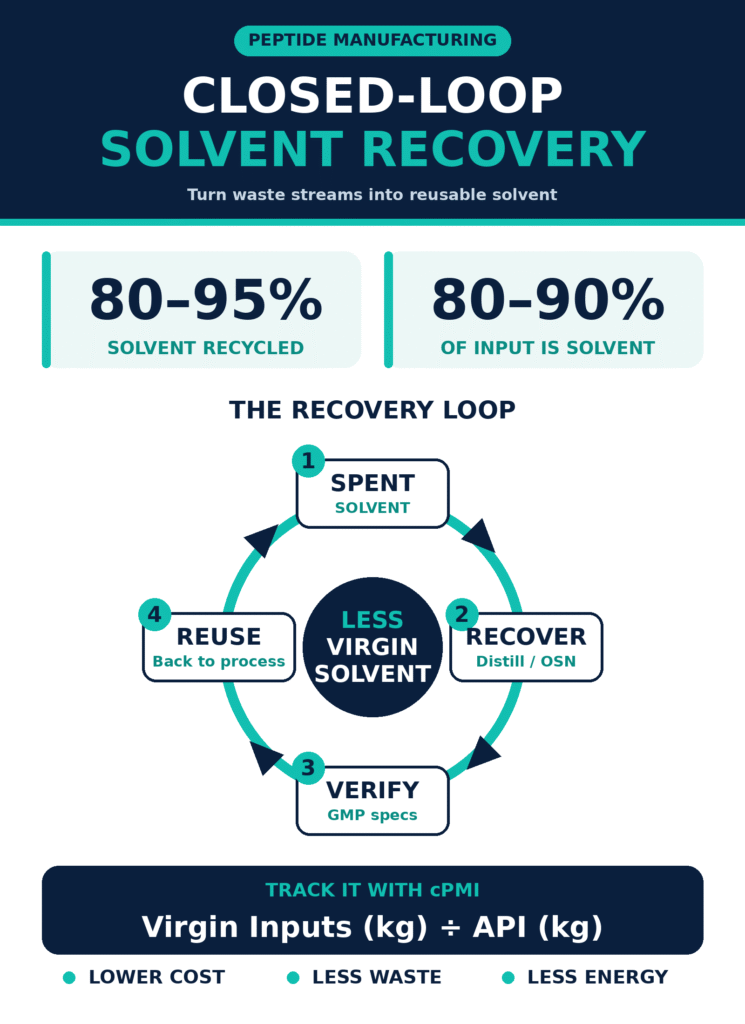
- Closed-loop solvent recovery using technologies such as distillation and Organic Solvent Nanofiltration (OSN) can recycle 80–95% of solvents, reducing virgin solvent demand and circular PMI.
- Modern downstream processing—including continuous chromatography, TFF/OSN, crystallization, precipitation, and spray drying—can improve API recovery while reducing solvent, energy, and lyophilization requirements.
- An integrated strategy combining process intensification, solvent recycling, efficient purification, and modern isolation can lower manufacturing costs, reduce waste and processing time, while maintaining product quality and regulatory compliance.
Upstream Process Optimization Strategies to Lower Peptide Cost of Goods
Upstream process optimization can reduce the Peptide Cost of Goods by selecting the synthesis platform that provides the most appropriate balance of material efficiency, process performance, and scalability. Depending on peptide sequence complexity and manufacturing volume, this may involve Solid-Phase Peptide Synthesis (SPPS), Liquid-Phase Peptide Synthesis (LPPS), hybrid approaches, or emerging synthesis technologies. Replacing conventional batch reactors with continuous-flow systems can further reduce reagent and solvent requirements while improving reaction kinetics and process control.
These changes can improve mass transfer, shorten reaction cycles, decrease excess reagent consumption, and reduce raw material expenditure at commercial manufacturing scales. The economic benefit becomes particularly important when manufacturing high-volume peptide APIs, where relatively small reductions in solvent or reagent consumption can translate into substantial annual savings.
Explore specialized custom peptide synthesis services for scalable peptide development and manufacturing.
Synthesis Platform Selection: SPPS, LPPS, and Hybrid Fragment Condensation
The selection between Solid-Phase Peptide Synthesis (SPPS), Liquid-Phase Peptide Synthesis (LPPS), and hybrid fragment condensation has a direct influence on raw material requirements, process capacity, downstream processing, and the overall cost structure of commercial peptide API production. SPPS provides rapid sequence assembly and considerable synthetic flexibility, whereas LPPS and convergent hybrid approaches can provide greater material efficiency for selected high-volume commercial processes.
SPPS continues to be an important manufacturing strategy, particularly for early-stage clinical development and structurally complex peptides. Its advantages include high automation potential, reliable coupling reactions enabled by excess reagents, and the ability to incorporate non-proteinogenic amino acids and other structural modifications. However, when manufacturing requirements expand to multi-kilogram or metric-ton quantities, the high stoichiometric excesses commonly used in SPPS can substantially increase unit costs. Protected amino acids and coupling reagents may frequently be employed at 3- to 5-fold excess, while repeated resin washing can require very large solvent volumes.
For shorter peptide sequences (<10 amino acids) or selected high-volume APIs, LPPS can provide a more economically attractive manufacturing route because it eliminates the requirement for expensive solid supports and permits purification at intermediate stages of synthesis. This approach can reduce the material burden associated with resin-based processing and may simplify downstream purification.
For medium-to-long synthetic peptides (>30–50 amino acids), hybrid strategies can combine the advantages of both platforms. In such processes, SPPS can be used to generate short, high-purity peptide fragments, followed by LPPS-based convergent fragment condensation. This configuration can provide a balance between reaction efficiency, sequence complexity, and material consumption.
Additional emerging platforms, including Chemo-Enzymatic Peptide Synthesis (CEPS) and Tag-Assisted Peptide Synthesis (TAPS), further expand the available manufacturing options. CEPS can replace certain conventional chemical coupling operations with highly selective biocatalytic transformations, while TAPS uses soluble tags to facilitate phase separation and product handling. These approaches may reduce the requirement for hazardous coupling reagents and large solvent volumes in appropriately selected peptide manufacturing processes.
Continuous-Flow Synthesis Platforms
Continuous-Flow Peptide Synthesis (CFPS) can lower manufacturing costs by continuously transporting reagents through packed-bed microreactors, thereby reducing solvent and reagent consumption compared with conventional batch synthesis. Under appropriately optimized conditions, continuous-flow processing can provide substantial reductions in material consumption while improving reaction kinetics, reducing equipment footprint, and lowering variable manufacturing expenses.
Traditional batch SPPS reactors generally depend on mechanical agitation or nitrogen sparging to promote contact between solvent-swollen resin beads and dissolved amino acids and reagents. These systems can experience mass transfer limitations and prolonged reaction cycles. They also require repeated solvent washing steps to remove residual reagents, protecting groups, and reaction byproducts from the resin.
In contrast, CFPS incorporates the solid support into packed-bed microreactors. Heated reagents and washing solvents are then continuously passed through the packed bed under controlled temperature, pressure, and flow conditions. This configuration provides more consistent fluid contact with the resin and can substantially improve heat and mass transfer.
The enhanced heat and mass transfer achieved in continuous-flow systems can accelerate coupling and deprotection reactions and reduce overall synthesis duration. Depending on the peptide sequence and process design, synthesis times can potentially be reduced from several days to hours. Faster processing can also reduce opportunities for side reactions, including racemization and aggregation.
The improved efficiency of flow processing may permit substantial reductions in wash-cycle volumes because solvent can be delivered according to defined process requirements rather than relying exclusively on large fixed-volume batch washes. Consequently, solvent purchasing requirements and hazardous waste generation can be reduced. The compact equipment footprint associated with flow reactors can additionally reduce Clean-In-Place (CIP) utility requirements and facility overhead, making CFPS an important process-intensification strategy for commercial peptide manufacturing.
Learn more about GMP peptide API manufacturing services for commercial-scale peptide production.
Material Efficiency, Green Chemistry, and Solvent Loop Closure
Material efficiency and green chemistry provide important mechanisms for reducing commercial peptide manufacturing costs. These strategies focus on minimizing reagent excesses, identifying safer and more sustainable solvent systems, improving process yields, and recovering solvents for reuse. Closing solvent loops through distillation or membrane-based separation can convert large waste streams into reusable process materials while lowering circular Process Mass Intensity (cPMI) and virgin raw material requirements.
Reagent Stoichiometry and Green Solvent Substitution
Reducing reagent stoichiometry and replacing hazardous solvents such as DMF with more sustainable alternatives, including DMM or dimethyl carbonate where technically appropriate, can reduce both material consumption and waste-treatment requirements. Optimization of coupling conditions using highly efficient reagent systems can decrease excess amino acid consumption while preserving coupling performance, product purity, and reaction rates.
Solvents account for approximately 80% to 90% of total material usage in many SPPS processes. Hazardous dipolar aprotic solvents, including DMF, N-methyl-2-pyrrolidone (NMP), and dichloromethane (DCM), can therefore represent major components of manufacturing input streams. Regulatory requirements, including REACH restrictions affecting DMF in Europe, together with fluctuations in solvent availability and cost, can increase the commercial risks associated with conventional solvent systems.
Green chemistry programs can address these challenges by evaluating alternative solvents capable of maintaining sufficient resin swelling, effective coupling kinetics, and acceptable control of aggregation-prone peptide sequences. Solvent selection must therefore be evaluated not only according to environmental considerations but also according to its influence on reaction performance, impurity formation, product quality, and downstream processing.
Reagent optimization represents another important cost-reduction opportunity. Conventional SPPS protocols may use 3 to 5 equivalents of protected amino acids and coupling reagents, including systems such as HOBt/DIC or HBTU, to drive coupling reactions toward completion. More efficient coupling systems, including combinations such as Oxyma Pure and N,N’-diisopropylcarbodiimide (DIC), can improve coupling efficiency while allowing lower stoichiometric excesses under appropriately optimized conditions.
Reducing reagent excesses decreases consumption of expensive raw materials while potentially limiting racemization and reducing the impurity burden entering downstream purification. Wash protocols can also be optimized by replacing predetermined fixed-volume washing cycles with Process Analytical Technology (PAT)-monitored approaches. Real-time monitoring can help determine when residual reagents have been adequately removed, allowing washing to stop when the required process endpoint is reached rather than continuing unnecessarily.
Closed-Loop Solvent Recovery and Circular PMI Metrics to Reduce Peptide Cost of Goods
On-site solvent recovery systems can achieve high solvent recycling rates and substantially reduce the quantity of virgin solvent required for peptide manufacturing. Depending on solvent type, contamination profile, recovery technology, and process configuration, solvent recycling rates of 80% to 95% can significantly lower the Peptide Cost of Goods by reducing recurring material purchases and waste-disposal requirements.
Circular Process Mass Intensity (cPMI) provides a useful metric for quantifying these improvements because it considers the quantity of virgin raw materials introduced into the process rather than treating recycled materials as entirely new material inputs.
cPMI formula:
cPMI = ∑ Mass of Virgin Raw Materials Input [kg] / Mass of Bulk API Produced [kg]
In a conventional linear peptide manufacturing model, spent solvents containing dissolved side-chain protecting groups, residual coupling reagents, and cleavage byproducts are generally transferred into hazardous waste streams. This generates additional costs associated with waste handling, treatment, incineration, and disposal.
Dedicated on-site solvent recovery infrastructure can transform these waste streams into reusable process resources. High-volume solvents such as acetonitrile (MeCN), DMF, and methyl tert-butyl ether (MTBE) can be recovered using technologies including continuous fractional distillation and advanced membrane separation.
Organic Solvent Nanofiltration (OSN) has emerged as an energy-efficient alternative to conventional thermal separation in selected applications. OSN uses solvent-resistant polymeric or ceramic membranes to separate low-molecular-weight organic solvents from larger dissolved peptide impurities, reagents, and salts. Because the separation can occur at relatively low temperatures, OSN may reduce energy consumption compared with thermal distillation.
Operating OSN-based solvent recovery loops can therefore reduce energy requirements while generating recovered solvents of suitable purity for reuse when the recovered material meets predefined GMP process specifications. Tracking circular PMI (cPMI), including the contribution of recycled solvent streams, provides manufacturers with a more representative measurement of process efficiency and virgin material consumption.
See how peptide analytical testing services can support impurity profiling, process optimization, and quality evaluation.
Downstream Purification and Isolation Modernization
Modernizing downstream purification is an important strategy for lowering peptide manufacturing costs because conventional single-column batch RP-HPLC can involve significant solvent consumption, limited recovery, long processing times, and substantial equipment requirements. Technologies such as continuous twin-column chromatography, membrane-based desalting, and non-chromatographic isolation can improve overall API recovery while reducing processing time and resource consumption.
Continuous Chromatography and Membrane Purification Workflows
Replacing conventional batch RP-HPLC with Multicolumn Countercurrent Solvent Gradient Purification (MCSGP) can improve chromatographic efficiency by increasing recovery while reducing solvent consumption. Depending on process configuration and peptide characteristics, continuous chromatography can improve chromatographic yields by approximately 10% to 20% and reduce solvent requirements by up to 50%.
Downstream purification is often one of the most significant operational bottlenecks and cost centers in peptide API manufacturing. Traditional reversed-phase high-performance liquid chromatography (RP-HPLC) typically uses batch binary solvent gradients consisting of water and acetonitrile, often containing trifluoroacetic acid, across silica-based stationary phases.
In batch chromatography, achieving regulatory purity requirements (>98–99%) can require substantial compromises between purity and recovery. Fractions containing overlapping target peptide and closely eluting deletion or deletion-related impurities may need to be discarded even when they contain a considerable quantity of the desired API. This loss of material directly reduces overall process yield and increases the effective cost of the final API.
Continuous countercurrent chromatography systems such as MCSGP address this yield-purity challenge by dynamically recycling appropriate overlapping side fractions into the purification process. Rather than treating potentially valuable material as waste, the system can redirect selected fractions through the purification sequence.
This continuous processing strategy can increase overall recovery while reducing acetonitrile consumption and decreasing the required column packing footprint. It can also provide more efficient use of chromatographic capacity compared with conventional batch purification.
Following purification, operations such as solvent exchange, concentration, and desalting can be transferred from energy- and solvent-intensive secondary chromatography operations to membrane-based technologies. Tangential Flow Filtration (TFF) and OSN can support these operations while reducing the requirement for large quantities of water and organic solvents.
For peptide impurity control and characterization, explore impurity control strategies under ICH Q3A.
Non-Chromatographic Isolation: Precipitation, Crystallization, and Spray Drying
Replacing multi-day batch lyophilization with crystallization, anti-solvent precipitation, or continuous spray drying can substantially reduce downstream capital requirements, energy consumption, and equipment-related processing constraints. These rapid isolation approaches can eliminate or reduce lyophilization bottlenecks while generating concentrated and high-density API material suitable for subsequent formulation operations.
Freeze-drying (lyophilization) remains a conventional final isolation technology for commercial peptide APIs because it can produce stable powder-form products. However, lyophilization is inherently capital- and energy-intensive. The process requires specialized high-vacuum equipment, sub-zero refrigeration, and extended processing cycles that can range from 24 to 72 hours per batch.
The limited capacity of industrial lyophilizers can become a major constraint when manufacturing volumes increase. Equipment availability and long cycle times can create significant scale-up bottlenecks and increase the overall cost associated with downstream processing.
To address these limitations, process developers are increasingly investigating non-chromatographic isolation strategies. Controlled crystallization or anti-solvent precipitation can enable direct isolation of purified peptide salts from concentrated process streams, potentially eliminating the need for a complete lyophilization step.
When crystallization is not technically suitable because of peptide sequence flexibility, solubility behavior, or other physicochemical characteristics, continuous spray drying can provide an alternative isolation strategy. In spray drying, the purified peptide solution is rapidly atomized into a heated drying-gas stream. The resulting droplets undergo rapid solvent removal and generate dry API particles within seconds.
When appropriately developed, spray drying can provide low thermal exposure, relatively low energy requirements, rapid processing, and high bulk density. These characteristics make it a potential alternative to conventional lyophilization for selected commercial peptide APIs.
Read more about formulating a lyophilized peptide injectable and the considerations involved in peptide lyophilization and injectable formulation.
Comprehensive Comparison of Peptide Manufacturing Methodologies
Evaluating peptide synthesis and purification technologies using key operational parameters demonstrates significant differences in material efficiency, processing duration, recovery, equipment requirements, and economic impact. The comparison below illustrates how continuous, hybrid, and alternative synthesis paradigms can potentially reduce resource consumption relative to conventional batch solid-phase synthesis.
Traditional Batch SPPS
- Typical Process Mass Intensity (PMI): 10,000–15,000 kg/kg API
- Solvent Reduction Potential: Baseline with high waste generation
- Synthesis Cycle Time: Days to weeks
- Downstream Purification Yield: 60%–75%
- Capital Equipment Footprint: Large, including multi-liter reactors
- Overall Cost Impact: High baseline cost
Green Continuous-Flow SPPS (CFPS)
- Typical Process Mass Intensity (PMI): 2,000–4,000 kg/kg API
- Solvent Reduction Potential: 70%–80% reduction
- Synthesis Cycle Time: Hours to days
- Downstream Purification Yield: 75%–85%
- Capital Equipment Footprint: Compact, using micro-/meso-reactors
- Overall Cost Impact: 25%–35% cost reduction
Liquid-Phase / Hybrid LPPS
- Typical Process Mass Intensity (PMI): 500–1,500 kg/kg API
- Solvent Reduction Potential: 80%–90% reduction
- Synthesis Cycle Time: Weeks, with a longer R&D lead time
- Downstream Purification Yield: 80%–90%
- Capital Equipment Footprint: Medium, using standard organic reactors
- Overall Cost Impact: 35%–50% cost reduction at large scale
Chemo-Enzymatic Synthesis (CEPS)
- Typical Process Mass Intensity (PMI): <500 kg/kg API
- Solvent Reduction Potential: 85%–95% reduction
- Synthesis Cycle Time: Hours to days
- Downstream Purification Yield: 85%–95%
- Capital Equipment Footprint: Medium, including bioreactors or standard reactors
- Overall Cost Impact: 40%–60% cost reduction for targeted sequences
Conclusion
Achieving a sustainably low Peptide Cost of Goods requires an integrated manufacturing strategy rather than reliance on a single process improvement. Combining continuous-flow synthesis, closed-loop solvent recovery, continuous chromatography, membrane-based purification, and modern isolation technologies can significantly reduce material consumption, processing time, waste generation, and overall manufacturing expenditure.
As the global therapeutic peptide market continues to expand across metabolic, oncology, and rare disease applications, commercial manufacturing efficiency and control of material costs are becoming increasingly important. Conventional batch solid-phase synthesis, with its high solvent intensity, reagent consumption, and extended processing cycles, can present substantial challenges when production requirements increase to high-volume commercial levels.
Explore North American peptide CDMO services for integrated peptide development, manufacturing, and process optimization support.
Transitioning toward continuous-flow platforms can improve reaction efficiency and reduce solvent requirements. Closing solvent loops through distillation or Organic Solvent Nanofiltration (OSN) can decrease dependence on virgin solvents, while continuous chromatography systems such as MCSGP can improve purification recovery and reduce solvent consumption. Similarly, crystallization, precipitation, and spray drying can provide alternatives to energy-intensive lyophilization for suitable peptide products.
These manufacturing changes must be implemented without compromising critical quality attributes (CQAs), product purity, process robustness, or regulatory compliance. Partnering with specialized analytical and process development providers can support the technical evaluation required to introduce these changes safely and systematically.
Precise analytical characterization, real-time process analytics, impurity profiling, and process-development studies are essential for determining whether manufacturing modifications maintain the required quality profile. Such analytical controls also help demonstrate that process optimization remains aligned with applicable global regulatory expectations.
To explore custom analytical testing, process optimization, and regulatory support for commercial peptide development, visit the ResolveMass Laboratories Contact Us page.
Frequently Asked Questions (FAQs)
Process Mass Intensity (PMI) measures the total quantity of materials required to manufacture a defined amount of final API. A higher PMI indicates that more solvents, reagents, water, and other materials are consumed relative to the amount of peptide produced. Consequently, reducing PMI can improve material efficiency and lower manufacturing and waste-management costs.
Continuous-Flow Peptide Synthesis (CFPS) improves process efficiency by continuously passing reagents through packed-bed microreactors under controlled operating conditions. Enhanced heat and mass transfer can accelerate coupling and deprotection reactions while reducing wash-cycle volumes and overall processing time. The smaller equipment footprint can also lower facility and utility requirements.
Liquid-Phase Peptide Synthesis (LPPS) or hybrid synthesis routes may become attractive when manufacturing moves toward higher-volume commercial production. LPPS eliminates the need for solid support resins and can allow intermediate purification during synthesis. Hybrid strategies can also combine SPPS-generated peptide fragments with LPPS-based convergent fragment condensation for selected medium-to-long peptide sequences.
Organic Solvent Nanofiltration (OSN) uses solvent-resistant membranes to separate organic solvents from larger dissolved peptide impurities, reagents, and salts. Because the process can operate at relatively low temperatures, it can reduce energy requirements compared with thermal distillation. Recovered solvents can then be reused when they meet predefined GMP process specifications.
Traditional batch RP-HPLC can generate substantial costs because achieving high purity may require sacrificing recovery when target peptide fractions overlap with closely eluting impurities. Large quantities of water and acetonitrile may also be required during chromatographic purification. At commercial scale, these solvent requirements, fraction losses, processing times, and equipment demands can become major manufacturing constraints.
Multicolumn Countercurrent Solvent Gradient Purification (MCSGP) improves recovery by continuously managing and recycling suitable overlapping fractions within the purification process. This approach helps reduce the amount of target peptide lost during conventional fraction cutting. Depending on process conditions, continuous chromatography can increase recovery while also reducing solvent consumption and chromatographic footprint.
Spray drying can rapidly convert a purified peptide solution into a dry API powder, substantially shortening the isolation step compared with conventional lyophilization. The process can reduce dependence on large freeze-drying units and minimize long batch cycle times. For suitable peptide products, spray drying can therefore improve throughput and reduce energy and equipment-related processing requirements.
Green chemistry strategies can reduce manufacturing expenditure by lowering reagent excesses, minimizing solvent requirements, and identifying safer alternatives to conventional solvents such as DMF. More efficient coupling systems can decrease protected amino acid and coupling reagent consumption while optimized washing can prevent unnecessary solvent use. Solvent recovery and reuse can further reduce virgin material purchasing and hazardous waste costs.
Any manufacturing change intended to reduce cost must be evaluated to confirm that API quality, purity, impurity profiles, and critical quality attributes (CQAs) remain within established specifications. Advanced analytical techniques, including liquid chromatography-mass spectrometry (LC-MS) and orthogonal analytical methods, can help identify changes in degradation products, process-related impurities, or diastereomeric impurities. Analytical comparability is therefore essential when demonstrating that process optimization has not adversely affected product quality.
Reference:
- Al Khzem, A. H., & Gomaa, M. S. (2026). Peptide-based therapeutics for Alzheimer’s disease: Medicinal chemistry, AI-guided computational design, and blood–brain barrier delivery. Drug Design, Development and Therapy, 20, 597087. https://doi.org/10.2147/DDDT.S597087
- American Chemical Society Green Chemistry Institute Pharmaceutical Roundtable. (2024). Process mass intensity (PMI): A holistic analysis of current peptide manufacturing processes informs sustainability in peptide synthesis. The Journal of Organic Chemistry, 89(7), 4261–4282. https://doi.org/10.1021/acs.joc.3c01494
- Yuan, S., Kaur, B., Fuchs, N. S., Cho, S., Abdo, A. N., & Gabr, M. T. (2026). Peptides as programmable molecular scaffolds: From chemical synthesis and engineering to translational medicine. RSC Chemical Biology, 7(7), 1237–1252. https://doi.org/10.1039/D6CB00117C
Get In Touch With Us
About The Author


