

Introduction
Peptide drug formulation challenges encompass the complex chemical and physical degradation risks that biological drugs may encounter during freeze-drying, contact with primary packaging, and prolonged storage. Addressing these challenges requires a detailed understanding of residue-specific reactivity and container-closure compatibility to maintain drug safety, quality, and clinical efficacy. Unlike conventional small-molecule drugs and large monoclonal antibodies, peptide therapeutics occupy a structurally complex intermediate space that can make them particularly vulnerable to enzymatic, physical, and chemical degradation. Synthetic peptides may degrade rapidly when subjected to temperature fluctuations, changes in pH, and interfacial shear stress. Under regulatory guidance, including the United States Food and Drug Administration (FDA) guidance for highly purified synthetic peptides, generic peptide formulations must identify and characterize impurities present between 0.10% and 0.50% and demonstrate that no newly observed impurity exceeds the 0.50% threshold. Therefore, developing a robust, inspection-ready formulation program requires advanced analytical characterization performed by specialized laboratories, such as ResolveMass Laboratories Inc., to define degradation pathways and confirm container-closure compatibility.
Learn more about overcoming formulation hurdles with specialized peptide drug development CDMO services.
Share via:
Article Summary:
- Peptide drug formulations are highly susceptible to chemical and physical degradation during manufacturing, storage, and administration. Factors such as pH, temperature, oxidation, and packaging interactions can reduce product stability, making robust formulation design essential for maintaining safety, efficacy, and regulatory compliance.
- Common degradation pathways include deamidation, isomerization, oxidation, and covalent adduct formation. These modifications can alter peptide structure, reduce biological activity, and generate impurities that must be carefully identified and controlled throughout product development.
- Lyophilization significantly improves peptide stability by removing water and restricting molecular movement. The use of excipients such as trehalose, sucrose, polymers, and surfactants helps protect peptide structure during freezing and drying while extending product shelf life.
- Optimized freeze-drying cycles balance process efficiency and product quality. Carefully controlled microcollapse, supported by suitable bulking agents and cryoprotectants, can shorten drying times while preserving cake integrity, rapid reconstitution, and long-term stability.
- Prefilled syringes introduce additional formulation risks through silicone oil interfaces, extractables, leachables, and residual tungsten contamination. Selecting advanced container-closure systems and low-interaction materials helps minimize peptide aggregation, oxidation, and unwanted chemical modifications.
- Comprehensive analytical characterization using orthogonal techniques—including HR-MS, LC-MS/MS peptide mapping, chromatography, NMR, and spectroscopy—enables precise identification of degradation products, supports impurity profiling, and ensures compliance with global regulatory expectations.
- A science-driven formulation strategy that integrates optimized excipients, compatible packaging systems, and advanced analytical testing reduces development risks, improves injectable peptide stability, and accelerates successful regulatory approval and commercialization.
Critical Chemical Degradation Pathways in Peptide Injectables
Chemical degradation in peptide injectables primarily involves non-enzymatic deamidation, isomerization, and site-specific oxidation. These reactions modify covalent bonds and generate chemically altered impurities. The occurrence and rate of these degradation pathways are strongly influenced by formulation pH, exposure to transition metals, and the peptide’s primary amino acid sequence.
| Degradation Pathway | Primary Chemical Mechanism | Primary Triggers / Accelerators | Structural / Biological Impact |
|---|---|---|---|
| Asparagine Deamidation | Intramolecular cyclization that generates a cyclic succinimide intermediate. | Neutral-to-alkaline pH (pH ≥ 7.0); elevated temperature; adjacent Gly residues. | Modifies peptide charge; introduces a negative charge; causes changes in backbone structure. |
| Aspartate Isomerization | Dehydration followed by formation of a succinimide intermediate and hydrolytic ring opening. | Mildly acidic pH (pH 4.0–5.0); thermal stress. | Introduces a methylene group into the backbone (isoAsp); decreases binding affinity. |
| Methionine Oxidation | Formal oxygen transfer to the sulfur atom within the side chain. | Reactive oxygen species (ROS); transition metal ions (Fe²⁺, Cu²⁺); hydrogen peroxide. | Changes peptide hydrophobicity; produces a mass shift of +16 Da (Met-SO) or +32 Da (Met-SO₂). |
| Covalent Adduct Formation | Nucleophilic addition reactions involving device-related leachates. | Reactive organic leachables, such as acrylic acid from needle adhesives. | Generates stable chemical adducts and may compromise drug purity and potency. |
Discover comprehensive analytical testing options for your pipeline by exploring our targeted peptide analytical characterization services.
Non-Enzymatic Deamidation and Isomerization Pathways
Non-enzymatic deamidation and isomerization of peptides can occur through intramolecular cyclization, producing a mixture of aspartyl and isoaspartyl residues under neutral-to-alkaline conditions. In acidic environments, the reaction mechanism changes and may proceed through direct hydrolysis of the side chain without formation of the cyclic intermediate.
At neutral-to-alkaline pH (pH ≥ 7.0), deamidation of asparagine (Asn) residues begins through an intramolecular nucleophilic attack. The backbone amide nitrogen of the adjacent C-terminal residue attacks the carbonyl carbon of the asparagine side-chain amide. This reaction releases ammonia (NH₃) and produces a five-membered cyclic aspartyl succinimide (aspartimide) intermediate. Because this cyclic intermediate is highly unstable, it rapidly undergoes hydrolytic ring opening through water-assisted cleavage. Hydrolysis can occur at either the α-carboxamide or β-carboxamide position of the ring, producing a mixture of L-aspartyl (L-Asp) and L-isoaspartyl (L-isoAsp) residues. Under typical conditions, these products are generally formed in an approximate 1:3 thermodynamic ratio, favoring the isoaspartate form.
Asn → Succinimide Intermediate → L-Asp (25%) + L-isoAsp (75%)
The formation of an isoaspartyl residue causes a significant structural alteration. In contrast to aspartic acid, isoaspartate incorporates the side-chain β-carbon into the peptide backbone, thereby extending the backbone by one methylene unit (−CH₂−). This structural change can modify the three-dimensional conformation of the peptide, alter its isoelectric point (pI), and potentially result in a complete loss of biological activity.
The rate of deamidation is strongly dependent on the peptide sequence. When a sterically unhindered residue, such as glycine, is positioned adjacent to the C-terminus of the asparagine residue (XXX-Asn-Gly-XXX), the rate of deamidation may increase by approximately 70- to 100-fold compared with sequences containing bulky neighboring residues such as isoleucine or valine. By contrast, proline residues adjacent to the Asn residue can almost completely inhibit deamidation because of steric restrictions.
Under strongly acidic conditions (pH < 3.0), the reaction mechanism changes substantially. Instead of proceeding through a cyclic succinimide intermediate, the reaction occurs through direct acid-catalyzed hydrolysis of the side-chain amide and produces only L-Asp. In mildly acidic formulations (pH 4.0–5.0), which are frequently selected to minimize alkaline deamidation, formation of the succinimide intermediate can continue while its hydrolytic breakdown becomes slower. As a result, substantial quantities, potentially reaching up to 40%, of the reactive cyclic succinimide may accumulate in the drug product over time.
Biological systems use specialized enzymes, including protein L-isoaspartate O-methyltransferase (PIMT), together with the methyl donor S-adenosyl-L-methionine (SAM), to convert isoaspartate back into succinimide and restore normal peptide bonds. In vitro formulations, however, must depend on carefully designed formulation microenvironments to limit this spontaneous degradation. Glutamine (Gln) residues can undergo a comparable deamidation process, although the reaction proceeds through a six-membered glutarimide intermediate and generally exhibits slower reaction kinetics.
Review a real-world application of these separation methods in our comprehensive generic peptide drug analytical characterization case study.
Oxidative Degradation and Metal-Induced Instability
Oxidative degradation of peptides is driven by reactive oxygen species and catalytic transition metals that attack electron-rich side chains, including methionine, cysteine, and histidine. Metal-ion-catalyzed oxidation is often highly site-specific, with preferential oxidation occurring at amino acid residues positioned near metal-binding regions.
Methionine (Met) is among the amino acids most susceptible to oxidative stress in peptide formulations. The divalent sulfur atom within the methionine side chain undergoes formal oxygen transfer to produce methionine sulfoxide (Met-SO), resulting in a molecular mass increase of +15.9949 Da, approximately +16 Da. Under prolonged or severe oxidative conditions, Met-SO may undergo an additional oxidation reaction to form methionine sulfone (Met-SO₂), corresponding to a mass increase of +31.9898 Da. Cysteine (Cys) residues are also highly vulnerable to oxidation and may form inter- or intra-molecular disulfide bonds or undergo further oxidation to produce sulfenic, sulfinic, or cysteic acid. Other amino acid residues that may be susceptible to oxidative degradation include histidine (His), tyrosine (Tyr), tryptophan (Trp), and phenylalanine (Phe).
Met → Met-SO (+16 Da) → Met-SO₂ (+32 Da)
In aqueous formulations, oxidation may be accelerated by trace concentrations of transition metals, including Fe²⁺ and Cu²⁺, that may leach from container-closure systems or be introduced as impurities associated with excipients. In these environments, metal-ion-catalyzed oxidation does not necessarily affect the residues that are most exposed to the solvent. Instead, the reaction may selectively occur at amino acid residues located close to metal-binding sites within the peptide structure.
For example, deprotonation of the imidazole side chain of a histidine residue can promote transition metal binding and generate a localized coordination complex. The bound metal can then undergo redox cycling, producing localized reactive oxygen species, including hydroxyl radicals (·OH), through Fenton-like reactions. These highly reactive species can selectively damage nearby coordinated residues. Such site-specific oxidation has been observed in human parathyroid hormone hPTH(1-34) following exposure to ferrous EDTA and H₂O₂. In this system, the methionine residue at position 8 (Met 8) and the histidine residue at position 9 (His 9) undergo highly selective oxidation, producing sulfoxide and imidazole-5-aldehyde products, respectively, because these residues coordinate with the catalytic metal complex.
Ensure your development program partners with the industry standard by choosing the best peptide CDMO for complex stability challenges.
Lyophilization as a Solution to Peptide Drug Formulation Challenges
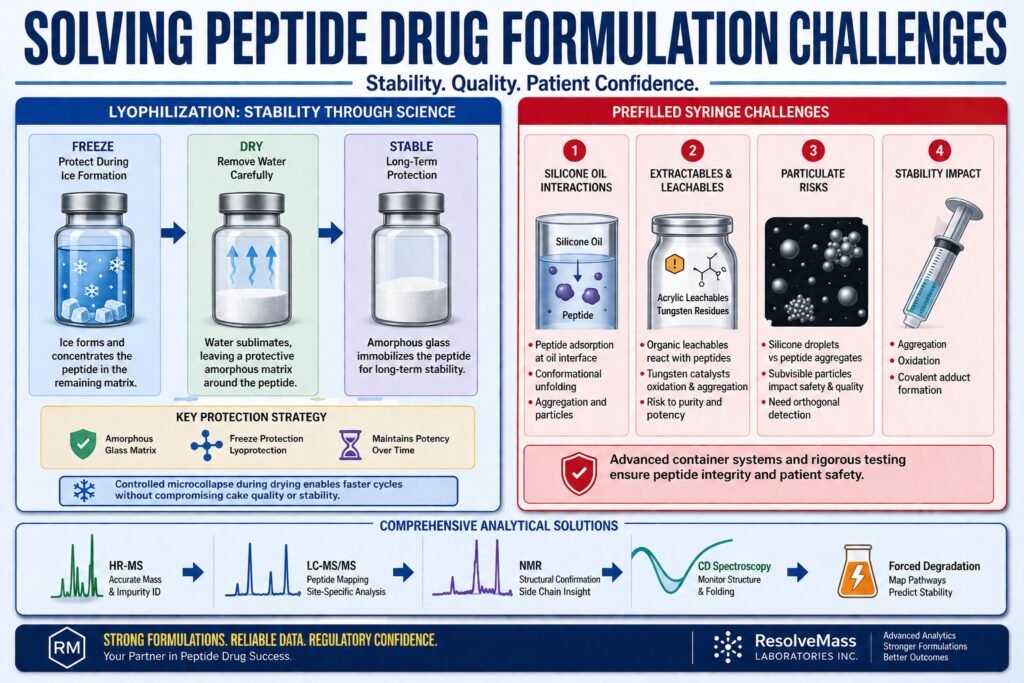
Lyophilization addresses several peptide drug formulation challenges by removing water through sublimation and desorption. This process immobilizes peptide molecules and substantially slows or halts many chemical degradation reactions. However, lyophilization also subjects the formulation to intense freezing and dehydration stresses. Therefore, carefully designed protective excipient matrices are required to preserve peptide structural integrity throughout processing and storage.
During the freezing stage of lyophilization, pure water crystallizes into ice. As a result, the remaining amorphous phase containing the peptide and excipients may become concentrated by as much as five-fold. This cryo-concentration effect can promote rapid peptide self-association, conformational unfolding, and aggregation at the ice-liquid interface. During the primary and secondary drying stages, the removal of the peptide hydration shell eliminates important hydrogen-bonding partners that help maintain the native folded structure. Effective management of these stresses requires specialized excipient matrices that provide cryoprotection during freezing and lyoprotection during dehydration.
Readily overcome complex processing hurdles and scale your operations when you outsource peptide manufacturing to CDMO specialists.
Thermodynamic Stabilization via Amorphous Glasses and Cryoprotectants
Amorphous glasses and cryoprotectants thermodynamically stabilize peptides by replacing some of the hydrogen-bonding interactions normally provided by water and creating a rigid, glassy matrix that limits molecular mobility. Non-reducing disaccharides, particularly sucrose and trehalose, are among the primary excipients used to achieve this molecular immobilization.
The molecular basis of lyoprotection is commonly explained through two principal theories: the water replacement hypothesis and the vitrification, or glass transition, hypothesis. According to the water replacement hypothesis, as water is removed through sublimation, specific excipient molecules form close and appropriately oriented hydrogen bonds with polar groups on the peptide. These interactions mimic aspects of the native hydration shell and help preserve the peptide’s folded and biologically active conformation in the dry state.
The vitrification hypothesis proposes that stabilizers should remain in a fully amorphous state to create a high-viscosity, glassy matrix surrounding the peptide. This amorphous glass restricts long-range rotational and translational movement of peptide molecules, thereby reducing diffusion-driven processes such as self-association, unfolding, and chemical degradation.
Peptide·(H₂O)ₙ + Sugar → Peptide·Sugar (Amorphous Glass) + nH₂O
The physical stability of the amorphous glass is determined in part by its glass transition temperature (Tg). When the storage temperature rises above Tg, the amorphous glass can transition into a highly mobile, rubbery state. This increased molecular mobility can substantially accelerate peptide degradation. Trehalose is often preferred over sucrose because of its relatively high glass transition temperature (Tg approximately 115 °C in the anhydrous state) and its greater resistance to moisture-induced plasticization, which refers to the reduction in Tg caused by water sorption.
Sucrose is also a highly effective hydrogen-bonding partner. However, it has a lower Tg and may undergo acid-catalyzed hydrolysis to produce reducing monosaccharides, including glucose and fructose. These reducing sugars can subsequently react with peptide amino groups through Maillard browning reactions.
Advanced formulations frequently use combinations of excipients to achieve complementary stabilization effects. The incorporation of amorphous polymers, such as polyvinylpyrrolidone (PVP) or polyvinylpyrrolidone-co-vinyl acetate (PVPVA), can increase the overall Tg of disaccharide-based formulations and reduce the likelihood of sugar crystallization under high-humidity conditions. In addition, selected surfactants, such as polysorbates, can help prevent peptide unfolding at ice-liquid and air-liquid interfaces during freezing and reconstitution.
| Cryo/Lyoprotectant | Secondary Structural Excipient | Solid-State Form | Critical Phase Transition (Tg or Tg′) | Stabilization Mechanism | Performance Risks |
|---|---|---|---|---|---|
| Sucrose | None | Fully Amorphous | Tg′ approximately −34 °C to −32 °C | Hydrogen bonding replaces interactions with water and produces a glassy matrix. | May hydrolyze under acidic conditions; lower Tg than trehalose. |
| Trehalose | None | Fully Amorphous | Tg′ approximately −29 °C to −27 °C | High glass transition temperature limits molecular mobility. | Higher raw material cost; less extensive historical regulatory data. |
| Sucrose | Mannitol | Partially Crystalline | Tg′ approximately −34 °C in the amorphous phase | Sucrose provides lyoprotection, while mannitol forms a crystalline structural scaffold. | Mannitol crystallization may promote peptide clumping when component ratios are not optimized. |
| Trehalose | PVP / PVPVA | Fully Amorphous | Elevated dry Tg | PVP enhances polymer-sugar hydrogen bonding and inhibits crystallization. | Increased formulation viscosity; potentially complex reconstitution behavior. |
| Sucrose | Dextran | Fully Amorphous | Elevated dry Tg | Dextran increases the collapse temperature, while sucrose maintains hydrogen-bonding interactions. | Increased viscosity after reconstitution; potential steric hindrance. |
Discover how specialized services help to accelerate generic drug development across the US and Canada.
Macrocollapse versus Microcollapse during Drying Operations
Macrocollapse refers to the widespread structural failure of a lyophilized cake when the product temperature exceeds the glass-rubber transition temperature (Tg′) during primary drying. Microcollapse, in contrast, involves localized viscous flow within a rigid crystalline scaffold. When properly controlled, this phenomenon can substantially accelerate drying cycles without negatively affecting the stability of the final product.
Primary drying involves the sublimation of frozen ice crystals under vacuum and requires accurate control of the product temperature (Tp). In conventional lyophilization cycle design, the product temperature is generally maintained below the collapse temperature (Tc), which is typically 1 °C to 2 °C higher than the glass-rubber transition temperature (Tg′) of the freeze-concentrated amorphous phase. In sucrose-based peptide formulations, Tg′ may range from approximately −34 °C to −25 °C, depending on the concentration of the peptide.
When Tp rises above Tg′ during primary drying, the freeze-concentrated amorphous matrix loses its rigidity and begins to undergo viscous flow. When this flow occurs throughout a substantial portion of the formulation, the micropores created by sublimating ice crystals can collapse. This phenomenon, known as macrocollapse, restricts the escape of water vapor, increases residual moisture, prolongs reconstitution time, and may contribute to accelerated long-term degradation of the peptide.
Because lyophilization cycles can be lengthy and costly, formulations may be engineered to promote controlled microcollapse and shorten processing times. This approach is achieved by combining amorphous stabilizers, such as sucrose or trehalose, with a crystalline bulking agent, such as mannitol or glycine. These components are commonly used at an approximate 1:4 ratio of amorphous to crystalline material. During freezing, the bulking agent crystallizes and creates a rigid structural scaffold.
During primary drying, the product temperature can then be increased above the Tg′ of the amorphous phase. Although the localized amorphous regions containing the peptide undergo viscous flow, producing microcollapse, the overall cake structure remains supported by the rigid crystalline mannitol scaffold. This arrangement permits drying at higher shelf temperatures, increases the rate of sublimation, and may reduce cycle times by up to 50%. At the same time, it can preserve excellent cake appearance, facilitate rapid reconstitution, and support long-term product stability.
Prefilled Syringe Challenges: Interface Interactions and Leaching
Prefilled syringes present distinct formulation challenges because of their interactions with hydrophobic lubricant layers and the possibility of organic and metallic impurities leaching from device components. These interactions may contribute to interface-induced peptide denaturation, aggregation, and the formation of covalent adducts.
Silicone Oil-Induced Adsorption and Particulate Aggregation
Silicone oil lubricants can promote peptide aggregation by creating a high-energy hydrophobic interface that encourages peptide adsorption, conformational unfolding, and subsequent self-association into subvisible particles. Controlling the amount of free silicone oil and selecting baked-on or silicone-oil-free systems are therefore important strategies for reducing this risk.
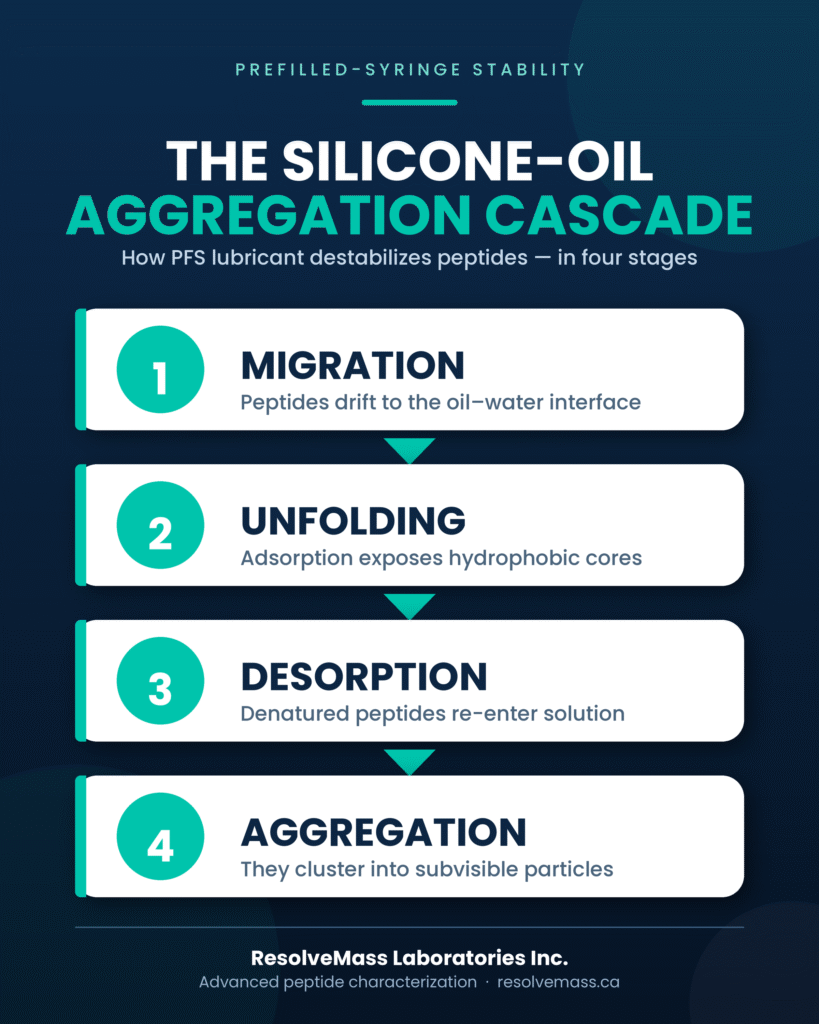
To ensure smooth plunger movement and consistent glide forces during injection, the glass barrels of prefilled syringes (PFS) are internally lubricated with polydimethylsiloxane (PDMS) silicone oil. However, direct exposure to this hydrophobic lubricant can create physical stability challenges for peptide therapeutics. The interface-induced aggregation process generally occurs through four sequential stages:
- Peptide migration to the PDMS interface →
- Adsorption and conformational unfolding →
- Desorption of denatured species →
- Covalent or non-covalent aggregation in the bulk solution
Initially, hydrophilic peptide molecules present in the formulation migrate toward and adsorb onto the highly hydrophobic silicone oil-water interface. To reduce interfacial free energy, the adsorbed peptide may undergo conformational unfolding, exposing hydrophobic regions that interact with the PDMS phase. These denatured peptide species may subsequently desorb into the bulk aqueous solution, where they self-associate and form soluble oligomers, subvisible particles, or visible fibrils.
The physical stability of the silicone oil layer is an important determinant of this degradation pathway. In conventional spray-on siliconization, liquid PDMS is sprayed directly onto the interior of the syringe barrel, producing a relatively thick layer greater than 100 nm. Mechanical stress during shipping, product filling, or freeze-thaw cycles can cause excess silicone oil to detach and enter the formulation as free silicone oil particles (SiOPs). The resulting suspended SiOPs substantially increase the total hydrophobic surface area available for peptide adsorption, thereby accelerating the kinetics of aggregation.
Furthermore, the addition of surfactants, such as Polysorbate 20 or Polysorbate 80, to reduce peptide adsorption onto glass surfaces may increase the potential for silicone oil leaching. Although available studies indicate that SiOPs do not directly induce immunogenic responses in vivo, differentiating silicone droplets from actual peptide aggregates remains an important analytical and regulatory challenge.
To address these concerns, developers may use baked-on siliconization. In this process, emulsified silicone oil is sprayed onto the syringe surface and heated to approximately 250 °C to 350 °C. The heating step volatilizes low-molecular-weight siloxanes and promotes crosslinking of the polymer chains to the glass surface. The resulting baked-on silicone layer has substantially greater resistance to leaching. For highly sensitive peptide products, silicone-oil-free (SOF) syringes and plungers laminated with fluoropolymer barrier films, including ETFE or PTFE, may be used to eliminate the silicone oil-water interface completely.
Evaluate outsourcing structures by analyzing the core differences in a detailed peptide CDMO vs CRO analysis.
Extractables, Leachables, and Tungsten Contamination
Extractables, leachables, and residual tungsten in prefilled syringes can create significant risks of chemical degradation and may catalyze rapid oxidative aggregation of peptides. Negatively charged tungsten polyanions can act as potent catalysts for aggregate formation, while organic leachables originating from elastomers and adhesives may react with peptides to form covalent adducts.
During the manufacture of staked-needle glass syringes, a tungsten pin is heated to extremely high temperatures to create the needle-opening channel at the tip of the syringe. This high-temperature process can volatilize tungsten oxide, which may subsequently deposit as microscopic residues on the internal glass surface of the fluid path. When the syringe is filled with an aqueous formulation, these residual tungsten oxides can dissolve and generate complex, negatively charged tungsten polyanions, including paratungstate-A or paratungstate-B.
These anionic polyanions can bind to positively charged regions of therapeutic peptides. The resulting electrostatic interactions may promote conformational changes, rapid site-specific oxidation, and the formation of visible precipitates or subvisible aggregates. Tungsten-induced instability may be particularly pronounced in Luer-tip syringes compared with staked-needle syringes because the needle adhesive used in the latter can reduce the exposed surface area of the fluid path.
Prefilled syringes also present potential risks associated with organic extractables and leachables. Elastomeric plunger stoppers and tip caps may contain curing agents, antioxidants, plasticizers, and metallic vulcanization activators that can migrate into the drug product during long-term storage. In addition, UV-cured adhesives used to attach staked needles to glass barrels can represent important sources of acrylic acid and methacrylate leachables.
These highly reactive acrylic monomer leachables can migrate into the formulation and react with functional groups on the peptide, resulting in covalent adduct formation. For example, mass spectrometry studies have demonstrated covalent attachment of polyacrylic leachables to pyridine rings in synthetic peptides such as ganirelix. Such chemical modification can directly reduce drug purity and potency. To limit this migration pathway, modern syringe systems may incorporate plungers laminated with high-purity fluoropolymer barrier films.
Ensure cross-border compliance with specialized regulatory support for generic drugs across US and Canadian CDMO networks.
Compendial Compliance and Particulate Characterization Standards
Compendial compliance standards require parenteral peptide formulations to meet stringent limits for both subvisible and visible particulate matter to protect patient safety. Standard release testing under USP must be supported by orthogonal characterization methods under USP to differentiate product-related aggregates from particles originating from device components.
Implementing USP and USP for Subvisible Particle Analysis
USP establishes enforceable numerical limits for subvisible particles ≥ 10 µm and ≥ 25 µm, whereas USP provides guidance on the appropriate use of orthogonal analytical methods for identifying different particle types. Because light obscuration alone cannot distinguish silicone oil droplets from peptide aggregates, imaging-based techniques are essential for establishing a comprehensive and compliant particulate characterization program.
Parenteral peptide products are subject to stringent release testing under USP. For small-volume parenterals (SVPs) with nominal contents <100 mL, including prefilled syringes, the primary compendial method is Light Obscuration (LO). When the sample is highly viscous or turbid, Membrane Particle Count (MPC) microscopy may be used as the compendial alternative.
However, LO has important limitations when applied to modern peptide formulations:
- It cannot determine the chemical or physical identity of the particles being counted.
- It cannot differentiate inert silicone oil droplets, which are intrinsic particles, from potentially immunogenic peptide aggregates, which are product-related particles.
- It has limited sensitivity for soft, translucent, or low-refractive-index particles, including early-stage peptide aggregates, which may not scatter sufficient light and can therefore remain undetected.
To overcome these limitations, USP strongly recommends complementary and orthogonal analytical techniques, particularly Flow Imaging Microscopy (FIM) or Dynamic Image Analysis (DIA), as covered in USP <1788.3>. DIA systems acquire high-resolution digital images of individual particles in real time as the formulation moves through a microfluidic channel. Advanced software algorithms then evaluate multiple morphological characteristics, including circularity, aspect ratio, optical density, and fiber curl.
This morphological assessment enables automated differentiation between highly spherical, high-contrast silicone oil droplets and irregular, translucent, or amorphous peptide aggregates. As a result, the approach provides a more comprehensive characterization of the total particulate burden in the formulation.
For therapeutic protein and peptide injections in which sample volumes are limited, USP is applied. This standard uses the same LO and MPC methodologies as USP but includes more stringent sample volume requirements and specific guidance for the management and characterization of proteinaceous particles. In addition, USP establishes separate and more stringent particle limits for ophthalmic solutions and extends the characterized particle range to ≥ 50 µm.
Ensure scientific precision in your regulatory dossiers through thorough analytical development for generic drugs in Canada.
Stability-Indicating Analytical Workflows
Stability-indicating analytical workflows must be capable of separating and quantifying the active pharmaceutical ingredient from potential process-related impurities and degradation products. These analytical strategies are governed by ICH Q2 and ICH Q14 to ensure that minor structural variants are appropriately resolved, characterized, and documented.
High-Resolution Mass Spectrometry and Orthogonal Peptide Mapping
High-resolution mass spectrometry and orthogonal peptide mapping provide detailed characterization of peptide degradation by combining accurate mass measurements with localized sequence confirmation at the individual residue level. This depth of analysis is essential for distinguishing native peptides from isomeric and isobaric degradation products.
Therapeutic peptides can present analytical challenges that are not adequately addressed by conventional small-molecule methods. For example, GLP-1 receptor agonists, which are typically 30 to 39 amino acids in length, occupy an intermediate structural space between traditional small molecules and large biologics. During reversed-phase chromatography, these molecules often exhibit an adsorption-desorption retention mechanism rather than simple gradual partitioning. Consequently, their retention can be highly sensitive to gradient slope, organic modifier concentration, temperature, and the specific ion-pairing reagent selected.
GLP-1 peptides are also highly susceptible to non-specific adsorption onto conventional stainless-steel flow paths. This interaction can deteriorate peak shape, produce severe tailing, and generate irreproducible chromatographic peak areas. Under applicable regulatory standards, generic peptide developers must characterize impurities above 0.10% and demonstrate that no impurity exceeds the 0.50% threshold. Achieving this level of analytical precision is essential.
To address these analytical challenges, robust stability-indicating workflows incorporate multiple orthogonal separation modes:
RP-HPLC (Hydrophobicity) ↔ IEX (Charge) ↔ SEC (Size) ↔ CE (Charge-to-Size)
Reversed-Phase High-Performance Liquid Chromatography (RP-HPLC) or Ultra-Performance Liquid Chromatography (UPLC) serves as the primary technique for separating peptide species according to hydrophobicity. This approach can be complemented by Ion-Exchange Chromatography (IEX) for separation based on net charge, Size-Exclusion Chromatography (SEC) for assessing oligomerization states, and Capillary Electrophoresis (CE) for separation according to charge-to-size ratios in solution.
A major challenge in mass spectrometric (MS) analysis of deamidated proteins and peptides is the relatively small mass shift associated with deamidation, which is approximately 0.984 Da. Without sufficient chromatographic resolution to completely separate deamidated species from the native peptide, deamidated peaks may overlap with naturally occurring ¹³C isotopic peaks of the unmodified species. This overlap can prevent accurate quantification of the deamidated product.
Streamline your asset validation pipeline by partnering with targeted peptide CDMO services.
Specialized Analytical Strategies to Resolve Peptide Drug Formulation Challenges
Specialized analytical strategies address peptide drug formulation challenges by integrating multidimensional chromatography, mass spectrometry, and spectroscopy to characterize complex degradation pathways. These complementary methods allow drug developers to identify specific degradants, determine their structures, and optimize the formulation microenvironment to improve product stability.
To reduce clinical development risk and support FDA compliance, ResolveMass Laboratories Inc. applies a step-by-step analytical characterization platform. This workflow integrates five core techniques to generate a comprehensive structural and chemical profile of therapeutic peptides and their degradation products:
High-Resolution Mass Spectrometry (HR-MS): Orbitrap and Q-TOF platforms are used to obtain highly accurate molecular weight measurements and determine the elemental composition of unknown impurities. These data help identify potential degradation products and establish possible degradation pathways.
LC-MS/MS Peptide Mapping: Enzymatic digestion, such as tryptic digestion, followed by LC-MS/MS fragment analysis is used to map the peptide sequence and determine the precise locations of chemical modifications, including deamidation and oxidation.
Nuclear Magnetic Resonance (NMR) Spectroscopy: NMR provides detailed information about the chemical environment of peptide side chains. It serves as an orthogonal confirmation of mass spectrometry findings and can provide additional information regarding peptide conformation.
Circular Dichroism (CD) Spectroscopy: CD spectroscopy is used to evaluate peptide folding patterns and monitor changes in secondary structure, including α-helices and β-sheets, under different formulation conditions.
Forced Degradation Studies: Controlled stress studies performed under severe conditions, including elevated temperature, oxidation, and acidic and basic environments, are used to generate degradation products in a controlled laboratory setting. These studies help map degradation pathways and support shelf-life predictions.
The practical value of this analytical strategy is illustrated by a real-world case study involving a lead Phase II peptide therapeutic candidate. The peptide was 29 amino acids in length and required a purity of >98% by HPLC. During accelerated testing at 40 °C and 75% relative humidity, the product demonstrated unexpected stability concerns, with unidentified HPLC peaks remaining after 3 months of storage.
ResolveMass Laboratories Inc. applied its multilayered characterization platform to investigate and resolve the issue. High-Resolution Mass Spectrometry (HR-MS) identified two previously unknown mass variants: a Δ +16 Da species and a Δ −18 Da species, indicating that oxidation and dehydration events had likely occurred. Targeted enzymatic peptide mapping using LC-MS/MS was then performed to determine the precise locations of the degradation events. This analysis identified site-specific oxidation at methionine-15 and deamidation at asparagine-22.
Ion Mobility Spectrometry (IMS) was subsequently used to separate deamidated conformational isomers that could not be adequately resolved using conventional liquid chromatography. Comprehensive stability profiling performed across a range of pH and temperature conditions then demonstrated that the peptide was particularly sensitive to environments with a pH greater than 7.0.
Based on these findings, the formulation team adjusted the formulation microenvironment to a pH below 7.0 and incorporated customized antioxidants. These optimization measures reduced the level of unknown impurities from approximately 2.3% to less than 0.2%. During accelerated stability testing at 40 °C and 75% relative humidity for 6 months, the formulation changed from a “Failed” status to a “Passed” status. This enabled the client to file an IND application within 6 months while remaining on schedule with the planned development timeline.
Mitigate market entry friction by choosing to outsource generic drug development in Canada to specialized analytical authorities.
Conclusion
Successfully addressing peptide drug formulation challenges requires a scientifically rigorous combination of advanced materials science, optimized container-closure selection, and ultra-high-resolution analytical characterization. Establishing these parameters at an early stage of development supports product stability while facilitating a more efficient path toward regulatory approval. By optimizing the ratio of amorphous lyoprotectants to crystalline bulking agents, lyophilization cycles can be shortened through controlled microcollapse without compromising cake elegance or long-term product stability.
In addition, addressing prefilled syringe challenges requires the careful selection of advanced baked-on or silicone-oil-free container systems and the use of fluoropolymer plunger barriers to eliminate interfaces that can promote peptide denaturation, tungsten-catalyzed oxidation, and covalent adduct formation. Ultimately, the implementation of orthogonal analytical platforms, including HR-MS, LC-MS/MS peptide mapping, NMR, and Flow Imaging, provides the high-resolution data required to reduce development risks and meet global regulatory standards.
To address complex formulation, stability, and characterization requirements, connect with the analytical experts at ResolveMass Laboratories Inc. Contact Us.
Frequently Asked Questions
Formation of an isoaspartyl (isoAsp) residue changes the normal connectivity of the peptide backbone by introducing a methylene group (−CH₂−) into the backbone structure. This occurs because the peptide linkage is redirected from the α-carbonyl position to the side-chain β-carbonyl position. The resulting structural rearrangement can alter the peptide’s three-dimensional conformation and shift its isoelectric point (pI). In addition, it may substantially reduce receptor-binding affinity and can impair or eliminate biological activity.
The amino acid sequence surrounding an asparagine residue strongly affects deamidation because neighboring residues can either facilitate or restrict intramolecular cyclization. A small residue such as glycine in an Asn-Gly sequence creates minimal steric obstruction and may increase the deamidation rate by up to 100-fold. Larger residues such as isoleucine or valine can hinder the required reaction geometry. Proline is particularly restrictive and may significantly slow or effectively prevent the deamidation reaction.
Methionine is particularly vulnerable to oxidative degradation because its side chain contains an electron-rich, highly nucleophilic divalent sulfur atom. During oxidative stress, this sulfur undergoes formal oxygen transfer and forms methionine sulfoxide (Met-SO), producing an approximate mass increase of +16 Da. Continued or severe oxidation can result in further conversion of Met-SO into methionine sulfone (Met-SO₂), associated with a +32 Da mass increase. These modifications can affect peptide structure and biological performance.
Cryoprotectants primarily protect peptides during the freezing stage by reducing damage associated with ice formation, cryo-concentration, and ice-crystal-related stress. Lyoprotectants mainly protect the peptide during dehydration throughout the primary and secondary drying stages. They can replace important hydrogen-bonding interactions lost when water is removed and may also form an amorphous glassy matrix around the peptide. This matrix limits molecular mobility and helps preserve structural integrity during storage.
The glass transition temperature (Tg) represents the temperature at which an amorphous solid changes from a rigid, glass-like state into a softer, more mobile rubbery state. When a lyophilized peptide formulation is stored above its Tg, molecular mobility within the excipient matrix increases substantially. This enhanced mobility facilitates diffusion-driven degradation processes, including peptide unfolding, self-association, deamidation, and oxidation. Maintaining storage conditions below Tg is therefore important for preserving long-term stability.
Silicone oil used to lubricate prefilled syringes can enter the formulation as free droplets and create a highly hydrophobic oil-water interface. Peptide molecules in the aqueous formulation may migrate to and adsorb onto this high-energy interface. Adsorption can promote conformational unfolding as hydrophobic regions become exposed and interact with the silicone oil phase. The destabilized molecules may then return to the bulk solution and self-associate into subvisible or visible aggregates.
Residual tungsten deposited during the high-temperature formation of syringe tips can dissolve into an aqueous formulation and generate negatively charged tungsten polyanions. These species may interact electrostatically with positively charged basic residues on therapeutic peptides. Such interactions can induce localized conformational changes and promote site-specific oxidative reactions. The resulting instability may lead to peptide degradation and the formation of subvisible or visible aggregates.
Light obscuration (LO) determines particle size and concentration based primarily on the amount of light blocked or scattered by particles. However, it does not provide sufficient information about particle morphology or chemical composition. As a result, LO cannot reliably distinguish inert silicone oil droplets from potentially immunogenic peptide aggregates. It may also have limited sensitivity for soft, translucent, or low-refractive-index peptide aggregates, potentially resulting in particle undercounting.
Under FDA guidance applicable to highly purified synthetic peptides, generic drug developers must identify, characterize, and appropriately justify relevant impurities present at levels between 0.10% and 0.50%. A new or unidentified impurity exceeding the 0.50% threshold may represent a significant regulatory concern and can delay approval. Therefore, robust stability-indicating analytical methods are required to detect, characterize, quantify, and control peptide-related impurities and degradation products.
Reference:
- Patel, A., & Patel, R. (2024). Analytical techniques for peptide-based drug development: Characterization, stability and quality control. International Journal of Science and Research Archive, 12(1), 3140–3159. https://doi.org/10.30574/ijsra.2024.12.1.1108
- Mant, C. T., Chen, Y., Yan, Z., Popa, T. V., Kovacs, J. M., Mills, J. B., Tripet, B. P., & Hodges, R. S. (2007). HPLC analysis and purification of peptides. In G. B. Fields (Ed.), Peptide synthesis and applications (pp. 3–55). Humana Press. https://doi.org/10.1007/978-1-59745-430-8_1
- Murphy, M. I., Leissa, J. A., Plata, S. B., Chamberlain, A. L., & Patel, S. M. (2023). Effect of various silicone oil and tungsten levels on the stability of a monoclonal antibody in nine commercially available prefilled syringes. Journal of Pharmaceutical Sciences, 112(6), 1586–1594. https://doi.org/10.1016/j.xphs.2023.03.009
Get In Touch With Us
About The Author


