

Introduction
Peptide Drug Master File (DMF) Preparation requires the development of a comprehensive Chemistry, Manufacturing, and Controls (CMC) technical dossier that documents the synthetic assembly, purification strategy, structural characterization, and quality control framework applied to peptide active pharmaceutical ingredients (APIs). A successful regulatory submission must satisfy stringent international expectations, demonstrate active ingredient sameness, and establish effective control of sequence-specific impurities. Synthetic peptides occupy a distinctive structural and regulatory position between conventional small-molecule pharmaceuticals and complex recombinant biological proteins. As a result, demonstrating chemical sameness, controlling sequence-specific impurities, and confirming structural integrity introduce analytical and regulatory challenges that cannot always be adequately addressed through conventional small-molecule frameworks.
Explore how peptide CDMO and CMO models differ when planning peptide development and manufacturing.
The expiration of patents covering several major therapeutic peptides, including GLP-1 receptor agonists such as liraglutide and semaglutide and therapeutic hormones such as teriparatide and glucagon, has contributed to increasing interest in highly purified synthetic peptide generic alternatives. Obtaining regulatory concurrence for a Type II Drug Master File (DMF) in the United States or an Active Substance Master File (ASMF / CEP) in Europe requires comprehensive orthogonal characterization packages, reliable impurity identification, and accurate impurity quantification. Specialized analytical services from independent testing organizations, including ResolveMass Laboratories Inc., can provide high-resolution mass spectrometry, nuclear magnetic resonance (NMR) spectroscopy, and chromatographic separation data required to support the evaluation of critical quality attributes (CQAs). Developing a compliant DMF package therefore requires detailed knowledge of international regulatory expectations, peptide process chemistry, advanced analytical methodologies, and comparative immunogenicity risk assessment.
Share via:
Quick Summary:
- Peptide DMF preparation requires a complete CMC dossier covering synthesis, purification, structural characterization, impurity control, and quality testing.
- FDA and EMA have distinct regulatory frameworks: FDA generally regulates synthetic peptides ≤40 amino acids through the ANDA/Type II DMF pathway, while the EMA framework applies to synthetic peptides of all lengths.
- Module 3 CMC documentation should detail SPPS/LPPS processes, starting materials, resin and protecting-group strategies, coupling, capping, cleavage, purification, and counter-ion exchange.
- Orthogonal analytical characterization combines LC-HRMS/MS, peptide mapping, AAA, NMR, CD, FTIR, RP-HPLC, SEC, IEX, and ion chromatography to confirm identity, structure, purity, aggregation, and charge variants.
- Impurity control is critical, covering deletion/insertion/truncated sequences, racemization, deamidation, oxidation, aspartimide, disulfide scrambling, residual solvents/reagents, elemental impurities, and potential nitrosamines.
- Comparative sameness and immunogenicity assessment requires comparison with reference listed drug batches, including sequence, structure, impurities, and degradation; new impurities in the 0.10–0.5% range may require additional immune-risk evaluation.
- A five-phase DMF workflow—method development, structural/batch characterization, impurity and sameness testing, forced degradation/stability studies, and eCTD filing/lifecycle management—helps build a robust regulatory submission.
Regulatory Frameworks Governing Peptide Drug Master File (DMF) Preparation
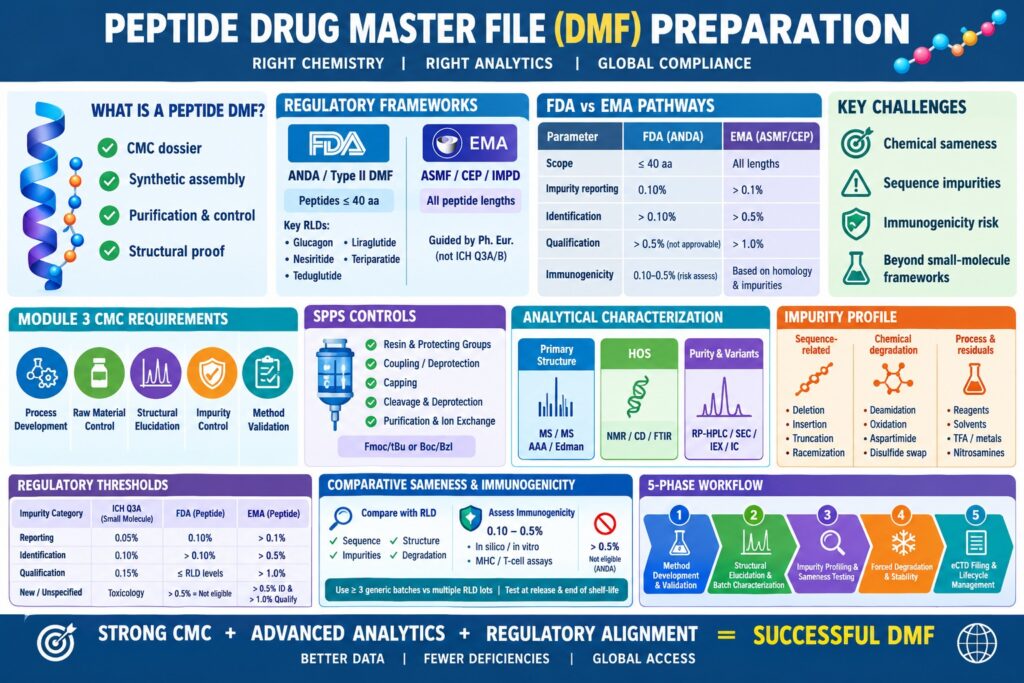
Regulatory requirements for Peptide Drug Master File (DMF) Preparation are established through region-specific requirements from regulatory authorities such as the FDA and EMA, together with harmonized ICH standards addressing impurity control, starting material selection, and analytical sameness. These frameworks are intended to ensure that synthetic peptides satisfy appropriate requirements for quality, safety, and efficacy before they are introduced for clinical or commercial use.
In the United States, the Food and Drug Administration (FDA) differentiates peptides from proteins according to polymer length, defining peptides as polymers containing 40 or fewer amino acids and proteins as polymers containing 41 or more amino acids. Synthetic peptides containing 40 or fewer amino acids are regulated as small-molecule drugs under Section 505 of the Federal Food, Drug, and Cosmetic Act (FD&C Act). Accordingly, generic products may seek approval through the Abbreviated New Drug Application (ANDA) pathway under Section 505(j). The FDA’s regulatory framework, described in its guidance ANDAs for Certain Highly Purified Synthetic Peptide Drug Products That Refer to Listed Drugs of rDNA Origin, places particular emphasis on synthetic versions of recombinant reference listed drugs (RLDs), including glucagon, liraglutide, nesiritide, teriparatide, and teduglutide.
In Europe, the European Medicines Agency (EMA) finalized its dedicated Guideline on the Development and Manufacture of Synthetic Peptides (EMA/CHMP/CVMP/QWP/367182/2025), establishing specific quality expectations for synthetic peptide products. The EMA framework recognizes that synthetic peptides are not fully covered by traditional small-molecule impurity guidelines, including ICH Q3A and ICH Q3B. Instead, impurity control for synthetic peptides is linked directly to the European Pharmacopoeia (Ph. Eur.) general monograph Substances for Pharmaceutical Use.
For a regional perspective, compare Canadian vs US peptide CDMOs when evaluating peptide development and manufacturing options.
Comparative Analysis of FDA and EMA Regulatory Pathways
A comparison of the FDA and EMA regulatory pathways demonstrates important differences in their respective scopes, impurity qualification criteria, and approaches to reference listed drugs when generic peptide products are evaluated. Although both regulatory authorities expect extensive characterization and appropriate process validation, the mechanisms used to establish impurity limits and demonstrate analytical sameness are not identical.
| Quality / Regulatory Parameter | FDA Pathway (ANDA / Type II DMF) | EMA Pathway (ASMF / CEP / IMPD) |
|---|---|---|
| Primary Governing Guidance | Guidance on Synthetic Peptides Referencing rDNA RLDs (May 2021) | Guideline on Development & Manufacture of Synthetic Peptides (Effective June 2026) |
| Scope & Size Definition | Applies to peptides ≤ 40 amino acids regulated under FD&C Act | Applies to all synthetic peptides regardless of sequence length |
| Impurity Threshold Standard | Comparative benchmark to RLD; ICH Q3A does not strictly apply | Anchored to Ph. Eur. monograph Substances for Pharmaceutical Use |
| Reporting Threshold | 0.10% (or RLD level, whichever is higher) | > 0.1% |
| Identification Threshold | > 0.10% (requires structural identification) | > 0.5% |
| Qualification Threshold | New impurities > 0.5% are unapprovable under ANDA pathway | > 1.0% (requires formal toxicological qualification) |
| Immunogenicity Evaluation | Required for new impurities between 0.10% and 0.5% (in silico / in vitro) | Integrated risk evaluation based on sequence homology and impurities |
See how peptide CDMO scale-up services can fit into a controlled development and manufacturing strategy.
Module 3 Chemistry, Manufacturing, and Controls (CMC) Technical Requirements
Module 3 Chemistry, Manufacturing, and Controls (CMC) technical requirements for peptide DMF preparation encompass the detailed technical information necessary to document the manufacturing process, raw material controls, structural elucidation, impurity control strategy, and analytical method validation. These sections collectively demonstrate that the manufacturing process is capable of consistently producing a drug substance that meets predefined critical quality attributes.
Process Development and Solid-Phase Peptide Synthesis (SPPS) Controls
Control of solid-phase peptide synthesis (SPPS) within a DMF requires comprehensive documentation covering resin selection, protecting group strategies, coupling performance, and starting material quality in accordance with ICH Q11 principles. The manufacturing description in Section 3.2.S.2 should clearly explain the selected synthetic assembly strategy, whether it involves SPPS, Liquid-Phase Peptide Synthesis (LPPS), or a hybrid fragment condensation process. For SPPS manufacturing, the DMF should identify the solid support used, such as Wang resin, 2-chlorotrityl chloride resin, or Rink amide resin, together with resin loading capacity and the applicable protecting group chemistry, typically Fmoc/tBu or Boc/Bzl chemistry.
Consistent with ICH Q11 principles, applicants should provide a scientifically justified rationale for the selection and control of peptide starting materials. Protected amino acid derivatives, such as Fmoc-AA-OH, are generally acceptable as starting materials when their specifications include stringent controls for enantiomeric purity, including D-amino acid content, chemical purity, and residual solvents. When short dipeptide or tripeptide fragments are employed as starting materials, the DMF should provide information concerning their complete synthetic origin, side-chain protection strategies, and impurity profiles. The manufacturing description should clearly present the repetitive reaction cycles involved in peptide assembly:
- Deprotection: Controlled removal of N-terminal protecting groups, such as the use of piperidine in DMF for Fmoc removal.
- Coupling: Formation of amide bonds through activation reagents such as HATU, HBTU, DIC/Oxyma and tertiary bases such as DIPEA.
- Capping: Deliberate blocking of unreacted amine functions with acetic anhydride to minimize the formation of insertion and deletion sequences.
- Cleavage and Global Deprotection: Detachment of the crude peptide from the resin support together with simultaneous removal of side-chain protecting groups using trifluoroacetic acid (TFA) cocktails containing suitable carbocation scavengers, including triisopropylsilane, water, dithiothreitol, and ethane-1,2-dithiol.
- Purification and Counter-Ion Exchange: Purification using preparative reverse-phase high-performance liquid chromatography (RP-HPLC), followed by ion exchange when required to replace residual TFA salts with pharmaceutically acceptable counter-ions such as acetate or chloride.
Review the capabilities available through peptide CDMO services in Canada for peptide development and manufacturing programs.
Analytical Characterization and Orthogonal Testing Protocols
Comprehensive analytical characterization of synthetic peptide APIs requires the application of complementary and orthogonal analytical methods capable of establishing the primary sequence, higher-order conformation, and charge heterogeneity of the molecule. Section 3.2.S.3 of the DMF should provide evidence of structural elucidation using a broad range of analytical techniques. Because peptides can undergo conformational folding as well as post-translational-like chemical modifications, regulatory assessment generally requires multiple complementary methods rather than reliance on a single analytical technique.
Analytical validation procedures should be consistent with ICH Q2(R2) and ICH Q14, with methods appropriately evaluated for specificity, linearity, range, precision, accuracy, and robustness. The structural characterization strategy can be organized into three principal analytical tiers:
- Primary Structure and Mass Mapping: Confirmation of sequence identity using tandem mass spectrometry (LC-MS/MS), peptide mapping following enzymatic cleavage, amino acid analysis (AAA) for stoichiometric evaluation, and N-terminal Edman degradation.
- Higher-Order Conformation (HOS): Evaluation of secondary and tertiary structural characteristics through 1D and 2D Nuclear Magnetic Resonance (¹H, ¹³C, ¹⁵N NMR) spectroscopy, Far-UV and Near-UV Circular Dichroism (CD), and Fourier-Transform Infrared (FTIR) spectroscopy.
- Purity, Charge, and Size Variants: Separation and characterization of closely related impurities using reverse-phase HPLC (RP-HPLC), size-exclusion chromatography (SEC-HPLC/UPLC) for aggregation assessment, ion-exchange chromatography (IEX-HPLC) for charge variant analysis, and ion chromatography (IC) for counter-ion determination.
| Structural Attribute | Primary Analytical Technique | Orthogonal / Complementary Technique | Regulatory Purpose |
|---|---|---|---|
| Monoisotopic Mass & Sequence | High-Resolution Mass Spectrometry (LC-HRMS Orbitrap / Q-TOF) | Tandem Mass Spectrometry (MS/MS) & Peptide Mapping | Confirms exact molecular weight and amino acid sequence order. |
| Amino Acid Composition | Amino Acid Analysis (AAA) via post-column ninhydrin derivatization | Edman Degradation N-terminal sequencing | Verifies quantitative amino acid stoichiometry. |
| Higher-Order Structure (HOS) | ¹H, ¹³C, ¹⁵N Nuclear Magnetic Resonance (NMR) 1D/2D Spectroscopy | Far-UV & Near-UV Circular Dichroism (CD) / FTIR | Demonstrates secondary/tertiary folding profiles. |
| Chromatographic Purity | Reverse-Phase High-Performance Liquid Chromatography (RP-HPLC) | Hydrophilic Interaction Liquid Chromatography (HILIC) | Resolves closely related sequence impurities. |
| Size-Based Aggregation | Size-Exclusion Chromatography (SEC-HPLC / SEC-UPLC) | Sedimentation Velocity Analytical Ultracentrifugation (SV-AUC) | Detects and quantifies soluble dimers and high-molecular-weight aggregates. |
| Charge Heterogeneity | Ion-Exchange Chromatography (IEX-HPLC) | Isoelectric Focusing (IEF) / Capillary Zone Electrophoresis (CZE) | Identifies acidic/basic degradation variants (e.g., deamidation). |
| Counter-Ion Content | Ion Chromatography (IC) with suppressed conductivity | Gradient RP-HPLC with Charged Aerosol Detection (CAD) | Quantifies acetate, chloride, or residual TFA levels. |
Learn more about analytical considerations within peptide CDMO services in the United States for peptide development programs.
Impurity Profiling and Threshold Evaluation in Peptide Drug Master File (DMF) Preparation
Impurity profiling in peptide Drug Master File (DMF) Preparation involves the systematic identification, quantification, and control of sequence-related variants, degradation products, residual solvents, and process-related chemicals within applicable regulatory limits. Since peptides can undergo multiple side-reactions during their iterative synthesis, a comprehensive impurity management strategy is necessary to establish product quality, safety, and stability.
Taxonomy of Synthetic Peptide Impurities
Synthetic peptide impurities can generally be classified into three major groups: sequence-related side-products generated during synthesis, chemical degradation products produced during processing or storage, and residual process-related substances. Peptide-related impurities must be appropriately identified, quantified, and controlled within the Module 3 specification framework described in Section 3.2.S.4.
- Sequence-Related Impurities:
- Deletion Sequences: Produced when an amino acid coupling reaction does not proceed to completion and the corresponding unreacted functional group is not adequately capped, producing peptides lacking one or more amino acid residues ([n-1], [n-2] species).
- Insertion Sequences: Generated when temporary protecting groups, such as Fmoc, are removed prematurely, creating an opportunity for an additional amino acid residue to become incorporated into the peptide chain ([n+1] species).
- Truncated Sequences: Produced through premature termination of peptide chain elongation or incomplete cleavage of the peptide from the resin support.
- Diastereomeric Impurities (Racemization): Occur through enantiomerization of chiral centers at the α-carbon during carboxyl activation, converting L-amino acids into D-amino acids. This issue can be particularly relevant for Cysteine and Histidine residues.
- Chemical Degradation Species:
- Deamidation: Conversion of Asparagine (Asn) and Glutamine (Gln) residues through succinimide intermediates, resulting in the formation of isoaspartic acid and aspartic acid.
- Oxidation: Addition of oxygen to Methionine, Tryptophan, or Cysteine residues, producing sulfoxide species or oxidized indole rings.
- Aspartimide Formation: Intramolecular cyclization associated with Asp-X motifs, including Asp-Gly and Asp-Ala, particularly under basic conditions during Fmoc deprotection.
- Disulfide Scrambling: Unintended rearrangement or reorganization of disulfide bonds in peptides containing multiple cysteine residues.
- Process-Related and Environmental Residuals: Substances requiring stringent control include residual coupling reagents such as HATU and HBTU; organic solvents such as DMF, NMP, DCM, and piperidine; cleavage reagents including TFA and scavengers; heavy metals; and elemental impurities assessed in accordance with ICH Q3D. Under current ICH M7 guidelines, synthetic peptide manufacturing processes should also undergo a formal risk assessment for potential nitrosamine formation, particularly where secondary or tertiary amines may react with nitrites present in raw materials or water sources.
Review practical approaches to impurity control strategies under ICH Q3A when developing a peptide impurity control framework.
Comparative Impurity Thresholds Across Regulatory Regimes
Comparison of impurity thresholds across different regulatory frameworks illustrates that synthetic peptides are subject to specific considerations that differ from those applied to conventional small molecules under ICH Q3A. The following table summarizes the impurity thresholds described within the respective regulatory frameworks.
| Impurity Category | Small Molecule Standard (ICH Q3A) | FDA Generic Peptide Guidance (ANDA) | EMA Synthetic Peptide Guideline (Ph. Eur.) |
|---|---|---|---|
| Reporting Threshold | 0.05% (for dose ≤ 2 g/day) | 0.10% | > 0.1% |
| Identification Threshold | 0.10% (for dose ≤ 2 g/day) | > 0.10% | > 0.5% |
| Qualification Threshold | 0.15% (for dose ≤ 2 g/day) | Specified impurities ≤ RLD levels | > 1.0% |
| New / Unspecified Impurities | Qualified via standard toxicology | > 0.5% is unacceptable for ANDA filing | Requires identification above 0.5% and qualification above 1.0% |
Comparative Sameness and Immunogenicity Risk Assessment
Demonstrating active ingredient sameness and addressing immunogenicity risk for generic synthetic peptides requires extensive comparative analytical evaluation against the reference listed drug (RLD). The comparison should encompass primary sequence, higher-order structure, impurity profiles, and degradation behavior. Establishing that newly observed impurities do not introduce an increased potential for anti-drug antibody responses is an important component of regulatory assessment for generic ANDA submissions.
Comparative characterization should be conducted using a statistically appropriate selection of API batches, typically including at least three distinct generic API batches manufactured using at least two separate lots of starting materials. These batches should be assessed alongside multiple commercial lots of the RLD. Comparative testing should be performed at both release and near the end of the shelf-life period to provide information on potential differences in degradation pathways over time.
One important aspect considered by health authorities is immunogenicity, particularly whether differences in impurity profiles or trace quantities of high-molecular-weight aggregates could contribute to an undesirable immune response or anti-drug antibody (ADA) formation. Under the FDA’s synthetic peptide framework:
- Specified Impurities Present in RLD: A specified impurity detected in the generic synthetic peptide at a concentration equal to or below the corresponding level in the RLD is considered acceptable within the described framework.
- New Impurities Between 0.10% and 0.5%: A new impurity that is absent from the RLD or occurs at a higher concentration than in the RLD and falls within the 0.10% to 0.5% range requires a detailed immunogenicity risk assessment. The assessment may include in silico Major Histocompatibility Complex (MHC) binding assays, T-cell epitope prediction, and in vitro cell-based assays, including MHC-binding assays, dendritic cell activation assays, or T-cell proliferation assays, to evaluate whether the impurity could increase immune recognition.
- New Impurities > 0.5%: A new peptide-related impurity exceeding 0.5% cannot be supported solely through non-clinical risk assessment under the described framework and makes the product ineligible for the generic ANDA pathway.
For broader sourcing considerations, review United States vs overseas peptide CDMOs and their implications for peptide programs.
Strategic Workflow for Peptide Drug Master File (DMF) Preparation and Filing Support
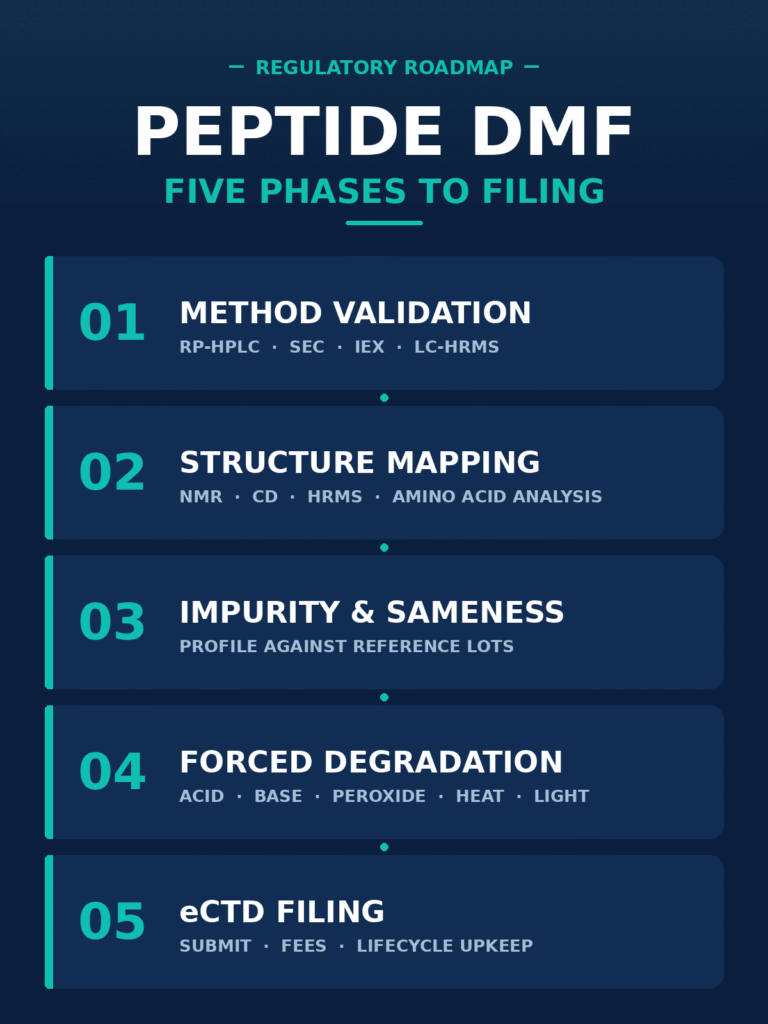
The strategic workflow for Peptide Drug Master File (DMF) Preparation and filing support encompasses five major operational phases, beginning with analytical method development and batch characterization and progressing through impurity evaluation, forced degradation, eCTD dossier preparation, submission, and post-submission lifecycle management. Following a structured workflow helps organize the technical package and reduce the potential for deficiencies during regulatory review.
- Phase 1: Analytical Method Development and Validation (ICH Q2/Q14)
- Develop and validate high-resolution RP-HPLC, SEC-HPLC, IEX-HPLC, and LC-HRMS methods capable of resolving baseline peptide impurities, closely related variants, and co-eluting sequence isomers.
- Phase 2: Structural Elucidation and Complete Batch Characterization
- Perform comprehensive 1D/2D NMR spectroscopy, circular dichroism, HRMS sequence mapping, and amino acid analysis using multiple commercial-scale API batches to establish primary, secondary, and tertiary structural identity.
- Phase 3: Impurity Profiling and Comparative Sameness Testing
- Isolate, synthesize where appropriate, and structurally characterize significant process-related impurities. Compare generic API impurity profiles directly with commercial RLD lots and conduct in silico / in vitro immunogenicity risk assessments for new impurities occurring between 0.10% and 0.5%.
- Phase 4: Forced Degradation and Stability Evaluation (ICH Q1A)
- Perform formal stability studies using ICH Q1A(R2) storage conditions, including 5 °C ± 3 °C for long-term storage and 25 °C ± 2 °C / 60% RH for accelerated conditions. Conduct stress studies involving acid, base, peroxide, heat, and light to establish the stability-indicating capability of the analytical control methods.
- Phase 5: eCTD Dossier Compilation, Filing, and Lifecycle Management
- Assemble Module 3 dossier documentation in accordance with electronic Common Technical Document (eCTD) specifications. Submit the DMF through the FDA Electronic Submissions Gateway (ESG) or EMA eSubmission Gateway, pay applicable GDUFA user fees, and maintain the dossier through annual updates and continued facility inspection readiness.
Explore how one-stop CDMO analytical services for ANDA can support integrated analytical requirements across an ANDA program.
Conclusion
Implementing a comprehensive Peptide Drug Master File (DMF) Preparation strategy is essential for managing the complex regulatory requirements associated with global peptide submissions and supporting an efficient drug approval process. Synthetic peptides occupy a distinctive regulatory position and require advanced purification strategies, orthogonal analytical characterization, and rigorous control of sequence-specific impurities to meet health authority expectations. Aligning Module 3 CMC documentation with regional regulatory frameworks, including the FDA’s synthetic peptide ANDA guidance and the EMA’s synthetic peptide framework, enables API manufacturers to systematically address regulatory requirements, demonstrate active ingredient sameness, and reduce the potential for submission deficiencies.
For programs involving generic peptide development, review bioequivalence study design for complex generic drug products alongside the broader CMC strategy.
Specialized analytical capabilities, such as those offered by ResolveMass Laboratories Inc., can support raw material testing, structural elucidation, impurity profiling, and stability studies in accordance with applicable ICH requirements. Establishing a comprehensive characterization strategy early during process development provides a strong technical foundation for DMF preparation, regulatory review, and continued commercial development within the global peptide market.
For expert analytical support, structural characterization, and high-resolution testing services tailored to your peptide DMF filings, contact ResolveMass Laboratories Inc. directly at: https://resolvemass.ca/contact/
Frequently Asked Questions (FAQs)
For synthetic peptides referencing recombinant Reference Listed Drugs (RLDs), active ingredient sameness is established through extensive comparative characterization. The assessment can include primary amino acid sequence, higher-order structure, aggregation, counter-ion composition, and relevant biological characteristics. Multiple batches of the generic API and commercial RLD are evaluated using complementary analytical methods to demonstrate comparability.
The EMA synthetic peptide framework links impurity control to the European Pharmacopoeia general monograph Substances for Pharmaceutical Use. The reported thresholds are generally described as greater than 0.1% for reporting, greater than 0.5% for identification, and greater than 1.0% for qualification. These thresholds provide a structured basis for determining when peptide-related impurities require additional characterization or toxicological assessment.
Trifluoroacetic acid (TFA) is widely used during peptide cleavage and purification and can remain associated with basic residues as a counter-ion. Excess residual TFA therefore requires appropriate analytical control because it may influence drug substance quality, formulation characteristics, and stability. Ion-exchange procedures can be used to replace residual TFA with pharmaceutically acceptable counter-ions such as acetate or chloride.
Higher-order structure (HOS) characterization generally requires multiple complementary analytical techniques rather than dependence on a single method. 1D/2D Nuclear Magnetic Resonance (¹H, ¹³C, ¹⁵N NMR) spectroscopy and Far-UV and Near-UV Circular Dichroism (CD) provide information on peptide conformation. FTIR, differential scanning calorimetry (DSC), and size-exclusion chromatography (SEC-HPLC) may provide additional evidence regarding structural characteristics and conformational stability.
ICH Q3A and ICH Q3B were developed primarily for impurity assessment of conventional small-molecule drug substances and products. Synthetic peptides require additional considerations because their sequence-related impurities and structural variants can have distinct characteristics. Regulatory assessment therefore relies on peptide-specific approaches, including comparative impurity evaluation and, where applicable, alignment with the European Pharmacopoeia framework.
When a new peptide-related impurity falls within the relevant concentration range, immunogenicity risk assessment can combine in silico prediction with in vitro immunological testing. Potential approaches include Major Histocompatibility Complex (MHC) binding studies, dendritic cell activation or maturation assays, T-cell proliferation assays, and cytokine release evaluations. The selected testing strategy should be scientifically justified according to the characteristics and potential immune activity of the impurity.
Under ICH Q11 principles, protected amino acid starting materials should be supported by a scientifically justified specification and appropriate characterization. Documentation should address their synthetic origin, chemical purity, enantiomeric purity, including D-amino acid content, and relevant impurity profile. The manufacturing process should also demonstrate that potentially introduced impurities are effectively removed or controlled during subsequent SPPS, purification, and isolation steps.
Peptide API stability programs should be designed according to applicable ICH Q1A(R2) principles and the intended storage conditions of the drug substance. Typical studies may include long-term refrigerated storage at 5 °C ± 3 °C and accelerated testing at 25 °C ± 2 °C / 60% RH ± 5% RH. Additional stress studies, including temperature, pH, freeze-thaw, oxidative, and photolytic conditions, may be necessary to understand degradation pathways and establish stability-indicating analytical methods.
Co-eluting peptide impurities, including diastereomers, deletion sequences, and deamidation products, can require optimization of chromatographic conditions and stationary-phase chemistry. RP-HPLC or UPLC methods using C18, C8, or phenyl-hexyl columns can be developed with suitable mobile-phase and gradient conditions to improve resolution. LC-MS/MS and high-resolution mass spectrometry can then support accurate mass assignment and structural differentiation of closely related impurity peaks.
Reference:
- U.S. Food and Drug Administration. (2022, September 20). Assessing immunogenicity risk of peptides: The synthetic peptide guidance and PSGs [Presentation]. Center for Drug Evaluation and Research. FDA presentation
- U.S. Food and Drug Administration. (2021, May). ANDAs for certain highly purified synthetic peptide drug products that refer to listed drugs of rDNA origin: Guidance for industry. Center for Drug Evaluation and Research. National Library of Medicine record
- Pakhare, S., Ali, S. S., & Tompe, A. (2026). Comparative review of Drug Master File (DMF) filing procedures in the United States, European Union, and India. International Journal of Pharmaceutical Sciences, 4(2), 1421–1432. https://doi.org/10.5281/zenodo.18582900
- U.S. Food and Drug Administration. (2022, November). Sameness evaluations in an ANDA—Active ingredients: Guidance for industry [Draft guidance]. Center for Drug Evaluation and Research. FDA document
- U.S. Food and Drug Administration. (2022, November). Sameness evaluations in an ANDA—Active ingredients: Guidance for industry [Draft guidance]. Center for Drug Evaluation and Research. FDA document
- U.S. Food and Drug Administration. (n.d.). Drug master files (DMFs). Retrieved September 21, 2026, from FDA
Get In Touch With Us
About The Author


