

Introduction:
Peptide Impurity Profiling by LC-MS is an advanced analytical approach used to detect and characterize structurally related impurities in peptide drug substances and products. Because peptide impurities can differ from the desired sequence by only one amino acid, a single modification, or a subtle structural change, conventional chromatographic detection with UV alone may not provide enough information for a confident identification.
Peptide manufacturing can generate impurities through synthesis and purification, while subsequent processing, formulation, storage, or exposure to environmental conditions can generate degradation products. Distinguishing these two categories matters because their origins, control strategies, investigation pathways, and regulatory justification are typically different.
FDA research has specifically highlighted the challenge of characterizing peptide-related impurities and has investigated high-resolution LC-MS approaches for peptide drug quality control. For pharmaceutical development and quality control, the objective is therefore not simply “how many impurities are present,” but a more complete set of questions:
- What is the impurity, and what is its molecular mass?
- Where did it originate — process or storage?
- Is it process-related or degradation-related?
- Can the proposed structure be supported by analytical evidence?
- Does it increase during storage or under stress?
- Can the manufacturing process consistently control it?
- Does it require additional safety or regulatory assessment?
Summary:
- Peptide Impurity Profiling by LC-MS combines chromatographic separation with accurate mass measurement and, when required, MS/MS fragmentation to detect, characterize, and differentiate peptide-related impurities.
- Process-related impurities generally originate during peptide synthesis, purification, processing, or raw-material handling.
- Degradation products form through chemical or physical changes to the peptide during storage, formulation, manufacturing, or exposure to stress conditions.
- Common process-related impurities include truncated sequences, deletion sequences, incomplete coupling products, modified residues, and residual synthesis-related species.
- Common degradation pathways include oxidation, deamidation, hydrolysis, disulfide-related changes, isomerization, fragmentation, and aggregation.
- A defensible impurity investigation combines LC-MS with stress studies, reference standards, orthogonal chromatography, MS/MS, and manufacturing-process knowledge — not mass data alone.
- FDA-affiliated research applying LC-MS/MS to synthetic peptides such as calcitonin salmon has demonstrated that a single peptide product can contain a large, complex population of low-level impurities, underscoring why high-resolution mass spectrometry is central to modern peptide quality control.
- A scientifically justified impurity profile supports process understanding, stability assessment, specifications, comparability, and regulatory CMC documentation.
1: What Is Peptide Impurity Profiling by LC-MS?
Peptide Impurity Profiling by LC-MS is the systematic detection and characterization of peptide-related impurities using liquid chromatography coupled with mass spectrometry. LC separates individual components, while MS provides the molecular-mass information needed to distinguish closely related species that UV detection cannot tell apart.
A typical workflow follows this sequence:
Sample preparation → LC separation → MS detection → accurate-mass assessment → MS/MS fragmentation → impurity identification → origin assessment → quantification/control
LC-MS is particularly valuable for peptides because closely related impurities can produce very similar UV responses and may differ from the parent peptide by only a small mass shift. FDA has reported the use of UPLC–high-resolution MS and LC-MS/MS approaches for peptide impurity characterization, demonstrating the analytical value of mass spectrometry when conventional chromatography alone cannot provide sufficient structural information.
For sponsors preparing an IND package, this level of structural detail is often expected early in development — see our dedicated peptide characterization CRO services for IND submission for how this fits into a first-in-human filing strategy.
2: Why Are Peptide Impurities Difficult to Characterize?
Peptide impurities are difficult to characterize because they often share nearly identical structures and physicochemical properties with the target peptide. Closely related sequences may co-elute chromatographically, and positional isomers can carry the exact same molecular mass.
| Challenge | Why It Matters |
|---|---|
| Truncated or deletion sequences | May differ from the parent by one or more amino acids |
| Deamidation | Produces a small mass shift with multiple possible modification sites |
| Oxidation | May occur at susceptible residues such as methionine or tryptophan |
| Isomerization | Structural change may occur without any simple mass difference |
| Coelution | Two distinct impurities may appear as a single chromatographic peak |
| Aggregation | Higher-molecular-weight species may require orthogonal techniques |
| Low-level impurities | Minor species can be difficult to detect using UV alone |
| Complex charge states | Multiple MS signals may originate from the same peptide species |
USP notes that peptide impurity analysis can involve challenges such as truncation, deamidation, isomerization, co-elution, and closely related or isomeric impurities — challenges that often require advanced techniques such as LC-MS alongside complementary orthogonal methods.
3: Process-Related Impurities vs. Degradation Products
The primary distinction is origin: process-related impurities are generated by the manufacturing process, while degradation products arise from chemical or physical changes occurring after — or during — manufacture, under relevant storage or stress conditions.
| Feature | Process-Related Impurities | Degradation Products |
|---|---|---|
| Origin | Synthesis, purification, raw materials, reagents | Storage, formulation, transport, stress exposure |
| Timing | Present at time of manufacture | Increase over time or with stress |
| Typical drivers | Incomplete coupling, side reactions, resin/reagent residues | Heat, light, moisture, pH, oxidation, enzymatic activity |
| Batch behavior | Relatively constant across a batch if the process is controlled | Increases with storage time and stress conditions |
| Control strategy | Process optimization, purification, in-process controls | Formulation design, packaging, storage conditions, stability studies |
| Typical LC-MS signature | Mass shifts matching missing/extra residues, protecting groups, diastereomers | Mass shifts matching oxidation, deamidation, hydrolysis, dimerization |
Process-Related Impurities
Process-related impurities originate from synthesis, purification, raw materials, reagents, intermediates, or manufacturing operations. For synthetic peptides, possible examples include:
- Incomplete coupling products
- Truncated sequences
- Deletion sequences
- Incompletely deprotected species
- Side-reaction products
- Modified amino-acid residues introduced during synthesis
- Starting-material-related impurities
- Residual reagents or solvents
- Purification-related impurities
FDA’s evaluation of synthetic peptides identifies incomplete coupling, truncations, side reactions, starting-material impurities, residual solvents, coupling reagents, activators, catalysts, scavengers, and aggregates among the potential impurity sources that manufacturers need to control.
Degradation Products
Degradation products result from changes to the peptide after it has been formed, including changes that occur during manufacturing, formulation, storage, or exposure to stress conditions. Potential pathways include:
- Oxidation
- Deamidation
- Hydrolysis
- Isomerization
- Disulfide-related changes
- Peptide bond cleavage / fragmentation
- Aggregation
- Chemical interaction with excipients or packaging components
The exact degradation pathway depends on the peptide sequence, formulation, pH, temperature, oxygen exposure, light, water activity, excipients, and the packaging environment.
4: How Does LC-MS Distinguish Process Impurities from Degradation Products?
LC-MS distinguishes process-related impurities from degradation products by combining impurity mass and structural data with manufacturing history, stress studies, stability data, and chromatographic behavior — mass spectrometry alone does not establish an impurity’s origin.
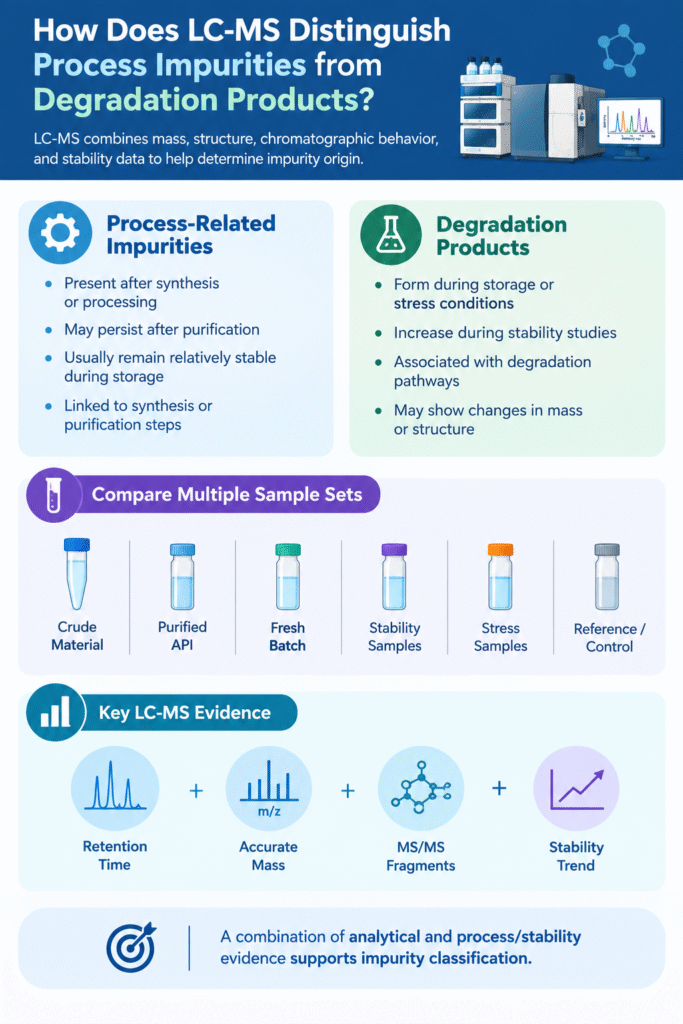
A practical investigation typically compares several sample sets side by side:
- Crude or early-process material
- Purified peptide/API
- Drug product
- Freshly manufactured batch
- Stability samples
- Forced-degradation samples
- Reference or control samples
For example, if an impurity is consistently present immediately after synthesis and does not increase during stability testing, a process-related origin is more plausible. Conversely, if a peak appears or grows during accelerated or long-term stability studies and its formation correlates with a known degradation pathway, it may be assigned as a degradation product, subject to appropriate supporting analytical evidence. ICH guidance distinguishes synthesis-related impurities from degradation products and notes that degradation products are typically identified through storage/stability studies as well as relevant stress testing.
5: LC-MS Workflow for Peptide Impurity Profiling
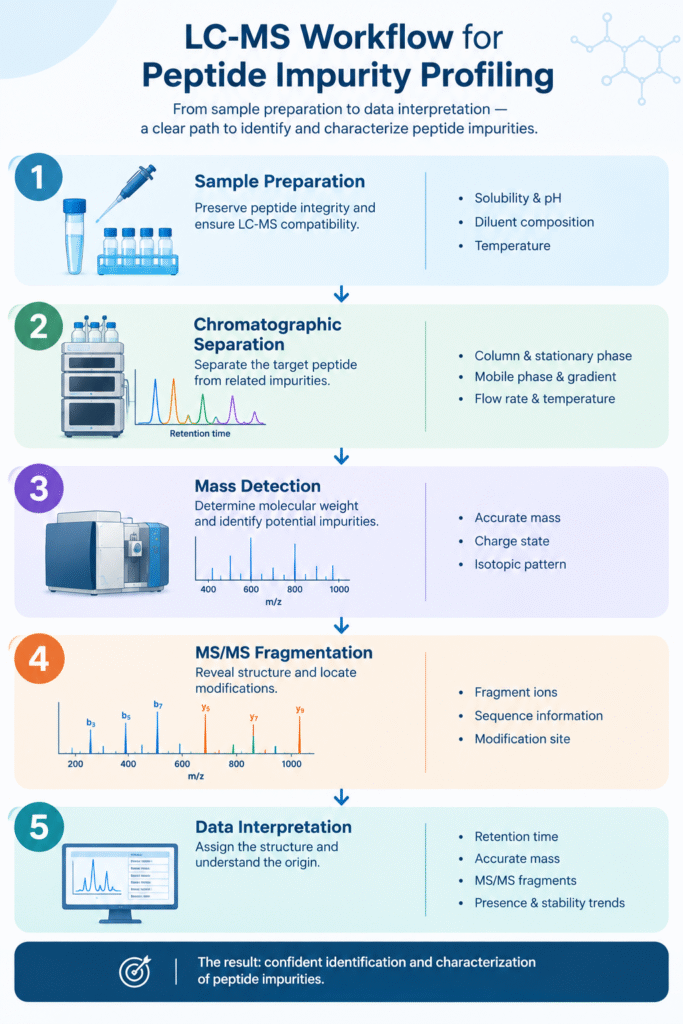
1. Sample Preparation
Sample preparation should preserve the peptide’s integrity while providing suitable recovery and LC-MS compatibility. Important considerations include solubility, diluent composition, pH, sample concentration, adsorption to containers, temperature, sample holding time, and prevention of artificial degradation during handling itself.
2. Chromatographic Separation
LC separates the target peptide from structurally related impurities before MS detection. Reversed-phase LC is commonly used for peptide-related impurity analysis, although orthogonal modes may be needed for particular species. Method-development variables include stationary phase, mobile-phase composition, organic modifier, gradient profile, column temperature, flow rate, injection volume, and MS compatibility. Adequate resolution matters because unresolved peaks complicate both identification and quantification.
3. Mass Detection
MS provides the molecular-weight information needed to determine whether an unknown peak is consistent with the parent peptide, a truncation, an oxidation product, a deamidated species, or another modification. High-resolution MS improves confidence in elemental-composition and modification assignments.
4. MS/MS Fragmentation
MS/MS increases structural confidence by examining fragmentation patterns rather than relying on intact mass alone. Fragment ions help locate the exact modification site or sequence difference, distinguishing candidate structures that share the same intact mass.
5. Data Interpretation
Analysts compare retention time, accurate mass, isotopic pattern, charge states, MS/MS fragments, relative abundance, presence across batches, behavior under stress, and stability trends. This multi-dimensional evidence is what makes an impurity assignment scientifically defensible.
6: Common Peptide Impurities Detected by LC-MS
| Impurity Type | Typical Origin | LC-MS Indication |
|---|---|---|
| Truncated peptide | Incomplete synthesis | Mass lower than parent |
| Deletion sequence | Failed amino-acid incorporation | Characteristic mass decrease |
| Oxidized peptide | Storage/process exposure | Mass increase consistent with oxidation |
| Deamidated peptide | Chemical degradation | Small mass change plus retention shift |
| Isomerized peptide | Chemical rearrangement | Similar mass, different retention |
| Fragment peptide | Hydrolysis/cleavage | Lower molecular mass |
| Modified peptide | Process or chemical reaction | Modification-specific mass shift |
| Aggregate | Association during processing/storage | Higher molecular-weight species |
| Residual process species | Manufacturing | Detected based on expected process chemistry |
An exact mass change should never be used as the sole basis for identification, because different chemical events can produce similar or overlapping analytical signatures.
7: Role of Forced Degradation in Peptide Impurity Profiling
Forced degradation helps establish whether observed impurities can arise through plausible degradation pathways and supports development of a stability-indicating analytical method. Depending on peptide stability and development goals, studies may investigate acidic conditions, basic conditions, oxidative conditions, thermal stress, photolytic exposure, humidity, agitation, and freeze-thaw cycling.
The goal is not to artificially reproduce every impurity seen during commercial storage — stress studies instead reveal degradation pathways and generate analytical knowledge that supports method development and impurity identification. ICH M7 recognizes stress testing and degradation chemistry as useful inputs when evaluating potential degradation products.
8: How Orthogonal Analytical Techniques Strengthen LC-MS Results
LC-MS is powerful, but confident peptide impurity characterization often benefits from orthogonal analytical techniques, particularly for impurities with identical or near-identical molecular masses, isomers, aggregates, or species where LC-MS alone cannot resolve the full structure. Depending on the impurity and development stage, complementary methods may include:
- HPLC/UPLC with UV or PDA detection
- High-resolution MS and MS/MS
- Size-exclusion and ion-exchange chromatography
- Capillary electrophoresis
- Amino-acid analysis and peptide mapping
- NMR spectroscopy
- Appropriately qualified reference standards
- Multi-attribute monitoring (MAM)-based peptide mapping, which layers identity, purity, and modification tracking into a single high-resolution MS workflow — see our multi-attribute monitoring (MAM) for peptide characterization approach
FDA has emphasized the value of sophisticated, comparative analytical approaches for peptide-related impurity characterization. A recent FDA inspection communication concerning tirzepatide API also highlighted concerns involving poor chromatographic resolution, overlapping peaks, lack of structural identification, and insufficient use of orthogonal high-resolution methods — a clear signal that regulators expect more than a single UV-based purity number.
9: Quantification and Method Validation Considerations
An impurity method must be demonstrated fit for its intended purpose, with validation characteristics selected according to the analytical procedure and regulatory context. Important considerations typically include specificity/selectivity, accuracy, precision, linearity, range, detection limit, quantitation limit, robustness, solution stability, system suitability, and peak purity or orthogonal confirmation.
For peptide impurity methods specifically, extra attention should be given to:
- Closely eluting impurities
- Low-level impurities and matrix effects
- Ion suppression and carryover
- Multiple charge states
- Sample and reference-material stability
- Adsorption during sample handling
The FDA maintains analytical-method resources for drug quality testing and refers applicants to its analytical procedures and methods-validation guidance when supporting regulatory submissions.
10: Regulatory Importance of Peptide Impurity Profiling
A comprehensive peptide impurity profile supports pharmaceutical quality decisions by linking impurity identity and origin to manufacturing controls, stability, specifications, and safety assessment. ICH’s quality framework includes dedicated guidance for impurities, analytical validation, specifications, stability, pharmaceutical development, quality risk management, and analytical procedure development.
For peptides specifically, regulatory interpretation requires product-specific consideration. ICH Q3B explicitly excludes peptides from its scope, so peptide impurity control should not be approached by mechanically applying small-molecule degradation-product frameworks without accounting for peptide-specific regulatory expectations. FDA has also published updated draft product-specific guidances for certain generic peptide products addressing impurity thresholds, higher-order structure, biological activity, and other considerations relevant to generic peptide development.
For sponsors preparing New Drug Applications or Abbreviated New Drug Applications, impurity data needs to be integrated into a broader comparability and CMC strategy — our page on therapeutic peptide characterization for NDA and ANDA outlines what that looks like in practice. Impurity profiling should be treated as part of the overall CMC strategy, not as an isolated analytical test.
11: How ResolveMass Laboratories Supports Peptide Impurity Characterization
ResolveMass Laboratories Inc. supports pharmaceutical and biotechnology analytical programs with advanced mass-spectrometry and chromatographic approaches for characterizing complex molecules and their impurities. For peptide impurity investigations, a scientifically structured analytical program can include:
- LC-MS-based impurity screening
- High-resolution mass characterization and MS/MS-based structural investigation
- Chromatographic impurity profiling
- Forced-degradation support
- Process-related impurity assessment and degradation-product characterization
- Analytical method development and validation
- Orthogonal analytical investigation
- Data interpretation for regulatory-ready CMC packages
The analytical strategy is adapted to the peptide sequence, manufacturing route, formulation, intended dosage form, impurity history, stability behavior, and regulatory requirements. This approach is especially relevant when a conventional chromatographic purity result reveals an unknown peak but cannot, on its own, tell you what that peak is or where it came from. For a full overview of our capabilities, visit our peptide characterization services page. If you are scoping out a project with an external lab, our guide on specifications to provide when outsourcing peptide characterization to a CRO is a useful starting point before you request a quote.
Key Takeaways
Peptide Impurity Profiling by LC-MS provides a powerful analytical framework for detecting and characterizing impurities that are difficult to resolve or identify using conventional chromatography alone. The most important principles are:
- Process-related impurities originate from manufacturing — synthesis, purification, starting materials, reagents, and process conditions.
- Degradation products arise from chemical or physical changes, often during manufacturing, formulation, storage, or stress exposure.
- LC separates; MS identifies molecular-mass differences; MS/MS provides additional structural evidence.
- Stress and stability studies help establish degradation pathways and impurity behavior over time.
- Manufacturing-process history is essential for determining an impurity’s true origin.
- Orthogonal analytical techniques strengthen structural assignments, particularly for isomers, co-eluting species, and aggregates.
- Method validation should demonstrate that the analytical procedure is genuinely fit for its intended purpose.
- Regulatory expectations should be considered throughout impurity profiling, not only at the point of submission.
FDA-affiliated peptide research underscores why advanced characterization matters: peptide impurity profiles can be genuinely complex, and low-level species often require high-resolution LC-MS/MS approaches for effective, defensible characterization. Ultimately, Peptide Impurity Profiling by LC-MS helps connect analytical observations with manufacturing history, degradation mechanisms, product quality, and regulatory decision-making — transforming an unknown chromatographic peak into scientifically supported information about its identity, origin, behavior, and appropriate control strategy.
Frequently Asked Questions:
Peptide impurity profiling helps identify and characterize unwanted substances associated with a peptide drug.
It provides information about impurity identity, origin, and formation pathways.
This supports process optimization, stability assessment, quality control, and regulatory documentation.
LC-MS is particularly useful when impurities are structurally similar to the target peptide.
Process-related impurities are substances generated during peptide synthesis, purification, or manufacturing.
Examples include truncated peptides, deletion sequences, incomplete coupling products, and side-reaction products.
Their presence is often linked to specific manufacturing steps or reaction conditions.
Understanding their origin helps establish appropriate process controls.
LC-MS can detect a wide range of sequence-related and chemically modified peptide species.
These may include truncations, deletion sequences, oxidation products, deamidated species, and fragments.
Depending on the method, higher-molecular-weight species and other related components may also be investigated.
The detectable impurity range depends on the analytical method and instrument configuration.
Stability studies monitor how peptide quality changes over defined storage periods and conditions.
Impurity trends can show whether specific degradation products increase over time.
Comparing fresh and stability samples helps establish impurity formation patterns.
LC-MS can provide additional information when new or increasing impurity peaks are observed.
Reference
- Chen G. Characterization of impurities and degradants using mass spectrometry. John Wiley & Sons; 2011 Apr 27.https://books.google.com/books?hl=en&lr=&id=1GH3JcYcVA0C&oi=fnd&pg=PP7&dq=Peptide+Impurity+Profiling:+Distinguishing+Process-Related+Impurities+from+Degradation+Products+by+LC-MS&ots=yLsuVyTGo4&sig=9sfDn8izqmaLLiW4p-mJZNvw3Ic
- Zeng K, Boyne MT, Toby TK, Ruzicka C. Impurity characterization and quantification by liquid chromatography–high-resolution mass spectrometry.https://books.rsc.org/books/edited-volume/801/chapter/541742
- Cheng J, Zhang T, Cui X, Wu P, Li M, Hu W, Dai X, Feng X. Identification and Quantification of Structurally Related Peptide Impurity in Linaclotide by Liquid Chromatography–High Resolution Mass Spectrometry. Rapid Communications in Mass Spectrometry. 2026 Apr 15;40(7):e70030.https://analyticalsciencejournals.onlinelibrary.wiley.com/doi/abs/10.1002/rcm.70030
- RUZICKA C. Impurity Characterization and Quantification by Liquid Chromatography–High-resolution Mass Spectrometry. Peptide Therapeutics: Strategy and Tactics for Chemistry, Manufacturing, and Controls. 2019 Aug 16;72:313.https://books.google.com/books?hl=en&lr=&id=WtFGEQAAQBAJ&oi=fnd&pg=PA313&dq=Peptide+Impurity+Profiling:+Distinguishing+Process-Related+Impurities+from+Degradation+Products+by+LC-MS&ots=S6n9lJTJAg&sig=eEkQ78QXzcDUtYd-5pQJpze0FzI
About the Author


