

Introduction: Why Specialized Peptide Oligonucleotide Conjugate Analysis Is Essential
Peptide Oligonucleotide Conjugate Analysis is critical because peptide–oligonucleotide conjugates (POCs) combine two chemically distinct biomolecules into one therapeutic entity. The peptide component and the oligonucleotide strand behave very differently during separation and detection. Their physical and chemical differences make standard single-platform testing insufficient. From early research to clinical development, specialized analytical strategies are required.
Peptide-oligonucleotide conjugates are widely used in targeted drug delivery, antisense therapies, siRNA systems, and cell-penetrating peptide platforms. As their use in precision medicine grows, so does the need for deep structural characterization. These conjugates present multiple analytical complexities, including:
- Molecular weight heterogeneity
- Multiple charge states
- Conjugation site variability
- Linker instability
- Sequence-specific degradation
- Phosphorothioate oxidation and peptide modifications
Expert Service: Looking for end-to-end development? Explore our comprehensive Peptide-Oligonucleotide Conjugation Services to streamline your therapeutic pipeline.
Each of these factors can influence potency, safety, and biodistribution. For example, linker instability may reduce delivery efficiency, while oxidation can change biological activity. Detecting these changes requires carefully designed, orthogonal analytical approaches. A single method rarely provides a complete molecular picture.
Robust Peptide Oligonucleotide Conjugate Analysis integrates chromatographic and mass spectrometric tools to confirm identity, purity, integrity, and stability. Using multiple complementary techniques reduces analytical risk and improves confidence in results. This approach is especially important under regulatory review.
Drug Discovery Support: Accelerate your early-stage research with specialized Custom Synthesis for Drug Discovery tailored to your specific molecular targets.
Executive Summary
- Peptide Oligonucleotide Conjugate Analysis requires integrated LC–MS, high-resolution mass spectrometry, and orthogonal chromatographic strategies due to dual molecular complexity.
- Analytical testing must address conjugation integrity, linker stability, charge heterogeneity, sequence confirmation, impurity profiling, and stability assessment.
- Regulatory expectations demand fully validated, stability-indicating methods with traceable documentation and data integrity compliance.
- Advanced services include intact mass analysis, peptide mapping, oligonucleotide sequencing, conjugation site confirmation, impurity identification, and forced degradation studies.
- AI-optimized, high-resolution platforms accelerate method development, batch release testing, and CMC support for IND-enabling programs.
- Comprehensive Peptide Oligonucleotide Conjugate Analysis ensures product safety, reproducibility, and regulatory acceptance.
Share via:
Peptide Oligonucleotide Conjugate Analysis: Core Analytical Testing Requirements
The primary goal of Peptide Oligonucleotide Conjugate Analysis is to characterize the peptide portion, the oligonucleotide strand, and the chemical linker at the same time. Each part contributes independently to therapeutic performance. Analytical workflows must confirm that all three components are present, properly attached, and stable. Even minor imbalance can reduce product effectiveness.
Unlike standalone biomolecules, peptide-oligonucleotide conjugates require:
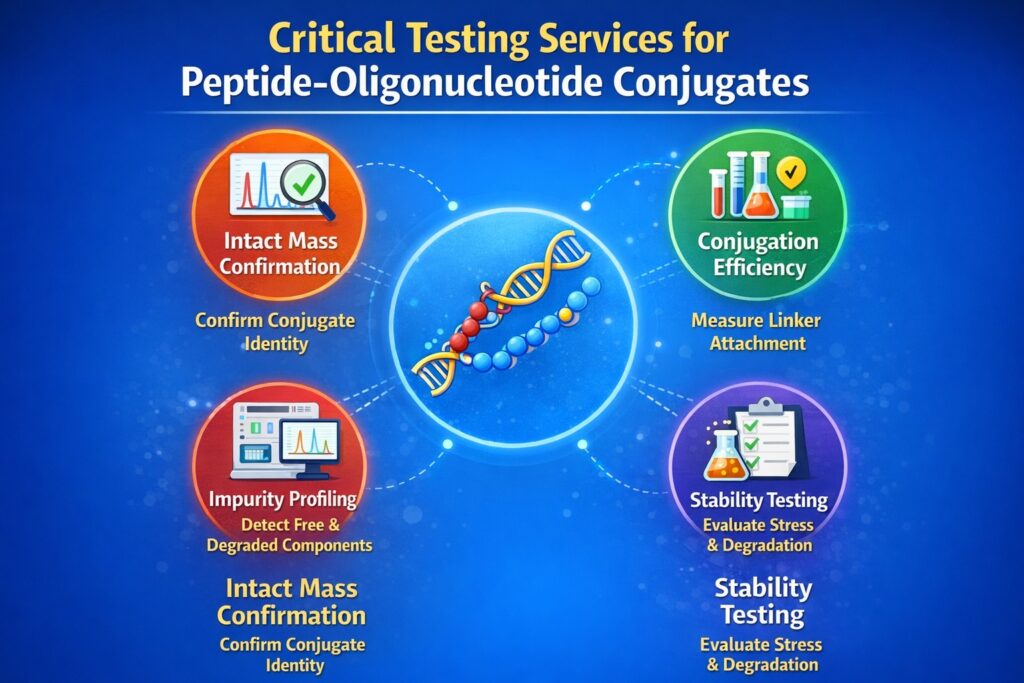
- Intact mass confirmation
- Conjugation efficiency measurement
- Free peptide and free oligonucleotide impurity assessment
- Aggregation profiling
- Oxidative and hydrolytic stability evaluation
POC Synthesis: Ensure high-quality starting materials and final products with our dedicated POC Synthesis and Characterization workflows.
These evaluations ensure that the final molecule matches its intended design. Aggregation studies are especially important because aggregates may increase immunogenic risk. Stability testing under stress conditions helps predict long-term storage behavior.
Key Testing Categories
| Analytical Objective | Testing Approach | Critical Outcome |
|---|---|---|
| Intact mass verification | HRMS, Orbitrap, Q-TOF | Confirms molecular identity |
| Conjugation site mapping | LC-MS/MS, enzymatic digestion | Confirms correct attachment |
| Impurity profiling | Ion-pair RP-HPLC, SEC | Detects truncated or free components |
| Stability testing | Forced degradation studies | Identifies degradation pathways |
| Charge heterogeneity | Capillary electrophoresis | Resolves charge variants |
| Oligonucleotide sequencing | MS fragmentation | Confirms base sequence |
Each testing category addresses a different structural or regulatory risk. Together, they create a complete quality framework required for regulated development programs.
Advanced LC-MS Strategies in Peptide Oligonucleotide Conjugate Analysis
High-resolution LC-MS is the backbone of Peptide Oligonucleotide Conjugate Analysis. It enables precise mass measurement, impurity detection, and structural confirmation in one workflow. Its sensitivity allows detection of low-level variants that may not be visible using conventional systems. Careful parameter optimization is required to manage multiple charge states and complex spectra.
1. Intact Mass Analysis
High-resolution mass spectrometry must:
- Resolve multiply charged species
- Detect small mass shifts from linker hydrolysis
- Identify oxidation or deamidation events
- Confirm complete conjugation
Accurate intact mass measurement confirms that the observed molecular weight matches the theoretical value. Even small deviations can signal degradation or incomplete synthesis. Monitoring isotopic distribution improves confidence in peak assignment.
Orbitrap and Q-TOF instruments are widely used due to:
- <5 ppm mass accuracy
- High isotopic resolution
- Sensitivity for low-level impurities
These systems provide the resolution needed to differentiate closely related molecular variants.
2. Conjugation Site Confirmation in Peptide Oligonucleotide Conjugate Analysis
Confirming the exact attachment site between the peptide and oligonucleotide is essential. Incorrect attachment can affect targeting, potency, or stability. Detailed fragmentation studies are required to ensure structural accuracy.
Common approaches include:
- Proteolytic digestion followed by LC-MS/MS
- Oligonuclease digestion combined with MS
- Hybrid fragmentation methods (CID/HCD/ETD)
These complementary strategies improve sequence coverage and mapping precision. Reliable site confirmation supports reproducibility and regulatory documentation.
Specialized CRO: Partner with a world-class Peptide Oligonucleotide Conjugates CRO to navigate complex conjugation site mapping and structural validation.
3. Impurity Profiling in Peptide Oligonucleotide Conjugate Analysis
Impurity profiling is critical because both components can generate unique degradation products. The hybrid structure increases the number of possible impurity types. Early detection reduces risks during long-term stability studies.
Common impurities include:
- Free peptide
- Free oligonucleotide
- Truncated oligonucleotide sequences
- Linker hydrolysis products
- Oxidized peptide residues
- Depurinated oligonucleotides
Orthogonal methods typically required:
- Ion-pair reversed-phase HPLC
- Strong anion exchange chromatography
- Size exclusion chromatography
- Capillary electrophoresis
Using multiple separation mechanisms improves impurity detection and supports regulatory compliance.
Peptide Analysis: Deepen your understanding of your molecule’s peptide component with our expert Peptide Characterization Service.
Stability-Indicating Methods in Peptide Oligonucleotide Conjugate Analysis
Stability studies determine how the conjugate behaves under stress. Stability-indicating methods must clearly separate intact material from degradation products. These studies help define shelf life and storage conditions.
Forced degradation should evaluate:
- Thermal stress
- Acidic and basic pH conditions
- Oxidative stress
- Photolytic exposure
- Freeze-thaw cycles
These experiments provide insights into linker cleavage, oxidation sensitivity, depurination rates, and aggregation behavior. Validated stability-indicating methods are mandatory for IND submissions and GMP release testing.
Method Development Challenges in Peptide Oligonucleotide Conjugate Analysis
Method development is complex because peptide regions are often hydrophobic, while oligonucleotides are highly polar and negatively charged. Designing a single method that resolves both regions requires careful optimization. Multiple iterations are often needed.
Technical Challenges
- Ion suppression in LC-MS
- Broad or tailing peaks
- Secondary interactions
- Salt sensitivity
- Variable charge states
Optimized Solutions
- HFIP/TEA ion-pair systems
- Careful gradient design
- MS-compatible buffers
- Desalting procedures
- Hybrid chromatographic strategies
Expert optimization improves sensitivity, resolution, and reproducibility while maintaining GMP compatibility.
Regulatory Expectations for Peptide Oligonucleotide Conjugate Analysis
Regulatory agencies require full molecular characterization, validated methods, and complete impurity profiling. All analytical procedures must comply with ICH Q2 guidelines. Method validation must demonstrate specificity, accuracy, precision, and robustness.
Key documentation requirements include:
- Method validation reports (ICH Q2)
- Impurity qualification strategies
- Stability-indicating validation data
- Data integrity compliance records
- Defined batch release specifications
Strong Peptide Oligonucleotide Conjugate Analysis supports IND, NDA, and BLA submissions and reduces the risk of regulatory delays.
Synthesis Solutions: Looking for reliable production? Discover our Peptide Oligonucleotide Conjugates (POCs) Synthesis Services for clinical and research applications.
Batch Release Testing in Peptide Oligonucleotide Conjugate Analysis
Batch release testing ensures that every manufactured lot meets predefined specifications. Consistent analytical results confirm process control and product quality. Clear acceptance criteria are established during development.
Typical release criteria include:
- Identity confirmation
- Purity percentage
- Impurity threshold limits
- Residual solvent testing
- Endotoxin testing (if applicable)
- Aggregation limits
All testing must be performed under GLP or GMP conditions with controlled SOPs and full documentation.
Emerging Technologies in Peptide Oligonucleotide Conjugate Analysis
New technologies are enhancing sensitivity, speed, and structural clarity. These innovations allow deeper molecular insight while improving turnaround times.
Emerging tools include:
- Native mass spectrometry
- Multi-dimensional LC systems
- Ion mobility spectrometry
- AI-assisted spectral interpretation
- Ultra-high resolution Orbitrap platforms
These technologies improve detection of low-level variants and simplify complex data interpretation.
Why Specialized Expertise Matters in Peptide Oligonucleotide Conjugate Analysis
Peptide Oligonucleotide Conjugate Analysis requires experience in both peptide and oligonucleotide chemistry. Cross-disciplinary expertise is essential for accurate structural interpretation and impurity identification. Regulatory knowledge is equally important for documentation and submission readiness.
A specialized laboratory provides reliable characterization, regulatory-ready reporting, and reduced development delays. Experienced teams anticipate analytical challenges early and design strategies to prevent regulatory setbacks.
Conclusion: The Critical Role of Peptide Oligonucleotide Conjugate Analysis in Therapeutic Development
Peptide Oligonucleotide Conjugate Analysis plays a central role in ensuring purity, stability, structural integrity, and regulatory compliance for peptide-oligonucleotide therapeutics. Complete characterization protects patient safety and supports clinical success. Reliable analytical data builds confidence with regulators and investors.
Without validated, stability-indicating methods, companies face serious risks such as regulatory rejection, inconsistent batches, and clinical delays. Strong analytical strategies prevent costly setbacks and improve submission outcomes.
For companies developing peptide-oligonucleotide therapeutics, investing in expert Peptide Oligonucleotide Conjugate Analysis is essential for IND readiness, GMP manufacturing, and long-term commercial success.
Contact Our Experts
If you are developing peptide-oligonucleotide conjugates and require comprehensive analytical testing services:
🔬 Contact our scientific team today.
Frequently Asked Questions
Peptide Oligonucleotide Conjugate Analysis is more complex because it evaluates two different biomolecules joined into one structure. The peptide and the oligonucleotide behave differently during separation, detection, and degradation studies. Their combined structure creates additional variability that must be carefully controlled. This makes multi-technique testing essential.
Conjugation sites are confirmed using enzymatic digestion followed by tandem mass spectrometry analysis. The fragmentation data reveals exactly where the peptide and oligonucleotide are connected. Multiple fragmentation approaches may be used to increase accuracy. This ensures the molecule matches its intended design.
Stability-indicating methods show how the conjugate behaves under heat, light, pH, and oxidative stress. These studies help identify degradation pathways and determine shelf life. Regulatory agencies require this information before approving clinical materials. Without proper stability data, submissions may be delayed.
Common impurities include free peptide, free oligonucleotide, truncated sequences, oxidation products, and linker breakdown compounds. These impurities can form during synthesis, purification, or storage. Careful impurity profiling ensures they stay within acceptable regulatory limits. Monitoring them protects product quality and patient safety.
Aggregation is commonly measured using size exclusion chromatography or light scattering techniques. These methods separate single molecules from higher-order clusters. Detecting aggregates is important because they may affect safety and immunogenicity. Routine monitoring helps maintain product consistency.
Artificial intelligence helps interpret complex mass spectrometry data more efficiently. It supports automated peak identification, spectral deconvolution, and impurity tracking. AI tools improve data consistency across batches. This reduces manual errors and speeds up reporting timelines.
Reference:
- Klabenkova, K., Fokina, A., & Stetsenko, D. (2021). Chemistry of peptide-oligonucleotide conjugates: A review. Molecules, 26(17), 5420. https://doi.org/10.3390/molecules26175420
- Venkatesan, N., & Kim, B. H. (2006). Peptide conjugates of oligonucleotides: Synthesis and applications. Chemical Reviews, 106(9), 3712–3761. https://doi.org/10.1021/cr0502448
- Malinowska, A. L., Huynh, H. L., & Bose, S. (2024). Peptide-oligonucleotide conjugation: Chemistry and therapeutic applications. Current Issues in Molecular Biology, 46(10), 11031–11047. https://doi.org/10.3390/cimb46100655
Get In Touch With Us
About The Author


