

Introduction
Peptide-Oligonucleotide Conjugate Drug Product Formulation Services address the complex development transition between bulk active pharmaceutical ingredient (API) bioconjugation and the manufacture of stable, sterile parenteral drug products. These specialized services are designed to manage the distinct dual-physicochemical characteristics of hybrid biomolecules, which combine polyanionic therapeutic nucleic acids with cationic or amphipathic target-directed peptides. The objective is to develop compliant, high-purity injectable formulations that are appropriate for clinical use as well as eventual commercial administration.
Peptide-oligonucleotide conjugates (POCs) constitute a highly targeted therapeutic modality developed to address conventional challenges associated with biopharmaceutical drug delivery. Through the covalent attachment of sequence-specific oligonucleotides, including antisense oligonucleotides (ASOs), small interfering RNAs (siRNAs), or phosphorodiamidate morpholino oligomers (PMOs), to cell-penetrating peptides (CPPs) or receptor-homing ligands, these molecular constructs can improve intracellular transport and provide enhanced extrahepatic tissue specificity. However, converting bulk POC APIs into ready-to-administer parenteral dosage forms involves substantial technical complexity. Structural heterogeneity, pH-dependent charge neutralization, self-assembly characteristics, and the separate degradation pathways of peptide and nucleic acid components necessitate specialized formulation strategies and extensive formulation engineering.
For a deeper look into overcoming payload entry barriers and design considerations, read our detailed guide on How Peptide-Oligonucleotide Conjugates Enter Cells.
Contract development and analytical testing facilities, including ResolveMass Laboratories Inc., utilize advanced bioanalytical characterization platforms and systematic preformulation screening frameworks to manage these challenging stability characteristics. The development process can extend from the preparation of preformulation phase diagrams through the optimization and validation of fill-finish operations. Consequently, technical expertise encompassing both synthetic nucleic acid chemistry and peptide formulation science is critical for successfully advancing lead candidates into stable, compliant, and commercially viable parenteral drug products.
Share via:
Quick Summary:
- POC formulation services convert peptide–oligonucleotide APIs into stable, sterile, injectable drug products, addressing the unique challenges of hybrid biomolecules.
- Preformulation characterization evaluates charge, pI, CMC, thermal stability, purity, linker integrity, and solid-state properties to prevent precipitation and aggregation.
- Excipient and matrix design uses optimized buffers, surfactants, tonicity agents, and lyoprotectants such as histidine, polysorbates, mannitol, trehalose, and sucrose to protect both peptide and oligonucleotide components.
- Aseptic manufacturing and fill-finish require low-shear processing, controlled 2–8°C handling, validated 0.22 µm sterile filtration, precise filling, and optimized lyophilization.
- Advanced analytical characterization combines RP-IP-HPLC/MS, SEC-MALS, CGE, Nano-DSC, FIM, and light obscuration to confirm identity, purity, stability, aggregation, and particle control.
- Container-closure selection and E&L control focus on low-adsorption materials, suitable glass/COP/COC containers, fluoropolymer-coated stoppers, and container-closure integrity testing.
- Overall, specialized POC formulation services support QbD-based development, regulatory compliance, reduced technical risk, and faster progression from API to clinical and commercial injectable products.
Preformulation Characterization and Physicochemical Mapping for Peptide-Oligonucleotide Conjugate Drug Product Formulation Services
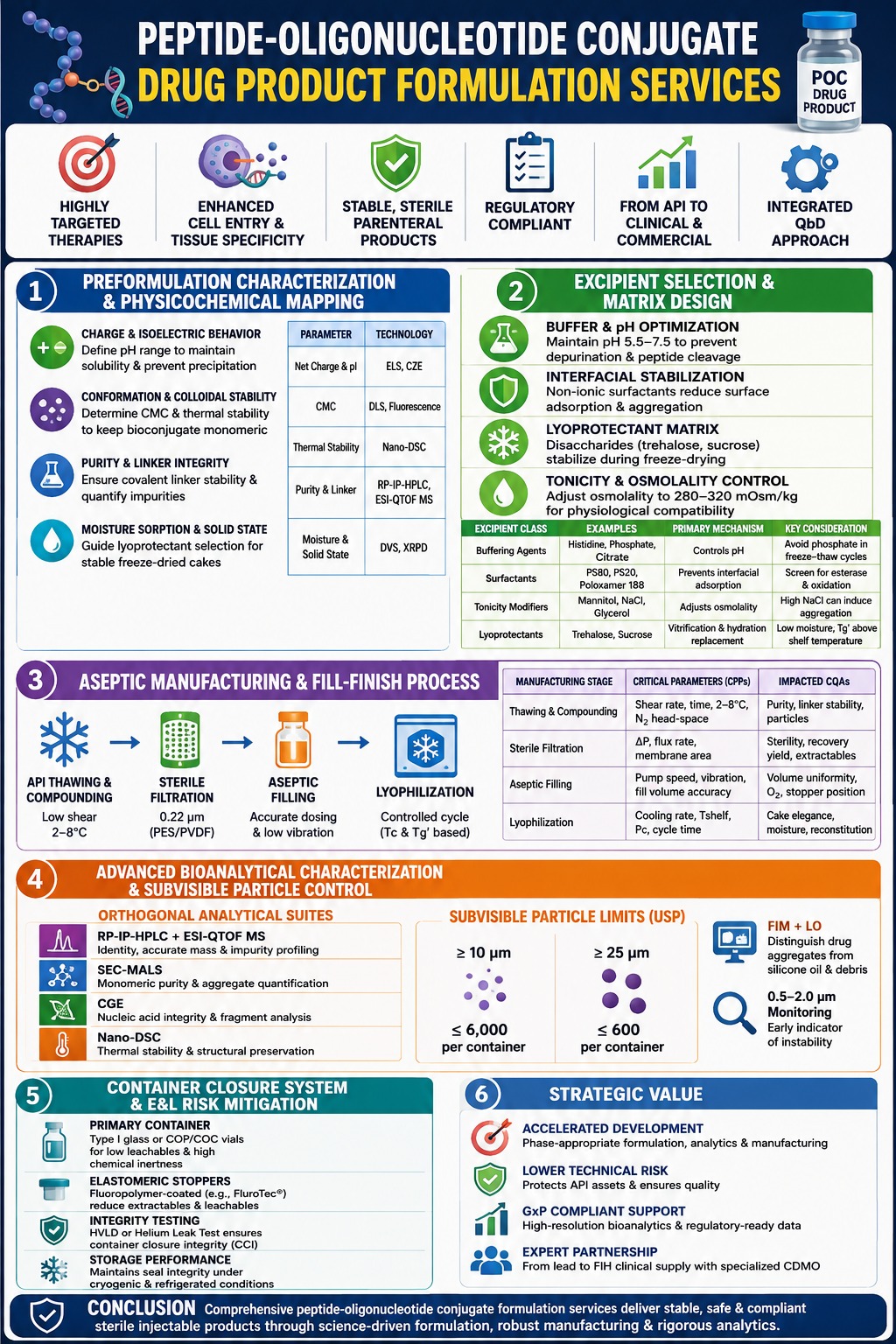
Preformulation characterization defines the fundamental thermodynamic, electrostatic, and structural characteristics of peptide-oligonucleotide conjugates and establishes suitable stability ranges for both liquid and solid-state formulations. Assessment of properties such as charge distribution, isoelectric points, and critical micelle concentrations enables Peptide-Oligonucleotide Conjugate Drug Product Formulation Services to identify and prevent major formulation failures, including pH-dependent precipitation and uncontrolled colloidal aggregation.
Charge Heterogeneity and Isoelectric Behavior
Characterizing charge distribution across a range of pH conditions establishes the electrostatic limits that must be maintained to preserve bioconjugate solubility and minimize self-association.
At physiological pH, the single- or double-stranded nucleic acid payload generally carries a negative charge because of its phosphodiester or phosphorothioate backbone. In contrast, cell-penetrating peptides (CPPs) and homing peptides commonly contain basic amino acid residues, including arginine and lysine, which generate localized regions of positive charge. As the net molecular charge approaches zero within particular pH ranges, the aqueous solubility of the conjugate can decrease substantially, potentially resulting in phase separation or micro-precipitation. Potentiometric titration, capillary zone electrophoresis (CZE), and electrophoretic light scattering (ELS) can be used to characterize this charge profile. These assessments enable formulation scientists to establish buffer pH ranges that maintain sufficient electrostatic repulsion between molecules and support solution clarity.
Learn more about overcoming charge-based physical instability and synthetic complexity in Challenges in Peptide-Oligonucleotide Conjugates.
Conformational and Colloidal Stability Profiling
Colloidal stability assessment determines the critical micelle concentration (CMC) and thermal unfolding thresholds (Tm) necessary to maintain monomeric integrity throughout manufacturing, handling, and storage.
Many cell-penetrating peptides contain amphiphilic alpha-helical or beta-sheet structures that can promote spontaneous assembly into micellar aggregates or other supramolecular structures once particular concentration thresholds are reached. Although controlled self-assembly may sometimes be intentionally exploited for nano-delivery applications, uncontrolled colloidal aggregation within parenteral formulations can reduce syringeability, increase subvisible particle formation, and potentially elevate immunogenicity risks. Size-exclusion chromatography with multi-angle light scattering (SEC-MALS) and nano-differential scanning calorimetry (Nano-DSC) can characterize the thermodynamic conditions under which the bioconjugate remains predominantly in a monomeric state.
| Physicochemical Parameter | Analytical Technology | Formulation Significance |
|---|---|---|
| Net Charge & Isoelectric Point (pI) | Electrophoretic Light Scattering (ELS), CZE | Identifies pH zones of minimal electrostatic repulsion to prevent charge-induced precipitation. |
| Critical Micelle Concentration (CMC) | Dynamic Light Scattering (DLS), Fluorescence Spectroscopy | Defines upper concentration limits for monomeric liquid formulations to avoid uncontrolled micellization. |
| Thermal Conformational Stability | Nano-Differential Scanning Calorimetry (Nano-DSC) | Measures denaturation temperatures (Tm) to establish thermal boundaries for processing and storage. |
| Purity & Linker Integrity | RP-IP-HPLC, ESI-QTOF High-Resolution Mass Spectrometry | Verifies covalent linker stability and quantifies free peptide or unreacted oligonucleotide impurities. |
| Moisture Sorption & Solid State | Dynamic Vapor Sorption (DVS), XRPD | Guides lyoprotectant selection by evaluating hygroscopicity profiles of freeze-dried cakes. |
Excipient Selection and Matrix Design in Peptide-Oligonucleotide Conjugate Drug Product Formulation Services
Excipient selection for peptide-oligonucleotide drug products requires the development of a carefully balanced stabilization matrix that protects both the nucleobase sequence and peptide domain while avoiding counterion dissociation or linker hydrolysis. Such formulation matrices generally incorporate non-ionic surfactants, buffer systems, tonicity modifiers, and cryoprotectants to reduce surface-induced aggregation and limit chemical degradation during extended storage.
Buffer Systems and pH Optimization
Selection of an appropriate buffer system helps maintain formulation pH within a defined stability range, typically pH 5.5 to 7.5, thereby reducing the potential for acid-catalyzed depurination of nucleic acids and base-catalyzed peptide cleavage.
Histidine is widely considered a useful buffering agent for bioconjugate formulations because its pKa is close to 6.0 and it generally exhibits smaller temperature-related pH changes than conventional phosphate buffers. For specialized administration routes, including intrathecal administration, the formulation must also provide an appropriate ionic environment. Trace amounts of calcium (Ca2+) and magnesium (Mg2+) chloride salts may be incorporated to approximate the ionic strength of cerebrospinal fluid (CSF), while care must be taken to avoid insoluble phosphate-calcium complex formation.
For details on optimizing therapeutics specifically for intrathecal and neurological targets, see Peptide-Oligonucleotide Conjugates in CNS Drug Delivery.
Interfacial Stabilization via Non-Ionic Surfactants
Non-ionic surfactants preferentially occupy hydrophobic interfaces and can therefore compete with amphiphilic bioconjugate molecules at these surfaces. This mechanism helps reduce surface-induced aggregation during manufacturing agitation, transportation, and contact with vial surfaces.
Polysorbate 20 (PS20), Polysorbate 80 (PS80), and Poloxamer 188 are commonly used surface-active agents in biopharmaceutical formulations. Within POC liquid formulations, these surfactants can occupy air-water and solid-water interfaces, thereby reducing the likelihood that hydrophobic regions of cell-penetrating peptides will unfold. Nevertheless, trace host-cell esterases or residual metal contaminants may promote polysorbate hydrolysis or oxidation, resulting in the generation of free fatty acids that can form subvisible particles. Surfactant selection and screening must therefore consider both the ability to provide interfacial protection and susceptibility to enzymatic or oxidative degradation.
Lyoprotectant Matrix Design for Freeze-Dried Dosage Forms
The incorporation of non-reducing disaccharides such as trehalose and sucrose can stabilize the amorphous phase of peptide-oligonucleotide conjugates during freeze-drying by vitrifying the formulation matrix and replacing bound hydration shells.
Disaccharides create an amorphous glass-like matrix that restricts molecular mobility and helps preserve native peptide secondary structures while limiting base stacking or duplex melting within nucleic acid payloads. When a structurally robust crystalline cake is required to support rapid reconstitution, bulking agents such as mannitol or glycine can be combined with amorphous disaccharides. This combination can provide improved cake integrity while maintaining favorable dissolution and reconstitution characteristics.
Understand the chemical degradation kinetics governing long-term storage in Peptide-Oligonucleotide Conjugate Stability Studies.
| Excipient Class | Representative Excipients | Primary Stabilization Mechanism | Critical Quality Considerations |
|---|---|---|---|
| Buffering Agents | L-Histidine/L-Histidine HCl, Sodium Phosphate, Sodium Citrate | Controls solution pH to suppress depurination and peptide hydrolysis. | Avoid phosphate in freeze-thaw cycles due to pH crystallization shifts (pH drop). |
| Surfactants | Polysorbate 80, Polysorbate 20, Poloxamer 188 | Prevents interfacial adsorption and agitation-induced particulate formation. | Screen for residual host-cell esterase activity to prevent free fatty acid precipitation. |
| Tonicity Modifiers | D-Mannitol, Sodium Chloride, Glycerol | Adjusts osmolality to physiological ranges (280–320 mOsm/kg). | High ionic strength (NaCl) can screen repulsive charges and induce aggregation. |
| Cryo-/Lyoprotectants | α,α-Trehalose Dihydrate, Sucrose | Vitrifies during freezing; replaces hydration shell via hydrogen bonding. | Maintain low residual moisture; ensure glass transition temperature (Tg’) exceeds drying shelf temperatures. |
Aseptic Manufacturing and Fill-Finish Process Engineering
Aseptic manufacturing transforms bulk POC API into sterile injectable drug products through low-shear compounding, validated 0.22-micron sterile membrane filtration, precise volume dosing, and carefully optimized lyophilization cycles. Each individual unit operation must maintain strict control over shear, temperature, and atmospheric exposure to protect sensitive covalent linkers and preserve fragile biomolecular conformations.
Compounding Dynamics and Thermal Controls
Bulk API compounding procedures establish strict shear-rate limits and typically maintain low-temperature conditions of 2°C to 8°C to reduce the risk of thermal cleavage of labile linkers and shear-induced aggregation.
Bulk POC APIs, which may be synthesized through solid-phase methods or post-synthetic click chemistry, are commonly provided as frozen concentrated solutions or desiccated powders. Thawing procedures must be carefully controlled to prevent localized hot spots that could accelerate degradation of enzyme-sensitive or reduction-sensitive linkers, including disulfide or ester bonds. Mixing operations generally employ low-shear impellers and high-purity single-use compounding systems to minimize trace metal contamination, which may catalyze oxidation of nucleic acid components.
Learn more about optimizing bio-cleavable vs. stable linkers during formulation in Peptide-Oligonucleotide Conjugate Linker Chemistry.
Sterile Filtration Validation and Shear Rate Boundaries
Sterilization of liquid POC formulations generally depends on aseptic filtration through dual 0.22-micron polyethersulfone (PES) or polyvinylidene fluoride (PVDF) membranes that have been validated for low API binding.
Because heat sterilization can disrupt peptide tertiary structure as well as oligonucleotide backbones, terminal sterilization is not considered viable for these sensitive formulations. Sterile filtration must therefore achieve an appropriate balance between filter loading and maximum differential pressure limits. Amphiphilic bioconjugates may adsorb onto membrane polymer surfaces or undergo shear-induced conformational changes when exposed to elevated pressure drops. Filter validation studies assess pre- and post-filtration bioburden, bubble point integrity, and product recovery yield to demonstrate that product loss does not occur across the filtration train.
Lyophilization Process Optimization
Lyophilization process optimization defines suitable freezing rates, primary drying shelf temperatures, and secondary drying chamber pressures according to the formulation’s collapse temperature (Tc) and glass transition temperature (Tg’).
Freezing conditions influence ice crystal morphology and consequently determine the pore structure of the frozen formulation matrix. Controlled thermal annealing steps may be incorporated to facilitate mannitol crystallization when combination bulking systems are used. During primary drying, shelf temperatures are generally maintained 2°C to 5°C below the collapse temperature (Tc) to minimize cake collapse and preserve cake elegance. Secondary drying then progressively increases temperature to remove residual bound water. The process targets residual moisture levels below 1.5% w/w while avoiding excessive thermal stress on sensitive peptide domains.
| Manufacturing Stage | Critical Process Parameters (CPPs) | Impacted Critical Quality Attributes (CQAs) | Risk Mitigation Strategy |
|---|---|---|---|
| API Thawing & Compounding | Shear rate, mixing duration, fluid temperature (2–8°C), vessel head-space gas | Purity, linker stability, subvisible particle counts | Use low-shear peristaltic pumping; blanket mixing vessels with inert nitrogen gas. |
| Sterile Membrane Filtration | Differential pressure (ΔP), flux rate, membrane contact surface area | Sterility, API recovery yield, extractable profiles | Employ low-protein-binding PES/PVDF membranes; perform product-specific filter validation. |
| Aseptic Dosing & Filling | Dosing pump speed, line vibration, fill volume accuracy | Volume uniformity, head-space dissolved oxygen, stopper placement | Implement non-destructive 100% in-line weight verification and ceramic peristaltic pumps. |
| Freeze-Drying (Lyophilization) | Cooling rate, shelf temperature (Tshelf), chamber vacuum (Pc), cycle time | Cake structural elegance, residual moisture, reconstitution kinetics | Conduct freeze-drying microscopy to identify Tg’; maintain product temperature below collapse limits. |
Advanced Bioanalytical Characterization and Subvisible Particulate Control
Bioanalytical characterization confirms the identity, potency, purity, and subvisible particulate characteristics of injectable peptide-oligonucleotide drug products through the combined use of orthogonal liquid chromatography, mass spectrometry, and light-scattering technologies. Strict adherence to USP and USP standards helps ensure that particulate matter remains within applicable regulatory safety limits, thereby reducing potential immunogenicity risks associated with injectable bioconjugate products.
Orthogonal Analytical Suites
Peptide-oligonucleotide conjugates present distinctive analytical challenges because degradation can occur through overlapping pathways involving both peptide and nucleic acid components. Comprehensive characterization of complex impurity profiles therefore requires complementary, high-resolution analytical techniques that provide orthogonal information:
- Reversed-Phase Ion-Pair High-Performance Liquid Chromatography (RP-IP-HPLC) coupled with ESI-QTOF Mass Spectrometry: Enables accurate mass characterization and helps distinguish full-length bioconjugates from truncated oligonucleotide sequences, deamidated peptide impurities, and unreacted precursors.
- Size-Exclusion Chromatography with Multi-Angle Light Scattering (SEC-MALS): Provides quantitative assessment of monomeric purity, soluble high-molecular-weight aggregates, and self-assembled complexes without depending exclusively on column-calibration standards.
- Capillary Gel Electrophoresis (CGE): Characterizes single- and double-stranded nucleic acid integrity and determines fragment size distribution with high quantitative resolution.
- Nano-Differential Scanning Calorimetry (Nano-DSC): Determines thermodynamic folding parameters (Tm) and supports confirmation of tertiary structural preservation within targeting peptide domains under different formulation matrix conditions.
For detailed analytical workflows verifying primary molecular structures, explore Peptide-Oligonucleotide Conjugate Sequence Confirmation Strategies.
Subvisible Particulate Control and Regulatory Compliance
Subvisible particle assessment is an essential quality control consideration for parenteral dosage forms. Injectable bioconjugate drug products must meet applicable United States Pharmacopeia (USP) limits for small-volume parenterals:
Subvisible Particles ≥ 10 μm: ≤ 6,000 per container
Subvisible Particles ≥ 25 μm: ≤ 600 per container
Analytical approaches can combine Flow Imaging Microscopy (FIM) with conventional Light Obscuration (LO) techniques to distinguish intrinsic drug-related aggregates from silicone oil micro-droplets and extrinsic packaging-related debris. Monitoring the formation of sub-micron particles within the 0.5 to 2.0 μm range can provide an early indication of formulation instability, allowing potential instability to be identified before visible or macroscopic precipitation occurs.
Discover strategies for establishing release testing thresholds in Specification Setting for Peptide-Oligonucleotide Conjugates.
Primary Container Closure System Selection and E&L Risk Mitigation
Selection of an appropriate container closure system is essential for controlling extractables and leachables (E&L), surface adsorption, and moisture ingress associated with parenteral bioconjugate packaging. Low-adsorption cyclic olefin polymers and fluoropolymer-coated elastomeric stoppers can help maintain drug product integrity during cryogenic, frozen, and refrigerated storage conditions.
Type I borosilicate glass vials remain a conventional packaging option for sterile injectable products; however, they may present potential risks related to glass delamination and sodium ion leaching. Over extended storage periods, these phenomena can influence the pH of liquid formulations. For highly sensitive bioconjugates, cyclic olefin polymer (COP) and cyclic olefin copolymer (COC) vials provide advantages that include chemical inertness, high break resistance, and relatively low heavy-metal leaching profiles.
Learn how to prevent container interactions and cold-chain issues in Handling and Storage for Peptide-Oligonucleotide Conjugates.
Elastomeric stoppers can represent a significant source of organic extractables, including vulcanization accelerators, antioxidants, and trace zinc ions. Fluoropolymer-coated chlorobutyl stoppers, such as FluroTec®, create an effective barrier that can reduce the potential for leachable-induced aggregation or covalent adduct formation involving oligonucleotide backbones and reactive peptide side chains. Container closure integrity (CCI) testing, performed using high-voltage leak detection (HVLD) or helium mass spectrometry, confirms seal integrity throughout the intended product shelf life while evaluating package performance under sub-zero or liquid nitrogen storage conditions.
Strategic Value of Specialized Peptide-Oligonucleotide Conjugate Drug Product Formulation Services
Comprehensive Peptide-Oligonucleotide Conjugate Drug Product Formulation Services support accelerated clinical development by integrating phase-appropriate preformulation, analytical validation, and sterile manufacturing within stringent Quality by Design (QbD) frameworks. Specialized contract facilities, including ResolveMass Laboratories Inc., provide high-resolution bioanalytical validation and GxP-compliant testing capabilities that support the analytical and regulatory requirements associated with successful drug development and regulatory filings.
Read our full technical overview on Peptide-Oligonucleotide Conjugates in IND Submissions to streamline your regulatory pipeline.
The development of commercial-grade bioconjugate injectable products requires expertise spanning synthetic nucleic acid chemistry and advanced biopharmaceutical formulation science. Contract development and manufacturing organizations (CDMOs) with specialized mass spectrometry capabilities and automated fill-finish systems can facilitate efficient progression from lead optimization to First-in-Human (FIH) clinical trial supply. Working with specialized formulation service providers can reduce technical execution risks, safeguard valuable API assets, and support the delivery of stable and compliant drug products to clinical sites.
Explore how POCs compare to monoclonal antibody conjugates in Peptide vs. Antibody Oligonucleotide Conjugates.
Conclusion
Comprehensive Peptide-Oligonucleotide Conjugate Drug Product Formulation Services establish the technical and regulatory foundation required to convert synthetic bioconjugate APIs into stable, safe, and commercially viable sterile injectable drug products. Addressing the inherent physical and chemical stability challenges of hybrid biomolecules requires a systematic strategy encompassing preformulation charge mapping, rational excipient selection, low-shear fill-finish process engineering, and rigorous control of subvisible particulates under USP standards.
For an in-depth review of synthetic strategies before formulation, read Peptide-Oligonucleotide Conjugate Synthesis Methods.
By integrating advanced orthogonal bioanalytical characterization technologies, including LC-HRMS, SEC-MALS, and Nano-DSC, with robust Quality by Design principles, biopharmaceutical developers can maintain both the targeting specificity of peptide domains and the therapeutic potency of nucleic acid components throughout the intended product shelf life. To learn more about how high-resolution analytical validation and specialized formulation engineering can support and advance your bioconjugate development pipeline, contact the experts at ResolveMass Laboratories Inc. Contact Page.
Frequently Asked Questions (FAQs)
The chemical characteristics of the linker directly affect the stability requirements of the finished POC formulation. Cleavable linkers, including acid-labile hydrazones, reduction-sensitive disulfides, and enzyme-responsive peptide linkers, require tightly controlled formulation conditions to prevent unintended payload release. Non-cleavable linkers generally provide greater chemical stability but still require formulation conditions that preserve the structural integrity of the targeting peptide.
Subvisible particulate matter is an important safety and quality consideration for injectable POC products because particulate formation may increase the risk of unwanted biological and immunogenic responses. Amphiphilic POCs can also associate or aggregate when exposed to interfacial stress during manufacturing and storage. Compliance with applicable USP limits, including no more than 6,000 particles ≥ 10 μm and 600 particles ≥ 25 μm per container, supports appropriate physical quality control.
Polysorbate 20, Polysorbate 80, and Poloxamer 188 are commonly evaluated as non-ionic surfactants for peptide-oligonucleotide conjugate formulations. They preferentially occupy air-water and container interfaces, reducing direct adsorption of the bioconjugate to surfaces. This protective effect can help limit conformational changes, agitation-related aggregation, and subsequent particulate formation during processing and storage.
Lyophilization substantially reduces the amount of mobile water available for hydrolytic degradation and other moisture-dependent chemical reactions. Converting the formulation into a dried matrix can improve the stability of sensitive nucleic acid, peptide, and linker components during storage. When appropriately designed, a freeze-dried product may provide improved refrigerated stability at 2°C to 8°C compared with an equivalent liquid formulation that requires more stringent temperature control.
Residual host-cell esterases can contribute to the enzymatic degradation of polysorbate-based surfactants during product storage. Hydrolysis of these surfactants may generate free fatty acids, which can have limited aqueous solubility and subsequently form particulate matter. Therefore, evaluating residual esterase activity and monitoring surfactant degradation are important aspects of formulation development and particulate control.
A combination of orthogonal analytical methods is typically required because no single technique can comprehensively characterize all structural attributes of a POC API. Reversed-Phase Ion-Pair HPLC coupled with High-Resolution Mass Spectrometry (RP-IP-HPLC-HRMS) can assess molecular mass and linker-related integrity, while Size-Exclusion Chromatography with Multi-Angle Light Scattering (SEC-MALS) evaluates monomeric species and aggregates. Capillary Gel Electrophoresis (CGE) provides additional information on nucleic acid integrity and fragment distribution.
Cyclic olefin polymer (COP) vials can provide packaging advantages for sensitive POC formulations where glass-related interactions are a concern. They eliminate risks associated with glass delamination and can offer low levels of extractable metal ions that might otherwise affect sensitive nucleic acid components. COP containers also provide strong mechanical performance and can be suitable for demanding frozen or cryogenic storage applications when the complete container closure system has been appropriately qualified.
The overall charge of a POC results from the combined contributions of its negatively charged nucleic acid backbone and positively charged amino acid residues within the peptide component. When the formulation pH approaches the conjugate’s isoelectric point (pI), electrostatic repulsion decreases and the likelihood of aggregation or reduced solubility can increase. Appropriate control of charge characteristics can therefore support formulation stability while also influencing cellular interactions, uptake, and tissue distribution.
Advancing a POC formulation into First-in-Human (FIH) clinical development requires appropriate analytical and manufacturing controls supported by phase-appropriate GxP practices. Key considerations include analytical method validation, container closure integrity testing, extractables and leachables (E&L) assessment, forced degradation studies, and evaluation of subvisible particulate matter against applicable USP requirements. Together, these controls help establish product quality, stability, safety, and manufacturing consistency before clinical administration.
Reference:
- Gras, M., Smietana, M., & Adler, P. (2025). Peptide–oligonucleotide conjugates: Catalytic preparation in aqueous solution or on-column. Current Protocols, 5(6), e70154. https://doi.org/10.1002/cpz1.70154
- Malinowska, A. L., Huynh, H. L., & Bose, S. (2024). Peptide-oligonucleotide conjugation: Chemistry and therapeutic applications. Current Issues in Molecular Biology, 46(10), 11031–11047. https://doi.org/10.3390/cimb46100655
- Dean, T. T., Jelú-Reyes, J., Allen, A. C., & Moore, T. W. (2024). Peptide-drug conjugates: An emerging direction for the next generation of peptide therapeutics. Journal of Medicinal Chemistry, 67(3), 1641–1661. https://doi.org/10.1021/acs.jmedchem.3c01835 (pubmed.ncbi.nlm.nih.gov)
- Bak, H., Mattila, J., Li, N., Tang, X., Dix, D., Li, C., & Markis, W. (2016). Process for reducing subvisible particles in a pharmaceutical formulation (U.S. Patent No. US20160101181A1). U.S. Patent and Trademark Office. Google Patents
- Bak, H., Mattila, J., Li, N., Tang, X., Dix, D., Li, C., & Markis, W. (2016). Process for reducing subvisible particles in a pharmaceutical formulation (WO Patent No. WO2016057739A1). World Intellectual Property Organization. Google Patents
- Murphy, M. I., Bruque, M., Hanford, A., Trayton, I., Handali, M., Leissa, J. A., Hasige, S., Day, K., & Patel, S. M. (2022). Qualitative high-throughput analysis of subvisible particles in biological formulations using backgrounded membrane imaging. Journal of Pharmaceutical Sciences, 111(6), 1605–1613. https://doi.org/10.1016/j.xphs.2022.03.010 (pubmed.ncbi.nlm.nih.gov)
Get In Touch With Us
Get In Touch With Us


