


Peptide-oligonucleotide conjugates (POCs) have emerged as an innovative class of chimeric therapeutics that integrate the exceptional sequence specificity of nucleic acids with the targeted delivery, cell-penetrating, and endosomal escape functions of biologically active peptides. A comprehensive understanding of Peptide-Oligonucleotide Conjugates Degradation Pathways is essential for reducing development risks during both early-stage research and late-stage Chemistry, Manufacturing, and Controls (CMC) validation. Since POCs occupy a distinctive physicochemical space between traditional small molecules and complex biologics, they demonstrate intricate degradation behaviors involving the peptide component, the oligonucleotide cargo, and the covalent linker that joins them. Therefore, evaluating how these hybrid constructs degrade under environmental and biological stress conditions is critical for maintaining therapeutic performance, ensuring patient safety, and meeting regulatory expectations.
Interested in learning more about how to structure your development process? Explore our CMC services for peptide-oligonucleotide conjugates.
Article Summary:
- Peptide-oligonucleotide conjugates (POCs) are advanced therapeutic molecules that combine the targeting precision of oligonucleotides with the delivery and cell-entry capabilities of peptides. Understanding their degradation pathways is crucial for ensuring efficacy, safety, and regulatory compliance.
- POC degradation is driven by multiple interconnected mechanisms, including enzymatic cleavage, linker instability, hydrolysis, oxidation, and reversible conjugation reactions. The peptide, oligonucleotide, and linker components influence one another, collectively determining overall stability.
- Linker chemistry is a major determinant of conjugate stability and circulation half-life. While traditional thiol-maleimide linkers can undergo reversible breakdown and payload transfer, more robust alternatives such as triazoles, amide bonds, native chemical ligation products, and next-generation maleimides offer improved resistance to degradation.
- The oligonucleotide portion is vulnerable to both chemical and enzymatic damage. Nucleases, acidic conditions, and alkaline environments can cause backbone cleavage, depurination, and transesterification, leading to loss of sequence integrity and reduced therapeutic activity.
- Peptide degradation occurs through proteolysis, oxidation, deamidation, aggregation, and other stress-induced modifications. These changes can weaken receptor binding, impair cellular uptake, and generate impurities that must be carefully controlled during manufacturing.
- Advanced analytical techniques are essential for monitoring degradation and product quality. High-resolution mass spectrometry, ion-pair reversed-phase HPLC, and tandem MS methods enable accurate identification of degradation products, modification sites, and structural changes across the conjugate.
- Comprehensive stress testing and purification strategies help ensure long-term stability and manufacturability. Evaluating thermal, oxidative, pH, photolytic, and mechanical stress conditions, combined with advanced purification technologies, supports high product purity, consistent quality, and successful therapeutic development.
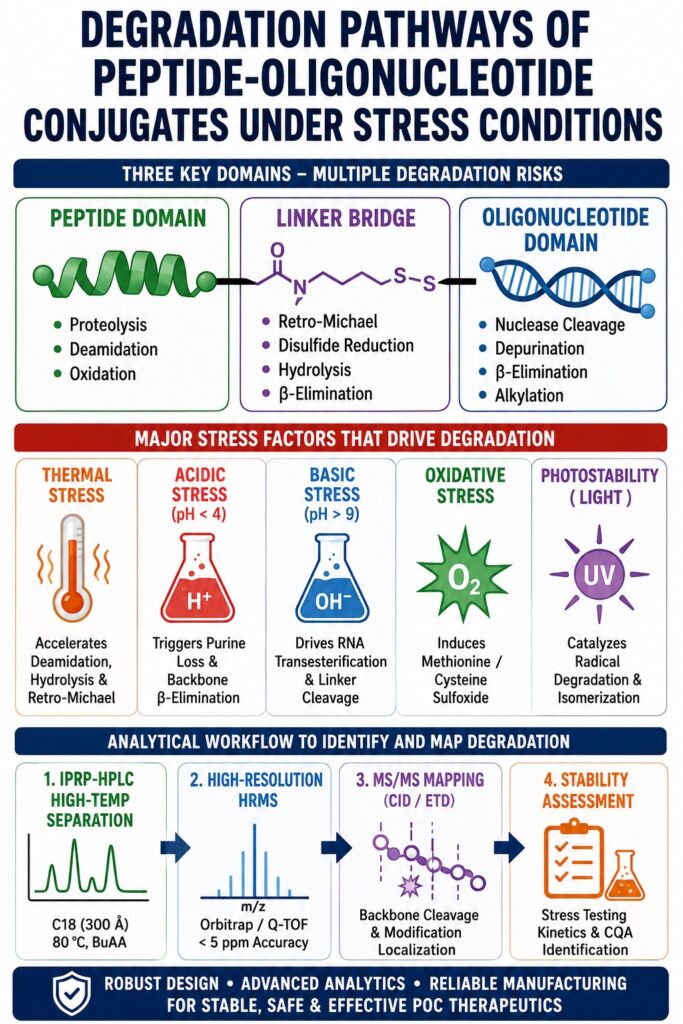
Identifying the Primary Drivers of Peptide-Oligonucleotide Conjugates Degradation Pathways
The principal factors driving degradation under biological and environmental stress include enzymatic cleavage, linker instability, reversible conjugation reactions, and chemical hydrolysis of the molecular backbone. These mechanisms rarely occur independently. Instead, the peptide, linker, and oligonucleotide domains interact dynamically, collectively influencing the overall stability profile of the conjugate. For example, highly cationic peptide segments may condense negatively charged nucleic acid backbones, thereby modifying nuclease accessibility while simultaneously altering the local microenvironment in a manner that promotes chemical degradation.
                    [PEPTIDE DOMAIN]
             (Proteolysis, Deamidation, Oxidation)
                           │
                           ▼
                     [LINKER BRIDGE]
          (Retro-Michael, Disulfide Reduction,
               Hydrolysis, β-Elimination)
                           ▲
                           │
               [OLIGONUCLEOTIDE DOMAIN]
          (Nuclease Cleavage, Depurination,
                 β-Elimination, Alkylation)
Need to understand the functional design? Check out our insights on peptide-oligonucleotide conjugates mechanism of action.
The degradation susceptibility of a POC is strongly influenced by its molecular architecture, including peptide sequence selection, linker design, and modifications incorporated into the oligonucleotide backbone. Throughout manufacturing, storage, and handling, these conjugates encounter numerous chemical and physical stressors, including fluctuations in temperature, oxidative conditions, and pH extremes.
Explore the diverse structural options by reviewing the types of peptide-oligonucleotide conjugates.
Robust stability assessment programs must evaluate all three structural domains simultaneously to prevent premature therapeutic payload release, minimize off-target effects, and preserve target recognition and binding efficiency.
How Does Linker Chemistry Dictate Conjugate Stability and Half-Life in Circulation?
Linker chemistry plays a decisive role in determining conjugate stability because it governs whether the covalent connection remains intact under physiological conditions or undergoes premature cleavage. Selecting an appropriate linker is therefore a central strategy for preventing unwanted degradation before the therapeutic payload reaches the intended cellular target. Different linker chemistries exhibit varying susceptibilities to thermal, pH-dependent, and redox-mediated degradation.
| Linker Class | Representative Chemistry | Primary Degradation Mechanism | Stability Profile & Environmental Susceptibility |
|---|---|---|---|
| Thiosuccinimide | Thiol-Maleimide coupling | Retro-Michael reaction / Ring hydrolysis | Moderate stability; highly vulnerable to thiol exchange in blood and ring hydrolysis at alkaline pH |
| Disulfide | S-S dynamic covalent link | Glutathione reduction | Low systemic stability; readily cleaved by extracellular thiols and reducing agents |
| Amide | Direct condensation / NCL | Enzymatic proteolysis | Excellent chemical stability; highly resistant to hydrolysis but susceptible to selective peptidases |
| Triazole | Click chemistry (CuAAC / SPAAC) | Thermally stable / Chemically inert | Exceptional stability against pH variation, thermal stress, and enzymatic degradation |
| Pyridazinedione | Next-Gen Maleimide (NGM) | Slow, tunable deconjugation | Enhanced stability with strong resistance to rapid hydrolysis and thiol exchange reactions |
Discover more about optimizing your connection points in our guide to peptide-oligonucleotide conjugate linker chemistry.
Mitigating Linker Reversibility in Peptide-Oligonucleotide Conjugates Degradation Pathways
Reducing linker reversibility involves transforming chemically unstable linkages into irreversible structures or employing highly durable conjugation chemistries. This approach represents a crucial design strategy for producing POCs capable of maintaining structural integrity throughout systemic circulation and formulation processes.
The thiol-maleimide (thiosuccinimide) linkage remains one of the most commonly utilized conjugation approaches because of its rapid reaction kinetics and high selectivity. However, this linkage exhibits reversible behavior under physiological and stress conditions. The thioether bond can undergo a retro-Michael reaction, resulting in regeneration of the maleimide moiety and release of a free thiol group. Within biological systems, this process can lead to payload migration, where regenerated maleimide reacts with abundant endogenous thiols such as human serum albumin (HSA) or glutathione (GSH). Such reactions may contribute to off-target toxicity while reducing therapeutic effectiveness.
To address this limitation, the thiosuccinimide ring can be deliberately hydrolyzed after completion of the conjugation process. Hydrolysis, typically accelerated at pH 8.5–9.0 and elevated temperatures, generates two ring-opened succinamic acid thioether isomers that are resistant to retro-Michael reactions.
                                      O
                                    ╓─┴─╖
                                    ║   ║─S─R'  (Thiosuccinimide Conjugate)
                                    ╙─┬─╜
                                      O
                                      │
             ┌────────────────────────┴────────────────────────┐
             ▼ (pH > 7.5, Hydrolysis)                          ▼ (Retro-Michael, Thiol Exchange)
        O         OH                                       O
      ╓─┴─╖     ╓─┴─╖                                    ╓─┴─╖
      ║   ║─S─R'║   ║                                    ║   ║  +  HS─R'
      ╙─┬─╜     ╙─┬─╜                                    ╙─┬─╜
        O         O                                        O
   (Ring-Opened Isomers, Stable)                     (Regenerated Maleimide)
Alternative linker systems provide even greater resistance to retro-Michael-mediated deconjugation:
Next-Generation Maleimides (NGMs): Compounds such as pyridazinediones (PDs) and 5-methylene pyrrolones (5MPs) create highly stable cysteine-selective conjugates that undergo extremely slow and controlled deconjugation while preventing payload transfer to circulating thiols.
Native Chemical Ligation (NCL): The reaction between a peptide thioester and a cysteine-functionalized oligonucleotide generates a native amide bond under mild aqueous conditions. This linkage exhibits remarkable chemical and metabolic stability while simplifying large-scale GMP manufacturing.
Click Chemistry: Copper-catalyzed (CuAAC) and strain-promoted copper-free (SPAAC) azide-alkyne cycloaddition reactions produce triazole linkages that are highly bio-orthogonal and exceptionally stable under physiological conditions.
Learn how to improve your yields and structural integrity with our peptide-oligonucleotide conjugate synthesis methods.
What Chemical and Enzymatic Stresses Drive the Degradation of the Oligonucleotide Backbone?
Chemical and enzymatic degradation of oligonucleotide components occurs through nuclease-mediated phosphodiester cleavage, acid-catalyzed depurination, and base-induced transesterification reactions. These degradation pathways compromise nucleic acid integrity, resulting in truncated fragments and loss of sequence-specific hybridization activity.
Native DNA and RNA phosphodiester backbones are highly susceptible to enzymatic hydrolysis by circulating exonucleases and endonucleases. To improve stability in therapeutic POCs, modifications such as phosphorothioate (PS) linkages, 2′-O-methyl (2′-OMe), 2′-O-methoxyethyl (2′-MOE), and locked nucleic acids (LNA) are commonly introduced. Nevertheless, prolonged thermal or chemical stress can still trigger slow non-enzymatic autohydrolysis.
Under acidic conditions (pH < 4.0), depurination becomes the dominant degradation mechanism. Protonation of purine bases, specifically adenine and guanine, weakens and ultimately cleaves the N-glycosidic bond connecting the base to the sugar moiety. This process generates an apurinic (AP) site, which is inherently unstable and prone to subsequent β-elimination, resulting in phosphodiester backbone cleavage and fragment formation.
[Acidic Stress: pH < 4.0] ──► Protonation of Purine Base ──► Glycosidic Bond Cleavage ──► Apurinic (AP) Site ──► β-Elimination ──► Backbone CleavageConversely, alkaline conditions (pH > 9.0) promote transesterification reactions within RNA-containing conjugates, causing sequence-dependent cleavage and loss of structural integrity. Additionally, strongly basic deprotection conditions employed during solid-phase synthesis may induce β-elimination of aliphatic linker structures, compromising conjugate stability.
Ensure your product remains robust under stress by accessing our peptide-oligonucleotide conjugate stability testing resources.
How Do Peptide Sequence Composition and Physical Stress Accelerate Degradation?
Peptide sequence composition and physical stress contribute significantly to degradation through protease-mediated cleavage, asparagine deamidation, methionine oxidation, and aggregation driven by electrostatic interactions. These changes can diminish receptor-binding affinity and cellular uptake while generating impurities that require stringent control during production.
Proteolytic enzymes present in biological fluids, including aminopeptidases and carboxypeptidases, readily degrade linear native peptide sequences. Incorporating D-amino acids, synthetic non-natural residues, or cyclized peptide architectures can substantially decrease enzymatic accessibility and improve stability.
From a chemical perspective, peptides are highly sensitive to oxidative and thermal stress. Deamidation of asparagine residues, particularly when positioned adjacent to glycine, proceeds through a cyclic glutarimide intermediate and yields a mixture of aspartic acid and isoaspartic acid. This transformation results in a +1.0 Da mass increase that can be accurately detected using high-resolution mass spectrometry.
Oxidative modification of methionine and cysteine residues by reactive oxygen species (ROS) or light exposure generates sulfoxides and sulfones, producing +16.0 Da and +32.0 Da mass shifts, respectively. Furthermore, exposure to extreme pH conditions may induce racemization (epimerization) at chiral α-carbons, potentially disrupting peptide secondary structure and reducing biological activity.
Managing Electrostatic Aggregation and Precipitation Under Stress
Electrostatic aggregation can be minimized by shielding oppositely charged groups through ion-pairing strategies, buffer optimization, or incorporation of hydrophilic spacers such as polyethylene glycol (PEG). These approaches help prevent precipitation and maintain physical stability, addressing significant CMC challenges encountered during conjugation and purification.
When strongly cationic cell-penetrating peptides, such as Tat or nona-arginine, are attached to negatively charged oligonucleotides, intense electrostatic attraction frequently results in self-association and rapid precipitation. This phenomenon reduces solubility, decreases conjugation efficiency, and can obstruct chromatographic purification systems.
One effective strategy involves immobilizing the oligonucleotide on an anion-exchange resin prior to coupling. This allows conjugation with the cationic peptide to proceed under controlled on-resin conditions while preventing precipitation.
[Pyridinesulfenyl-Activated Oligonucleotide] ──► Absorbed on Anion-Exchange Resin ──► Reacted with Cationic Peptide ──► On-Resin Conjugation (No Precipitation)In solution-based processes, optimization of ionic strength, utilization of bioinert chromatographic surfaces, and incorporation of PEG spacers help preserve solubility while reducing nonspecific interactions during purification and formulation.
Overcoming these hurdles is key to clinical success. Read about the common challenges in peptide-oligonucleotide conjugates.
What Analytical Workflows Resolve and Sequence These Hybrid Modalities?
High-resolution mass spectrometry (HRMS) combined with high-temperature Ion-Pair Reversed-Phase liquid chromatography (IPRP-HPLC) represents the benchmark analytical workflow for resolving complex degradation products generated from peptide-oligonucleotide conjugates. These methods effectively address the electrostatic aggregation and ionization challenges inherent to hybrid biomolecular systems.
Analyzing POCs is particularly demanding because peptides are generally cationic and relatively hydrophobic, whereas oligonucleotides are highly anionic and hydrophilic. When these biomolecules are conjugated, especially in arginine-rich peptide systems such as Tat or nona-arginine, strong electrostatic interactions frequently occur between the peptide and phosphate backbone.
These interactions commonly result in:
- Significant sample precipitation and poor recovery during preparation.
- Reduced chromatographic performance characterized by peak tailing and column carryover.
- Suppression of electrospray ionization (ESI) efficiency in both positive and negative ionization modes.
To overcome these limitations, specialized IPRP-HPLC methods are required. Wide-pore C18 stationary phases (e.g., 300 Å) combined with hydrophobic ion-pairing reagents such as butylammonium acetate or triethylammonium acetate (TEAA) provide enhanced separation performance.
Running the chromatographic system at elevated temperatures, such as 80 °C, disrupts secondary structures and electrostatic interactions, resulting in sharper and more symmetrical chromatographic peaks.
                     ┌──────────────────────────────┐
                     │  IPRP-HPLC High-Temp Column  │
                     │  (C18 300 Å, 80 °C, BuAA)    │
                     └──────────────┬───────────────┘
                                    │ (High-Resolution Separation)
                                    ▼
                     ┌──────────────────────────────┐
                     │    Orbitrap / Q-TOF HRMS     │
                     │  (Accurate Mass, < 5 ppm)    │
                     └──────────────┬───────────────┘
                                    │ (Deconvolution)
                                    ▼
                     ┌──────────────────────────────┐
                     │     CID / ETD MS/MS Mapping  │
                     │  (Backbone Cleavage Analysis)│
                     └──────────────────────────────┘
Following chromatographic separation, samples are introduced into high-resolution mass spectrometers such as Orbitrap or Quadrupole Time-of-Flight (Q-TOF) platforms through electrospray ionization. These systems provide isotopic resolution and mass accuracies below 5 ppm, enabling precise identification of degradation products.
For sequence determination and degradation-site localization, tandem mass spectrometry (MS/MS) techniques are employed. Collision-Induced Dissociation (CID) effectively characterizes peptide modifications but often preferentially fragments the oligonucleotide phosphodiester backbone when applied to intact POCs.
To obtain comprehensive sequence coverage across both molecular domains, Electron Transfer Dissociation (ETD) and related supplemental activation techniques are utilized. ETD targets peptide amide bonds while preserving labile conjugation linkages, enabling precise localization of modifications such as asparagine deamidation (+1.0 Da) and methionine oxidation (+16.0 Da).
Establishing Stability Profiles Through Stress Testing Panels
Comprehensive stability profiles are generated through systematic stress testing that exposes conjugates to accelerated environmental conditions. These studies provide valuable information regarding degradation kinetics and facilitate identification of Critical Quality Attributes (CQAs). Stress testing simulates real-world challenges such as shipping excursions, formulation stress, and extended storage conditions.
[CONJUGATE STRESS INTAKE]
       │
       ├─► Thermal Stress ────────► Accelerates Deamidation, Hydrolysis, & Retro-Michael
       ├─► Acidic Stress (pH < 4) ► Triggers Purine Loss & Backbone β-Elimination
       ├─► Basic Stress (pH > 9)  ► Drives RNA Transesterification & Linker Cleavage
       ├─► Oxidative Stress ──────► Induces Methionine/Cysteine Sulfoxide Formation
       └─► Photostability ────────► Catalyzes Radical Degradation & Isomerization
To support IND and BLA submissions, stability studies should follow established regulatory expectations and utilize stability-indicating analytical methods capable of distinguishing intact conjugates from degradation products with high sensitivity and specificity.
| Stress Panel Parameter | Primary Experimental Conditions | Target Degradation Mechanism | Required Stability-Indicating Readout |
| Elevated Temperature | 40 °C to 60 °C; real-time incubation | Retro-Michael reaction / Deamidation | High-Resolution ESI-MS and IPRP-HPLC profiling |
| Acidic pH Stress | pH 2.0 to 4.0; 0.1 M HCl | Glycosidic cleavage and depurination | Capillary Electrophoresis / HRMS Fragment Analysis |
| Basic pH Stress | pH 9.0 to 11.0; 0.1 M NaOH | Succinimide hydrolysis / Transesterification | SEC-MALS and High-Resolution Orbitrap MS |
| Forced Oxidation | 0.1% to 3.0% H₂O₂ exposure | Methionine and cysteine sulfoxide formation | Peptide Mapping via on-line LC-MS/MS (ETD/CID) |
| Photostability | ICH Q1B guidelines; UV and fluorescent light | Radical-mediated cleavage / Isomerization | CD spectroscopy and DLS particle size profiling |
| Mechanical Stress | Agitation, shaking, stirring at controlled RPM | Physical denaturation and precipitation | DLS sizing and SEC-MALS aggregate quantitation |
Optimizing Downstream Purification to Control Impurities
Effective downstream purification is achieved through the integration of orthogonal chromatographic techniques and advanced continuous separation technologies. These approaches enable the isolation of intact conjugates from structurally similar impurities, ensuring high purity and manufacturing consistency.
Manufacturing processes typically generate a heterogeneous mixture containing the desired bioconjugate, residual starting materials, truncated peptide fragments, and linker degradation products. Traditional chromatographic methods often struggle to separate these closely related species. Advanced purification platforms provide enhanced resolution through complementary separation mechanisms.
Ion-Pair Reversed-Phase (IPRP-HPLC): Separates compounds based on hydrophobic interactions and is highly effective for resolving chemically modified species and linker-derived isomers.
Anion Exchange (IEX): Utilizes charge-based separation to distinguish n-1 deletions, truncated oligonucleotides, and unconjugated materials.
Hydrophilic Interaction Liquid Chromatography (HILIC): Provides additional selectivity for highly polar impurities and structural isomers.
Size-Exclusion Chromatography with Multi-Angle Light Scattering (SEC-MALS): Detects, quantifies, and characterizes aggregates, dimers, and higher-order oligomeric structures.
At commercial manufacturing scales, Multicolumn Countercurrent Solvent Gradient Purification (MCSGP) has emerged as a transformative purification technology. By continuously recycling overlapping side fractions, MCSGP can improve recovery of purified active pharmaceutical ingredient (API) by more than 20% while reducing solvent consumption by as much as 75%.
Following chromatographic purification, Tangential Flow Filtration (TFF) enables efficient desalting and concentration under gentle processing conditions, minimizing shear-induced degradation and preparing the conjugate for lyophilization and long-term storage.
Need expert validation? Discover our peptide-oligonucleotide conjugate analysis capabilities.
Conclusion: De-risking Peptide-Oligonucleotide Conjugates Degradation Pathways in Therapeutic Development
Successfully addressing the structural liabilities associated with Peptide-Oligonucleotide Conjugates Degradation Pathways is essential for realizing the full therapeutic potential of these highly targeted hybrid molecules. Through systematic evaluation of chemical, enzymatic, and physical degradation mechanisms affecting the peptide component, oligonucleotide payload, and conjugation linker, developers can establish rational design principles and robust formulation strategies.
The implementation of advanced analytical technologies, including wide-pore high-temperature IPRP-HPLC, high-resolution Orbitrap mass spectrometry, and continuous MCSGP purification systems, enables comprehensive characterization and reliable manufacturing of these sophisticated bioconjugates. Such approaches support high product purity, batch-to-batch reproducibility, and regulatory compliance throughout the development lifecycle.
For expert analytical characterization, impurity profiling, and stability study validation of complex peptide-oligonucleotide conjugates, please connect with our bioconjugate specialists through the ResolveMass Contact Us Portal.
Frequently Asked Questions
The retro-Michael reaction can compromise the stability of peptide-oligonucleotide conjugates by reversing the thiol-maleimide linkage formed during conjugation. As the bond breaks, the maleimide group becomes available to react with naturally occurring thiols such as glutathione and human serum albumin in circulation. This process causes premature separation of the therapeutic payload from its targeting component. As a result, drug delivery efficiency decreases, bioavailability is reduced, and the likelihood of unintended biological interactions increases.
Although thiosuccinimide and thiazine structures can possess identical molecular masses, they differ significantly in their chemical architecture and fragmentation behavior. Thiosuccinimide is characterized by a five-membered ring that can undergo hydrolysis, generating stable ring-opened derivatives. In contrast, the thiazine structure forms through intramolecular rearrangement and exhibits greater resistance to certain cleavage reactions. These differences produce distinct fragmentation patterns during MALDI-MS and MS/MS analysis, enabling researchers to differentiate between the two species.
Column temperature is a key parameter in the chromatographic analysis of peptide-oligonucleotide conjugates because it influences molecular interactions and separation efficiency. Elevated temperatures, commonly around 80 °C, help disrupt strong electrostatic attractions between positively charged peptide residues and negatively charged oligonucleotide backbones. This reduction in intermolecular interactions improves peak shape and minimizes chromatographic artifacts such as tailing and carryover. Consequently, higher temperatures provide more reliable and reproducible impurity profiling.
The synthesis of peptide-oligonucleotide conjugates presents challenges because peptide and oligonucleotide chemistries require fundamentally different processing conditions. Oligonucleotide deprotection typically relies on strongly basic environments, whereas peptide synthesis often involves highly acidic reagents. Exposure of peptides to harsh bases may lead to epimerization, backbone damage, or side-chain degradation. Likewise, acidic conditions can trigger depurination and fragmentation within oligonucleotide sequences, creating significant stability concerns during in-line synthesis.
Ion-pairing agents play a crucial role in controlling the chromatographic behavior of peptide-oligonucleotide conjugates by masking the negative charges present on the oligonucleotide backbone. More hydrophobic reagents, such as butylammonium acetate, often provide improved retention and separation compared to traditional agents like triethylammonium acetate (TEAA). The selection of a suitable ion-pairing system can significantly enhance peak resolution and reduce chromatographic complexity. Additionally, volatile ion-pairing reagents support better compatibility with electrospray ionization mass spectrometry by minimizing ion suppression effects.
Collision-Induced Dissociation (CID) tends to favor fragmentation of the most chemically labile bonds within a molecule. In peptide-nucleic acid heteroconjugates, the phosphodiester bonds of the oligonucleotide backbone generally require less energy to break than peptide amide bonds. Consequently, CID predominantly generates fragments from the nucleic acid portion while leaving much of the peptide sequence intact. This fragmentation bias limits peptide sequencing capabilities and makes precise localization of peptide modifications more challenging.
Native Chemical Ligation produces a native amide bond through the reaction of a peptide thioester with a cysteine-containing oligonucleotide under mild aqueous conditions. The resulting linkage is highly stable and closely resembles naturally occurring peptide bonds found in biological systems. Unlike maleimide-thiol conjugates, which may undergo retro-Michael deconjugation or thiol exchange reactions, NCL-generated amide bonds are chemically irreversible. This enhanced stability reduces the risk of premature payload release and improves long-term in vivo performance.
Depurination occurs when acidic conditions promote cleavage of the N-glycosidic bond connecting purine bases to the sugar backbone of the oligonucleotide. The loss of adenine or guanine generates an apurinic (AP) site that lacks structural stability. These AP sites become highly susceptible to subsequent β-elimination reactions, which break the phosphodiester backbone. The overall process results in strand fragmentation, shortened oligonucleotide products, and a significant loss of biological activity.
Thiosuccinimide ring hydrolysis is an important stabilization step that converts a reversible maleimide-thiol linkage into a more durable conjugate structure. Following hydrolysis, the resulting succinamic acid derivatives become resistant to retro-Michael reactions and unwanted thiol exchange processes. High-resolution mass spectrometry is commonly used to monitor this transformation because hydrolysis introduces a predictable increase in molecular mass. Detection of this characteristic mass shift confirms successful conversion to the stabilized form.
Arginine-rich cell-penetrating peptides possess a high positive charge density that strongly interacts with the negatively charged phosphate groups of oligonucleotides. These electrostatic attractions can rapidly induce self-association, aggregation, and precipitation during conjugation reactions. Such physical instability often reduces reaction efficiency and complicates purification workflows. To minimize these effects, strategies such as on-resin conjugation, ion-exchange immobilization, and charge-shielding approaches are frequently employed to maintain solubility and processability.
Reference:
- Nitto Denko Corporation. (2006). Conjugates of oligonucleotides and cell penetrating peptides and methods of use thereof (European Patent No. EP1725250A2). European Patent Office. https://patents.google.com/patent/EP1725250A2/en
- Naganuma, M., Tsuji, G., Amiya, M., Hirai, R., Higuchi, Y., Hata, N., Nozawa, S., Watanabe, D., Nakajima, T., & Demizu, Y. (2025). High-resolution HPLC for separating peptide–oligonucleotide conjugates. ACS Omega, 10(20), 20578–20584. https://doi.org/10.1021/acsomega.5c01308
- Mikhailova, O. A., Shmendel, E. V., Zenkova, M. A., & Chernolovskaya, E. L. (2021). Chemistry of peptide-oligonucleotide conjugates: A review. Molecules, 26(17), 5420. https://doi.org/10.3390/molecules26175420
- Quaglio, D., Peruzzi, G., Ghirga, F., Mori, M., & Botta, B. (2025). Tunable linkers for dynamic thiol-based bioconjugation strategies. Bioconjugate Chemistry. Advance online publication. https://doi.org/10.1021/acs.bioconjchem.5c00109
- Baldwin, A. D., & Kiick, K. L. (2011). Tunable degradation of maleimide–thiol adducts in reducing environments. Bioconjugate Chemistry, 22(10), 1946–1953. https://doi.org/10.1021/bc200148v
- Klabenkova, K., Fokina, A., & Stetsenko, D. (2021). Chemistry of peptide-oligonucleotide conjugates: A review. Molecules, 26(17), 5420. https://doi.org/10.3390/molecules26175420
- Soni, N., Bhatt, N., Patel, D., & Vachhani, D. D. (2025). Visible light induced Mukaiyama reagent promoted desulfurative modification of peptides and proteins with nucleotides. Organic Chemistry Frontiers. Advance online publication. https://doi.org/10.1039/D5QO01241A
Get In Touch With Us
About The Author


