


Introduction:
Peptide-Oligonucleotide Conjugates for Blood-Brain Barrier Delivery are being explored because conventional oligonucleotides generally struggle to reach therapeutic concentrations in the brain after systemic administration. Their size, polarity, charge, susceptibility to enzymatic degradation, and limited passive membrane permeability all work against CNS exposure.
The blood-brain barrier (BBB) is a highly selective interface formed principally by brain microvascular endothelial cells, tight junctions, transport proteins, pericytes, astrocytic interactions, and the surrounding neurovascular unit. Its physiological purpose is to protect the CNS and maintain a tightly regulated environment — but that same protective function makes systemic delivery of many therapeutic molecules difficult.
ASOs and siRNAs offer highly specific mechanisms for modifying gene expression, yet systemic delivery to the brain remains a persistent bottleneck. Recent literature on CNS oligonucleotide delivery consistently points to large molecular size, high negative charge, and enzymatic vulnerability as the primary limitations. This has pushed researchers toward bioconjugation strategies — including peptide-, antibody-, and lipid-based systems — that can improve tissue targeting, cellular uptake, pharmacokinetics, and pharmacodynamics. For a closer look at how these constructs are being positioned specifically for neurological indications, see ResolveMass’s overview of POCs in CNS drug delivery.
Summary:
- Peptide-Oligonucleotide Conjugates for Blood-Brain Barrier Delivery combine a targeting or cell-penetrating peptide with an antisense oligonucleotide (ASO), siRNA, or related nucleic-acid payload to improve systemic access of oligonucleotide therapeutics to the CNS.
- Peptides can facilitate BBB transport through several distinct mechanisms — receptor-mediated transcytosis, adsorptive-mediated transport, and cell-penetrating pathways — each with different design trade-offs.
- Preclinical evidence, including an MTfp-siRNA conjugate targeting NOX4 in an ischemic stroke model and a peptide-conjugated ASO targeting α-synuclein in an Alzheimer’s model, shows that selected constructs can cross an intact BBB and produce measurable pharmacological effects.
- Successful development requires far more than demonstrating brain uptake: chemical identity, conjugation integrity, purity, stability, biodistribution, cellular uptake, pharmacodynamics, and safety must all be established.
- Mass spectrometry is central to confirming the molecular identity and structural integrity of these hybrid peptide-oligonucleotide constructs, and current research increasingly emphasizes quantitative biodistribution and PK/PD relationships over qualitative brain-uptake signals alone.
- FDA’s regulatory framework already includes clinical pharmacology recommendations specific to oligonucleotide therapeutics, plus a 2024 draft guidance on nonclinical safety assessment — both relevant to sponsors developing CNS-targeted conjugates.
1: What Are Peptide-Oligonucleotide Conjugates?
Peptide-oligonucleotide conjugates are molecular constructs in which a peptide is chemically linked to an oligonucleotide payload to improve delivery, cellular uptake, targeting, or pharmacological performance.
The two components generally provide complementary functions:
| Component | Primary Function |
|---|---|
| Peptide | BBB transport, targeting, cellular uptake, or membrane interaction |
| Oligonucleotide | Gene silencing, RNA modulation, or sequence-specific activity |
| Linker | Controls attachment, stability, and potentially intracellular release |
| Chemical modifications | Improve nuclease resistance, stability, potency, or pharmacokinetics |
The oligonucleotide payload may be an ASO, siRNA, or another chemically modified nucleic-acid therapeutic — including the emerging modification chemistries discussed in ResolveMass’s review of next-generation oligonucleotide chemistries.
Conjugation is not simply a matter of attaching any peptide to any oligonucleotide. The final molecular architecture influences circulation time, proteolytic stability, BBB interaction, cellular internalization, endosomal escape, tissue distribution, and pharmacological activity — which is why peptide-oligonucleotide conjugation is increasingly treated as an integrated delivery strategy rather than a simple labeling exercise.
2: How Do Peptides Help Oligonucleotides Cross the Blood-Brain Barrier?
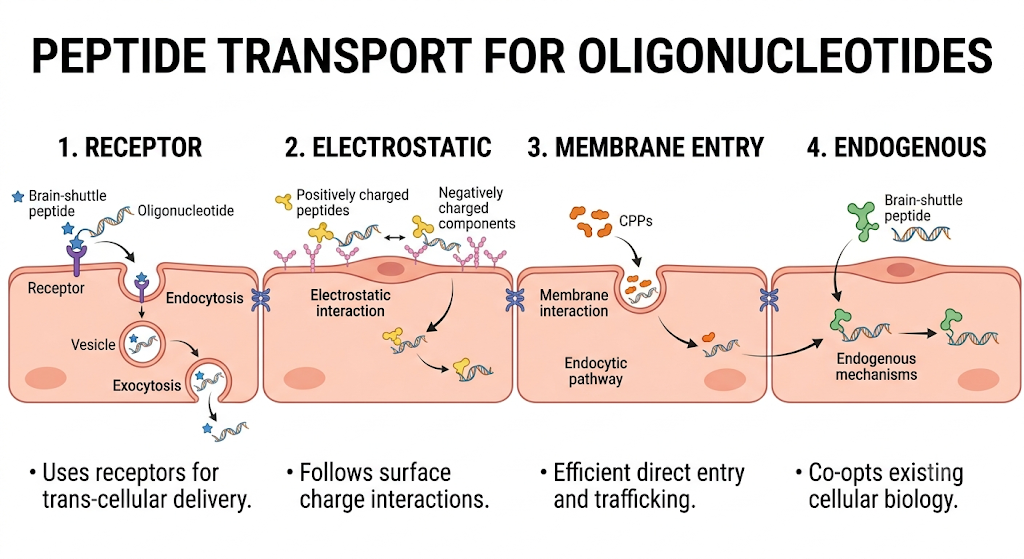
Peptides can facilitate BBB transport by interacting with endothelial receptors, surface charges, or membrane-associated transport mechanisms, potentially enabling transcytosis rather than relying on passive diffusion. A more detailed breakdown of the cell-level mechanics involved is available in ResolveMass’s explainer on how peptide-oligonucleotide conjugates enter cells.
Four mechanisms are currently under active investigation:
1. Receptor-Mediated Transcytosis (RMT) Brain-shuttle peptides can be designed or selected to interact with receptors expressed on brain endothelial cells. Following receptor binding, the conjugate may undergo cellular internalization and vesicular transport across the endothelial cell. The central challenge is achieving productive transport to the brain side rather than simply trapping the conjugate within endothelial cells.
2. Adsorptive-Mediated Transport Some positively charged peptides interact electrostatically with negatively charged components of the endothelial surface, which may promote cellular uptake and transport. However, excessive positive charge can also increase nonspecific binding, alter pharmacokinetics, or raise safety concerns.
3. Cell-Penetrating Peptides (CPPs) CPPs are another important class investigated for nucleic-acid delivery. They can facilitate cellular entry through interactions with plasma membranes and endocytic pathways, and several CPP platforms have been investigated specifically for trans-BBB delivery of therapeutic cargoes.
4. Brain-Shuttle Peptides Brain-shuttle peptides are increasingly investigated as molecular transport systems that work with endothelial biology rather than physically disrupting the BBB. Recent research emphasizes their potential to engage endogenous transport mechanisms while offering chemical tunability and compatibility with nucleic-acid payloads.
3: What Evidence Supports Peptide-Oligonucleotide Conjugates for BBB Delivery?
Preclinical studies provide evidence that appropriately designed peptide-oligonucleotide conjugates can cross an intact BBB and produce biological effects in CNS disease models, although translation to humans remains an important open question.
- MTfp-siRNA / NOX4 in ischemic stroke: An siRNA conjugated to a 12-amino-acid peptide known as MTfp was investigated for delivery of siRNA targeting NOX4 in a model of ischemic stroke. Researchers reported BBB crossing, brain gene knockdown, and therapeutic effects in the animal model.
- Peptide-conjugated ASO / α-synuclein in Alzheimer’s disease: A separate study investigated a peptide-conjugated antisense oligonucleotide targeting α-synuclein. Systemic administration in an Alzheimer’s disease mouse model was reported to deliver the ASO to neurons and reduce pathological α-synuclein accumulation.
These studies matter because they go beyond demonstrating that a fluorescently labeled molecule appears in brain tissue — they connect delivery with target engagement and pharmacological outcomes. That said, animal evidence should not be interpreted as proof of clinical efficacy. Differences in BBB biology, receptor expression, metabolism, immune response, peptide stability, and oligonucleotide pharmacology can all affect translation from rodent models to humans.
4: What Are the Key Design Strategies for Peptide-Oligonucleotide Conjugates?
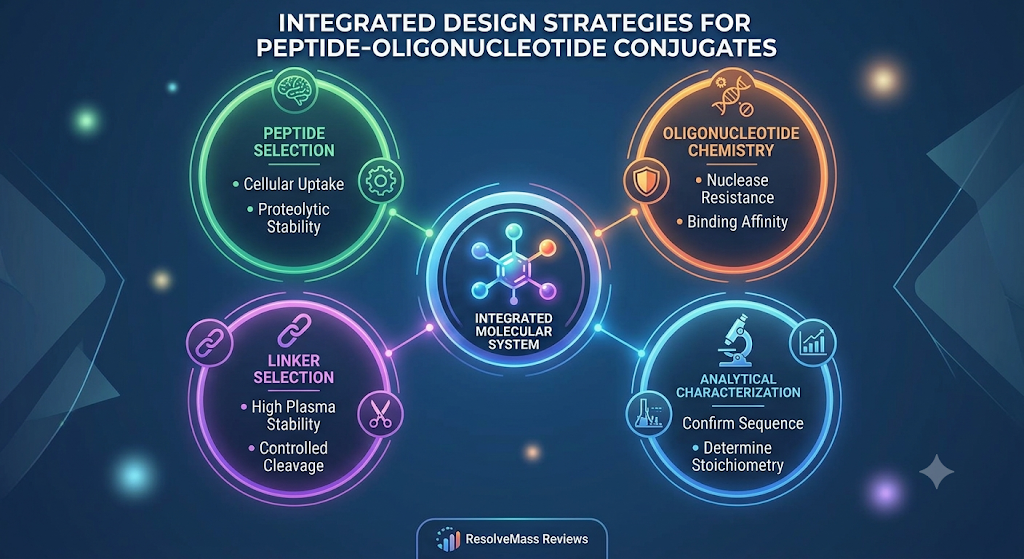
The most effective design strategy is to optimize the peptide, oligonucleotide, linker, and chemical modifications as an integrated molecular system rather than treating each component independently.
Peptide selection considerations typically include BBB receptor recognition, cellular uptake, transcytosis efficiency, proteolytic stability, immunogenicity, molecular size, charge, sequence composition, and synthetic accessibility. Peptides containing non-natural amino acids or alternative configurations — such as D-amino-acid-containing and retro-inverso peptides — can sometimes improve resistance to enzymatic degradation.
Oligonucleotide chemistry may require modification to improve nuclease resistance, binding affinity, pharmacokinetic behavior, intracellular stability, and target engagement. This chemistry must be balanced carefully, since modifications can influence both efficacy and safety; see ResolveMass’s review of next-generation oligonucleotide chemistries for a closer look at current modification strategies.
Linker selection determines how the peptide and oligonucleotide remain connected during circulation and what happens after cellular uptake. A linker may be designed for high plasma stability, controlled intracellular cleavage, enzymatic release, hydrolytic stability, or reduction-sensitive release — the correct choice depends on the intended mechanism and biological compartment.
Confirming that the intended sequence, conjugation site, and stoichiometry were actually achieved is a distinct analytical question from confirming BBB activity; ResolveMass discusses this in detail in its guide to sequence confirmation strategies for peptide-oligonucleotide conjugates.
5: Which Analytical Methods Are Important for Peptide-Oligonucleotide Conjugates?
Analytical characterization is essential because successful BBB delivery cannot compensate for an inadequately characterized or unstable molecular construct. ResolveMass has published a detailed breakdown of this topic in its guide to analytical characterization of peptide-oligonucleotide conjugates.
| Analytical Objective | Potential Analytical Approach |
|---|---|
| Molecular mass confirmation | LC-MS / HRMS |
| Peptide identity | LC-MS/MS, peptide mapping |
| Oligonucleotide identity | LC-MS, LC-UV, orthogonal chromatographic methods |
| Conjugation confirmation | HRMS, LC-MS/MS |
| Purity assessment | RP-HPLC, ion-pair LC, orthogonal chromatography |
| Impurity profiling | LC-MS/MS, HRMS |
| Linker integrity | LC-MS / HRMS |
| Stability | LC-MS, chromatography, stress studies |
| Aggregation/association | SEC or appropriate orthogonal methods |
| Quantitative bioanalysis | LC-MS/MS or validated ligand-based approaches where appropriate |
| Biodistribution | LC-MS/MS, imaging, tissue analysis |
| Structural characterization | MS-based and complementary analytical techniques |
ResolveMass has specifically discussed mass spectrometry characterization of peptide-oligonucleotide conjugates as a way to establish identity, purity, stoichiometry, and conjugation-site information for these complex hybrid molecules. This type of characterization becomes particularly important as a project progresses from discovery toward preclinical development and CMC documentation — a transition that increasingly relies on automation in peptide-oligonucleotide conjugate synthesis to maintain batch-to-batch consistency at scale.
6: Why Is Mass Spectrometry Valuable for BBB-Targeted POCs?
Mass spectrometry provides molecular-level evidence that can distinguish the intended peptide-oligonucleotide conjugate from unconjugated components, truncated species, degradation products, and other impurities. For POCs, a single conventional analytical measurement is rarely sufficient, because the construct contains chemically different domains that behave differently under standard assay conditions.
High-resolution MS can help investigate:
- Intact molecular mass
- Charge-state distributions
- Conjugation stoichiometry
- Peptide-related impurities
- Oligonucleotide-related impurities
- Linker-associated species
- Degradation and truncation products
- Batch-to-batch consistency
MS/MS can provide additional structural information when fragmentation is appropriately optimized, and pairing this with the sequence confirmation strategies referenced above gives a more complete identity picture. This matters because POC characterization combines the analytical challenges of peptide chemistry and oligonucleotide chemistry within a single molecular entity.
7: How Should BBB Delivery Evidence Be Evaluated?
A strong BBB-delivery study should distinguish true brain delivery from vascular retention, nonspecific tissue association, and degradation-product signals — simply detecting a signal in homogenized brain tissue does not, by itself, demonstrate that intact, pharmacologically active conjugate reached the relevant CNS cells.
A robust evidence package typically evaluates, in progression:
- Chemical identity
- Plasma stability
- BBB interaction
- Cellular uptake
- Brain tissue exposure
- Cell-specific localization
- Target engagement
- Pharmacodynamic response
- Dose-response relationship
- Safety and tolerability
Recent reviews emphasize the importance of biodistribution, quantitative bioanalysis, and PK/PD relationships when evaluating oligonucleotide delivery to the CNS — a shift away from relying solely on qualitative evidence of brain fluorescence or tissue accumulation.
8: What Are the Major Challenges of Peptide-Oligonucleotide BBB Delivery?
The major challenges include insufficient transcytosis, peptide degradation, endosomal trapping, limited intracellular release, nonspecific uptake, variability in BBB models, and uncertainty about translation from animals to humans.
- BBB transport vs. brain retention — a conjugate may interact strongly with BBB endothelial cells without efficiently reaching the brain parenchyma
- Proteolytic instability — peptides can be degraded by circulating and endothelial proteases, reducing the amount of intact conjugate available for transport
- Endosomal entrapment — even conjugates that successfully undergo transcytosis can become trapped intracellularly rather than releasing the oligonucleotide where it can act
- Off-target effects — peptide-mediated uptake can occur in tissues other than the CNS, changing systemic exposure and safety
- Manufacturing complexity — POCs combine multiple chemically complex components, and small variations in peptide sequence, oligonucleotide length, conjugation efficiency, or linker chemistry can affect product quality
- Translational uncertainty — a successful mouse study does not necessarily establish human BBB transport
These factors make comprehensive characterization and mechanism-based development essential rather than optional.
9: Peptide-Oligonucleotide Conjugates vs. Other CNS Delivery Strategies
Peptide-oligonucleotide conjugates are one of several approaches being investigated for CNS delivery, and their principal advantage is the possibility of combining molecular targeting with the intrinsic activity of an oligonucleotide.
| Strategy | Major Advantage | Major Limitation |
|---|---|---|
| Peptide-oligonucleotide conjugate | Molecular targeting and tunable chemistry | Stability, uptake, and translation challenges |
| Lipid/nanoparticle systems | Payload protection and delivery | Size, composition, and tissue-distribution considerations |
| Intrathecal administration | Bypasses systemic BBB barrier | Invasive administration |
| Intranasal delivery | Potentially less invasive | Variable deposition and transport |
| Antibody-based shuttles | High targeting specificity | Large molecular size and complex development |
| Direct CNS administration | High local exposure | Invasive and limited distribution |
Nanomedicine approaches remain an active field for improving oligonucleotide transport across the BBB, while intrathecal and other administration routes can bypass portions of the BBB altogether — but at the cost of procedural burden for chronic dosing regimens.
10: Regulatory and Development Considerations
POC development should incorporate characterization, pharmacology, biodistribution, and safety considerations early, because conjugated oligonucleotides carry modality-specific development risks that cannot be inferred from either component alone.
FDA issued final guidance in June 2024 covering clinical pharmacology considerations for oligonucleotide therapeutics, including immunogenicity risk assessment, organ impairment, drug-drug interactions, and QT-related considerations. FDA also issued a November 2024 draft guidance on nonclinical safety assessment of oligonucleotide-based therapeutics — explicitly identified by FDA as draft and non-binding. Sponsors planning a CNS-targeted conjugate program should review ResolveMass’s summary of the FDA regulatory pathway for peptide-oligonucleotide conjugates for a more complete walkthrough of how these guidances apply.
For a peptide-oligonucleotide construct, developers should consider the characteristics of the complete conjugate rather than assuming that safety and pharmacology can be inferred independently from the peptide or oligonucleotide component. Important development areas include:
- Biodistribution and tissue exposure
- Target engagement and pharmacodynamic biomarkers
- Immunogenicity risk
- Off-target and systemic toxicity
- CNS-specific toxicity
- Degradation products and conjugate stability
- Analytical comparability across batches
11: How Can ResolveMass Support Peptide-Oligonucleotide Conjugate Development?
ResolveMass Laboratories supports the analytical development of peptide-oligonucleotide conjugates through advanced mass spectrometry and complementary characterization strategies designed around complex hybrid molecules. An analytical workflow can be structured around the specific questions that need answering at each stage of development:
- Discovery — confirm molecular identity, compare candidate conjugates, investigate conjugation efficiency, identify major impurities
- Preclinical development — monitor molecular stability, characterize degradation products, support bioanalytical method development, investigate tissue or biological-matrix samples
- CMC development — establish analytical control strategies, characterize critical quality attributes, evaluate batch consistency, support impurity profiling, and generate scientifically defensible characterization data
As programs move toward scale-up, automation in peptide-oligonucleotide conjugate synthesis becomes increasingly relevant to maintaining conjugation consistency, and formulation questions specific to this modality are addressed in ResolveMass’s peptide-oligonucleotide conjugate drug product formulation services.
For developers working on CNS-targeted oligonucleotide programs, the analytical strategy should ultimately connect molecular quality → exposure → biodistribution → target engagement → pharmacodynamic response.
12: Future Outlook for Peptide-Oligonucleotide Conjugates for Blood-Brain Barrier Delivery
The future of Peptide-Oligonucleotide Conjugates for Blood-Brain Barrier Delivery will likely depend on improving selective transcytosis, intracellular delivery, molecular stability, and quantitative understanding of CNS exposure. The field is moving toward increasingly sophisticated brain-shuttle designs and more rigorous evaluation platforms, combining rational peptide engineering, non-natural amino acids, high-resolution mass spectrometry, quantitative tissue bioanalysis, BBB-on-chip models, molecular imaging, computational peptide discovery, PK/PD modeling, and cell-specific biodistribution analysis.
The key development question is therefore shifting from “Does the conjugate enter the brain?” toward “Does sufficient intact conjugate reach the correct CNS cell, engage its intended target, and produce a predictable pharmacodynamic effect at an acceptable safety margin?” That distinction will be critical for translating promising preclinical POC platforms into clinically useful CNS medicines.
Conclusion:
Peptide-Oligonucleotide Conjugates for Blood-Brain Barrier Delivery represent a promising strategy for improving systemic delivery of sequence-specific therapeutics to the CNS, but successful translation requires integrated molecular design, quantitative biodistribution studies, and rigorous analytical characterization. The strongest evidence to date comes from preclinical studies demonstrating that selected peptide-oligonucleotide constructs can cross an intact BBB and produce biological effects in CNS disease models — but BBB penetration alone is not enough. Developers must establish whether the intact conjugate reaches the appropriate CNS compartment, remains chemically stable, engages its intended target, and produces a reproducible pharmacodynamic response.
For these reasons, advanced analytical characterization — including LC-MS, HRMS, LC-MS/MS, and complementary chromatographic approaches — plays an important role throughout discovery, preclinical development, and CMC programs.
Frequently Asked Questions:
Yes, certain peptide-oligonucleotide conjugates have demonstrated BBB transport in preclinical models. Peptides may facilitate transport through receptor-mediated transcytosis, adsorptive interactions, or cell-penetrating mechanisms. However, successful BBB transport in animals does not necessarily predict effective delivery in humans.
Peptide conjugates can be designed with different nucleic-acid payloads, including antisense oligonucleotides (ASOs), siRNA, and other chemically modified oligonucleotides. The appropriate payload depends on the therapeutic target and desired mechanism of gene regulation.
A brain-shuttle peptide is a peptide designed or selected to facilitate transport of a therapeutic cargo across the BBB. Rather than physically opening the barrier, brain-shuttle approaches generally aim to exploit endogenous transport or cellular trafficking mechanisms to improve CNS exposure.
Mass spectrometry can provide detailed information about the molecular identity and structural integrity of peptide-oligonucleotide conjugates. LC-MS and HRMS can help evaluate intact mass, conjugation, impurities, degradation products, and molecular heterogeneity. These measurements support characterization during discovery, preclinical development, and CMC programs.
No. BBB penetration alone does not demonstrate therapeutic efficacy. Researchers need to establish that sufficient intact conjugate reaches the appropriate CNS cells, engages the intended molecular target, produces the expected pharmacodynamic response, and does so at an acceptable safety margin.
Reference
- Leitão AD, Ahammad RU, Spencer B, Wu C, Masliah E, Rissman RA. Novel systemic delivery of a peptide-conjugated antisense oligonucleotide to reduce α-synuclein in a mouse model of Alzheimer’s disease. Neurobiology of disease. 2023 Oct 1;186:106285.https://www.sciencedirect.com/science/article/pii/S0969996123003005
- Khorkova O, Wahlestedt C. Oligonucleotide therapies for disorders of the nervous system. Nature biotechnology. 2017 Mar;35(3):249-63.https://www.nature.com/articles/nbt.3784
- Hammond SM, Abendroth F, Goli L, Stoodley J, Burrell M, Thom G, Gurrell I, Ahlskog N, Gait MJ, Wood MJ, Webster CI. Antibody-oligonucleotide conjugate achieves CNS delivery in animal models for spinal muscular atrophy. JCI insight. 2022 Dec 22;7(24):e154142.https://pmc.ncbi.nlm.nih.gov/articles/PMC7614086/
- Eyford BA, Singh CS, Abraham T, Munro L, Choi KB, Hildebrandt R, Hill T, Welch I, Okon M, Vitalis TZ, Gabathuler R. A nanomule peptide-siRNA conjugate that traverses the intact blood brain barrier and attenuates stroke. BioRxiv. 2019 Dec 10:871186.https://www.biorxiv.org/content/10.1101/871186.abstract
About the Author


