Introduction
The Peptide Oligonucleotide Conjugates Mechanism of Action is based on combining a therapeutic oligonucleotide with a delivery peptide. The oligonucleotide regulates gene expression by binding to specific RNA or DNA sequences, while the peptide improves cellular uptake and intracellular transport. This dual structure helps overcome major limitations of traditional nucleic acid therapies, such as poor membrane permeability and limited cellular entry.
Understanding the Peptide Oligonucleotide Conjugates Mechanism of Action is important for developing more effective gene-targeted therapies. The biological activity of POCs depends not only on sequence specificity but also on how efficiently the conjugate reaches the cytoplasm or nucleus. These locations are where most gene regulation processes occur.
The following sections explain the key biological steps involved in POC activity, including cellular uptake, intracellular trafficking, and gene modulation mechanisms. Each stage contributes to the overall therapeutic effectiveness of peptide-oligonucleotide conjugates.
Explore our custom synthesis for drug discovery to accelerate your therapeutic research.
Share via:
Summary of Key Insights
- Peptide-Oligonucleotide Conjugates (POCs) act by combining a targeting or cell-penetrating peptide with a functional oligonucleotide, enabling efficient intracellular delivery and gene-specific activity.
- The mechanism of action of Peptide Oligonucleotide Conjugates involves a multistep biological process: cellular binding, internalization via endocytosis, endosomal trafficking, cytosolic release, and target RNA/DNA interaction.
- Cell-penetrating peptides (CPPs) are critical for improving membrane permeability and facilitating uptake into cells.
- Endosomal escape is a major determinant of POC efficiency; only a small fraction of internalized molecules reach the cytoplasm or nucleus to exert activity.
- Once released, the oligonucleotide component modulates gene expression through antisense inhibition, splice switching, RNA interference, or antigene mechanisms.
- Structural design—such as peptide charge, hydrophobicity, and linker chemistry—directly influences intracellular trafficking and pharmacological activity.
- Advanced POC architectures enable tissue targeting, enhanced biodistribution, and improved pharmacokinetics, making them promising tools for nucleic acid therapeutics and precision gene regulation.
Mechanism of Action of Peptide-Oligonucleotide Conjugates (POCs): Key Biological Steps
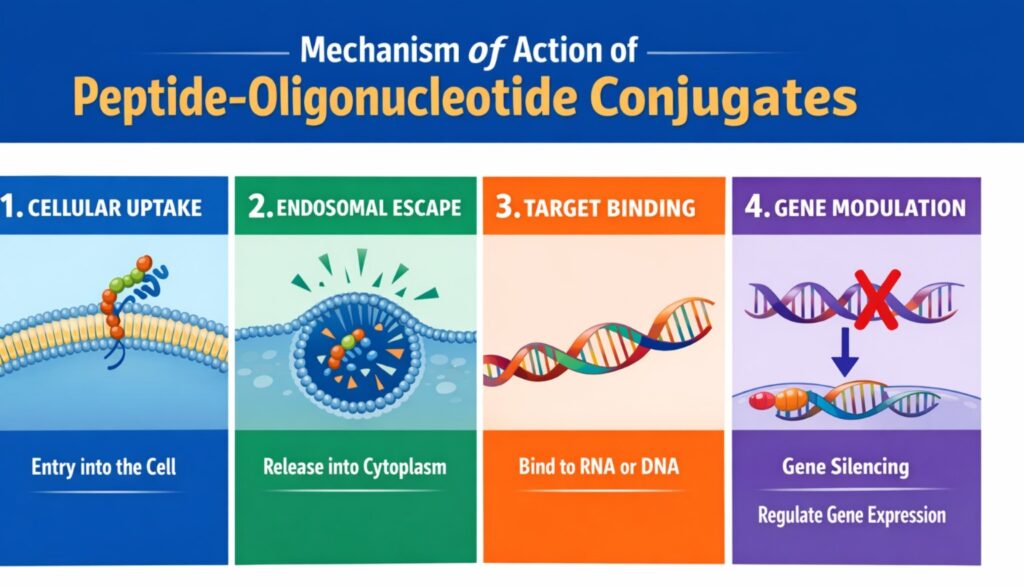
The Peptide Oligonucleotide Conjugates Mechanism of Action involves a sequence of coordinated biological events that ultimately allow the therapeutic oligonucleotide to interact with its genetic target. These processes begin at the cell membrane and continue through several intracellular compartments before gene modulation occurs. The success of each step directly influences the final therapeutic outcome.
Effective delivery requires strong coordination between the peptide and oligonucleotide components. The peptide facilitates cellular uptake and intracellular movement, while the oligonucleotide performs the gene-specific regulatory function. If any stage of the process is inefficient, the overall activity of the conjugate may be reduced. For this reason, optimizing each stage of the delivery pathway is a major focus in modern nucleic acid research.
Core mechanistic stages
| Step | Biological Process | Functional Outcome |
|---|---|---|
| 1 | Cell surface interaction | Peptide moiety binds membrane components or receptors |
| 2 | Cellular internalization | Uptake via endocytosis or direct translocation |
| 3 | Endosomal trafficking | Conjugates move through endosomal compartments |
| 4 | Endosomal escape | Release of oligonucleotide into cytoplasm |
| 5 | Target binding | Sequence-specific hybridization to RNA or DNA |
| 6 | Gene modulation | Inhibition, degradation, or splice modulation |
These stages collectively represent the Peptide Oligonucleotide Conjugates Mechanism of Action and determine the therapeutic effectiveness of POC-based nucleic acid strategies. Each step contributes to the successful delivery and functional activity of the oligonucleotide component. Improvements in any part of this pathway can significantly enhance therapeutic outcomes.
Need expert assistance? Learn more about our peptide-oligonucleotide conjugates CRO services.
Cellular Binding and Membrane Interaction in the Peptide Oligonucleotide Conjugates Mechanism of Action
The first stage in the Peptide Oligonucleotide Conjugates Mechanism of Action involves the interaction between the peptide component and the cellular membrane. This initial binding step determines whether the conjugate can accumulate at the cell surface and initiate internalization. The peptide acts as the primary interface between the conjugate and the biological membrane. Strong membrane interaction increases the probability of successful cellular entry.
Peptides used in POCs often belong to the group known as cell-penetrating peptides (CPPs). These peptides typically contain positively charged amino acids such as arginine and lysine. Their positive charge allows them to interact electrostatically with negatively charged molecules present on the cell surface. This interaction helps the conjugate attach to the membrane before entering the cell.
These positively charged peptides interact with negatively charged cell surface structures, including:
- Glycosaminoglycans
- Proteoglycans
- Phospholipid membranes
These interactions concentrate the conjugate at the cell membrane and promote internalization. When more molecules gather at the membrane surface, the chances of cellular uptake increase significantly. This stage prepares the conjugate for the next steps of intracellular transport.
Typical peptide characteristics enabling membrane interaction
- High cationic charge density
- Amphipathic structures
- Presence of arginine-rich motifs
- Ability to disrupt lipid packing
These structural characteristics allow peptides to interact strongly with lipid bilayers. Amphipathic peptides can align with membrane structures and temporarily disrupt lipid organization. Such interactions create favorable conditions for cellular uptake and internalization.
Research studies have shown that conjugating CPPs such as Tat or penetratin with antisense oligonucleotides significantly improves cellular entry. Compared with unconjugated oligonucleotides, peptide-linked molecules demonstrate greater uptake and more efficient intracellular distribution. This enhanced delivery efficiency is a major reason why POCs are widely studied in nucleic acid therapeutics.
Discover our specialized peptide-oligonucleotide conjugation services for high-efficiency delivery systems.
Endocytosis-Driven Internalization in the Peptide Oligonucleotide Conjugates Mechanism of Action
After membrane binding, the Peptide Oligonucleotide Conjugates Mechanism of Action usually continues through endocytosis-mediated internalization. Endocytosis is a natural cellular process that allows cells to capture external molecules and transport them into intracellular vesicles. Many POCs rely on this pathway to gain entry into the cell interior.
During endocytosis, the cell membrane folds inward and forms vesicles that enclose the conjugate. These vesicles carry the molecule into the cytoplasm where it enters the intracellular trafficking pathway. This mechanism provides a controlled route for transporting large biomolecules such as peptide-oligonucleotide conjugates.
Several endocytic pathways may contribute to POC uptake.
Major uptake pathways
- Clathrin-mediated endocytosis
- Caveolae-mediated endocytosis
- Macropinocytosis
- Receptor-mediated endocytosis
The dominant uptake pathway depends on several biological and molecular factors, including:
- peptide sequence
- cell type
- conjugate size
- membrane receptor availability
After internalization, the conjugates are enclosed within early endosomes. These vesicles function as intracellular transport compartments that move molecules deeper into the cell. Endosomal trafficking represents the next stage in the delivery pathway and plays a major role in determining the final destination of the oligonucleotide.
Ensure the integrity of your molecules with our peptide characterization service.
Endosomal Trafficking and the Critical Role of Endosomal Escape
The Peptide Oligonucleotide Conjugates Mechanism of Action depends strongly on the ability of the conjugate to escape from endosomal compartments. After internalization, most molecules remain trapped within these vesicles. If the conjugate cannot exit the endosome, it may eventually be transported to lysosomes where enzymatic degradation occurs.
For this reason, endosomal escape is widely considered one of the main limiting steps in POC efficiency. Even when cellular uptake is high, therapeutic activity may remain low if the oligonucleotide cannot reach the cytoplasm. Improving this step is therefore critical for enhancing the biological activity of peptide-oligonucleotide conjugates.
Mechanisms enabling endosomal escape
- Membrane destabilization by amphipathic peptides
- Proton sponge effect causing osmotic rupture
- pH-responsive peptide conformational changes
- Direct lipid bilayer disruption
Certain engineered peptides, such as HA2-derived peptides or Pip peptides, are designed to become active under the acidic conditions found in endosomes. When activated, these peptides disrupt the endosomal membrane and allow the oligonucleotide to enter the cytoplasm. This targeted activity improves delivery while minimizing damage to other cellular structures.
Optimize your lead candidates with POC synthesis and characterization designed for endosomal efficiency.
Consequences of efficient escape include:
- Cytosolic release of oligonucleotides
- Avoidance of lysosomal degradation
- Access to RNA or nuclear DNA targets
Improving this stage greatly increases the functional activity of POC therapeutics. Many modern peptide designs focus specifically on enhancing endosomal escape efficiency.
Intracellular Target Engagement in the Peptide Oligonucleotide Conjugates Mechanism of Action
Once the oligonucleotide reaches the cytoplasm or nucleus, the Peptide Oligonucleotide Conjugates Mechanism of Action shifts from delivery to genetic interaction. At this stage, the oligonucleotide begins binding to its complementary nucleic acid target. This binding occurs through base-pairing interactions between the therapeutic sequence and the target RNA or DNA.
This process allows the conjugate to regulate gene expression with high specificity. Because the sequence of the oligonucleotide can be carefully designed, researchers can target specific genes involved in disease pathways. This programmable targeting is a major advantage of nucleic acid therapeutics.
Major molecular mechanisms
- Antisense inhibition
- RNA degradation via RNase H
- Splice modulation
- RNA interference (siRNA pathway)
- Antigene transcription inhibition
Each mechanism alters gene expression in a controlled and sequence-specific way. Depending on the design, the oligonucleotide may block translation, degrade RNA transcripts, or modify RNA processing events. This flexibility allows POCs to address many different genetic and molecular diseases.
Antisense Gene Silencing in the Peptide Oligonucleotide Conjugates Mechanism of Action
Antisense gene silencing is one of the most widely studied applications of the Peptide Oligonucleotide Conjugates Mechanism of Action. In this strategy, the oligonucleotide binds directly to a complementary region of messenger RNA (mRNA). This interaction blocks the mRNA from being translated into protein.
The antisense mechanism can function in multiple ways. In some cases, the oligonucleotide simply prevents ribosome binding and blocks protein synthesis. In other situations, it recruits RNase H enzymes that degrade the target mRNA molecule. Both pathways ultimately reduce the production of harmful or disease-associated proteins.
This process leads to several biological effects:
- steric blocking of ribosome binding
- recruitment of RNase H enzymes
- degradation of the mRNA transcript
Resulting biological outcomes include:
- reduced translation of disease-related proteins
- modulation of pathogenic gene expression
Peptide conjugation significantly improves the delivery efficiency of antisense oligonucleotides. Better delivery allows these molecules to reach tissues such as muscle, liver, and the central nervous system more effectively. As a result, POC-based antisense therapies are being studied for multiple genetic and metabolic disorders.
Access high-quality peptide-oligonucleotide conjugates (POCs) synthesis services for your antisense and splicing projects.
Splice Switching and RNA Editing Mechanisms
Another important aspect of the Peptide Oligonucleotide Conjugates Mechanism of Action is splice modulation. In this strategy, oligonucleotides interact with precursor messenger RNA (pre-mRNA) during the RNA splicing process. By binding to specific sequences, they influence whether certain exons are included or excluded during RNA processing.
Some oligonucleotides, such as phosphorodiamidate morpholino oligomers (PMOs), are especially effective for splice-switching applications. These molecules bind to pre-mRNA without triggering RNA degradation pathways. Instead, they redirect the splicing machinery to produce a modified and potentially functional mRNA transcript.
Mechanistic outcomes
- Inclusion or exclusion of specific exons
- Restoration of correct reading frames
- Production of functional proteins
This approach has been widely explored in treatments for genetic disorders such as Duchenne muscular dystrophy. By restoring the correct reading frame, splice-switching oligonucleotides can enable the production of partially functional proteins. This provides a promising therapeutic strategy for many inherited diseases.
Peptide conjugation improves the delivery of splice-switching oligonucleotides to muscle and neuronal tissues. Enhanced tissue distribution increases their therapeutic potential and supports ongoing development of gene-based therapies.
Structural Design Factors That Influence the Peptide Oligonucleotide Conjugates Mechanism of Action
The Peptide Oligonucleotide Conjugates Mechanism of Action is strongly influenced by molecular design. Both the peptide and oligonucleotide components contribute to the overall performance of the conjugate. Even small structural changes can affect cellular uptake, stability, and intracellular trafficking.
Optimizing POC design requires careful consideration of several physicochemical properties, including charge, hydrophobicity, and molecular size. These properties influence how the conjugate interacts with cell membranes and biological fluids. Rational design strategies ensure that the molecule remains stable while maintaining efficient delivery.
Key design parameters
| Design Parameter | Impact on Mechanism |
|---|---|
| Peptide charge | Influences membrane interaction and uptake |
| Hydrophobic residues | Enhance membrane insertion |
| Linker chemistry | Determines conjugate stability and release |
| Oligonucleotide modification | Improves nuclease resistance |
| Peptide length | Affects uptake and toxicity balance |
Proper optimization of these parameters improves several therapeutic characteristics:
- cellular uptake efficiency
- intracellular trafficking
- pharmacokinetics
- therapeutic index
Advances in chemical synthesis and molecular engineering now allow researchers to precisely modify these properties. As a result, modern POCs can be tailored for optimal performance in different biological environments.
Looking for regulatory support? Check our CMC services for peptide-oligonucleotide conjugates.
Advanced Targeting Strategies in Modern POC Design
Recent research is expanding the Peptide Oligonucleotide Conjugates Mechanism of Action by integrating tissue-specific targeting strategies. These methods use peptides that recognize and bind to receptors expressed on particular cell types. By using these interactions, POCs can be directed toward specific tissues.
Targeted delivery improves therapeutic specificity and reduces off-target effects. When the conjugate accumulates mainly in the intended tissue, lower doses may be required to achieve therapeutic activity. This also improves safety by limiting exposure to non-target organs.
Examples of targeting strategies include:
- receptor-targeting peptides
- ligand-directed peptides
- multi-functional conjugates
These designs allow selective delivery to tissues such as:
- tumor cells
- muscle tissue
- neurons
By combining targeting peptides with functional oligonucleotides, researchers can significantly improve therapeutic precision. This strategy enhances biodistribution and helps overcome challenges associated with systemic nucleic acid delivery.
Conclusion
The Peptide Oligonucleotide Conjugates Mechanism of Action represents an advanced solution to the delivery challenges faced by nucleic acid therapeutics. By combining peptide-mediated cellular entry with sequence-specific oligonucleotide activity, POCs allow precise control over gene expression. This dual-component system improves both delivery efficiency and therapeutic specificity.
The mechanism involves a series of coordinated biological processes that begin with membrane interaction and continue through intracellular trafficking and target engagement. Key stages such as endocytosis, endosomal escape, and cytosolic release determine whether the oligonucleotide reaches its functional site. Efficient performance at each step is necessary for achieving the full therapeutic effect.
Advances in peptide engineering, linker chemistry, and oligonucleotide modification continue to improve the performance of peptide-oligonucleotide conjugates. These innovations support greater stability, improved tissue distribution, and more effective gene targeting. As research progresses, POCs are becoming powerful tools in modern gene regulation strategies.
A deeper understanding of the Peptide Oligonucleotide Conjugates Mechanism of Action will help guide the development of next-generation nucleic acid therapies. Continued research into intracellular delivery and gene-modulating mechanisms may eventually lead to clinically successful treatments based on this technology.
Ensure the highest standards for your research with QC testing for peptide-oligonucleotide conjugates.
Frequently Asked Questions (FAQs)
The efficiency depends on several factors including cellular uptake, endosomal escape, stability of the oligonucleotide, and accurate binding to the target RNA or DNA sequence. If any step in the delivery pathway fails, the therapeutic effect may decrease. Optimizing these biological processes improves the overall performance of POC-based therapies.
After entering the cell, many conjugates become trapped in endosomal vesicles. If they cannot escape, they may be transported to lysosomes and degraded before reaching their target. Successful endosomal escape allows the oligonucleotide to enter the cytoplasm or nucleus where gene regulation occurs. Therefore, this step is essential for effective therapeutic activity.
Common peptides used in POC design include Tat, penetratin, arginine-rich peptides, Pip peptides, and other amphipathic membrane-active peptides. These peptides are known for their ability to cross cellular membranes and improve intracellular delivery. Their structural features enable strong interaction with lipid bilayers and promote efficient uptake.
Several types of oligonucleotides can be used in POCs depending on the intended therapeutic strategy. These include antisense oligonucleotides, siRNA molecules, morpholino oligomers (PMO), and splice-switching oligonucleotides. Each class functions through a different molecular mechanism to regulate gene expression. The selection depends on the specific disease target and treatment goal.
The amino acid composition of the peptide determines how effectively the conjugate interacts with cellular membranes. Factors such as peptide charge, hydrophobicity, and amphipathic structure influence cellular uptake and intracellular transport. Well-designed peptide sequences significantly improve the efficiency of the delivery system.
Despite their advantages, several challenges still exist in POC development. Limited endosomal escape, potential toxicity from highly cationic peptides, and difficulties in achieving precise tissue targeting are important issues. Researchers continue to address these challenges through improved peptide design and advanced delivery technologies.
Reference:
- Gras, M., Smietana, M., & Adler, P. (2025). Peptide–oligonucleotide conjugates: Catalytic preparation in aqueous solution or on-column. Current Protocols, 5(6), e70154. https://doi.org/10.1002/cpz1.70154
- Venkatesan, N., & Kim, B. H. (2006). Peptide conjugates of oligonucleotides: Synthesis and applications. Chemical Reviews, 106(9), 3712–3761. https://doi.org/10.1021/cr0502448
- Williams, B. A. R., Diehnelt, C. W., Belcher, P., Greving, M., Woodbury, N. W., Johnston, S. A., & Chaput, J. C. (2010). Synthesis of peptide–oligonucleotide conjugates using a heterobifunctional crosslinker. Bioconjugate Chemistry, 21(10), 1808–1816. https://doi.org/10.1021/bc1001137
- Arar, K., Aubertin, A. M., Roche, A. C., Monsigny, M., & Mayer, R. (1995). Synthesis and antiviral activity of peptide-oligonucleotide conjugates prepared by using Nα-(bromoacetyl) peptides. Bioconjugate Chemistry, 6(5), 573–577. https://doi.org/10.1021/bc00035a011
Get In Touch With Us
About The Author