

Introduction
Peptide Oligonucleotide Conjugates Preclinical Services play an important role in supporting the development of Peptide Oligonucleotide Conjugates (POCs), which are becoming a powerful approach in RNA-targeted drug discovery. By linking peptides with oligonucleotides, these therapeutics can improve cellular delivery, enhance pharmacokinetics, and allow more precise tissue targeting. Because of these advantages, POCs are increasingly being studied in fields such as genetic medicine, oncology, and neuromuscular disease research.
However, developing these complex molecules requires specialized scientific expertise and advanced testing strategies. Traditional drug development methods are often not suitable for these hybrid therapeutics, since both the peptide and oligonucleotide components influence how the drug behaves in biological systems. Therefore, detailed analytical characterization and carefully designed biological studies are essential during early-stage development.
Explore our specialized solutions: Custom Synthesis for Drug Discovery
Through integrated Peptide Oligonucleotide Conjugates Preclinical Services, researchers can evaluate molecular stability, pharmacokinetics, tissue distribution, and safety before clinical trials. These studies provide the essential data needed to support regulatory submissions and advance innovative RNA-based therapies.
Share via:
Article Summary
- Peptide Oligonucleotide Conjugates (POCs) require specialized preclinical development workflows because their therapeutic performance depends on conjugation chemistry, delivery efficiency, pharmacokinetics, and tissue targeting.
- Effective Peptide Oligonucleotide Conjugates Preclinical Services integrate analytical characterization, stability assessment, biodistribution studies, PK/PD profiling, and toxicity evaluation.
- The major goal of preclinical programs is to optimize delivery, increase cellular uptake, improve pharmacokinetics, and confirm safety before clinical development.
- Advanced bioanalytical mass spectrometry, LC-MS/MS quantification, and conjugate stability assays are critical to understand in vivo fate of POC therapeutics.
- Preclinical testing must also assess linker stability, peptide-mediated cellular uptake, tissue specificity, and metabolism pathways.
- Well-designed Peptide Oligonucleotide Conjugates Preclinical Services accelerate the transition from discovery to IND-enabling studies.
Why Specialized Peptide Oligonucleotide Conjugates Preclinical Services Are Essential
Specialized Peptide Oligonucleotide Conjugates Preclinical Services are necessary because POC therapeutics involve complex chemistry and delivery mechanisms. The interaction between peptide and oligonucleotide components can significantly influence pharmacokinetics, biodistribution, and biological activity. Without dedicated testing strategies, these interactions may not be fully understood.
Preclinical studies for POCs focus not only on therapeutic activity but also on delivery efficiency and molecular stability. Researchers must determine whether the peptide component successfully improves cellular uptake and whether the oligonucleotide payload reaches its intended target.
Learn more about our core capabilities: Peptide Oligonucleotide Conjugates (POCs) Synthesis Services
Key reasons include:
1. Dual-component molecular complexity
POCs contain two active components:
- Oligonucleotide therapeutics (ASOs, siRNA, PMO)
- Targeting or cell-penetrating peptides
Each component contributes to drug uptake, intracellular transport, and metabolic stability. The peptide can help the molecule cross cellular membranes, while the oligonucleotide interacts with genetic targets inside the cell. Understanding this interaction is essential for evaluating therapeutic performance.
2. Linker stability and release kinetics
The chemical linker that joins the peptide and oligonucleotide determines:
- Controlled intracellular release
- Enzymatic stability
- Therapeutic activation
Linker design strongly influences drug behavior in circulation. If the linker breaks too early, the therapeutic may lose targeting ability. On the other hand, if the linker is too stable, the oligonucleotide may not be released efficiently inside the cell.
3. Tissue targeting mechanisms
Many peptide conjugates are designed to target specific tissues such as:
- Muscle tissue
- Central nervous system
- Tumor environments
Preclinical models are required to confirm tissue targeting and biodistribution. These studies ensure that the therapeutic accumulates in the intended tissue while limiting exposure in non-target organs.
Research has shown that peptide conjugation can improve cellular uptake and pharmacokinetic behavior of oligonucleotide drugs in preclinical systems.¹² These improvements often lead to stronger target engagement and better therapeutic outcomes.
Discover how we support development: Peptide Oligonucleotide Conjugates CRO Services
Core Components of Peptide Oligonucleotide Conjugates Preclinical Services
Comprehensive Peptide Oligonucleotide Conjugates Preclinical Services involve several interconnected studies that evaluate the behavior, stability, and safety of POC therapeutics. These studies generate the scientific data required to support regulatory submissions and clinical development.
Below is a structured overview of the major development stages.
| Preclinical Stage | Objective | Key Techniques |
|---|---|---|
| Conjugate characterization | Confirm structure and purity | LC-MS, HRMS, peptide mapping |
| Stability assessment | Evaluate degradation pathways | Forced degradation studies |
| Bioanalytical quantification | Measure POC concentration in biological samples | LC-MS/MS assays |
| PK/PD profiling | Understand exposure and efficacy relationship | Animal models |
| Biodistribution studies | Identify tissue targeting | Imaging and quantitative assays |
| Toxicology evaluation | Confirm safety profile | Repeat-dose toxicity studies |
Each stage contributes to the data package needed for regulatory progression toward IND submission. Regulatory authorities require clear documentation of safety, pharmacology, and product quality before human trials can begin.
When these datasets are analyzed together, researchers can refine molecular design and dosing strategies. Early identification of potential issues helps reduce development risks and improves overall research efficiency.
Access our expert synthesis and analysis: POC Synthesis and Characterization
Analytical Characterization in Peptide Oligonucleotide Conjugates Preclinical Services
Analytical characterization ensures the structural integrity and purity of peptide-oligonucleotide conjugates before biological testing. Because POC molecules are structurally complex, detailed analysis is required to confirm that the therapeutic candidate has been produced correctly.
Within Peptide Oligonucleotide Conjugates Preclinical Services, analytical platforms help verify molecular composition, detect impurities, and ensure reproducibility across production batches. These analyses form the scientific foundation for all subsequent preclinical studies.
Critical analytical assessments include:
Structural confirmation
Techniques used include:
- High-resolution mass spectrometry
- LC-MS peptide mapping
- Hybrid oligonucleotide sequencing
These methods provide precise information about molecular weight, sequence composition, and overall structure. Accurate structural data confirm that the conjugate matches the intended design before it is used in biological studies.
Ensure the quality of your sequences: Peptide Characterization Service
Conjugation efficiency analysis
Researchers must confirm:
- Conjugation site
- Linker attachment
- Peptide-to-oligonucleotide ratio
Measuring conjugation efficiency helps ensure batch-to-batch consistency. If the ratio between peptide and oligonucleotide varies significantly, it may affect biological activity and therapeutic performance.
Impurity profiling
Common impurities include:
- Unconjugated peptide
- Free oligonucleotide
- Truncated sequences
- Degradation products
Identifying these impurities helps improve purification processes and maintain high product quality. Detailed impurity analysis is also important for meeting regulatory standards.
Robust analytical characterization ensures that the material used in preclinical experiments accurately represents the intended therapeutic molecule.
Pharmacokinetic Evaluation in Peptide Oligonucleotide Conjugates Preclinical Services
Pharmacokinetic studies examine how POC therapeutics are absorbed, distributed, metabolized, and eliminated in biological systems. These studies are a critical part of Peptide Oligonucleotide Conjugates Preclinical Services because peptide conjugation can significantly change oligonucleotide behavior in vivo.
Researchers analyze how long the therapeutic remains in circulation and how effectively it reaches target tissues. This information is necessary to design appropriate dosing strategies and predict therapeutic performance.
Optimize your therapeutic delivery: Peptide Oligonucleotide Conjugation Services
Key PK parameters include:
- Plasma half-life
- Tissue distribution
- Clearance pathways
- Cellular uptake efficiency
Understanding these parameters helps scientists determine how frequently a drug should be administered and whether it accumulates in specific organs.
Advanced PK studies often involve:
- Rodent models
- Non-human primate studies
- Time-course plasma analysis
- Tissue exposure measurements
These experiments provide detailed pharmacokinetic profiles over time. By collecting samples at multiple intervals, researchers can evaluate systemic exposure and organ distribution patterns.
Studies have shown that peptide conjugation can improve tissue uptake and extend circulation time for oligonucleotide therapeutics.³⁴ These improvements may enhance overall therapeutic effectiveness.
Biodistribution and Tissue Targeting Studies
Biodistribution studies determine how effectively peptide conjugates deliver oligonucleotides to specific tissues. These studies are a key component of Peptide Oligonucleotide Conjugates Preclinical Services because successful therapy depends on reaching the correct biological target.
Many POCs are developed to improve delivery to tissues that are traditionally difficult to reach, including:
- Skeletal muscle
- Central nervous system
- Tumors
Efficient delivery to these tissues can significantly improve therapeutic outcomes and expand treatment possibilities for many diseases.
Key experimental approaches include:
- In vivo biodistribution assays
- Quantitative LC-MS measurements
- Radiolabeled conjugate tracking
- Tissue exposure profiling
These techniques allow researchers to measure drug concentrations in different organs and evaluate targeting efficiency.
Scientists typically analyze:
- Liver accumulation
- Kidney clearance
- Target tissue penetration
- Cellular uptake levels
Such data help determine whether the therapeutic preferentially reaches its intended site while minimizing off-target exposure.
Peptide components often act as cell-penetrating peptides (CPPs), which improve intracellular delivery of the oligonucleotide payload.⁵ Understanding these mechanisms helps researchers optimize molecular design and delivery strategies.
Stability and Metabolism Studies in Peptide Oligonucleotide Conjugates Preclinical Services
Stability studies evaluate how peptide-oligonucleotide conjugates behave under physiological conditions. These studies help determine whether the therapeutic remains intact long enough to reach target tissues and perform its biological function.
Within Peptide Oligonucleotide Conjugates Preclinical Services, researchers analyze several factors that may affect stability:
- Proteolytic degradation of peptides
- Nuclease degradation of oligonucleotides
- Chemical linker cleavage
Each of these processes can influence therapeutic activity and drug exposure duration.
Typical stability studies
In vitro assessments
- Plasma stability
- Serum nuclease resistance
- Cellular lysate degradation
These laboratory experiments simulate biological environments and help predict how quickly the conjugate may degrade inside the body.
In vivo metabolism
- Identification of metabolites
- Determination of cleavage products
- Evaluation of bioactive fragments
Metabolism studies reveal how the therapeutic is processed over time. Understanding metabolic pathways helps researchers evaluate safety and refine molecular design.
Together, these studies help determine the therapeutic window and optimal dosing strategy.
Toxicology Evaluation for POC Therapeutics
Toxicology studies ensure that peptide-oligonucleotide conjugates do not cause harmful systemic or organ-specific effects. Safety testing is a mandatory part of Peptide Oligonucleotide Conjugates Preclinical Services before a therapeutic candidate can enter clinical trials.
Preclinical toxicology programs typically include multiple study types to assess both short-term and long-term exposure risks.
Maintain high quality standards: QC Testing for Peptide Oligonucleotide Conjugates
Safety assessment components
- Acute toxicity
- Repeat-dose toxicity
- Immunogenicity evaluation
- Off-target hybridization risk analysis
These studies help identify any biological responses that may affect patient safety.
Common toxicity considerations
| Toxicity Concern | Cause |
|---|---|
| Kidney accumulation | Oligonucleotide clearance |
| Immune activation | CpG motifs |
| Peptide immunogenicity | Foreign peptide sequences |
For example, oligonucleotides are often cleared through the kidneys, which may lead to renal accumulation. In addition, certain nucleotide sequences may stimulate immune responses. Evaluating these risks early allows researchers to adjust molecular design and improve safety profiles.
Role of Advanced Bioanalytical Platforms in Peptide Oligonucleotide Conjugates Preclinical Services
Advanced bioanalytical platforms enable precise measurement and characterization of POC therapeutics in biological samples. These technologies are an important component of Peptide Oligonucleotide Conjugates Preclinical Services because they allow researchers to detect very small concentrations of drug molecules in complex matrices.
Key technologies include:
- LC-MS/MS quantification
- Hybridization-based assays
- High-resolution mass spectrometry
- Peptide-specific analytical workflows
These tools allow scientists to analyze multiple aspects of the therapeutic molecule simultaneously.
Bioanalytical platforms help researchers measure:
- Intact conjugate concentrations
- Free oligonucleotide fragments
- Metabolite profiles
By tracking these components, scientists can understand how the therapeutic changes over time in biological systems. This information supports pharmacokinetic modeling and dose optimization.
Such analytical capabilities are particularly valuable for conjugated therapeutics where peptide and oligonucleotide components may follow different metabolic pathways.
Conclusion
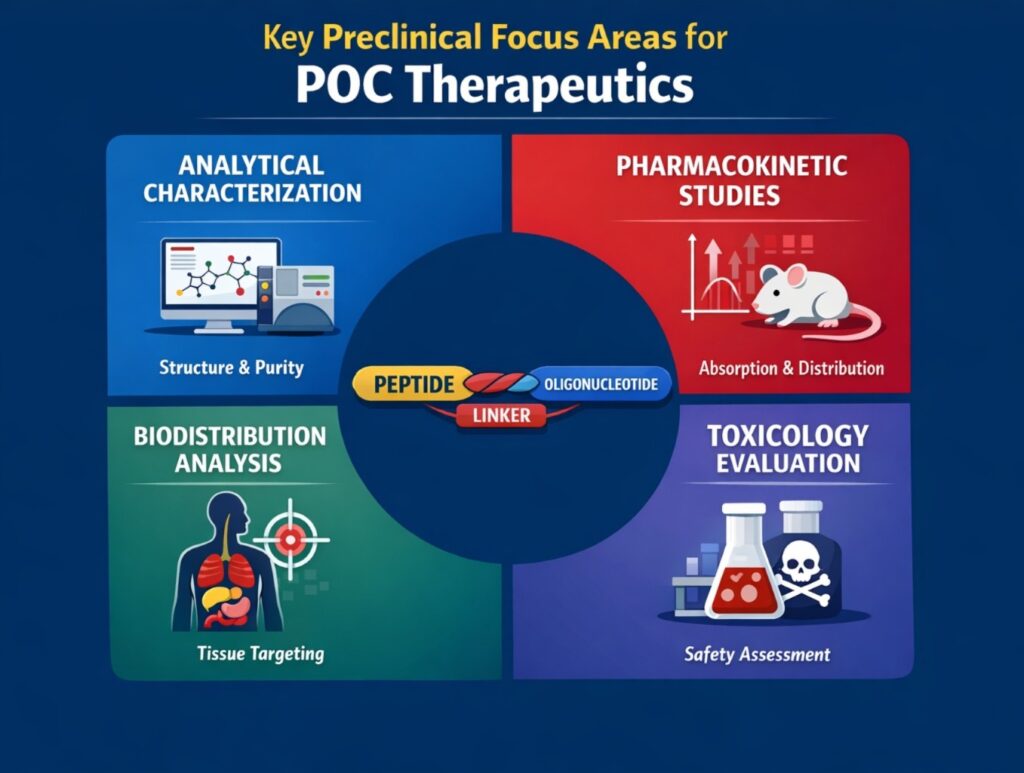
The successful development of POC-based therapeutics depends on advanced Peptide Oligonucleotide Conjugates Preclinical Services that address the complex interaction between peptide delivery systems and oligonucleotide pharmacology. These services provide the analytical tools and experimental models required to evaluate conjugated therapeutics before clinical testing.
A strong preclinical program typically integrates:
- Analytical characterization
- Pharmacokinetic profiling
- Biodistribution analysis
- Stability and metabolism studies
- Toxicology evaluation
Together, these components create a comprehensive understanding of how the therapeutic behaves in biological systems. They help determine whether the molecule is stable, effective, and safe enough for human trials.
Integrated Peptide Oligonucleotide Conjugates Preclinical Services enable researchers to optimize delivery strategies, confirm tissue targeting, and establish safety profiles. Addressing these factors early in development can significantly reduce risks and improve the likelihood of clinical success.
For organizations working on RNA-targeted therapeutics, access to specialized analytical expertise and coordinated preclinical workflows is essential. These capabilities help accelerate the transition from early discovery to IND-ready drug candidates while maintaining high scientific standards.
Ensure your project meets regulatory requirements: CMC Services for Peptide Oligonucleotide Conjugates
Contact Us
For more information about specialized analytical and preclinical support for complex therapeutic modalities:
Frequently Asked Questions (FAQs)
Peptides are attached to oligonucleotides to improve how these molecules enter cells and reach specific tissues. Many oligonucleotide drugs struggle to cross biological barriers on their own. By adding a peptide component, researchers can enhance delivery efficiency and increase the chances of achieving stronger therapeutic effects.
Several advanced analytical tools are used to examine peptide-oligonucleotide conjugates. These include LC-MS, high-resolution mass spectrometry, peptide mapping, and oligonucleotide sequencing. Together, these techniques confirm the molecular structure, detect impurities, and ensure the conjugate has been synthesized correctly before biological testing begins.
POC therapeutics contain both peptide and oligonucleotide components, which may behave differently inside the body. This can create complex patterns of distribution, metabolism, and clearance. Specialized pharmacokinetic studies help researchers understand these behaviors and design dosing strategies that maintain effective drug exposure.
Biodistribution studies track where the conjugate travels after it is administered. Researchers use techniques such as LC-MS quantification, imaging tools, and sometimes radiolabeled tracking in animal models. These studies help determine whether the therapeutic successfully reaches its intended tissues.
Potential safety concerns may include immune reactions, kidney accumulation, or unwanted interactions with non-target genes. These risks are carefully evaluated during preclinical toxicology studies. The goal is to identify and address possible safety issues before the therapy is tested in humans.
Mass spectrometry is widely used to analyze complex therapeutic molecules like peptide-oligonucleotide conjugates. It allows researchers to confirm molecular structure and accurately measure drug levels in biological samples. This information is essential for understanding metabolism, pharmacokinetics, and stability.
Researchers are exploring POCs for several disease areas, including genetic disorders, cancer, neuromuscular diseases, and central nervous system conditions. These therapies are designed to regulate gene expression or silence harmful genetic signals. Improved delivery technologies make it possible to target tissues that were previously difficult to treat.
Reference:
- Malinowska, A. L., Huynh, H. L., & Bose, S. (2024). Peptide-oligonucleotide conjugation: Chemistry and therapeutic applications. Current Issues in Molecular Biology, 46(10), 11031–11047. https://doi.org/10.3390/cimb46100655
- Klabenkova, K., Fokina, A., & Stetsenko, D. (2021). Chemistry of peptide-oligonucleotide conjugates: A review. Molecules, 26(17), 5420. https://doi.org/10.3390/molecules26175420
Get In Touch With Us
About The Author


