

Introduction:
Peptide-Oligonucleotide Conjugation Yield Optimization is the systematic improvement of the reaction and recovery processes used to make a peptide-linked oligonucleotide. It aims to increase formation and recovery of the intended conjugate while keeping purity, molecular integrity, and stability acceptable. For programs using cell-penetrating peptides or targeting ligands, such as peptide-oligonucleotide conjugates for oncology, low yield means higher cost, longer timelines, and unreliable material for biological studies.
This case study shows how the scientists at ResolveMass Laboratories Inc., a Canadian analytical CRO/CDMO experienced in mass spectrometry and oligonucleotide characterization, approach a complex conjugation program. The case is illustrative and anonymized. The figures are representative, not measured results from a specific client study.
Summary:
Peptide-oligonucleotide conjugation yield can be raised substantially by controlling thiol integrity, preventing aggregation, tuning reaction conditions through designed experiments, and monitoring every step with orthogonal analytics and a stage-by-stage recovery assessment.
- The problem: a cationic peptide and an anionic oligonucleotide gave low, variable yields and hard-to-purify mixtures.
- The root causes: thiol oxidation, electrostatic aggregation, linker hydrolysis, and purification losses.
- The fixes: reduction and degassing controls, ionic-strength and co-solvent tuning, a design-of-experiments (DoE) screen, and re-engineered purification.
- The proof: IP-RP-HPLC, LC-HRMS and SEC confirmed identity, purity and aggregation at every stage.
- The controls: documented specifications, risk assessment and reproducibility checks support scale-up toward GMP.
- The takeaway: conversion is not isolated yield, so measure losses at each stage before changing the chemistry.
1: Why Peptide-Oligonucleotide Conjugation Yield Optimization Is Difficult
Yield is hard to optimize because peptides and oligonucleotides have opposing physical properties, and reactive handles degrade while the reaction runs. A cationic peptide and a polyanionic oligonucleotide can form insoluble complexes before any covalent bond forms.
| Factor | What happens | Typical impact |
|---|---|---|
| Thiol oxidation | 5′-thiol oligonucleotides form disulfide dimers | Lost reactive material |
| Electrostatic aggregation | Cationic peptide binds anionic backbone | Precipitation, broad peaks |
| Linker hydrolysis | Maleimide or NHS ester reacts with water | Inert, capped peptide |
| Stoichiometry drift | Excess or deficit of either partner | Unreacted starting material |
| Purification loss | Conjugate co-elutes with impurities | Low recovery after chromatography |
Phosphorothioate backbones add diastereomer mixtures, which broaden peaks and make impurity resolution harder.
2: Case Study Background: The Program and Its Challenges
The program aimed to conjugate a 16-residue cationic peptide to a 21-mer, fully modified phosphorothioate oligonucleotide through a thiol-maleimide linkage. The first-generation process gave an isolated yield of about 28%, with run-to-run variation above 10 percentage points. The team set three goals:
- Raise isolated yield above 60% without compromising purity.
- Keep conjugate purity at or above 95% by IP-RP-HPLC.
- Produce a method another laboratory could reproduce.
How We Diagnosed the Low-Yield Problem
The problem was diagnosed by tracking every species in the reaction with orthogonal methods rather than relying on one end-point result. Measuring only final isolated mass would have hidden where material was lost.
- IP-RP-HPLC: resolved conjugate, free oligonucleotide, and free peptide.
- LC-HRMS with deconvolution: confirmed identity and flagged side-products by exact mass.
- Size-exclusion chromatography: detected aggregates.
- UV at 260 nm and 280 nm: tracked oligonucleotide and peptide content.
The data pointed to four leaks: disulfide dimer formation, partial maleimide hydrolysis, aggregation, and losses during purification. Reliable identity work, including sequence confirmation strategies, is what separates a real conjugate from a look-alike species. Impurity assignments should rest on adequate evidence, not on retention time or a single mass measurement.
3: Peptide-Oligonucleotide Conjugation Yield Optimization: Strategies That Worked
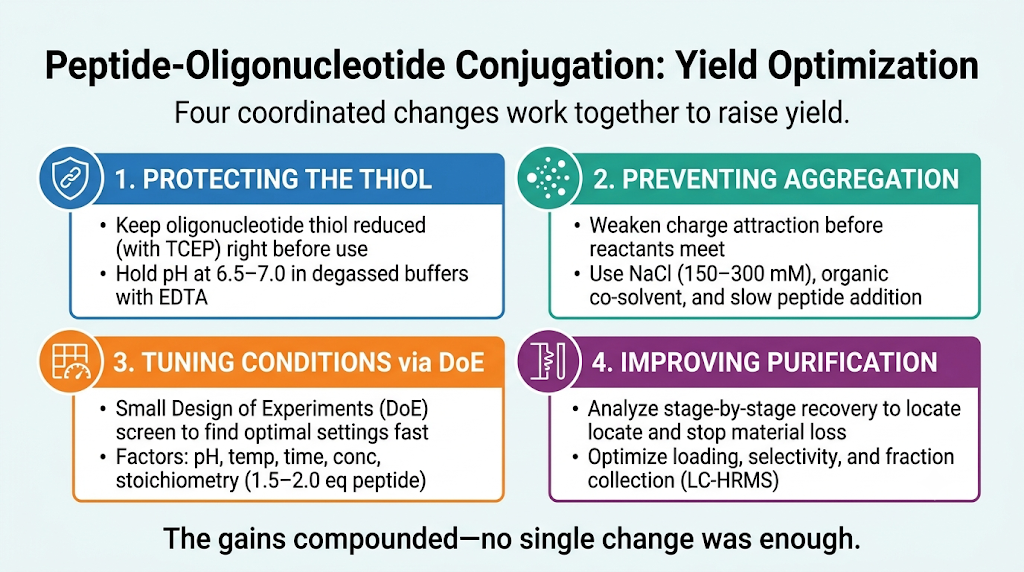
Four coordinated changes raised yield: protecting the thiol, preventing aggregation, tuning conditions by DoE, and improving purification. The gains compounded; no single change was enough.
Protecting the Thiol
Keeping the oligonucleotide thiol reduced until the reaction starts is the most effective single step. The team reduced the oligonucleotide with TCEP immediately before use, desalted it, and ran the reaction in degassed buffers with EDTA. The pH was held near 6.5 to 7.0 to favor thiol-maleimide selectivity and slow maleimide hydrolysis.
Preventing Electrostatic Aggregation
Aggregation is reduced by weakening the charge attraction before the partners meet. The team used 150 to 300 mM NaCl, 20 to 30% organic co-solvent, dilute reactants, and slow peptide addition. SEC traces showed high-molecular-weight species dropping sharply.
Tuning Conditions with Design of Experiments
A small DoE screen found good settings faster than one-factor-at-a-time work. The factors were pH, temperature, reaction time, concentration, and stoichiometry. A modest peptide excess of about 1.5 to 2.0 equivalents with short reaction time and controlled temperature gave the best conversion. Confirmatory runs are still needed to show the optimum is reproducible and keeps product quality.
Improving Purification and Product Recovery
Purification optimization can raise usable conjugate recovery without changing reaction conversion. The best approach depends on the conjugate’s charge, hydrophobicity, size, linker chemistry, and impurity profile. Options include preparative reversed-phase chromatography, ion-exchange chromatography, and size-based separation. The team investigated:
- Loading conditions: whether concentration, injection volume, or solvent composition affects separation.
- Chromatographic selectivity: whether the conjugate separates from unreacted components and critical impurities.
- Fraction collection: criteria that avoid product loss and impurity carryover, set from LC-HRMS identity data rather than UV alone.
- Product stability: whether purification conditions affect linker integrity or molecular stability.
- Post-purification handling: desalting, buffer exchange, concentration, and storage effects on recovery.
A stage-by-stage recovery assessment shows where material is lost. If purification is the main limit, changing reaction conditions alone will not fix it.
4: Illustrative Outcome: A Data-Driven Development Strategy
The optimized process is judged against the original using predefined analytical endpoints and confirmatory experiments. The table below uses representative values.
| Metric | First-generation process | Optimized process |
|---|---|---|
| Isolated yield | ~28% | ~64% |
| Run-to-run variation | >10 percentage points | ~3 percentage points |
| Conjugate purity (IP-RP-HPLC) | ~88% | ≥95% |
| Oligonucleotide lost as disulfide dimer | ~25% | <5% |
| Aggregate by SEC | Visible, variable | Minimal |
Improvement should be shown by documented analytical results across independent runs with predefined acceptance criteria, not inferred from one successful experiment. The next table is a decision framework for reading development data. It is not a report of measured results.
| Development observation | Interpretation | Appropriate next action |
|---|---|---|
| Residual starting material is high | Conjugation may be incomplete | Investigate stoichiometry, reactive-group availability, and reaction conditions |
| Target conjugate decreases during incubation | Product instability or secondary reactions | Examine time-course data and characterize emerging species |
| Crude conversion acceptable but isolated yield low | Purification or handling losses may dominate | Perform a recovery assessment across processing steps |
| Unexpected molecular masses detected | Side products, degradation, or adducts | Investigate by LC-MS and complementary methods |
| Replicate runs inconsistent | Uncontrolled process variables or material variability | Review analytical precision, raw materials, and process controls |
Once the main source of loss is identified, the team applies targeted corrections and repeats the experiments under controlled conditions.
5: Establishing Process Controls and Reproducibility
A robust process needs documented controls for reproducibility, traceability, and consistent quality, not just one good run. Important controls include:
- Defined specifications for peptide and oligonucleotide starting materials.
- Approved procedures for stock preparation and concentration determination.
- Controlled reaction parameters and sampling times.
- System suitability and analytical quality controls.
- Documented calculations for conversion, selectivity, and recovery.
- Defined purification and product-handling procedures.
- Investigation procedures for unexpected results and deviations.
- Appropriate storage conditions and stability monitoring.
A risk-based approach prioritizes parameters by the severity of potential failure, its likelihood, and the ability of existing controls to detect it. Programs should also plan around the ICH guidelines for peptide-oligonucleotide conjugates and the wider peptide-oligonucleotide conjugates regulation landscape.
For programs moving toward GMP, process understanding and documentation should match the development stage and intended use. Process characterization, method qualification or validation, and technology transfer should be planned against the applicable requirements. See ResolveMass resources on GMP manufacturing of peptide-oligonucleotide conjugates and GMP-grade conjugate production. A well-controlled process also supports later pharmacokinetics and biodistribution studies, because consistent material makes in vivo data easier to interpret.
How ResolveMass Laboratories Can Support Conjugate Development
ResolveMass Laboratories Inc. provides analytical science support for pharmaceutical development, including chromatographic and mass spectrometric characterization. For conjugate programs, an analytical strategy links reaction performance with molecular identity, impurity formation, and product quality. A suitable workstream may include:
- Method development: fit-for-purpose chromatographic conditions for the target conjugate and related species.
- Mass spectrometric characterization: confirming expected mass and evaluating reaction-related impurities.
- Reaction monitoring: comparing samples across stages to separate incomplete conversion from degradation.
- Impurity profiling: investigating unexpected peaks and supporting justified assignments.
- Method performance assessment: specificity, precision, accuracy, and other characteristics suited to the intended use.
- Process development support: using analytical evidence to guide reaction and purification work.
The exact scope depends on the molecular structure, analytical challenges, reference materials, and project objectives. Method suitability should be assessed before the study begins.
Conclusion:
Peptide-Oligonucleotide Conjugation Yield Optimization requires an integrated understanding of reaction chemistry, biomolecule properties, analytical performance, and downstream purification. Low isolated yield may come from incomplete coupling, competing reactions, degradation, analytical bias, or purification losses, and each needs a targeted investigation.
A structured approach starts with reliable characterization of starting materials, then reaction monitoring, systematic parameter evaluation, and impurity investigation. DoE, stage-by-stage recovery measurements, and confirmatory studies build a reproducible process. The best strategy is not the one with the highest apparent yield, but the one that consistently delivers the intended conjugate with the required identity, purity, integrity, stability, and recovery.
Frequently Asked Questions:
Conversion measures the proportion of a starting material that reacts, whereas isolated yield measures the amount of purified target product recovered relative to its theoretical amount. High conversion does not guarantee high isolated yield because side reactions and purification losses may occur.
Yes. Design of Experiments helps identify critical process parameters and interactions between variables. It can reduce unnecessary experiments and support the selection of conditions that balance conversion, selectivity, purity, and recovery.
Linker chemistry influences reactive-group accessibility, coupling efficiency, product stability, and impurity formation. Selecting a suitable linker and attachment site can improve conjugation performance while preserving the intended molecular structure and function.
Reaction conditions can be optimized by systematically evaluating pH, temperature, reaction time, reactant molar ratio, concentration, and buffer composition. The selected conditions should improve productive conversion without increasing degradation or unwanted side products.
Reference
- Venkatesan N, Kim BH. Peptide conjugates of oligonucleotides: synthesis and applications. Chemical reviews. 2006 Sep 13;106(9):3712-61.https://pubs.acs.org/doi/full/10.1021/cr0502448
- Klabenkova K, Fokina A, Stetsenko D. Chemistry of peptide-oligonucleotide conjugates: a review. Molecules. 2021 Sep 6;26(17):5420.https://www.mdpi.com/1420-3049/26/17/5420
- Lu K, Duan QP, Ma L, Zhao DX. Chemical strategies for the synthesis of peptide− oligonucleotide conjugates. Bioconjugate chemistry. 2010 Feb 17;21(2):187-202.https://pubs.acs.org/doi/abs/10.1021/bc900158s
- Zubin EM, Romanova EA, Tat’yana SO. Modern methods for the synthesis of peptide–oligonucleotide conjugates. Russian chemical reviews. 2002 Mar 31;71(3):239-64.https://iopscience.iop.org/article/10.1070/RC2002v071n03ABEH000707/meta
About the Author


