

Introduction
Synthetic peptide active pharmaceutical ingredients (APIs) present unique regulatory and analytical challenges because conventional International Council for Harmonisation (ICH) quality guidelines do not comprehensively address their distinctive structural complexity. Effectively managing Peptide-Related Impurities and Degradation requires the integration of conventional chemical impurity principles with peptide-specific regulatory considerations covering side-chain modifications, chiral variations, and possible immunogenicity concerns.
Peptides containing up to 40 amino acids occupy an intermediate category between small-molecule synthetic drugs and large biological therapeutics. Although they are regulated as chemical drug substances, their multistep manufacturing processes—performed through Solid-Phase Peptide Synthesis (SPPS), Liquid-Phase Peptide Synthesis (LPPS), or hybrid approaches—can generate and accumulate structurally related process impurities and degradation products. In contrast to small molecules, for which impurity control is largely based on toxicological exposure associated with the daily intake, peptide impurities may influence higher-order conformation and potentially trigger undesirable immune responses. Therefore, defining robust critical quality attributes (CQAs) for synthetic peptide APIs requires the use of advanced mass spectrometry, orthogonal chromatographic separation techniques, and focused risk-based assessments. ResolveMass Laboratories Inc. assists drug developers through specialized analytical workflows designed to characterize complex peptide impurity profiles and support compliance with stringent global regulatory expectations.
Explore how specialized CDMO partnerships can accelerate generic drug development across the US and Canada with robust analytical strategies.
Share via:
Article Summary:
- Synthetic peptide APIs require specialized impurity control because conventional ICH Q3A/Q3B guidelines do not fully address peptide-specific structural complexity, degradation behavior, and immunogenicity risks.
- Regulatory expectations for peptides are more stringent, with the FDA requiring structural identification of peptide-related impurities at 0.10% or higher and imposing strict limits for generic peptide approvals.
- Peptide impurities arise from both manufacturing and degradation, including amino acid substitutions, deletions, oxidation, deamidation, racemization, diketopiperazine (DKP) formation, pyroglutamate formation, and aggregation.
- Chemical and physical degradation are influenced by formulation and storage conditions, such as pH, temperature, oxygen exposure, trace metals, agitation, and freeze-thaw cycles, making stability control essential.
- Advanced analytical techniques are necessary to accurately detect and characterize peptide impurities. High-resolution LC-HRMS, RP-UHPLC, ion-exchange chromatography, chiral LC-MS/MS, SEC-MALS, and particle analysis provide complementary impurity profiling.
- Immunogenicity assessment is a critical regulatory requirement, as altered peptide sequences and aggregates may trigger anti-drug immune responses. Developers must evaluate impurity profiles, aggregation, and immune activation risks against the reference product.
- Successful peptide development depends on integrating regulatory compliance with robust analytical characterization, enabling manufacturers to ensure product quality, demonstrate API comparability, maintain stability, and support global regulatory submissions.
Regulatory Frameworks for Peptide-Related Impurities and Degradation
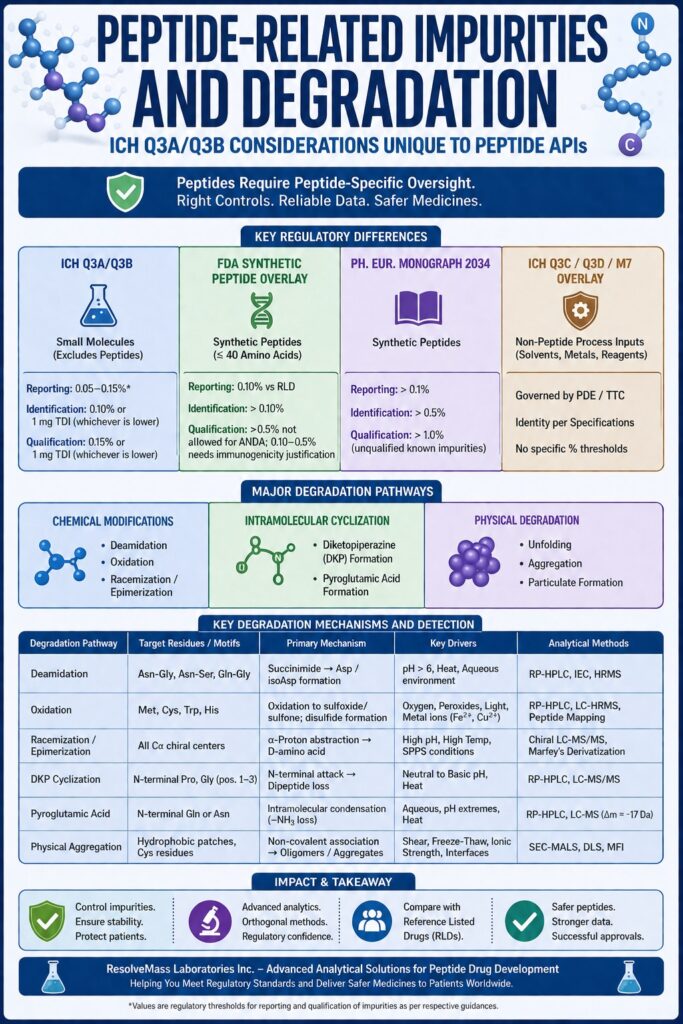
Regulatory frameworks applicable to synthetic peptides combine the principles of standard ICH Q3A/Q3B guidelines with peptide-specific requirements that establish defined thresholds for the complete identification of peptide-related impurities at or above 0.10%. These regulatory overlays emphasize comparative impurity profiling against reference listed drugs (RLDs) to assess potential safety and immunogenicity concerns rather than depending exclusively on maximum daily dose-based thresholds.
ICH Q3A/Q3B Scope Exclusions and Synthetic Peptide Overlays
Although ICH Q3A(R2) and Q3B(R2) provide requirements for impurities in new chemical drug substances and drug products, synthetic peptide APIs are specifically excluded from the baseline threshold tables established under these guidelines. To address this regulatory gap, agencies have developed peptide-specific overlays, including FDA guidance for generic synthetic peptides, that establish lower reporting and identification thresholds and require stringent comparison with approved reference products.
For conventional small-molecule drugs, reporting, identification, and qualification thresholds are generally scaled according to the Maximum Daily Dose (MDD), with typical values ranging from 0.05% to 0.15%. However, peptides contain repeating peptide bonds, reactive side chains, and multiple chiral centers, meaning that even a single amino acid substitution or deletion may substantially affect biological activity or safety. The FDA synthetic peptide guidance establishes an identification threshold of 0.10% for specified peptide-related impurities. In addition, for Abbreviated New Drug Application (ANDA) submissions referencing recombinant or synthetic listed drugs, including liraglutide, semaglutide, and glucagon, the presence of any new peptide-related impurity above 0.5% generally prevents reliance on the generic approval pathway. Such products may instead require a New Drug Application (NDA) under section 505(b)(2) or extensive clinical justification. Non-peptide process-related inputs, including residual solvents such as dimethylformamide and dichloromethane, heavy metals, and reagents, continue to be regulated under ICH Q3C, ICH Q3D, and ICH M7, as applicable.
Read our detailed case study on generic peptide drug analytical characterization to learn how to fulfill rigorous generic submission requirements.
Regional Variance in Impurity Qualification Thresholds
Regulatory expectations for synthetic peptide impurities vary considerably across regions, particularly when comparing U.S. FDA requirements with European Pharmacopoeia (Ph. Eur.) monographs. The FDA applies a strict 0.10% identification threshold and a 0.5% limit for new impurities in generic products, whereas Ph. Eur. Monograph 2034 allows higher default limits, with an identification threshold of 0.5% and an unqualified known impurity limit of 1.0%.
This difference in regulatory expectations creates important considerations for global Chemistry, Manufacturing, and Controls (CMC) strategy development. Applicants seeking approval in European markets may apply the standards described in Ph. Eur. 2034 for non-specified impurities. However, FDA submissions require complete individual characterization of any impurity that reaches 0.10%. As a result, global drug development programs commonly adopt the more stringent FDA thresholds as the foundation for analytical method validation and specification setting.
Evaluate regional compliance differences and advantages by reviewing Canadian vs. US peptide CDMOs for your CMC pathway.
| Regulatory Framework | Scope & Application | Reporting Threshold | Identification Threshold | Qualification Threshold / New Impurity Limit |
|---|---|---|---|---|
| ICH Q3A(R2) / Q3B(R2) | Chemically synthesized small molecules; peptides are explicitly excluded | 0.05% for MDD ≤ 1 g | 0.10% or 1.0 mg TDI, whichever is lower | 0.15% or 1.0 mg TDI, whichever is lower |
| FDA Synthetic Peptide Overlay | Highly purified synthetic peptides containing ≤ 40 amino acids and referencing rDNA or synthetic RLDs | 0.10%, scaled against the RLD profile | ≥ 0.10%; complete structural identification required | > 0.5% is prohibited for generic ANDA pathways; 0.10–0.5% requires immunogenicity justification |
| Ph. Eur. Monograph 2034 | Substances for pharmaceutical use, including synthetic peptides | > 0.1% | > 0.5% | > 1.0% for unqualified known impurities |
| ICH Q3C / Q3D / M7 Overlay | Non-peptide process inputs, including residual solvents, heavy metals, and mutagenic small molecules | Governed by Permitted Daily Exposure (PDE) values | Chemical identity confirmed according to the applicable raw material specification | Governed by the Toxicological Threshold of Concern (TTC) or PDE |
Mechanisms Driving Peptide-Related Impurities and Degradation Pathways
Peptide-Related Impurities and Degradation pathways arise from chemical modifications of side-chain functional groups, intramolecular cyclization reactions, and physical self-association. The occurrence and progression of these pathways are influenced by the primary amino acid sequence, solution pH, temperature, exposure to trace metals, and interactions with storage interfaces.
Chemical Pathways: Deamidation, Oxidation, and Isomerization
Chemical degradation in synthetic peptides can modify covalent structures through several mechanisms, including side-chain deamidation, oxidation of susceptible amino acid residues, and backbone racemization. Among the degradation pathways most frequently observed during stability testing, deamidation of asparagine and oxidation of methionine are particularly significant.
Deamidation generally occurs more readily under neutral to basic pH conditions through nucleophilic attack by the peptide backbone nitrogen on the side-chain carbonyl group of asparagine (Asn) or glutamine (Gln), resulting in the formation of a cyclic succinimide intermediate. Subsequent hydrolysis of this intermediate produces a mixture of L-aspartic acid (Asp) and L-isoaspartic acid (isoAsp), commonly in an approximate 1:3 ratio, together with smaller quantities of D-enantiomers. Sequences with limited steric hindrance, including Asn-Gly and Asn-Ser, may undergo degradation at substantially accelerated rates.
Oxidation predominantly affects methionine (Met) and cysteine (Cys) residues. Methionine may undergo autoxidation or transition metal-catalyzed oxidation in the presence of metal ions such as Fe2+ and Cu2+, initially producing methionine sulfoxide, which may subsequently undergo further oxidation to methionine sulfone. Free cysteine thiol groups may oxidize to produce intra- or intermolecular disulfide linkages or may undergo disulfide scrambling. Isomerization and racemization can convert L-amino acids into D-enantiomers during SPPS coupling reactions or deamidation processes, generating diastereomeric epimers that possess molecular weights identical to those of the target API.
Learn more about targeting these complex pathways by working with the best peptide CDMO for synthetic synthesis and impurity management.
Intramolecular Cyclization: Diketopiperazine and Pyroglutamic Acid Formation
Intramolecular cyclization pathways occur when terminal amino acid residues interact with internal amide bonds, resulting in terminal truncation or structural masking of the peptide. Diketopiperazine (DKP) formation involves cleavage of the N-terminal dipeptide, whereas N-terminal glutamine residues may undergo spontaneous cyclization to form pyroglutamic acid.
Diketopiperazine formation occurs when the unprotonated N-terminal amine carries out a nucleophilic attack on the carbonyl group of the peptide bond located between the second and third amino acids. This reaction releases a cyclic dipeptide, known as diketopiperazine, while leaving behind a truncated (n-2) peptide chain. The presence of proline or glycine at positions 1, 2, or 3 may accelerate DKP formation because of favorable conformational flexibility and the geometry associated with cis-peptide bonds.
Pyroglutamic acid formation occurs when an N-terminal glutamine (Gln) or asparagine (Asn) residue undergoes intramolecular condensation, resulting in the elimination of ammonia and formation of a cyclic lactam ring. This structural transformation neutralizes the terminal charge and can consequently modify the peptide’s isoelectric point (pI) and its affinity for the target receptor.
Physical Degradation and Aggregation Mechanics
Physical degradation encompasses non-covalent self-association and structural unfolding, leading peptides to form soluble oligomers, subvisible particles, or insoluble precipitates. These physical changes modify the higher-order structure of the drug product without disrupting covalent bonds and are frequently accelerated by prior chemical modifications.
Peptide aggregation generally develops through a progression from native monomers to soluble non-covalent oligomers, which may subsequently nucleate into fibrillar structures or amorphous aggregates. Hydrophobic interactions, mechanical agitation, freeze-thaw stress, and contact with liquid-container interfaces can significantly accelerate this process. Chemical degradation mechanisms, including deamidation and oxidation, may produce localized conformational alterations that expose hydrophobic side chains and reduce the activation energy required for physical aggregation. Conversely, physical aggregation may limit solvent accessibility or locally increase the concentration of reactive species, thereby influencing the rate of chemical degradation. Controlling both physical and chemical degradation is essential because aggregated peptides are among the major contributors to undesirable clinical immunogenicity.
The principal peptide degradation mechanisms can be classified into three distinct structural domains:
Chemical Modifications: Deamidation at Asn/Gln sites, producing Asp/isoAsp mixtures; oxidation of Met side chains to form sulfoxides and sulfones; cleavage of Asp-Pro or Asp-Gly peptide bonds; and backbone racemization resulting in D-amino acid epimers.
Intramolecular Cyclizations: Diketopiperazine (DKP) cleavage involving the removal of N-terminal dipeptides, together with pyroglutamic acid formation from N-terminal Gln or Asn residues.
Physical Transformations: Structural unfolding and non-covalent self-association that progresses from soluble oligomers to subvisible particulate matter and fibrillar insoluble aggregates.
Ensure high yield and purity during batch scale-up by optimizing your peptide API scale-up strategy with specialized analytical oversight.
| Degradation Pathway | Target Residues / Motifs | Primary Mechanism | Environmental / Formulation Drivers | Analytical Detection Methods |
|---|---|---|---|---|
| Deamidation | Asn-Gly, Asn-Ser, Gln-Gly | Formation of a succinimide intermediate followed by generation of an Asp / isoAsp mixture | Alkaline pH > 6.0, elevated temperature, and aqueous media | RP-HPLC, Ion-Exchange Chromatography (IEC), HRMS |
| Oxidation | Met, Cys, Trp, His | Conversion to sulfoxide or sulfone products and formation of inter- or intramolecular disulfides | Dissolved oxygen, peroxides, light, and trace metal ions such as Fe2+ and Cu2+ | RP-HPLC, LC-HRMS, Peptide Mapping |
| Racemization / Epimerization | All Cα chiral centers, including His, Cys, Asp, and Phe | Base-catalyzed abstraction of the α-proton followed by D-amino acid formation | High temperature and alkaline coupling conditions during SPPS | Chiral LC-MS/MS, Marfey’s Reagent Derivatization |
| DKP Cyclization | N-terminal Pro; Gly at positions 1, 2, or 3 | Intramolecular attack by the N-terminal amine on the C-2 carbonyl, resulting in dipeptide loss | Solution state, neutral to slightly basic pH, and elevated heat | RP-HPLC, LC-MS/MS based on the mass loss of the dipeptide |
| Pyroglutamic Acid | N-terminal Gln or Asn | Condensation of the N-terminal amine with the side-chain amide carbonyl | Aqueous solution, elevated temperature, and acidic or basic catalysis | RP-HPLC, LC-MS; Δm = -17 Da for Gln |
| Physical Aggregation | Hydrophobic patches and Cys residues | Non-covalent self-association or covalent crosslinking into oligomers and fibrils | Mechanical shear, freeze-thaw cycles, ionic strength, and interfaces | SEC-UV/MALS, Dynamic Light Scattering (DLS), Flow Imaging |
Advanced Analytical Workflows for Resolving Peptide-Related Impurities and Degradation
Characterizing Peptide-Related Impurities and Degradation requires high-resolution chromatographic and mass spectrometric workflows capable of separating closely related sequence variants and diastereomers. The use of orthogonal analytical methods improves the reliability of impurity detection, quantification, and structural elucidation by reducing the risk associated with co-eluting species and method-specific limitations.
Reverse-Phase UHPLC and High-Resolution Mass Spectrometry (LC-HRMS)
Reverse-Phase Ultra-High Performance Liquid Chromatography coupled with High-Resolution Mass Spectrometry (RP-UHPLC-HRMS) is widely regarded as a leading analytical approach for separating and identifying peptide impurities. Modern UHPLC columns containing organosilica charged-surface hybrid (CSH) stationary phases provide the high peak capacity required to resolve deletion and insertion sequences.
High-resolution mass spectrometers, including Q-TOF and Orbitrap systems, can achieve accurate mass measurements with mass errors below 2 ppm, enabling reliable determination of empirical formulas. Tandem mass spectrometry (MS/MS), using Higher-energy Collisional Dissociation (HCD) or Electron-Transfer Dissociation (ETD), fragments the peptide backbone through b/y or c/z ion series. This enables the localization of single amino acid modifications, oxidation sites, and point mutations. Automated informatics platforms can extract ion chromatograms (EICs) to evaluate peak purity and support the detection of co-eluting trace impurities below the 0.10% identification threshold.
Access specialized expertise in characterization by utilizing dedicated peptide analytical characterization services for sequence and impurity validation.
Orthogonal Separation for Co-Eluting Variants and Chiral Impurities
Orthogonal separation techniques, including Hydrophilic Interaction Liquid Chromatography (HILIC), Ion-Exchange Chromatography (IEC), and Chiral LC-MS/MS, are essential for resolving impurities that may co-elute with the primary API peak during reverse-phase analysis. These complementary techniques separate peptide variants according to differences in net surface charge, polarity, and stereochemical configuration.
Peptide variants such as isoaspartate isomers and single D-amino acid epimers may co-elute with the target API when analyzed using conventional C18 columns. Consequently, dependence on a single analytical separation mode can create a substantial risk of impurity underreporting. IEC separates charge variants associated with deamidation or pyroglutamic acid formation, whereas HILIC provides separation based on differences in hydrophilic characteristics. Chiral purity analysis may involve total acid hydrolysis followed by Marfey’s reagent derivatization or direct separation using chiral stationary phases to quantify trace D-amino acid content. Size-Exclusion Chromatography coupled with Multi-Angle Light Scattering (SEC-MALS) enables the quantification of soluble dimers and higher-order aggregates, supporting regulatory expectations for supramolecular characterization.
Discover key analytical methodologies in action with our peptide characterization case study of semaglutide.
| Analytical Method | Primary Target Attribute | Technical Capabilities & Strengths | Regulatory & Compendial Role |
|---|---|---|---|
| RP-UHPLC-HRMS | Identity, Purity, Sequence Variants, and Degradants | Mass accuracy below 2 ppm; MS/MS fragmentation enables precise localization of modification sites | Essential for identity confirmation, impurity profiling, and API sameness |
| SEC-UV / MALS | Soluble Aggregates, Dimers, and High-MW Species | Non-denaturing separation based on hydrodynamic radius; MALS provides absolute molecular weight determination | Required for assessing aggregation state and comparative oligomeric profiles |
| Chiral LC-MS/MS / Marfey’s | Epimers, Enantiomers, and D-amino acid Content | Differentiates stereoisomers following hydrolysis or through direct chiral separation | Critical for controlling starting material and API chiral purity under applicable USP requirements |
| Ion-Exchange Chromatography (IEC) | Charge Variants, Deamidation, and Succinimide | Separates acidic and basic variants according to differences in surface net charge | Orthogonal method for confirming peak purity and resolving co-eluting degradants |
| Micro-Flow Imaging (MFI) / DLS | Subvisible Particles and Colloidal Aggregates | Detects particles in the 0.1–100 µm range and quantifies particle counts | Compendial requirement for injectable drug product stability and release |
Immunogenicity Risk Assessment for Peptide-Related Impurities and Degradation
A major safety concern associated with Peptide-Related Impurities and Degradation is their potential to induce anti-drug antibody (ADA) responses in clinical populations. Regulatory approval of synthetic peptides therefore requires comprehensive risk assessments demonstrating that impurity profiles resulting from generic manufacturing or process modifications do not increase immunogenic potential compared with the corresponding reference listed drugs.
Unintended immunogenicity may modify drug pharmacokinetics, reduce or neutralize therapeutic efficacy, or trigger systemic hypersensitivity reactions. Impurities containing sequence alterations, including insertion variants, point mutations, and frameshifts, may generate novel T-cell epitopes capable of binding to Human Leukocyte Antigen (HLA) Class II receptors. In addition, subvisible aggregates can act as physical adjuvants by stimulating innate immune receptors and enhancing antigen presentation.
To address these risks during ANDA development, applicants may implement a multi-tiered immunogenicity assessment strategy:
In Silico HLA Binding Analysis: Computational algorithms evaluate specified impurities present at levels ≥ 0.10% to predict their binding affinity for prevalent HLA-DR, DQ, and DP alleles.
In Vitro Innate Immune Response Assays (IIRA): Cell-based assays using human peripheral blood mononuclear cells (PBMCs) or dendritic cells assess cytokine release, including IL-6, TNF-α, and IFN-γ, following exposure to the fully formulated drug product and comparison with the RLD.
Comparative Aggregate and Impurity Profiling: High-sensitivity SEC-MALS and micro-flow imaging are used to confirm that aggregate levels and specified impurity concentrations remain at or below the levels observed in the RLD throughout the product’s shelf life.
Learn how to mitigate regulatory hurdles when choosing whether to outsource peptide manufacturing to CDMO partners.
Conclusion
Effective control of Peptide-Related Impurities and Degradation requires the integration of mechanistic chemistry, high-resolution analytical technologies, and rigorous compliance with peptide-specific regulatory overlays. Synthetic peptide APIs require control strategies that extend beyond conventional small-molecule ICH Q3A/Q3B guidelines to support clinical safety, API sameness, and long-term product stability.
As synthetic peptide therapeutics continue to expand into additional clinical indications, regulatory scrutiny of impurity characterization and immunogenicity risk mitigation is expected to become increasingly stringent. Successful peptide development depends on establishing stability-indicating analytical workflows, implementing orthogonal separation strategies, and maintaining rigorous comparative purity standards against reference listed drugs. Collaboration with experienced analytical organizations such as ResolveMass Laboratories Inc. can provide pharmaceutical developers with advanced LC-HRMS technologies, structural elucidation expertise, and regulatory testing packages required to advance peptide development programs toward commercialization with confidence.
Discover tailored development solutions by browsing our full range of peptide CDMO services.
To discuss customized analytical strategies, forced degradation studies, or peptide characterization services, visit the ResolveMass Contact Page.
Frequently Asked Questions
According to FDA synthetic peptide guidance, specified peptide-related impurities present at or above 0.10% of the drug substance generally require complete structural identification and characterization. This lower threshold reflects the potential biological significance of even minor sequence-related changes in peptide APIs. The requirement is more stringent than the default identification thresholds established in Ph. Eur. Monograph 2034.
Peptide-related impurities may contain altered amino acid sequences or modified higher-order structures that can introduce novel antigenic features. These changes may generate T-cell epitopes capable of interacting with HLA Class II receptors. Because peptides can structurally resemble endogenous biological molecules, and because aggregates may enhance immune stimulation, such impurities can potentially disrupt immune tolerance and promote anti-drug antibody responses.
For an Abbreviated New Drug Application (ANDA) referencing a recombinant or synthetic peptide, a new specified peptide-related impurity above 0.5% generally prevents the product from following the standard generic approval pathway. New impurities detected between 0.10% and 0.5% require a detailed scientific justification. The applicant must demonstrate that the impurity does not introduce unacceptable safety or immunogenicity concerns.
Asparagine deamidation involves nucleophilic attack by the peptide backbone nitrogen on the side-chain carbonyl group, producing a cyclic succinimide intermediate. Hydrolysis of this intermediate generates L-aspartic acid and L-isoaspartic acid products. The resulting structural and charge differences can be monitored using Reverse-Phase UHPLC, Ion-Exchange Chromatography (IEC), and LC-HRMS, including detection of the characteristic +0.984 Da mass shift.
Methionine and cysteine are among the amino acid residues most vulnerable to oxidative degradation in peptide APIs. Oxidation of methionine may produce methionine sulfoxide and, with further oxidation, methionine sulfone. Free cysteine thiol groups can form intra- or intermolecular disulfide bonds and may also undergo disulfide scrambling, potentially changing the peptide’s structure and biological properties.
Diketopiperazine (DKP) formation is an intramolecular cyclization reaction in which the unprotonated N-terminal amine attacks the amide carbonyl between the second and third amino acids. This reaction results in the loss of the N-terminal dipeptide and formation of a cyclic diketopiperazine structure. Risk reduction may involve controlling formulation pH below neutral, maintaining low storage temperatures for lyophilized powders, and avoiding susceptible proline or glycine residues at critical terminal positions when possible.
Chiral purity testing is necessary to identify D-amino acid epimers that may form through base-catalyzed racemization during SPPS or through degradation-related processes. These epimers can have the same molecular mass as the intended API, making conventional mass-based detection insufficient. Specialized chiral stationary phases or total acid hydrolysis followed by Marfey’s derivatization can therefore be used to separate and quantify these stereoisomeric impurities.
High-Resolution Mass Spectrometry (HRMS) enables accurate mass determination with errors below 2 ppm, supporting the assignment of empirical formulas for trace-level peptide impurities. When combined with MS/MS, fragmentation techniques such as HCD and ETD provide structural information about the peptide backbone. These approaches help identify sequence changes, characterize modifications, and localize specific degradation or modification sites.
Peptide process-related impurities that are not peptide structures, such as residual solvents, heavy metals, and coupling reagents, are generally assessed under established frameworks including ICH Q3C, ICH Q3D, and ICH M7. In contrast, peptide-related impurities such as deletion sequences, epimers, and degradation variants require peptide-specific assessment strategies. These strategies commonly include the 0.10% identification threshold and comparative evaluations of potential safety and immunogenicity risks.
Reference:
- U.S. Food and Drug Administration. (2023). Common deficiencies associated with comparative peptide impurity profile studies and qualification of impurity levels and proposed limits. https://www.fda.gov/media/166572/download
- United States Pharmacopeia. (n.d.). Reference standards to support quality of synthetic peptide therapeutics. https://www.usp.org/sites/default/files/usp/document/our-work/biologics/reference_standards_to_support_quality_of_synthetic_peptide_therapeutics.pdf
- United States Pharmacopeia. (n.d.). <795> peptide reference standards. https://www.usp.org/sites/default/files/usp/document/our-work/biologics/resources/1699-peptide-flyer.pdf
- Hellebrand, T. (n.d.). Analytical toolbox to enable the synthesis [PowerPoint slides]. United States Pharmacopeia. https://www.usp.org/sites/default/files/usp/document/events-and-training/05-Analytical-toolbox-to-enable-the-synthesis_Tim-Hellebrand.pdf
- U.S. Food and Drug Administration. (2021). ANDAs for certain highly purified synthetic peptide drug products that refer to listed drugs of rDNA origin: Guidance for industry. https://www.fda.gov/media/107622/download
- U.S. Food and Drug Administration. (2026). Considerations for the use of the plausible mechanism framework to develop individualized therapies that target specific genetic conditions with known biological cause [Draft guidance]. https://www.fda.gov/media/192485/download
Get In Touch With Us
About The Author


