

Introduction:
Peptide Sameness Study Services in United States are essential analytical programs designed to demonstrate that a generic peptide drug is structurally and chemically identical to its reference listed drug (RLD). In highly regulated submissions to the U.S. Food and Drug Administration, sameness is not optional—it is mandatory for approval pathways such as ANDA.
Choosing the right Contract Research Organization (CRO) for Peptide Sameness Study Services in United States directly impacts regulatory success, approval timelines, and market entry strategy. In this guide, we explain what peptide sameness involves, regulatory expectations, and how to select a technically capable and regulatory-focused CRO.
Summary:
- What Peptide Sameness Study Services in United States involve
- Why peptide sameness is critical for ANDA and 505(b)(2) submissions
- Key regulatory expectations from the U.S. Food and Drug Administration (FDA)
- How to evaluate and select the right CRO for peptide characterization
- Technical capabilities required: HRMS, LC-MS/MS, impurity profiling, structural confirmation
- How ResolveMass Laboratories Inc. supports regulatory-ready peptide sameness studies
Video Guide: Peptide Sameness Study Services in United States
1: What are Peptide Sameness Study Services in United States?
Peptide sameness studies are comprehensive analytical investigations designed to confirm that a generic peptide drug is structurally identical to its reference product.
These studies integrate advanced analytical techniques described in:
Unlike small molecules, peptides present additional complexity due to:
- Amino acid sequence precision requirements
- Disulfide bond arrangements
- Higher-order structural concerns
- Process-related impurities
- Deamidation, oxidation, and truncation risks
In the United States, regulatory authorities require robust analytical evidence that demonstrates sameness at multiple levels.
2: Why Peptide Sameness Study Services in United States are Critical for FDA Approval
Because peptides are complex molecules, the FDA requires extensive structural characterization beyond basic bioequivalence studies.
The U.S. Food and Drug Administration expects:
- Primary structure confirmation
- Molecular weight verification
- Impurity profile comparison
- Degradation pathway assessment
- Comparative analytical characterization
Detailed regulatory perspective:
https://resolvemass.ca/fda-requirements-for-peptide-characterization/
https://resolvemass.ca/characterization-of-peptides-for-fda/
For ANDA-specific strategy:
https://resolvemass.ca/peptide-sameness-study-for-anda/
For IND and NDA regulatory support:
https://resolvemass.ca/peptide-characterization-for-ind-and-nda/
Peptide Sameness Study Services in United States go beyond bioequivalence—they establish structural identity.
Key Regulatory Expectation Areas
| Study Component | Purpose | Regulatory Importance |
|---|---|---|
| Primary Structure Analysis | Confirm amino acid sequence | Mandatory |
| HRMS Molecular Weight | Confirm exact mass | Critical |
| MS/MS Fragmentation | Sequence mapping | Required |
| Impurity Profiling | Compare related substances | High |
| Forced Degradation | Stability comparison | Important |
| Disulfide Bond Mapping | Confirm structural integrity | Required (if applicable) |
Detailed regulatory perspective:
https://resolvemass.ca/fda-requirements-for-peptide-characterization/
https://resolvemass.ca/characterization-of-peptides-for-fda/
For ANDA-specific strategy:
https://resolvemass.ca/peptide-sameness-study-for-anda/
For IND and NDA regulatory support:
https://resolvemass.ca/peptide-characterization-for-ind-and-nda/
Peptide Sameness Study Services in United States go beyond bioequivalence—they establish structural identity.
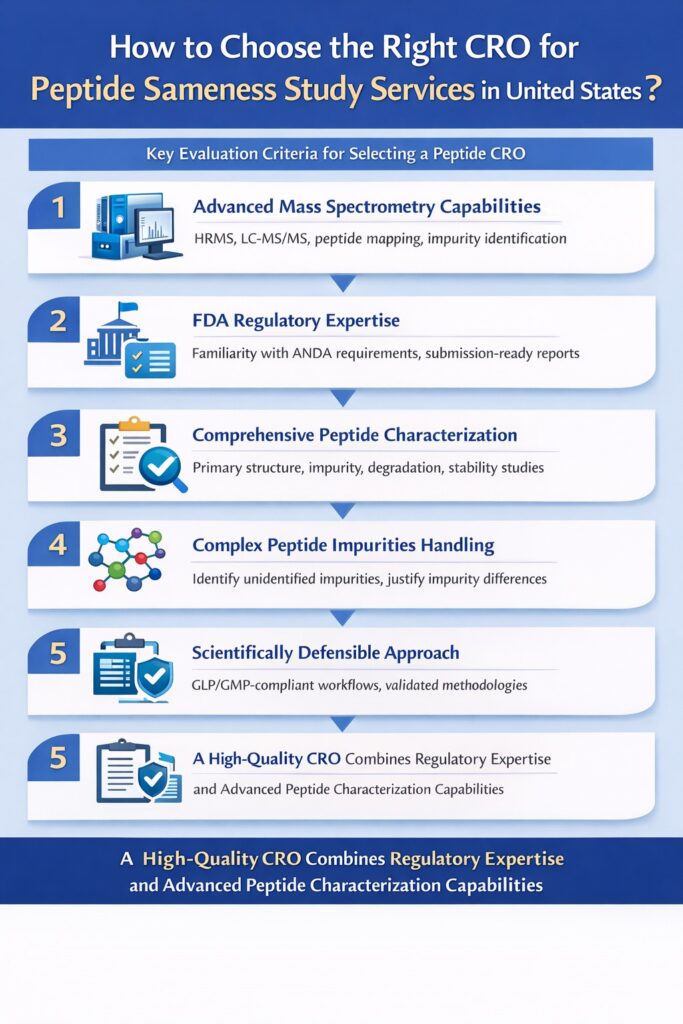
3: How to Choose the Right CRO for Peptide Sameness Study Services in United States
The right CRO should combine regulatory expertise, advanced mass spectrometry capabilities, and proven experience in peptide characterization.
Below are the most important evaluation criteria:
1. Does the CRO have Advanced Mass Spectrometry Capabilities?
High-resolution mass spectrometry (HRMS) is non-negotiable for peptide sameness studies.
A capable CRO must offer:
- High-resolution accurate mass (HRAM) systems
- Tandem MS (MS/MS) sequencing
- Peptide mapping workflows
- Disulfide bond mapping techniques
- Impurity identification at trace levels
Mass spectrometry expertise:
https://resolvemass.ca/peptide-mass-spectrometry-experts/
https://resolvemass.ca/how-to-identify-unknown-peptides-by-lcms-testing/
Without these tools, structural confirmation is incomplete.
2. Does the CRO Understand FDA Regulatory Expectations?
Technical capability alone is not sufficient—regulatory strategy is equally critical.
The CRO must:
- Align studies with FDA guidance expectations
- Generate submission-ready reports
- Provide defensible impurity justifications
- Understand ANDA review processes
- Support deficiency responses
Impurity science reference:
https://resolvemass.ca/impurity-profiling-in-peptides-why-it-matters-in-drug-development/
Peptide purity evaluation:
https://resolvemass.ca/what-is-peptide-purity-by-hplc-and-why-it-matters/
https://resolvemass.ca/peptide-purity-testing-in-united-states/
Regulatory experience significantly reduces review cycles and information requests.
3. Does the CRO Offer Comprehensive Characterization or Limited Testing?
Peptide sameness requires a multi-dimensional approach—not isolated testing.
Comprehensive services should include:
- Primary structure confirmation
- Molecular weight determination
- Comparative impurity profiling
- Degradation pathway analysis
- Orthogonal analytical techniques
- Stability-indicating method evaluation
Understanding degradation pathways:
https://resolvemass.ca/peptide-degradation-product-characterization/
Partial characterization can lead to regulatory deficiencies.
4. Can the CRO Handle Complex Peptide Impurities?
Impurity profiling is one of the most scrutinized areas in peptide ANDA submissions.
Common peptide impurities include:
- Deamidated variants
- Oxidized forms
- Truncated sequences
- Aggregates
- Epimers
The CRO should demonstrate:
- Ability to identify unknown impurities
- Capability to quantify trace-level species
- Comparative impurity assessment vs. RLD
- Scientific justification of differences
Solid vs liquid phase synthesis considerations:
https://resolvemass.ca/solid-vs-liquid-phase-peptide-synthesis-which-method-is-better/
Analytical support during synthesis:
https://resolvemass.ca/analytical-support-in-peptide-synthesis-why-its-essential/
CRO selection guidance:
https://resolvemass.ca/peptide-synthesis-service-how-to-choose-the-right-cro-partner/
5. Does the CRO Follow a Scientifically Defensible Approach?
Regulators expect data integrity, traceability, and validated methods.
Look for:
- GLP/GMP-compliant workflows
- Data audit trails
- Method validation or verification
- System suitability documentation
- Robust SOP-driven operations
Outsourcing checklist:
https://resolvemass.ca/peptide-testing-services-for-pharmaceutical-rd-what-you-need-to-know-before-outsourcing/
Laboratory evaluation criteria:
https://resolvemass.ca/top-5-things-to-look-for-in-a-peptide-testing-laboratory/
Trustworthiness in documentation is as important as technical data.
4: Common Challenges in Peptide Sameness Study Services in United States
Peptide sameness studies often fail due to incomplete structural mapping or poor impurity justification.
Major challenges include:
- Minor impurity differences between generic and RLD
- Oxidation variability
- Sequence-related artifacts
- Manufacturing process differences
- Insufficient fragmentation data
Project examples:
Ganirelix generic characterization:
https://resolvemass.ca/peptide-characterization-of-ganirelix-generic-project/
Lanreotide generic characterization:
https://resolvemass.ca/peptide-characterization-of-lanreotide-generic-project/
A scientifically experienced CRO anticipates and mitigates these issues proactively.
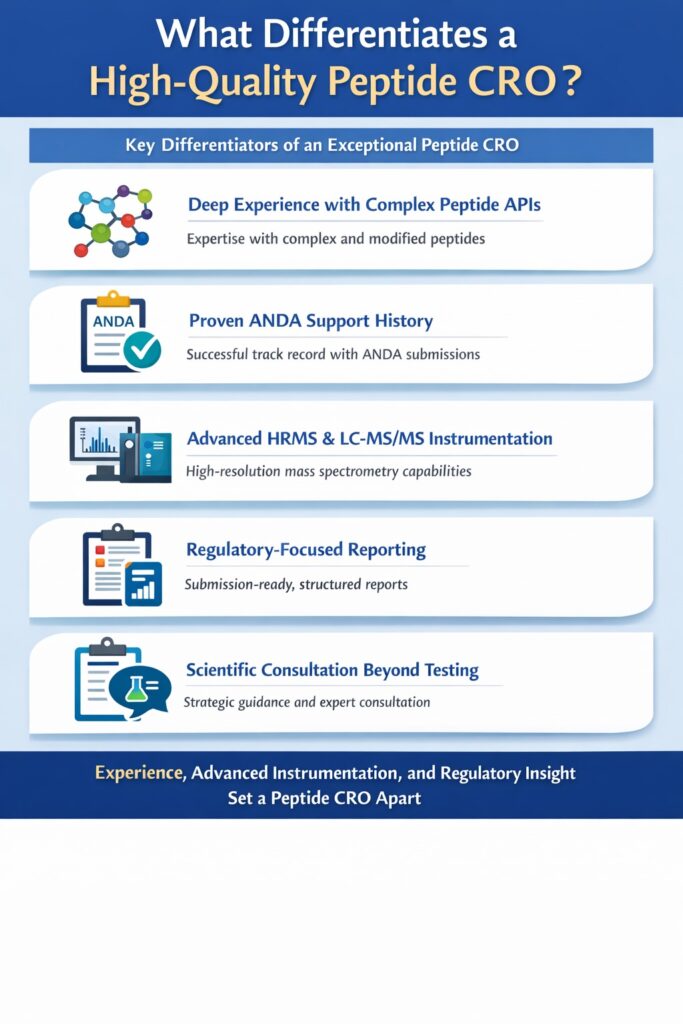
5: What Differentiates a High-Quality Peptide CRO?
A high-quality peptide CRO differentiates itself through deep analytical expertise, proven regulatory experience, advanced instrumentation, and the ability to provide strategic scientific guidance—not just laboratory testing.
When selecting a partner for Peptide Sameness Study Services in United States, the CRO must go beyond routine analysis and deliver regulatory-ready, defensible data aligned with expectations from the U.S. Food and Drug Administration.
Below are the core differentiators that separate an average testing lab from a regulatory-focused peptide CRO.
Key Differentiators
1. Deep Experience with Complex Peptide APIs
A high-quality CRO has hands-on experience working with:
- Long-chain and cyclic peptides
- Peptides with disulfide bridges
- Modified peptides (PTMs, pegylation, lipidation)
- Highly sensitive and unstable peptides
Experience with complex peptide APIs ensures accurate sequence confirmation, impurity identification, and degradation pathway analysis—critical in Peptide Sameness Study Services in United States.
2. Proven ANDA Support History
Peptide sameness studies are heavily scrutinized in ANDA submissions. A CRO with prior ANDA support experience understands:
- FDA review expectations
- Common deficiency trends
- How to structure analytical comparison reports
- How to scientifically justify minor impurity differences
ANDA experience significantly reduces regulatory risk and review delays.
3. Advanced HRMS and LC-MS/MS Instrumentation
High-resolution accurate mass (HRAM) systems and advanced LC-MS/MS platforms are essential for:
- Exact molecular weight confirmation
- Full sequence mapping
- Trace-level impurity identification
- Unknown peptide characterization
- Disulfide bond mapping
Without high-end mass spectrometry, defensible peptide characterization is not possible.
4. Regulatory-Focused Reporting
Data alone is not enough. Regulators expect:
- Structured analytical comparison tables
- Clear impurity justification narratives
- Method validation summaries
- Stability comparison data
- Logical scientific conclusions
A high-quality CRO prepares submission-ready documentation aligned with FDA expectations, reducing the likelihood of information requests.
5. Scientific Consultation Beyond Testing
The most valuable CROs act as scientific partners—not just service providers.
They provide:
- Early-stage regulatory strategy input
- Risk assessment of impurity differences
- Guidance on orthogonal analytical approaches
- Degradation pathway interpretation
- Support in responding to regulatory queries
This consultative approach strengthens the overall peptide regulatory strategy and improves approval probability.
6: ResolveMass Laboratories Inc.: Expertise in Peptide Sameness Study Services in United States
ResolveMass Laboratories Inc. provides advanced Peptide Sameness Study Services in United States, supporting pharmaceutical companies in achieving regulatory confidence and submission readiness.
Our Technical Strengths
- High-resolution accurate mass spectrometry (HRMS)
- LC-MS/MS sequence confirmation
- Impurity profiling and identification
- Disulfide bond mapping
- Forced degradation and stability assessment
- Comparative analytical studies
Our Regulatory-Focused Approach
- Submission-ready documentation
- Clear scientific justifications
- Structured analytical reporting
- Support for regulatory queries
Our Experience
Our scientific team brings extensive experience in:
- Peptide API characterization
- Generic drug development
- Complex impurity investigations
- Regulatory submission support
Canadian parallel services:
https://resolvemass.ca/peptide-sameness-study-services-in-canada/
We prioritize scientific rigor, transparency, and defensibility—key elements regulators expect.
7: Why Experience and Scientific Depth Matter
Peptide sameness is not just analytical—it is strategic.
The difference between approval and deficiency often depends on:
- Depth of characterization
- Scientific interpretation
- Regulatory alignment
- Clear documentation
A CRO must not only generate data but also interpret and defend it scientifically.
8: Future Trend in Peptide Sameness Study Services in United States
Regulatory scrutiny for complex generics is increasing.
Emerging expectations include:
- More detailed impurity characterization
- Advanced structural confirmation
- Increased use of orthogonal techniques
- Greater emphasis on degradation profiling
CROs must continuously upgrade instrumentation and regulatory knowledge to stay aligned with FDA expectations.
Conclusion:
Peptide Sameness Study Services in United States are a critical requirement for regulatory approval of generic peptide drugs. Selecting the right CRO requires evaluating technical capability, regulatory understanding, documentation practices, and scientific depth.
ResolveMass Laboratories Inc. combines advanced mass spectrometry expertise, regulatory insight, and comprehensive characterization capabilities to deliver reliable, submission-ready peptide sameness studies.
If you are planning an ANDA or peptide generic submission, partnering with an experienced and regulatory-focused CRO for Peptide Sameness Study Services in United States can significantly improve approval outcomes and reduce review cycles.
Frequently Asked Questions:
Peptide Sameness Study Services in United States are analytical and regulatory studies designed to demonstrate that a generic peptide drug is structurally and impurity-wise equivalent to the Reference Listed Drug (RLD).
These services typically include:
-Primary structure confirmation
-Molecular weight verification
-Impurity profiling
-Degradation pathway assessment
-Comparative analytical evaluation
They are essential for ANDA submissions involving complex peptide APIs.
Peptide sameness studies are critical because the FDA requires comprehensive structural and impurity comparison—not just bioequivalence.
For complex peptides, sameness must be demonstrated through:
-High-resolution mass spectrometry (HRMS)
-LC-MS/MS sequencing
-Comparative impurity profiling
-Orthogonal analytical methods
Without robust Peptide Sameness Study Services in United States, regulatory deficiencies and review delays are common.
The right CRO should demonstrate:
-Proven ANDA regulatory experience
-Advanced HRMS instrumentation
-Expertise in peptide impurity characterization
-Submission-ready reporting
-GLP/GMP-compliant operations
Technical capability must be combined with regulatory strategy to reduce review cycles.
Common peptide impurities include:
-Deamidated variants
-Oxidized species
-Truncated sequences
-Aggregates
-Epimers
A high-quality CRO must identify unknown impurities and justify any differences compared to the RLD.
Timelines vary depending on peptide complexity, impurity profile, and required orthogonal techniques.
On average, comprehensive Peptide Sameness Study Services in United States may take several weeks to a few months, especially when impurity investigations are required.
Reference
- Recommendation for Clarifying FDA Policy in Evaluating “Sameness” of Higher Order Structure for Generic Peptide Therapeutics.https://link.springer.com/article/10.1208/s12248-024-00994-8
- Building parity between brand and generic peptide products: Regulatory and scientific considerations for quality of synthetic peptides.https://www.sciencedirect.com/science/article/abs/pii/S0378517316311930
- Canadian Proteomics: A Journey across the Country Highlights Discovery and Innovation.https://pubs.acs.org/doi/full/10.1021/acs.jproteome.4c00960
- Peptide Therapeutics and the Pharmaceutical Industry: Barriers Encountered Translating from the Laboratory to Patients.https://www.ingentaconnect.com/content/ben/cmc/2016/00000023/00000037/art00004
About the Author


