

Introduction
Peptide Sequencing of GLP-1 Drugs is a detailed analytical process used to confirm the exact amino acid sequence and structural integrity of incretin-based therapeutics. It goes beyond simple peptide analysis by focusing on structural modifications that directly impact drug safety and effectiveness. This level of precision is essential in modern pharmaceutical development.
Unlike standard peptides, GLP-1 analog drugs require in-depth identification of sequence changes, lipid attachments, and degradation pathways. These factors influence how the drug behaves in the body, including its absorption, stability, and therapeutic action. Missing even a small modification can lead to inaccurate conclusions about drug quality.
Learn more about our comprehensive LC-MS Characterization of GLP-1 Peptides for precise structural mapping.
GLP-1 analogs such as semaglutide and liraglutide are intentionally modified with specific substitutions and lipid chains. These changes improve their half-life and dosing convenience, but they also make sequencing more challenging. As a result, advanced analytical tools are necessary to fully characterize these molecules.
This article explains the key techniques, common challenges, and best practices used in Peptide Sequencing of GLP-1 Drugs. It also highlights why accurate structural confirmation is essential for regulatory approval and consistent therapeutic performance.
View our specialized Analytical Characterization of GLP-1 Peptide Drugs to understand complex analog analysis.
Share via;
🔬 Summary
- Peptide Sequencing of GLP-1 Drugs relies heavily on high-resolution LC–MS/MS to confirm amino acid sequence, PTMs, and analog-specific modifications.
- Structural confirmation requires multi-layered workflows: intact mass analysis, peptide mapping, and fragmentation-based sequencing.
- Advanced fragmentation methods (CID, HCD, ETD/EThcD) are essential to resolve lipidation, glycosylation, and sequence variants.
- Regulatory-grade characterization demands orthogonal validation (LC-MS, chromatographic purity, degradation profiling).
- GLP-1 analogs (e.g., semaglutide, liraglutide) present unique analytical challenges due to fatty acid conjugation and stability issues.
- Forced degradation and metabolite profiling are critical for confirming structural integrity across lifecycle stages.
- Emerging techniques improve detection of low-level impurities, clipped peptides, and sequence misincorporations.
Advanced Workflow for Peptide Sequencing of GLP-1 Drugs
A reliable workflow for Peptide Sequencing of GLP-1 Drugs includes multiple analytical steps such as intact mass analysis, enzymatic digestion, and LC–MS/MS fragmentation. Each step plays a specific role in confirming the peptide structure. Together, they provide complete sequence coverage and reduce the risk of missing critical details.
Partner with the Best CRO for Peptide Sameness Study to ensure your workflow meets global standards.
Key Steps in the Workflow:
Intact Mass Analysis
- Confirms the total molecular weight of the peptide
- Detects major structural differences or inconsistencies
- Provides a quick overview of product integrity before detailed analysis
Enzymatic Digestion (Peptide Mapping)
- Uses enzymes like trypsin, Glu-C, or Asp-N to break peptides into smaller fragments
- Enables precise mapping of amino acid sequences
- Helps identify modifications and minor sequence variations
LC–MS/MS Fragmentation
- Generates fragment ions (b/y ions) for sequence confirmation
- Differentiates closely related peptide variants
- Improves confidence in structural identification
Data Interpretation
- Combines database searches with de novo sequencing
- Validates results using reference standards
- Requires expert review for accurate conclusions
📊 Why multi-step confirmation matters:
GLP-1 analogs often contain non-standard amino acids and chemical linkers. Using only one technique may lead to incomplete or misleading results. A multi-step workflow ensures accurate and regulatory-compliant analysis.
Read about Peptide Sequencing and Mapping for Sameness Study to optimize your digestion protocols.
Structural Complexity in GLP-1 Analog Drugs
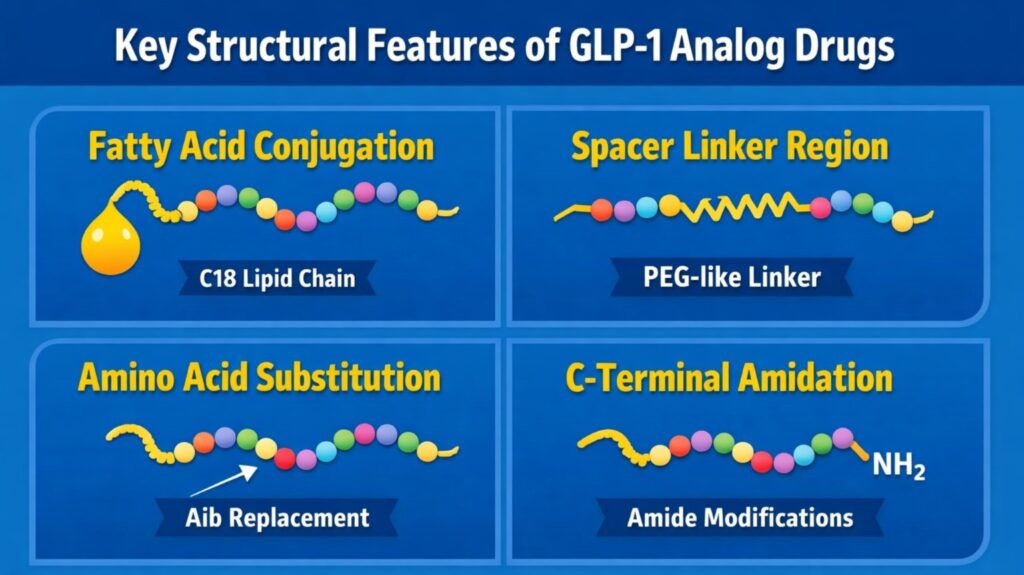
GLP-1 analogs are structurally complex due to intentional molecular modifications. These changes enhance drug performance but also make Peptide Sequencing of GLP-1 Drugs more challenging. Each modification must be carefully identified and confirmed.
Key Structural Features:
- Fatty acid conjugation (e.g., C18 chains in semaglutide)
- Spacer or linker regions (e.g., γGlu, PEG-like linkers)
- Amino acid substitutions for stability (e.g., Aib replacement)
- C-terminal amidation
These features improve drug stability and receptor binding but complicate fragmentation and sequence analysis. As a result, advanced analytical strategies are required.
📌 Analytical implication:
Standard fragmentation methods may not fully capture heavily modified peptides. Hybrid and advanced techniques are often necessary for accurate sequencing.
Ensure your complex molecules meet FDA Peptide Sameness Study Requirements for market entry.
Fragmentation Strategies in Peptide Sequencing of GLP-1 Drugs
Fragmentation methods are essential for successful Peptide Sequencing of GLP-1 Drugs. Techniques like CID, HCD, and ETD each offer unique advantages and help build a complete structural picture.
Comparison of Fragmentation Techniques:
CID (Collision-Induced Dissociation)
- Produces strong backbone fragmentation
- Less effective for fragile PTMs
- Commonly used for basic sequence mapping
HCD (Higher-energy C-trap Dissociation)
- Generates high-resolution fragment ions
- May lose sensitive modifications
- Useful for confirming sequence data
ETD / EThcD
- Preserves delicate modifications like lipidation
- Produces complex but informative data
- Ideal for analyzing modified peptides
💡 Best Practice:
Hybrid methods like EThcD provide balanced results by preserving modifications while still offering detailed sequence coverage.
Confirming Lipidation and Modifications
Confirming lipidation is one of the most critical steps in Peptide Sequencing of GLP-1 Drugs. These modifications directly affect drug behavior and must be accurately identified.
Analytical Strategies:
- Targeted MS/MS analysis of modified regions
- Monitoring neutral loss patterns of lipid chains
- Observing retention time shifts in LC
- Using complementary degradation studies
📌 Example:
In liraglutide, the palmitoylation site is confirmed by detecting fragments that retain the lipid group. This verifies correct attachment and ensures the drug structure is accurate.
Role of LC–MS/MS in Structural Confirmation
LC–MS/MS is the backbone of Peptide Sequencing of GLP-1 Drugs. It provides both qualitative and quantitative data needed for full structural characterization. Its high sensitivity makes it ideal for detecting even minor impurities.
Capabilities:
- Detects low-level impurities and variants
- Confirms sequences through fragment ion analysis
- Identifies degradation products
- Quantifies metabolites and structural variants
Recent advancements allow highly sensitive detection of GLP-1 analogs in biological samples. These improvements support both research and regulatory applications.
Access our Peptide Sequencing Service for high-resolution mass spectrometry analysis.
Degradation Profiling and Stability-Indicating Sequencing
Degradation studies are essential in Peptide Sequencing of GLP-1 Drugs to ensure long-term stability. These studies simulate stress conditions to understand how the drug behaves over time.
Common Degradation Pathways:
- Oxidation (e.g., methionine residues)
- Deamidation (asparagine, glutamine)
- Peptide backbone cleavage
- Loss of lipid chains
Analytical Approach:
- Conduct forced degradation studies
- Perform LC–MS/MS impurity profiling
- Compare originator and biosimilar products
📊 Outcome:
These studies confirm stability, identify degradation products, and ensure drug safety throughout its lifecycle.
Request our Forced Degradation Studies to evaluate your peptide’s long-term profile.
Impurity and Variant Detection
Detecting impurities is a key requirement in Peptide Sequencing of GLP-1 Drugs. Even very small variations must be identified to meet regulatory standards.
Types of Variants:
- Truncated peptides
- Misincorporated amino acids
- Oxidized forms
- Aggregates
Detection Tools:
- High-resolution mass spectrometry
- Extracted ion chromatograms (XIC)
- Targeted SRM/MRM methods
📌 Regulatory expectation:
Impurities must be characterized at levels below 0.1% to ensure safety and consistency.
Learn how we assist with Peptide Sameness Study for ANDA submissions to identify critical variants.
Orthogonal Techniques for Structural Confirmation
Mass spectrometry alone is not enough for complete Peptide Sequencing of GLP-1 Drugs. Orthogonal techniques provide additional confirmation and improve data reliability.
Supporting Techniques:
- HPLC/UPLC for purity analysis
- Circular Dichroism (CD) for structure
- NMR for detailed conformation
- Bioassays for biological activity
Using multiple techniques ensures both structural and functional validation of the peptide.
Utilize NMR for Peptides to confirm 3D conformation and structural purity.
Best Practices for Reliable Peptide Sequencing of GLP-1 Drugs
Accurate Peptide Sequencing of GLP-1 Drugs depends on strong workflows and expert analysis. Following best practices improves reproducibility and data quality.
Recommended Practices:
- Use multiple enzymes for digestion
- Apply hybrid fragmentation techniques
- Validate results with reference standards
- Perform routine degradation studies
- Follow ICH regulatory guidelines
These steps help ensure reliable and consistent analytical outcomes.
Conclusion
Peptide Sequencing of GLP-1 Drugs is a complex but essential process in modern pharmaceutical analysis. It ensures that peptide therapeutics are structurally accurate, safe, and effective. The combination of advanced tools and detailed workflows makes this possible.
From confirming sequences to detecting impurities, LC–MS/MS remains the most important technique in this field. Its precision and sensitivity support both research and regulatory needs. As GLP-1 drugs continue to evolve, sequencing methods will also become more advanced.
Accurate structural confirmation will remain critical for biosimilar development, regulatory approvals, and maintaining high-quality therapeutic standards.
Explore Peptide Sameness Testing Methods
or contact our teams for Peptide Sameness Study Services in Canada.
📞 Contact Experts for GLP-1 Peptide Analysis
For advanced analytical support in peptide sequencing and structural confirmation:
❓ FAQs: Peptide Sequencing of GLP-1 Drugs
GLP-1 analogs contain added features like fatty acid chains, linkers, and amino acid substitutions. These changes improve drug performance but make analysis more difficult. Specialized techniques are needed to study these complex structures. Standard peptide methods are often not detailed enough.
LC–MS/MS is the most commonly used method for analyzing GLP-1 drugs. It provides detailed information about the peptide sequence and structure. The technique is highly sensitive and can detect even small differences. This makes it suitable for both research and quality control.
Lipidation is confirmed by studying fragmentation patterns in mass spectrometry. Scientists look for fragments that still carry the lipid group. Changes in retention time during chromatography also support this finding. Together, these signals confirm correct lipid attachment.
There is no single method that works best in every case, but hybrid techniques are highly effective. Methods like EThcD can preserve delicate modifications while still giving clear sequence data. This balance is important for complex peptides. It helps improve accuracy in structural analysis.
Degradation profiling shows how a drug changes under stress conditions like heat or light. It helps identify weak points in the molecule. This information is useful for improving stability and shelf life. It also ensures the drug remains safe over time.
Regulatory compliance is achieved by following approved guidelines and validated testing methods. Laboratories must provide detailed structural data for the drug. All results should be consistent and reproducible. This ensures the product meets global quality standards.
Reference:
- Drucker, D. J. (2018). Discovery, characterization, and clinical development of the glucagon-like peptides. Molecular Metabolism, 14, 80–99. https://doi.org/10.1016/j.molmet.2018.01.001
- Jiang, N., Su, D., Chen, D., Huang, S., Tang, C., Jing, L., Yang, C., Zhou, Z., Yan, Z., & Han, J. (2024). Discovery of a novel glucagon-like peptide-1 (GLP-1) analogue from bullfrog and investigation of its potential for designing GLP-1-based multiagonists. Journal of Medicinal Chemistry, 67(1), 180–198. https://doi.org/10.1021/acs.jmedchem.3c01049
- Müller, T. D., Finan, B., Bloom, S. R., D’Alessio, D., Drucker, D. J., Flatt, P. R., Fritsche, A., Gribble, F., Grill, H. J., Habener, J. F., Holst, J. J., Langhans, W., Meier, J. J., Nauck, M. A., Perez-Tilve, D., Pocai, A., Reimann, F., Sandoval, D. A., Schwartz, T. W., … Tschöp, M. H. (2019). Glucagon-like peptide 1 (GLP-1). Molecular Metabolism, 30, 72–130. https://doi.org/10.1016/j.molmet.2019.09.010
- Manandhar, B., & Ahn, J.-M. (2015). Glucagon-like peptide-1 (GLP-1) analogs: Recent advances, new possibilities, and therapeutic implications. Journal of Medicinal Chemistry, 58(3), 1020–1037. https://doi.org/10.1021/jm500810s
Get In Touch With Us
About The Author


