
Peptide Technology Transfer: A Sponsor’s Step-by-Step Guide to Moving Programs Between CDMOs
 By Anusha Sinha
•
July 24, 2026
By Anusha Sinha
•
July 24, 2026
Introduction

Peptide Technology Transfer is a structured, risk-based technical process through which peptide manufacturing processes, analytical testing methods, and quality specifications are transferred from a sending Contract Development and Manufacturing Organization (CDMO) to a receiving facility. This comprehensive process is designed to ensure that the Critical Quality Attributes (CQAs) of the synthetic or recombinant peptide drug substance remain consistent across manufacturing sites throughout the asset’s lifecycle. Pharmaceutical sponsors commonly transfer peptide assets between CDMOs to overcome manufacturing capacity limitations, improve commercial production economics, create regional supply chain redundancy, or address persistent quality and compliance concerns at the incumbent site.
Explore pharmaceutical CDMO services in North America to optimize your drug substance scale-up and supply strategy.
Achieving a seamless transfer for peptide therapeutics involves technical challenges that differ from those associated with small molecules or conventional biologics. Peptides occupy a structural position between small synthetic molecules and larger proteins and therefore require stringent control of multi-step chemical synthesis, secondary structural folding, aggregation propensity, and complex degradation pathways. A successful transition requires effective control of Critical Process Parameters (CPPs) throughout solid-phase peptide synthesis (SPPS), global cleavage kinetics, preparative High-Performance Liquid Chromatography (prep-HPLC) resolution, and lyophilization thermodynamics. Furthermore, compliance with global regulatory standards—including United States Pharmacopeia (USP) chapters <661.1>, <661.2>, and <1663>, International Council for Harmonisation (ICH) guidelines Q2(R2) and Q14, and applicable Food and Drug Administration (FDA) guidance addressing synthetic peptide impurities—is essential for demonstrating comparability and maintaining regulatory approval.
Discover end-to-end peptide CDMO solutions tailored to high-purity therapeutic synthesis and technical transfer.
Planning to transfer your peptide manufacturing program to a new CDMO? Our experts can help you manage process knowledge transfer, analytical method transfer, critical quality attributes, documentation, comparability, and receiving-site readiness to support a smooth, controlled transition between CDMOs. Contact us
Article Summary Key Takeaways
- Peptide technology transfer is a structured process that enables pharmaceutical companies to move peptide manufacturing between CDMOs while maintaining product quality, process consistency, and regulatory compliance.
- Successful transfer begins with a detailed feasibility assessment, including equipment compatibility, facility capabilities, raw material quality, and identification of process gaps that could affect critical quality attributes.
- A comprehensive transfer protocol defines team responsibilities, acceptance criteria, documentation requirements, and a stepwise execution plan covering technical transfer, analytical qualification, pilot batches, PPQ, and regulatory submission.
- Analytical method transfer (AMT) ensures the receiving laboratory can accurately verify peptide identity, purity, potency, impurity profiles, and stability using validated methods aligned with USP and ICH guidance.
- Engineering and pilot-scale manufacturing optimize key processes such as SPPS, peptide cleavage, purification, and lyophilization to minimize scale-up risks before commercial GMP production.
- Process Performance Qualification (PPQ) and stability studies demonstrate that the transferred manufacturing process consistently produces peptide APIs meeting predefined quality standards while generating data required for CTD regulatory filings.
- Strong risk management practices, including electronic data integrity, qualified reference standards, robust analytical controls, and close collaboration between sending and receiving CDMOs, help ensure reliable technology transfer and uninterrupted long-term peptide supply.
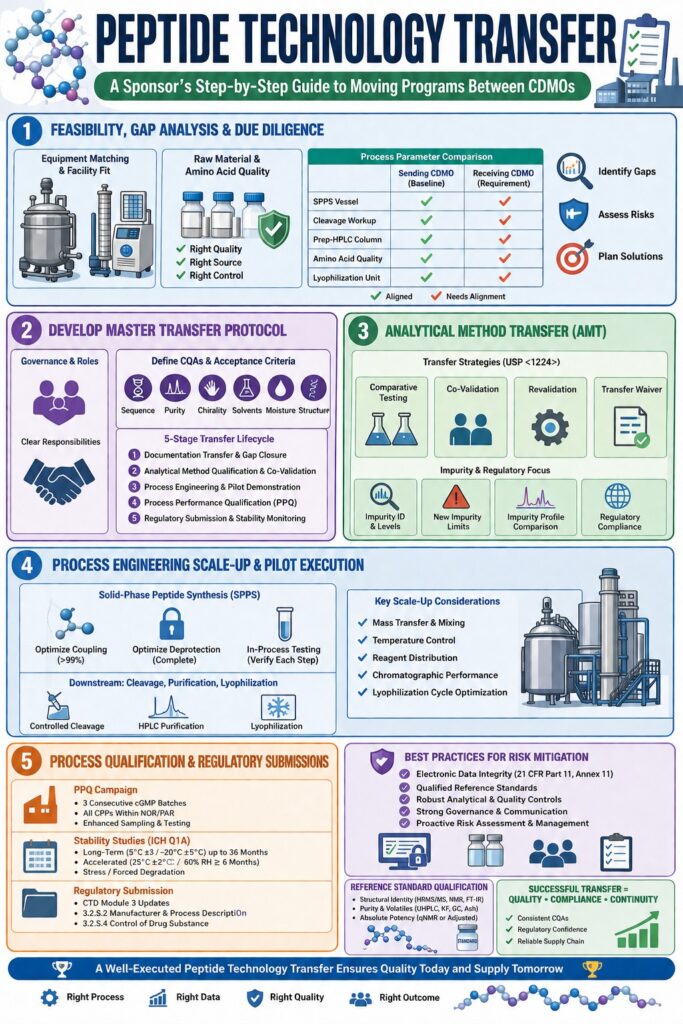
Phase 1: Feasibility, Gap Analysis, and Due Diligence in Peptide Technology Transfer
Feasibility and gap analysis in Peptide Technology Transfer involves evaluating the receiving CDMO’s facility infrastructure, reaction vessel geometries, downstream processing capabilities, and raw material control systems against the established baselines of the sending site. Performing a comprehensive gap analysis before beginning physical execution allows equipment differences, process limitations, and material-related risks to be identified before batch manufacturing activities commence.
Learn key strategies on how to select a peptide CDMO in North America for seamless site transitions.
Equipment Matching and Facility Fit Assessment
Equipment matching determines whether the receiving CDMO has the mechanical, thermal, and automated capabilities necessary to perform the synthesis and purification process without changing the peptide’s impurity profile. For solid-phase peptide synthesis, technical teams must assess vessel geometry, agitation mechanisms, including mechanical stirring versus nitrogen bubbling or vessel oscillation, heating and cooling accuracy, and solvent distribution manifolds. Differences in shear stress or localized heat transfer may damage solid-phase resin beads or modify amino acid coupling kinetics, potentially resulting in incomplete reactions and the formation of deletion impurities.
Alignment of downstream equipment is equally important for maintaining process performance. Sponsors should audit the receiving facility’s preparative HPLC infrastructure and specifically evaluate dynamic axial compression (DAC) column diameters, pressure ratings, gradient mixing performance, and linear velocity limitations. For the final isolation stage, industrial-scale lyophilizers must be assessed for shelf surface area, ice condenser capacity, minimum achievable shelf temperatures, and sublimation rates. These evaluations are necessary to minimize the risk of cake collapse or thermal degradation during the drying cycle.
Understand the operational trade-offs by comparing a peptide CDMO versus a traditional CMO.
Raw Material and Amino Acid Quality Controls
Evaluation of starting material specifications is necessary to confirm that incoming reagents, solvents, and amino acid derivatives at the receiving site will not introduce unforeseen process-related contaminants. Under USP <1086> guidelines, protected amino acid derivatives, including Fmoc- or Boc-protected amino acids, are considered critical starting materials because their chemical and chiral purity can directly influence the quality of the final API. Sponsors should therefore review the receiving site’s vendor qualification systems and incoming material testing procedures to confirm that enantiomeric impurities, including D-amino acids, are adequately and consistently controlled.
| Process Parameter | Sending CDMO Baseline | Receiving CDMO Requirement | Impact on Critical Quality Attributes (CQAs) |
|---|---|---|---|
| SPPS Reaction Vessel | Oscillating vessel with jacketed temperature control of ± 0.5 °C | Mechanically stirred vessel with jacketed temperature control of ± 1.0 °C | Excessive mechanical shear may damage resin beads, while temperature fluctuations can influence coupling kinetics and racemization rates. |
| Cleavage Workup | Closed trifluoroacetic acid (TFA) transfer with a continuous scrubber system | Manual acid addition with localized exhaust extraction | Inconsistent scavenger ratios or localized exothermic reactions during cleavage may promote side-chain modification and oxidation. |
| Prep-HPLC Column | Dynamic axial compression (DAC) 200 mm column | Fixed-bed 300 mm packed column | Differences in packing density can affect theoretical plate count and alter the resolution of closely eluting deletion sequences. |
| Protected Amino Acids | Enantiomeric purity greater than 99.5% determined by chiral HPLC | Verification against USP <661.1> monographs | Incoming D-amino acid impurities may produce diastereomeric peptide impurities that co-elute with the target API. |
| Lyophilization Unit | Sublimation shelf control with automated vacuum regulation | Automated shelf loading with static vacuum control | Uncontrolled thermal profiles may cause cake collapse, increase residual moisture, and accelerate hydrolysis. |
Swipe horizontally to view the full table on smaller screens.
Phase 2: Developing the Master Peptide Technology Transfer Protocol
Developing a Master Peptide Technology Transfer Protocol establishes the formal governance structure, defined responsibilities, execution milestones, and statistical acceptance criteria required to transfer peptide programs between manufacturing sites. The protocol serves as a comprehensive compliance record that coordinates the activities of sending and receiving teams while supporting adherence to global regulatory inspection expectations.
Evaluate differences between options using this breakdown of Canadian vs. US peptide CDMO facilities.
Governance, Roles, and Responsibilities
Clearly assigning responsibilities across cross-functional teams promotes accountable execution throughout process development, analytical transfer, quality control, and regulatory submission activities. The sending laboratory is responsible for providing historical batch records, established critical process parameter ranges, original validation packages, and historical reference standard data. The receiving laboratory is responsible for conducting facility fit trials, preparing site-specific standard operating procedures (SOPs), performing analytical method qualification, and executing pilot-scale and validation manufacturing campaigns.
Establishing Critical Quality Attributes and Acceptance Criteria
Defining acceptance criteria ensures that the peptide manufactured at the receiving facility demonstrates equivalent chemical, physical, and biological characteristics to those observed in historical production lots. The transfer protocol must define clear numerical limits for the core CQAs, including the following:
- Primary Sequence Identity: Confirmation through high-resolution tandem mass spectrometry (UHPLC-HRMS/MS) peptide mapping and nuclear magnetic resonance (NMR) spectroscopy.
- Chromatographic Purity and Impurity Profile: Quantification of total impurities, individual specified impurities, and unspecified impurities using validated orthogonal HPLC/UHPLC methods.
- Chiral Purity: Quantitative determination of D-amino acid content following complete acid hydrolysis and chiral derivatization.
- Residual Solvents and Scavengers: Strict control of Class 1, Class 2, and Class 3 organic solvents, including DMF, DCM, acetonitrile, and piperidine, in accordance with ICH Q3C guidance.
- Counterion Content and Moisture: Determination of trifluoroacetate, acetate, or chloride counterion stoichiometry, together with measurement of water content using Karl Fischer analysis.
- Higher-Order Structure and Aggregation: Characterization of secondary conformation and self-association states using circular dichroism (CD) and size-exclusion chromatography (SEC).
Step-by-Step Lifecycle of the Transfer Protocol
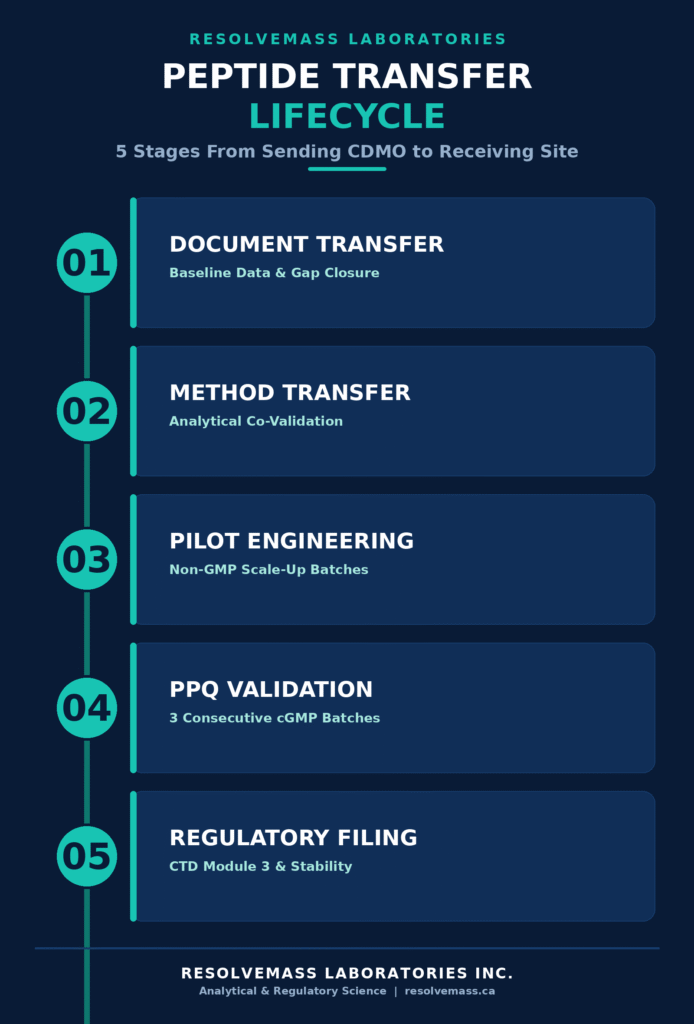
The execution lifecycle of a master peptide transfer protocol progresses sequentially through five clearly defined stages. Each stage establishes the foundation for the next phase and ensures that technical knowledge, analytical capability, manufacturing performance, and regulatory documentation are transferred in a controlled and traceable manner.
Stage 1: Technical Documentation Transfer and Gap Closure
The sending site transfers master batch records, development history, process knowledge, historical manufacturing data, and documented risk assessments to the receiving site team. This information establishes the baseline operating parameters and enables the receiving facility to identify and close technical, procedural, equipment, and documentation gaps before process execution begins.
Stage 2: Analytical Method Qualification and Co-Validation
The receiving Quality Control (QC) laboratory implements the applicable analytical test procedures, conducts feasibility and system suitability runs, and completes formal analytical method transfer activities under USP <1224>. Where appropriate, the receiving laboratory may participate in co-validation activities to demonstrate that the analytical procedure can generate reliable, reproducible, and comparable results at the new testing site.
Stage 3: Process Engineering and Pilot Demonstration
Non-cGMP engineering batches are manufactured at an appropriate scale to evaluate and optimize key process operations. These activities may include adjustment of coupling cycles, refinement of cleavage conditions, optimization of preparative HPLC fraction pooling, and development of suitable lyophilization cycles. The objective is to identify and resolve scale-dependent process risks before the process advances to formal GMP manufacturing.
Stage 4: Process Performance Qualification (PPQ)
Consecutive cGMP manufacturing runs are executed under strict quality oversight to demonstrate that the transferred process is capable of consistently producing peptide drug substance that meets predefined specifications. PPQ activities evaluate process robustness, reproducibility, and lot-to-lot consistency while confirming that the established Critical Process Parameters (CPPs) remain within their approved operating ranges.
Stage 5: Regulatory Submission and Stability Monitoring
Data generated from PPQ batch release testing, together with accelerated and long-term stability studies, are compiled into the relevant CTD Module 3 regulatory documentation. These updates are then prepared for submission to applicable global regulatory agencies. Ongoing stability monitoring provides continued evidence that the transferred manufacturing process consistently maintains the established quality profile throughout the product’s intended shelf life.
Phase 3: Executing Analytical Method Transfer (AMT) for Peptide Programs
Analytical Method Transfer (AMT) for peptide programs ensures that the receiving quality control laboratory can independently perform validated analytical testing and consistently verify peptide identity, purity, potency, and other relevant quality attributes. Conducting AMT in accordance with USP <1224> and ICH Q14 frameworks helps minimize analytical variability, supports reliable inter-site data comparability, and preserves the integrity of data generated during the technology transfer process.
Explore high-resolution peptide analytical characterization services designed for regulatory comparability.
Transfer Strategies under Compendial Frameworks
The selection of an analytical method transfer strategy depends on several factors, including the validation status of the analytical method, the development stage of the peptide program, the extent of changes between the sending and receiving laboratories, and the technical expertise available at the receiving site. Teams generally select from four formal transfer approaches described in USP <1224>.
| Transfer Strategy | Methodological Design | Primary Regulatory Application | Statistical Acceptance Criteria |
|---|---|---|---|
| Comparative Testing | Both laboratories test identical retained samples from the same production batches using identical analytical procedures. | Late-phase clinical assets and commercial drug product transfers. | Mean assay results should remain within ± 1.5%; intermediate precision RSD should be ≤ 2.0% between sites. |
| Co-Validation | The receiving site analyzes a defined subset of validation samples concurrently with the original laboratory during the initial validation exercise. | Relocation of early- to mid-phase programs between affiliated or sister facilities. | The approach may replace a conventional transfer exercise when the original ICH Q2(R2) validation criteria are fully satisfied. |
| Revalidation | The receiving laboratory independently validates critical method characteristics, including specificity, precision, and robustness. | Significant instrument platform changes or modified matrix conditions at the receiving facility. | The analytical procedure must fully comply with applicable ICH Q2(R2) validation acceptance criteria. |
| Transfer Waiver | Comparative experimental testing is omitted when a scientifically justified rationale demonstrates that formal transfer testing is unnecessary. | Standard compendial procedures, such as USP moisture determination using Karl Fischer analysis. | A comprehensive Quality Assurance (QA) justification must be documented, scientifically supported, reviewed, and approved. |
Swipe horizontally to view the full table on smaller screens.
Advanced Impurity Profiling and Regulatory Guidance
Peptide synthesis can produce highly complex impurity profiles containing closely related molecular species. These may include deletion peptides, which lack one or more amino acid residues, insertion peptides, regioisomers, D-amino acid diastereomers, and cleavage-induced adducts. Because many of these impurities can have physicochemical properties that closely resemble those of the target peptide, their separation and characterization may be technically challenging. Effective resolution often requires high-efficiency Ultra-High-Performance Liquid Chromatography (UHPLC) coupled with Charged Aerosol Detection (CAD), ultraviolet (UV) detection, and High-Resolution Mass Spectrometry (UHPLC-HRMS/MS).
Read a detailed case study on the analytical characterization of Semaglutide for practical insights into complex peptide profiling.
Synthetic Peptide Impurity Types
Process-Related Impurities
- Residual solvents, including DMF and DCM
- Heavy metals
- Residual reagents, such as PyBOP
Peptide-Related Impurities
- Deletion sequences
- Diastereomers, including racemates
- Insertion peptides
- Truncated peptide sequences
Higher-Order Aggregates
- Dimer and oligomer states
- Beta-sheet fibrils
- Sub-visible particles
For synthetic peptides referencing recombinant listed drugs or for post-approval CDMO migrations, regulatory expectations defined by the FDA require comprehensive comparative assessments of impurity profiles. The primary expectations include the following:
Specified Impurity Identification
Every peptide-related impurity present at or above 0.10% should undergo structural characterization and quantitative determination. Characterization may require orthogonal analytical techniques, including high-resolution mass spectrometry and, where necessary, additional spectroscopic or structural approaches.
Impurity Level Equivalence
For specified impurities detected in both the sending-site and receiving-site lots, the concentration measured in the receiving CDMO product should be equivalent to or lower than the established baseline level from the sending site. Any meaningful increase in an existing impurity requires scientific evaluation and an appropriate assessment of its potential impact on product quality and patient safety.
New Impurity Controls
Any new peptide-related impurity present at levels above 0.5% is generally considered unacceptable for abbreviated regulatory filings. New impurities detected between 0.10% and 0.5% require appropriate characterization and may also require comparative assessments of potential immunogenicity risks, depending on the nature of the impurity and the regulatory context of the product.
Review advanced techniques for GLP-1 peptide analytical characterization to satisfy stringent FDA impurity guidance.
Phase 4: Process Engineering Scale-Up and Pilot Execution
Process engineering scale-up confirms that solid-phase chemical reactions, resin cleavage, preparative chromatography, and lyophilization can be performed reproducibly under full-scale operating conditions at the receiving CDMO. Conducting non-cGMP engineering batches provides technical teams with an opportunity to identify scale-dependent challenges and refine Critical Process Parameters before the process is committed to formal regulatory validation.
Learn more about key considerations during peptide API scale-up to ensure smooth process transitions.
Solid-Phase Peptide Synthesis (SPPS) Kinetics and Scale-Up
Scaling up SPPS requires careful management of changes in mass transfer rates, solvent distribution, and mixing efficiency within larger reaction vessels. The swelling behavior of solid-phase resin beads can vary depending on the geometry of the reaction vessel and the applied agitation method, which can directly affect the diffusion of reactants into the resin matrix. As a result, process engineers must systematically optimize several parameters during scale-up.
Coupling Cycle Kinetics
Reagent concentrations, activation times, and reaction temperatures must be adjusted and controlled to achieve coupling efficiencies greater than 99% at each synthesis step while minimizing the risk of thermal racemization. Coupling systems such as DIC/Oxyma or HATU may require site-specific optimization because changes in mixing, heat transfer, reagent addition rates, and reaction volume can influence reaction kinetics at larger scales.
Deprotection Efficiency
Fmoc removal cycles using piperidine in DMF must be optimized to achieve complete and consistent deprotection of the growing peptide chain. The process must also be controlled to minimize the formation of unwanted by-products, including aspartimide-related impurities and piperidinyllanine adducts. Differences in reagent distribution, contact time, temperature, and mixing efficiency at larger scales can influence the overall effectiveness of the deprotection process.
In-Process Testing
Rapid quantitative or qualitative in-process monitoring should be established to confirm completion of each coupling step before the synthesis proceeds to the next cycle. Suitable approaches may include quantitative Kaiser testing or mini-cleavage followed by UHPLC-MS analysis. These monitoring strategies provide timely confirmation of reaction completion and enable process adjustments before incomplete coupling reactions generate additional deletion sequences or other peptide-related impurities.
Downstream Cleavage, Purification, and Isolation
Global deprotection and cleavage of the peptide from the solid support represent a critical stage of the manufacturing process because exothermic reactions can promote product degradation. Cleavage cocktails containing trifluoroacetic acid (TFA) and scavenger mixtures, such as water, triisopropylsilane, ethanedithiol, and phenol, must be introduced under carefully controlled thermal conditions. Strict temperature monitoring is necessary to prevent scavenger depletion and localized overheating, both of which can promote the re-attachment of protecting group cations and increase the formation of unwanted degradation products.
During preparative HPLC scale-up, maintaining a consistent linear velocity and sample loading ratio, expressed as mg target peptide per g stationary phase, is essential for preserving chromatographic performance. Gradient slope, mobile phase temperature, and the quality of organic modifiers, including acetonitrile purity, must remain within tightly controlled operating limits. Fraction pooling criteria at the receiving site must also be verified using rapid UHPLC release methods. This approach helps maximize product recovery while ensuring that the specified API purity limits are consistently maintained.
During the final isolation stage, freeze-drying parameters must be carefully optimized to achieve the desired product characteristics. Shelf freezing rates, primary drying sublimation temperatures, and secondary drying vacuum levels must be adjusted to achieve the target residual moisture content without causing product melt-back, structural damage, or cake collapse. These parameters should be evaluated during engineering and pilot activities to ensure that the transferred lyophilization cycle is suitable for the receiving facility’s equipment configuration and operating environment.
Examine strategic considerations when deciding to outsource peptide manufacturing to a CDMO.
Phase 5: Process Performance Qualification (PPQ) and Regulatory Submissions
Process Performance Qualification (PPQ) demonstrates, through consecutive cGMP manufacturing campaigns, that the transferred peptide manufacturing process operates consistently in a state of control at the receiving facility. Successful completion of PPQ generates the process performance, product quality, and stability data required to support regulatory submissions and updates to CTD Module 3 documentation.
Discover how specialized partners can accelerate generic drug development in the US and Canada.
Executing the PPQ Campaign
Executing a PPQ campaign generally involves manufacturing a minimum of three consecutive full-scale cGMP batches using the finalized process parameters established during development and scale-up activities. All Critical Process Parameters (CPPs) must remain within their established normal operating ranges (NORs) and proven acceptable ranges (PARs) throughout the manufacturing process.
Enhanced sampling protocols are implemented across the different stages of PPQ execution. Crude synthesized intermediates, cleavage liquids, preparative HPLC fractions, concentrated aqueous pools, and final lyophilized API lots undergo expanded testing to evaluate process capability, manufacturing consistency, yield reproducibility, and compliance with all established batch release specifications. The resulting data provide a comprehensive assessment of whether the transferred process can consistently deliver product that meets predefined quality requirements at the receiving CDMO.
ICH Stability Testing and Module 3 CTD Filings
To support regulatory approval of the new manufacturing site, representative lots from the PPQ campaign must be enrolled in formal ICH Q1A stability programs. The stability program should be designed to evaluate the product under long-term, accelerated, and, where applicable, stress or forced degradation conditions.
Long-Term Stability
Samples are stored at 5 °C ± 3 °C or −20 °C ± 5 °C, depending on the sensitivity and storage requirements of the peptide compound, for a period that may extend up to 36 months. These studies provide information regarding the long-term chemical, physical, and microbiological stability of the peptide drug substance under its proposed storage conditions.
Accelerated Stability
Samples are stored at 25 °C ± 2 °C and 60% RH for a minimum of 6 months. Accelerated studies help identify potential degradation pathways and provide an early indication of how the peptide may respond to elevated temperature and humidity conditions.
Stress and Forced Degradation Studies
The peptide is exposed to acid, base, peroxide, thermal, and photolytic conditions to evaluate its degradation behavior and identify relevant degradation products. These studies also demonstrate that the analytical release methods transferred to the receiving site remain stability-indicating and are capable of detecting meaningful changes in the quality profile of the peptide.
Data generated from the feasibility assessment, analytical method transfer activities, PPQ execution, and stability commitments are compiled into updated Common Technical Document (CTD) Module 3 sections. The primary sections include 3.2.S.2 (Manufacturer and Process Description) and 3.2.S.4 (Control of Drug Substance). These sections provide regulatory authorities with documented evidence regarding the manufacturing process, site transfer, process controls, analytical testing strategy, and control of the peptide drug substance.
Best Practices for Risk Mitigation in Peptide Technology Transfer
Effective risk mitigation during Peptide Technology Transfer requires rigorous data integrity governance, comprehensive reference standard characterization, and proactive alignment between the sending and receiving sites. Implementing robust analytical and quality controls helps protect the program against regulatory delays, analytical discrepancies, unexpected process failures, and batch rejection.
Electronic Data Integrity and Compliance
Regulatory authorities evaluate electronic record infrastructures against requirements such as 21 CFR Part 11 and Annex 11 during facility inspections and quality audits. Receiving CDMOs must therefore use validated Chromatography Data Systems (CDS), such as Empower 3, with individual user access controls, automated system audit trails, appropriate electronic security controls, and secure data backup architectures.
All original analytical chromatograms, integration files, processing methods, and instrument metadata generated during analytical method transfer activities must remain fully traceable and readily available for inspection. Data must be maintained in a manner that protects its integrity throughout the entire data lifecycle and ensures that original records can be reconstructed and reviewed when required.
Reference Standard Qualification Infrastructure
Sponsors should establish qualified Primary and Working Reference Standards to provide consistent analytical anchors across manufacturing sites and laboratories. Properly characterized reference standards are essential for ensuring that analytical method transfer results remain comparable during CDMO transitions.
Complete characterization of a peptide reference standard requires the following assessments:
Structural Identity Verification
Structural identity should be confirmed using High-Resolution Mass Spectrometry (HRMS/MS), multi-nuclear NMR, including ¹H, ¹³C, and ¹⁵N NMR where appropriate, and Fourier-Transform Infrared (FT-IR) spectroscopy. These complementary techniques provide orthogonal information regarding molecular mass, structural composition, chemical environment, and characteristic functional groups.
Purity and Volatile Assignment
Mass balance determination should combine chromatographic purity assessment using UHPLC-UV/CAD with Karl Fischer water determination, residual solvent analysis using GC-FID/MS, counterion content determination, and inorganic ash analysis. This comprehensive approach helps establish the overall composition of the reference standard and supports accurate assignment of its purity profile.
Absolute Potency Determination
Absolute potency may be determined using direct quantitative NMR (qNMR) or through mathematical correction of the measured purity by subtracting the contribution of total volatile content. The selected approach should be scientifically justified, appropriately validated, and suitable for the characteristics of the peptide reference standard.
Establishing reference standards through qualified analytical testing partners, such as ResolveMass Laboratories Inc., helps ensure that analytical comparability assessments, impurity profiling, and reference standard qualification activities remain scientifically robust and compliant throughout complex CDMO transitions.
Explore full-lifecycle support with leading peptide drug development CDMO solutions.
Conclusion
Mastering Peptide Technology Transfer is essential for pharmaceutical sponsors seeking to preserve product quality, regulatory compliance, and commercial continuity during transitions between CDMOs. By implementing a structured transfer strategy that integrates solid-phase synthesis dynamics, preparative purification parameters, lyophilization controls, and high-resolution analytical methods under applicable USP <1224>, USP <1086>, and USP <661.1> guidelines, sponsors can effectively reduce operational and regulatory risks.
Strong governance over analytical method comparability, starting material quality, process performance, reference standards, and electronic data integrity ensures that transferred peptide assets continue to maintain their Critical Quality Attributes across global manufacturing sites. A well-controlled technology transfer process not only supports successful manufacturing relocation but also establishes the technical and regulatory foundation required for long-term supply continuity and lifecycle management.
To learn more about expert analytical support, method verification, and characterization strategies during peptide migrations, contact ResolveMass Laboratories Inc. through the contact page.
USP <1224> provides a recognized framework for transferring analytical procedures between sending and receiving laboratories. It describes approaches such as comparative testing, co-validation, revalidation, and scientifically justified transfer waivers. The chapter also supports the development of documented transfer protocols, predefined acceptance criteria, and procedures for managing deviations or unexpected analytical differences.
For synthetic peptide programs, peptide-related impurities present at or above 0.10% generally require identification and quantitative assessment. Impurity levels in the receiving-site product should also remain comparable to or lower than the established reference baseline. New impurities above 0.5% are generally considered unacceptable for abbreviated submissions unless adequate scientific and non-clinical safety justification is provided.
UHPLC-HRMS combines high chromatographic resolution with accurate mass measurement, making it highly valuable for characterizing complex peptide impurity profiles. The technique can help distinguish closely eluting species, deletion sequences, isobaric compounds, diastereomers, and degradation products. These capabilities provide a level of structural and analytical discrimination that conventional UV detection alone may not provide.
Comparative testing requires the sending and receiving laboratories to analyze equivalent samples, typically from the same production lots, using established analytical procedures and then compare the resulting data. Co-validation, in contrast, involves the receiving laboratory participating in the original validation exercise alongside the sending laboratory. This allows performance characteristics such as precision and reproducibility to be assessed across both sites during the same validation activity.
The quality of protected amino acid starting materials can directly influence the impurity profile of the final synthetic peptide because contaminants may be incorporated into the growing peptide chain during SPPS. Impurities such as D-amino acids or β-alanyl contaminants can generate closely related or diastereomeric species that may be difficult to separate from the target API. Appropriate USP controls and incoming material testing help minimize these risks during technology transfer.
Preparative HPLC scale-up may introduce risks such as reduced chromatographic resolution, column channeling, inconsistent bed packing, inefficient gradient mixing, and inappropriate fraction pooling. These issues can result in incomplete separation of closely related peptide impurities and may reduce overall API recovery. Poor process control can also contribute to purity failures and increased residual solvent levels in the isolated product.
Following a CDMO transfer, relevant CTD Module 3 sections should be revised to reflect the new manufacturing site and associated process controls. These may include sections 3.2.S.2, covering the manufacturer and manufacturing process, 3.2.S.4, addressing control of the drug substance, 3.2.S.7, covering the container closure system, and 3.2.S.8, addressing stability. Supporting documentation may include comparative analytical data, transfer reports, PPQ results, and available stability data.
Peptide reference standards are qualified through a combination of orthogonal structural and purity assessments. Structural identity may be evaluated using HRMS/MS, NMR, and FT-IR, while mass-balance approaches can combine UHPLC-UV/CAD, Karl Fischer moisture analysis, residual solvent testing, and qNMR. These studies establish the standard’s assigned potency, identity, purity, and impurity profile before it is used to support clinical or commercial batch testing.
Reference:
- Li, Y. (2022, September 20). Common deficiencies associated with comparative peptide impurity profile studies and qualification of impurity levels and proposed limits [PowerPoint slides]. U.S. Food and Drug Administration. https://www.fda.gov/media/166572/download
- U.S. Food and Drug Administration. (2024, March). Q14 analytical procedure development: Guidance for industry. U.S. Department of Health and Human Services. https://www.fda.gov/media/161202/download
- U.S. Food and Drug Administration. (2021, May). ANDAs for certain highly purified synthetic peptide drug products that refer to listed drugs of rDNA origin: Guidance for industry. U.S. Department of Health and Human Services. FDA guidance document
- Pang, E. (2022, September 20). Assessing immunogenicity risk of peptides: The synthetic peptide guidance and PSGs [PowerPoint slides]. U.S. Food and Drug Administration. https://www.fda.gov/media/166571/download
Planning to transfer your peptide manufacturing program to a new CDMO?
Our experts can help you manage process knowledge transfer, analytical method transfer, critical quality attributes, documentation, comparability, and receiving-site readiness to support a smooth, controlled transition between CDMOs.
Contact us
About The Author
Anusha Sinha
Anusha Sinha, B.Pharm, is an experienced pharma professional with a strong background in Analytical Chemistry and Polymer Chemistry. With a passion for translating complex scientific data into clear, accessible content, she plays a vital role in communicating ResolveMass Laboratories Inc.’s advanced testing capabilities. In addition to her scientific expertise, Anusha leads Business Development initiatives, helping clients across pharmaceutical, biotechnology, and materials science sectors find tailored analytical solutions. Her combined experience in science and strategy positions her at the forefront of client engagement and technical communication.

