


Introduction:
Pharmacopoeial methods for nitrosamine testing were not purpose-built for the sensitivity levels modern regulators now demand. When the nitrosamine contamination crisis emerged in 2018 with the NDMA recalls in valsartan and other sartans, it exposed a critical blind spot: existing compendial frameworks simply lacked the analytical precision to detect carcinogenic nitrosamines at parts-per-billion (ppb) and sub-ppb concentrations.
The United States Pharmacopeia (USP), European Pharmacopoeia (Ph. Eur.), and Japanese Pharmacopoeia (JP) are cornerstone references in pharmaceutical quality control — but their general chapters on limit tests, residual solvents, and elemental impurities were developed for entirely different classes of contaminants. Applying these pharmacopoeial methods to nitrosamine testing creates significant compliance risk, regulatory gaps, and — most critically — potential patient harm from undetected carcinogens.
For pharmaceutical manufacturers, contract research organizations (CROs), and CDMOs navigating the current regulatory environment, understanding exactly where pharmacopoeial methods break down — and what purpose-built alternatives exist — is no longer optional. It is a regulatory imperative.
Summary:
- Pharmacopoeial methods for nitrosamine testing — such as those in USP, Ph. Eur., and ICH guidelines — were not originally designed to detect the ultra-trace nitrosamine levels now required by regulators.
- Major gaps include insufficient sensitivity, lack of compound-specific coverage, limited matrix adaptability, and absence of validated methods for novel nitrosamines.
- Regulatory agencies (FDA, EMA, Health Canada) now require limits as low as 18 ng/day for NDMA, far below the detection capabilities of many traditional pharmacopoeial approaches.
- Specialized analytical techniques — particularly LC-MS/MS and GC-MS/MS — are necessary to meet current regulatory expectations for nitrosamine risk assessment and control.
- ResolveMass Laboratories Inc. provides scientifically rigorous, regulatory-aligned nitrosamine testing services that go well beyond pharmacopoeial defaults to protect patient safety and support drug approvals.
1: What Are Pharmacopoeial Methods and What Were They Designed For?
Pharmacopoeial methods are standardized, compendial analytical procedures established by official pharmacopoeia bodies to ensure pharmaceutical quality, safety, and consistency. They cover a broad range of tests including identity, purity, potency, dissolution, and impurity profiling.
Key pharmacopoeial frameworks relevant to impurity testing include:
- USP <232> / <233>: Elemental impurities (designed for metals, not volatile nitrosamines)
- USP <467>: Residual solvents (designed for Class 1/2/3 solvents, not N-nitroso compounds)
- ICH Q3A/Q3B: Impurities in drug substances and products (threshold-focused; predates nitrosamine-specific guidance)
- ICH M7: Mutagenic impurities, including the threshold of toxicological concern (TTC) framework
While ICH M7 comes closest to addressing nitrosamines — particularly through its TTC of 1.5 µg/day for most mutagenic impurities — it was not designed to accommodate the extremely potent carcinogenicity of specific nitrosamines like NDMA (acceptable intake limit: 96 ng/day) and NDEA (acceptable intake limit: 26.5 ng/day), which require limits many orders of magnitude lower than the general TTC.
2: Key Gaps in Existing Pharmacopoeial Methods for Nitrosamine Testing
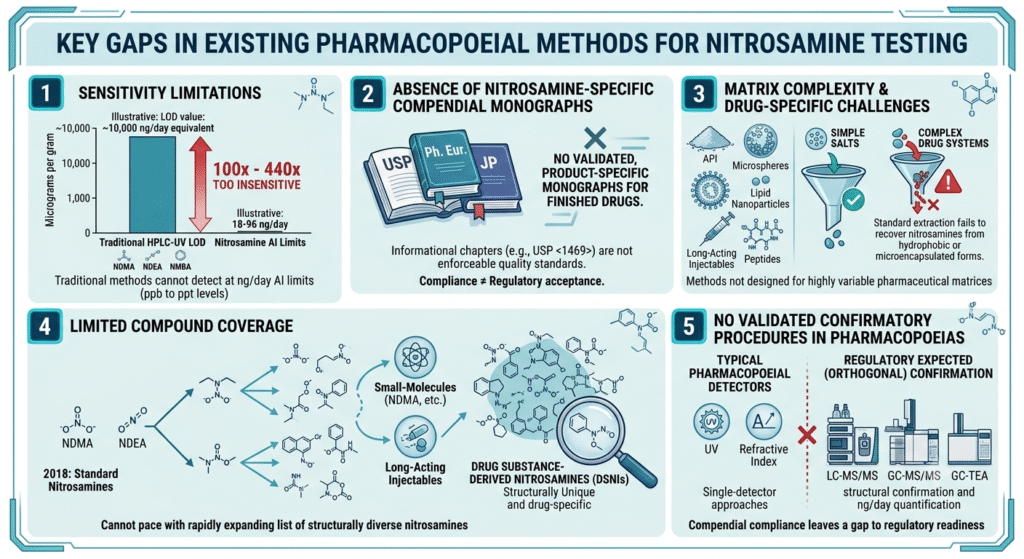
1. Sensitivity Limitations: Detection at the ng/day Level Is Not Achievable
Traditional pharmacopoeial methods lack the sensitivity required to detect nitrosamines at regulatory acceptable intake (AI) limits. FDA and EMA AI limits for nitrosamines range from 18 ng/day (NMBA) to 1,500 ng/day (NEC), with NDMA at 96 ng/day — concentrations that require detection at the low ppb to ppt level in pharmaceutical matrices.
Standard HPLC-UV methods referenced in pharmacopoeias typically achieve detection limits in the microgram-per-gram range. That is approximately 100 to 1,000 times less sensitive than what is required for nitrosamine testing. Even the most optimized UV-based methods cannot reliably quantify NDMA or NDEA at clinically relevant thresholds without the risk of false negatives.
| Nitrosamine | FDA AI Limit (ng/day) | Typical USP/HPLC-UV LOD | Gap |
|---|---|---|---|
| NDMA | 96 ng/day | ~10,000 ng/day equivalent | ~100x too insensitive |
| NDEA | 26.5 ng/day | ~5,000 ng/day equivalent | ~190x too insensitive |
| NMBA | 18 ng/day | ~8,000 ng/day equivalent | ~440x too insensitive |
| NIPEA | 26.5 ng/day | Not typically covered | No pharmacopoeial method |
| NMPA | 26.5 ng/day | Not typically covered | No pharmacopoeial method |
Note: LOD figures are matrix-dependent approximations for illustrative comparison.
2. Absence of Nitrosamine-Specific Compendial Monographs
No current pharmacopoeia — USP, Ph. Eur., or JP — contains a validated, product-specific monograph for nitrosamine impurity testing in finished drug products. The USP has published informational chapters (e.g., USP <1469> on nitrosamine impurities), but informational chapters are not enforceable quality standards in the same way that general chapters with “<1000” designations are.
Ph. Eur. has similarly moved toward guidance documents rather than binding monographs for nitrosamine control, leaving manufacturers to develop and validate their own product-specific methods in-house or through specialized CRO partners.
This absence means that even full pharmacopoeial compliance does not guarantee regulatory acceptance of nitrosamine data during FDA or EMA submissions.
3. Matrix Complexity and Drug-Specific Challenges
Pharmacopoeial methods are not designed to accommodate the highly variable matrices encountered in real-world pharmaceutical formulations. Nitrosamines can be present in:
- Active pharmaceutical ingredients (APIs) as process-related impurities
- Finished drug products from packaging, excipients, or degradation
- PLGA microspheres, long-acting injectables, and lipid nanoparticles — complex matrices with unique extraction challenges
- Biological products and peptide-based drugs where matrix interference is significant
Standard pharmacopoeial extraction and preparation procedures (designed for simple salt matrices or aqueous systems) fail to adequately recover nitrosamines from hydrophobic polymers, microencapsulated formulations, or lipid-based systems. Method optimization for each unique matrix is therefore essential.
4. Limited Compound Coverage: The Expanding Nitrosamine Universe
Pharmacopoeial frameworks were not designed to keep pace with the rapidly expanding list of structurally diverse nitrosamines now under regulatory scrutiny. The FDA’s list of nitrosamines of concern has grown substantially since 2018 and now includes:
- Small-molecule nitrosamines: NDMA, NDEA, NMBA, NIPEA, NMPA, NDIPA, NDBA, NDELA
- Drug substance-derived nitrosamines (DSNIs): Structurally unique nitrosamines formed from reactions between APIs and nitrosating agents
- Nitrosamines from synthetic routes: Formed during manufacturing using amine reagents, sodium nitrite, nitrous acid, or recycled solvents
DSNIs in particular represent a significant analytical gap in existing pharmacopoeial frameworks. Because their structure is drug-specific, no general compendial method can anticipate, detect, or quantify them. Each requires a custom, validated, stability-indicating method — a far cry from what pharmacopoeial testing offers.
5. No Validated Confirmatory Procedures in Pharmacopoeias
Pharmacopoeial methods typically rely on single-detector approaches (UV, refractive index, or conductivity), which are insufficient for unambiguous nitrosamine confirmation. Regulatory guidance from FDA (as outlined in the Nitrosamine Draft Guidance, 2021) and EMA’s NfG (2020) both expect confirmatory data using orthogonal techniques, particularly:
- LC-MS/MS (Liquid Chromatography – Tandem Mass Spectrometry): Gold standard for non-volatile and semi-volatile nitrosamines; provides structural confirmation and quantification at ng/day levels
- GC-MS/MS or GC-TEA (Thermal Energy Analyzer): Preferred for volatile nitrosamines like NDMA and NDEA; TEA is nitrosamine-specific and widely used in FDA-referenced methods
- HRMS (High-Resolution Mass Spectrometry): Used for identifying unknown or suspect nitrosamines in complex matrices
None of these confirmatory techniques are currently codified in binding pharmacopoeial chapters — leaving a significant gap between compendial compliance and true regulatory readiness.
3: What Regulatory Agencies Actually Expect: Beyond the Pharmacopoeia
Regulatory agencies have made it clear — explicitly and implicitly — that pharmacopoeial compliance alone is insufficient for nitrosamine control. Here is what FDA, EMA, and Health Canada actually require:
| Regulatory Requirement | Pharmacopoeial Method Adequate? | Required Approach |
|---|---|---|
| Nitrosamine risk assessment (Step 1) | Partially (ICH M7 framework applicable) | Holistic root cause analysis of synthesis routes, materials, and processes |
| Confirmatory testing (Step 2) | No | LC-MS/MS, GC-MS/MS, or GC-TEA with method validation |
| Acceptable intake limits | No general method covers AI limits | Product-specific validated methods at ppb/ppt sensitivity |
| DSNI characterization | No | Custom synthesis, reference standard qualification, and validated assay |
| Reporting in regulatory submissions | Compendia provide no submission template | ICH M7 / EMA/FDA NfG-aligned method packages with full validation reports |
4: How Purpose-Built Nitrosamine Testing Differs from Pharmacopoeial Approaches
Purpose-built nitrosamine testing methods overcome all the major pharmacopoeial gaps through specialized instrumentation, custom validation, and deep regulatory alignment. At ResolveMass Laboratories Inc., our nitrosamine testing capabilities are built from the ground up to meet the most stringent regulatory expectations, not adapted from general compendial templates.
Key differentiators of purpose-built nitrosamine testing include:
- Instrument sensitivity: Triple-quadrupole LC-MS/MS and GC-MS/MS platforms routinely achieve LOQs of 0.01–0.1 ppm in complex matrices — well below AI limit thresholds
- Custom extraction methods: Tailored to pharmaceutical form (tablet, capsule, microsphere, injectable) to ensure accurate nitrosamine recovery
- Reference standard validation: In-house qualification of nitrosamine reference standards, including DSNIs that are not commercially available
- ICH Q2(R2)-compliant method validation: Specificity, linearity, accuracy, precision, LOD/LOQ, and robustness validated for each product-matrix combination
- Regulatory documentation support: Method validation reports, analytical data packages, and risk assessment summaries formatted for FDA, EMA, and Health Canada submissions
5: When Should You Rely on Pharmacopoeial Methods — And When Should You Not?
Use pharmacopoeial methods as a starting framework for risk identification, not as a final analytical solution for nitrosamine control. Specifically:
Appropriate use of pharmacopoeial frameworks:
- Initial hazard identification using ICH M7 structure-activity relationship (SAR) tools
- Setting the toxicological context for nitrosamine concern (Cohort of Concern classification)
- General GMP and quality system framework for impurity control
Do not rely solely on pharmacopoeial methods for:
- Quantitative nitrosamine testing in API or finished drug products
- Regulatory submissions requiring confirmation of nitrosamine levels below AI limits
- DSNI detection and characterization
- Complex matrix testing (biologics, PLGA formulations, long-acting injectables)
- New chemical entity (NCE) nitrosamine risk assessments
6: Practical Implications for Pharmaceutical Manufacturers and CROs
The regulatory consequence of over-relying on pharmacopoeial methods for nitrosamine testing can be severe:
- FDA Warning Letters and import alerts for failing to adequately characterize or control nitrosamine impurities
- EMA referrals and market suspension orders (as seen in the sartan class recalls)
- Health Canada Notices of Compliance (NOC) delays due to inadequate analytical data in submissions
- Patient safety risk from undetected or under-quantified carcinogenic impurities in marketed products
For pharmaceutical companies in Canada and globally, partnering with a specialized analytical CRO that has both the instrumentation and regulatory expertise to go beyond pharmacopoeial defaults is the surest path to compliant, patient-safe nitrosamine testing.
Conclusion:
Pharmacopoeial methods for nitrosamine testing provide a conceptual foundation but fall critically short of the sensitivity, compound coverage, and regulatory alignment demanded by FDA, EMA, and Health Canada in 2024 and beyond. The gap between what a compendial method can detect and what regulators require can span two to three orders of magnitude — a difference that carries real consequences for patient safety and drug approval timelines.
Meeting current nitrosamine regulatory expectations requires purpose-built, validated, matrix-specific analytical methods anchored in LC-MS/MS or GC-MS/MS technology, combined with deep regulatory knowledge of ICH M7, FDA Nitrosamine Guidance, and EMA NfG frameworks. No pharmacopoeial chapter replaces that capability.
At ResolveMass Laboratories Inc., our team of analytical scientists and regulatory experts brings the depth of experience and technical infrastructure needed to close these gaps — protecting your product, your submission, and your patients.
Frequently Asked Questions:
Pharmacopoeial methods can serve as a useful starting point for nitrosamine analysis, but they are often not sufficient on their own. Most compendial methods were developed before nitrosamines became a major regulatory concern and may lack the required sensitivity. Regulatory agencies typically expect detection at very low ppb levels. Therefore, additional method development and validation are often necessary. Advanced analytical techniques are frequently required to ensure compliance.
Many pharmacopoeial methods were designed for routine impurity testing rather than trace-level nitrosamine detection. They may not provide the selectivity needed to distinguish nitrosamines from other compounds in complex drug matrices. In addition, they may not cover newly identified nitrosamine impurities. Sensitivity limitations can also prevent reliable quantification at regulatory thresholds. These factors often necessitate customized analytical approaches.
Regulatory agencies may accept pharmacopoeial methods if their suitability for nitrosamine detection is demonstrated. However, companies must provide evidence that the method can reliably detect and quantify nitrosamines at required levels. Method validation is critical to proving fitness for purpose. In many cases, compendial methods require modification or enhancement. Regulatory acceptance depends on scientific justification and performance data.
Drug-substance-related nitrosamines (NDSRIs) are nitrosamine impurities that originate from the active pharmaceutical ingredient or its degradation pathways. Unlike common nitrosamines such as NDMA, NDSRIs are often unique to specific drug products. Their identification can be challenging due to limited reference standards and analytical data. Specialized testing methods are frequently needed. Regulatory agencies increasingly expect manufacturers to assess NDSRI risks.
No single analytical method can universally detect all nitrosamines because these compounds differ significantly in their chemical properties. Some nitrosamines are volatile, while others are non-volatile or highly polar. Different analytical platforms may be required depending on the target compounds. Method suitability should be assessed based on the specific nitrosamines of interest. A tailored testing strategy generally provides the most reliable results.
Nitrosamine risk assessments should be reviewed whenever there are significant changes in manufacturing processes, raw material suppliers, packaging components, or product formulations. Regulatory expectations also continue to evolve, requiring periodic reassessment. Routine reviews help identify emerging nitrosamine risks before they become compliance issues. Ongoing monitoring supports patient safety and product quality. A proactive approach is strongly recommended.
Nitrosamine testing methods should be validated for specificity, accuracy, precision, linearity, detection limit, quantitation limit, and robustness. These parameters demonstrate that the method consistently produces reliable results. Validation ensures that trace-level impurities can be detected with confidence. Regulatory agencies expect scientific evidence supporting method performance. Proper validation is essential for compliance and data integrity.
Companies should adopt a comprehensive risk-based approach that includes process evaluation, supplier qualification, analytical testing, and ongoing monitoring. Advanced technologies such as LC-MS/MS and HRMS can improve detection capabilities. Regular reviews of regulatory guidance are also important. Product-specific method development and validation help address unique risks. Together, these measures support effective nitrosamine control and regulatory compliance.
Reference
- Tarafder A, Vega E, Beck HP, Mundal D, Tilala M, Wang S. Nitrosamine control: From risk assessment to analytical testing with emphasis on sample preparation and phase-appropriate method validation. Organic Process Research & Development. 2025 Nov 7;29(11):2602-24.https://pubs.acs.org/doi/abs/10.1021/acs.oprd.5c00158
- Alsayadi YM, Dogra R, Arora V, Shiven A. Innovations in the detection of N-nitrosamine impurities in pharmaceuticals: analytical and regulatory challenges. Critical Reviews in Analytical Chemistry. 2025 May 31:1-26.https://www.tandfonline.com/doi/abs/10.1080/10408347.2025.2512443
- Eissa ME. Pharma’s nitrosamine challenge: A review of a call for vigilance. Universal Journal of Pharmaceutical Research. 2024 Jul 15.https://www.ujpronline.com/index.php/journal/article/view/1119
- Umrethwala A, Mutalik R, Sharma S. Nitrosamine Impurities: Critical Insights into Chemistry, Analytical Tools, and Worldwide Regulatory Requirements. InAnnales Pharmaceutiques Françaises 2026 Apr 4. Elsevier Masson.https://www.sciencedirect.com/science/article/pii/S0003450926000441
- Bhirud D, Agrawal G, Shah H, Patel A, Palkar MB, Bhattacharya S, Prajapati BG. Nitrosamine impurities in pharmaceuticals: an empirical review of their detection, mechanisms, and regulatory approaches. Current Topics in Medicinal Chemistry. 2024 Mar 1;24(6):503-22.https://www.benthamdirect.com/content/journals/ctmc/10.2174/0115680266278636240125113509
About the Author


