

Introduction:
PLA stereochemistry — specifically the ratio and arrangement of L- and D-lactic acid units — determines crystallinity, degradation rate, mechanical strength, and ultimately drug release kinetics. Before a formulation scientist selects a molecular weight or an excipient, the stereochemical identity of the polymer must be established.
Polylactic acid (PLA) is the most widely studied biodegradable polyester in pharmaceutical and biomedical engineering. It is synthesized from lactic acid, a molecule that carries a chiral carbon, meaning it exists in two mirror-image forms: L-lactic acid and D-lactic acid. The polymerization of these monomers — alone or in combination — gives rise to three distinct stereoisomeric polymer architectures: PLLA, PDLA, and PDLLA. Together, the study of PLA stereochemistry: PLLA vs PDLA vs PDLLA is not a matter of academic nuance; it is a practical, clinically consequential engineering decision.
ResolveMass Laboratories Inc. has been at the forefront of PLA polymer characterization and custom analytical services, helping pharmaceutical manufacturers, medical device developers, and academic researchers resolve exactly these questions with rigorous, reproducible data.
Summary:
- PLA stereochemistry — the spatial arrangement of lactic acid repeat units — is the single most important structural variable governing how a PLA-based drug delivery system behaves in vivo.
- PLLA (poly-L-lactic acid) is highly crystalline, degrades slowly, and is ideal for long-term controlled-release and structural implants.
- PDLA (poly-D-lactic acid) mirrors PLLA chemically but is rarely used alone; it plays a critical role in stereocomplex formation.
- PDLLA (poly-DL-lactic acid, the racemic form) is amorphous, degrades faster, and dominates in injectable microspheres and short-to-medium-term drug delivery applications.
- Stereocomplex PLA (sc-PLA), formed by blending PLLA + PDLA, achieves a melting point ~50 °C higher than either homopolymer — unlocking next-generation high-performance carriers.
- Choosing the wrong stereoisomer is one of the most common — and most avoidable — reasons for premature drug release, implant failure, or poor biocompatibility outcomes.
- ResolveMass Laboratories Inc. provides expert polymer characterization, GPC/SEC analysis, and custom synthesis support to help formulators select the right PLA stereoisomer for their application.
1: What Is PLA Stereochemistry? A Structural Overview
PLA stereochemistry refers to the spatial configuration of the methine (–CH–) carbon in each lactic acid repeat unit, which can be either the L- (left-handed) or D- (right-handed) configuration. The sequence and ratio of these configurations along the polymer chain dictate almost every physically and biologically relevant property.
Lactic acid is a simple α-hydroxy acid with molecular formula C₃H₆O₃. Its chiral centre gives rise to:
- L-Lactic Acid → polymerizes to PLLA (isotactic, all same configuration)
- D-Lactic Acid → polymerizes to PDLA (isotactic, all same configuration, mirror image of PLLA)
- Racemic Mixture (D+L) → polymerizes to PDLLA (atactic, random mix of L and D units)
The ring-opening polymerization (ROP) of lactide — the cyclic dimer of lactic acid — is the dominant industrial route. The three lactide diastereomers (L-lactide, D-lactide, and meso-lactide) and their ratios control the stereochemical outcome precisely.
The Role of Crystallinity in Stereochemistry
Crystallinity is the most direct consequence of PLA stereochemistry: PLLA and PDLA are semicrystalline, while PDLLA is fully amorphous. Crystallinity arises because isotactic chains (all-L or all-D) can pack into ordered lamellae; random D/L sequences in PDLLA cannot.
| Property | PLLA | PDLA | PDLLA |
|---|---|---|---|
| Stereosequence | Isotactic (all-L) | Isotactic (all-D) | Atactic (random D/L) |
| Crystallinity | 37–47% (semicrystalline) | 37–47% (semicrystalline) | 0% (amorphous) |
| Tg (°C) | 55–65 | 55–65 | 50–60 |
| Tm (°C) | ~175 | ~175 | None |
| Degradation Rate | Slow (1–3+ years) | Slow (1–3+ years) | Fast (weeks–months) |
| Primary Applications | Sutures, bone screws, long-release implants | Stereocomplex formation | Microspheres, nanoparticles, short-release systems |
2: PLLA — The Workhorse of Long-Term Drug Delivery
PLLA (poly-L-lactic acid) is the standard choice when slow, predictable degradation and mechanical integrity are required. Its high crystallinity creates a dense, ordered matrix that resists hydrolytic attack and provides structural stability over months to years.
Key Properties and Drug Delivery Applications of PLLA
- Degradation profile: Bulk-eroding hydrolysis over 1–5 years depending on molecular weight and processing. Degradation produces L-lactic acid, which is naturally metabolized via the Krebs cycle.
- Drug release mechanism: Primarily diffusion-controlled in early stages; erosion-controlled in later stages as molecular weight drops and crystalline fragments form.
- Mechanical strength: Tensile modulus of 2.7–4.1 GPa, making it suitable for load-bearing implants.
- Typical applications:
- PLGA/PLLA composite bone fixation devices
- Long-acting injectable depots (months-scale release)
- Drug-eluting sutures
- Cardiovascular stent coatings requiring slow drug elution
Limitations of PLLA in Drug Delivery
- The crystalline domains slow degradation but can also trap drug molecules, creating biphasic or lag-phase release profiles that must be characterized carefully.
- Acidic degradation by-products can accumulate in poorly vascularized or enclosed implant sites, causing local inflammation — a critical QC checkpoint that ResolveMass routinely evaluates through degradation byproduct profiling.
- Processing above its melting point (~175 °C) risks thermal degradation of heat-sensitive APIs.
3: PDLA — The Mirror Molecule With a Unique Role
PDLA (poly-D-lactic acid) has near-identical physical properties to PLLA but is primarily used not as a standalone carrier, but as the essential partner in stereocomplex PLA (sc-PLA) formation. On its own, PDLA would perform similarly to PLLA in degradation timescales.
Stereocomplex PLA — When PLLA Meets PDLA
When PLLA and PDLA are blended in a 1:1 ratio, their chains co-crystallize in an antiparallel arrangement, forming stereocomplex crystallites with a melting point of approximately 220–230 °C — roughly 50 °C higher than either homopolymer alone.
This melting point elevation has profound practical implications:
- Thermal stability for sterilization processes (e.g., gamma irradiation, autoclaving)
- Slower degradation than either PLLA or PDLA alone — relevant for multi-year implantable devices
- Enhanced mechanical properties — sc-PLA shows higher tensile strength and modulus than PLLA
- Reduced water uptake due to tighter crystal packing, reducing premature hydrolysis
| Property | PLLA | PDLA | sc-PLA (50:50 blend) |
|---|---|---|---|
| Melting Point (°C) | ~175 | ~175 | ~220–230 |
| Degradation Rate | Slow | Slow | Very slow |
| Crystal Type | α-form homocrystallites | α-form homocrystallites | Stereocomplex crystallites |
| Mechanical Strength | High | High | Very High |
Expert Note from ResolveMass Laboratories: The ratio of PLLA to PDLA in a stereocomplex blend must be verified analytically. Even slight deviations from 1:1 result in incomplete stereocomplex formation and residual homocrystallite populations — a heterogeneity that affects batch-to-batch drug release consistency. Our polarimetry and DSC services are specifically designed to quantify this.
4: PDLLA — The Amorphous Polymer Powering Most Injectable Drug Delivery Systems
PDLLA (poly-DL-lactic acid) is the go-to polymer for most injectable microspheres, nanoparticles, and short-to-medium-term drug release applications because its amorphous structure allows faster, more homogeneous hydrolytic degradation. There are no crystalline barriers to water ingress or drug diffusion.
Why Amorphous Structure Matters in Drug Delivery
Because PDLLA has no crystalline domains:
- Water uptakes rapidly into the bulk, initiating autocatalytic hydrolysis throughout the matrix
- Drug release is more linear in many formulation designs — a highly desirable profile for pharmacokinetic modeling
- Processing is easier — lower Tg (~55 °C) means milder thermal processing conditions that are kinder to sensitive APIs
- Encapsulation efficiency can be higher for hydrophilic drugs due to less phase segregation during matrix formation
Drug Delivery Applications of PDLLA
- Microspheres for depot injection (e.g., 1–6 month release of small molecule drugs or peptides)
- Nanoparticles for oncology (targeted delivery, surface-functionalized carriers)
- Electrospun scaffolds for wound care and tissue engineering where controlled resorption is needed
- Film coatings on stents or wound dressings
The D:L Ratio — A Critical and Often Overlooked Variable
In commercial PDLLA, the D-to-L ratio matters:
- True 50:50 PDLLA is fully amorphous and degrades in weeks to a few months
- PDLLA with slight L-enrichment (e.g., 80:20 L:D, sometimes sold under the same name) retains partial isotacticity and has meaningfully different degradation kinetics
- Mislabeled or imprecisely characterized PDLLA is a significant risk in pharmaceutical supply chains
This is precisely the type of analytical gap that ResolveMass Laboratories is equipped to close. Our optical rotation measurements (polarimetry) paired with quantitative ¹H NMR homonuclear decoupling reliably distinguish true 50:50 PDLLA from L-enriched compositions.
5: PLA Stereochemistry and Degradation Kinetics — A Comparative Deep Dive
Degradation rate follows the order: PDLLA >> PLLA ≈ PDLA >> sc-PLA. Understanding the mechanism behind these differences allows formulators to engineer precise release windows.
Mechanism of Hydrolytic Degradation
All PLA variants degrade via bulk erosion under physiological conditions (pH 7.4, 37 °C):
- Water diffuses into the polymer matrix
- Ester bonds hydrolyze randomly throughout the bulk
- Oligomers and monomers diffuse out as molecular weight drops
- Autocatalytic acceleration occurs as carboxylic acid end groups accumulate
Why does crystallinity slow this process? Crystalline regions are hydrophobic and geometrically ordered — water cannot easily penetrate ordered lamellae. Degradation therefore preferentially attacks amorphous regions first, then the crystalline fraction last. In PLLA, this creates a long lag phase. In PDLLA, the absence of crystallites means hydrolysis proceeds uniformly.
Estimated In Vitro Degradation Windows
| Polymer | Approximate Mass Loss to 50% | Approximate Full Resorption |
|---|---|---|
| PDLLA (50:50) | 4–8 weeks | 3–6 months |
| PLLA (Mw ~100 kDa) | 6–12 months | 2–5 years |
| PDLA (Mw ~100 kDa) | 6–12 months | 2–5 years |
| sc-PLA (50:50 blend) | 12–18 months | 5+ years |
Note: These figures are indicative. Actual degradation depends on molecular weight, processing history, device geometry, and physiological environment. ResolveMass provides in vitro degradation studies under ICH-aligned conditions.
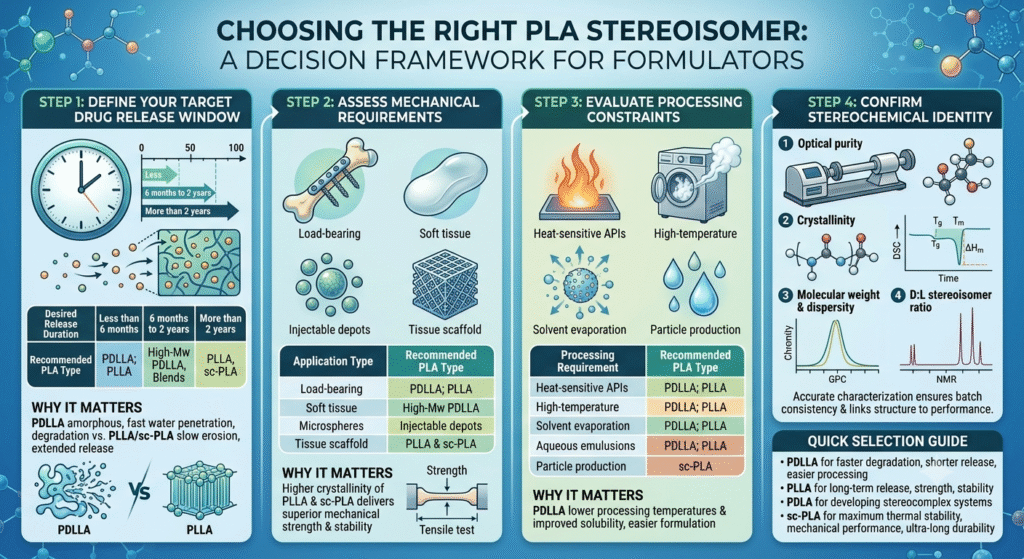
6: Choosing the Right PLA Stereoisomer — A Decision Framework for Formulators
The correct PLA stereoisomer selection depends on three primary variables: desired drug release duration, mechanical requirements, and processing constraints.
Use the following framework as a starting point:
Step 1 — Define Your Release Window
- < 6 months: PDLLA is almost always the right choice
- 6 months – 2 years: PLLA or high-MW PDLLA; consider PLLA/PDLLA blends
- > 2 years or permanent/semi-permanent implant: PLLA or sc-PLA
Step 2 — Assess Mechanical Requirements
- Load-bearing (bone, cardiovascular): PLLA or sc-PLA
- Soft tissue, injectable, non-structural: PDLLA
Step 3 — Consider Processing Constraints
- Heat-sensitive APIs: PDLLA (lower processing temperature)
- High-temperature sterilization required: sc-PLA
- Aqueous emulsion / solvent evaporation processes: PDLLA (faster dissolution, easier particle formation)
Step 4 — Confirm Stereochemical Identity Analytically
This step is non-negotiable for regulatory submissions and GMP manufacturing. Confirm:
- Optical purity (specific rotation, polarimetry)
- Crystallinity (DSC — Tg, Tm, ΔHm)
- Molecular weight and dispersity (GPC/SEC with appropriate calibration)
- D:L ratio (quantitative NMR)
7: Analytical Characterization of PLA Stereoisomers — The ResolveMass Approach
Accurate stereochemical characterization of PLA requires at least three complementary analytical techniques: DSC, GPC/SEC, and optical rotation or NMR. Relying on a single technique routinely misses critical heterogeneities.
At ResolveMass Laboratories Inc., our polymer characterization workflow for PLA stereoisomers includes:
- Differential Scanning Calorimetry (DSC): Quantifies Tg, Tm, crystallization behavior, and the presence/absence of stereocomplex crystallites (distinct endotherm at ~220–230 °C)
- Gel Permeation Chromatography / Size Exclusion Chromatography (GPC/SEC): Absolute molecular weight, number-average molecular weight (Mn), weight-average molecular weight (Mw), dispersity (Ð)
- Polarimetry: Specific optical rotation confirms the L/D configuration at the bulk level
- Quantitative ¹H and ¹³C NMR: Resolves D:L ratio, end-group identity, and residual monomer content
- TGA (Thermogravimetric Analysis): Thermal stability and residual solvent content
- FTIR: Rapid screening of stereocomplex content and crystallinity index
This multi-technique approach is especially critical for:
- Incoming raw material testing of PLA grades from suppliers
- Release testing of PLA-based drug product intermediates
- Stability studies on degradable implants and microspheres
- Regulatory dossier support (IND, NDA, 510(k), CE Mark)
8: Regulatory and Quality Considerations for PLA Stereoisomer Selection
Regulatory agencies including the FDA and EMA treat the stereochemical identity of a polymer excipient as part of its chemical identity — not a mere specification detail. A change from PDLLA to PLLA in an approved product would constitute a major formulation change requiring new stability and potentially new clinical data.
Key regulatory touchpoints:
- USP/NF: Polylactic acid monographs specify optical rotation ranges; manufacturers must demonstrate batch compliance
- ICH Q6A/Q6B: Identity testing requirements for polymeric excipients include stereochemical identity
- FDA guidance on biodegradable polymers (1997, updated guidance ongoing): Explicitly requires characterization of molecular weight distribution AND stereochemical composition
- ISO 10993 (Biocompatibility): Degradation product profiles must account for the actual stereoisomer used — L-lactic acid and D-lactic acid have different metabolic fates
Conclusion:
PLA stereochemistry — the distinction between PLLA, PDLA, and PDLLA — is not a footnote in a formulation brief. It is the foundational design decision that determines whether a drug delivery system succeeds or fails. The right choice of stereoisomer aligns degradation kinetics with therapeutic intent, ensures processability, satisfies regulatory requirements, and protects patient safety.
To summarize the core distinctions in PLA stereochemistry: PLLA vs PDLA vs PDLLA:
- PLLA: Semicrystalline, slow-degrading, high-strength — long-term implants and depots
- PDLA: Mirror of PLLA; critical for stereocomplex PLA formation with dramatically elevated thermal and mechanical performance
- PDLLA: Amorphous, faster-degrading, more processable — the dominant choice for injectable microspheres and nanoparticulate systems
- sc-PLA (PLLA + PDLA blend): Next-generation material for applications demanding exceptional stability and longevity
At ResolveMass Laboratories Inc., we combine deep polymer science expertise with precision analytical infrastructure to help you characterize, select, and validate the right PLA stereoisomer for your application — from early feasibility through GMP-scale development and regulatory submission.
Frequently Asked Questions:
PLA stereochemistry determines how the polymer interacts with water, degrades over time, and releases an active pharmaceutical ingredient. The arrangement of D- and L-lactic acid units influences crystallinity, which directly affects degradation kinetics and release profiles. Choosing the right stereochemistry helps formulators achieve targeted therapeutic outcomes. It also impacts formulation stability, manufacturability, and product performance. Therefore, stereochemistry is a critical design parameter in drug delivery systems.
PDLLA generally degrades faster than PLLA and PDLA because it is predominantly amorphous rather than crystalline. Its less ordered structure allows water to penetrate the polymer matrix more easily. This accelerates hydrolysis and polymer erosion. Faster degradation often translates into quicker drug release. For this reason, PDLLA is commonly used in short- to medium-term controlled-release formulations.
PLLA is often the preferred choice for long-acting drug delivery systems due to its high crystallinity and slower degradation rate. The crystalline structure restricts water penetration and delays polymer breakdown. This enables sustained drug release over extended periods, sometimes lasting months or years. PLLA is frequently used in implants and long-acting injectable formulations. Its mechanical strength also supports long-term structural stability.
Stereocomplex PLA is formed when PLLA and PDLA chains interact and crystallize together. This unique structure is more stable than conventional PLA and exhibits higher melting temperatures and mechanical strength. Stereocomplex PLA also degrades more slowly than standard PLLA or PDLLA. These properties make it attractive for advanced drug delivery systems and long-term implants. Researchers continue to explore its potential in next-generation pharmaceutical formulations.
Crystallinity influences how quickly water can enter a polymer matrix and initiate degradation. Highly crystalline polymers such as PLLA and PDLA tend to degrade more slowly, resulting in prolonged drug release. In contrast, amorphous polymers like PDLLA allow faster water penetration and quicker erosion. This leads to faster drug release and shorter treatment durations. Understanding crystallinity helps formulators design products with predictable release profiles.
PDLLA is often preferred for microsphere formulations when faster degradation and controlled release over weeks or months are desired. Its amorphous structure supports more uniform drug distribution and predictable erosion. PLLA, on the other hand, may be more suitable for long-term release applications. The choice depends on therapeutic goals and the desired duration of action. Both polymers are widely used in pharmaceutical microsphere technologies.
Yes, PLLA and PDLA can be blended to form stereocomplex PLA. This interaction creates highly ordered crystalline regions that improve thermal stability and mechanical properties. Stereocomplex formation can also slow degradation and extend drug release duration. These advantages make PLLA/PDLA blends attractive for challenging drug delivery applications. Such systems are increasingly being studied for long-acting and implantable products.
Reference
- Tsuji H. Poly (lactide) stereocomplexes: formation, structure, properties, degradation, and applications. Macromolecular bioscience. 2005 Jul 14;5(7):569-97.https://onlinelibrary.wiley.com/doi/abs/10.1002/mabi.200500062
- Im SH, Im DH, Park SJ, Chung JJ, Jung Y, Kim SH. Stereocomplex polylactide for drug delivery and biomedical applications: A review. Molecules. 2021 May 11;26(10):2846.https://www.mdpi.com/1420-3049/26/10/2846
- Burke J, Donno R, d’Arcy R, Cartmell S, Tirelli N. The effect of branching (star architecture) on poly (D, L-lactide)(PDLLA) degradation and drug delivery. Biomacromolecules. 2017 Mar 13;18(3):728-39.https://pubs.acs.org/doi/abs/10.1021/acs.biomac.6b01524
- Hu C, Zhang Y, Pang X, Chen X. Poly (lactic acid): recent stereochemical advances and new materials engineering. Advanced Materials. 2025 Jun;37(22):2412185.https://advanced.onlinelibrary.wiley.com/doi/abs/10.1002/adma.202412185
- de França JO, da Silva Valadares D, Paiva MF, Dias SC, Dias JA. Polymers based on PLA from synthesis using D, L-lactic acid (or racemic lactide) and some biomedical applications: a short review. Polymers. 2022 Jun 8;14(12):2317.https://www.mdpi.com/2073-4360/14/12/2317
About the Author


