


Is PLGA Biocompatible? The Direct Answer
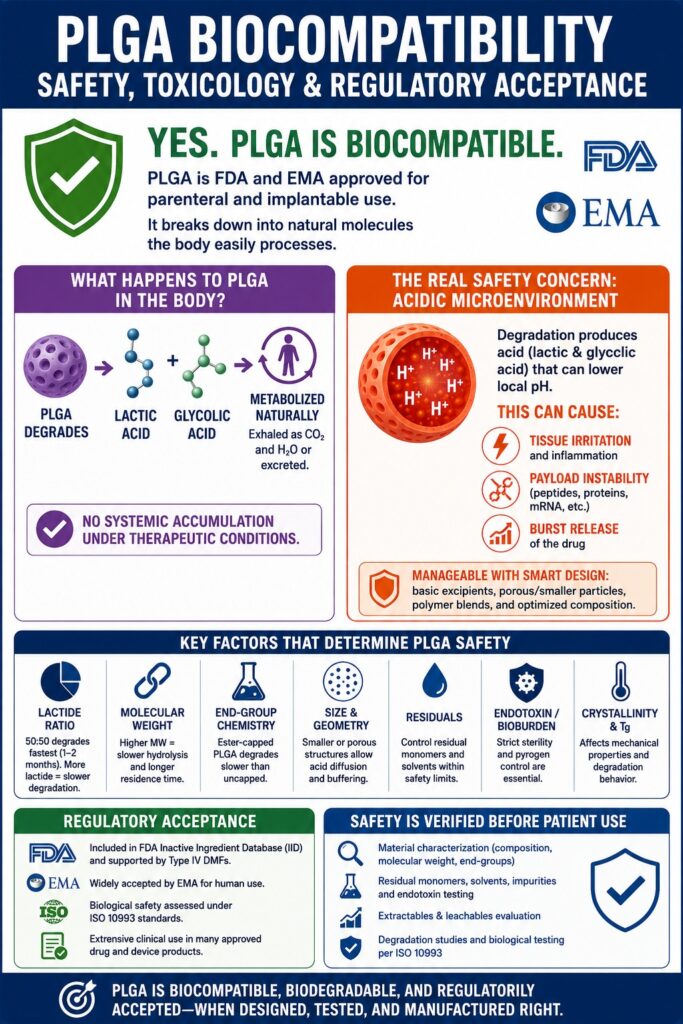
Yes. PLGA is widely recognized as a highly biocompatible polymer and is one of the relatively few synthetic polymers that have received approval from both the FDA and EMA for parenteral and implantable applications in humans. Its established safety profile is not based on promotional claims but on more than four decades of clinical experience, beginning with the introduction of polyglactin 910 (Vicryl) resorbable sutures in 1974, along with a substantial body of in vitro and in vivo research. The foundation of this safety record lies in its chemical structure. PLGA is a polyester composed exclusively of lactic acid and glycolic acid units. As the material degrades, it breaks down into these same molecules, both of which are naturally produced and routinely metabolized by the human body.
However, the term “biocompatible” should not be viewed as an absolute characteristic of a material. Rather, biocompatibility depends on the specific material being used in a particular application and biological environment. This principle also applies to PLGA. For this reason, the remainder of this article examines what the toxicological evidence actually demonstrates, where the legitimate safety concerns exist, and how regulatory authorities assess PLGA-based products.
Need to ensure your material meets regulatory standards? Explore our services for polymer equivalence assessment.
Article Summary:
- PLGA is a well-established biocompatible polymer that has been used in medical products for decades and is approved by major regulatory authorities, including the FDA and EMA, for injectable and implantable applications.
- Its strong safety profile comes from its natural degradation process. PLGA breaks down into lactic acid and glycolic acid, both of which are naturally occurring compounds that the body can metabolize and eliminate through normal physiological pathways.
- Scientific studies consistently show low toxicity and good tissue compatibility. Research demonstrates minimal systemic toxicity and only a temporary, mild inflammatory response that typically resolves as the material degrades.
- Biocompatibility depends on how and where PLGA is used. Factors such as implantation site, polymer dose, degradation rate, and particle size can influence the local biological response and overall safety performance.
- The main safety challenge is localized acidification during degradation. Accumulation of acidic byproducts may lower the surrounding pH, potentially causing tissue irritation, affecting drug stability, or altering drug-release behavior if formulations are not properly optimized.
- PLGA safety and performance are strongly influenced by formulation design. Polymer composition, molecular weight, end-group chemistry, implant geometry, residual impurities, and sterility controls all play important roles in determining degradation behavior and biocompatibility.
- Regulatory acceptance of PLGA is extensive, but product-specific testing remains essential. Comprehensive material characterization, toxicological assessment, and biological evaluation are required to confirm the safety of each individual PLGA-based drug delivery system or medical device.
What the Biocompatibility Evidence Actually Shows
Available evidence consistently demonstrates that PLGA exhibits minimal systemic toxicity and generally induces only a mild, self-limiting local tissue response. For a biodegradable polymer, biocompatibility is primarily determined by two factors: the toxicity of its degradation products and the rate at which those degradation products are released. PLGA performs favorably in both respects.
In vitro studies have repeatedly shown that PLGA and its degradation products exhibit low cytotoxicity across commonly used cell lines. In vivo implantation studies similarly report a predictable and transient foreign-body response characterized by initial neutrophil infiltration, followed by macrophage recruitment and, in some cases, the formation of foreign-body giant cells. This response gradually diminishes as the polymer resorbs, typically resulting in the formation of only a thin fibrous capsule rather than chronic inflammation, tissue necrosis, or long-term adverse effects. The influential biocompatibility review by Anderson and Shive established this foreign-body response model for PLA and PLGA microspheres, while subsequent reviews, including those by Ramot et al. (2016) and Elmowafy et al. (2019), confirmed similar findings across a wide range of formulations and implantation sites.
Developing a new treatment? Learn more about our support for PLGA long-acting injectable formulations.
Several important practical considerations emerge from the published literature:
Site Matters
The biological response to PLGA varies depending on the implantation site. The same polymer formulation may produce different outcomes in subcutaneous tissue, skeletal muscle, joints, ocular tissues, or the central nervous system. Implants with a large surface area located in sensitive anatomical regions are more likely to provoke a stronger local response.
Dose and Clearance Matter
The severity of local adverse effects is closely associated with the concentration of acidic degradation products present at the implantation site. Lower polymer loads that degrade gradually and allow efficient clearance tend to be better tolerated than large polymer masses that generate acidic byproducts more rapidly.
Particulate Debris
During the later stages of degradation, PLGA may fragment into smaller particles. These particles can temporarily increase macrophage activity and local immune responses before they are ultimately cleared from the tissue.
Optimize your delivery system: Read about PLGA depot formulation strategies here.
PLGA Toxicology: What Happens to the Polymer in the Body
From a toxicological perspective, PLGA is considered highly favorable because it does not remain permanently within the body. Instead, it undergoes hydrolysis and is converted into endogenous compounds that enter normal metabolic pathways. Water molecules, aided in part by esterases, cleave the ester bonds within the polymer backbone, producing lactic acid and glycolic acid.
Importantly, these compounds are not foreign xenobiotics. They are naturally occurring metabolic intermediates that the body routinely generates and processes.
| Degradation Product | How the Body Handles It | End Fate |
|---|---|---|
| Lactic Acid | Converted to pyruvate and enters the Krebs (TCA) cycle | Exhaled as CO₂ and H₂O |
| Glycolic Acid | Partially metabolized through the TCA cycle and partially excreted unchanged | Renal excretion; CO₂ and H₂O |
| Minor Oxalic Acid (from glycolic acid) | Produced only in trace quantities | Renally excreted; clinically insignificant at therapeutic doses |
| Polymer Fragments | Phagocytosed by macrophages | Intracellular hydrolysis followed by metabolic clearance |
Because these degradation products are integrated into normal physiological pathways, systemic accumulation does not occur under standard therapeutic conditions. This metabolic clearance pathway represents one of the most important reasons why PLGA demonstrates such a favorable toxicological profile compared with non-degradable synthetic polymers, which may remain in the body indefinitely and often require surgical removal.
Are your materials consistent? Discover the importance of PLGA PDI in pharmaceutical applications.
The Real Safety Concern: The Acidic Microenvironment
The primary safety concern associated with PLGA is local acidification rather than systemic toxicity. As PLGA degrades, the lactic acid and glycolic acid generated within a dense polymer matrix may accumulate faster than they can be neutralized by surrounding biological fluids. This process lowers the local pH and promotes autocatalytic degradation because acidic conditions accelerate ester bond hydrolysis.
Researchers using pH-sensitive probes have reported internal microsphere pH values as low as approximately 1.5 (Fu et al., 2000). Acidic microenvironments have also been shown to significantly influence both polymer degradation behavior and drug-release characteristics (Zolnik & Burgess, 2007).
Why This Matters in Practice
Tissue Irritation
A substantial decrease in local pH can irritate surrounding tissues and intensify inflammatory responses at the implantation site.
Payload Instability
Acid-sensitive therapeutic agents, particularly peptides, proteins, mRNA, and other nucleic acid-based therapeutics, may degrade within the carrier system before they are released.
Burst Release
Poorly optimized formulations may release a significant proportion of the encapsulated drug immediately following administration, resulting in undesirable burst-release effects.
Fortunately, these challenges can be addressed through formulation design. Common mitigation strategies include incorporating basic excipients such as magnesium hydroxide or magnesium carbonate to neutralize acidic byproducts, designing porous or smaller particles that facilitate acid diffusion, blending different polymer grades, and selecting PLGA compositions specifically tailored to the intended therapeutic payload. The availability of these well-established solutions is why such concerns are generally regarded as manageable rather than prohibitive.
Dealing with complex drugs? See how we handle the characterization of long-acting biologics.
Factors That Determine PLGA Biocompatibility, Safety, Toxicology, and Regulatory Outcomes
The biocompatibility and degradation characteristics of PLGA are determined by the specific polymer grade and device design rather than by the term “PLGA” alone. The following factors have the greatest influence on safety performance and degradation behavior.
| Factor | Effect on Degradation and Safety |
| Lactide Ratio | A 50:50 ratio degrades most rapidly, typically within approximately 1–2 months. Increasing lactide content increases hydrophobicity and slows degradation. |
| Molecular Weight | Higher molecular weight results in slower hydrolysis, extended residence time, and more gradual acid release. |
| End-Group Chemistry | Ester-capped PLGA degrades more slowly than uncapped PLGA containing free carboxylic acid end groups. |
| Particle/Implant Size and Geometry | Large, dense matrices can trap acidic degradation products and exacerbate local pH reduction, whereas smaller or porous structures facilitate diffusion and buffering. |
| Residual Monomers and Solvents | Residual lactide, glycolide, and process solvents such as dichloromethane must be controlled within established safety limits. |
| Endotoxin/Bioburden | Strict sterility and pyrogen control are essential for injectable and implantable products. |
| Crystallinity and Tg | Glass-transition temperature (approximately 40–60 °C) and crystallinity influence mechanical performance and erosion behavior. |
For formulation scientists and quality teams, the key takeaway is that a biocompatibility determination is valid only for the specific PLGA grade, manufacturing source, and final product design that have been evaluated.
Navigating the regulatory landscape? Learn about proving PLGA polymer sameness for ANDA submissions.
Regulatory Acceptance of PLGA: FDA, EMA, and ISO 10993
PLGA benefits from broad global regulatory acceptance and is regarded as a well-characterized biomaterial rather than a novel material. It is included in the FDA Inactive Ingredient Database (IID), supported through suppliers’ Type IV Drug Master Files (DMFs), and incorporated into numerous approved long-acting injectable and implantable products. In medical device applications, biological safety assessments are typically performed according to ISO 10993-1, “Biological Evaluation of Medical Devices.”
Representative Examples of Approved PLGA-Based Products
| Product (Drug) | Format | Clinical Use |
| Vicryl (polyglactin 910) | Resorbable suture | General surgery (approved in 1974) |
| Lupron Depot (leuprolide) | PLGA microspheres | Prostate cancer and endometriosis |
| Eligard (leuprolide) | In situ forming PLGA depot | Prostate cancer |
| Risperdal Consta (risperidone) | PLGA microspheres | Schizophrenia |
| Vivitrol (naltrexone) | PLGA microspheres | Opioid and alcohol dependence |
| Sandostatin LAR (octreotide) | PLGA microspheres | Acromegaly and neuroendocrine tumors |
| Ozurdex (dexamethasone) | PLGA intravitreal implant | Retinal disorders |
| Sublocade (buprenorphine) | In situ forming PLGA depot | Opioid use disorder |
| Zilretta (triamcinolone) | PLGA microspheres | Osteoarthritis-related knee pain |
For regulatory evaluation, the relevant ISO 10993 endpoints generally include cytotoxicity (ISO 10993-5), sensitization and irritation (ISO 10993-10 and ISO 10993-23), acute, subchronic, and chronic systemic toxicity (ISO 10993-11), genotoxicity (ISO 10993-3), implantation studies (ISO 10993-6), hemocompatibility (ISO 10993-4), and, particularly for biodegradable materials, degradation characterization (ISO 10993-13) and toxicokinetic assessment of degradation products and leachables.
Drug-delivery systems are also evaluated for extractables and leachables, residual solvents in accordance with ICH Q3C, and elemental impurities according to ICH Q3D requirements.
Understanding degradation mechanisms? Read our insights on bulk erosion vs. surface erosion in PLGA.
How PLGA Safety Is Verified Before It Reaches Patients
The safety of PLGA-based products is established through comprehensive material characterization and biological testing rather than being assumed based on the polymer’s historical reputation. Since biocompatibility depends on both polymer grade and final product design, extensive analytical evaluation forms the basis of every regulatory submission.
These assessments typically include verification of the lactide ratio and molecular-weight distribution, quantification of residual monomers and residual solvents, identification and characterization of extractables and leachables, confirmation of endotoxin and sterility specifications, and detailed evaluation of degradation kinetics under physiologically relevant conditions.
This is where analytical laboratories such as ResolveMass Laboratories Inc. provide significant value by generating the extractables and leachables data, residual-solvent analyses, impurity profiles, and material characterization information required to support both safety assessments and regulatory submissions. Thorough, scientifically rigorous testing transforms the general statement that “PLGA is biocompatible” into a defensible, product-specific safety conclusion.
Facing technical hurdles? Explore the common challenges in PLGA microsphere development.
Conclusion
When considering PLGA biocompatibility, safety, toxicology, and regulatory acceptance as a whole, the evidence leads to a clear and well-supported conclusion. PLGA is a biocompatible and biodegradable polymer that is ultimately cleared through normal metabolic pathways. It has been used clinically for decades and is broadly accepted within the regulatory frameworks of the FDA, EMA, and ISO 10993.
Its primary limitations, namely local acidification and a transient foreign-body response, are genuine considerations but are well understood, extensively characterized, and effectively managed through appropriate formulation strategies and rigorous quality control. For drug-delivery developers and medical device manufacturers, the practical implication is straightforward: biocompatibility should always be demonstrated for the specific PLGA grade and product design through comprehensive analytical characterization and biological evaluation.
Need extractables and leachables testing, residual-solvent analysis, impurity profiling, or material characterization to support the safety assessment and regulatory submission of your PLGA-based product? Contact ResolveMass Laboratories.
Frequently Asked Questions (FAQs)
PLGA is generally considered non-toxic when used at approved therapeutic levels. As the polymer degrades, it breaks down into lactic acid and glycolic acid, which are naturally occurring compounds involved in normal cellular metabolism. These byproducts are processed through established physiological pathways and ultimately eliminated from the body. While temporary local acidity may occur at the degradation site, significant systemic toxicity is not typically observed.
PLGA itself is not approved as a standalone pharmaceutical product, but it is a well-established biomaterial that is widely accepted by regulatory agencies. The polymer is included in the FDA Inactive Ingredient Database and is used in numerous FDA-approved injectable and implantable drug products. Its long history of clinical use and extensive safety data have contributed to its broad regulatory acceptance in drug delivery and medical device applications.
The degradation timeline of PLGA varies considerably depending on its formulation and physicochemical properties. Factors such as the lactide ratio, molecular weight, end-group chemistry, and implant geometry all influence the degradation rate. Certain formulations may degrade within a few weeks, while others can remain intact for several months. PLGA grades with a 50:50 lactide ratio generally exhibit the fastest degradation profile.
PLGA undergoes hydrolytic degradation, resulting in the formation of lactic acid and glycolic acid. These naturally occurring metabolites enter the body’s normal biochemical pathways, where they are further processed into carbon dioxide and water. Glycolic acid may also be partially eliminated through the kidneys. Because the degradation products are endogenous compounds, they are efficiently metabolized and cleared under normal physiological conditions.
A mild inflammatory response is a normal biological reaction to implanted biomaterials, including PLGA. Macrophages and other immune cells temporarily accumulate around the implant as part of the body’s natural healing process. In addition, the release of acidic degradation products can lower local pH levels and contribute to short-term tissue irritation. In most cases, this response gradually subsides as the polymer degrades and is cleared from the site.
Yes, PLGA is widely regarded as a safe and effective material for nanoparticle-based and controlled drug-delivery systems. Its biodegradability, biocompatibility, and regulatory acceptance have made it one of the most commonly used polymers in advanced pharmaceutical formulations. However, factors such as particle size, surface characteristics, dosage, and manufacturing quality can affect safety and performance. Therefore, each formulation must undergo its own comprehensive evaluation.
PLA, PGA, and PLGA are all biodegradable polyesters with well-established safety profiles in biomedical applications. The primary distinction lies in their degradation behavior, with PGA typically degrading the fastest and PLA degrading the slowest. PLGA offers a balance between the two and allows degradation rates to be tailored by adjusting the polymer composition. Despite these differences, all three materials degrade into biologically manageable compounds and are considered clinically acceptable.
Under normal therapeutic conditions, PLGA does not accumulate within the body. Once implanted or administered, the polymer gradually breaks down into metabolites that enter normal metabolic pathways and are subsequently eliminated. Unlike non-degradable synthetic materials that can persist indefinitely, PLGA is designed to be completely resorbed over time. This biodegradation process significantly reduces the risk of long-term material accumulation.
The biological safety of PLGA-based products is primarily evaluated according to the ISO 10993 series of standards for medical devices. These standards address critical endpoints such as cytotoxicity, sensitization, irritation, systemic toxicity, genotoxicity, implantation effects, and hemocompatibility. For pharmaceutical products, additional regulatory guidance is provided through ICH standards covering residual solvents, elemental impurities, extractables, and leachables. Together, these frameworks help ensure product safety before clinical use.
Reference:
- Makadia, H. K., & Siegel, S. J. (2011). Poly lactic-co-glycolic acid (PLGA) as biodegradable controlled drug delivery carrier. Polymers, 3(3), 1377–1397. https://doi.org/10.3390/polym3031377
- Ramot Y, Haim-Zada M, Domb AJ, Nyska A. Biocompatibility and safety of PLA and its copolymers. Adv Drug Deliv Rev. 2016;107:153–162. doi:10.1016/j.addr.2016.03.012
- Elmowafy EM, Tiboni M, Soliman ME. Biocompatibility, biodegradation and biomedical applications of poly(lactic acid)/poly(lactic-co-glycolic acid) micro and nanoparticles. J Pharm Investig. 2019;49(4):347–380. doi:10.1007/s40005-019-00439-x
- Anderson JM, Shive MS. Biodegradation and biocompatibility of PLA and PLGA microspheres. Adv Drug Deliv Rev. 1997;28(1):5–24 (reprinted 2012;64:72–82). doi:10.1016/j.addr.2012.09.004
- Fu K, Pack DW, Klibanov AM, Langer R. Visual evidence of acidic environment within degrading poly(lactic-co-glycolic acid) (PLGA) microspheres. Pharm Res. 2000;17(1):100–106. doi:10.1023/A:1007582911958
- Zolnik BS, Burgess DJ. Effect of acidic pH on PLGA microsphere degradation and release. J Control Release. 2007;122(3):338–344. doi:10.1016/j.jconrel.2007.05.034
- U.S. Food and Drug Administration. (n.d.). Inactive ingredients database download. FDA. Retrieved June 20, 2026, from FDA Inactive Ingredients Database Download
Get In Touch With Us
About The Author


