


Comparative Analytical Framework for PLGA Systems
PLGA Implant vs Microsphere Characterization focuses on understanding how PLGA polymer structure affects the performance of implants and microspheres in long-acting drug delivery systems. Although both systems use biodegradable poly(lactic-co-glycolic acid) (PLGA), their manufacturing processes are very different, which leads to unique challenges in polymer stability, degradation, and drug release behavior.
PLGA implants are usually exposed to high thermal and mechanical stress during hot-melt extrusion, while microspheres are influenced by solvent diffusion, emulsification, and surfactant interactions during production. These differences directly affect release kinetics, structural stability, and long-term product performance.
The selection of PLGA grades also depends on the required release profile. Implants commonly use higher molecular weight polymers for better structural strength, whereas microspheres often use a wider molecular weight range to achieve controlled release for small molecules, peptides, and proteins.
Explore our insights on selecting the right material for your formulation: Learn more about the Role of PLGA Polymer Grade in Long-Acting Release Formulation
Because polymer hydration, hydrolysis, and erosion vary between these dosage forms, advanced analytical characterization is essential for ensuring formulation quality, consistency, and regulatory compliance.
Share via:
Molecular Weight Dynamics and GPC Methodological Nuances
Gel Permeation Chromatography (GPC) is one of the most important analytical techniques used for determining molecular weight distributions in PLGA systems. Within PLGA Implant vs Microsphere Characterization, molecular weight serves as a primary indicator of degradation behavior, polymer stability, and mechanical performance. Although the principle of size exclusion chromatography remains the same across formulations, the interpretation of molecular weight parameters varies significantly depending on whether the polymer exists as a microsphere or a solid implant.
Parameters such as number-average molecular weight (Mn), weight-average molecular weight (Mw), and the polydispersity index (PDI) are critical for evaluating polymer quality. In microspheres, these values are strongly linked to release consistency across particle populations. In implants, however, they are more directly associated with structural integrity and the ability to maintain controlled drug release over prolonged periods. A reduction in molecular weight often signals ongoing hydrolysis and the initiation of bulk erosion processes.
Ensure your generic development meets stringent analytical standards: Discover our expertise in PLGA Polymer Characterization for Generics
Another important consideration is the effect of processing conditions on molecular weight stability. Thermal stress during extrusion can reduce polymer chain length, while solvent exposure during microsphere preparation may alter polymer conformation. These changes can significantly influence drug diffusion pathways and degradation rates. Therefore, accurate molecular weight characterization is essential not only during formulation development but also throughout stability studies and batch-release testing.
Modern GPC systems are frequently coupled with advanced detectors to improve analytical precision. Multi-detector configurations, including refractive index, viscometry, and light scattering detection, provide a more complete understanding of polymer architecture and degradation mechanisms. Such approaches are particularly valuable for identifying subtle shifts in polymer distribution that may affect long-term formulation performance.
The growing complexity of long-acting injectable products has increased the importance of molecular weight profiling in regulatory evaluations. Regulatory agencies now expect detailed characterization data that correlates polymer degradation with release kinetics and therapeutic reliability. As a result, GPC remains a cornerstone analytical technique for PLGA system development.
Absolute vs. Relative Molecular Weight Determination
The precision of molecular weight determination in PLGA systems is often limited when relative calibration methods are used. Traditional GPC calibration relies heavily on polystyrene (PS) standards, yet PLGA exhibits a substantially different hydrodynamic volume in solvents such as Tetrahydrofuran (THF) and Chloroform. Because of these differences, relative calibration may either overestimate or underestimate the true molecular weight, sometimes by as much as 70%, depending on the lactide-to-glycolide ratio and solvent interactions.
For solid implants, absolute molecular weight determination is especially important because mechanical strength depends directly on polymer chain length and integrity. Long polymer chains are required to maintain device rigidity throughout prolonged degradation periods. Any reduction in molecular weight caused by thermal stress, moisture exposure, or hydrolysis can compromise implant performance and accelerate failure of the controlled-release system.
Navigate the complexities of Abbreviated New Drug Applications: Read about PLGA Reverse Engineering for ANDA success
High-precision analytical platforms increasingly utilize Multi-Angle Light Scattering (MALS) detection in combination with GPC to generate absolute molecular weight data. This approach eliminates the inaccuracies associated with relative calibration standards and provides more reliable characterization of polymer degradation kinetics. In thick implants, where bulk erosion dominates, accurate molecular weight monitoring is essential for predicting the point at which structural collapse and rapid drug release may occur.
Microsphere formulations also benefit from absolute molecular weight determination, although the analytical emphasis differs. In these systems, maintaining consistent molecular weight distribution across particles is crucial for ensuring predictable drug release behavior. Variability in polymer chain length may contribute to uneven degradation rates and inconsistent therapeutic performance between batches.
Advanced molecular weight analysis also supports formulation troubleshooting and process optimization. By identifying changes in polymer distribution after manufacturing or storage, researchers can detect early signs of instability and adjust process parameters accordingly. This capability is particularly valuable for long-acting injectable products, where even minor molecular changes can significantly alter release kinetics.
| GPC Parameter | Microsphere Specificity | Solid Implant Specificity |
|---|---|---|
| Primary Goal | Predict release consistency across particles | Ensure mechanical strength and structural life |
| PDI Threshold | Narrow PDI (< 1.8) preferred for uniform degradation | Broader PDI often tolerated if Mw is sufficiently high |
| Interferences | Residual PVA or surfactants may mask small MW peaks | High drug load may require complex filtration steps |
| Degradation Indicator | Shift in $M_w$ signals onset of bulk erosion | Broadening of distribution signals heterogeneous scission |
Mark-Houwink-Sakurada Relationships in PLGA Characterization
The relationship between intrinsic viscosity [\eta] and molecular weight M is defined by the Mark-Houwink-Sakurada equation:
[η]=KMa[\eta] = K M^a[η]=KMa
In this equation, the constants K and a depend on the polymer-solvent system and temperature conditions. For PLGA characterization, these constants vary according to the lactide-to-glycolide composition, making the analysis highly formulation-specific. PLGA with a high lactic acid content behaves differently from glycolic-rich polymers because the hydrophobicity and chain flexibility of the copolymer change substantially with composition.
Understanding the a parameter is particularly important in implant formulations because it reflects polymer conformation in solution. Variations in this parameter can indicate transitions from random coil configurations to more rigid or branched structures. During degradation studies, a shift in the Mark-Houwink relationship may signal preferential hydrolysis of glycolic segments or the formation of low molecular weight oligomers.
In microsphere systems, intrinsic viscosity measurements are valuable for monitoring polymer processing effects and solvent interactions. Solvent exposure during emulsification may alter chain arrangement and influence final particle morphology. As a result, viscosity analysis contributes to understanding how manufacturing variables affect drug encapsulation efficiency and release behavior.
The Mark-Houwink-Sakurada relationship also supports comparative quality assessment between reference and generic PLGA products. Even when molecular weight values appear similar, differences in polymer conformation may produce significant variations in degradation and release kinetics. Therefore, intrinsic viscosity analysis provides an additional level of structural insight beyond conventional GPC measurements.
Advanced analytical laboratories frequently integrate viscometry with light scattering and refractive index detection to establish comprehensive polymer profiles. This combined approach improves the ability to identify subtle changes in polymer architecture that may not be visible through molecular weight analysis alone.
Understand the nuances of oncology-specific drug delivery: View our Case Study on PLGA for Oncology Implants
Nuclear Magnetic Resonance (NMR) for Stoichiometric Analysis
Nuclear Magnetic Resonance (NMR) spectroscopy provides atomic-level information regarding polymer composition, sequence distribution, and end-group chemistry in PLGA systems. In PLGA Implant vs Microsphere Characterization, NMR serves as a critical analytical tool for confirming polymer identity and evaluating structural features that directly influence degradation and drug release behavior.
NMR analysis is particularly valuable because it allows researchers to determine the lactide-to-glycolide (L:G) ratio with high accuracy. Since the hydrophilicity and degradation rate of PLGA strongly depend on this ratio, even minor compositional differences can significantly alter product performance. Accurate stoichiometric characterization therefore plays an essential role in formulation development and regulatory compliance.
Another major advantage of NMR is its ability to identify polymer end-group functionality. Acid-capped and ester-capped PLGA polymers exhibit markedly different hydration properties, which affect water uptake, autocatalysis, and drug diffusion. By analyzing end-group chemistry, scientists can better predict in vivo release behavior and optimize polymer selection for specific therapeutic applications.
NMR also provides insights into sequence randomness and copolymer architecture. The arrangement of lactic and glycolic units within the polymer chain can influence crystallinity, glass transition temperature, and hydrolytic stability. This information is particularly important for long-acting implants, where small structural variations may lead to major differences in release duration and mechanical stability.
As analytical expectations continue to evolve, NMR has become increasingly important in demonstrating formulation equivalence between generic and reference products. Regulatory agencies often require detailed spectroscopic evidence confirming polymer composition, sequence distribution, and impurity profiles before approving complex PLGA-based drug delivery systems.
Deep dive into a specific clinical application: Read the Dexamethasone Implant PLGA Characterization Case Study
Quantitative 1H NMR for L:G Ratio and Monomer Sequence
The molar ratio of lactide to glycolide is typically determined by integrating the methine proton signal of lactide units at approximately 5.2 ppm against the methylene proton signal of glycolide units near 4.8 ppm. This ratio is considered one of the most influential variables controlling PLGA degradation kinetics and drug release duration.
A 50:50 PLGA composition generally exhibits rapid degradation because the polymer is more hydrophilic and less crystalline. In contrast, polymers rich in lactide content, such as 85:15 formulations, degrade more slowly due to increased hydrophobicity and reduced water penetration. This difference enables formulation scientists to tailor therapeutic release periods from several weeks to multiple months.
Beyond basic compositional analysis, 13C NMR provides detailed information about copolymer sequence distribution and “blockiness.” By examining the carbonyl region between approximately 166–170 ppm, researchers can identify the relative abundance of LA-LA, LA-GA, and GA-GA sequences. Sequence distribution significantly influences polymer flexibility, crystallinity, and glass transition temperature.
Blocky copolymers may exhibit heterogeneous degradation because glycolic-rich regions hydrolyze more rapidly than lactic-rich domains. This can result in uneven erosion patterns, particularly in microsphere populations where particle-to-particle variability already influences release consistency. Consequently, sequence analysis is critical for predicting degradation uniformity and formulation stability.
Quantitative NMR techniques also support process validation and quality control efforts. Changes in monomer ratio or sequence distribution after manufacturing may indicate thermal degradation, incomplete polymerization, or formulation instability. Routine spectroscopic monitoring therefore contributes to maintaining consistent product quality throughout development and commercialization.
End-Group Functionalization: Acid-Capped vs. Ester-Capped
The chemical structure present at the end of a PLGA polymer chain has a major influence on hydration behavior, polymer-drug interaction, and degradation speed. In PLGA Implant vs Microsphere Characterization, Nuclear Magnetic Resonance (NMR) is commonly used to confirm whether the polymer is acid-capped or ester-capped.
- Acid-Capped PLGA: Acid-capped PLGA contains free carboxylic acid terminal groups that increase hydrophilicity and support faster water absorption. This type of polymer is widely used in microsphere formulations, especially for hydrophilic drugs, because it can improve encapsulation efficiency and accelerate drug release.
- Ester-Capped PLGA: Ester-capped PLGA contains hydrophobic end groups such as methyl or ethyl esters. These terminal groups slow down water uptake and delay the early hydration phase. Ester-capped polymers are often preferred for implant formulations that require a long lag phase and better structural stability during extended drug release.
| NMR Feature | Impact on Microspheres | Impact on Solid Implants |
|---|---|---|
| L:G Ratio Accuracy | Influences the duration of secondary drug release | Determines the functional lifetime of the implant |
| End-Group Type | Affects burst release and drug partitioning | Impacts moisture-related mechanical weakening |
| Sequence Randomness | Controls particle erosion consistency | Influences matrix rigidity and crystallinity |
| Residual Monomers | May indicate incomplete purification after emulsification | Can accelerate degradation during high-temperature extrusion |
Thermal Analysis and Glass Transition Dynamics
Differential Scanning Calorimetry (DSC) and Thermogravimetric Analysis (TGA) are important tools used to evaluate the thermal behavior and stability of PLGA systems. In PLGA Implant vs Microsphere Characterization, thermal analysis helps identify changes caused by manufacturing conditions, solvent retention, and polymer-drug interactions.
The glass transition temperature (Tg) is especially important because it is sensitive to residual solvents, moisture content, and the presence of active pharmaceutical ingredients.
Optimize your manufacturing and storage protocols: Check our guide on PLGA Packaging Conditions
Tg as an Indicator of Stability and Drug Release
The glass transition temperature of PLGA generally falls between 40^{\circ}C and 60^{\circ}C, which is close to normal body temperature. Because of this, even a small reduction in Tg can shift the polymer from a rigid glassy state into a softer rubbery state after administration.
In microsphere formulations, the effective Tg is often reduced because of residual solvents such as Dichloromethane (DCM) or because certain drug molecules act as plasticizers. DSC testing is commonly used to compare the dry Tg with the wet Tg after moisture exposure, providing a more realistic picture of in vivo behavior.
A lower Tg in microspheres is often linked to a stronger burst release because the softened polymer chains allow drug molecules to diffuse more rapidly.
For implants manufactured through Hot-Melt Extrusion (HME), DSC analysis is used to confirm that the processing conditions have not caused unwanted crystallization or excessive reduction in glass transition temperature. If the implant Tg falls below physiological temperature, the device may lose its mechanical structure too early and fail to maintain controlled drug delivery.
TGA-DTG for Residual Solvent and Moisture Analysis
Thermogravimetric Analysis (TGA) measures mass loss during heating, while Derivative Thermogravimetry (DTG) evaluates the rate of mass loss. These methods are highly valuable in PLGA Implant vs Microsphere Characterization for measuring residual solvents and moisture levels.
- Microspheres: DTG can separate loosely attached surface solvents from solvents trapped inside the polymer matrix. Lower-temperature peaks typically represent surface-bound solvent, while higher-temperature peaks indicate solvent retained within PLGA chains.
- Implants: TGA is especially important before hot-melt extrusion processing. Even very small amounts of moisture can trigger hydrolytic degradation at high processing temperatures, causing a major reduction in molecular weight and mechanical strength.
Microstructural Analysis and Porosity Evolution
The microstructure of PLGA systems, including porosity and internal drug distribution, strongly affects water penetration and drug release behavior. In PLGA Implant vs Microsphere Characterization, imaging methods such as Scanning Electron Microscopy (SEM), Optical Coherence Tomography (OCT), and Micro-CT are widely used to study these structural properties.
Specific Surface Area and Particle Size in Microspheres
Microspheres have a very high surface-area-to-volume ratio, making them more prone to burst release. Particle size distribution is commonly measured using laser diffraction techniques.
Researchers must also differentiate between internal and external porosity. Porous microspheres created using double-emulsion methods or porogens often display honeycomb-like structures that allow rapid water entry.
SEM remains one of the most reliable techniques for evaluating surface morphology, although cross-sectioning is needed to examine internal structure. BET nitrogen adsorption analysis is used to measure total surface area, which directly affects burst release intensity.
Bulk Density and Autocatalytic Core Formation in Implants
PLGA implants are generally dense and monolithic, especially when manufactured using hot-melt extrusion. However, their structure changes significantly during degradation.
Because water diffuses into the implant faster than the polymer erodes, degradation occurs through bulk erosion. During this process, acidic degradation products can accumulate in the center of the implant and form an autocatalytic core.
Non-destructive imaging methods such as OCT help visualize hollow core formation during degradation. This hollowing process often occurs before the rapid final release phase of the implant.
| Microstructural Feature | Microsphere Perspective | Solid Implant Perspective |
|---|---|---|
| Surface Area | Main factor controlling burst release | Minimal effect compared to total bulk volume |
| Porosity | Often intentionally designed for fast or dual release | Usually indicates processing defects |
| Drug Distribution | Surface-heavy loading increases burst release | Core-focused loading is common in HME implants |
| Swelling | Can cause particle aggregation | May result in significant volume expansion |
Mechanisms of Autocatalysis and Erosion
One of the biggest differences in PLGA Implant vs Microsphere Characterization is how autocatalysis affects degradation behavior.
Autocatalysis occurs when acidic degradation products accumulate inside the polymer matrix, accelerating further hydrolysis. The impact of this process depends heavily on diffusion path length.
Heterogeneous vs. Homogeneous Bulk Erosion
PLGA is considered a bulk-eroding polymer because water penetration occurs faster than ester bond hydrolysis. However, erosion patterns differ between microspheres and implants.
- Microspheres (Homogeneous): Small microspheres have short diffusion pathways, allowing acidic degradation products to leave the particle quickly. As a result, degradation occurs more evenly throughout the particle structure.
- Implants (Heterogeneous): In larger implants, acidic fragments remain trapped in the core. This creates a low-pH microenvironment that accelerates internal degradation. The implant core may become highly degraded while the outer surface still appears structurally intact.
Cross-sectional SEM and OCT imaging often reveal hollow internal regions caused by this process.
Accelerate your development timeline with specialized CRO support: Partner with our PLGA Reverse Engineering CRO
Mathematical Modeling of Drug Release
Drug release from PLGA systems is commonly described using the Peppas-Sahlin equation: MtM∞=k1tm+k2t2m\frac{M_t}{M_{\infty}} = k_1 t^m + k_2 t^{2m}M∞Mt=k1tm+k2t2m
In microspheres, the diffusion component ($k_1$) is usually dominant because of high surface area. In implants, the erosion-related term ($k_2$) becomes increasingly important during later degradation stages when autocatalytic breakdown accelerates drug mobility.
In Vitro Release (IVR) Testing: USP 4 vs. USP 7
Reliable In Vitro-In Vivo Correlation (IVIVC) requires dissolution methods that closely represent physiological conditions. In PLGA Implant vs Microsphere Characterization, standard paddle and basket dissolution systems are often insufficient.
USP Apparatus 4 for Microspheres
USP Apparatus 4, also called the flow-through cell system, is widely used for microsphere formulations.
Key Advantages
- Prevents particle aggregation through continuous laminar flow
- Maintains sink conditions for poorly soluble drugs
- Provides improved reproducibility for porous microspheres
- Supports inline UV and fiber optic analysis
USP Apparatus 7 for Implants
USP Apparatus 7 is better suited for rod-shaped and monolithic implants because it uses vertical reciprocating movement in small media volumes.
Key Benefits
- Suitable for low-dose formulations
- Allows automated media changes and pH adjustments
- Improves sensitivity during HPLC analysis
| Dissolution Factor | USP Apparatus 4 | USP Apparatus 7 |
|---|---|---|
| Agitation Type | Continuous laminar flow | Vertical reciprocation |
| Typical Sample | Microspheres | Single implant |
| Media Volume | Flexible, including large volumes | Small-volume vessels |
| Automation | Compatible with inline UV systems | Excellent for automated buffer changes |
| Main Challenge | Filter clogging and pressure buildup | Evaporation in small-volume systems |
Residual Solvent and Monomer Quantification
Regulatory guidelines for residual solvents and monomers in injectable products are extremely strict. Accurate impurity analysis is therefore essential in PLGA Implant vs Microsphere Characterization.
Analytical Techniques for Impurity Analysis
- Headspace GC-FID/MS: This method is commonly used for volatile solvents such as Dichloromethane and Ethyl Acetate. By analyzing only the vapor phase, interference from the polymer matrix is minimized.
- HPLC-UV/RID: High-Performance Liquid Chromatography is used to measure non-volatile monomers such as lactic acid and glycolic acid.
- Karl Fischer Titration: This method accurately measures residual moisture, which is critical because moisture accelerates hydrolytic degradation during storage and thermal processing.
Effect of Residual Solvents on Product Performance
In PLGA Implant vs Microsphere Characterization, the manufacturing process plays a major role in determining the final quality, stability, and release performance of the product. Whether the formulation is prepared using Hot-Melt Extrusion (HME) for implants or Emulsion-Solvent Evaporation for microspheres, each process introduces unique structural and chemical changes that must be carefully monitored to maintain batch-to-batch consistency.
The manufacturing method can directly influence molecular weight distribution, porosity, residual solvent levels, drug distribution, and degradation behavior. Because of this, advanced analytical characterization is essential during both formulation development and commercial manufacturing.
Thermal History and Hot-Melt Extrusion (HME) for Implants
During hot-melt extrusion, PLGA polymers are exposed to elevated temperatures and strong mechanical shear forces. These harsh processing conditions can lead to polymer chain scission, where long polymer chains break into smaller fragments. In analytical testing, this degradation is often identified through Gel Permeation Chromatography (GPC) as a multi-modal molecular weight distribution.
The thermal history of the implant also affects its physical structure. Parameters such as extrusion speed, barrel temperature, and cooling rate strongly influence the internal porosity of the final device.
A very rapid cooling process may trap residual air pockets or solvent traces inside the implant matrix. This can unintentionally create a porous structure that absorbs water more rapidly after administration. As a result, the implant may degrade faster than the Reference Listed Drug (RLD), potentially changing the release profile and reducing long-term therapeutic consistency.
For this reason, implant manufacturers routinely evaluate:
- Molecular weight stability
- Residual moisture content
- Initial porosity
- Mechanical strength
- Thermal transitions using DSC and TGA
These analytical controls help ensure that the implant maintains structural integrity throughout its intended release duration.
Emulsification and Solvent Removal for Microspheres
For microsphere formulations, solvent removal rate is considered one of the most important Critical Process Parameters (CPPs). During emulsion-solvent evaporation manufacturing, the speed of solvent extraction directly affects particle morphology, density, and porosity.
If solvent evaporation occurs too quickly, the microspheres may develop highly porous or hollow internal structures. These structural defects can increase burst release, weaken particle stability, and create inconsistent drug release behavior between batches.
To monitor these changes, researchers commonly evaluate:
- Particle density
- Surface area
- Porosity
- Particle size distribution
- Residual solvent concentration
Surface area analysis and Scanning Electron Microscopy (SEM) are frequently used to identify hollow or highly porous microsphere populations.
The concentration of Polyvinyl Alcohol (PVA), which is commonly used as an emulsifier, must also be carefully controlled. Excess PVA can remain adsorbed on the microsphere surface after manufacturing. This residual surfactant may alter the glass transition temperature (Tg), affect hydration behavior, and change drug release kinetics.
Because of these risks, analytical testing during microsphere development focuses heavily on process optimization and surface characterization.
Regulatory Landscape and Generic Equivalence
Regulatory agencies such as the FDA and EMA have significantly increased their expectations for the characterization of PLGA-based drug delivery systems. In modern PLGA Implant vs Microsphere Characterization, developers must demonstrate equivalence not only in composition, but also in structural and functional performance.
For organizations such as ResolveMass Laboratories, this requires a detailed comparative characterization strategy that evaluates polymer chemistry, microstructure, degradation behavior, and release kinetics.
Find answers to common industry questions: Visit our PLGA Supplier FAQs for technical and regulatory support
The Q1/Q2/Q3 Equivalence Framework
Regulatory evaluation of generic PLGA products commonly follows the Q1, Q2, and Q3 equivalence model.
- Q1 Equivalence – Qualitative Sameness: Q1 equivalence confirms that the generic product uses the same polymer type and excipients as the reference product. For example, both formulations may use ester-capped PLGA 75:25.
- Q2 (Quantitative): Q2 equivalence ensures that the amount of polymer, drug substance, and excipients matches the reference listed product within an acceptable range.
- Q3 (Microstructure): Q3 equivalence is often the most technically challenging requirement in PLGA Implant vs Microsphere Characterization. This level of comparison evaluates whether the generic product has a microstructure similar to the reference product.
Drug Master Files (DMFs) and Excipient Qualification
Because PLGA is frequently classified as a non-pharmacopoeial excipient, its quality and manufacturing controls must be fully documented through a Type IV Drug Master File (DMF). Regulatory authorities generally require the DMF to contain comprehensive information related to manufacturing process validation, impurity characterization, residual catalyst analysis (including metals such as tin), and long-term stability studies.
In PLGA Implant vs Microsphere Characterization, regulatory evaluation also focuses on how polymer properties influence drug release behavior, degradation patterns, and formulation consistency. Any modification involving the PLGA supplier, raw material source, or polymerization technique—such as changing from ring-opening polymerization to polycondensation—may significantly affect the physical and chemical behavior of the polymer.
Because of this, even small manufacturing or sourcing changes often require complete re-qualification studies to confirm that the updated polymer maintains the same release profile, stability, and therapeutic performance as the original formulation.
Conclusion: Understanding the Analytical Differences
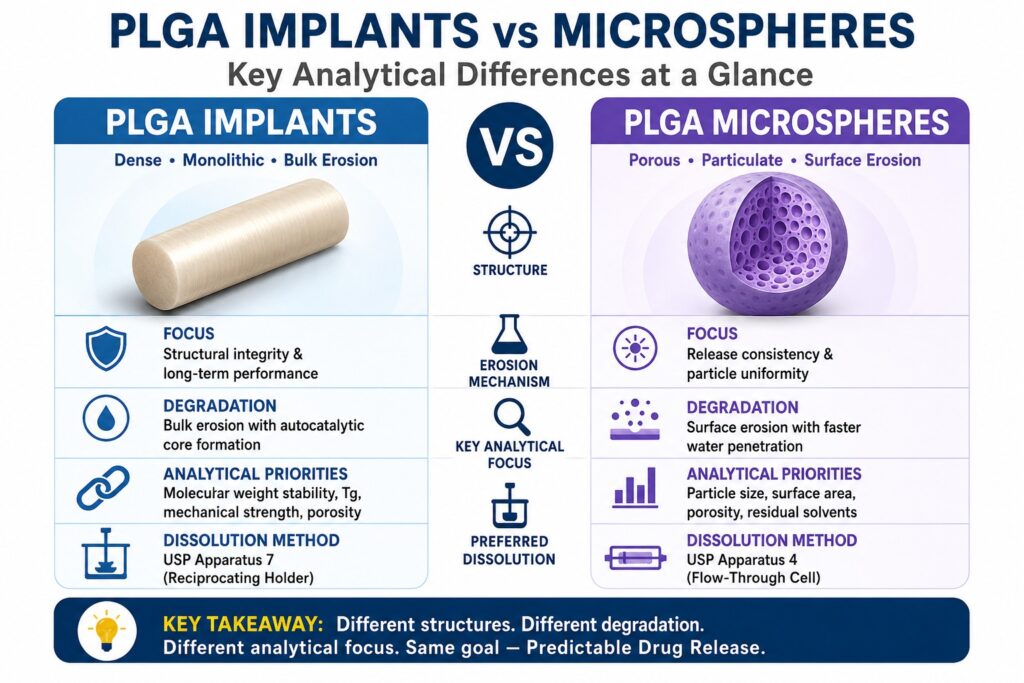
In PLGA Implant vs Microsphere Characterization, the core polymer chemistry may remain the same, but the analytical priorities differ significantly because of the physical structure of each dosage form. Microsphere formulations require detailed analysis of particle size distribution, surface area control, porosity, and the prevention of particle aggregation during dissolution testing. These factors strongly influence burst release behavior and overall release consistency.
Solid PLGA implants, on the other hand, require more extensive evaluation of bulk erosion behavior, mechanical stability, polymer degradation patterns, and autocatalytic core formation. Since implants are designed for prolonged drug delivery, maintaining structural integrity throughout the release period is a critical quality requirement.
Successful development of long-acting PLGA drug delivery systems depends on the use of advanced analytical technologies. Techniques such as GPC-MALS for absolute molecular weight determination, quantitative NMR for polymer sequence analysis, and USP Apparatus 4 and 7 for physiologically relevant dissolution testing play a major role in ensuring product safety, stability, and therapeutic reliability.
As regulatory expectations for long-acting injectable formulations continue to increase, advanced analytical characterization remains essential for developing robust, reproducible, and compliant pharmaceutical products.
For more information about optimizing your PLGA Implant vs Microsphere Characterization strategy, contact the experts at ResolveMass Laboratories: Contact us
Frequently Asked Questions
In PLGA Implant vs Microsphere Characterization, the biggest difference is how acidic degradation products behave inside the polymer matrix. Large implants tend to trap acidic byproducts within the core, creating a low-pH environment that accelerates internal degradation. Microspheres are much smaller, so acidic fragments can diffuse out more easily, resulting in more uniform erosion throughout the particle.
Absolute molecular weight analysis helps researchers accurately evaluate polymer stability and mechanical performance. Methods such as GPC-MALS provide more reliable molecular weight data than standard relative calibration techniques. In implant systems, precise molecular weight monitoring is critical because it helps predict structural weakening, bulk erosion behavior, and the timing of the final drug release phase.
Acid-capped PLGA absorbs water more quickly because of its hydrophilic terminal groups. This usually increases burst release and speeds up overall degradation. Ester-capped PLGA is more hydrophobic, which slows water penetration and extends the release duration, making it useful for formulations that require longer therapeutic activity.
USP Apparatus 4, also called the Flow-Through Cell system, is commonly preferred for microsphere testing. The continuous media flow helps prevent particle aggregation and maintains proper sink conditions during release studies. This setup also improves reproducibility compared to traditional sample-and-separate dissolution methods.
Important CQAs for PLGA include the lactide-to-glycolide ratio, molecular weight distribution, polydispersity index, glass transition temperature, residual monomer levels, and residual catalyst content. These properties strongly influence degradation rate, mechanical stability, and drug release performance. Regulatory agencies expect these parameters to be carefully monitored throughout development and manufacturing.
Residual DCM can act as a plasticizer inside the polymer matrix and reduce the glass transition temperature of PLGA. When the polymer becomes softer, water penetration and drug diffusion increase more rapidly. High solvent levels may therefore cause excessive burst release, faster degradation, and reduced formulation stability during storage.
PLGA 50:50 contains a higher proportion of glycolic acid, which is more hydrophilic than lactic acid. This allows water to enter the polymer matrix more easily and accelerates hydrolysis of ester bonds. PLGA 75:25 contains more lactic acid, making the polymer more hydrophobic and slower to degrade.
Reference:
- U.S. Food and Drug Administration. (2016). FY2016 regulatory science report: Long-acting injectable formulations. U.S. Food and Drug Administration. FDA Long-Acting Injectable Formulations Report
- Son YJ, Yun TH, Lee JG, Bang KH, Kim KS. Development and Characterization of Long-Acting Injectable Risperidone Microspheres Using Biodegradable Polymers: Formulation Optimization and Release Kinetics. Processes. 2024 Dec 13;12(12):2858.https://www.mdpi.com/2227-9717/12/12/2858
- Hua Y, Wang Z, Wang D, Lin X, Liu B, Zhang H, Gao J, Zheng A. Key factor study for generic long-acting PLGA microspheres based on a reverse engineering of Vivitrol®. Molecules. 2021 Feb 25;26(5):1247.https://www.mdpi.com/1420-3049/26/5/1247
- Su ZX, Shi YN, Teng LS, Li X, Wang LX, Meng QF, Teng LR, Li YX. Biodegradable poly (D, L-lactide-co-glycolide)(PLGA) microspheres for sustained release of risperidone: Zero-order release formulation. Pharmaceutical Development and Technology. 2011 Aug 1;16(4):377-84.https://www.tandfonline.com/doi/abs/10.3109/10837451003739297
Get In Touch With Us
About The Author


