

Introduction:
If you work in pharmaceutical formulation, you already know that PLGA in drug delivery isn’t a trend — it’s the established benchmark against which every other biodegradable polymer is measured. Poly(lactic-co-glycolic acid), or PLGA, is a synthetic copolymer made from lactide and glycolide, valued for its ability to degrade gradually while supporting controlled release of an incorporated API. Its prominence doesn’t come from any single property, but from a rare combination: biodegradability, biocompatibility, formulation flexibility, and decades of pharmaceutical development experience. At ResolveMass Laboratories, we support formulation and analytical teams working with PLGA daily — which is exactly why we want to lay out, in practical terms, why this polymer keeps winning the selection process and what still needs careful management once it’s chosen.
Summary:
- PLGA in drug delivery is the most widely used biodegradable polymer because it combines biodegradability, biocompatibility, formulation versatility, and tunable release behavior in one platform.
- It degrades through hydrolysis of its ester bonds, ultimately breaking down into lactic acid and glycolic acid, which the body clears through normal metabolic pathways.
- The lactide-to-glycolide ratio, molecular weight, end-group chemistry, and particle characteristics can all be adjusted to influence degradation speed and release profile.
- PLGA can be formulated into microspheres, nanoparticles, implants, in-situ forming systems, and inhalable microparticles, supporting small molecules, peptides, proteins, and nucleic acids alike.
- Despite its versatility, PLGA is not a plug-and-play excipient — burst release, acidic microenvironments, manufacturing sensitivity, and scale-up variability all need careful evaluation.
- Rigorous analytical characterization (polymer and finished product) is what turns PLGA’s theoretical flexibility into a reproducible, regulatory-ready product.
1: What Is PLGA and Why Is It Used in Drug Delivery?
PLGA is a biodegradable polyester built from lactic- and glycolic-acid-derived units, and it’s used in drug delivery because its degradation and release characteristics can be engineered for different therapeutic requirements rather than being fixed.
The polymer contains hydrolysable ester bonds. In an aqueous physiological environment, these bonds hydrolyze progressively, reducing the polymer’s molecular weight and eventually generating lactic acid and glycolic acid — both of which feed into normal metabolic pathways. Rather than treating PLGA as one uniform material, formulation scientists select a specific grade based on:
- Lactide-to-glycolide ratio
- Molecular weight and molecular-weight distribution
- End-group chemistry
- Intrinsic viscosity
- Particle size and morphology
- Drug loading
- Manufacturing process
These variables collectively govern water uptake, degradation rate, drug diffusion, and erosion — and therefore the final release profile.
2: Why Is PLGA in Drug Delivery So Widely Used?
PLGA is widely used because it offers a rare combination of biodegradability, formulation versatility, tunable degradation, established manufacturing pathways, and an extensive body of pharmaceutical research and clinical experience.
1. Biodegradability
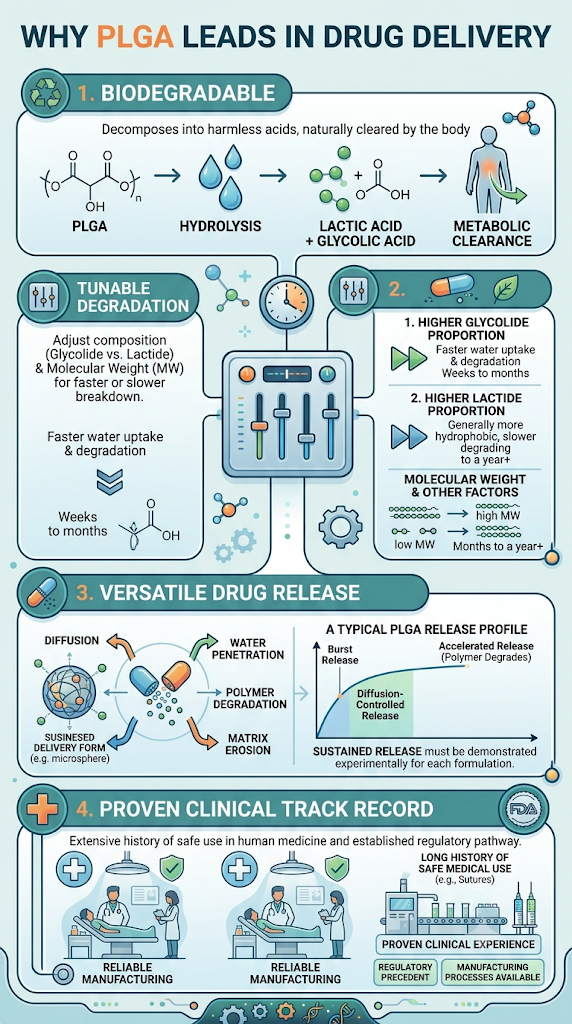
PLGA doesn’t need to remain permanently at the delivery site. It progressively degrades through hydrolysis, following a simplified pathway: PLGA → hydrolysis → lactic acid + glycolic acid → metabolic clearance. This makes it well suited to temporary drug-delivery matrices and depot systems that shouldn’t require surgical removal.
2. Tunable Degradation Rate
Degradation can be adjusted by changing polymer composition and molecular characteristics. Glycolide is more hydrophilic than lactide, so shifting the ratio changes how quickly water penetrates the matrix and triggers hydrolysis.
| PLGA characteristic | General formulation implication |
|---|---|
| Higher glycolide proportion | Often associated with faster water uptake and degradation |
| Higher lactide proportion | Generally more hydrophobic and slower degrading |
| Lower molecular weight | Usually faster degradation |
| Higher molecular weight | Generally slower degradation |
| Different end groups | Can alter polymer-water interactions and degradation |
| Smaller particles | Higher surface-area-to-volume ratio can affect release and degradation |
These relationships are formulation-dependent, not absolute — crystallinity, porosity, drug-polymer interactions, and processing conditions can all shift the observed behavior. This is where a solid understanding of long-acting injectable design becomes essential; see our team’s perspective on PLGA long-acting injectable formulation for a closer look at how these variables come together in practice.
3. Controlled and Sustained Drug Release
Release typically occurs through a combination of diffusion, water penetration, polymer degradation, and matrix erosion — often an initial burst, followed by diffusion-controlled release, then accelerated release as the polymer degrades further. Sustained release should never be assumed just because PLGA is used; it has to be demonstrated experimentally, since composition and processing can substantially change the final profile.
3: How Does the Lactide-to-Glycolide Ratio Affect PLGA Drug Release?
The lactide-to-glycolide ratio affects PLGA’s hydrophilicity, degradation behavior, and therefore its release kinetics — so polymer selection should be linked to the intended release window, not chosen from the ratio alone.
Common grades include 50:50, 65:35, 75:25, and 85:15, with 50:50 typically showing faster degradation than more lactide-rich compositions. In simplified terms: more glycolide tends toward greater hydrophilicity, faster water penetration, and faster degradation; more lactide tends toward the opposite. In practice, the relationship is more complex, which is why experimental characterization of the selected polymer grade — not just its nominal ratio — is non-negotiable.
4: What Types of Drug Delivery Systems Use PLGA?
PLGA can be manufactured into several different dosage-form architectures, which is a major reason it has stayed relevant across both research and commercial pharmaceutical development. Common PLGA-based platforms include:
- Microspheres and microparticles
- Nanoparticles and nanocapsules
- Injectable depot systems
- Implants
- In-situ forming systems
- Composite delivery matrices
- Inhalable microparticle systems
Microspheres remain particularly important for controlled-release applications because size, morphology, polymer grade, and drug loading can all be engineered during formulation. PLGA is also increasingly explored for pulmonary delivery — our overview of PLGA inhalable microparticle development covers some of the specific formulation considerations for that route.
5: PLGA in Drug Delivery for Small Molecules, Peptides, and Proteins
PLGA is versatile enough to support both conventional small molecules and more complex biologic payloads, though each API type brings its own formulation and stability challenges.
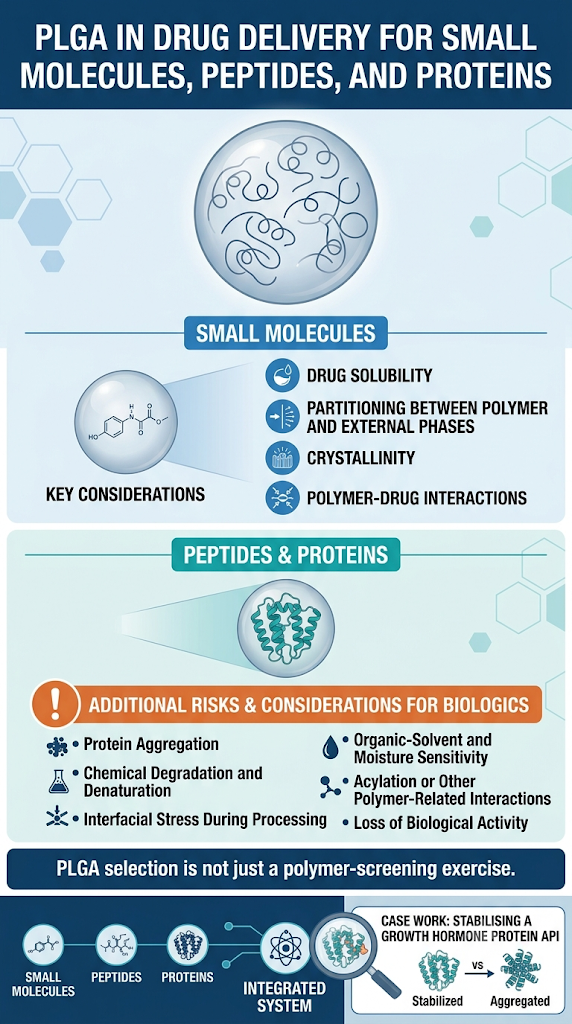
For small molecules, key considerations include drug solubility, partitioning between the polymer and external phases, crystallinity, and polymer-drug interactions. For peptides and proteins, additional risks come into play, including:
- Protein aggregation
- Chemical degradation and denaturation
- Interfacial stress during processing
- Organic-solvent and moisture sensitivity
- Acylation or other polymer-related interactions
- Loss of biological activity
These risks mean PLGA selection is never just a polymer-screening exercise — the API, polymer, manufacturing process, and target release profile all need to be evaluated as one integrated system. This is especially true for sensitive biologics; our case work on stabilising a growth hormone protein API illustrates how these interactions play out with a real protein therapeutic.
6: What Makes PLGA Different From Other Biodegradable Polymers?
PLGA’s main differentiator is the combination of established biodegradability with the ability to tune its physical and degradation properties through composition and formulation design.
| Property | PLGA | PLA | Natural polymers |
|---|---|---|---|
| Biodegradability | Yes | Yes | Depends on material |
| Synthetic composition control | High | High | Generally lower |
| Degradation tuning | High | Moderate–high | Material dependent |
| Microsphere/nanoparticle applications | Extensive | Extensive | Extensive |
| Controlled-release applications | Extensive | Extensive | Material dependent |
| Pharmaceutical research history | Extensive | Extensive | Extensive |
| Suitability for peptides/proteins | Demonstrated | Demonstrated | Material dependent |
This comparison is conceptual — the right polymer ultimately depends on the API, route of administration, target release period, manufacturing process, and regulatory strategy.
7: How Is PLGA Characterized During Drug Delivery Development?
PLGA-based systems require analytical characterization of both the raw polymer and the finished formulation, because polymer properties directly determine product performance.
Polymer characterization typically covers:
- Molecular weight and molecular-weight distribution
- Lactide/glycolide ratio
- Intrinsic viscosity
- End-group characterization
- Residual monomers and solvents
- Thermal properties and moisture content
Finished formulation characterization typically covers:
- Particle size distribution and morphology
- Drug loading and encapsulation efficiency
- Assay and related substances
- In-vitro drug release
- Polymer molecular-weight change during stability testing
Depending on the formulation, tools such as HPLC, LC-MS, GC, GPC/SEC, DSC, TGA, and Karl Fischer analysis all contribute to this picture. A documented Certificate of Analysis for pharmaceutical-grade PLGA is the practical starting point — it’s what confirms the polymer grade you’re formulating with actually matches what your release and stability studies were built on.
8: What Are the Main Challenges of PLGA in Drug Delivery?
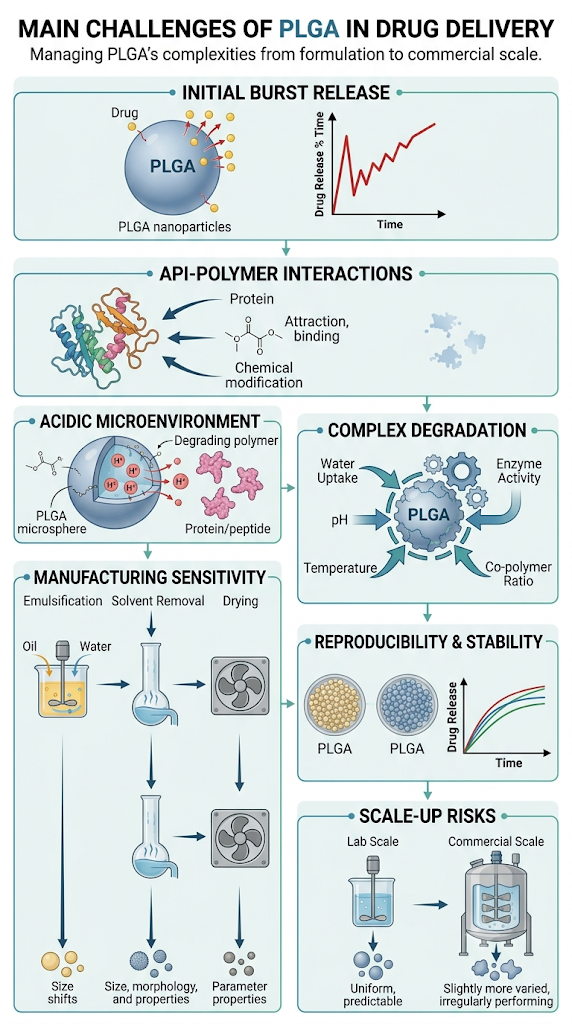
PLGA offers real formulation flexibility, but developers still have to manage burst release, degradation-related changes, API stability, and manufacturing variability. Common challenges include:
- Initial burst release — drug near or on the particle surface can release rapidly before sustained release begins
- Complex degradation — influenced by multiple material and physiological factors simultaneously
- API-polymer interactions — especially relevant for peptides and proteins
- Acidic microenvironment — degradation byproducts can alter the local environment inside particles, potentially affecting sensitive APIs
- Manufacturing sensitivity — emulsification, solvent removal, drying, and mixing parameters can all shift particle properties
- Scale-up — a formulation that performs well at lab scale may behave differently at commercial volume
- Reproducibility and stability — small shifts in polymer grade or process can change release performance over time
Scale-up is often where these risks compound. Our breakdown of scaling PLGA microsphere manufacturing walks through how to carry a formulation from bench to larger batch sizes without losing the release profile you validated early on.
9: Why Is PLGA Important for Advanced Drug Delivery Development?
PLGA remains important because its well-established chemistry can be paired with modern formulation and analytical technology to build increasingly sophisticated delivery systems. Current research continues to explore PLGA nanoparticles, microspheres, and implants for oncology, neurological disease, inflammation, and biologic delivery.
The next phase of PLGA development is less about proving the polymer can deliver a drug, and more about achieving predictable, reproducible, and scalable performance — which is exactly where GMP-grade material sourcing matters. For programs moving into clinical supply, our resource on GMP-grade PLGA for Phase II/III clinical supply covers what to look for in a supplier at that stage.
10: PLGA in Drug Delivery: Key Factors to Evaluate
When selecting PLGA for a new program, developers should weigh:
- API characteristics — solubility, stability, potency, and sensitivity
- Polymer grade — lactide/glycolide ratio, molecular weight, end groups, viscosity
- Desired release period — days, weeks, or months
- Dosage form — nanoparticle, microsphere, implant, or inhalable microparticle
- Encapsulation efficiency — whether the manufacturing process delivers acceptable drug incorporation
- Release behavior — burst release, sustained release, total drug recovery
- Stability — physical and chemical stability of both polymer and API
- Manufacturing scalability — reproducibility from lab to larger-scale batches
- Analytical strategy — orthogonal methods to characterize polymer, API, and impurities
Conclusion:
PLGA in drug delivery remains the most widely used biodegradable polymer because it combines biodegradability, biocompatibility, formulation versatility, tunable degradation, and an extensive base of pharmaceutical development experience. Its lactide-to-glycolide ratio, molecular weight, end-group chemistry, and particle characteristics can all be adjusted to fit a specific release target — but none of that flexibility is automatic. Successful development depends on understanding how polymer properties, formulation design, manufacturing conditions, and analytical data connect to real release performance.
Frequently Asked Questions:
PLGA formulations can be optimized by systematically evaluating polymer grade, polymer concentration, API-to-polymer ratio, particle size, processing parameters, drug loading, encapsulation efficiency, and release kinetics. A Quality by Design approach can help connect critical material attributes and process parameters with critical quality attributes.
Analytical testing helps establish the identity, purity, physical properties, stability, degradation behavior, drug loading, and release performance of PLGA-based formulations. Orthogonal analytical methods can provide a more comprehensive understanding of both the polymer and the incorporated API.
PLGA remains important because it provides a flexible biodegradable platform that can be engineered for different drug-release objectives. Its extensive scientific and pharmaceutical development history also provides a substantial knowledge base for formulation development, characterization, and process optimization.
Yes. PLGA molecular weight can influence water penetration, polymer degradation, matrix erosion, and drug diffusion. Higher-molecular-weight polymers generally degrade more slowly than lower-molecular-weight polymers, although the final release profile also depends on other formulation and processing variables.
PLGA can be characterized using analytical techniques that assess molecular weight, molecular-weight distribution, monomer ratio, viscosity, end-group chemistry, residual solvents, moisture, and thermal behavior. Depending on the formulation, techniques may include GPC/SEC, HPLC, GC, DSC, TGA, Karl Fischer analysis, microscopy, and particle-size analysis.
Reference
- Thomas CM, Lutz JF. Precision synthesis of biodegradable polymers. Angewandte Chemie International Edition. 2011 Sep 26;50(40):9244-6.https://www.academia.edu/download/39997587/Precision_Synthesis_of_Biodegradable_Pol20151114-24061-c6du05.pdf
- Bala I, Hariharan S, Kumar MR. PLGA nanoparticles in drug delivery: the state of the art. Critical Reviews™ in Therapeutic Drug Carrier Systems. 2004;21(5).https://www.dl.begellhouse.com/journals/3667c4ae6e8fd136,3531fe42318c587e,108d6b8570af47da.html
- Yang J, Zeng H, Luo Y, Chen Y, Wang M, Wu C, Hu P. Recent applications of PLGA in drug delivery systems. Polymers. 2024 Sep 14;16(18):2606.https://www.mdpi.com/2073-4360/16/18/2606
- Xu Y, Kim CS, Saylor DM, Koo D. Polymer degradation and drug delivery in PLGA‐based drug–polymer applications: A review of experiments and theories. Journal of biomedical materials research part B: applied biomaterials. 2017 Aug;105(6):1692-716.https://onlinelibrary.wiley.com/doi/abs/10.1002/jbm.b.33648
About the Author


