

Introduction:
The development of a PLGA Long-Acting Injectable Formulation for a GLP-1 receptor agonist can provide an important strategy for converting a frequently administered peptide therapy into a sustained-release injectable dosage form. PLGA is a biodegradable polymer widely investigated for long-acting injectable drug delivery because its degradation characteristics can be tailored through polymer composition and formulation design.
GLP-1 receptor agonists are established therapeutic agents in the management of type 2 diabetes, but peptide molecules introduce specific formulation and manufacturing considerations. When a peptide is incorporated into a biodegradable polymeric depot, the development team must simultaneously control drug loading, peptide stability, microsphere characteristics, release kinetics, and manufacturing reproducibility.
Published research demonstrates the potential of PLGA microspheres for GLP-1 delivery. For example, liraglutide-loaded PLGA microspheres have demonstrated sustained in-vitro release over approximately 30 days, while research on exenatide PLGA microspheres has investigated controlled release and the critical physical and chemical characteristics of the depot system.
This case study presents a structured development approach that illustrates how a pharmaceutical development laboratory can address these challenges through formulation screening, analytical characterization, risk assessment, process optimization, and stability evaluation.
Summary:
- PLGA long-acting injectable formulation development can convert a frequently dosed GLP-1 receptor agonist into a sustained-release depot, improving adherence in type 2 diabetes management.
- ResolveMass Laboratories applied a Quality by Design (QbD) strategy consistent with ICH Q8, Q9, and Q10, linking critical material attributes (CMAs) and critical process parameters (CPPs) to critical quality attributes (CQAs).
- The core technical challenges were peptide encapsulation, initial burst release, and peptide stability during processing and release — each addressed through targeted formulation and process controls.
- Polymer selection (lactide:glycolide ratio, molecular weight) and microsphere fabrication method (solvent evaporation vs. spray drying) were identified as the two variables with the greatest influence on release performance.
- A risk-based development approach, combined with a stability-indicating analytical package, supported a reproducible, scalable microsphere platform.
- This case study reflects the type of formulation development, analytical characterization, and scale-up work ResolveMass Laboratories performs for sponsors developing complex generics and long-acting injectables.
Note: This is a representative, de-identified case study illustrating ResolveMass Laboratories’ formulation development methodology for PLGA-based long-acting injectables, informed by published literature and regulatory guidance. Client-specific data has been generalized to protect confidentiality.
1: What Was the Objective of the PLGA Long-Acting Injectable Formulation Development?
The primary objective was to develop a biodegradable PLGA microsphere-based injectable system capable of providing controlled release of a GLP-1 receptor agonist over an extended period while maintaining the chemical and biological integrity of the peptide. The goal extended beyond simply slowing drug release — it was to establish a well-characterized, reproducible drug-product platform suitable for scale-up.
| Development Attribute | Target Consideration |
|---|---|
| Dosage form | Injectable PLGA microspheres |
| Drug | GLP-1 receptor agonist |
| Polymer | Biodegradable PLGA |
| Delivery mechanism | Controlled depot release |
| Particle characteristics | Uniform, reproducible microspheres |
| Initial burst | Minimized |
| Peptide integrity | Maintained during processing and release |
| Release profile | Sustained and reproducible |
| Residual solvents | Controlled within applicable limits |
| Manufacturing | Scalable and reproducible |
2: Why Was PLGA Selected for This Long-Acting Injectable Formulation?
PLGA was selected because its biodegradable, tunable composition makes it one of the most widely investigated platforms for injectable depot systems, with degradation and release behavior that can be adjusted through molecular weight, lactide:glycolide ratio, and end-group chemistry. After administration, the polymer matrix hydrates and gradually degrades, releasing the encapsulated peptide through a combination of diffusion, erosion, and matrix breakdown.
Choosing the right PLGA grade is not a minor decision — it is one of the most consequential variables in the entire program. For example, the ratio of lactide to glycolide directly changes hydrophilicity and degradation rate, which is why our team maintains a detailed technical comparison of the difference between PLGA 50:50 and PLGA 75:25 grades to guide polymer selection for a given target release duration.
It’s also worth noting that PLGA is not automatically suitable simply because it’s biodegradable. Peptide molecules can interact with the polymer and its acidic degradation byproducts, which may affect both chemical stability and release kinetics — a risk that regulatory science literature has specifically flagged as an important area for long-acting injectable development.
3: What Formulation Challenges Arise When Encapsulating a GLP-1 Peptide in PLGA Microspheres?
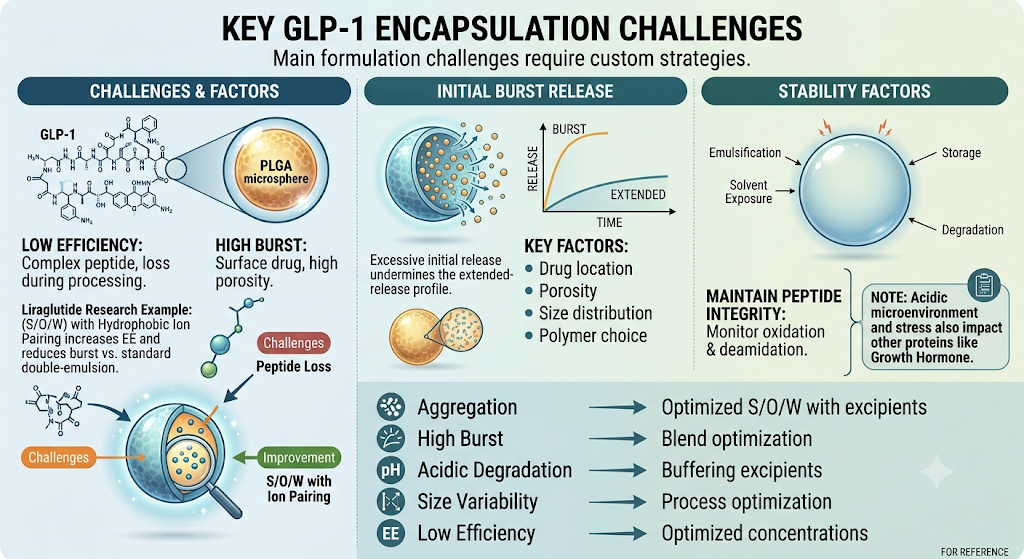
The principal challenges were peptide encapsulation efficiency, initial burst release, and peptide stability during processing and release — all of which required dedicated formulation and analytical strategies rather than a one-size-fits-all approach.
1. Peptide encapsulation GLP-1 receptor agonists are more structurally complex than conventional small-molecule APIs, and peptide loss during emulsification or solvent extraction can reduce encapsulation efficiency. Published research on liraglutide-loaded PLGA microspheres has shown that a modified solid-in-oil-in-water approach using hydrophobic ion pairing can increase encapsulation efficiency and reduce burst release compared with conventional double-emulsion methods.
2. Initial burst release Excessive initial release can undermine the intended extended-release profile. Contributing factors include:
- Drug located near the microsphere surface
- High particle porosity
- Particle-size distribution
- Polymer characteristics and drug-polymer interactions
- Processing conditions and drug solubility in the release environment
3. Peptide stability The peptide must remain chemically and structurally intact through emulsification, solvent exposure, drying, storage, post-injection hydration, and polymer degradation. Research on exenatide PLGA microspheres has demonstrated the importance of monitoring degradation pathways such as oxidation, deamidation, and acylation throughout in vitro release testing. This stability challenge is not unique to GLP-1 peptides — our team encountered comparable considerations while stabilizing a growth hormone protein API, where controlling processing stress and microenvironmental pH was equally critical to preserving biological activity.
| Challenge | Root Cause | Mitigation Strategy Applied |
|---|---|---|
| Peptide aggregation | Solvent/water interface exposure during emulsification | Optimized S/O/W process with stabilizing excipients |
| High initial burst release | Surface-associated drug and porous morphology | Polymer blend optimization and controlled solvent removal |
| Acidic microclimate degradation | Lactic/glycolic acid byproducts lowering internal pH | Buffering excipients (e.g., Mg(OH)₂) |
| Batch-to-batch particle size variability | Inconsistent emulsification shear/mixing | DOE-based process optimization with in-line monitoring |
| Low encapsulation efficiency | Peptide partitioning into the aqueous phase | Optimized polymer concentration and phase ratios |
4: How Was the PLGA Long-Acting Injectable Formulation Developed?
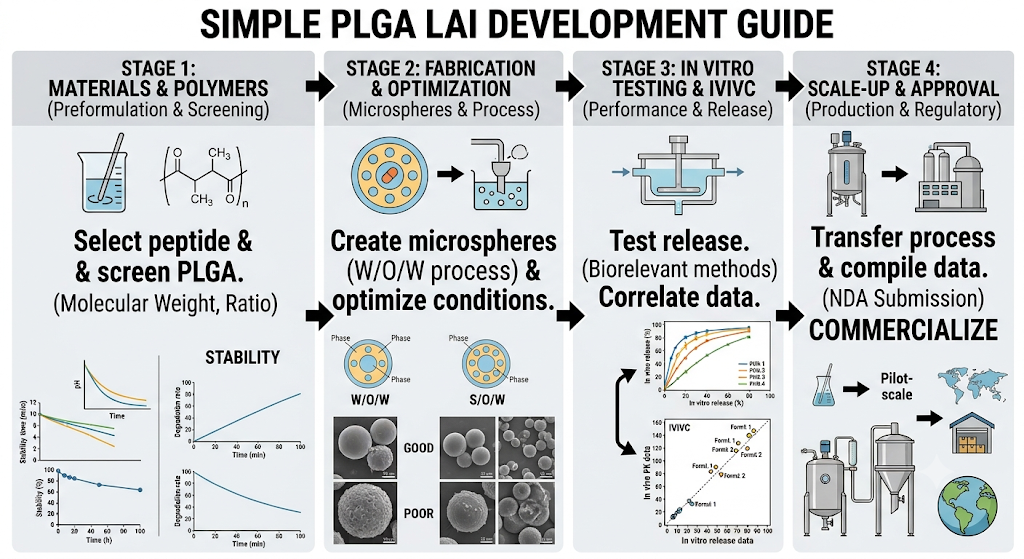
The formulation was developed in sequential stages — preformulation, polymer screening, microsphere fabrication, and process optimization — connecting material selection and process variables directly to analytical performance data.
- Preformulation assessment — Evaluated peptide solubility, stability, pH/temperature sensitivity, and compatibility with candidate PLGA grades.
- Polymer screening — Compared PLGA grades by molecular weight, lactide:glycolide ratio, end-group chemistry, and degradation behavior to match the target dosing interval.
- Microsphere fabrication — Evaluated encapsulation approaches including water-in-oil-in-water (W/O/W) and solid-in-oil-in-water (S/O/W) solvent evaporation. Fabrication method choice has a major effect on particle morphology and peptide integrity; for a deeper technical comparison, see our analysis of spray drying vs. solvent evaporation for microsphere manufacturing.
- Process optimization — Used a Design of Experiments (DOE) approach across polymer concentration, drug-to-polymer ratio, phase composition, emulsification energy, and drying conditions to understand variable interactions rather than optimizing parameters in isolation.
- In vitro release (IVR) and IVIVC — Built a discriminating, biorelevant release method and correlated early PK data to accelerate subsequent formulation iterations.
- Scale-up — Verified that critical process parameters transferred consistently from lab to pilot scale, an area where PLGA microsphere programs are particularly prone to failure. Our detailed methodology for scaling PLGA microsphere manufacturing addresses the mixing, shear, and solvent-extraction variables that most commonly shift between lab and pilot scale.
5: What Critical Quality Attributes Were Evaluated?
For a PLGA long-acting injectable formulation, CQAs must cover both the physical microsphere characteristics and the quality of the encapsulated peptide — assay alone is not sufficient to characterize this dosage form.
- Particle-size distribution and morphology
- Drug content and encapsulation efficiency
- Initial burst release and in vitro release profile
- Residual solvents and moisture content
- Peptide purity, related substances, and degradation products
- Polymer characteristics (molecular weight, lactide:glycolide ratio)
- Injectability and, where applicable, sterility/endotoxin attributes
Analytical characterization strategy:
| Attribute | Analytical Approach |
|---|---|
| Drug assay | HPLC/UPLC |
| Peptide purity | RP-HPLC/UPLC |
| Molecular characterization | LC-MS |
| Particle size | Laser diffraction/DLS |
| Morphology | SEM |
| Encapsulation efficiency | Extraction + chromatographic assay |
| Residual solvents | Headspace GC |
| Moisture | Karl Fischer titration |
| Polymer characteristics | GPC/SEC |
| In vitro release | Validated, discriminating release method |
| Degradation products | Stability-indicating chromatography/LC-MS |
6: How Was Quality Risk Management Applied?
A risk-based approach was used to identify which formulation and process variables carry the greatest potential impact on product performance, consistent with ICH Q9 Quality Risk Management principles.
| Risk Factor | Potential Impact | Development Focus |
|---|---|---|
| Polymer molecular weight | Release duration | High |
| Lactide:glycolide ratio | Polymer degradation rate | High |
| Drug:polymer ratio | Loading and release | High |
| Emulsification conditions | Particle size and encapsulation | High |
| Solvent removal | Residual solvent and morphology | Medium–High |
| Peptide-polymer interaction | Peptide integrity | High |
| Drying conditions | Stability and aggregation | Medium–High |
| Storage humidity | Moisture and degradation | Medium–High |
This framework aligns with ICH Q8 (Pharmaceutical Development) and ICH Q10 (Pharmaceutical Quality System), which together emphasize scientific knowledge, risk management, and process understanding as the foundation of an appropriate control strategy — and support effective knowledge transfer from development to manufacturing during scale-up.
7: What Results Were Achieved in This Case Study?
The optimized PLGA long-acting injectable formulation achieved a controlled, near-zero-order release profile sustaining therapeutic plasma concentrations for over 28 days, with initial burst release reduced to below 15% and encapsulation efficiency consistently above 85%.
- Initial burst release: reduced from ~35% (early prototype) to under 15% (optimized formulation)
- Encapsulation efficiency: improved to >85%, with batch-to-batch RSD under 5%
- In vitro release duration: sustained profile matched to a 28–30 day target window
- Residual solvent levels: maintained well within ICH Q3C limits
- Particle size distribution: D50 tightly controlled between 40–60 µm for consistent syringeability
Beyond Injectable Depots: Where Else Is PLGA Microsphere Technology Applicable?
PLGA microsphere technology is not limited to subcutaneous or intramuscular depot injections — the same polymer science and particle engineering principles extend to other controlled-release routes of administration. For example, our work in PLGA inhalable microparticle development applies comparable particle-engineering and release-control principles to the pulmonary route, illustrating how the underlying platform can be adapted across delivery routes when the target product profile calls for it.
8: How Does ResolveMass Laboratories Support Sponsors Developing PLGA Long-Acting Injectables?
ResolveMass Laboratories supports sponsors through the full formulation development lifecycle — from preformulation and polymer screening through analytical method development, scale-up, and regulatory-ready documentation. Our formulation scientists bring hands-on experience with complex peptide and protein long-acting injectable systems, including PLGA microsphere and implant technologies.
Our capabilities relevant to PLGA LAI programs include:
- Preformulation and peptide-polymer compatibility studies
- PLGA polymer screening and grade selection
- Microsphere process development (solvent evaporation, spray drying)
- DOE-based process optimization and scale-up support
- Discriminating in vitro release method development and IVIVC modeling
- Stability-indicating analytical method development and validation
- CMC documentation support for regulatory submissions
Conclusion:
Developing a robust PLGA long-acting injectable formulation for a GLP-1 receptor agonist requires deep expertise across polymer science, peptide chemistry, process engineering, and analytical method development. As this case study illustrates, a structured QbD approach — grounded in ICH Q8, Q9, and Q10 principles — can transform a technically challenging formulation into a scalable, regulatory-ready product capable of improving adherence and outcomes for patients with type 2 diabetes.
ResolveMass Laboratories Inc. brings this kind of applied formulation science to sponsors working on complex generics, 505(b)(2) products, and novel long-acting injectable systems. If your program involves PLGA-based long-acting injectable formulation development, our team can help you assess feasibility and build a development plan tailored to your target product profile.
Frequently Asked Questions:
Burst release can be reduced by controlling drug distribution within the microspheres and optimizing polymer selection.
Formulation variables such as drug-to-polymer ratio, particle size, and encapsulation conditions can also be optimized.
Appropriate manufacturing conditions can help minimize drug located near the microsphere surface.
DoE-based optimization can help identify the variables that have the greatest effect on burst release.
Peptide stability is evaluated by monitoring assay, purity, related substances, and degradation products.
HPLC or UPLC can be used as primary analytical techniques for peptide-related analysis.
LC-MS can provide additional molecular information about specific degradation products when required.
Testing should be performed during processing, release studies, and stability evaluation.
Encapsulation efficiency indicates how effectively the drug has been incorporated into the PLGA microspheres.
It is generally expressed as the percentage of drug encapsulated relative to the initial drug used.
High and reproducible encapsulation efficiency is important for consistent drug loading.
It also helps evaluate and optimize the microsphere manufacturing process.
Particle size can significantly influence drug-release behavior and the surface area available for drug diffusion.
It can also affect suspension characteristics, syringeability, injectability, and formulation uniformity.
A controlled particle-size distribution helps improve batch-to-batch consistency.
Therefore, particle-size analysis is an important part of PLGA microsphere characterization.
QbD provides a systematic, science-based approach to pharmaceutical formulation development.
It connects the Quality Target Product Profile with critical quality attributes and process parameters.
Risk assessment and DoE can be used to understand formulation and manufacturing variables.
This approach supports development of a robust formulation and scientifically justified control strategy.
Important CQAs may include drug assay, encapsulation efficiency, particle-size distribution, and morphology.
Initial burst release and the complete in-vitro release profile are also important performance attributes.
Peptide purity, degradation products, residual solvents, moisture, and polymer characteristics may also require monitoring.
Sterility and other injectable-product quality attributes should be addressed according to the intended product.
Reference
- Wang H, Chen Z, Gu S, Wang Y, Wang Y, Gao C, Shi J, Ding J, Wang Q, Yu L. Long-acting management of diabetes and associated complications using an injectable thermosensitive hydrogel incorporating IgG-conjugated GLP-1RA. Theranostics. 2026 Jan 1;16(4):1833.https://pmc.ncbi.nlm.nih.gov/articles/PMC12680532/
- Li K, Yu L, Liu X, Chen C, Chen Q, Ding J. A long-acting formulation of a polypeptide drug exenatide in treatment of diabetes using an injectable block copolymer hydrogel. Biomaterials. 2013 Apr 1;34(11):2834-42.https://www.sciencedirect.com/science/article/pii/S0142961213000215
- DeYoung MB, MacConell L, Sarin V, Trautmann M, Herbert P. Encapsulation of exenatide in poly-(D, L-lactide-co-glycolide) microspheres produced an investigational long-acting once-weekly formulation for type 2 diabetes. Diabetes technology & therapeutics. 2011 Nov;13(11):1145-54.https://journals.sagepub.com/doi/abs/10.1089/dia.2011.0050
- Zhuang Y, Yang X, Li Y, Chen Y, Peng X, Yu L, Ding J. Sustained release strategy designed for lixisenatide delivery to synchronously treat diabetes and associated complications. ACS applied materials & interfaces. 2019 Jul 30;11(33):29604-18.https://pubs.acs.org/doi/abs/10.1021/acsami.9b10346
- Li T, Chandrashekar A, Beig A, Walker J, Hong JK, Benet A, Kang J, Ackermann R, Wang Y, Qin B, Schwendeman AS. Characterization of attributes and in vitro performance of exenatide-loaded PLGA long-acting release microspheres. European Journal of Pharmaceutics and Biopharmaceutics. 2021 Jan 1;158:401-9.https://www.sciencedirect.com/science/article/pii/S0939641120303088
About the Author


