


Introduction:
The development of long-acting injectables (LAIs) relies on careful design and optimization of poly(lactic-co-glycolic acid) (PLGA) systems to achieve controlled and predictable drug release over long periods. PLGA Microsphere Formulation Development plays a key role in ensuring that drugs are released at the right rate, helping maintain stable drug levels in the body. These systems are widely used in the treatment of chronic diseases, where consistent dosing is essential for better outcomes.
In recent years, improvements in formulation technologies and analytical tools have made these delivery systems more reliable and easier to scale for commercial production. This article provides a clear and professional overview of PLGA microsphere development, including polymer science, manufacturing techniques, and regulatory requirements. The goal is to present practical insights while maintaining a strong focus on quality, performance, and patient safety.
Learn more about our specialized services: Explore Formulating Highly Potent APIs Using PLGA Microspheres
Share via:
PLGA Microsphere Formulation Development: A Strategic Technical Overview
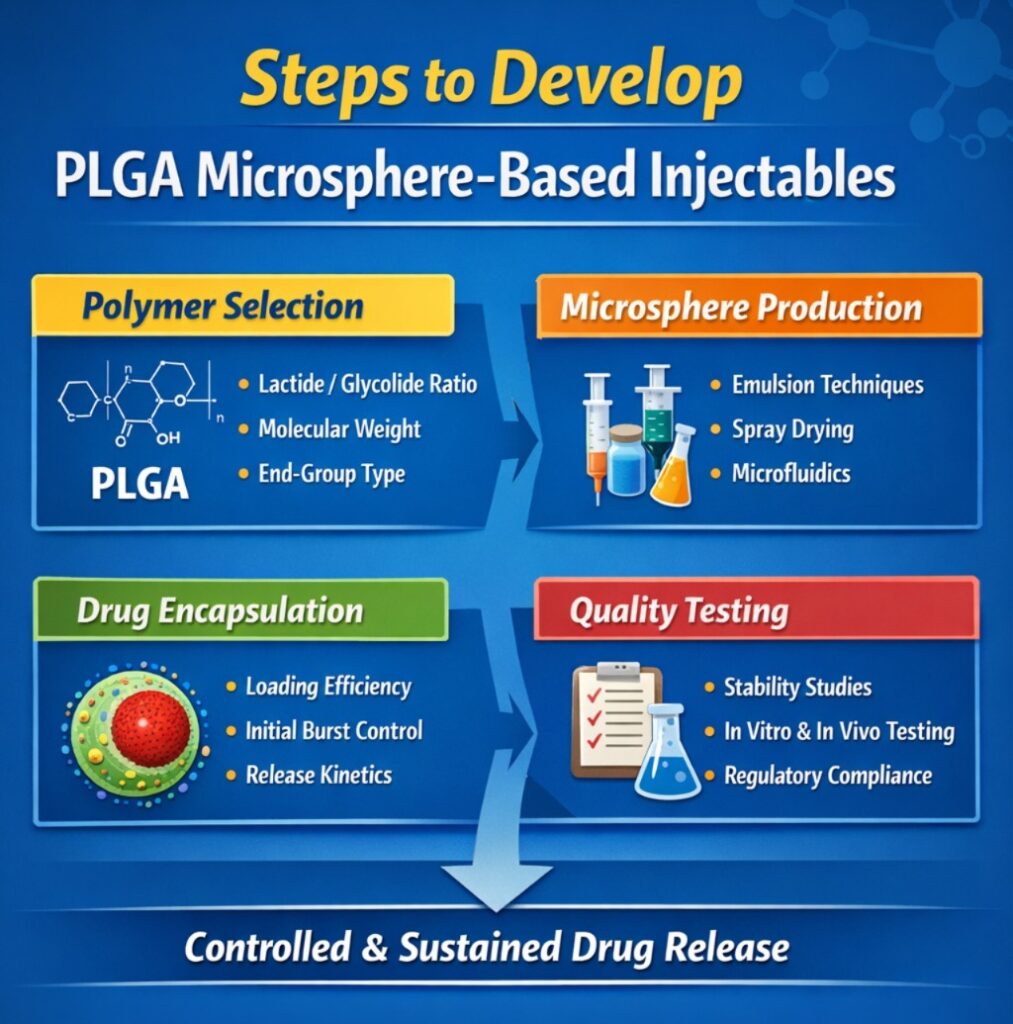
PLGA Microsphere Formulation Development combines polymer science, particle engineering, and analytical testing to create effective long-acting drug delivery systems. In this approach, active pharmaceutical ingredients (APIs) are encapsulated within a biodegradable polymer matrix. This allows controlled drug release, reduces dosing frequency, and improves patient compliance, especially in long-term treatments.
This strategy is highly useful in areas such as oncology, endocrinology, and psychiatry, where consistent medication use is often challenging. With modern advancements, it is now possible to include a wide range of drugs, including biologics and small molecules, within PLGA systems.
The performance of these injectables depends on both the stability of the drug and the degradation behavior of the polymer. Advanced tools like Design of Experiments (DoE) help optimize formulations by studying how different factors interact. In addition, predictive modeling and in vitro–in vivo correlation (IVIVC) methods are used to improve accuracy and reduce development time.
Discover the potential of PLGA in parenteral applications: PLGA (Polylactic-co-Glycolic Acid) for Parenteral Use
The Role of PLGA Polymers in Controlled Drug Release
PLGA polymers are widely used because they naturally break down into lactic acid and glycolic acid, which are safe for the body. This degradation happens through hydrolysis and leads to a controlled drug release pattern. Typically, this includes an initial burst, followed by a steady release phase, and finally a slow erosion phase.
This type of release helps maintain consistent drug levels while reducing side effects caused by sudden spikes. Because of these advantages, PLGA is considered one of the best materials for long-acting injectable formulations.
As water enters the polymer matrix, it reduces the glass transition temperature and starts the degradation process. Over time, the polymer chains break into smaller fragments that dissolve in the body. Understanding this process is very important for designing formulations with stable and predictable performance.
Technical Insight: The Role of PLGA Polymer Grade in Long-Acting Release Formulations
Polymer Physicochemical Properties and Selection Criteria in PLGA Microsphere Formulation Development
Choosing the right PLGA polymer is a critical step in PLGA Microsphere Formulation Development. The physical and chemical properties of the polymer directly affect how the drug is released and how the microspheres behave. Important factors include monomer ratio, molecular weight, end-group type, and viscosity.
Each of these properties influences the strength, porosity, and drug-loading capacity of the microspheres. Proper selection ensures that the formulation meets the desired therapeutic goals while maintaining stability and compatibility with the API.
Optimize your formulation efficiency: Understanding PLGA Drug Loading Strategies
Influence of Lactide to Glycolide (L:G) Ratio
The lactide-to-glycolide ratio is one of the most important factors in controlling polymer degradation. Lactide is more hydrophobic, which slows down water absorption, while glycolide increases hydrophilicity and speeds up degradation.
For example, a 50:50 ratio degrades quickly, making it suitable for short-term release. In contrast, higher lactide content allows for longer drug release periods. This flexibility helps formulators design products for different treatment durations while maintaining stability and performance.
| PLGA Ratio | Degradation Timeframe | Hydrophilicity | Typical Applications |
|---|---|---|---|
| 50:50 | 3–4 weeks | Highest | Vaccines, short-term peptide delivery |
| 65:35 | 6–9 weeks | Intermediate | Tissue engineering, medium-term depots |
| 75:25 | 2–3 months | Moderate | Monthly antipsychotics, monthly hormonal therapy |
| 85:15 | 3–6 months | Low | Long-acting orthopedic or ocular implants |
| 100:0 (PLA) | >6 months | Lowest | Years-long delivery, orthopedic devices |
Molecular Weight and Inherent Viscosity (IV)
Molecular weight affects both the strength and degradation rate of the polymer. High molecular weight PLGA forms stronger microspheres and provides slower drug release. Lower molecular weight polymers degrade faster and release drugs more quickly.
Inherent viscosity is often used as an indirect measure of molecular weight. By adjusting viscosity, scientists can control particle formation and ensure consistent results across batches, which is essential for large-scale production.
Overcome solubility challenges: PlGA Solubility Enhancement Techniques
End-Group Chemistry: Acid vs. Ester Termination
End-group chemistry also plays an important role in polymer behavior. Acid-terminated PLGA absorbs water more easily and degrades faster, while ester-terminated PLGA provides a slower and more controlled release.
The choice depends on the type of drug and the desired release profile. Interactions between the polymer and drug can also affect encapsulation efficiency and long-term stability, making this factor important during formulation design.
| Feature | Acid-Terminated (e.g., RG 502 H) | Ester-Terminated (e.g., RG 502) |
|---|---|---|
| Hydrophilicity | High | Low |
| Initial Burst | Generally higher | Generally lower |
| Release Profile | Faster, triphasic | Slower, smoother |
| Stability | Can interact with basic drugs | Often better for neutral drugs |
Advanced Manufacturing Methodologies in PLGA Microsphere Formulation Development
Manufacturing methods are selected based on the properties of the drug, such as solubility and heat sensitivity. Traditional emulsion methods are still widely used, but newer technologies offer better control and efficiency.
Modern approaches like microfluidics and supercritical fluid extraction improve particle uniformity and drug distribution. These methods also help solve common issues like variability and low encapsulation efficiency. Continuous manufacturing is becoming more popular due to its scalability and consistency.
Double Emulsion Solvent Evaporation (W/O/W)
This method is commonly used for hydrophilic drugs such as proteins and peptides. The drug is placed in an internal water phase, which is then surrounded by polymer and another water phase.
This structure helps protect sensitive drugs during processing. However, preventing drug leakage is a challenge, and careful optimization is required to improve efficiency and maintain drug stability.
Single Emulsion Solvent Evaporation (O/W)
The O/W method is suitable for hydrophobic drugs. Both the drug and polymer are dissolved in an organic solvent, which is then emulsified in water.
As the solvent evaporates, solid microspheres are formed. This method is simple, reliable, and widely used in commercial production due to its high efficiency and scalability.
Read a detailed technical analysis: Reverse Engineering of PLGA Polymer in Lupron Depot Case Study
Spray Drying and SFEE Technology
Spray drying is a fast method that produces uniform microspheres in a single step. However, temperature control is important to protect sensitive drugs.
Supercritical Fluid Extraction of Emulsion (SFEE) uses carbon dioxide to remove solvents quickly, resulting in dense particles with reduced initial burst release. Both methods are increasingly used in industrial applications.
Microfluidics and Precision Engineering
Microfluidics allows precise control over particle formation using very small channels. This produces highly uniform microspheres with consistent drug release profiles.
Although initially limited to small-scale use, recent advancements have made it possible to scale up this technology. It represents a major step forward in precision drug delivery systems.
Critical Process Parameters (CPPs) in PLGA Microsphere Formulation Development
Controlling process parameters is essential to ensure consistent product quality. Even small changes can affect particle size, drug distribution, and release behavior.
Advanced monitoring tools are now used to maintain control during manufacturing. These tools help ensure that every batch meets the required standards.
Homogenization and Stirring Rates
Homogenization speed affects particle size and drug encapsulation. Higher speeds create smaller particles but may increase drug loss. Lower speeds produce larger particles with slower release.
Stirring rates must also be carefully controlled to prevent aggregation and ensure uniform microsphere formation.
| Parameter | Optimized Range | Effect on CQAs |
| Primary Homogenization | 10,000–20,000 rpm | Increases EE for biologics by refining W1 droplets. |
| Secondary Homogenization | 5,000–10,000 rpm | Determines the average microsphere diameter (D{50}). |
| Stirring Speed | 300–800 rpm | Prevents aggregation during the solidification phase. |
| Solvent Removal Rate | 4–6 hours | Slower removal leads to denser matrices and lower burst release. |
Solvent Systems and Volatility
The choice of solvent influences particle formation and residual solvent levels. Dichloromethane is commonly used, but safer alternatives like ethyl acetate are becoming more popular due to regulatory concerns.
Selecting the right solvent helps ensure both product quality and compliance with safety guidelines.
| Solvent | Volatility | Regulatory Class | Impact on Formulation |
|---|---|---|---|
| Dichloromethane (DCM) | High | Class 2 | Rapid solidification; risk of crystallization. |
| Ethyl Acetate | Moderate | Class 3 | Slower hardening; improved drug distribution. |
| Glycofurol | Low | Non-hazardous | Prolonged release; requires specialized removal. |
| Chloroform | Moderate | Class 2 | High solubility for PLGA; limited usage. |
Critical Quality Attributes (CQAs) and Analytical Characterization
Thorough testing is necessary to confirm that the formulation meets safety and performance requirements. Advanced analytical techniques provide detailed information about the product.
These tests are also required by regulatory agencies to support product approval and commercialization.
Molecular and Chemical Composition (NMR and GPC)
NMR is used to confirm polymer composition and detect impurities. GPC provides information about molecular weight distribution, which is important for predicting degradation.
Together, these methods ensure consistency and reliability in the final product.
Thermal Properties and Glass Transition (Tg)
DSC is used to measure thermal properties such as glass transition temperature. Changes in these values can indicate interactions between the drug and polymer.
Monitoring these properties helps maintain stability during storage and processing.
Microstructural Equivalence and Morphology
Imaging techniques like SEM are used to study particle structure and drug distribution. Uniform distribution is important to avoid sudden drug release.
Modern tools, including AI-based analysis, are improving the accuracy and speed of these evaluations.
Explore specialized characterization: PLGA Polymer Characterization for Generics
Strategies for Mitigating Initial Burst Release
Reducing the initial burst release is an important goal in PLGA Microsphere Formulation Development. A high burst release can cause side effects and reduce treatment effectiveness.
Various formulation and processing strategies are used to address this issue and improve overall product performance.
Stabilization of Biologics and Buffering
Stabilizers such as sucrose and trehalose help protect sensitive drugs during formulation. Buffering agents reduce acidity caused by polymer degradation.
These approaches help maintain drug stability and effectiveness over time.
Advanced Coating and Hardening
Additional coatings can reduce drug release from the surface of microspheres. Techniques like electrospray and osmotic balancing further improve release control.
These methods enhance product consistency and reduce variability between batches.
Scale-Up Strategies and Technology Transfer
Scaling up production introduces new challenges, including mixing efficiency and heat control. Careful planning is required to maintain product quality at larger volumes.
Advanced engineering solutions help ensure consistent performance during commercial manufacturing.
Computational Fluid Dynamics (CFD) and Reactor Design
CFD modeling helps optimize reactor design and predict fluid behavior. This ensures uniform mixing and temperature control during production.
Custom-designed systems are often used to achieve high precision.
Process Validation and Shelf-Life
Validation ensures that the process consistently produces high-quality products. Storage conditions also affect product stability.
Well-designed formulations can achieve shelf lives of up to two years under proper conditions.
Ensure product stability: Optimal PLGA Packaging Conditions
Regulatory Requirements and Bioequivalence (BE)
Regulatory approval requires detailed data on quality, safety, and performance. Both FDA and EMA have strict guidelines for PLGA-based products.
Meeting these requirements is essential for successful commercialization.
Streamline your regulatory path: PLGA Reverse Engineering for ANDA Submissions
FDA and EMA Expectations for ANDAs
Generic products must match the reference product in composition and performance. IVIVC studies are important for predicting in vivo behavior.
Bioequivalence studies focus on parameters like peak concentration and overall drug exposure.
Conclusion
PLGA Microsphere Formulation Development requires a balanced approach that combines polymer science, advanced manufacturing, and strong quality control. By selecting the right materials and optimizing processes, it is possible to create reliable long-acting drug delivery systems.
Continuous improvements in analytical tools and manufacturing technologies are making these formulations more efficient and scalable. As regulatory expectations continue to evolve, adopting a Quality by Design approach will remain essential for successful development and commercialization.
Partner with experts for your next project: Discover the Benefits of a Specialized PLGA Supplier
Frequently Asked Questions (FAQs)
The lactide-to-glycolide (L:G) ratio plays a major role in controlling how fast the polymer breaks down and releases the drug. A higher amount of lactide makes the polymer more water-resistant, which slows down degradation. This results in a longer drug release period that can extend from weeks to several months. Because of this, selecting the right ratio is important for designing long-acting formulations.
Reducing the initial burst release requires careful control of how the microspheres are formed and hardened. Slower solvent removal and higher polymer concentration can help keep the drug evenly distributed داخل the matrix. Adding stabilizers such as sucrose can also prevent the drug from moving to the surface. These approaches help achieve a smoother and more controlled drug release profile.
PLGA is widely used because it is safe, biodegradable, and approved by regulatory authorities like the FDA. It naturally breaks down into lactic acid and glycolic acid, which are easily processed by the body. In addition, its properties can be adjusted to control how long the drug is released. This flexibility makes it suitable for many different types of treatments.
Homogenization speed determines how finely the formulation is dispersed during processing. Higher speeds create smaller droplets, which form smaller microspheres with larger surface areas. These smaller particles may release the drug faster and show a higher initial burst. On the other hand, lower speeds produce larger particles that generally release the drug more slowly.
Scaling up production can be difficult because it is hard to maintain uniform mixing and temperature in larger equipment. Small variations in these conditions can lead to differences in particle size and drug distribution. This can affect the consistency of drug release between batches. Ensuring uniform processing is essential to meet quality and regulatory requirements.
Gel Permeation Chromatography (GPC) is the most reliable method for measuring the molecular weight of PLGA. It provides detailed information about molecular weight distribution and polymer consistency. When combined with advanced detectors like MALS, it offers very high accuracy. This information is important for predicting how the polymer will degrade over time.
As PLGA degrades, it produces acidic byproducts that can lower the internal pH of the microsphere. This acidic environment may damage sensitive proteins by causing them to unfold or aggregate. Such changes can reduce the effectiveness of the drug or trigger unwanted immune responses. To avoid this, buffering agents are often added to maintain a stable internal environment.
Q1/Q2 sameness means that the generic product contains the same ingredients in the same amounts as the original product. This is important because small differences in composition can change how the drug is released. Maintaining this similarity ensures that the generic version performs in the same way as the reference product. It is also a key requirement for regulatory approval.
Reference:
- Yang, J., Zeng, H., Luo, Y., Chen, Y., Wang, M., Wu, C., & Hu, P. (2024). Recent applications of PLGA in drug delivery systems. Polymers, 16(18), 2606. https://doi.org/10.3390/polym16182606
- Makadia, H. K., & Siegel, S. J. (2011). Poly lactic-co-glycolic acid (PLGA) as biodegradable controlled drug delivery carrier. Polymers, 3(3), 1377–1397. https://doi.org/10.3390/polym3031377
- Ochi, M., Wan, B., Bao, Q., & Burgess, D. J. (2021). Influence of PLGA molecular weight distribution on leuprolide release from microspheres. International Journal of Pharmaceutics, 599, 120450. https://doi.org/10.1016/j.ijpharm.2021.120450
- Su, Y., Zhang, B., Sun, R., Liu, W., Zhu, Q., Zhang, X., Wang, R., & Chen, C. (2021). PLGA-based biodegradable microspheres in drug delivery: Recent advances in research and application. Drug Delivery, 28(1), 1397–1418. https://doi.org/10.1080/10717544.2021.1938756
- Hausberger, A. G., Kenley, R. A., & DeLuca, P. P. (1995). Gamma irradiation effects on molecular weight and in vitro degradation of poly(D,L-lactide-co-glycolide) microparticles. Pharmaceutical Research, 12(6), 851–856. https://doi.org/10.1023/A:1016256903322
- Wei, R., Dou, J., Wu, Y., & others. (2025). End-group chemistry modulates physical properties and drug release behavior of PLGA microspheres for long-acting delivery. Langmuir. Advance
- Thong, N. G., Ha, B. T. N., Thuong, B. T., Hai, N. T., & Tran, T. H. Y. (2024). Effect of processing parameters on characteristics of biodegradable extended-release microspheres containing leuprolide acetate. Drug Development and Industrial Pharmacy, 50(12), 981–994. https://pmc.ncbi.nlm.nih.gov/articles/PMC10857302/
Get In Touch With Us
About The Author


