

Introduction:
PLGA molecular weight and drug release are closely connected because polymer chain length controls water penetration, degradation, matrix erosion and the pathways an encapsulated drug takes out of the system. When a formulation is sterilized, any change to the polymer can therefore change the release profile.
Poly(lactic-co-glycolic acid) (PLGA) is widely used in microspheres, nanoparticles, implants and depots because it gradually hydrolyzes into lactic and glycolic acid. During degradation, molecular weight falls well before substantial mass loss occurs, which makes it an early indicator of polymer breakdown. Readers new to the polymer can start with our overview of PLGA in drug delivery.
Sterilization adds another layer of complexity. Gamma irradiation introduces ionizing radiation that can break polymer chains, while autoclaving introduces heat, pressure and moisture. Either can modify the polymer before the product reaches its release environment. The practical question for developers is therefore not just “which method?” but:
Does the chosen sterilization process change the PLGA structure enough to alter the intended drug-release performance?
ResolveMass Laboratories Inc. characterizes PLGA polymers and finished delivery systems from raw material through sterile product, and this article reflects how we approach that question analytically.
Summary:
- Gamma irradiation can reduce PLGA molecular weight through radiolytic chain scission. Higher doses generally cause larger reductions, although the magnitude depends on the formulation.
- Autoclaving can also reduce molecular weight, because PLGA is susceptible to heat- and moisture-assisted hydrolysis.
- A lower molecular weight can increase water penetration, degradation, porosity and, potentially, the drug-release rate.
- PLGA molecular weight and drug release are not linked by molecular weight alone. Lactide:glycolide ratio, end groups, morphology, porosity, drug loading, particle size, crystallinity and manufacturing process all matter.
- Published results range from minimal change (25 kGy on ibuprofen microspheres) to clear release acceleration (leuprolide matrices). Never assume sterilization is neutral.
- Evaluate every sterilization process with before/after molecular weight (SEC/GPC), drug assay, impurities, morphology and in vitro release testing.
1: How Does PLGA Molecular Weight Control Drug Release?
Molecular weight influences chain entanglement, water uptake, hydrolytic degradation, pore formation and erosion, so lower molecular weight often leads to faster degradation and earlier release, although the relationship is not always linear.
Degradation begins when water enters the matrix and hydrolyzes ester bonds:
PLGA → chain scission → lower molecular weight → increased solubilization → matrix erosion → drug release
Drug release can involve several mechanisms at once:
- Diffusion through the polymer matrix
- Water penetration
- Polymer chain scission
- Pore formation
- Polymer erosion
- Drug dissolution
- Changes in drug-polymer interactions
Because molecular weight drops before visible erosion, SEC/GPC monitoring can detect change long before mass loss. This matters most for PLGA long-acting injectable formulations, where a small polymer change can shift the timing of release over weeks or months.
2: Does Gamma Irradiation Reduce PLGA Molecular Weight?
Yes. Gamma irradiation can reduce PLGA molecular weight, mainly through radiation-induced chain scission, and the reduction generally increases with dose. Gamma sterilization is popular because it penetrates packaged product and provides terminal sterilization, but PLGA is sensitive to ionizing radiation.
The simplified chemistry is:
Gamma radiation → reactive species → PLGA chain scission → lower Mw/Mn → altered degradation behavior
What the literature shows:
- A study of PLGA microparticles at different gamma doses found that higher doses reduced the initial molecular weight and shortened the time before measurable mass loss during subsequent in vitro degradation.
- A 2025 study of PLGA films reported reduced molecular weight across the tested dose range, with larger reductions at higher doses.
- Both number-average (Mn) and weight-average (Mw) values have been reported to fall after irradiation.
The effect can also continue after irradiation, because radiation-generated reactive species may drive further oxidation or degradation during storage. For sensitive products, test immediately after sterilization and again after relevant storage.
3: Does Gamma Irradiation Affect Drug Release?
Yes, it can. Gamma irradiation can alter release kinetics by lowering molecular weight and changing matrix morphology and degradation behavior, and several studies report faster initial or overall release. The magnitude and duration vary by formulation.
| Study system | Reported outcome |
|---|---|
| 5-fluorouracil PLGA microparticles | Higher dose accelerated the initial rapid-release phase; the later phase was less affected |
| Leuprolide acetate PLGA matrix | About 17.8% molecular weight reduction and roughly 1.6-fold greater release at 33 days versus non-irradiated matrix |
| Ibuprofen PLGA microspheres (25 kGy) | No significant change in molecular weight or dissolution under the conditions studied |
These results do not contradict each other. They show that the effect of gamma sterilization must be demonstrated for the specific formulation rather than inferred from the dose alone. Peptide and protein products add a further concern, since the drug itself may be affected. Our work on stabilising a growth hormone protein API illustrates how sensitive biologic payloads can be to processing stress.
4: Does Autoclaving Affect PLGA Molecular Weight?
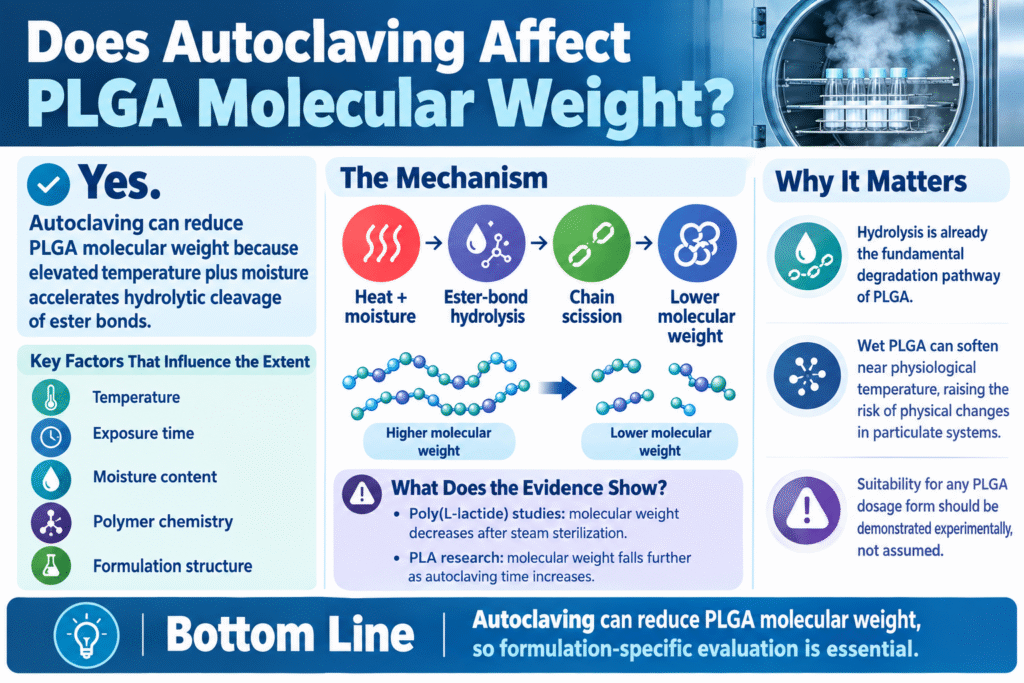
Yes. Autoclaving can reduce PLGA molecular weight because elevated temperature plus moisture accelerates hydrolytic cleavage of ester bonds. The extent depends on temperature, exposure time, moisture content, polymer chemistry and formulation structure.
Direct autoclave data vary by PLGA grade and dosage form, but evidence from closely related lactide-based polymers is consistent:
- Studies of poly(L-lactide) found molecular weight decreases after different steam sterilization programs.
- Research on PLA showed that molecular weight fell further as autoclaving time increased.
The mechanism is:
Heat + moisture → ester-bond hydrolysis → chain scission → lower molecular weight
Hydrolysis is already the fundamental degradation pathway of PLGA, so steam sterilization is a particular concern. Wet PLGA also softens near physiological temperature, which raises the risk of physical changes in particulate systems. Suitability for any PLGA dosage form should be demonstrated experimentally rather than assumed.
5: Gamma Irradiation vs Autoclaving: What Is the Difference?
Gamma irradiation mainly causes radiation-induced chemical changes, while autoclaving combines heat and moisture to promote hydrolysis. Both can lower molecular weight, and both need formulation-specific validation.
| Factor | Gamma irradiation | Autoclaving |
|---|---|---|
| Primary stress | Ionizing radiation | Heat, moisture, pressure |
| Main concern | Radiolytic chain scission | Hydrolytic chain scission |
| Effect on PLGA molecular weight | Can decrease | Can decrease |
| Effect on degradation | May accelerate | May accelerate |
| Possible effect on release | Can increase initial or overall release | May alter release via polymer degradation |
| Key process variables | Dose, atmosphere, temperature, packaging | Temperature, time, moisture, cycle |
| Main analytical test | SEC/GPC | SEC/GPC |
| Validation | Essential | Essential |
Sterilization cannot be evaluated independently of the polymer and the dosage form.
6: Which PLGA Properties Influence Sterilization-Induced Changes?
The outcome depends on more than the sterilization method. Molecular weight, composition, end groups, moisture, morphology and drug properties all shape the response.
- Initial molecular weight: higher and lower molecular weight grades may respond differently.
- Lactide:glycolide ratio: composition affects hydrophilicity and degradation rate, so different ratios can behave very differently.
- End-group chemistry: acid- and ester-terminated PLGA differ in water uptake and hydrolysis.
- Moisture content: residual water and chain-end chemistry strongly influence molecular weight change during elevated-temperature processing.
- Morphology and porosity: microparticles, nanoparticles, films, implants and scaffolds differ in surface area and water access.
- Drug properties: the drug can alter the microenvironment inside the matrix and influence degradation and release.
Polymer sourcing is part of this picture. Batch-to-batch consistency and documented quality, as discussed in our guide to GMP-grade PLGA for Phase II/III clinical supply, make it easier to separate sterilization effects from raw material variability.
7: Do the Same Concerns Apply to Different PLGA Dosage Forms?
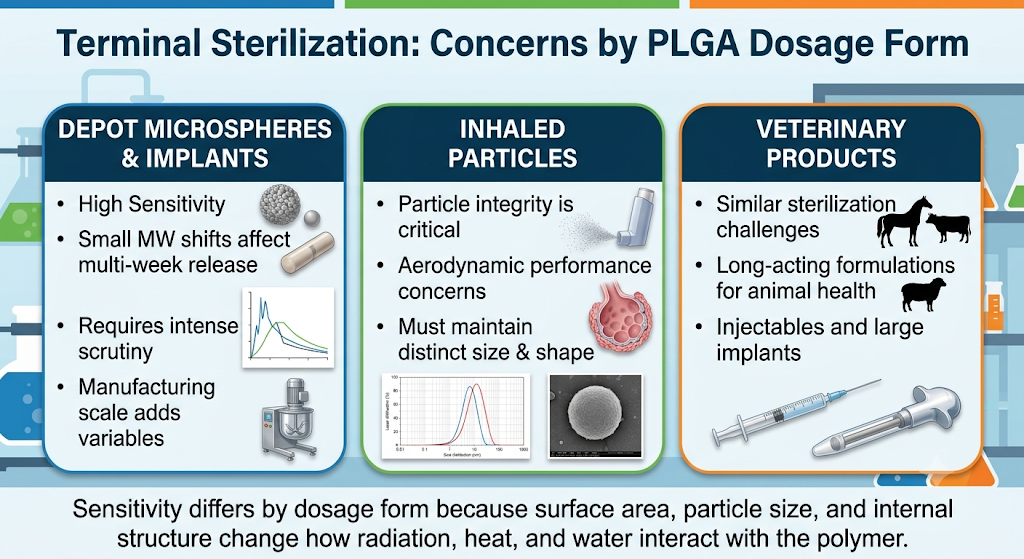
Yes, but the sensitivity differs by dosage form because surface area, particle size and internal structure change how radiation, heat and water interact with the polymer.
- Depot microspheres and implants: small molecular weight shifts can alter multi-week release, so these are usually the most scrutinized. Manufacturing scale adds variables, as described in our article on scaling PLGA microsphere manufacturing.
- Inhaled particles: particle integrity and aerodynamic performance are added concerns, covered in our case study on PLGA inhalable microparticle development.
- Veterinary products: long-acting animal health injectables face the same sterilization questions. See PLGA and PLA veterinary long-acting injectables.
8: How Should PLGA Molecular Weight and Drug Release Be Evaluated After Sterilization?
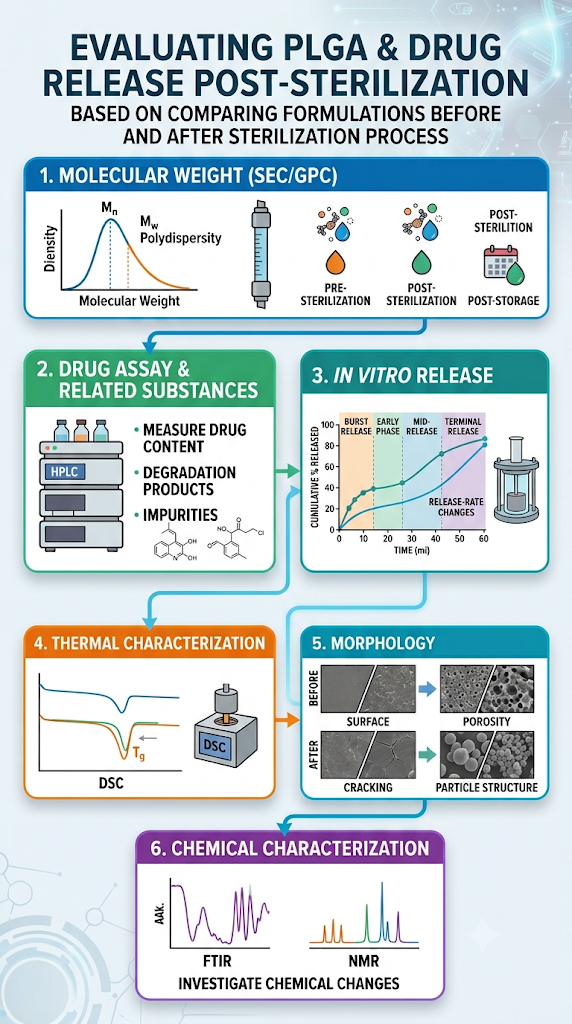
Compare the formulation before and after sterilization using molecular weight, physicochemical and drug-release measurements. A practical workflow includes:
- Molecular weight (SEC/GPC): determine Mn, Mw, polydispersity and the full distribution. Compare pre-sterilization, post-sterilization and post-storage samples to separate an immediate effect from continued degradation.
- Drug assay and related substances: measure drug content, degradation products and relevant impurities to see whether the drug is affected as well as the polymer.
- In vitro release: compare the whole profile, not a single time point. Look at burst release, early phase, mid-release, terminal release, cumulative percentage released and release-rate changes.
- Thermal characterization: DSC can reveal changes in glass transition behavior.
- Morphology: SEM or related imaging can show changes in surface, porosity, cracking and particle structure.
- Chemical characterization: FTIR and NMR help investigate chemical changes when needed.
Why Is SEC/GPC Critical for PLGA Characterization?
SEC/GPC directly measures molecular weight distribution, so it detects chain degradation that morphology or mass-loss measurements may not yet show.
Drug assay alone is not enough for controlled-release products. A formulation can keep the same drug content while its polymer molecular weight changes substantially, and the consequence may only appear later in dissolution or long-term degradation. A stronger strategy connects the whole chain:
Sterilization → PLGA molecular weight → morphology and degradation → drug-release profile
What Does a Practical Sterilization Comparability Study Look Like?
It uses stage-gate testing to show whether a measurable molecular weight change translates into a meaningful change in performance.
| Stage | Molecular weight | Drug assay | Impurities | Morphology | Drug release |
|---|---|---|---|---|---|
| Before sterilization | ✓ | ✓ | ✓ | ✓ | ✓ |
| Immediately after sterilization | ✓ | ✓ | ✓ | ✓ | ✓ |
| After accelerated or relevant storage | ✓ | ✓ | ✓ | ✓ | ✓ |
Additional variables to define:
- Gamma irradiation: dose, irradiation temperature, atmosphere, packaging configuration, oxygen exposure, dose mapping.
- Autoclaving: temperature, exposure time, moisture, cycle configuration, number of cycles, product geometry.
9: Which Variables Should Be Controlled in a PLGA Sterilization Study?
Control every formulation and process variable you can, so that any change in release can be attributed to sterilization.
- PLGA grade and supplier
- Initial molecular weight
- Lactide:glycolide ratio
- End-group chemistry
- Residual solvent and residual moisture
- Drug loading
- Particle size and porosity
- Formulation process
- Packaging
- Gamma dose or autoclave cycle
- Storage conditions
- Release-test conditions
Without this control, it is difficult to know whether a release shift came from sterilization or from another formulation or analytical variable.
What Do Regulators Expect?
Regulators expect the sterilization method to be justified and shown not to compromise product quality or performance. Typical expectations include:
- A rationale for the chosen method and why alternatives were not used
- Evidence that molecular weight, release profile, potency and impurities remain within specification
- Validated parameters, including dose mapping for irradiation
- Post-sterilization stability data
- Consistency between clinical and commercial batches
Conclusion:
Gamma irradiation and autoclaving can both influence PLGA molecular weight and drug release, but the mechanism and magnitude depend on the polymer, formulation, sterilization conditions and delivery system. Gamma irradiation causes radiolytic chain scission and may accelerate release, while autoclaving introduces heat and moisture that promote hydrolytic scission. Published evidence spans minimal to substantial effects.
For developers of microspheres, nanoparticles, implants and other long-acting products, the most informative strategy is to connect molecular weight characterization with release performance instead of treating sterilization as an isolated step.
Frequently Asked Questions:
SEC/GPC shows whether the polymer’s molecular-weight distribution has changed, while drug-release testing shows whether that change affects product performance. Together, they provide a stronger understanding of the relationship between PLGA molecular weight and drug release.
A useful comparison includes testing the formulation before sterilization, immediately after sterilization, and after relevant storage. Comparing molecular weight with drug-release profiles helps determine whether polymer changes translate into meaningful performance changes.
It can. If sterilization reduces molecular weight or changes the polymer matrix, water penetration and drug diffusion may increase, potentially contributing to a higher initial burst release. However, this must be confirmed experimentally.
Yes. PLGA end-group chemistry can influence water uptake and hydrolysis. Acid-terminated and ester-terminated PLGA can therefore exhibit different degradation and drug-release behavior.
Reference
- Sintzel MB, Merkli A, Tabatabay C, Gurny R. Influence of irradiation sterilization on polymers used as drug carriers—a review. Drug development and industrial pharmacy. 1997 Jan 1;23(9):857-78.https://www.tandfonline.com/doi/abs/10.3109/03639049709148693
- Tapia-Guerrero YS, Del Prado-Audelo ML, Borbolla-Jiménez FV, Giraldo Gomez DM, García-Aguirre I, Colín-Castro CA, Morales-González JA, Leyva-Gómez G, Magaña JJ. Effect of UV and gamma irradiation sterilization processes in the properties of different polymeric nanoparticles for biomedical applications. Materials. 2020 Mar 1;13(5):1090.https://www.mdpi.com/1996-1944/13/5/1090
- Domańska IM, Figat R, Zalewska A, Cieśla K, Kowalczyk S, Kędra K, Sobczak M. The influence of ionizing radiation on paclitaxel-loaded nanoparticles based on PLGA. Applied Sciences. 2023 Oct 7;13(19):11052.https://www.mdpi.com/2076-3417/13/19/11052
- Hausberger AG, Kenley RA, DeLuca PP. Gamma irradiation effects on molecular weight and in vitro degradation of poly (D, L-lactide-co-glycolide) microparticles. Pharmaceutical research. 1995 Jun;12(6):851-6.https://link.springer.com/article/10.1023/A:1016256903322
- Friess W, Schlapp M. Sterilization of gentamicin containing collagen/PLGA microparticle composites. European journal of pharmaceutics and biopharmaceutics. 2006 Jun 1;63(2):176-87.https://www.sciencedirect.com/science/article/pii/S0939641105003127
- Carrascosa C, Espejo L, Torrado S, Torrado JJ. Effect of c-Sterilization Process on PLGA Microspheres Loaded with Insulin-Like Growth Factor-I (IGF-I). Journal of biomaterials applications. 2003 Oct;18(2):95-108.https://journals.sagepub.com/doi/abs/10.1177/088532803038026
About the Author


