

Designing Controlled-Release Systems Through Aliphatic Polyester Erosion
Selecting the most appropriate bioresorbable matrix for long-acting drug delivery systems or implantable medical devices requires a thorough PLGA PLA & PCL Degradation Rates Comparison to ensure that the polymer resorption profile aligns with the intended therapeutic release kinetics of the active pharmaceutical ingredient (API). The inherent chemical composition and physical characteristics of these aliphatic polyesters determine how water penetrates the matrix, hydrolyzes the ester backbone, and ultimately facilitates the elimination of degradation products from the body.
To learn more about how specific monomer ratios dictate performance, read about PLA vs PLGA vs PCL.
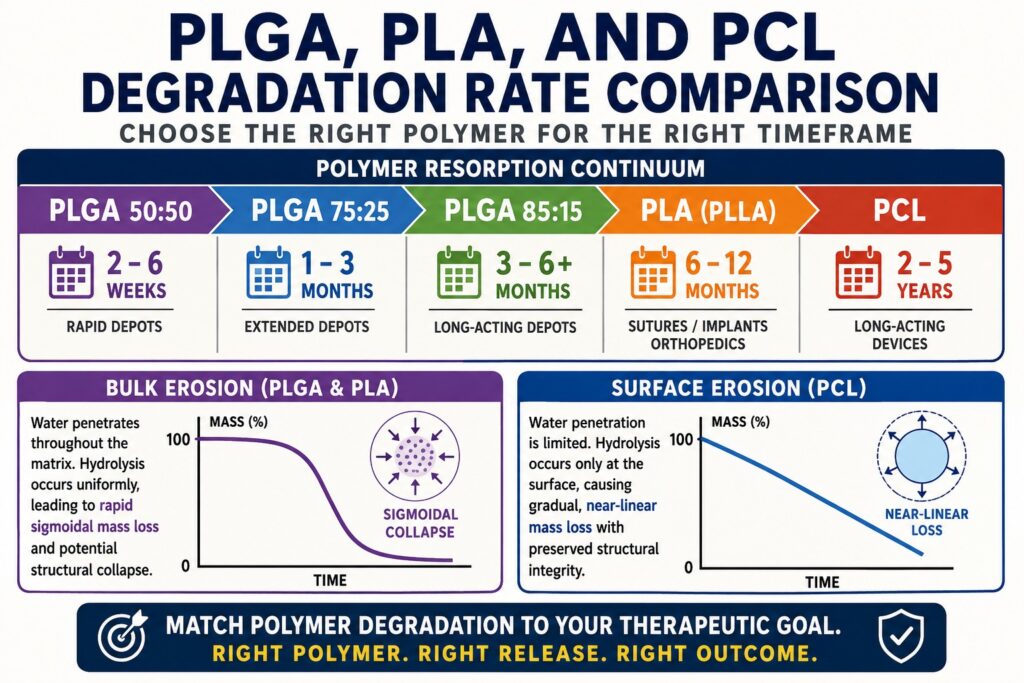
Polymer Resorption Continuum:
[PLGA 50:50] ———-> [PLGA 85:15] ———-> ———-> [PLLA] ———-> [PCL]
2 to 6 Weeks 3 to 6 Months 6 to 12 Months 1 to 2 Years 2 to 5 Years
(Rapid Depots) (Extended Depots) (Sutures/Implants) (Orthopedics) (Long-Acting Devices)
The development of clinically effective controlled-release formulations involves numerous technical challenges. Formulation scientists must address critical variables such as premature matrix failure, burst drug release, localized tissue acidification, and chemical incompatibilities between the API and acidic degradation products generated by the polymer.
For technical guidance on overcoming formulation hurdles, explore Challenges in PLGA Microsphere Development.
For instance, accelerated polymer degradation may induce localized inflammatory responses or compromise the stability of acid-sensitive peptide therapeutics. To reduce these risks and maintain regulatory compliance, formulators depend on rigorous analytical validation procedures and high-purity polymer manufacturing processes. Collaborating with an ISO 9001:2015-certified and FDA-registered contract research organization (CRO) and contract development and manufacturing organization (CDMO), such as ResolveMass Laboratories Inc., provides access to specialized polymer synthesis and advanced analytical characterization capabilities required to advance formulations confidently from early research through clinical development.
For more information on establishing comparability for regulatory filings, visit PLGA Polymer Sameness for ANDA.
Share Via:
Article Summary:
- PLGA, PLA, and PCL are biodegradable polymers used in controlled-release drug delivery and implantable medical devices, each offering different degradation timelines.
- PLGA degrades the fastest due to its high hydrophilicity, PLA degrades at a moderate rate, and PCL degrades the slowest because of its highly hydrophobic structure.
- PLGA and PLA primarily undergo bulk erosion, while PCL degrades mainly through surface erosion, resulting in more predictable long-term performance.
- The lactide-to-glycolide ratio controls PLGA degradation, allowing release durations to be tailored from a few weeks to several months.
- Factors such as molecular weight, crystallinity, and end-group chemistry also influence polymer degradation and drug release behavior.
- Acidic byproducts generated during PLGA degradation can affect drug stability, making buffering strategies important for sensitive formulations.
- Selecting the right polymer is critical for achieving the desired balance between drug release, mechanical performance, and biodegradation.
PLGA PLA & PCL Degradation Rates Comparison: Structural and Chemical Drivers
The degradation behavior of aliphatic polyesters is fundamentally controlled by the molecular architecture of their monomeric building blocks. These structural characteristics directly influence polymer hydrophobicity, water uptake, and steric resistance to hydrolytic attack. Among these materials, PLGA exhibits the most rapid degradation because of the highly hydrophilic nature of glycolic acid. In contrast, the methyl side groups present in PLA and the extended methylene segments found in PCL substantially slow hydrolytic cleavage.
Steric Hindrance and Hydrophobicity in PLA vs. PLGA
PLA is a homopolymer composed exclusively of repeating lactic acid units. Each lactic acid monomer contains a pendant methyl group attached to the alpha carbon. This methyl substituent serves as a hydrophobic barrier, limiting water penetration and sterically restricting access to neighboring ester carbonyl groups. As a result, hydrolytic degradation occurs at a significantly slower rate.
When glycolic acid is incorporated into the polymer backbone to produce PLGA, the absence of the methyl side group reduces steric hindrance and substantially increases polymer hydrophilicity. Glycolic acid-rich regions readily absorb water, promoting rapid hydrolytic cleavage of ester bonds throughout the matrix. Consequently, PLGA degrades much more quickly than PLA under comparable physiological conditions.
Understand how to verify your monomer ratios precisely through NMR Spectroscopy for Accurate Monomer Ratio.
The Long-Chain Methylene Chemistry of PCL
PCL is synthesized through the ring-opening polymerization of ε-caprolactone, producing a linear polyester consisting of repeating 6-hydroxycaproic acid units. Its structure contains five hydrophobic methylene (−CH₂−) groups for every ester linkage. This high methylene content significantly reduces the concentration of hydrolytically susceptible ester bonds and creates a pronounced hydrophobic barrier against water ingress.
As a result, water diffusion into PCL occurs very slowly, and non-catalytic ester hydrolysis proceeds at only a small fraction of the rate observed in PLA or PLGA systems. This molecular architecture is responsible for the exceptionally long degradation timeline associated with PCL-based devices.
Crystallinity and Thermomechanical Behavior
The physical morphology of a polymer, whether amorphous or semi-crystalline, exerts a major influence on degradation kinetics. Water diffusion occurs predominantly through amorphous domains because crystalline regions are densely packed and highly resistant to water penetration.
During physiological incubation at 37 °C, these materials undergo structural and thermodynamic changes that further influence degradation behavior. Experimental studies have demonstrated that semi-crystalline PLLA sponges experience secondary crystallization during incubation, enhancing their crystalline barrier and reducing water transport. Likewise, semi-crystalline PCL sponges undergo lamellar thickening, increasing structural stability over time. By comparison, amorphous PLGA systems exhibit physical aging through enthalpy relaxation within the amorphous phase, affecting polymer density and altering available pathways for water diffusion.
| Polymer Type | Crystallinity | Glass Transition Temp (Tg) | Melting Point (Tm) | Degradation Mechanism | Degradation Timeline | Best Solvents |
|---|---|---|---|---|---|---|
| PLGA 50:50 | Amorphous | 40 °C–55 °C | N/A | Fast Bulk Erosion | 2–6 weeks | DCM, Ethyl Acetate |
| PLGA 75:25 | Amorphous | 45 °C–55 °C | N/A | Moderate Bulk Erosion | 1–3 months | DCM, Ethyl Acetate |
| PLGA 85:15 | Amorphous | 45 °C–55 °C | N/A | Slow Bulk Erosion | 3–6+ months | DCM, Ethyl Acetate |
| PLLA (L-PLA) | Semi-crystalline | 55 °C–60 °C | ~165 °C | Very Slow Bulk Erosion | 10 months to years | DCM, Chloroform |
| PDLLA (DL-PLA) | Amorphous | 50 °C–55 °C | N/A | Slow Bulk Erosion | 6–12 months | DCM, Chloroform, Acetone |
| PCL | Semi-crystalline | ~ -60 °C | 59 °C–64 °C | Surface-Dominated Erosion | 2–5 years | DCM, THF |
Erosion Mechanisms: Characterizing Homogeneous Bulk Cleavage Versus Heterogeneous Surface Thinning
Bulk erosion occurs when water diffuses into the polymer matrix faster than ester bonds are hydrolyzed, resulting in uniform degradation throughout the entire volume. Surface erosion, in contrast, occurs when water penetration is restricted, confining degradation to the exterior surface. PLA and PLGA primarily undergo bulk erosion and may experience abrupt mechanical failure, whereas PCL exhibits predominantly surface-controlled erosion with a more linear mass-loss profile.
Erosion Kinetics and Mass Loss Profiles
Bulk Erosion (PLA/PLGA) Surface Erosion (PCL)
Mass (%) Mass (%)
100|—-\ 100|—–
| \ |
| \ (Sigmoidal collapse) | \ (Near-linear loss)
0|______Time 0|_______Time
Explore the differences between degradation modes at Bulk Erosion vs Surface Erosion in PLGA.
The Bimolecular Acyl-Oxygen Cleavage (AAC2) Mechanism of Bulk Erosion
In bulk-eroding polymers such as PLA and PLGA, water rapidly infiltrates and saturates the matrix. Once hydration occurs, ester linkages undergo bimolecular acyl-oxygen cleavage (AAC2), an acid-catalyzed hydrolytic process involving nucleophilic attack by water molecules on protonated ester carbonyl groups:
Pn + Pm + H₂O → Pn−m + COOH + OH
Because water diffusion is significantly faster than hydrolysis (DH₂O >> Rhydrolysis), ester cleavage occurs uniformly throughout the matrix.
During the early stages of degradation, polymer chain scission causes substantial reductions in molecular weight (Mw and Mn). Despite this decrease, overall device mass and dimensions remain largely unchanged because the resulting oligomers are not yet sufficiently small to dissolve into the surrounding medium.
Once molecular weights decline below a critical solubility threshold, generally around 7,000 Daltons, oligomers dissolve and diffuse outward, producing a rapid sigmoidal mass-loss profile and often triggering structural collapse.
Surface-Dominated Erosion in PCL
PCL follows a markedly different degradation pathway. Owing to its highly hydrophobic and semi-crystalline structure, water penetration into the polymer core remains extremely limited (DH₂O << Rhydrolysis). Consequently, hydrolysis is confined to a thin outer reaction zone.
As degradation progresses, the device gradually erodes from the exterior inward. This process generates a predictable, near-linear mass-loss profile that closely resembles zero-order erosion kinetics. Importantly, the interior matrix remains largely dry and chemically intact, preserving molecular weight and mechanical integrity throughout most of the degradation period.
Optimizing Copolymer Kinetics Through PLGA PLA & PCL Degradation Rates Comparison
The lactide-to-glycolide ratio is the primary formulation variable used to tailor PLGA degradation behavior. Increasing glycolide content enhances hydrophilicity and water uptake, thereby accelerating hydrolysis. Conversely, increasing lactide content introduces greater hydrophobicity and slows degradation.
PLGA 50:50 (Fastest Resorption)
This composition contains equal proportions of lactide and glycolide, producing a highly hydrophilic and fully amorphous polymer. Rapid water uptake, early hydrolysis initiation, and extensive bulk erosion result in complete degradation within approximately 2 to 6 weeks. This grade is particularly suitable for short-duration depots, rapidly releasing microspheres, and peptide formulations requiring immediate therapeutic activity.
PLGA 75:25 (Intermediate Resorption)
Containing 75% lactide, this polymer demonstrates reduced hydrophilicity and slower water diffusion during early degradation stages. The resulting degradation profile extends over approximately 1 to 3 months, making it a preferred choice for monthly depot injections and ophthalmic sustained-release implants.
PLGA 85:15 (Slow Resorption)
The high lactide content of this grade produces a strongly hydrophobic matrix that significantly limits water penetration. Polymer chain breakdown occurs gradually, extending degradation to approximately 3 to 6 months or longer. This profile is particularly advantageous for long-acting hormonal therapies and intravitreal drug delivery systems.
| PLGA Copolymer Ratio | Hydrophilicity Index | Water Absorption Rate | Complete Degradation Window | Typical Therapeutic Application |
| 50:50 | High | Rapid (Days) | 2–6 weeks | Short-term vaccine adjuvants, acute pain depots |
| 65:35 | Moderate-High | Moderate-Rapid | 4–8 weeks | Bi-weekly peptide depots, microparticle systems |
| 75:25 | Moderate | Slower | 1–3 months | Monthly GLP-1 agonists, ophthalmic implants |
| 85:15 | Low | Very Slow | 3–6+ months | Long-acting oncology depots, hormonal implants |
Secondary Formulation Variables
Although monomer ratio is the dominant determinant of PLGA degradation behavior, additional molecular characteristics must also be optimized.
Polymer molecular weight (Mw) directly influences chain length and entanglement density. High-molecular-weight polymers require a greater number of hydrolytic cleavage events before soluble oligomers are produced, resulting in slower degradation.
End-group chemistry is equally important. Acid-terminated PLGA grades contain free carboxyl groups (−COOH), increasing hydrophilicity and promoting autocatalytic hydrolysis. In contrast, ester-capped variants restrict water uptake and exhibit substantially longer lag phases before measurable erosion occurs.
Autocatalysis and Microenvironmental pH Dynamics in Bulk Erosion
Autocatalysis represents a self-propagating degradation mechanism caused by the accumulation of acidic oligomeric byproducts within bulk-eroding matrices. Internal pH values may decrease to approximately 2.8, substantially accelerating ester cleavage while simultaneously threatening the stability of pH-sensitive drug molecules.
The Autocatalytic Feedback Loop
Ester Hydrolysis → Carboxylic Acid Oligomers Created → Local pH Drops (to ~2.8)
Swelling Kinetics and Acid Accumulation
During the initial stages of PLGA degradation in physiological media such as PBS at pH 7.4, water rapidly diffuses throughout the matrix. Quantitative studies have shown that water content may reach approximately 71% within ten days, causing substantial swelling and volume expansion.
As hydrolysis proceeds, carboxylic acid end groups are generated. Because outward diffusion of acidic oligomers occurs more slowly than water ingress, these degradation products accumulate within the polymer core. This accumulation causes a pronounced decline in microenvironmental pH (μpH).
Within 14 to 16 days, the internal pH of PLGA microspheres commonly decreases from approximately 6.2 to 3.89, while localized regions may reach values as low as 2.8.
For insights on managing formulation stability, visit PLGA Long-Acting Injectable Formulation.
The “Inside-Out” Hollowing Phenomenon
Hydrogen ions (H+) generated by accumulated carboxylic acids act as catalysts for additional ester hydrolysis. As a result, degradation proceeds more rapidly in the interior of the device than at the surface.
Meanwhile, acidic oligomers generated near the outer surface are continuously neutralized and removed by surrounding physiological fluids. This difference creates a steep pH gradient, producing an “inside-out” degradation pattern in which the core liquefies while the external shell remains structurally intact.
Eventually, the weakened shell collapses suddenly, resulting in rapid release of the encapsulated therapeutic payload.
Stabilization Strategies for Sensitive Payloads
The acidic microenvironment generated during PLGA degradation presents a substantial challenge for encapsulated peptides, proteins, and oligonucleotides. Exposure to μpH values below 4.0 may cause denaturation, deamidation, oxidation, or covalent aggregation.
To mitigate these effects and control autocatalytic degradation, formulation scientists frequently incorporate buffering agents directly into the polymer matrix. Magnesium hydroxide (Mg(OH)₂), zinc oxide (ZnO), and calcium carbonate (CaCO₃) are commonly used to neutralize acidic degradation products.
These buffering additives maintain internal pH values above 5.0, improving therapeutic stability while reducing the likelihood of rapid autocatalytic matrix collapse.
Metabolic Fate and Elimination Pathways of Polyester Monomers
Following hydrolysis, polyester degradation products are efficiently metabolized through endogenous biochemical pathways.
Lactic acid and glycolic acid enter the tricarboxylic acid cycle, where they are ultimately converted into carbon dioxide and water. Similarly, 6-hydroxycaproic acid undergoes β-oxidation before entering the citric acid cycle for complete metabolic processing.
Enzymatic Contributions and Biofilm Effects
Although degradation of PLA, PLGA, and PCL is primarily governed by passive hydrolytic cleavage, enzymatic activity and microbial biofilms can substantially accelerate degradation in certain biological environments.
PLA Enzymatic Pathways
In vivo, PLA degradation may be enhanced by proteolytic enzymes produced by actinomycete species such as Amycolatopsis, Saccharothrix, Kibdelosporangium, Actinomadura, Laceyella, and Pseudonocardia. Proteinase K is particularly effective in cleaving L-lactide ester bonds present in semi-crystalline PLLA.
PCL Enzymatic Pathways
PCL is especially susceptible to enzymatic degradation by bacterial lipases from Pseudomonas and Lactobacillus species, as well as fungal lipases produced by Aspergillus, Candida, Mucor, Rhizopus, and Thermomyces species. These enzymes hydrolyze surface-exposed ester linkages, accelerating mass loss.
Biofilm-Induced Degradation
Within environments such as the oral cavity, microbial biofilms can play a significant role in polymer degradation. Research has demonstrated that Streptococcus mutans biofilms actively enhance degradation of both PLA and PCL materials, emphasizing the importance of antimicrobial strategies in dental and oral applications.
In Vitro Degradation Protocols: Standardizing ASTM F1635 and ISO 13781 Methodologies
Standardized testing procedures established under ASTM F1635 and ISO 13781 provide a consistent framework for evaluating chemical, physical, and mechanical changes under simulated physiological conditions.
These methodologies require incubation in phosphate-buffered saline (PBS) maintained at pH 7.4 and 37 °C while preserving high solution-to-sample ratios ranging from 30:1 to 100:1 to minimize artificial autocatalytic effects.
Standardized In Vitro Setup (ASTM F1635)
+————————————————————-+
| [ Incubator Maintained at 37 °C ] |
| |
| |
| |
+————————————————————-+
Critical Testing Parameters
Buffer Volume and Replenishment
To prevent acidic degradation products from artificially lowering solution pH and accelerating hydrolysis, PBS-to-polymer ratios should ideally approach 100:1 and remain above 30:1. Standard protocols recommend replacing the upper three-fourths of the buffer solution weekly to maintain sink conditions.
Temperature Control
Real-time degradation studies should be maintained at 37 °C ± 1 °C. Accelerated studies may be conducted at 50 °C or 70 °C for quality-control purposes. However, temperatures must remain below the polymer’s Tg and Tm values to avoid artificial transitions that alter degradation behavior.
Specimen State and Processing
Manufacturing methods including extrusion, solvent casting, and 3D printing significantly influence polymer crystallinity and molecular weight. For regulatory testing, specimens should be sterilized and packaged exactly as intended for clinical use because sterilization methods such as gamma irradiation and ethylene oxide treatment can induce polymer chain scission prior to testing.
For comprehensive regulatory characterization support, visit PLGA Characterization for RLD.
Analytical Characterization: GPC/SEC and Calibration Standards
Gel Permeation Chromatography (GPC), also referred to as Size Exclusion Chromatography (SEC), remains the gold-standard analytical technique for monitoring polymer degradation.
This methodology enables continuous assessment of molecular weight parameters including Mw, Mn, and polydispersity index (PDI). During analysis, polymer samples are dissolved in optimized solvents such as tetrahydrofuran (THF) or chloroform and filtered through a 0.2 µm membrane before injection.
Universal Calibration
This advanced approach utilizes polystyrene standards in combination with Mark-Houwink intrinsic viscosity relationships. By accounting for structural differences between calibration standards and analytes, it provides highly accurate molecular weight measurements.
Conventional Calibration
This comparative approach employs polymer-specific standards. Although simpler than universal calibration, it remains highly effective for evaluating batch consistency and monitoring relative molecular weight loss during degradation studies.
In addition to GPC analysis, formulators routinely perform mechanical testing to establish strength-retention profiles. Depending on the intended application, tensile, compressive, and flexural properties are evaluated using ASTM D638, ASTM D695, ASTM D790, and ASTM D1708 standards to confirm that devices maintain adequate mechanical integrity throughout the required clinical period.
For deeper insights into PDI and its impact on manufacturing, see PLGA PDI Pharmaceutical.
Conclusion: Strategic Polymer Selection via PLGA PLA & PCL Degradation Rates Comparison
A comprehensive and scientifically grounded PLGA PLA & PCL Degradation Rates Comparison is essential for the successful design of controlled-release drug delivery platforms and implantable medical devices intended for reliable in vivo performance. Effective formulation development requires balancing polymer chemistry, mechanical requirements, and degradation timelines to align material resorption with therapeutic objectives.
For guidance on Q1/Q2 equivalence assessments, visit Q1/Q2 Polymer Equivalence Assessment.
Formulator’s Selection Matrix
- Short-Term Peptide Depots (2–6 Weeks) → Select PLGA 50:50 (Amorphous, rapid bulk erosion)
- Medium-Term Parenteral Depots (1–3 Months) → Select PLGA 75:25 (Balanced erosion and diffusion)
- Rigid Orthopedic Fixation (1–2 Years) → Select PLLA (Semi-crystalline, slow bulk erosion)
- Flexible, Ultra-Long Implants (2–5 Years) → Select PCL (Semi-crystalline, surface-dominated erosion)
Conducting this comparative assessment enables formulation scientists to understand and strategically manage the strengths and limitations of each polymer platform.
PLGA continues to serve as the benchmark polymer for tunable short- to medium-duration long-acting injectables (LAIs), providing precise release control through adjustment of the lactide-to-glycolide ratio.
PLA remains the preferred material for rigid structural implants and slow-resorbing sutures where long-term mechanical performance is essential.
PCL is particularly advantageous for flexible, ultra-long-duration implantable systems, including contraceptive implants, where its slow, surface-dominated degradation and excellent elasticity support predictable zero-order release kinetics over multiple years without generating significant local tissue acidosis.
Achieving consistent clinical performance depends on strict control of polymer purity, molecular weight distribution, and residual solvent content. ResolveMass Laboratories Inc. supports these critical requirements through specialized polymer synthesis and advanced analytical characterization services. Utilizing state-of-the-art GPC/SEC, DSC, TGA, and high-resolution NMR technologies, their team of PhD-level scientists delivers comprehensive analytical data and custom polymer synthesis solutions, including PLGA, PLA, PCL, and PEGylated block copolymers, to reduce development risk for complex formulations.
To collaborate with ResolveMass Laboratories Inc. for custom polymer synthesis, analytical testing, or formulation development services, visit the Contact Us page and speak directly with our experienced scientific expert.
Frequently Asked Questions
PLGA 50:50 contains equal proportions of lactide and glycolide, creating the most hydrophilic composition within the PLGA family. The glycolide component lacks the methyl side group found in lactide, allowing water molecules to penetrate the polymer matrix more easily. Additionally, PLGA 50:50 is fully amorphous, meaning it lacks crystalline regions that could restrict water diffusion. This combination of high water uptake and unrestricted hydrolysis results in the fastest degradation profile among commonly used PLGA grades.
Molecular weight plays a major role in determining how quickly a polymer degrades. Polymers with higher molecular weights contain longer chains and greater chain entanglement, requiring more hydrolytic cleavage events before soluble fragments can be generated. As a result, degradation and mass loss occur more slowly. Lower-molecular-weight polymers generally break down faster because fewer bond-cleavage events are needed to produce diffusible oligomers.
PLLA and PDLLA differ primarily in their structural organization. PLLA is semi-crystalline because it is composed exclusively of L-lactide units, while PDLLA is amorphous due to its random mixture of D- and L-lactide. The crystalline regions in PLLA act as barriers to water penetration and hydrolysis, significantly slowing degradation. In contrast, PDLLA allows more uniform water diffusion throughout the matrix, leading to faster erosion and shorter degradation timelines.
The highly hydrophobic nature of PCL limits water penetration into the interior of the polymer matrix. Its structure contains a high concentration of methylene (-CH₂-) groups, which create an effective barrier against water diffusion. As a result, hydrolysis occurs primarily at the polymer surface, causing gradual thinning from the outside inward. PLA and PLGA absorb water much more readily, allowing hydrolysis to occur throughout the entire polymer volume and resulting in bulk erosion.
As PLGA degrades, acidic degradation products accumulate within the polymer matrix and can substantially lower the local microenvironmental pH. This acidic environment may destabilize sensitive therapeutic agents such as peptides, proteins, and other biologics through processes including deamidation, oxidation, and aggregation. In addition, the sudden release of acidic byproducts following matrix collapse can contribute to localized inflammation, discomfort, and tissue irritation at the administration site.
One of the most effective approaches is incorporating alkaline buffering agents directly into the polymer formulation. Compounds such as magnesium hydroxide (Mg(OH)₂), zinc oxide (ZnO), and calcium carbonate (CaCO₃) gradually neutralize acidic degradation products as they are generated. This buffering action helps maintain a more stable internal microenvironmental pH and protects sensitive drug molecules. It also reduces the likelihood of accelerated autocatalytic degradation and sudden polymer collapse.
PLGA degrades into lactic acid and glycolic acid, both of which enter naturally occurring metabolic pathways and are eventually converted into carbon dioxide and water. Lactic acid is metabolized through pyruvate and the tricarboxylic acid cycle, while glycolic acid undergoes further biochemical processing before elimination. PCL degradation produces 6-hydroxycaproic acid, which is metabolized through β-oxidation to form acetyl-CoA. This intermediate then enters the citric acid cycle and is ultimately cleared through normal physiological processes.
Sterilization can significantly impact polymer performance by altering molecular structure and degradation behavior. Radiation-based methods such as gamma irradiation and electron-beam sterilization may induce polymer chain scission, reducing molecular weight and accelerating subsequent degradation. Ethylene oxide sterilization generally preserves polymer integrity more effectively but must be carefully controlled to avoid thermal effects. The selected sterilization process should therefore be evaluated during formulation development to ensure consistent product performance.
Reference:
- Ding, A. G., & Schwendeman, S. P. (2008). Acidic microclimate pH distribution in PLGA microspheres monitored by confocal laser scanning microscopy. Pharmaceutical Research, 25(9), 2041–2052. https://doi.org/10.1007/s11095-008-9594-3
- Makadia, H. K., & Siegel, S. J. (2011). Poly lactic-co-glycolic acid (PLGA) as biodegradable controlled drug delivery carrier. Polymers, 3(3), 1377–1397. https://doi.org/10.3390/polym3031377
- Shive, M. S., & Anderson, J. M. (1997). Biodegradation and biocompatibility of PLA and PLGA microspheres. Advanced Drug Delivery Reviews, 28(1), 5–24. https://doi.org/10.1016/S0169-409X(97)00048-3
- Chen, Z., Zhang, X., Fu, Y., Jin, Y., Weng, Y., Bian, X., & Chen, X. (2024). Degradation behaviors of polylactic acid, polyglycolic acid, and their copolymer films in simulated marine environments. Polymers, 16(13), 1765. https://doi.org/10.3390/polym16131765
- Gentile, P., Chiono, V., Carmagnola, I., & Hatton, P. V. (2014). An overview of poly(lactic-co-glycolic) acid (PLGA)-based biomaterials for bone tissue engineering. International Journal of Molecular Sciences, 15(3), 3640–3659. https://doi.org/10.3390/ijms15033640
- Ciocîlteu, M.-V., Gabriela, R., Amzoiu, M. O., Amzoiu, D. C., Pisoschi, C. G., & Poenariu, B. A.-M. (2023). PLGA-The smart biocompatible polimer: Kinetic degradation studies and active principle release. Current Health Sciences Journal, 49(3), 416–422. https://doi.org/10.12865/CHSJ.49.03.15
- von Burkersroda, F., Schedl, L., & Göpferich, A. (2002). Why degradable polymers undergo surface erosion or bulk erosion. Biomaterials, 23(21), 4221–4231. https://doi.org/10.1016/S0142-9612(02)00170-9
Get In Touch With Us
About The Author


