

Introduction to Post-Translational Modifications (PTMs) in Biosimilars
Post-Translational Modifications (PTMs) in Biosimilars play a central role in defining the safety, quality, and effectiveness of biologic therapies. These modifications occur after protein synthesis and can influence how a drug behaves inside the body. Because biosimilars are designed to closely match reference biologics, even small differences in PTMs can impact their performance. For this reason, accurate and detailed PTM analysis is essential in biosimilar development.
Advanced LC-MS (liquid chromatography–mass spectrometry) methods are widely used to study these modifications. These techniques provide high-resolution and site-specific data, helping scientists understand structural variations at a deeper level. With strong analytical support, manufacturers can ensure that biosimilars meet strict regulatory expectations while maintaining consistent therapeutic outcomes.
Learn more about our comprehensive analytical solutions: Explore Analytical Services for Generic Drug Development
Unlike small molecule drugs, biosimilars are produced in living systems, which naturally introduce variability. PTMs such as glycosylation, oxidation, and deamidation contribute to this complexity. While this variation cannot be completely avoided, it can be carefully monitored. LC-MS workflows allow researchers to examine proteins at multiple structural levels, ensuring quality and consistency across batches.
Share via:
Why LC-MS is the Gold Standard for Post-Translational Modifications (PTMs) in Biosimilars
LC-MS is considered the most reliable tool for analyzing Post-Translational Modifications (PTMs) in Biosimilars because of its accuracy and flexibility. It allows scientists to identify, locate, and measure PTMs within complex protein structures. This level of detail is essential when comparing biosimilars with their reference products.
Modern LC-MS systems combine advanced separation techniques with high-resolution detection. This combination helps distinguish between very similar molecular structures that older methods might miss. As a result, researchers gain a clearer and more complete understanding of protein composition.
See how we apply advanced spectrometry to biologics: Discover Biosimilar Characterization Using Mass Spectrometry
These systems also support multiple analytical approaches within a single workflow. They can detect low-level variants, perform site-specific mapping, and monitor several attributes at once using multi-attribute monitoring (MAM). This reduces the need for separate tests and improves efficiency in both research and quality control environments.
Studies such as Rathore et al. (2018) highlight how LC-MS can detect even subtle PTM differences. This sensitivity is important because small structural changes can influence drug safety and effectiveness. Reliable detection ensures better decision-making during development and approval processes.
Multi-Level LC-MS Strategies for PTM Analysis
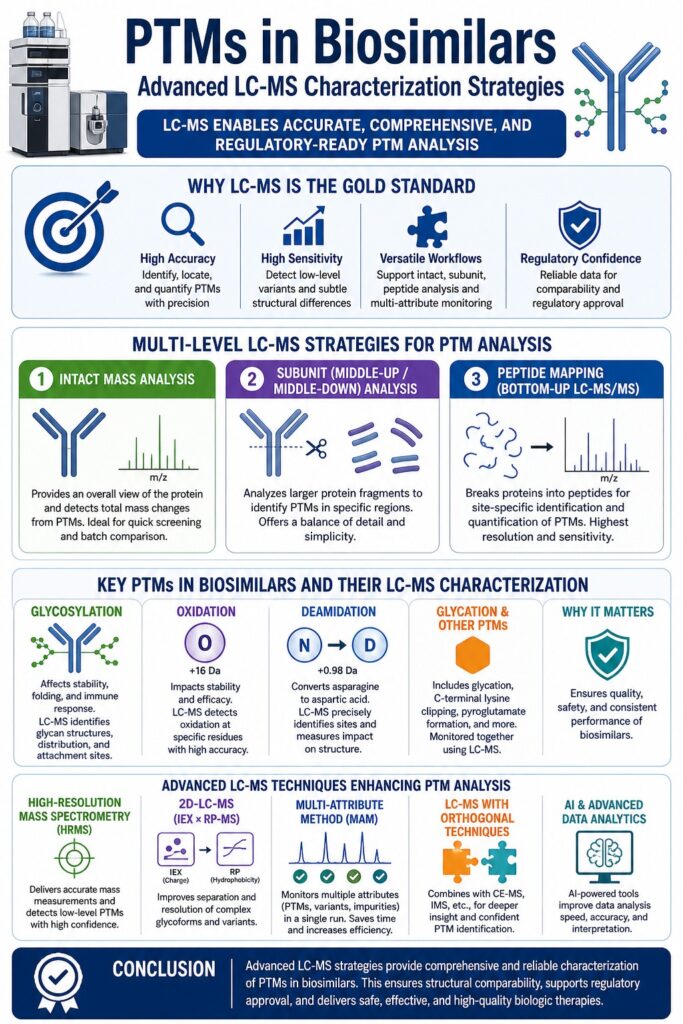
To fully understand Post-Translational Modifications (PTMs) in Biosimilars, scientists use a multi-level LC-MS approach. This includes intact, subunit, and peptide-level analysis. Each level provides different insights, and together they offer a complete picture of protein structure.
1. Intact Mass Analysis in PTMs
Intact mass analysis gives an overall view of the protein and its modifications. It helps detect changes in total mass caused by PTMs like glycosylation or oxidation. This method is useful for quick screening and comparing batches.
However, it does not provide detailed information about where the modification occurs. Even with this limitation, it remains an important first step in structural evaluation. It helps identify major differences early in the analysis process.
Deep dive into intact mass techniques: Read about Intact Mass Analysis for Biosimilars
2. Subunit (Middle-Up / Middle-Down) Analysis for PTMs
Subunit analysis involves breaking proteins into larger fragments using specific enzymes. This approach allows scientists to study PTMs in specific regions of the protein. It is especially helpful for analyzing differences between functional domains such as Fc and Fab regions.
This method offers a balance between detail and simplicity. It requires less preparation than peptide-level analysis while still providing useful structural information. Research by Dyck (2023) shows that this approach improves detection of oxidation and deamidation compared to intact analysis.
3. Peptide Mapping (Bottom-Up LC-MS/MS)
Peptide mapping is the most detailed method for studying Post-Translational Modifications (PTMs) in Biosimilars. Proteins are broken down into small peptides and analyzed using LC-MS/MS. This allows precise identification and measurement of PTMs.
It can detect small mass changes, such as deamidation (+0.98 Da) and oxidation (+16 Da). This method is highly sensitive and widely used in regulatory submissions. It provides strong evidence for structural comparability between biosimilars and reference products.
Explore high-resolution mapping services: Learn about Peptide Mapping in Biosimilars
Key Post-Translational Modifications (PTMs) in Biosimilars and Their LC-MS Characterization
Glycosylation
Glycosylation is one of the most important PTMs affecting biosimilar function. It influences protein stability, folding, and immune response. Differences in glycosylation can lead to changes in drug performance.
LC-MS helps identify glycan structures, their distribution, and attachment sites. This information is critical for ensuring similarity with the reference product. Oh et al. (2025) emphasize its importance, especially for proteins with multiple glycosylation sites.
Need to prove structural similarity for your project? Prove Biosimilarity Using LC-MS
Oxidation
Oxidation can affect protein stability and reduce effectiveness. It usually occurs during storage or exposure to stress conditions like light. Methionine and tryptophan residues are particularly sensitive.
LC-MS detects oxidation through specific mass changes and peptide mapping. Studies such as Kamble et al. (2022) show how oxidation impacts protein structure and how it can be accurately measured using high-resolution techniques.
Deamidation
Deamidation involves the conversion of asparagine to aspartic acid. This leads to a small mass change and can alter protein charge and structure. It often occurs in regions critical for binding activity.
LC-MS peptide mapping allows precise identification of deamidation sites. Even small differences can impact biosimilar performance. Beck et al. (2012) highlight its importance in comparability studies.
Glycation and Other Modifications
Other PTMs include glycation, C-terminal lysine clipping, and pyroglutamate formation. These changes can occur during manufacturing or storage. They may influence product stability and shelf life.
Multi-attribute LC-MS methods allow these modifications to be monitored together. This improves efficiency and ensures comprehensive quality control throughout the product lifecycle.
Advanced LC-MS Techniques Enhancing PTM Analysis
High-Resolution Mass Spectrometry (HRMS)
HRMS provides very accurate mass measurements, helping detect even low-level PTMs. Its precision makes it essential for regulatory submissions and detailed structural studies. It improves confidence in analytical results.
2D-LC-MS (IEX × RP-MS)
Two-dimensional LC-MS improves separation before detection. Ion exchange separates molecules based on charge, while reverse-phase separates based on hydrophobicity. This combination increases resolution.
Fekete et al. (2016) demonstrated improved separation of glycoforms using this method. It is especially useful for highly complex samples with many variants.
Ensuring your data meets global standards: Access Regulatory Support for Generic Drug Development
Multi-Attribute Method (MAM)
MAM allows multiple attributes, including PTMs and impurities, to be analyzed in a single run. This saves time and reduces the need for separate tests. It is increasingly used in quality control settings.
MAM also supports real-time monitoring during manufacturing. As regulatory acceptance grows, it is becoming a standard tool in biosimilar analysis.
LC-MS with Orthogonal Techniques
Combining LC-MS with other analytical methods improves reliability. Techniques like capillary electrophoresis (CE-MS) and ion mobility spectrometry (IMS) provide additional separation and structural insight.
These methods help confirm PTM identification and resolve complex data. They are particularly useful when dealing with overlapping or similar variants. This combined approach strengthens overall analytical confidence.
Comparative PTM Analysis: Biosimilar vs Reference Product
LC-MS plays a key role in comparing Post-Translational Modifications (PTMs) in Biosimilars with their reference products. It allows direct and accurate measurement of structural differences.
Key parameters include glycosylation, oxidation, deamidation, and glycation levels. Each is carefully evaluated to ensure similarity. Studies such as Fazel et al. (2019) confirm that LC-MS provides high precision in these comparisons.
This detailed analysis supports regulatory approval and ensures consistent product performance. It also builds trust in biosimilar therapies.
Specialized support for complex peptide generics: View our Generic Peptide Semaglutide Projects
Challenges in LC-MS Characterization of PTMs in Biosimilars
Despite its strengths, LC-MS analysis can be complex. Issues like co-elution, ion suppression, and complex glycan structures can affect results. These challenges require careful method optimization.
Data analysis is another major challenge due to large and complex datasets. Advanced software and bioinformatics tools are needed to interpret results accurately. AI-based tools are now helping improve speed and accuracy.
Continuous improvements in technology are making these processes more efficient. New workflows are reducing errors and improving overall reliability.
Scaling from lab to commercial production: Learn about Manufacturing Scale-Up for Generic Drugs
Emerging Trends in LC-MS-Based PTM Characterization
New developments are making LC-MS faster, more sensitive, and more automated. These improvements are helping reduce manual work and increase consistency.
Innovations include AI-assisted data analysis, automated peptide mapping, and real-time monitoring systems. These tools allow faster and more reliable PTM identification.
Tank et al. (2024) highlight the growing role of advanced LC-HRMS systems in biosimilar development. These technologies are expected to shape the future of analytical strategies.
Conclusion
Post-Translational Modifications (PTMs) in Biosimilars are critical for ensuring product quality, safety, and effectiveness. Advanced LC-MS techniques provide the detailed insights needed to understand and control these modifications.
By combining multi-level analysis, high-resolution detection, and advanced data tools, scientists can achieve accurate PTM characterization. This supports regulatory compliance and consistent product performance.
As technology continues to evolve, LC-MS will remain essential in biosimilar development. Its integration with automation and AI will further improve efficiency and reliability, supporting the delivery of safe and effective therapies.
❓ FAQs: Post-Translational Modifications (PTMs) in Biosimilars
LC-MS is important because it gives very detailed information about protein modifications. It helps scientists see small differences between a biosimilar and its reference product. These details are critical for confirming safety and consistent performance. It is also widely accepted by regulators for analytical studies.
Glycosylation is often the hardest PTM to study because it can exist in many different forms. A single protein site may carry multiple glycan structures. This makes the data complex and harder to interpret. Advanced LC-MS methods are needed to fully understand these variations.
LC-MS identifies these modifications by measuring small changes in mass and fragmentation patterns. Each modification produces a unique signal during analysis. Peptide mapping further helps locate the exact position in the protein. This ensures accurate identification of both oxidation and deamidation.
MAM is a modern LC-MS approach that tracks several product attributes at the same time. It can monitor PTMs, impurities, and sequence changes in one run. This reduces the need for multiple separate tests. It also improves efficiency and consistency in quality control processes.
Regulatory agencies consider LC-MS data to be reliable and scientifically strong. It provides detailed structural insights that support biosimilarity claims. Such data is often expected in submission packages. It helps demonstrate that the product meets required quality standards.
Middle-up LC-MS studies larger protein fragments, which keeps more structural information intact. It requires less sample preparation compared to bottom-up analysis. At the same time, it still provides useful details about modifications. This makes it a practical and balanced approach.
Low-level PTMs can be detected using highly sensitive LC-MS instruments. These systems can identify even very small signals in complex samples. Careful method optimization further improves detection. This ensures that minor variants are not missed during analysis.
Reference:
- Segu, Z., Stone, T., Berdugo, C., Roberts, A., Doud, E., & Li, Y. (2020). A rapid method for relative quantification of N-glycans from a therapeutic monoclonal antibody during trastuzumab biosimilar development. MAbs, 12(1), 1750794. https://pmc.ncbi.nlm.nih.gov/articles/PMC7188402/
- Nupur, N., Joshi, S., Guillarme, D., & Rathore, A. S. (2022). Analytical similarity assessment of biosimilars: Global regulatory landscape, recent studies and major advancements in orthogonal platforms. Frontiers in Bioengineering and Biotechnology, 10, 832059. https://pmc.ncbi.nlm.nih.gov/articles/PMC8865741/
- D’Atri, V., Guillarme, D., & Beck, A. (2025). Biopharmaceutical analysis—current analytical challenges, limitations, and perspectives. Analytical and Bioanalytical Chemistry. https://pmc.ncbi.nlm.nih.gov/articles/PMC12783247/
- Berkowitz, S. A., Engen, J. R., Mazzeo, J. R., & Jones, G. B. (2012). Analytical tools for characterizing biopharmaceuticals and the implications for biosimilars. Nature Reviews Drug Discovery, 11(7), 527–540. https://pmc.ncbi.nlm.nih.gov/articles/PMC3714370/
Get In Touch With Us
About The Author


