

Product-Specific Guidance for Semaglutide: FDA Requirements for Generic Drug Development
 By Anusha Sinha
•
July 30, 2026
By Anusha Sinha
•
July 30, 2026
Introduction
The Product-Specific Guidance for Semaglutide outlines the regulatory expectations and bioanalytical requirements established by the United States Food and Drug Administration (FDA) for demonstrating therapeutic equivalence in generic semaglutide Abbreviated New Drug Applications (ANDAs). By specifying detailed requirements for Active Pharmaceutical Ingredient (API) sameness, impurity control, higher-order structure (HOS) assessment, and immunogenicity risk evaluation, this guidance offers generic pharmaceutical manufacturers a clearly defined pathway toward regulatory approval.
Semaglutide is a highly complex 31-amino acid lipopeptide GLP-1 receptor agonist composed of a peptide backbone that is modified co-translationally or through chemical synthesis with a hydrophobic C18 fatty diacid side chain. This side chain is attached through a di-ethylene glycol and γ-glutamic acid (γ-Glu-2xOEG) spacer. As market exclusivity and patent protections move closer to expiration, generic manufacturers seeking ANDA approval for products referencing the innovator drug (NDA 215256) must satisfy extensive comparative analytical requirements. Demonstrating equivalence in accordance with the Product-Specific Guidance for Semaglutide requires advanced analytical characterization, complementary physicochemical testing strategies, and comprehensive comparative stability assessments. Analytical technologies such as high-resolution mass spectrometry (HRMS) and multi-nuclear magnetic resonance (NMR) spectroscopy are particularly important for meeting the FDA’s rigorous expectations for complex peptide-based generic submissions.
Learn more about our comprehensive Semaglutide Sameness Study Services for ANDA submissions.
Need Expert Support for Semaglutide Generic Development? ResolveMass provides comprehensive analytical characterization, impurity profiling, peptide characterization, bioanalytical testing, and regulatory support services to help sponsors meet FDA expectations for generic semaglutide development. Contact us
Article Summary Key Takeaways
- FDA Product-Specific Guidance (PSG) defines the regulatory pathway for generic semaglutide ANDAs, requiring comprehensive evidence of API sameness, impurity control, higher-order structure (HOS) comparability, and product quality.
- Batch-to-batch comparison is essential, with at least three generic batches evaluated against three Reference Listed Drug (RLD) batches throughout their shelf life to demonstrate structural stability and comparable degradation profiles.
- Advanced analytical techniques such as UHPLC-HRMS/MS, multi-nuclear NMR, Circular Dichroism (CD), FTIR, AF4-MALS, and SEC-MALS are required to confirm peptide sequence, molecular structure, aggregation behaviour, and physicochemical equivalence.
- Strict impurity specifications must be met, including reporting impurities above 0.1%, identifying those above 0.5%, controlling new impurities below 1.0%, and ensuring the overall impurity burden does not exceed that of the RLD.
- Subcutaneous semaglutide may qualify for an FDA bioequivalence waiver when Q1/Q2 formulation sameness is established, while oral semaglutide generally requires multiple pharmacokinetic studies because of its SNAC absorption enhancer.
- Combination product requirements extend beyond the drug itself, requiring generic prefilled autoinjectors to closely match the reference device in design, functionality, needle specifications, and human factors performance.
- Successful FDA approval depends on integrating robust analytical characterization, regulatory compliance, formulation comparability, and device evaluation to demonstrate that the generic product matches the safety, quality, and performance of the reference semaglutide product.
FDA Regulatory Pathways and Batch Sampling Under the Product-Specific Guidance for Semaglutide
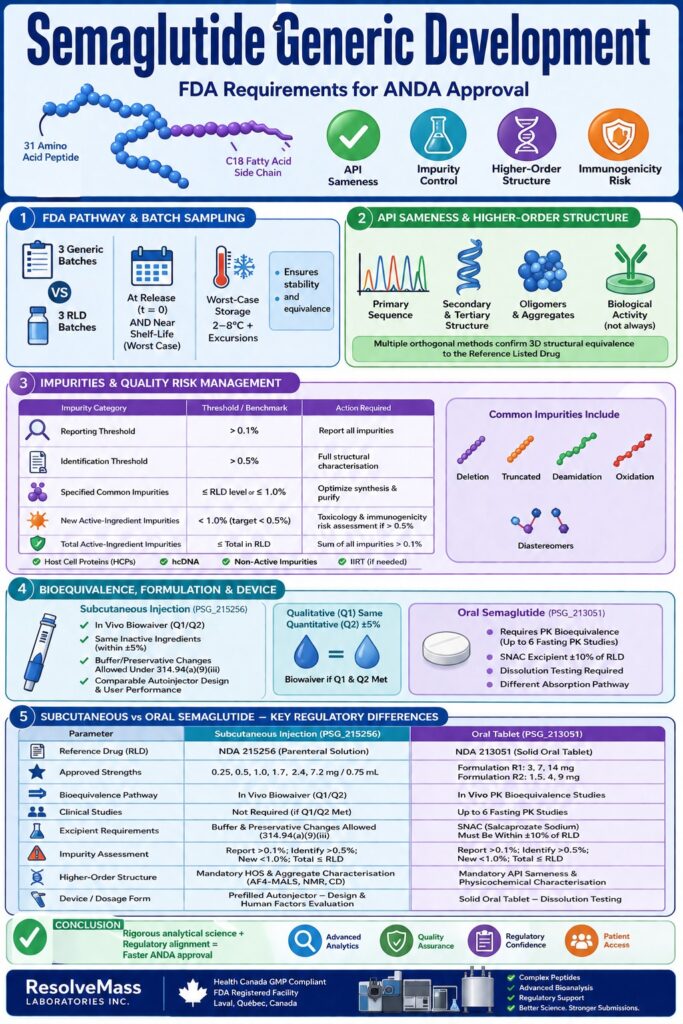
According to the Product-Specific Guidance for Semaglutide, generic sponsors are required to assess a minimum of three batches of the proposed generic drug product and compare them with at least three batches of the Reference Listed Drug (RLD) spanning their respective shelf-life periods. This batch evaluation approach provides a statistically meaningful basis for demonstrating active ingredient sameness, long-term structural integrity, and comparable degradation behaviour.
Synthetic peptides consisting of 40 amino acids or fewer are eligible for approval through the ANDA pathway under Section 505(j) of the Federal Food, Drug, and Cosmetic Act (FD&C Act). Although the reference product (NDA 215256) is manufactured using recombinant DNA (rDNA) technology, generic manufacturers may utilise solid-phase peptide synthesis (SPPS), liquid-phase peptide synthesis (LPPS), or hybrid semi-synthetic manufacturing approaches, provided they can conclusively establish API sameness and demonstrate comparable purity characteristics. In contrast, recombinant versions developed as generic alternatives are not eligible for the ANDA route and instead must be submitted through the New Drug Application (NDA) pathway.
To create a regulatory submission that aligns with FDA expectations, applicants must implement a batch sampling strategy capable of distinguishing active substance variability from drug product manufacturing variability. The three proposed generic drug product batches must be produced using at least two different drug substance lots. Comprehensive analytical characterisation must be conducted on generic samples both at the initial release stage (t = 0) and near the proposed shelf-life endpoint. These generic samples must then be directly compared with at least three separate RLD batches that have undergone ageing prior to expiry while stored under conditions reflecting worst-case labelled storage recommendations. Maintaining samples under worst-case labelled conditions, such as refrigerated storage at 2°C to 8°C combined with real-time temperature excursion scenarios, helps ensure that all relevant degradation mechanisms—including deamidation, oxidation, and oligomeric aggregation—are adequately detected, characterised, and quantified.
Review key insights on FDA Peptide Sameness Study Requirements to ensure your regulatory filing meets all criteria.
Active Pharmaceutical Ingredient Sameness and Higher-Order Structure Characterization in Product-Specific Guidance for Semaglutide
Establishing API sameness under the Product-Specific Guidance for Semaglutide requires confirmation of an identical primary amino acid sequence, comparable physicochemical characteristics, matching secondary and tertiary structural conformations, equivalent oligomeric aggregation profiles, and similar biological activity. To achieve this objective, generic manufacturers must apply multiple orthogonal analytical methodologies capable of demonstrating that the three-dimensional solution structure is highly comparable to that of the Reference Listed Drug.
Because semaglutide contains a hydrophobic C18 fatty diacid side chain, it exhibits a tendency to self-associate in aqueous environments, resulting in the formation of dynamic oligomeric micelles and short fibrillar structures. Consequently, regulatory acceptance depends on demonstrating that these higher-order assemblies do not introduce differences in safety, pharmacokinetic behaviour, or immunogenic potential when compared with the RLD.
Discover the differences in regulatory strategies between Peptide Sameness vs. Biosimilar Comparability.
Verification of primary sequence identity and overall structural comparability requires an integrated analytical strategy involving ultra-high-performance liquid chromatography-tandem mass spectrometry (UHPLC-HRMS/MS), multi-nuclear magnetic resonance (NMR) spectroscopy, circular dichroism (CD), and light-scattering techniques. Comprehensive tandem MS analysis using collision-induced dissociation (CID) or electron-transfer dissociation (ETD) peptide mapping confirms the complete 31-amino acid sequence, verifies the exact monoisotopic mass, and confirms the correct incorporation of the Aib8 substitution and Lys26 fatty acid linker. In addition, high-resolution tandem mass spectrometry is essential for assessing stereochemical purity by detecting trace levels of D-amino acid isomeric impurities that may arise from racemisation during peptide synthesis.
See how we perform Peptide Sequencing and Mapping for Sameness Studies using advanced UHPLC-HRMS tools.
Assessment of conformational comparability is performed using Far-UV Circular Dichroism, Fourier-Transform Infrared (FTIR) spectroscopy, and two-dimensional (2D) 1H-13C NMR spectroscopy. Comparative spectral overlay analyses provide detailed information regarding backbone amide chemical shifts, thereby confirming equivalent secondary structural features, including α-helical content, as well as comparable tertiary conformational arrangements relative to the RLD. Oligomeric and aggregation behaviour is further characterised using non-destructive techniques such as Asymmetrical Flow Field-Flow Fractionation coupled with Multi-Angle Light Scattering (AF4-MALS) and Size-Exclusion Chromatography with MALS (SEC-MALS). Since conventional SEC methodologies may introduce stationary-phase interactions or exclude larger molecular species, AF4-MALS offers enhanced resolution for measuring soluble oligomers and aggregate populations reaching molecular weights of up to 10⁸ Da directly within the formulated product matrix.
Explore the full range of Analytical Techniques for Peptide Sameness used to evaluate secondary and tertiary structures.
Although cell-based GLP-1 receptor activation assays and ligand-binding assays are commonly used to assess functional potency, the FDA permits applicants to justify the exclusion of biological activity studies under specific circumstances. Such omission may be considered scientifically acceptable when comprehensive comparative physicochemical characterisation convincingly demonstrates that the formulated active ingredient exhibits no meaningful higher-order structural differences relative to the RLD.
Impurity Thresholds and Quality Risk Management in Product-Specific Guidance for Semaglutide
The Product-Specific Guidance for Semaglutide establishes defined acceptance criteria for active ingredient-related impurities. Under this framework, all impurities exceeding 0.1% must be reported, impurities above 0.5% require structural identification, and newly observed impurities must remain below 1.0%. Furthermore, the overall level of active ingredient-related impurities present in the generic product must not exceed the total impurity burden observed in the Reference Listed Drug.
The chemical synthesis of large peptides such as semaglutide can generate a diverse range of impurities, including deletion sequences, truncated peptide fragments, insertion analogues, deamidated variants, oxidised methionine species, and diastereomeric forms. To ensure consistent product quality and patient safety, the FDA has established specific regulatory expectations governing the control and qualification of these peptide-related impurities within generic ANDA submissions.
| Impurity Classification | Regulatory Threshold / Qualification Benchmark | Mandated Regulatory & Analytical Action |
|---|---|---|
| Reporting Threshold | > 0.1% of drug substance | Document and report all peptide-related impurities within release and stability specification tables. |
| Identification Threshold | > 0.5% of drug substance | Conduct complete structural characterisation using LC-HRMS/MS, tandem MS fragment mapping, or NMR techniques. |
| Specified Common Impurities | ≤ RLD level or ≤ 1.0% (whichever is higher) | Implement optimised synthesis processes and preparative HPLC purification strategies to minimise impurity levels. |
| New Active-Ingredient Impurities | Must be controlled to < 1.0% (target < 0.5%) | Provide detailed toxicological and immunogenicity risk assessments when levels exceed 0.5%. |
| Total Active-Ingredient Impurities | ≤ Total impurity content in the Reference Listed Drug | Calculate the sum of all active ingredient-related impurities > 0.1%; the cumulative level in the generic product must not exceed that of the RLD. |
Swipe horizontally to view the full table on smaller screens.
For generic semaglutide products manufactured using recombinant or semi-synthetic production routes, host-cell-derived impurities represent an important aspect of product safety evaluation. Applicants must demonstrate that host cell proteins (HCPs) and residual host cell DNA (hcDNA) remain below established toxicological thresholds through the use of robust purification strategies and validated analytical methods, including immunoassays and digital PCR technologies.
In addition to active ingredient-related impurities, non-active ingredient impurities such as particulate matter, residual organic solvents (ICH Q3C), elemental impurities (ICH Q3D), microbial endotoxins, and extractables and leachables (E&L) associated with container closure systems must comply with all applicable compendial requirements. When these non-active ingredient impurities remain within established limits and aggregate profiles are comparable to those of the RLD, formal in vitro innate immune response testing (IIRT) may be scientifically justified for omission. However, the presence of elevated aggregate levels or previously unobserved impurities may trigger the requirement for additional immunogenicity assessments, including cell-based cytokine release studies and other relevant immune response evaluations.
Learn how to prevent common regulatory rejections by reviewing typical Peptide Sameness Study Deficiencies.
Bioequivalence Waivers, Formulation Considerations, and Combination Device Design
Generic semaglutide subcutaneous solutions may qualify for an in vivo bioequivalence waiver under 21 CFR 320.22(b)(1) when the proposed generic formulation is both qualitatively (Q1) and quantitatively (Q2) equivalent to the Reference Listed Drug (RLD). For formulations that do not meet Q1/Q2 equivalence criteria, applicants must provide a scientific and regulatory justification for any modifications involving preservatives, buffers, or antioxidants in accordance with 21 CFR 314.94(a)(9)(iii), while demonstrating that such changes do not adversely affect safety, efficacy, or product performance.
Qualitative sameness (Q1) requires that the generic drug product contain the same inactive ingredients as the RLD. Quantitative sameness (Q2) further requires that the concentration of each inactive ingredient remains within ±5% of the corresponding level present in the reference product. When Q1/Q2 equivalence is established in combination with demonstrated API sameness and comprehensive structural comparability, the FDA generally considers bioequivalence to be sufficiently supported, thereby eliminating the requirement for human pharmacokinetic clinical studies.
For generic parenteral products containing excipient differences, 21 CFR 314.94(a)(9)(iii) allows certain variations in preservative systems, antioxidant components, or buffering agents. However, the applicant bears the responsibility of demonstrating that these formulation modifications do not negatively influence peptide stability, alter oligomeric aggregation characteristics, impact local tolerability at the injection site, or modify systemic pharmacokinetic behaviour.
Since semaglutide is administered using a single-use prefilled autoinjector, generic development must address the requirements associated with a drug-device combination product. The FDA expects generic autoinjectors to maintain comparable design characteristics and operational functionality relative to the RLD device. Essential attributes include a single-use, single-dose configuration, a transparent inspection window that enables visual assessment of formulation clarity, and equivalent needle gauge and needle length specifications. In addition, applicants must perform comparative human factors evaluations and user interface assessments to demonstrate that any device-related differences do not increase the likelihood of user error or compromise safe and effective administration.
Subcutaneous vs. Oral Semaglutide: Comparative FDA Regulatory Frameworks
The regulatory framework governing subcutaneous semaglutide injection (PSG_215256) differs significantly from that of oral semaglutide tablets (PSG_213051) because of differences in dosage form, route of administration, absorption mechanisms, and bioequivalence assessment requirements. Subcutaneous products primarily rely on Q1/Q2-based biowaiver strategies, whereas oral semaglutide products generally require multiple in vivo pharmacokinetic studies due to the presence of specialised absorption-enhancing excipients.
The oral formulation incorporates the absorption enhancer salcaprozate sodium (SNAC), which facilitates trans-epithelial transport across the gastric mucosal barrier and improves systemic absorption of semaglutide. As a result, generic oral product developers must ensure that SNAC concentrations remain within ±10% of the level present in the RLD. Furthermore, extensive fasting-state pharmacokinetic studies are required to establish bioequivalence and demonstrate comparable systemic exposure.
Learn about the regulatory framework for Semaglutide Sameness Evaluation for Health Canada.
| Regulatory / Technical Parameter | Subcutaneous Injection Guidance (PSG_215256) | Oral Tablet Guidance (PSG_213051) |
|---|---|---|
| Reference Listed Drug (RLD) | NDA 215256 (Parenteral Solution) | NDA 213051 (Solid Oral Tablet) |
| Approved Strengths | 0.25 mg, 0.5 mg, 1.0 mg, 1.7 mg, 2.4 mg, 7.2 mg per 0.75 mL | Formulation R1 (3, 7, 14 mg); Formulation R2 (1.5, 4, 9 mg) |
| Primary Bioequivalence Pathway | In vivo Bioequivalence Waiver through Q1/Q2 Sameness (21 CFR 320.22) | In Vivo Pharmacokinetic (PK) Bioequivalence Studies |
| Clinical Study Requirements | Not required when Q1/Q2 biowaiver criteria are fully satisfied | Up to six fasting PK studies, including single-dose crossover and multiple-dose evaluations |
| Permissible Excipient Variations | Buffer and preservative modifications permitted under 21 CFR 314.94(a)(9)(iii) | Salcaprozate sodium (SNAC) concentration must remain within ±10% of the RLD |
| Impurity Thresholds | Report >0.1%; identify >0.5%; new impurities <1.0% | Report >0.1%; identify >0.5%; comparative impurity profile against the RLD required |
| Higher-Order Structure (HOS) | Mandatory HOS evaluation, aggregate characterisation using AF4-MALS and related methods, and CD analysis | Mandatory API sameness demonstration and comparative physicochemical characterisation |
| Device Constituent Evaluation | Comparative assessment of prefilled autoinjector design and user interface performance | Standard solid oral dosage form considerations, including dissolution testing |
Swipe horizontally to view the full table on smaller screens.
Conclusion
Successfully complying with the Product-Specific Guidance for Semaglutide requires a comprehensive regulatory and analytical strategy that establishes active ingredient sameness, maintains rigorous impurity control, confirms higher-order structural comparability, and demonstrates compatibility of the device interface where applicable. Through the implementation of robust comparative characterisation programmes, generic pharmaceutical developers can streamline the ANDA submission process and improve the likelihood of obtaining FDA approval.
Advanced bioanalytical technologies—including high-resolution mass spectrometry (UHPLC-HRMS/MS), multi-nuclear NMR spectroscopy, extractables and leachables (E&L) assessments, and detailed physicochemical characterisation platforms—serve as the analytical foundation of successful peptide generic development programmes. ResolveMass Laboratories Inc. supports complex generic peptide projects from its Health Canada GMP-compliant and FDA-registered facility in Laval, Québec, providing specialised analytical expertise and regulatory support for challenging generic submissions.
Discover why ResolveMass is recognized as a Best CRO for Peptide Sameness Studies.
For organisations seeking assistance with comparative characterisation strategies, impurity identification programmes, higher-order structure assessments, or bioanalytical testing timelines for generic peptide products, the technical experts at ResolveMass Laboratories Inc. can provide tailored analytical solutions designed to support regulatory success throughout the development lifecycle – Contact us today.
Frequently Asked Questions
How can generic applicants obtain a bioequivalence waiver under the Product-Specific Guidance for Semaglutide?
A bioequivalence waiver for subcutaneous semaglutide may be granted when the proposed generic product is qualitatively and quantitatively equivalent to the Reference Listed Drug (RLD). In addition to matching excipient composition, applicants must provide robust evidence demonstrating API sameness and comparable higher-order structural characteristics. When these requirements are met, separate human pharmacokinetic studies may not be necessary.
What batch testing requirements does the Product-Specific Guidance for Semaglutide mandate?
The FDA expects applicants to perform comparative analyses using multiple batches of both the generic product and the RLD. At least three generic drug product batches, manufactured from a minimum of two drug substance lots, must be evaluated against at least three aged RLD batches. Testing is typically conducted at product release and near the proposed shelf-life endpoint to confirm stability and consistency over time.
What are the regulatory impurity thresholds specified in the Product-Specific Guidance for Semaglutide?
The guidance establishes specific reporting and identification requirements for active ingredient-related impurities. Impurities exceeding 0.1% must be documented, while those above 0.5% require structural characterization and identification. Any newly observed impurity should remain below 1.0%, and the cumulative impurity profile of the generic product should not surpass that of the RLD.
Is a synthetic semaglutide candidate eligible for ANDA approval against a recombinant RLD?
Yes, a chemically synthesized semaglutide product can be submitted through the ANDA pathway even when the reference product is manufactured using recombinant technology. Eligibility depends on demonstrating complete API sameness, equivalent purity, and comparable quality attributes. However, generic products produced using recombinant methods generally do not qualify for the ANDA route and must follow the NDA pathway.
Which analytical techniques are required to verify higher-order structure for semaglutide?
Evaluation of higher-order structure requires the use of complementary analytical techniques capable of assessing different structural attributes. Commonly employed methods include 2D 1H-13C NMR spectroscopy, Far-UV Circular Dichroism (CD), Fourier-Transform Infrared (FTIR) spectroscopy, AF4-MALS, and SEC-MALS. Together, these technologies provide insight into secondary structure, tertiary conformation, oligomer formation, and aggregation behaviour.
Under what conditions can cell-based biological assays be waived for generic semaglutide?
The FDA may accept the omission of biological activity studies when extensive physicochemical and structural characterization demonstrates that the generic product is highly comparable to the RLD. Applicants must provide convincing evidence that no meaningful differences exist in higher-order structure or functional performance. Such a justification must be supported by robust analytical data generated using orthogonal methodologies.
What device attributes must be evaluated for generic semaglutide autoinjectors?
Generic semaglutide autoinjectors must closely resemble the reference device in both design and functionality. Key characteristics include the single-use configuration, inspection window, needle dimensions, and overall operating mechanism. Manufacturers are also required to conduct human factors and usability studies to confirm that the device can be used safely and effectively without increasing the risk of administration errors.
How does the FDA handle non-active ingredient impurities and immunogenicity risks for semaglutide?
Non-active ingredient impurities, including extractables and leachables, residual solvents, elemental impurities, particulate matter, and endotoxins, must comply with applicable compendial and regulatory standards. When impurity levels remain within acceptable limits and aggregate profiles are comparable to the RLD, additional innate immune response testing may not be necessary. However, unexpected impurities or elevated aggregation levels may trigger further immunogenicity assessments.
How do FDA requirements differ between subcutaneous and oral semaglutide generic development?
Regulatory expectations vary significantly between injectable and oral semaglutide products because of differences in formulation design and absorption mechanisms. Subcutaneous products may qualify for a Q1/Q2-based bioequivalence waiver when formulation sameness is established. In contrast, oral semaglutide products generally require multiple fasting-state pharmacokinetic studies and strict control of salcaprozate sodium (SNAC) levels to demonstrate equivalent drug absorption and systemic exposure.
Reference:
- U.S. Food and Drug Administration. (2025, December). Draft guidance on semaglutide: Product-specific guidance for generic drug development (PSG 215256). U.S. Department of Health and Human Services. FDA Product-Specific Guidance for Semaglutide
- Patel, A., & Patel, R. (2024). Analytical techniques for peptide-based drug development: Characterization, stability and quality control. International Journal of Science and Research Archive, 12(1), 3140–3159. https://doi.org/10.30574/ijsra.2024.12.1.1108
- Yang, E.-J., Kim, S. H., Kim, A., Choi, J., Jeong, H. J., & Na, D. H. (2026). Regulatory and analytical considerations for the quality assessment of peptide drugs. Journal of Pharmaceutical Investigation. Advance online publication. https://doi.org/10.1007/s40005-026-00817-2
- U.S. Food and Drug Administration. (2025, November). Draft guidance on liraglutide: Product-specific guidance for generic drug development (PSG 213051). U.S. Department of Health and Human Services. FDA PSG 213051 PDF
- U.S. Food and Drug Administration. (2025, December). Draft guidance on semaglutide: Product-specific guidance for generic drug development (PSG 215256). U.S. Department of Health and Human Services. FDA PSG 215256 PDF
- Marassi, V., Macis, M., Giordani, S., Ferrazzano, L., Tolomelli, A., Roda, B., Zattoni, A., Ricci, A., Reschiglian, P., & Cabri, W. (2022). Application of Af4-multidetection to liraglutide in its formulation: Preserving and representing native aggregation. Molecules, 27(17), 5485. https://doi.org/10.3390/molecules27175485
Need Expert Support for Semaglutide Generic Development?
ResolveMass provides comprehensive analytical characterization, impurity profiling, peptide characterization, bioanalytical testing, and regulatory support services to help sponsors meet FDA expectations for generic semaglutide development.
Contact usAbout The Author
Anusha Sinha
Anusha Sinha, B.Pharm, is an experienced pharma professional with a strong background in Analytical Chemistry and Polymer Chemistry. With a passion for translating complex scientific data into clear, accessible content, she plays a vital role in communicating ResolveMass Laboratories Inc.’s advanced testing capabilities. In addition to her scientific expertise, Anusha leads Business Development initiatives, helping clients across pharmaceutical, biotechnology, and materials science sectors find tailored analytical solutions. Her combined experience in science and strategy positions her at the forefront of client engagement and technical communication.

