

Introduction
The FDA’s Product-Specific Guidance for Tirzepatide outlines the regulatory, analytical, formulation, and drug-device combination product requirements that generic manufacturers must satisfy to establish therapeutic equivalence for Abbreviated New Drug Application (ANDA) submissions. This regulatory pathway allows developers of generic medicines to demonstrate bioequivalence to the reference listed drugs (RLDs)—Mounjaro (NDA 215866) and Zepbound (NDA 217806)—without repeating extensive clinical efficacy studies that have already been conducted for the innovator products.
Tirzepatide is a synthetically or recombinantly produced 39-amino acid linear peptide that acts as a dual agonist of the glucose-dependent insulinotropic polypeptide (GIP) receptor and the glucagon-like peptide-1 (GLP-1) receptor. Its molecular design includes two non-proteinogenic alpha-aminobutyric acid (Aib) residues located at positions 2 and 13, together with a C20 fatty diacid side chain conjugated through a di-glutamate linker to the Lys20 residue. Possessing a molecular weight of approximately 4813.5 Da, tirzepatide exhibits a highly sophisticated molecular structure that introduces significant analytical, manufacturing, characterization, and formulation challenges during generic drug development.
To obtain approval under Section 505(j) of the Federal Food, Drug, and Cosmetic Act, ANDA applicants must comply with the recommendations described in FDA guidance documents PSG_215866 and PSG_217806. These guidance documents require a comprehensive scientific approach encompassing primary sequence confirmation, higher-order structure (HOS) characterization, active ingredient-related impurity control, innate immune response risk (IIRR) mitigation, Qualitative (Q1) and Quantitative (Q2) formulation sameness, and comparative usability assessments for drug-device combination products. Specialized analytical contract research organizations (CROs), including ResolveMass Laboratories Inc., provide advanced high-resolution mass spectrometry, structural characterization, and biophysical testing capabilities that support the generation of regulatory-compliant comparative analytical packages for ANDA submissions.
Accelerate your generic drug submission with specialized guidance: Explore ResolveMass Analytical Services for Generic Drug Development.
Article Summary:
- FDA Product-Specific Guidance (PSG) for tirzepatide outlines the requirements for developing generic versions of Mounjaro® and Zepbound® through the ANDA pathway, focusing on therapeutic equivalence without repeating extensive clinical trials.
- Active ingredient sameness must be demonstrated by confirming the complete 39-amino acid sequence, C20 fatty diacid modification, higher-order structure, aggregation profile, and comparable dual GIP/GLP-1 receptor activity using advanced analytical techniques.
- Impurity control is a critical regulatory requirement, with strict thresholds for reporting, identification, and qualification of peptide-related impurities while ensuring non-peptide contaminants comply with pharmacopeial safety standards.
- Q1/Q2 formulation sameness can support a biowaiver when the generic product closely matches the reference formulation, including excipient composition, pH, osmolality, viscosity, and stability characteristics.
- Drug-device combination products must closely replicate the reference autoinjector or prefilled pen in terms of dose delivery, needle specifications, usability, injection performance, and human factors to minimize the risk of user errors.
- A structured development strategy involving API synthesis, comparative analytical characterization, formulation optimization, device evaluation, and early FDA engagement under GDUFA III helps reduce regulatory risks and streamline ANDA approval.
- Comprehensive analytical characterization, including LC-MS/MS, HRMS, NMR, SEC-MALS, and bioassays, is essential to generate regulatory-compliant evidence supporting FDA approval of generic tirzepatide products.
Active Ingredient Sameness Protocols Under Product-Specific Guidance for Tirzepatide
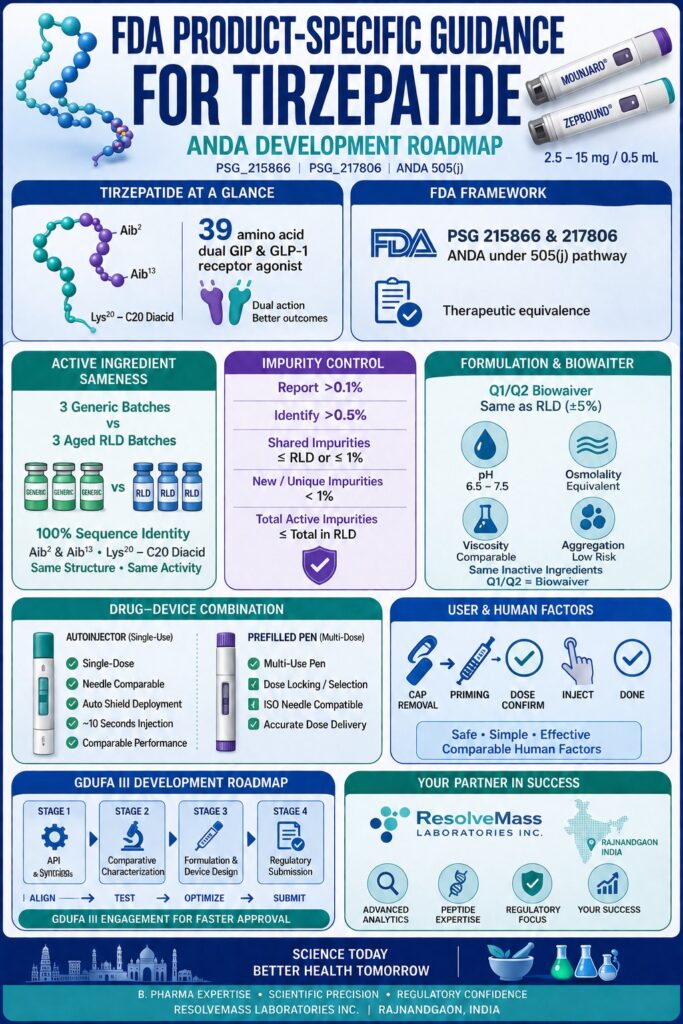
Establishing active ingredient sameness under the Product-Specific Guidance for Tirzepatide requires extensive comparative testing between the proposed generic product and the reference listed drug to verify identical primary structure, comparable higher-order structure, and equivalent dual GIP/GLP-1 receptor activity. To meet FDA expectations, ANDA applicants are required to perform these evaluations using a minimum of three independent batches of the proposed generic drug product and three aged batches of the reference listed drug, employing multiple orthogonal analytical techniques.
The recommended testing strategy requires comparison of generic product samples analyzed both near the time of release and at the end of the proposed shelf life against RLD batches that have been aged under labeled storage conditions and tested before expiration. Primary sequence confirmation must demonstrate complete identity, with no amino acid substitutions, deletions, insertions, or sequence alterations. Particular emphasis is placed on confirming the presence and correct positioning of the non-natural Aib residues at positions 2 and 13, as well as verification of the Lys20-linked lipophilic side chain.
Ensure complete structural identity for complex peptides: Learn more about Peptide Mapping in Biosimilars & Complex Peptides.
| Structural & Functional Parameter | Analytical Characterization Strategy | Acceptance Criteria Relative to RLD |
|---|---|---|
| Primary Sequence Identity | LC-MS/MS peptide mapping, High-Resolution Mass Spectrometry (HRMS), Edman degradation | 100% sequence identity with exact correspondence of all 39 amino acid residues |
| C20 Diacid Side-Chain Modification | LC-HRMS fragment analysis, 1H and 13C Nuclear Magnetic Resonance (NMR) | Identical chemical composition, attachment position (Lys20), and linker stoichiometry |
| Secondary & Tertiary Structure (HOS) | Far/Near-UV Circular Dichroism (CD), 2D 1H-15N HSQC NMR, FTIR spectroscopy | Highly overlapping spectral signatures and equivalent secondary structure distribution |
| Oligomeric State & Aggregation | Size-Exclusion Chromatography coupled with MALS (SEC-MALS), Analytical Ultracentrifugation (AUC) | Comparable monomer and oligomer distribution with no new aggregate populations |
| Biological Activity (Dual Agonism) | In vitro cell-based cAMP accumulation assays using GIPR and GLP-1R expressing cell lines | Comparable potency (EC50) and efficacy across both receptor-mediated signaling pathways |
Assessment of higher-order structure must be supported through multiple complementary biophysical methods. Circular dichroism spectroscopy and multidimensional NMR techniques provide confirmation that the peptide exhibits a secondary structural profile comparable to that of the reference product, characterized predominantly by random coil conformations with partial alpha-helical content. Functional characterization using in vitro cell-based assays that measure cyclic adenosine monophosphate (cAMP) production in GIP- and GLP-1-receptor expressing cell lines further demonstrates comparable biological performance. In situations where an applicant can scientifically establish that the formulated peptide does not possess functionally relevant higher-order structure, a scientifically justified request to waive biological activity testing may be submitted to the FDA for consideration.
Verify exact molecular mass and higher-order comparability: Discover Intact Mass Analysis Solutions.
Impurity Profiling and Regulatory Thresholds in Tirzepatide ANDA Submissions
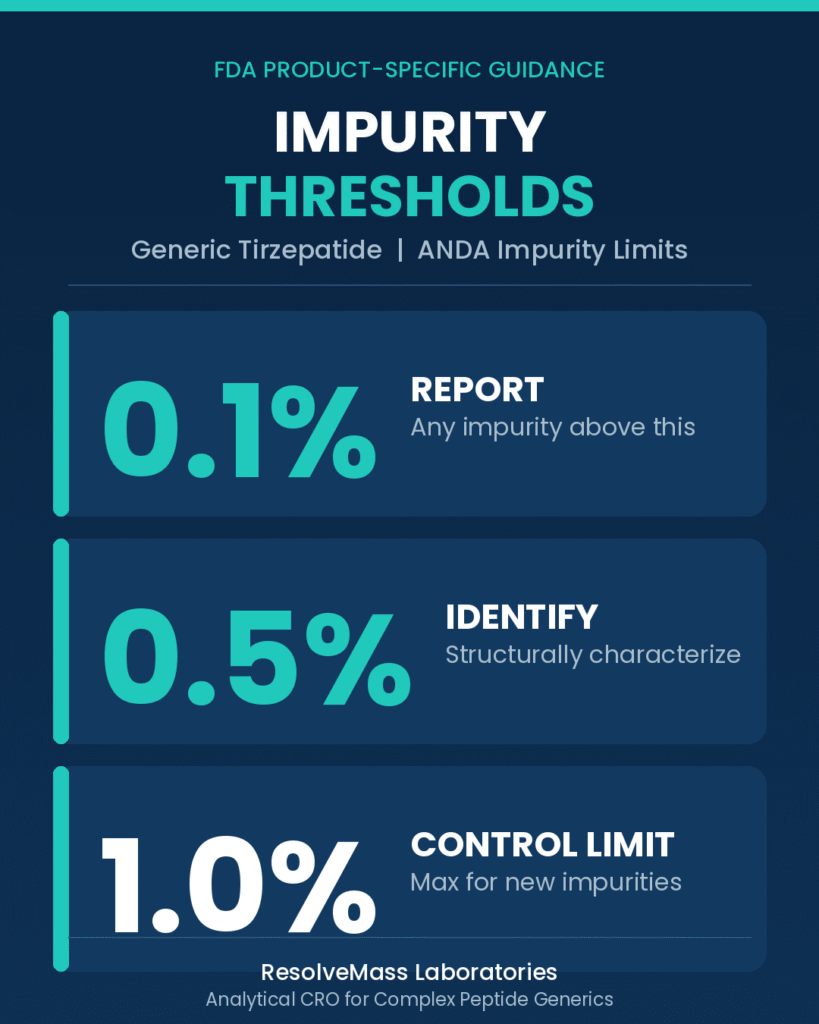
Effective impurity management for generic tirzepatide products requires rigorous control of active ingredient-related impurities while simultaneously ensuring comprehensive monitoring of non-peptide process contaminants and aggregation-related species. FDA recommendations require sponsors to report active ingredient-related impurities present above 0.1%, identify impurities exceeding 0.5%, and maintain total active-related impurity levels at or below those observed in the reference listed drug.
Active ingredient-related impurities may include deletion variants, insertion sequences, racemized forms, deamidated products, oxidized species, and other structurally related peptide variants. These impurities must be thoroughly characterized and evaluated against applicable regulatory thresholds. For impurities that are also present in the reference listed drug, the concentration in the generic product must not exceed either the level observed in the RLD or 1.0% of the drug substance, whichever value is greater. Any newly identified active ingredient-related impurity unique to the generic manufacturing process must be controlled below 1.0% using validated manufacturing and purification strategies.
De-risk your peptide impurity profiles: Explore Forced Degradation & Impurity Profiling Services.
| Impurity Category | Regulatory Threshold | Analytical & Regulatory Requirement |
|---|---|---|
| Reporting Threshold | > 0.1% of drug substance | Quantify and report during release testing and throughout stability studies included in the ANDA |
| Identification Threshold | > 0.5% of drug substance | Isolate and structurally characterize using LC-HRMS, tandem MS, NMR, or equivalent techniques |
| Shared Impurities | ≤ RLD level or ≤ 1.0% | Demonstrate impurity levels do not exceed the reference product baseline or allowable limit |
| New / Unique Impurities | < 1.0% of drug substance | Implement process controls and provide scientific justification if levels exceed 0.5% |
| Total Active Impurities | ≤ Total impurity level in RLD | The cumulative amount of all active ingredient-related impurities above 0.1% must remain comparable to or below the RLD |
| Non-Peptide Impurities | USP / Compendial limits | Demonstrate compliance with established toxicological and compendial specifications |
Non-active ingredient-related impurities—including elemental impurities, residual solvents, microbial contamination, particulate matter, extractables, and leachables—must comply with applicable pharmacopeial requirements and toxicological safety limits. When non-peptide process impurities satisfy these requirements and the aggregation profile is shown to be comparable to that of the reference listed drug, applicants are generally not required to perform in vitro innate immune response testing, including cytokine release assays or cell-based reporter assays. However, for products manufactured through recombinant expression systems, residual host-cell proteins (HCPs) and host-cell DNA levels must be carefully controlled, adequately characterized, and scientifically justified, typically through discussions conducted during pre-ANDA product development interactions with the FDA.
Resolve complex peptide heterogeneity: Check out Charge Variant Analysis using High-Resolution Mass Spectrometry.
Biowaiver Criteria and Physicochemical Sameness for Tirzepatide Formulations
Generic tirzepatide injectable solutions may qualify for a waiver of in vivo bioequivalence study requirements under 21 CFR 320.22(b)(1) when applicants successfully demonstrate both Qualitative (Q1) and Quantitative (Q2) formulation sameness relative to the reference listed drug. In certain circumstances, formulations containing limited non-Q1/Q2 differences in buffer systems or preservative components may also be considered acceptable under 21 CFR 314.94(a)(9)(iii), provided that comprehensive safety, tolerability, and scientific justification data are submitted to support the formulation modifications.
To obtain a Q1/Q2 biowaiver, the proposed generic formulation must contain the same inactive ingredients as the reference listed drug, including dibasic sodium phosphate heptahydrate, sodium chloride, and water for injection, with concentrations maintained within ±5% of the target RLD composition. In addition, applicants must conduct extensive comparative physicochemical evaluations using multiple production batches to establish equivalence across critical formulation attributes.
pH and Buffering Capacity:
The formulation should maintain a target pH range of approximately 6.5 to 7.5 while demonstrating buffering performance equivalent to the phosphate-buffered system utilized in the reference listed drug.
Osmolality and Ionic Strength:
Comparative studies must confirm equivalent tonicity and ionic characteristics, primarily governed by sodium chloride concentrations that typically range from approximately 6.2 to 9.5 mg/mL.
Viscosity and Rheological Properties:
Detailed rheological characterization is necessary to verify comparable Newtonian flow behavior and ensure that injection force requirements remain consistent with those of the reference product when used within the intended delivery device.
Surface Tension and Aggregation Propensity:
Evaluation of interfacial properties, including air-water surface interactions, is required to confirm a low risk of peptide aggregation, fibrillation, or instability resulting from handling, storage, or administration-related agitation.
For formulations that are not Q1/Q2 identical and contain alternative buffer systems or preservative components, the ANDA submission must include sufficient analytical, in vitro, and/or non-clinical evidence demonstrating that the formulation differences do not adversely affect peptide stability, aggregation behavior, local subcutaneous tolerability, pharmacokinetic performance, or systemic bioavailability. The supporting data should clearly establish that the modified formulation performs comparably to the reference listed drug throughout its intended shelf life and clinical use conditions.
Streamline your scale-up and formulation readiness: Read about Manufacturing Scale-Up for Generic Drugs.
Combination Drug-Device Requirements and Human Factors Evaluation for Tirzepatide
The Product-Specific Guidance for Tirzepatide places significant emphasis on the comparability of drug-device combination products. Generic tirzepatide delivery systems must closely replicate the external design characteristics, operational functionality, and user interface elements of the reference listed drug device constituent parts. Whether supplied as single-use autoinjectors or multi-dose prefilled pen systems, generic devices are expected to match the RLD with respect to needle dimensions, dose delivery mechanisms, user handling procedures, and overall device performance.
The reference listed drug is marketed in both single-dose autoinjector presentations and multi-dose prefilled pen configurations across multiple dosage strengths ranging from 2.5 mg to 15 mg per 0.5 mL. Generic device constituent parts must demonstrate functional equivalence through adherence to stringent performance and usability expectations.
Autoinjector Constituent Parts
- Must function as a single-use, single-dose automated injection device.
- Must utilize needle gauge dimensions and exposed needle lengths comparable to those of the reference listed drug.
- Must incorporate an automated needle shield deployment mechanism that operates similarly to the RLD.
- Must exhibit injection duration characteristics that are comparable to the reference product, typically completing dose administration within approximately 10 seconds.
- Must demonstrate equivalent actuation force requirements and overall delivery performance during administration.
Prefilled Pen Injector Parts
- Must employ a multi-use disposable prefilled pen design consistent with the reference product architecture.
- Must include fixed-dose locking or dose-selection mechanisms that function comparably to those of the RLD.
- Must maintain compatibility with universally accepted needle connection systems, including standard ISO needle hub interfaces where applicable.
- Must support accurate, reproducible dose delivery throughout the intended period of use.
User Interface and Ergonomic Comparative Analysis
Applicants are required to perform a comprehensive comparative assessment of all user-facing device features. This evaluation should include detailed analysis of physical design layout, cap removal procedures, priming operations, dose confirmation displays, injection initiation mechanisms, and user feedback systems such as audible clicks and visual indicators signaling completion of dose administration.
Comparative Use Human Factors (CUHF) studies are essential for demonstrating that any minor differences in external appearance or design do not introduce new use-related risks, increase the likelihood of administration errors, or negatively affect clinical performance. These studies must confirm that patients can safely and effectively operate the generic device under the conditions described in the approved product labeling and intended self-administration scenarios.
Navigating complex drug-device regulatory submission pathways? Learn more about Regulatory Support for Generic Drug Development.
Strategic Development Roadmap and GDUFA III Regulatory Execution
A successful generic tirzepatide development program requires a coordinated strategy that integrates synthetic process development, advanced analytical characterization, formulation optimization, device engineering, and proactive regulatory engagement with the FDA under the Generic Drug User Fee Amendments (GDUFA III) framework. Aligning development activities with FDA expectations at each stage can substantially reduce regulatory risk, streamline review cycles, and improve the likelihood of timely approval.
A structured stage-gate development model helps ensure that scientific, technical, and regulatory objectives are achieved efficiently while maintaining compliance with all applicable FDA requirements.
| Development Stage | Key Technical Deliverables | Critical Regulatory Milestones |
|---|---|---|
| Stage 1: API Sourcing & Synthesis | Process optimization using solid-phase peptide synthesis (SPPS) or recombinant production methods, impurity characterization, and reference standard generation | Drug Master File (DMF) submission and establishment of active ingredient sameness strategy |
| Stage 2: Comparative Characterization | Execution of comparative testing using three generic batches and three aged RLD batches, including HOS characterization and cell-based bioassays | GDUFA III PSG teleconference requests and alignment of analytical testing protocols |
| Stage 3: Formulation & Device Design | Q1/Q2 formulation matching, autoinjector performance evaluation, injection force testing, and user interface assessments | Comparative Human Factors study planning, review, and execution |
| Stage 4: Regulatory Submission | Generation of final stability datasets, impurity qualification documentation, and compilation of the biowaiver package | Formal ANDA submission through the 505(j) generic approval pathway |
Engagement with the FDA through GDUFA III pre-ANDA teleconferences and formal product development meetings allows applicants to obtain regulatory feedback on proposed analytical strategies, formulation approaches, device comparability assessments, and impurity control plans before submitting an ANDA. This proactive communication strategy can significantly reduce the likelihood of receiving Information Requests (IRs), Discipline Review Letters (DRLs), or other review-cycle deficiencies that may delay approval timelines.
Conclusion
Successfully navigating the FDA Product-Specific Guidance for Tirzepatide requires a comprehensive scientific and regulatory strategy encompassing active ingredient sameness, impurity control, Q1/Q2 formulation equivalence, and drug-device combination product comparability. Adherence to these requirements enables generic manufacturers to establish therapeutic equivalence, support ANDA approval, and expand access to high-quality and cost-effective treatment options.
Demonstrating compliance with FDA expectations requires extensive analytical evidence across multiple domains, including primary sequence verification, higher-order structure characterization, dual receptor biological activity assessment, impurity profiling, and comparative device usability evaluations. These activities demand specialized scientific expertise and advanced analytical technologies capable of generating robust, regulatory-compliant datasets.
Contract research organizations such as ResolveMass Laboratories Inc. provide comprehensive support for generic tirzepatide development through advanced liquid chromatography-mass spectrometry platforms, high-resolution mass spectrometry, nuclear magnetic resonance spectroscopy, and biophysical characterization capabilities specifically tailored to complex peptide products. By aligning development programs with FDA regulatory expectations and implementing scientifically rigorous testing strategies, generic drug developers can efficiently overcome regulatory challenges and contribute to broader patient access to affordable peptide-based therapies worldwide.
Leverage cutting-edge LC-MS technology for your pipeline: Read about Proving Biosimilarity Using LC-MS.
For specialized peptide characterization, active ingredient sameness evaluations, impurity profiling studies, and regulatory-focused technical consultation, connect directly with the scientific experts at ResolveMass Laboratories Inc. through the ResolveMass Contact Page.
Frequently Asked Questions
The FDA recommends a comprehensive comparative assessment using a minimum of three batches of the proposed generic product and three batches of the reference listed drug. Generic product lots should be evaluated both near release and at the end of their proposed shelf life, while the reference product batches should represent aged material tested before expiration. This approach ensures a robust comparison across the product lifecycle.
Active ingredient-related impurities present above 0.1% of the drug substance must be reported and quantified as part of the regulatory submission. Impurities exceeding 0.5% require structural identification and characterization using validated analytical techniques. In addition, manufacturers must demonstrate that overall impurity levels remain comparable to or below those observed in the reference listed drug.
A bioequivalence waiver may be granted when the proposed generic formulation is both Qualitative (Q1) and Quantitative (Q2) the same as the reference listed drug. This generally requires the use of the same inactive ingredients at closely matched concentrations, typically within ±5% of the reference formulation. Supporting physicochemical data must also confirm comparable product performance and stability.
Higher-order structure comparability is established through a combination of orthogonal analytical and biophysical techniques. Commonly used methods include Far/Near-UV Circular Dichroism (CD), multidimensional 2D Nuclear Magnetic Resonance (NMR), Fourier-Transform Infrared (FTIR) spectroscopy, and Size-Exclusion Chromatography coupled with Multi-Angle Light Scattering (SEC-MALS). Together, these techniques provide detailed insight into peptide conformation, structural integrity, and aggregation behavior.
Any impurity that is unique to the generic manufacturing process must be carefully controlled and scientifically assessed. The FDA generally expects such impurities to remain below 1.0% of the drug substance, supported by validated process controls and purification strategies. If a novel impurity exceeds 0.5%, additional toxicological and safety evaluations may be necessary to demonstrate that it does not introduce increased clinical or immunogenicity risks.
In vitro innate immune response risk testing is typically considered when there are concerns regarding process-related contaminants, novel impurities, or differences in aggregation behavior. However, if non-peptide impurities meet established compendial and toxicological standards and the aggregation profile closely matches that of the reference product, applicants may be able to justify omitting IIRR studies. The decision should be supported by comprehensive analytical evidence.
Generic autoinjectors must closely resemble the reference device in terms of operating principles, dose delivery mechanism, needle specifications, and overall user interaction. Key characteristics such as needle gauge, exposed needle length, injection sequence, and activation process should be comparable to the reference listed drug. Manufacturers must also perform user interface assessments to confirm that the device can be used safely and effectively.
Recombinant manufacturing processes may introduce product-related impurities such as host-cell proteins (HCPs) and residual host-cell DNA. Applicants must establish appropriate control strategies and demonstrate that these contaminants are reduced to acceptable safety levels. Early engagement with the FDA through pre-ANDA meetings can help align analytical strategies and address potential regulatory concerns before submission.
Yes, limited differences in buffer systems, preservatives, or antioxidants may be acceptable under certain regulatory provisions. However, the applicant must provide sufficient scientific evidence showing that these formulation changes do not negatively affect product safety, stability, bioavailability, efficacy, or local tolerability. Comprehensive analytical and supporting studies are typically required to justify such differences during regulatory review.
Reference:
- American Pharmaceutical Review. (2024, November 20). FDA publishes new product-specific guidances to facilitate generic drug development. American Pharmaceutical Review. American Pharmaceutical Review article
- U.S. Food and Drug Administration. (2024). Product-specific guidance for industry: Tirzepatide injection, solution (ANDA 217806). U.S. Department of Health and Human Services. https://www.accessdata.fda.gov/drugsatfda_docs/psg/PSG_217806.pdf
- U.S. Food and Drug Administration. (2024). Product-specific guidance for industry: Tirzepatide injection, solution (ANDA 215866). U.S. Department of Health and Human Services. https://www.accessdata.fda.gov/drugsatfda_docs/psg/PSG_215866.pdf
- U.S. Food and Drug Administration. (2024). Product-specific guidance for industry: Tirzepatide injection, solution (ANDA 217806). U.S. Department of Health and Human Services. https://www.fda.gov/media/173626/download
Get In Touch With Us
About The Author


